
Experts Matter. Find Yours.
Connect for media, speaking, professional opportunities & more.
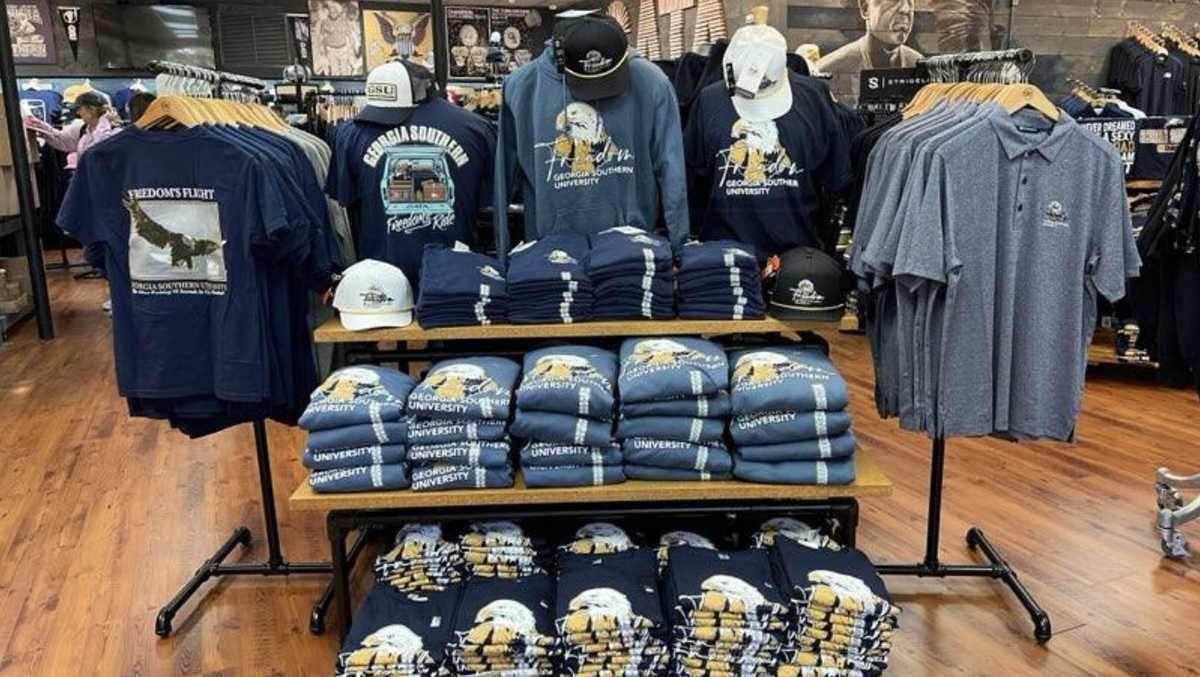
It's been called the most exciting 30 seconds in college football - and recently Freedom, Georgia Southern University’s live bald eagle mascot that flies before each home game was flying high with some serious media attention on TV, radio and print. Unable to survive on his own because of an injury to his beak as a newborn, Freedom came to Georgia Southern in 2004 and now lives at the University’s Center for Wildlife Education in Statesboro alongside other eagles, raptors, reptiles and waterfowl. He will celebrate his 20th birthday this December. The school recently launched a new line of merchandise - and the news soon went viral putting Freedom and his handler, Wildlife Center Executive Director Steve Hein in the spotlight. The coverage was tremendous and if you're looking to know more about Freedom - let us help. Simply click on Wildlife Center Executive Director Steve Hein's icon now or Contact Georgia Southern's Director of Communications Jennifer Wise at jwise@georgiasouthern.edu to arrange an interview today.


Promoting your expertise just got easier with a host of new platform features. Well the world’s best platform for Expertise Marketing just got even better! We’ve just released the latest release of ExpertFile and it’s huge. Our newly designed, mobile-ready platform provides the most intuitive, collaborative solution for creating, managing, and showcasing your experts and insights. Whether you are managing content directly on your website or promoting it through one of our powerful distribution channels like our expertfile.com search engine used by leading media outlets, you will find a lot of great new features packed into this release. With a host of new and enhanced features, streamlined workflows and more advanced analytics we’ve made showcasing your expertise, capturing valuable inquiries, and tracking your results easier than ever. You will see some exciting improvements that enable you to create highly customizable, searchable directories and media-rich profiles and content features to sharing valuable expert insights with detailed Posts and Q&A. Built for marketing and communications professionals and compatible with your current systems we continue to take the burden out of managing your expert content, and eliminate the need for ongoing, costly or time-consuming IT projects. The following highlights some of the great new features and functionality that can be found across the platform. We hope you take a moment to explore the new ExpertFile. And please let us know what you think! Cheers, Robert ------------ Robert Carter Co-Founder & VP Product | ExpertFile A Quick Tour of What's New with the ExpertFile Platform Home Screen Experience the power of the ExpertFile Platform from the moment you log in. The *NEW* Home Screen is your gateway to a wealth of essential information related to your account, key analytics, recent activities and more. With intuitive menus and a new universal search bar for easy discovery, the Home tab is your jumping off point for effortlessly exploring all your expert content and quickly connecting with valuable inquiries. Our refined layout features clear tab structures, quick action buttons and links making it a breeze to create and manage your experts and their insights, whether creating detailed media-rich profiles, insightful posts, Q&A or other featured content. Plus, gain valuable insights and optimize your expertise marketing strategy with convenient access to resource links and tools to grow your online presence both on your website, through Google or by one of our powerful distribution channels. New Home Screen features include: Quick action buttons to access all frequent activities Universal search capabilities for all your expert content User/license overview Analytics summary Recent content & login activity People Tab Manage your experts and your team through the People tab. Quickly add users and create captivating mobile-ready profiles that showcase their knowledge and thought-provoking content. Effortlessly update experts profiles using our user-friendly inline editor or take advantage of bulk actions to make changes across your entire team. Easily create and assign your experts to categories and tags enhancing discovery and building of custom directories and featured content. Transition profiles seamlessly from drafts to public visibility, or establish private password-protected viewing for exclusive restricted access directories and targeted profile outreach. Build the perfect support network. Manage your experts, their content, and inquiries with ease, while collaborating with diverse teams. With unlimited admins and agent users, we allow for more efficient management and better visibility across your entire roster of experts or within specific groups of experts. Easily add users from a diverse range of departments such as marketing communications, digital, research, analyst relations, and more to help maintain fresh and engaging expert content and ensure you never miss valuable inquiries. Assign agents to make edits or handle inquiries on an expert or multiple experts behalf. Extend your reach with access to leading tools for leveraging your experts, including easy export functionality and variety of integrations options for your website and with external platforms. New People Tab features include: New user setup enhancements Streamlined profile status options Advanced filtering capabilities People specific activity log Post Tab The Post tab is the starting point for sharing your organization’s insights on current news, trending topics and more by creating shareable Posts that connect back to your experts. Interactive and mobile-ready, Posts let you quickly deliver expert, SEO friendly content to your audiences on any device at any time. Quick links allow you to create drafts including using our new AI Brainstorming feature to help generate ideas and initial drafts. For more interaction with your expert Posts streamline content discovery and expand your content distribution capabilities by tagging your Posts. Whether you choose to publish immediately or schedule for future release, you have the flexibility to align your content with breaking news, important announcements, cyclical trends or your marketing calendar. Finally increase the power of Posts by assigning individual experts to each post to better connect your insights to your experts, driving more profiles views and valuable inquiries. New Post Tab features include: Quick create button with AI brainstorming Advanced filtering capabilities Bulk action management options Connected “experts” visibility Enhanced tag management Post specific activity log Q&A Tab The Q&A tab makes leveraging the power of Q&A easy. Deliver insights through expert curated Q&A, either with a single question and answer from an expert or organization, or allow for multiple experts to provide a variety of answers. By connecting your answer to your experts, you’ll drive profile views and capture valuable inquiries. Streamline content discovery and expand your content distribution capabilities by tagging your Q&A. New Q&A Tab features include: Quick create button Advanced filtering capabilities Bulk action management options Connected “experts” visibility Enhanced tag management Q&A specific activity log Analytics Tab Track your performance with the customizable features of the new Analytics Tab. Access current metrics across all important areas from your people to Posts, Q&A and inquiries. Define your view by type and time period. Quickly export your monthly PDF reports or create custom exports to allow for detailed reporting that matches your organization’s reporting cycles. Easily export all your metrics to create additional reports in other systems you currently use. New Analytics Tab features Include Content-type specific reporting Date range filtering Customizable graphing capabilities Enhanced data exports Downloadable monthly reports Bulk actions & Filtering Inquiries Tab The Inquiries tab provides access to all the capabilities you need for viewing, managing and responding to your opportunities. The layout lets you quickly understand the nature of your incoming inquiries whether they’re related to media, speaking, research, customer/business requests and more. Quickly view key details of all incoming inquiries including time-sensitive requests that require immediate follow-up. Activate only the type of inquiries you’re looking to receive through our inquiry type setup. At the same time keep unwanted messages away from your experts with our AI Quarantine function that monitors all your incoming inquiries and proactively blocks messages that can be reviewed later. Ensure total visibility with our mailing list functionality that enables inquiries to be seen by type beyond the specific setup for each expert. New Inquiry Tab features include: Enhanced AI Quarantine protection Organization wide blocking Network level blocking Enhanced inquiry filtering Inquiry specific activity log Settings The new Settings section provides easier more intuitive access to a wide variety of account customizations and system settings to tailor your implementation. This includes access to integration options from Custom API to Embeds and our WordPress plugin. New Settings Section features Include Enhanced brand management capabilities Improved asset uploader Refined layout New “Customer Success” resources


ChristianaCare Launches a New Speakers Bureau: Is This the Future of Healthcare Communications?
Only just a few months after their win of an IABC Gold Quill Award (shared with ExpertFile), the ChristianaCare healthcare communications and digital team has once again made major moves to make their organization even more accessible to the community with the launch of their new ChristianaCare Speakers Bureau. As one of the leading healthcare systems in the United States, Delaware based ChristianaCare is home to a wide variety of medical experts. Now live, the ChristianaCare Speakers Bureau features 80 experts who are currently available for speaking engagements on a wide variety of health topics including: Aging and Senior Health, Cancer, Children’s Health, COVID-19, Diabetes, Pregnancy and Childbirth. Sports Medicine, Stroke, Weight Management and Women’s Health. Designed with the ExpertFile platform, the ChristianaCare Speakers Bureau provides easy discovery and access to experts, including their biographies, downloadable photographs, samples of past presentations, languages spoken and more. The site can be viewed here. Screenshot from the new ChristianaCare Speakers Bureau launched Aug. 2023. The site provides easy discovery and access to experts, with the ability to search by topics and keywords. Detailed profiles for experts include biographies, downloadable photographs, samples of past presentations, languages spoken and more. How a Speakers Bureau boosts thought leadership A Speaker's Bureau is an initiative within an organization that assembles a team of expert speakers who can represent the organization and speak authoritatively on its behalf. While media appearances are often the core focus for experts in organizations, a Speakers Bureau opens up additional opportunities to speak at events such as in-person conferences, webinars, podcasts. Speakers ideally represent a diverse group of professionals from within the organization, and can share their knowledge, insights, and experiences on a range of topics relevant to the organization's mission, values, and field of work. Through event appearances, these experts help to enhance the organization's visibility, foster community engagement, and solidify the organization's reputation as a thought leader in its field. Speakers Bureaus provide effective and efficient way to promote the organization's initiatives, achievements, and viewpoints to the wider public. Creating New Connections Between Experts and the Community Following a string of successes that followed the launch of their ChristianaCare Experts site that resulted in major increases in national media coverage and SEO performance, the formation of a Speakers Bureau was a smart move that will further extend the reach of the ChristianaCare brand. Events provide an excellent way to connect meaningfully with a wider audience to help ChristianaCare make progress on key goals such as delivering effective community health education and improving healthcare equity. “At ChristianaCare, our mission of service to the community includes a commitment to provide timely, accurate health information so that people can make informed decisions about their health,” said Karen Browne, vice president of marketing and communications. “Through our new speakers bureau, we’ve expanded our capacity to meet these needs in the community.” The Benefits of a Speakers Bureau Given the fragmentation of traditional media channels and the massive growth in events such as webinars and podcasts, Speakers Bureaus are fast gaining popularity as a proven way to personify your organization and build a stronger connection to your brand. So far the ChristianaCare Speakers Bureau appears to be off to a solid start. "We had a huge response to our media release when we launched earlier this week and in the first day alone we had multiple organizations sending speaking opportunities for our medical experts. We're also seeing a great response internally as more of our experts requested to join the Speakers Bureau once it went live," said Hiran Ratnayake, Senior Manager of Media Relations at ChristianaCare who played a key role in developing the Speakers Bureau with his colleagues Shane Hoffman, Communications Director and Tom Hendrich - Senior Digital Content Editor at ChristianaCare. Is a Speakers Bureau Right For Your Organization? Here are some key benefits to consider in determining if a speakers bureau makes sense for your organization: Bolsters Community Engagement: An active Speaker's Bureau helps create a bridge between your organization and the community you serve. Promotes Diversity and Inclusion: A Speaker's Bureau offers an exciting opportunity to showcase the diverse voices and unique experiences within your organization. Enhances Organizational Visibility: The increased exposure at events can lead to greater recognition in the industry, more opportunities for collaborations, and ultimately, a wider reach for your healthcare services. It also is a proven way to boost SEO pagerank and domain authority in search engines and also provides a lot of additional content for your social channels. Develops Professional Skills: For healthcare professionals who participate, a Speakers Bureau offers an excellent opportunity to develop public speaking skills, foster leadership abilities, and establish themselves as thought leaders in their respective fields. Facilitates Knowledge Sharing: A Speaker's Bureau cultivates a more dynamic learning environment, which can lead to new ideas, innovations, and improved patient care within your organization. Strengthens Crisis Management Readiness: Having a pool of trained speakers ready to contribute can be incredibly beneficial in times of crisis. These professionals can help your communications team more effectively communicate critical information to the public, media, and other stakeholders. Enhances Employee Engagement: Employees who are given the opportunity to share their knowledge and represent their organization publicly, often feel more valued and invested in their work. Going Beyond the Walls of Your Medical Facility In the constantly evolving world of healthcare, accurate and timely information is critical to informed patient decisions and effective treatments. Organizations such as ChristianaCare understand that their role as a prominent healthcare system is to deliver information that extends beyond their immediate medical responsibilities. It’s simply no longer adequate to provide care within the walls of a medical facility. Today there is a critical demand for a more engaged approach, requiring hospitals and healthcare systems to leverage their in-house expertise for community education. A more informed community, armed with knowledge, which can make empowered decisions about their healthcare. While the public has an abundance of medical information at their fingertips, to help them participate more actively in their healthcare, much of the information found on social media today often lacks clarity, context, and credibility, leading to confusion and misinterpretations. Healthcare experts, leaders, and executives can play a pivotal role in dispelling myths and offering credible, evidence-based insights. An engaged, approachable healthcare professional is a reassuring sight, reinforcing the community’s faith in the system. It’s a win-win for these experts and the healthcare institution they represent. And most importantly it's a win for the communities they serve, as people identify potential health issues earlier, adopt healthier lifestyles, and reduce emergency hospital visits. This puts less burden on the region’s healthcare system, and better utilizes resources to reach a broader audience. After all, healthcare is not just about curing the sick; it’s about educating, engaging, and empowering the community for a healthier future. Congratulations to the entire team at ChristianaCare for creating such a valuable resource for your community. And thank you for letting us be a part of this exciting journey.

It's as if it has been the biggest love story since Grace Kelley married Prince Rainer or when Harry met Meghan for that matter. But as much as fans, media and even the play-by-play callers are giving an enormous amount of attention to Taylor Swift every time she shows up and cheers on her new beau Travis Kelce, experts wonder...will it have a lasting impact on attracting new fans to the NFL? Recently, Bloomberg News explored if an entertainment powerhouse like Taylor Swift can move the yard-stick of a generation that is seeing a shrinking fanbase and serious decline in viewership. For expert insight, Bloomberg contacted Goizueta Business School's Mike Lewis to offer his opinion and perspective on the situation. Historically, leagues didn’t worry much about the transmission of passion for a sport and team. Homes typically had one screen — the family television — and if a parent was watching the Chiefs game, so were the kids. Fandom at home drove fandom outside of it. Kids wore NFL merchandise to school and bonded with their classmates. Youth sports participation, partly inspired by what was on TV, amplified the community solidarity and enthusiasm for all levels of a given sport. Those traditional forms of fan development are breaking down. "We've evolved to this situation where kids are getting their content via the smartphone and everyone going off to their corner," explains Michael Lewis, director of the marketing analytics center at Emory University. The consequences are striking. In 2021, Lewis published data on sports fandom among different generations. Millennials overwhelmingly identified themselves as the most avid fans (42%), followed by Gen X and Baby Boomers. Gen Z was a striking outlier. Though 23% identified themselves as passionate spectators, 27% identified themselves as "anti-sports." No other generation came close to that level of sports antipathy. However, Gen Z isn’t uninterested in competition. Rather, its media consumption habits are pushing it to different outlets. Survey data that Lewis published in August reveals that esports (competitive video gaming) is now more popular than traditional sports. Professional sports is a multi-billion dollar business and appealing to multi-generational audiences is no easy task. If you're covering or interested in learning more - we can help. Mike Lewis’s work focuses on the intersection of sports analytics and sports marketing. He studies issues ranging from player performance analytics to brand equity in sports. This approach makes Professor Lewis a unique expert on fandom as his work addresses the complete process from success on the field to success at the box office. Michael is available to speak with media - simply click on his icon now to arrange an interview today.



The Role of Artificial Intelligence in Customer Experience
Gaurav Jain, assistant professor of marketing at the Rensselaer Lally School of Management, examines how individuals make judgments, estimates, and decisions in the absence of complete information. Previously, Jain served as the chief marketing advisor at multiple firms. Below are his thoughts on the impact of artificial intelligence (AI) on customer experience. Voice of the Customer In today's hyper-connected world, the voice of the customer (VoC) is louder and clearer than ever. But how do we sift through this cacophony to understand what our customers are really saying? Enter AI. It's revolutionizing the way customer experience teams handle VoC programs, and as a marketing leader, I find this incredibly exciting. Take direct customer feedback, for example. We're no longer just collecting survey responses and storing them in a database for quarterly review. AI algorithms, particularly those using natural language processing, are helping us instantly categorize and prioritize this feedback. Imagine an e-commerce platform that can immediately flag a customer's mention of "late delivery" in a post-purchase survey. That's not just efficient; it's customer-centric. But what about the things customers are saying when they're not directly talking to us? That's where AI-driven sentiment analysis comes in. These tools can scan social media, forums, and review sites to gauge the sentiment behind a customer's words. I've seen hotel chains use this technology to monitor travel forums and review sites. If a guest mentions "noisy rooms," even without lodging a direct complaint, the brand can proactively look into soundproofing solutions. Then there's inferred feedback, the kind you get by reading between the lines. AI can analyze customer behavior, like frequent page visits without conversion or cart abandonment, to suggest what might be going wrong. For instance, an online fashion retailer could use AI to figure out why a particular dress gets a lot of views but few purchases. Maybe it's the sizing, maybe it's the price, but the point is, you get to know without having to ask. And it doesn't stop at gathering feedback. AI is helping us turn this raw data into actionable insights. We can predict future behavior, like churn rates, based on past feedback. This allows us to be proactive rather than reactive, which is a game-changer in customer experience management. Finally, let's talk about what happens after we've gathered all this feedback. AI is ensuring that every customer who takes the time to share their thoughts receives an immediate and appropriate response. Chatbots can handle common queries or concerns, making the customer feel heard and valued right away. So, from the perspective of a marketing leader, it's not just about the efficiency that AI brings to VoC programs. It's about the opportunity to deepen our connection with customers. By truly understanding their words, their sentiments, and even their behaviors, we can craft experiences that resonate on a human level. And in a world that's increasingly digital, that human touch is what sets a brand apart. Customer Service It's truly intriguing to observe how AI is weaving its way into the customers’ experience. Online, chatbots are making waves. Chatbots are not just digital tools; they're our first point of contact, bridging the gap between brands and consumers. However, there was always the question of accuracy versus efficiency while managing these chatbots – AI has answered that question. AI chatbots provide real-time yet accurate assistance, making the digital shopping journey feel more interactive. Companies can reduce customer dropout while avoiding the expense of managing a large human customer service team. AI is revolutionizing phone-based customer service as well. Voice recognition allows natural language processing for easier navigation, while predictive analysis anticipates caller needs based on their history. Enhanced personalization means customers no longer repetitively provide account details, and emotion detection aids in gauging caller mood. The result? Reduced wait times, more efficient interactions, and a significantly improved telephonic customer experience. In essence, AI is bridging the gap between technology and human touch in the retail world, making our interactions with brands more meaningful and personalized. Again, companies can do this in a cost-effective manner. Jain is available to speak with media - - simply click on his icon now to arrange an interview today.


Back to School: Expert Tips for a Smooth Transition in the New Academic Year
With the start of school now upon us, Gary Henry, dean of the University of Delaware’s College of Education and Human Development and professor in the School of Education and the Joseph R. Biden, Jr. School of Public Policy & Administration, is here to answer some common questions educators and parents may have. What are your three biggest concerns about K-12 education going into this academic year? I think the overarching concern for many K-12 teachers and administrators is creating a sense of continuity as children and young adults go back to school. The three big concerns that contribute to this issue are teacher turnover, school leader turnover and the number of long-term substitutes who are not fully prepared to teach in classrooms. These trends were already in place before the pandemic, but the pandemic heightened this crisis. For the last 20 years, we’ve seen a crisis in the enrollment in traditional teacher preparation programs. Between 2010 and 2018, we saw about a 35% reduction in the number of undergraduates who enroll in education majors across the U.S., but in Delaware, that reduction was 60%. Teacher shortages are affecting every state around the country right now. What is the best way to address these chronic teacher shortages? Chronic teacher shortages are a systemic problem, which means it’s largely a result of the system in which we educate and support teachers. We know, for example, that many alternative teacher preparation programs — where students come in with a bachelor’s degree outside of the field of education and take only a few courses in preparation for teaching — actually contribute to teacher shortages. So part of the answer is investing in traditional teacher preparation programs and in financial aid. Our team at CEHD’s Center for Excellence and Equity in Teacher Preparation is working directly with Delaware students from motivation to pursue teaching, through recruitment into UD teacher preparation programs, through graduation from those degree programs and into schools within Delaware, whenever possible. For example, our Teachers of Tomorrow program introduces underrepresented high schoolers to the field of education through an immersive, two-week summer institute at UD where they can learn about our programs, meet current students and talk with educators. In partnership with high-needs Delaware school districts and the Delaware Department of Education, our Teacher Residency program allows early childhood education, elementary teacher education and secondary STEM education students to pursue yearlong, paid teaching placements in Delaware schools. Overall, we find that 80% of the students we recruit from Delaware stay in our schools to teach. What recommendations do you have for school leaders who are struggling with turnover challenges? The first thing to do is to have a human resources professional conduct exit interviews with teachers who are leaving and for building leaders to pay attention to their responses so they can really understand the key causes of turnover in their school. In my research, I have analyzed exit interview data and I’ve found that teachers are often very straightforward about why they are leaving. The second step is to act on those reasons. And the third step is to constantly check in with the teachers. Ask, “how are things going? What can we do to help you address your instructional needs?” Developing relationships around instructional issues and the teachers’ work with students is fundamental to diagnosing and addressing issues before they lead to teacher turnover. What advice would you give a brand-new teacher about to start their first year in charge of a classroom? I believe that all educators should view students and their families for their assets and recognize that a student’s culture at home is an asset. A relationship with parents and students that recognizes and values the family’s culture allows you to unite with the family, unite with the student and give the student the confidence to take risks, to work hard and to want to come to school because that’s where they feel welcomed and honored. If parents are interested in supporting their child's education, how can they do so? I think the key ingredient for parents is working with teachers and principals to articulate the outcomes that they’re seeking for their children. It’s much easier to get everyone on the same page if you start from a position of common ground. I would also encourage parents to seek the person in the school system that’s closest to the issue. So if your child is struggling in math, reach out to your child’s math teacher first. If the teacher identifies other resources that may be helpful, then seek out additional support from the school principal. Gary T. Henry has much more to talk about as the school year gets underway. He is available for interviews. Click the "View Profile" button to get in touch with him.



Georgia Southern University to offer new executive master’s in criminal justice degree
Georgia Southern University is offering members of the law enforcement community a chance to boost their careers with a brand new executive master’s in criminal justice (EMCJ), a program specifically tailored for law enforcement professionals seeking career advancement. This program is certified by the Georgia Peace Officer Standards & Training Council (P.O.S.T.) and offers a comprehensive curriculum designed to accommodate the demanding work schedules of law enforcement agencies. Students in the program follow a unique schedule that features two, three-week modules per semester, requiring only one week of on-site attendance at the Armstrong Campus in Savannah, Georgia. Program participants can complete their degree in just two years. “I am excited about this new and innovative executive-style graduate program designed for law enforcement professionals across Georgia,” said Ryan Schroeder, Ph.D., Dean of the College of Behavioral and Social Sciences. “Students in the program will be exposed to current research in criminology and criminal justice and develop research skills to advance their careers. Graduates are prepared to be leaders in law enforcement organizations across the state.” The EMCJ program is especially beneficial for officers in county and city law enforcement, sheriff’s department personnel, Georgia Bureau of Investigation, Georgia FBI, University System of Georgia law enforcement agencies and more. Through the coursework, students will refine their analytical, research and critical thinking skills, foster a superior understanding of criminal justice and have the chance to network with fellow officers, build relationships and enhance connections nationwide. “We’re excited to offer this executive master’s program to all our law enforcement partners throughout the state,” said Laura Mcullough, director of Public Safety and Chief of Police for Georgia Southern. “This program is designed to work specifically with the agencies and for the upcoming leaders in law enforcement within Georgia. As an agency head, the ability to develop our future leaders while being able to provide for the demands of our communities is invaluable. This program will allow officers to develop into better officers and stronger leaders within their agencies and community without demanding large amounts of time away from work or home.” The program does not require a nomination, but candidates must hold a bachelor’s degree from a regionally accredited institution and be a certified, registered or exempt peace officer currently employed with a Georgia law enforcement agency recognized by the Georgia P.O.S.T. Interested in learning more? Contact Georgia Southern's Director of Communications Jennifer Wise at jwise@georgiasouthern.edu to arrange an interview today.

#Expert Insight: US Firms 20 Years Out of Date on Customer Diversity
Diversity, equity, and inclusion have steadfastly risen to the top of corporate agendas in the U.S. and elsewhere over the course of the last few years. From 2022, all 100 of the Fortune 100 companies had clearly-defined diversity, equity, and inclusion (DEI) initiatives outlined on their websites—good news for their workforce, suppliers, and distributors. But what about their customers? A landmark new study by Goizueta Business School’s Omar Rodriguez-Vila finds that while intra-organizational DEI efforts are robust, many U.S. firms are lagging behind societal reality when it comes to fully representing diversity in their marketplace actions. Rodriguez-Vila finds that in terms of skin type, body type, and physical (dis)ability, actions by the top 50 American brands are a good 20 years behind the current demographic makeup of the country. Rodriguez-Vila, who is a professor in the practice of marketing at Goizueta, has teamed with Dionne Nickerson of the University of Indiana’s Kelley School of Business, and Sundar Bharadwaj of The University of Georgia’s Terry College of Business, to measure brand inclusivity; a term that he and his colleagues have coined to describe how well brands serve underrepresented consumer communities. Inclusive brands, he says, are those that “enhance consumers’ perceptions of acceptance, belonging, equity, and respect through their actions and market offerings.” To assess how well some of the biggest firms are doing in terms of this kind of marketplace inclusivity, Rodriguez-Vila worked with a team of full-time MBA and undergraduate students[1] to assess the 50 most valuable brands across 10 consumer-facing industries. Using machine learning and human coders they analyzed these brands’ social media posts on Facebook, Instagram, and TikTok, looking for patterns of representational diversity across four measures: skin type; body type; hair type; and physical ability. Altogether, they processed just short of 11,000 social media posts made between June 2021 and July 2022. What they find is stunning. “We used our data to apply the Simpson’s Diversity Index (SDI) to the population of social media posts by the largest brands in the United States. The SDI is a commonly used equation to measure the diversity of a population,” says Rodriguez-Vila. According to the 2020 U.S. Census, the racial diversity index of the country is 61 percent, and has been consistently increasing over the past 20 years. Applying the SDI calculation to measure the diversity in social media messages is a novel idea and one that provides clarity on the state of inclusion in brand communications, he adds. We found that the racial diversity index of social media messages by the top U.S. brands was just 41%. The last time the racial diversity index was in that range was in the year 2000. Omar Rodriguez-Vila In other words, the racial diversity these brands are collectively representing in their messages is 20 years behind the reality of the country. Interestingly, this lag between representation and demographic reality is common to brands in virtually all of the industries studied—from airlines to fashion, consumer packaged goods to financial services, hospitality to retail. The only sector that bucks the trend in any substantive way, he says, is beauty; even then this is likely only because beauty firms have come under fire for underrepresenting Black and non-white customers in the recent past. “Brands’ social media is typically more nuanced and comprehensive than advertising, so it’s more telling as a measure of what they prioritize. And by this measure, we’re seeing systemic bias across a majority of industries,” says Rodriguez-Vila. “Some, like beauty, fare better than others, but then beauty arguably has the strongest business case for diversity.” That being said, there is a robust business case for organizations across all industries to do better in marketplace inclusion. Not only does representational diversity have the potential to open up new markets, new customer bases, and areas for expansion, but “Feeling represented and included matters to everyone,” says Rodriguez-Vila. “To understand the importance of inclusion to customers we used a discrete choice model where people made trade-offs between price and a collection of product features in order to understand the factors that motivated them to make a purchase,” he explains. “We tested a sample of consumers looking to buy sportswear, and we added representation of diversity and inclusion as a characteristic, to see if it had any impact on their choices.” Again, the results are stunning. On average, 51 percent of customers took inclusion into account as a primary driver of athletic apparel choices. Inclusion was a priority driver of choice among 38 percent of consumers in historically well-represented communities—slim, white, able-bodied people. When Rodriguez-Vila and his colleagues expanded the analysis to other historically under-represented groups they found a significantly greater impact. Here, inclusion was a primary driver among 61 percent of plus-size, Black consumers and for 87 percent of consumers that identified as non-binary. In other words, inclusion can be a critically important factor to a majority of customers who are making decisions about whether to purchase products and services, or not. The marketplace is changing, says Rodriguez-Vila, and brands need new ways of understanding their customer base if they are to avoid missing out on opportunities. To this end, he, Nickerson and Bharadwaj are working with three of the firms in their study, piloting a range of interventions designed to accelerate marketplace inclusion. They have partnered with Sephora, Conde Nast, and Campbells to roll out specific practices both in the workplace and the marketplace—from advocacy to communication and commercial practices to things like greater diversity in marketing operations, and in talent recruitment practices. Early indicators are promising, says Rodriquez-Vila. “Our work is set to deliver tools that will help firms normalize and institutionalize marketplace inclusion as a function of their day-to-day operations. And it’s exciting to see a shift in thinking about DEI—from an exclusive focus on the workplace and how you eliminate bias within the organization, to practices that are geared also to eliminating bias in the way you serve markets.” Looking to know more? Connect with Omar Rodriguez-Vila today. Comply click on his icon now to arrange a time to talk.


Smartphones push consumers to prefer a customizable purchasing experience
In a world where purchasing is only a click away, studies have shown that smartphones complicate the most preferred items. Aner Sela, a professor in UF’s Warrington College of Business conducted a new study that discovered consumers who are captivated by their phones gravitate towards specialized, custom products. Compared to large computers or borrowing someone’s phone, an individual’s phone sparks privatized feelings that allow stronger self-expression and strengthens our unconscious preference for a customized consumer journey. Working alongside Camilla Song, an assistant professor at City University of Hong Kong, Sela published their findings in the Journal of Marketing Research in early August. “When you use your phone, your authentic self is being expressed to a greater extent. That affects the options you seek and the attitudes you express,” said Sela, one of the authors of the study. The researchers suspected that smartphones encourage people to reflect on their inner identity, calling on the psychological state of private self-focus that affects all kinds of behaviors. “People with high levels of private self-focus tend to be more independent in the attitudes that they express. They conform less,” the UF professor said. “When they make choices, they tend to choose based on privately or deeply held beliefs, preferences or tastes, and they’re less influenced by social contexts.” Sela and Song chose to test if smartphones have the capability to promote enough private self-focus that it changes behavioral patterns, so they performed five experiments with undergraduates and online respondents. The study found that smartphone users were more likely to choose unique, tailored products rather than large ones than if the user hopped on a large computer. These results vanished if the user was given another phone from the same brand, suggesting that companies should alter their consumer suggestions based on the device they are using. The professor and her former doctoral student found the self-expression mindset likely to cause behavioral changes can be activated by the use of a smartphone. “With a borrowed phone, it doesn’t feel like you’re in your own little bubble. What we find is the use of smartphones and its activation of private self-focus is really unique to a personal device,” Sela said. By Halle Burton


(WILMINGTON, Del. – June 22, 2023) For a fourth year in a row, Modern Healthcare has recognized ChristianaCare President and CEO Janice E. Nevin, M.D., MPH, as one of the nation’s 50 Most Influential Clinical Executives. The publication praised her and ChristianaCare for the innovative work being done to extend the reach of the health system via new offerings, including Hospital Care at Home, ChristianaCare Business Health Solutions and Virtual Primary Care. “Dr. Nevin has a bold, courageous and clear-eyed vision for the future of health care regionally and nationally,” said Nicholas Marsini, chair of the Board of Directors of ChristianaCare. “In service of our system’s vision of creating health together so that every person can flourish, she has committed ChristianaCare to transforming care delivery by aspiring to keep people healthy at home, radically simplify access and much more.” Dr. Nevin has led ChristianaCare since 2014. Under her leadership the health system has experienced substantial growth and maintained a high level of quality and safe care. In addition to numerous other accolades, Healthgrades has continually recognized ChristianaCare as one of America’s Top 50 Hospitals, and Forbes has repeatedly called ChristianaCare one of the country’s best health systems to work for. Modern Healthcare’s annual list of the most influential clinical executives honors currently or previously licensed clinicians in executive roles who are deemed by their peers and the senior editors of Modern Healthcare to be paving the way to better health through their executive responsibility, leadership qualities, innovation, community service and achievements inside and outside of their respective organizations. “These executives are broadening access to care through expansion and embracing digital tools to make their operations more efficient and their patients more connected,” said Mary Ellen Podmolik, editor-in-chief of Modern Healthcare. “They also are tackling workforce challenges by developing strategies to attract newcomers to the field. The complete list is included Modern Healthcare’s June 19 issue with awardee profiles available at www.modernhealthcare.com/50mostinfluential. About ChristianaCare Headquartered in Wilmington, Delaware, ChristianaCare is one of the country’s most dynamic health care organizations, centered on improving health outcomes, making high-quality care more accessible and lowering health care costs. ChristianaCare includes an extensive network of primary care and outpatient services, home health care, urgent care centers, three hospitals (1,299 beds), a freestanding emergency department, a Level I trauma center and a Level III neonatal intensive care unit, a comprehensive stroke center and regional centers of excellence in heart and vascular care, cancer care and women’s health. It also includes the pioneering Gene Editing Institute. ChristianaCare is nationally recognized as a great place to work, rated by Forbes as the 5th best health system to work for in the United States and by IDG Computerworld as one of the nation’s Best Places to Work in IT. ChristianaCare is rated by HealthGrades as one of America’s 50 Best Hospitals and continually ranked among the nation’s best by U.S. News & World Report, Newsweek and other national quality ratings. ChristianaCare is a nonprofit teaching health system with more than 260 residents and fellows. With its groundbreaking Center for Virtual Health and a focus on population health and value-based care, ChristianaCare is shaping the future of health care. About Modern Healthcare Modern Healthcare is the most trusted business news and information brand in the healthcare industry. Modern Healthcare empowers healthcare leaders and influencers to make timely and informed business decisions. To learn more or subscribe, go to www.modernhealthcare.com/subscriptions.
