
Experts Matter. Find Yours.
Connect for media, speaking, professional opportunities & more.

Opinion: Artists, influencers key to successful public health messages re: COVID
Can the artists and culture-bearers among us help move people who are unvaccinated to action? That’s the hope of a new initiative from the Centers for Disease Control and Prevention (CDC) to build vaccine confidence across the country. Read more from Jill Sonke in her op-ed in the Atlanta Journal-Constitution.



Experts in the Media – Learn how UMW is doing its part to preserve Indigenous history
The members of Virginia’s Rappahannock and Patawomeck tribes can trace their roots back to the times before the first European contact. For hundreds of years, their people fished the rivers and inhabited the area near the Potomac and Rappahannock rivers. It was a rich history and today the efforts to preserve the stories and records of those times are being bolstered by UMW students and faculty. The work was recently featured in a piece by NBC-4 in Washington, D.C. Professor Lauren McMillan and her students are helping with that mission. King George County economic development officials approached her with an idea to create a Native American heritage trail, hopeful that it would drive ecotourism and draw visitors to public access points. “The first step that we did was say we need to consult with the tribes whose stories we’d be telling," McMillan said. Then the class did a deep dive. "We then started diving into the archives, the historical records, oral histories and the archaeological record as well,” McMillan said. They’ve created signs that will go up in seven different locations in King George. Each one tells a different story about the local tribes, spotlighting the past and present. “When you learn Virginia history, you learn about a lot of stuff that happened in Jamestown and that’s kind of the last place you learn about Indians in Virginia history, but we've been here all along,” Brad Hatch, a member of the Patawomeck Tribe, said. “We’ve been preserving our own culture and heritage and it's here for everybody to see." The students worked hard to put that heritage and culture on full display. They also envision their project inspiring others to do some research of their own about Virginia’s first residents. December 07 - NBC News Indigenous history is a fascinating topic – and one being covered more and more by media. And if you’re a reporter looking to know about the work UMW is doing with of the Rappahannock and Patawomeck tribes or other topics – then let us help. Lauren McMillan is the University of Mary Washington's resident historical archaeologist and an expert on middle-Atlantic American history. Dr. McMillan is available to speak with media – simply click on her icon now to arrange an interview today.


On Rethink What’s Possible, a podcast by Milwaukee School of Engineering, MSOE students, faculty, staff, alumni and community partners share their inventions, research, industry trends, projects, experiences and how they’re rethinking what's possible. Episode Two, “Erasing the Stigma of Mental Health,” features industry experts Dr. Carol Sabel, MSOE School of Nursing chairperson, and Sue McKenzie Dicks, vice president of healthy culture at Rogers Behavioral Health. The pair discusses the importance of mental health with recent MSOE graduate Jake Egan, who shares his own personal mental health journey and how he dealt with juggling an intense academic workload and a variety of internships. According to the National Alliance on Mental Illness, trying to tell the difference between what expected behaviors are and what might be the signs of a mental health condition isn’t always easy, but identifying a problem early can help lead to the best outcome. The U.S. has the highest rates of mental health disease (27%) as compared to any other industrialized country. One in five adults suffer from some sort of mental health illness and 3.3 million children ages 6-17 receive treatment or counseling for emotional or behavioral issues. The stigma surrounding mental health care is beginning to subside, and more individuals are seeking care. By 2025, the demand for mental health services is expected to outpace supply by 10,000—and in the U.S. 60% of psychiatrists are 55 or older. Our nation is facing a shortage of mental health care providers. In a move to address the shortage of mental health care providers in the United States, Dr. Carol Sabel and the MSOE School of Nursing partnered with Rogers Behavioral Health to offer a Psychiatric Mental Health Nurse Practitioner Program (PMHNP). This innovative new program, coupled with educating nurses at the bachelor’s and advanced practice levels in the area of mental health, is increasing the pipeline of qualified mental health professionals. The podcast is available for download and well worth listening to. And, if you are a journalist interested in learning more or arranging an interview with Dr. Carol Sabel – simply click on her icon now to arrange an interview today.



Squid Game: why you shouldn’t be too hard on translators
By David Orrego-Carmona Squid Game has recently become Netflix’s biggest debut ever, but the show has sparked controversy due to its English subtitles. This occurred after a Korean-speaking viewer took to Twitter and TikTok to criticise the subtitles for providing a “botched” translation, claiming: “If you don’t understand Korean you didn’t really watch the same show.” Only this year, Squid Game, Lupin, and Money Heist – all non-English originals – have consistently been at the top of Netflix’s most-watched shows globally. This growing popularity of productions in languages other than English and streaming platforms investing more in them has led to an increase in the visibility of the work of translators. When it comes to translating films and series, subtitling and dubbing are the most common forms of translation. Subtitles show the dialogue translated into text displayed at the bottom of the screen; while in dubbing, the original voices of the characters are replaced with voices in a new language. Translation is not new to viewers, but the instant, almost frictionless access to different language versions of the same film or show definitely is. Streaming platforms allow viewers to swiftly change from watching a film with subtitles to listening to the dubbed version or the original. This creates an opportunity for viewers to compare the different versions. Why do originals and translations differ? Just because the translation doesn’t say exactly the same as the original, it doesn’t mean it’s wrong. Films and TV series are packed with cultural references, wordplay and jokes that require changes and adaptation to make sure what’s said and seen on screen makes sense across languages. Making allowances and adapting what’s said are common practices in translation because, otherwise, the translators would need to include detailed notes to explain cultural differences. Consider the representations of washoku (traditional Japanese cuisine) which are so beautifully embedded in Studio Ghibli films. While additional explanations about the significance of harmony, kinship and care represented in the bowls of ramen in Ponyo or the soft steaming red bean buns in Spirited Away could be interesting, they might get in the way of a viewer who just wants to enjoy the production. Professional translators analyse the source content, understand the context, and consider the needs of the variety of viewers who will be watching. They then look for translation solutions that create an immersive experience for viewers who cannot fully access the original. Translators, similarly to screenwriters and filmmakers, need to make sure they provide good, engaging storytelling; sometimes that implies compromises. For instance, some original dialogue from season two of Money Heist uses the expression “somanta de hostias”. Literally, “hostia” means host – as in the sacramental bread which is taken during communion at a church service. But it is also Spanish religious slang used as an expletive. Original: Alberto, como baje del coche, te voy a dar una somanta de hostias que no te vas ni a mantener en pie. Literal translation: Alberto, if I get out the car, I’m going to give you such a hell (hostia) of a beating that you won’t be able to stay on your feet. Dubbed version: If I have to get out of the car, I’m gonna beat you so hard you don’t know what day it is. Subtitles: Alberto, if I get out of the car, I’ll beat you senseless. The dubbed version of the dialogue adopts the English expression “to beat someone”. The subtitled version uses the same expression but offers a shorter sentence. The difference between the two renderings reflects the constraints of each form of translation. In dubbing, if the lip movements don’t match the sound, viewers often feel disconnected from the content. Equally, if subtitles are too wordy or poorly timed, viewers could become frustrated when reading them. Dubbing needs to match the duration of the original dialogue, follow the same delivery to fit the gesticulations of the characters, and adjust to the lip movements of the actors on the screen. Subtitles, on the other hand, need to be read quickly to keep up with the pace of the film. We talk faster than we can read, so subtitles rarely include all the spoken words. The longer the subtitle, the longer the viewer will take to read it and the less time they will have to watch. According to Netflix policies, for example, subtitles can’t have more than two lines and 42 characters, and shouldn’t stay on the screen for longer than seven seconds. Additionally, in the above example, the translations do not reflect the reference to religious slang, typical of Spanish culture. Rather than fixating on this reference and assuming it is an essential part of the dialogue, a good translator would consider what an English-speaking character would say in this context and find a suitable alternative that will sound natural and make sense to the viewer. New rules of engagement It is encouraging to see that some viewers are so devoted to the content they watch: foreign films and TV shows help promote cultural understanding and empathy. But not all viewers act in the same way and the solutions provided by the translators need to cater to everyone who decides to watch the show. This leads to different viewing experiences, but it only reflects the reality of watching any culturally charged product, even in our own languages. In English, for instance, consider all the references and nuances that a British viewer could miss when watching an English-language film produced in South Africa, Jamaica or Pakistan. Translators do not blindly look for literal translations. On the contrary, in the translation profession, hints of literal translation often signal low-quality work. Translators focus on meaning and, in the case of films and series, will endeavour to provide viewers with a product that will create a similar experience to the original. The case of Squid Game has been instrumental in bringing discussions about translation to the fore. Of course there are good and bad translations, but the main gain here is the opportunity to debate what determines this. Through such discussions, viewers are becoming more aware of the role and complexities of translation.

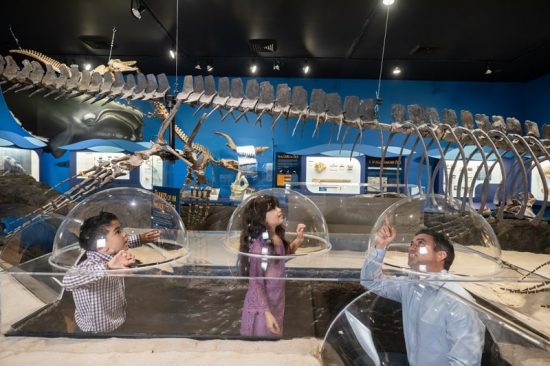
Georgia Southern University Museum reopens just in time to celebrate Earth Sciences Week
After nearly three years and following extensive architectural renovations, the Georgia Southern Museum, one of the longest-standing educational centers on the University's Statesboro Campus, has reopened. "It has been a long project, but well worth the journey," said Georgia Southern Museum Director Brent Tharp, Ph.D. "The upgraded facility and newly designed galleries represent a new era for the museum. Visitors will still find old friends, like the mosasaur, but exhibited in new more exciting ways, and will make new discoveries with never before exhibited artifacts in expanded permanent exhibits preserving the area's culture. We are really excited to be back open to the public." The Georgia Southern Museum serves as the premier institution interpreting the natural and cultural history of Georgia's coastal plain. The museum displays permanent exhibits and changing exhibits curated by the University's faculty and students, and provides a place where researchers can explore its collections and students of all ages can learn. As part of its reopening celebration, the Museum will recognize Earth Sciences Week with events featuring social media videos and interactive displays by Georgia Southern students, faculty and alumni. Highlighted events for Earth Sciences Week include: Oct. 12 - Earth Observation Day Oct. 13 - National Fossil Day Oct, 14 - Geoscience for Everyone Day Oct. 15 - Geologic Map Day Oct. 16 - International Archaeology Day Admission to the museum is $4 per person; however, for a limited time the museum also will accept donations for admission. Children 3 years of age and younger, museum members, and Georgia Southern students receive free admission. If you’re a journalist looking to cover Earth Sciences Week or talk to any of the many experts at the museum – then let us help. The researchers behind this study are available, simply reach out to Georgia Southern Director of Communications Jennifer Wise at jwise@georgiasouthern.edu to arrange an interview today.


Japan House: Fifty Years Ago Today
Joshua W. Walker, Ph.D., President and CEO, Japan Society This September we're celebrating the 50th anniversary of Japan House, Japan Society's landmarked headquarters building. Let's jump in our time machine and go back to 1971, when Japan Society was only 64 years old. At that time, U.S.-Japan relations were deeply embroiled in trade frictions while the ending of the U.S. embargo of China had just begun to impact East Asia. 1971 snapshots In the United States: Richard M. Nixon is President; Apollo 14 lands on the moon; massive protests are held throughout America against the Vietnam War; Walt Disney World opens in Orlando, Florida; Joe Frazier defeats Muhammad Ali in 15 rounds at Madison Square Garden; the first Starbucks opens in Pike Place Market, Seattle. In Japan: Eisaku Sato is Prime Minister; the U.S. and Japan sign an accord to return Okinawa to Japan; NHK TV implements colorization of all programs; Kamen Rider TV series begins broadcasting; the 48th reigning Sumo champion Yokozuna Taihō announces his retirement; McDonald's opens its first store in Ginza, Tokyo; Nissin creates the first "cup noodle." Japan House Meanwhile in New York City, Japan Society had occupied eight different locations since its founding in 1907, and by the mid-1960s, a dedicated building had become necessary to house the Society's rapidly expanding initiatives. Japan Society President John D. Rockefeller 3rd made a very generous pledge by donating the land for the building site and Japanese modernist architect Junzo Yoshimura was confirmed to design the building. On September 16, 1969, John D. Rockefeller 3rd and Japanese Foreign Minister Kiichi Aichi broke ground at a formal ceremony. Construction proceeded on schedule and staff moved in during the spring of 1971, with Executive Director Douglas Overton noting, "Each day we have found some new and delightful feature which has come off the drawing board as an unexpectedly brilliant success. Japan House will be a national important building worthy of its high purposes." Opening Week—five star-studded days of celebratory events—began on September 13, 1971 with Their Imperial Highnesses Prince and Princess Hitachi at the ceremonies. The Prince brought Japan's best wishes to the Society "for a new chapter, both rich in content and wide in scope." The Gallery opened its first exhibition, Rimpa: Masterworks of the Japanese Decorative School and the Tokyo String Quartet performed in the new auditorium. Junzo Yoshimura wrote about Japan House, "People the world over used to build their houses with local and traditional materials. Today, however, contemporary buildings all over the world use the same basic materials—concrete, steel and glass—yet different characters and nationalities can still be perceived among them. In designing Japan House I have tried to express in contemporary architecture the spirit of Japan." With the formal opening of the Society's headquarters a new era had begun. Their Imperial Highnesses Prince and Princess Hitachi and Japan Society chairman John D. Rockefeller 3rd view the first Japan Society Gallery exhibition Rimpa: Masterworks of the Japanese Decorative School. Photo © Thomas Haar. The next 50 years Fifty years later, we are at another inflection point. The novel coronavirus pandemic has taught us just how interconnected we are as a global community while placing new importance on our homes and transforming the nature of work. This unprecedented global crisis has also illuminated the strengths and weaknesses of our organization, providing new opportunities for envisioning the future. Just as the opening of Japan House shaped the Society's last 50 years, today we are reimagining how we use our space, from the physical to the digital, forging broader connections or kizuna for U.S.-Japan and for the world. We embrace our mission for the years to come, reaching out far beyond our building, to our city, country, and world as we seek to connect American and Japanese people, cultures, and societies through a global lens. Like a hike up Mt. Fuji, Japan Society’s nearly 115-year-long journey itself defines us far more than our current destination. Beginning in 1907, the first iteration of Japan Society focused on business relations between the U.S. and Japan. For its 1952 post-Occupation reconstitution under the leadership of John D. Rockefeller 3rd, the Society dedicated itself to arts, culture, and education, with an emphasis on supporting Japanese students in New York as well as spreading the word about Japan through significant cultural milestones such as partnerships with The Metropolitan Museum of Art and Lincoln Center, with traveling exhibitions and outreach on both sides of the Pacific. With the opening of Japan House in 1971, politics was reintroduced into the mix, the business and policy communities energized, and Japanese popular culture landed large—nearly 50,000 people came to the Grand Sumo Tournament at Madison Square Garden co-sponsored by Japan Society and the Asia Society in 1985! Today at Japan House we present Japan and U.S.-Japan as a way to engage with history and tradition, on the one hand, and innovation and the future on the other. As in 1971, the time to act is now and our opportunities are as great as the challenges of 2021. It's up to us to work together on new, critical connections to take us through the next 50 years. I'll be there with you. Joshua Walker (@drjwalk) is president and CEO of Japan Society. Follow Japan Society on Twitter, Instagram, Facebook, and LinkedIn. The views expressed in this article are the writer's own.


Timpson CEO joins Aston University as visiting professor
• James Timpson OBE has been the chief executive of Timpson since 2011 • He will work within Aston University’s College of Business and Social Sciences to develop connections in personal financial wellbeing and tax • Professor Timpson will engage with students about values in leadership and will deliver a public lecture on corporate kindness. The CEO of retail chain Timpson has joined Aston University as a visiting professor within the College of Business and Social Sciences. James Timpson will work closely with Aston University’s head of accounting to develop connections between Aston Business School and the tax and financial wellbeing industry over the next three years. In his first 12 months he will engage with both first year and pre-University students about University life, running a business and values in leadership and corporate kindness, delivering a public lecture around the latter reflecting Timpson’s work with ex offenders. He will also have the opportunity to talk to Masters students who have interests in corporate cultural development alongside Aston University’s Work and Organizations and Strategy departments and its MBA programme. Professor Timpson will also work with colleagues at Aston Business School to develop connections on his interests related to the University’s research agenda, such as TaxWatch, and connect Timpson with the student placements team to explore possible opportunities for student third year placements on MSc and MBA project work. Professor Timpson said: “I am excited to join Aston University as a visiting professor and to pass on some of the knowledge and connections I have built over the last 27 years in business. “I am looking forward to discussing the mechanisms of business with the business leaders of tomorrow at Aston University and about culture and corporate kindness at the University and its activity and plans in this area. “The Timpson Foundation specialises in the recruitment of marginalised groups within society as well as supporting numerous other socially minded projects. Approximately 10 per cent of our workforce is made up of people who have criminal convictions. We believe in giving people a second chance.” Professor Andy Lymer, head of accounting at Aston Business School, said: “I am really looking forward to working with James. “This well-deserved award recognises the distinguished contribution that he has made and continues to make to the business community. We are privileged to have a business leader of James' stature join our faculty. “As a university that values highly practical experience, his wide and varied track record at boardroom level will provide invaluable stimulus and advice for our students and staff alike.”

Media, gender and celebrity culture expert on Britney Spears news developments
Claire Sisco King, associate professor of communication studies, is available for commentary on the recent resurgence in media interest in Britney Spears's personal life, including the #FreeBritney movement and the pop star's recent engagement. Sisco King teaches about Spears in a celebrity culture class, as part of a discussion on gender and trauma as they relate to fame. She can discuss: Spears and the public’s emotional investments in the lives of celebrities The misogyny that often typifies celebrity culture Our culture’s general fascination with trauma


Baylor Expert: 9/11 Reshaped Every Aspect of American Life – Not Necessarily for the Better
English professor, culture expert says terror attacks damaged America, but it’s not too late to recover sense of purpose and generosity The Sept. 11, 2001, terrorist attacks on the World Trade Center and the Pentagon continue – 20 years later – to have profound effects on everything from America’s political, religious and cultural polarization to American entertainment choices, said Baylor University faith and culture expert Greg Garrett, Ph.D., professor of English. “It shouldn’t surprise anyone that an event that shook our sense of security and our identity would be reflected in every aspect of American life,” Garrett said. “But what does surprise and alarm me is the degree to which 9/11 continues to shape our attitudes about race, religion, immigration and the Other, whether that Other is in Afghanistan or just across town. The United States initiated a perpetual war against terror in response to the 9/11 attacks, and the fear that took root in the American psyche has proven difficult to shake.” Garrett, author of more than two dozen books, is internationally recognized as an expert on faith, culture, race and story, and he argues that the reaction to 9/11 can be measured just as much through literature and culture as through accounts of executive orders and covert military operations. Country music, procedurals and reality TV after 9/11 “Initially, Americans supported the War on Terror across political, religious and cultural lines,” Garrett said. “Country musicians like Toby Keith leaned into militant songs about American greatness and righteous revenge. The top-selling act the Chicks (then the Dixie Chicks) was drummed out of country music for their public stand against going to war. The TV show 24 reflected the growing darkness of America’s extra-legal approach to that war—the willingness to use torture, rendition and the opening of a dark site in Guantanamo Bay to house suspected terrorists—and it actually shaped opinion and policy as it grew in popularity and influence.” Two other types of television shows became extremely popular as a result of 9/11, Garrett said. Procedurals (shows such as CSI, Law and Order and House, M.D.) gained a new popularity because they offered viewers something the ongoing War on Terror never could or will: closure. “A serious problem was introduced in every episode, grappled with and solved by the end of an hour,” he said. Another type of show that leapt in popularity in the months and years following the attacks – reality shows – offered “train-wreck escapism,” Garrett said. “The contestants on Survivor and The Bachelor, and the wayward souls on Jersey Shore and Keeping Up with the Kardashians, presented exaggerated versions of our present moment that allowed viewers to forget about the dark actuality of the times,” he said. Springsteen, Harry Potter and critiquing ‘moral failures of the War on Terror’ Not all popular culture offered reinforcement or escapism, Garrett said, adding that some of the most powerful pop culture from 2001 onward critiqued the “moral failures of the War on Terror and critiqued the American people for so readily accepting them.” “Punk rock, always a prime medium for protest, was one of the earliest forms of dissent,” Garrett said. Green Day’s 2004 album American Idiot reached the top of the charts in the United States and 18 other countries, ultimately selling 16 million albums. But mainstream acts like Bruce Springsteen also asked complicating questions about the attacks and their aftermath. “After primarily offering empathy and comfort in The Rising (2002), Springsteen realized that America had betrayed many of its most important ideals, as revealed by songs like ‘Your Own Worst Enemy’ on the No. 1 2007 album Magic,” Garrett said. “Later novels in J. K. Rowling’s Harry Potter series, the most popular fictional narrative of all time, introduce questions of torture and terror, and powerful TV dramas like Battlestar Galactica and the British import Doctor Who also criticize the choices made by the American government and its allies.” Zombies and the Apocalypse Perhaps the most significant byproduct of 9/11 in our culture is the resurgence in apocalyptic stories such as 28 Days Later, Sean of the Dead, The Walking Dead, Game of Thrones, World War Z and The Road, Garrett said. Stories about the Zombie Apocalypse – whether in games, books, comics, TV or movies – asked serious questions about what it means to be human, and about what moral compromises a person might be willing to take to stay alive, Garrett explained. They also reflected the new 24/7 sense of encroaching menace that “seeped into our culture and lit up our phones at all hours of the day and night.” “You could fight all day every day against this menace, these creatures who look like humans but seek your destruction. And then the next morning, you still have to rise and confront it again,” Garrett said. ‘Not too late’ “People 20 years ago said that 9/11 changed everything, and so it did.” Garrett said. “But 20 years later it is not too late to recognize that the fears those attacks brought to the surface don’t have to be the way we continue to live. In my faith tradition, Jesus constantly admonishes his followers not to be so afraid. We make bad and selfish decisions out of fear. We abridge hospitality, compassion and liberty when we believe we are endangered. That’s not the America I grew up in, and it’s not the America in which I hope to die. That America, the light of the world, the city on a hill, Lady Liberty lifting her torch to welcome all, is the America that our founders dreamed, and that we can dream once again.” ABOUT GREG GARRETT, PH.D Greg Garrett, Ph.D., is a professor of English at Baylor University and Theologian-in-Residence at the American Cathedral of the Holy Trinity in Paris. An award-winning professor, Garrett has written about 9/11 and its aftermath in a number of books, including One Fine Potion: The Literary Magic of Harry Potter (Baylor University Press), Living with the Living Dead: The Wisdom of the Zombie Apocalypse, and A Long, Long Way: Hollywood’s Unfinished Journey from Racism to Reconciliation (both Oxford University Press). ABOUT BAYLOR UNIVERSITY Baylor University is a private Christian University and a nationally ranked research institution. The University provides a vibrant campus community for more than 19,000 students by blending interdisciplinary research with an international reputation for educational excellence and a faculty commitment to teaching and scholarship. Chartered in 1845 by the Republic of Texas through the efforts of Baptist pioneers, Baylor is the oldest continually operating University in Texas. Located in Waco, Baylor welcomes students from all 50 states and more than 90 countries to study a broad range of degrees among its 12 nationally recognized academic divisions. ABOUT THE COLLEGE OF ARTS & SCIENCES AT BAYLOR UNIVERSITY The College of Arts & Sciences is Baylor University’s largest academic division, consisting of 25 academic departments and eight academic centers and institutes. The more than 5,000 courses taught in the College span topics from art and theatre to religion, philosophy, sociology and the natural sciences. Faculty conduct research around the world, and research on the undergraduate and graduate level is prevalent throughout all disciplines. Visit baylor.edu/artsandsciences.


Millennials at Work – Let our experts offer insight into the next generation of employees
Millennial workers now total 56 million, representing 35% of the total US labor force. How can organizations harness their unique talents and strengths? Goizueta Professor Andrea Hershatter recently joined the Goizueta Effect to explore this generation’s use of technology as a “sixth sense,” their inherent trust in organizations, and their tendency toward an extrinsic sense of fulfillment. In the interview Hershatter uses her expertise and years of experience to discuss a wide variety of topics such as: Defining Generations What Makes a Millennial? Exploring Boomers, GenX and Zoomers Millennials’ Relationship with Technology & Organizations How COVID-19 Has Impacted Millennials Dynamics & Interplay Between Generations The Next Generation and The Future Andrea Hershatter is Senior Associate Dean and Director of the BBA Program in Emory’s Goizueta Business School. She regularly provides consultation to corporations and academia on the Millennial generation and has been an outside expert to the Graduate Management Admission Council in enhancing undergraduate student outreach. She is a frequent presenter on the topics of entrepreneurship, generational workplace culture, and management education. Andrea is available to speak with media about this topic – simply click on her icon now to arrange an interview today.

