
Experts Matter. Find Yours.
Connect for media, speaking, professional opportunities & more.

Ask an expert: Are children mentally rebounding back to a sense of normalcy?
With kids heading back to class and schools facing a new normal, there's a lot to consider about life post-pandemic, especially when it comes to America's children. Recently, we sat down with Augusta University's Dr. Dale Peeples, a child and adolescent psychiatrist who treats young patients and educates parents on psychological disorders such as anxiety, ADHD and depression. Throughout the pandemic, Peeples has also been the go-to psychiatrist for media and parents, providing tips to maintain mental wellbeing. Q: Are children mentally rebounding or adjusting back to a sense of normalcy? I think we are seeing an impact from the pandemic that’s continued even though life is getting much closer to what we consider normal. The impact with kids largely focuses on school, both through education and through those social interactions. I still see kids who are struggling to make up for things after falling behind during the pandemic and struggling to work back to that classroom setting when they developed a little bit of anxiety for such extended periods. You also are seeing kids dealing with a lot of regret having missed out on life, on friendships and connections, and some kids have been really struggling with how to deal with a bunch of people again. Q: Is there a certain age group that you’ve seen that may be struggling more than others? I think the older kids are, because when they were going through this, the more impact it had. A couple of reasons for that: Peer relationships become a lot more important as you become a teenager as compared to when you are little bit younger. Also, school becomes more demanding and sometimes that catch-up on work that was missed is going to be a little more challenging than younger grades. Q: What would your advice be to parents to help their children mentally in these increasingly challenging times, specifically as we begin the new school year? Communication, obviously, is still ideal. Families want to make sure that they are still getting together, having dinner as a family, discussing how the children's day went, so parents are in the loop about what kids are dealing with, trying to maintain that open line of communication. Parents also want to kind of generally be on the lookout for symptoms of depression. Obviously that's the changes in mood, feeling sad, feeling down, but also when kids kind of socially withdrawal and they lock themselves in their rooms and they don't want to go out, be around other people, do things they enjoy. When you see grades begin to decline, those are warning signs that there might be a little bit more going on here. Q: What can children do to help themselves and make sure they feel heard? Any time I'm sitting down with a patient for the first time and we're talking about treatment options, we'll talk about medication sometimes. We generally talk about talk therapy, behavioral and cognitive interventions. They also always talk about lifestyle interventions, healthy lifestyle, and there is a ton there that people can really do to make a big difference. The biggest thing I see kids struggle with, honestly, is sleep. Sleep has a huge impact on mood and anxiety and getting proper sleep is really tough in this day and age, when you've got cell phone notifications going off around the clock. Q: We know kids are resilient. Those who have struggled the most over the last two years, can they turn the corner and get better? Absolutely, I 100% agree that the kids are resilient. I'd say almost always, I share that optimistic attitude that if they have a hard time, they're going to get better. Sometimes it's just putting out the safety guards to support them and make sure that they keep on that right track. Q: Unfortunately, school shootings are again in the news and seem to be on the rise in recent years. Are you seeing more concern and stress for children or maybe even from their parents as it relates to safety in school? I try to remind my patients that part of the reason they get a lot of national attention is because they're infrequent and they're rare. So part of it is parents kind of controlling media for younger kids. Teenagers, obviously, they understand what's going on, and it's going to be a little bit harder for parents to monitor the media, but having those open dinner table discussions can let parents know when their kids are having worries. This is an important topic, especially as students are heading back to school and beginning a fresh start to a new academic year. If you're a reporter looking to cover this topic, then let us help. Dr. Dale Peeples is available to speak with media. Simply click on his icon now to arrange an interview today.


What happens when the human body gets too hot?
What happens when the human body gets too hot? And what can you do if someone gets too hot? Douglas Casa, professor of kinesiology and chief executive officer of UConn’s Korey Stringer Institute – a leading authority on research, advocacy, and education about exertional heat stroke – explains in this edition of UConn Science in Seconds. The Korey Stringer Institute at UConn was established in honor of the Minnesota Vikings offensive lineman Korey Stringer, who passed away from exertional heat stroke in 2001. Looking to know more? Then let us help with your questions and coverage! Douglas Casa is an expert on athletic training, heat illness, and hydration. Dr. Casa is available to speak with media about this topic. Simply click on his icon now to arrange an interview today.



What does back to school look like this year? Augusta University expert talks challenges
Students will be back at the bus stop with school starting soon, but what can parents expect as their children return to the classroom after the effects of the pandemic years? Dr. Stacie Pettit, associate professor in the College of Education and Human Development at Augusta University, said not being in the classroom full-time has had an impact. Pettit said it’s documented that reading scores are down and many students were unaccounted for during at-home learning. But students also developed other skills during this period of time. “On one hand, you can’t completely make up for learning loss,” said Pettit. “Teachers just need to assess where students are and both students and teachers do the best you can from this point. On the other hand, students didn’t just stop learning altogether. There are important life and family skills that were gained during quarantine and the months after. I believe we should look at students from 'funds of knowledge' perspective rather than a deficit lens in order to recognize the cultural resources that a student’s household contains.” She added some students did become isolated and will need to relearn social skills, but many found a lively community online through social media during the pandemic. Pettit also pointed out students are resilient, as well as teachers. They didn’t stop teaching, but rather found new skills in instruction to make learning accessible in the new reality. There are some challenges going back to in-person instruction after the last couple of years. “Overcoming fear they’ve picked up through other people and the news,” she added. “”Feeling uncomfortable with their faces exposed after getting used to hiding behind a mask and dealing with germ phobia. Students also have the additional challenge of another recent school shooting in Uvalde, so not only are they getting used to being back in school full-time, but they also have safety concerns.” Pettit added there are still a few groups of students who could struggle being back in the classroom full-time. “Certainly kids who missed kindergarten. Students from foster care. Students in special education who didn’t have the support they needed during at home learning.” If you're a journalist covering education or are looking to line up your back-to-school stories this year, then let us help. Pettit is a respected leader in middle level teacher education and meeting the needs of marginalized young adolescents. She's available to speak with media - simply click on her icon now to arrange an interview today.

Are You an Expert? Here’s How to Tell
Have you ever wondered whether or not you are an expert? When asked this question about what defines expertise, you will hear a variety of answers. Many will reference key requirements such as an expert must have extensive knowledge in their field. Others will see education, published work, or years of experience as key qualifiers. Yet there are so many other dimensions of expertise that contribute to how visible, influential and authoritative they are within their community of practice or with the general public. Who Qualifies as an Expert? I started looking closer at this topic for two reasons. The first is my personal work with experts. Having worked with thousands of them across a variety of sectors I've observed that many are driven to develop themselves professionally as an expert to meet a variety of objectives. Often these are focused on raising one's profile and reputation among peers or with the broader market to inform the public. Some see media coverage being an essential part of their strategy while others are more interested in developing a larger audience for their research or client work, by speaking at conferences or on podcasts. Others have a focus on improving their PageRank on search engines. All these activities can enable important objectives such as attracting new clients, research funding or talent. The second reason for this deeper dive into expertise is a need to better organize how we look at experts within organizations. My work with communications departments in knowledge-based sectors reveals that they are keen to learn more about how they can better engage their experts to build reputation, relationships and revenue. However, better engagement starts with a better understanding of what qualifies someone as an expert - what attributes can we objectively look at that define expertise? With that knowledge, we can first better appreciate the amount of work experts have put into establishing themselves in their field. Then organizations can nurture this expertise in a more collaborative way to accomplish shared goals. My observation is that with a little more insight, empathy, and alignment, both experts and their organizations can accomplish incredible things together. And there has never been a more important time for experts to "show their smarts." By definition, an expert is someone with comprehensive or authoritative knowledge in a particular area of study. While formal education and certifications are a starting point for expertise, many disciplines don’t have a set list of criteria to measure expertise against. It’s also important to recognize other dimensions of expertise that relate not just to the working proficiency in a field but also to the degree of influence and authority they have earned within their profession or community of practice. Because of this, expertise is often looked at as a person’s cumulative training, skills, research and experience. What are the Key Attributes of Expertise? In evaluating your accomplishments and the various ways you can contribute as an expert to both your community of practice and the public, here are some key questions that can help you assess how you are developing your expertise: Have you completed any formal education or gained relevant experience to achieve proficiency in your chosen field? Are you actively building knowledge in a specific discipline or practice area by providing your services as an expert? Are you generating unique insights through your research or fieldwork? Are you publishing your work to establish your reputation and reach a broader audience such as publications or books? Are you teaching in the classroom or educating and inspiring audiences through speaking at conferences? Do you demonstrate a commitment to impact your community of practice and help advance your field and generate an impact on society by informing the public? Have you established a reputation as a go-to source for well-informed, unique perspectives? Some Additional Tips to Help you Develop Your Expertise To further the discussion, I’ve also shared further thoughts about the meaning of “expertise”. As you think about developing your own personal skills, or if you are a communicator who is responsible for engaging with your organizations experts, here are a few additional principles to keep in mind. Experts Aren't Focused on Some“Magic Number” Related to Hours of Experience Malcolm Gladwell’s book “Outliers” (2008), outlined the now famous “10,000-hour rule” as the magic number of greatness for the time it takes to master a given field. As the rule goes, you could become a genuine expert in a field with approximately 10,000 hours of practice — roughly 3 hours a day, every day for a consecutive decade. But is that what it really takes to become an expert? But is that what it really takes to become an expert? Or did Gladwell oversimplify the concept of expertise? Some of his assumptions for “Outliers” (which became a major bestseller) relied on research from Dr. Anders Ericsson at Florida State University who made expertise the focus of his research career. Contrary to how Gladwell outlined it, Ericsson argued that the way a person practised mattered just as much, if not more, than the amount of time they committed to their discipline. It also depends on the field of research or practice one is involved in. Some disciplines take decades to achieve expertise and many experts will admit they are just scratching the surface of what they are studying, well after they have passed the 10,000-hour mark. That might be just the first stage of proficiency for some disciplines. Experts are Continuously Learning It’s difficult to claim proficiency as an expert if you are not staying current in your field. The best experts are constantly scouring new research and best practices. Dr. Anders Ericsson observed in his work that "deliberate practice" is an essential element of expertise. His reasoning was that one simply won’t progress as an expert unless they push their limits. Many experts aren’t satisfied unless they are going beyond their comfort zone, opening up new pathways of research, focusing on their weaknesses, and broadening their knowledge and skills through avenues such as peer review, speaking, and teaching. The deliberate practice occurred “at the edge of one’s comfort zone” and involved setting specific goals, focusing on technique, and obtaining immediate feedback from a teacher or mentor. Experts Apply their Knowledge to Share Unique Perspectives While many experts conduct research, simply reciting facts isn't enough. Those who can provide evidence-based perspectives, that objectively accommodate and adapt to new information will have more impact. Expertise is also about developing unique, informed perspectives that challenge the status quo, which can at times be controversial. Experts know that things change. But they don’t get caught up in every small detail in ways that prevent them from seeing the whole picture. They don't immediately rush toward new ideas. They consider historical perspectives and patterns learned from their research that provide more context for what's happening today. And these experts have the patience and wisdom to validate their perspectives with real evidence. That's why expert sources are so valuable for journalists when they research stories. The perspectives they offer are critical to countering the misinformation and uninformed opinions found on social media. Experts Connect with a Broader Audience Many experts are pushing past traditional communication formats, using more creative and visual ways to translate their research into a wider audience. We conducted research with academics in North America and in Europe who are trying to balance their research (seen in traditional peer-reviewed journals) with other work such as blogs, social media, podcasts and conferences such as TEDx - all with the goal to bring their work to a wider audience. While that's an essential part of public service, it pays dividends for the expert and the organization they represent. Experts Are Transparent More than ever, credible experts are in demand. The reason for this is simple. They inspire trust. And the overnight success some have seemingly achieved has come from decades of work in the trenches. They have a proven record that is on display and they make it easy to understand how they got there. They don't mask their credentials or their affiliations as they didn't take shortcuts. They understand that transparency is a critical part of being seen as credible. Experts Don’t Take “Fake It Till You Make It” Shortcuts The phrase “fake it till you make it,” is a personal development mantra that speaks to how one can imitate confidence, competence, and an optimistic mindset, and realize those qualities in real life. While this pop psychology construct can be helpful for inspiring personal development, it gets problematic when it becomes a strategy for garnering trust with a broader audience to establish some degree of authority - especially when this inexperience causes harm to others who may be influenced by what they see. When self-appointed experts take shortcuts, promoting themselves as authorities on social media without the requisite research or experience, this blurs the lines of expertise and erodes the public trust. Experts Are Generous The best experts are excited about the future of their field, and that translates to helping others become experts too. That's why many openly share their valuable time, through speaking, teaching and mentorship. In the end, they understand that these activities are essential to developing the scale and momentum necessary to tackle the important issues of the day. How Do You Show your Smarts? How do you personally score on this framework? Or if you are in a corporate communications or academic affairs role in an institution how does this help you better understand your experts so you can better develop your internal talent and build your organization’s reputation? As always we welcome your comments as we further refine this and other models related to expertise. Let us know what you think. Helpful Resources Download our Academic Experts and the Media (PDF) This report, based on detailed interviews with some of the most media-experienced academics across the UK and United States draws on their experiences to identify lessons they can share in encouraging other academics to follow in their path. Download the UK Report Here Download the US Report Here The Complete Guide to Expertise Marketing for Higher Education (PDF) Expertise Marketing is the next evolution of content marketing. Build value by mobilizing the hidden people, knowledge and content you already have at your fingertips. This win-win solution not only gives audiences better quality content, but it also lets higher ed organizations show off their smarts. Download Your Copy



The University of Florida aims to bring a scientist to every Florida school
By Emma Richards It was the encouraging support of his 10th grade earth science teacher that led Bruce MacFadden to pursue his dream of becoming a scientist. Now an accomplished paleontologist, MacFadden is paying it forward as director of the UF Thompson Earth Systems Institute and its “Scientist in Every Florida School” program. The program connects more than 700 scientists to K-12 classrooms in 42 counties throughout the state, providing students and teachers alike with up-to-date science lessons that both inform and, hopefully, inspire future scientists. Teachers use the program’s online application portal to request a visit by a scientist to teach a specific concept. Teachers are then matched with a scientist with that expertise, who delivers the requested lesson in person or virtually. Participating scientists are vetted to ensure they can communicate clearly with audiences of varying education levels. The program benefits students, teachers and scientists, MacFadden said. Students get to see the amazing things scientists do. Teachers receive timely knowledge and professional development. And scientists get to give back to society and gain confidence in their ability to share research, even with the youngest students. “We want to let young people know that if they want to be a scientist and apply themselves, they can also be a scientist,” MacFadden said. “It’s a synergy between the scientists and the teacher,” he said in an interview on the From Florida podcast. “We do not have prescribed, off-the-shelf lesson plans, but instead we typically talk with the teacher and say, ‘What would you like to do?’” It is the only program that currently works throughout the state to deliver high-quality STEM instruction to teachers and students, particularly in public Title 1 schools. “We want to make sure that there’s a level playing field with the understanding and teaching about STEM in a larger context,” he said. “But for me, it’s more about earth system science so that all teachers and students can benefit from what we know about current research in this field.” Outreach conducted through the Thompson Earth Systems Institute focuses on those systems — the interaction of air, water, land and life, and human impacts. Another important aspect of the “Scientist in Every Florida School” program is showcasing what a 21-st century career in science can look like for people from a variety of different backgrounds and interests. MacFadden said graduate students serve as role models in their visits to schools. “We want to let young people know that if they want to be a scientist and apply themselves, they can also be a scientist,” MacFadden said. The program aims to get a scientist into every public school in Florida at least once. With more than 4,000 public schools in the state, the scientists have a lot of stops to make — though virtual visits have helped them reach distantly located schools. MacFadden said once the team accomplishes that feat, they’ll focus on expanding outreach to other states. “Right now, I’m totally focused on making a difference in Florida’s public education,” he said. To learn more about the Scientist in Every Florida School program, listen to the full episode on From Florida at this link. Listen to other episodes of the From Florida podcast here. To learn more about the Thompson Earth Systems Institute, visit this link.

Georgia Southern University’s annual economic impact soars to more than $1B
The latest report released by the University System of Georgia (USG) shows that Georgia Southern continues to have a strong economic impact on the region it serves and significantly contributed to the USG’s $19.3 billion total economic impact between July 1, 2020, and June 30, 2021. The report indicates that Georgia Southern’s annual economic impact has soared to more than $1 billion for FY 2021, a 7.4% increase over FY 2020. The report found these economic impacts demonstrate that continued emphasis on colleges and universities as a pillar of the state’s economy translates into jobs, higher incomes and greater production of goods and services. “We faced unprecedented challenges in FY 2021, but we’ve come out stronger than ever,” said Georgia Southern President Kyle Marrero. “With more than $1.03 billion of direct impact on southeast Georgia, Georgia Southern will continue to create more academic programs that meet specific needs for economic development. Informed by our regional academic plan and University strategic plan, we’re committed to making our region a thriving economic hub in Georgia.” There are 3,250 jobs on Georgia Southern’s campuses in Statesboro, Savannah and Hinesville. Because of institution-related spending, 6,363 jobs exist off-campus. Georgia Southern’s “initial spending” is $806,753,630. That breaks down in three areas: $235,513,929 is spent on personnel services $161,882,006 is spent on operations $409,357,695 is spent by Georgia Southern’s students Included in the initial spending by USG institutions are rounds of funding from the Higher Education Emergency Relief Fund (HEERF), which are federal funds allocated by the Coronavirus Response and Relief Supplemental Appropriations Act that provided emergency grants for postsecondary education. The study is conducted on behalf of USG by Jeffrey M. Humphreys, Ph.D., director of the Selig Center for Economic Growth in the University of Georgia’s Terry College of Business. If you are a journalist looking to know more about the positive economic Georgia Southern is having - then let us help. Georgia Southern President Kyle Marrero is available to speak with media - simply reach out to Georgia Southern Director of Communications Jennifer Wise at jwise@georgiasouthern.edu to arrange an interview today.


News in Atlanta is attracting from across the country. A Starbucks tucked away in the Ansley Mall in midtown Atlanta became the third of the popular chain's locations in the state to unionize. Georgia is not known a union strong state. But efforts are also on to see an Amazon warehouse in Gwinnett County organized as well. The union push in the Peach State is getting a lot of attention. In a state that has been historically non-union, the battle to organize in Georgia has often been uphill. And in a workforce of 5 million, most efforts may have a minimal impact. Yet in recent months, there have been public signs of union activism: among low-wage marginal workers, long-time unionists pushing for better contracts and — most visibly — upstart efforts in high-profile, non-factory settings like Starbucks and Apple. Maybe it's the tight labor market that gives workers more leverage. After all, the historically low unemployment rate during a time of economic growth has many employers desperate for workers, less able to dictate terms and pay, said Anthony Barilla, Ph.D, economist at Georgia Southern University, who has researched labor issues. "There is a shortage of workers willing to work at the minimum wage or at a wage that simply doesn't mesh with the area's standard of living," he said. "When labor deserves a higher wage, organizing is simply a tool to be used in accomplishing this." July 07 - Atlanta Journal Constitution/Miami Herald There's a lot of interest in the union push in Georgia and a lot of questions to ask: Are perceptions of organized labor changing in the south? What's motivating the union drives? Is it time larger corporations took notice? If you are a journalist looking to know more about this labor trend - then let us help. Anthony Barilla, Ph.D., is an associate professor of economics. He has published research in the fields of labor economics, sports economics and the aspects of economic education. He is available to speak with media about these recent developments - simply reach out to Georgia Southern Director of Communications Jennifer Wise at jwise@georgiasouthern.edu to arrange an interview today.
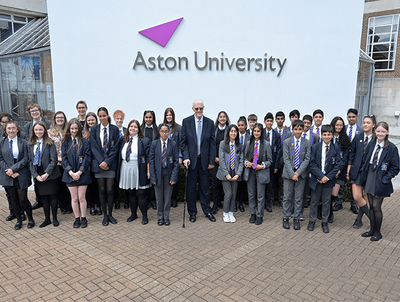
Dr Keith Bradshaw OBE and the West Midlands Mayor met students on the Introduction to Healthcare programme at Aston University ‘NHS outbreak’ experience day The Introduction to Healthcare programme is generously funded by Keith Bradshaw 55 local school students attend the one-day event on Aston University campus. Dr Keith Bradshaw OBE and West Midlands Mayor Andy Street have visited Aston University to meet Year 9 students who were attending a healthcare experience day on campus as part of the University’s Introduction to Healthcare programme. 55 school students took part in a full day of activities experiencing some areas of the healthcare professions. In one activity, the students acted as NHS finance directors during a disease outbreak, where they were asked to make financial decisions, such as choosing which departments in a hospital would be allocated funds from a £1 million budget. The students listened to pitches from different NHS departments before creating a presentation outlining which areas would get some of the budget and the reasons why. The exercise allowed them to develop their teamwork, as well as reasoning and presentation skills. Keith Bradshaw, a prominent businessman and philanthropist, generously funds the Keith Bradshaw Introduction to Healthcare programme, which is designed to increase students' awareness of the various careers within the healthcare sector and support students with their journeys into higher education. Working with students in Years 8, 9 and 10 from schools within the Solihull, Birmingham and Black Country area, the programme aims to educate young people about opportunities within healthcare and the importance of achieving the right GCSE grades to pursue those professions. The programme was launched in 2018 following the success of Aston University’s Pathway to Healthcare Programme. Keith said: “It’s been a pleasure to meet students attending the healthcare programme and hearing more - through their presentations - about their ideas on how they might manage an NHS budget and in which areas they would choose to allocate funds. “One of the key objectives of this programme is to support young people so they can develop and deploy their skills for the benefit of the local community. “We must get the most out of our young people, so they can support our health and welfare and live fulfilling and rewarding lives, which is why this programme – intended to widen participation into healthcare – is so very important.” Andy Street, Mayor of the West Midlands, said: “I was pleased to have the chance to visit the Introduction to Healthcare experience day, to learn more about the programme and to hear directly from the participating students. “A key part of my mayoral mission is to help young people from across our region to raise their aspirations and support the creation of high-quality job opportunities for them here in the West Midlands. “So, I congratulate Aston University on their wonderful widening participation efforts and will certainly play my part in advocating to Government the merits of funding and expanding these sorts of pathway programmes that do so much to help young people from all backgrounds to not only aspire to brilliant jobs but also be practically supported on the best possible route into these professions.” For more information about the Introduction to Healthcare Programme at Aston University please visit our website.


ChristianaCare is out to revolutionize health care. One of the country’s most dynamic health care systems, ChristianaCare is partnering with two leaders in medical and therapy services to provide comprehensive, integrated virtual health services 24/7 to colleges, universities and other institutions of higher education. Together with PursueCare and SimpleTherapy, ChristianaCare created a bundled health care product that combines general medical services from ChristianaCare’s Center for Virtual Health, mental health and addiction treatment programs from PursueCare and hyper-personalized musculoskeletal care from SimpleTherapy. ‘The future of health care is virtual’ “At ChristianaCare, we know that the future of health care is virtual,” said Sharon Anderson, MS, RN, FACHE, ChristianaCare’s chief virtual health officer and president of ChristianaCare’s Center for Virtual Health. “When college students are able to access medical, behavioral health and musculoskeletal services through their phone or laptop, from their dorm room or a private space on campus, they’ll be more likely to get help when they need it. This is about delivering care to students on their terms, so that they can be healthy and supported with high-quality care throughout their college experience.” Personalized virtual health solutions will be available to students at participating higher education institutions through a customized portal accessible from any computer or mobile device. Students will be able to access assessments, resources and virtual treatment via modules or telemedicine sessions with licensed providers. The offering provides students with unlimited, on-demand care from a multidisciplinary team solving for a multitude of conditions. “For college and university student health services and administrators, this partnership offers a powerful new way to provide comprehensive, affordable health solutions that benefit students,” Anderson said. “In a highly competitive recruiting environment, these solutions are easy to implement and can add tremendous value. We are excited to partner with colleges and universities to strengthen their student health programs by creating a comprehensive virtual care solution to meet their student’s health care needs.” Through a single digital portal, participating students can access internal and family medicine providers from ChristianaCare’s Center for Virtual Health. PursueCare’s Joint Commission-accredited mental health, psychiatric and medication-assisted treatment providers, and SimpleTherapy’s licensed physical therapists specializing in musculoskeletal care, acute or chronic pain management, and strength and mobility training can all be accessed through the portal. Students will also have the option of using PursueCareRx for their pharmacy needs. PursueCareRx is a competitively priced full-service pharmacy that accepts most major insurance and delivers directly to customers. “Young adults face an escalating mental health and substance use crisis,” said Nick Mercadante, founder, and CEO of PursueCare. “Colleges and universities are frequently unable to comprehensively serve the increased need, and research suggests substance use, mental health and suicide carry a significant social stigma. Our goal is to work collaboratively with campus health resources to bring a low-barrier solution students can access privately, any time, on their terms. Additionally, partnering with a world-class health system like ChristianaCare means we can help support whole-person care needs.” “Chronic musculoskeletal disorders have never been more prevalent and traditional care pathways are often ineffective and costly,” said Arpit Khemka, co-founder and CEO of SimpleTherapy. "SimpleTherapy removes barriers for students allowing them to take control of their musculoskeletal health, reducing their need for high-cost, high-risk services, such as surgery and opioids, to manage pain. This results in higher compliance rates and more successful outcomes." Customized and co-branded product The product is designed for colleges, universities and all other higher education institutions. For a flat fee, a school will be able to offer care that is customized and co-branded with school-specific content to be an extension of existing campus health services. It provides curated resources for rapid pre-assessment, on-demand chat and discreet, personalized access to care for students on or off-campus. The innovative patient portal aims to improve and strengthen how schools offer health care solutions to their student population while reducing any potential interruptions of academic and athletic pursuits by making it possible for students to conveniently access care from anywhere. In addition, the offering eliminates social stigma and other access obstacles for students who are at-risk or potentially at-risk, making it more likely that students will avail themselves of treatment options and remain in school. These services are currently licensed to operate in Delaware, New Jersey, Pennsylvania and Maryland. Applications for licenses are underway in other states. ChristianaCare has long been a trailblazer in virtual health. Among its achievements, during the COVID-19 pandemic, ChristianaCare developed a COVID-19 virtual monitoring program that helped 37 companies in 14 states safely reopen with daily symptom monitoring, testing and connections to care for more than 10,000 employees. It’s Center for Virtual Health makes receiving care radically convenient, offering a full continuum of virtual care delivery programs. These programs include virtual primary care, specialty care programs and a Hospital Care at Home Program bringing hospital level of care to a patient’s home. The Center for Virtual Health cares for thousands of patients using state-of-the-art virtual care capabilities supporting patients in receiving care anytime, anyplace, including in the comfort of their own homes. For more information about the program, visit StudentCareSolutions.com.


ChristianaCare Launches Gender Wellness Program for Transgender and Gender Diverse Individuals
Pride Month announcement highlights need for quality health care for LGBTQ+ community ChristianaCare has opened a Gender Wellness Program to provide psychotherapy and support services for individuals age 13 and older who are exploring their gender identity or experiencing gender dysphoria—a sense of incongruence and distress that a person may have because of a mismatch between their gender identity and their sex affirmed at birth. Downloadable: PHOTOS VIDEO The program also provides treatment for any behavioral health condition the individual may be struggling with, such as anxiety and depression. People who identify as transgender have higher rates of suicide attempts than individuals who do not identify as transgender, according to the National Institutes of Health. “ChristianaCare aims to provide the safest, highest quality health care and the best experience possible for our entire community, guided by our values of love and excellence,” said Mustafa A. Mufti, M.D., interim chair of the ChristianaCare Department of Psychiatry. “Caring for our entire community means providing sensitive, compassionate, and state-of-the-art behavioral health and medical care to transgender and gender-diverse individuals. Our Gender Wellness Program will help improve health equity and outcomes for individuals and families who need these services. We know that transgender and gender-diverse individuals face health disparities, and our program will help address that.” The program follows the guidelines of the World Professional Association for Transgender Health (WPATH). WPATH promotes the highest standards of health care for the health of transsexual, transgender and gender-nonconforming people based on the best available science and expert professional consensus. “Our Gender Wellness Program is ready to support anyone age 13 or older who is exploring their gender identity, experiencing gender dysphoria or who needs education and support around social and medical transition,” said Brett E. Herb, DSW, LCSW, program manager of the Gender Wellness Program. Dr. Herb has been in clinical practice for more than 25 years as a psychotherapist and a clinical and administrative manager for numerous behavioral health programs, and has been working with the transgender and gender-diverse populations for the past 17 years. “We provide referrals to compassionate, gender-affirming health care experts,” Dr. Herb said. “Often, families find themselves having to educate their primary care providers, schools, neighbors and family members about how to appropriately care for gender-diverse individuals. Our program provides individuals and families with access to specially trained gender therapists they can trust who can get them the answers they need to help navigate the complexities they may encounter.” The Gender Wellness Program provides referrals to trans-competent primary care providers who prescribe gender-affirming hormone treatment, along with specialists for gynecological and obstetrics care. The program offers individual, couples, family and group therapy sessions. It also provides existing patients with assistance with personal documentation changes and letters of surgical support. “This program has provided me with tremendous support throughout my transition,” said Julie Brown of Wilmington, Delaware. “My therapist empathizes with what I am experiencing in my life, and has guided me through my evolution. The group therapy sessions help me understand that I am not alone. “We form a community, share information and support each other in a safe environment. My child is also a patient of the Gender Wellness Program. Their support has helped him deal with my changes and understand his gender dysphoria.” “Brett Herb and the Gender Wellness Program have helped me grow the confidence I needed,” said Kristopher Snedeker of Newark, Delaware. “Working with the professionals at the program has provided resources to help further my gender transition to become who I truly am.” Gender therapists at the Gender Wellness Program are: Brett E. Herb, DSW, LCSW, Program Manager. Amanda Pope Evans, MSW, LCSW. Katherine Goemaat-Suarez, MSW, LCSW. ChristianaCare is a national leader in LGBTQ+ health care. For the past 11 consecutive years, Christiana and Wilmington hospitals have been recognized by the Healthcare Equality Index as an LGBTQ+ Healthcare Equality Leader. Individuals who would like to learn more can contact the Gender Wellness Program at genderwellnessprogram@christianacare.org or call 302-623-6773. For more on ChristianaCare’s LGBTQ+ health initiatives, visit LGBTQ Health Initiatives.