
Experts Matter. Find Yours.
Connect for media, speaking, professional opportunities & more.

Will schools reopen before semester ends? Georgia Southern pandemic expert can give perspective
While education has moved into homes across the country because of the COVID-19 pandemic, people are wondering if the shutdowns will actually help stop the spread of the disease. Isaac Chun-Hai Fung, Ph.D., a digital health expert and infectious disease epidemiologist at Georgia Southern University, said school closures can delay the peak of the outbreak, reduce the amount of cases and decelerate the spread of the virus. Fung was a part of a study in 2015 that modeled a potential flu pandemic. The study showed that delaying the spread of a virus can give health care professionals more time to come up with vaccines and other treatments, as well as giving the system time to brace itself for the onslaught of patients. “The key message of my paper is not necessarily how quickly we shut down schools,” Fung told Rolling Stone. “It is the duration of school closure that matters. Whenever we relax social distancing measures, we will see a bounce-back of the cases, unless we are able to completely block all transmission chains and have driven the case number to zero — i.e., extinction of the virus, as in the case of SARS in 2003.” While some think opening schools and other public places would benefit the economy, Fung said doing so could leave the country vulnerable. “To save the U.S. economy, we must control this disease first,” Hung said to Rolling Stone. “That is what China is going to achieve — even if they have already suffered a great deal economically due to COVID-19. That is why (Narendra) Modi asks the whole of India to stay home for three weeks. That is also what Boris Johnson asks the British people to do now. The Americans should take heed.” Fung analyses social media data for public health surveillance and health communication and uses digital technologies for public health interventions. He investigates the transmission of communicable diseases with a focus on respiratory infections and environmentally transmitted infections. He applied a variety of methods, from classical statistical methods to machine learning and mathematical modeling, to address public health problems and to provide solutions to policymakers. He is especially interested in assisting public health agencies in their responses to public health emergencies. Fung is available to speak with media regarding this topic — simply reach out to Georgia Southern Director of Communications Jennifer Wise at jwise@georgiasouthern.edu to arrange an interview.


Baylor Expert Shares Tips to Help Kids Maintain, Improve Fitness During Time Out of School
Millions of children and teens throughout the United States are relegated to their homes in attempt to help “flatten the curve” and spread of COVID-19. As parents struggle to carve out a new normal for themselves and their children, a Baylor University professor says physical fitness should still be a priority. Paul Gordon, Ph.D., professor and chair of Baylor University’s department of health, human performance and recreation, is recognized nationally as a top expert in muscular fitness and health outcomes. His areas of expertise include physical activity and lifestyle-based research related to obesity. “Beyond improving your health, physical activity will also improve your mental state,” Gordon said. “A sense of accomplishment and satisfaction is often felt after exercise. Consequently, when you need a mood lift either from ‘cabin fever’ as a result of being shut in or the stress of our current health crisis, take an exercise break. It will help you keep your spirits up.” In the following Q&A, Gordon shares tips to help parents and children stay fit during the coronavirus pandemic. Q: With millions of kids now out of school due to coronavirus – and without the benefits of a gym class – what advice would you give parents and guardians about helping those kids maintain or improve fitness? A: With the onset of school closures and recommendations to limit groups, parents do find themselves challenged to figure out a new routine that encourages healthy living such as opportunities for exercise. Given the current challenges we are facing to prevent the spread of this dangerous disease, parents need to step up and actively oversee their children’s activities. The following points are important considerations: Engage in Active Parenting. Many children/adolescents will be engaging in remote learning formats through much, if not all, of the remaining school year. Consequently, parents will need to assist their kids, particularly the younger children, with access and supervise their work. We cannot expect teachers to have the same control as when they are in class. Similarly, opportunities for engaging in physical activity need to be planned and encouraged and where possible supervised. Some exercise is better than none. This concept is true for adults and kids alike. Don’t give up on getting exercise completely if you can’t plan a full workout. A little is good, and more is better. Remember, exercise is helpful for more than weight control. It improves cardiovascular and skeletal health as well. It can even bolster your immunity response. Q: Are there exercises that kids from kindergarten on up can do? What would you recommend in terms of time and style of exercise? A: Younger children are more likely to engage in activity if they have someone to play with. Parents should engage in active games with their children. If the parent is working from home, take short breaks and play with your child. Active games that involve running, skipping, jumping and climbing are perfect types of activities. Take them for walks in the park or neighborhood. Once children hit adolescence, they are more inclined to perform limited stationary exercises such as on a stationary bicycle or cross trainer. Throwing the ball and playing controlled games (tag, kickball, etc.) can be effective. Playing with your child is an excellent way to spend time and build memories that last a lifetime. Older children can also engage in regular calisthenics such as push-ups, jumping jacks, wall sits, etc. Make it a game or contest and you’ll likely get their involvement. Q: Do you recommend any online plans or resources for parents to follow? A: There are a number of online resources available. A few examples are listed below: GoNoodle KidsHealth.org BeActiveKids.org Q: What are the negatives associated with being sedentary – whether it’s in front of a television or sitting and spending too much time in front of a screen? A: A sedentary lifestyle has numerous untoward effects on health. In fact, even individuals who are meeting basic activity levels can be at increased risk for diseases if they are overly sedentary. Increased risk for cancer, cardiovascular disease and metabolic abnormalities (i.e., diabetes) occur from sedentary living. Obesity has reached epidemic levels in our society, and a primary factor is sedentariness. It’s important to take breaks from sitting and get up and walk around. ABOUT BAYLOR UNIVERSITY Baylor University is a private Christian University and a nationally ranked research institution. The University provides a vibrant campus community for more than 18,000 students by blending interdisciplinary research with an international reputation for educational excellence and a faculty commitment to teaching and scholarship. Chartered in 1845 by the Republic of Texas through the efforts of Baptist pioneers, Baylor is the oldest continually operating University in Texas. Located in Waco, Baylor welcomes students from all 50 states and more than 90 countries to study a broad range of degrees among its 12 nationally recognized academic divisions. ABOUT ROBBINS COLLEGE OF HEALTH AND HUMAN SCIENCES AT BAYLOR UNIVERSITY The Robbins College of Health and Human Sciences at Baylor University was established in 2014, a result of identified priorities for strengthening the health sciences through Baylor’s strategic vision, Pro Futuris, and the University’s Illuminate strategic plan. The anchor academic units that form Robbins College – Communication Sciences and Disorders; Family and Consumer Sciences; Health, Human Performance and Recreation; Public Health; and Division of Health Professions – share a common purpose: improving health and quality of life. The College’s curricula promotes a team-based approach to transformational education and research that has established interdisciplinary research collaborations to advance solutions for improving quality of life for individuals, families and communities. For more information, visit www.baylor.edu/chhs.


The global pandemic of COVID-19 is no longer just daily news, it is pretty much the only news happening right now across America and most of the globe. Reporters and journalists are working hard to cover this story that is changing and progressing almost exponentially by the day. There are multiple angles to consider, and each storyline is just as important as the other when it comes to informing the public and ensuring that the correct and proper facts are relayed to an audience that is concerned, curious and waiting for answers. If you are a journalist covering COVID-19 – then let our team of experts help. Our experts can assist with and answer your questions about transmission, vulnerable populations and age groups, prevention and how the medical system is handling this outbreak. Emi Minejima is an Assistant Professor of Clinical Pharmacy at USC School of Pharmacy and an expert in infectious diseases pharmacotherapy and antimicrobial stewardship. She is an infectious diseases specialist at LAC+USC Medical Center. Irving Steinberg is the Associate Dean for Faculty Affairs & Associate Professor of Clinical Pharmacy and Pediatrics at USC School of Pharmacy and Keck School of Medicine. He is a pediatric pharmacist at LAC+USC Medical Center and an expert in the areas of predictive performance of pharmacokinetic models for dosing in children. Annie Wong-Beringer is the Associate Dean for Research and Graduate Education & Professor of Clinical Pharmacy at USC School of Pharmacy and an expert in bacterial resistance and virulence, host microbial interactions and host immune response. All three experts are available and ready to speak with reporters – simply click on an individual's icon to make contact and arrange an interview.


This Video Game Can Teach You How to Bring a Vaccine to Market
Getting a drug or vaccine from the research bench to the bedside of a patient in need is a complex process, and one that researchers around the globe are currently trying to navigate as quickly as possible to address the spread of COVID-19. To improve understanding of this intricate, interdisciplinary undertaking, faculty and students in the Games and Simulation Arts and Sciences (GSAS) program at Rensselaer Polytechnic Institute, in collaboration with the Icahn School of Medicine at Mt. Sinai Hospital, are developing a video game called "Cure Quest." This game will help bridge the gap in med school education between the clinical side of medicine and basic research. “Cure Quest will allow medical students to tie together the necessary steps for vaccine development in dramatic cases like we’re seeing right now with COVID-19,” said Ben Chang, a professor of arts and Director of GSAS at Rensselaer, “or in drugs we would use day-to-day.” The main character in the game is sent to an island where there is a new disease and must overcome obstacles in their pursuit of creating a new drug to cure the disease. When its development is complete, Chang envisions Cure Quest being used by the general public, as well by students in scientific and medical fields, to better understand the drug development pipeline. Chang is available to speak about Cure Quest and the use of video games as important educational tools.


Baylor Gerontology Expert Shares Tips to Care for Aging Population During Coronavirus Pandemic
“This is not a vacation from caring; it is a time when caring is needed most of all,” social work professor says The Center for Disease Control and Prevention (CDC) has announced that older adults and people who have serious chronic medical conditions such as heart disease, diabetes and lung disease are at a high risk for the coronavirus. The virus hit hard in late January at a nursing facility in the state of Washington, where a number of residents died. As a result, the CDC has recommended strong restrictions on visitors to long-term care facilities, and the health organization continues to preach limited physical contact and “social distancing” – creating intentional space of six feet or more between each person – to stem the spread of the virus. James Ellor, Ph.D., The Dorothy Barfield Kronzer Endowed Professor in Baylor University’s Diana R. Garland School of Social Work, is an expert on working with older adults as well as disaster behavioral health. He said it’s important in this time of uncertainty to continue to support and minister to those older adults who are self-isolating in their homes and those in long-term care facilities. “Remember, no one stops caring about others just because germs are in the way,” Ellor said. “Express your caring in appropriate ways. This is not a vacation from caring; it is a time when caring is needed most of all. We also know that prayer is very important. Hold the person in prayer and let them know you are doing so.” In the following Q&A, Ellor shares tips on how to care for this population during this time. Q: What are some ways we can check on older relatives and neighbors without using physical touch and interaction? A: There is a fine line in this unknown time between caution and paranoia. Respect for each other’s boundaries is the critical value. It seems very awkward to want to affirm someone, yet not shake their hand. However, we need to use our words and ask what the other person is comfortable with, and by the same measure, let them know what you are comfortable with. At this point, the most obvious ways to check on people is through social media or paper and pencil. Drop them a note, call them on a phone, use other social media devices as appropriate. I would suggest that if you normally visit them, say on Fridays, be sure to continue to do that, albeit by phone or even just drop them a card. Q: If people have chosen to self-isolate or if they’re scared to venture out due to this health crisis, what are some ways people can help? A: Be consistent. If you have a pattern, continue the pattern. Remember the principles above. If the person is feeling out of control, talk quietly with them and offer them a card or other gesture of caring. Q: Can you explain the importance of personal interaction for people who are shut in? A: People with human contact simply live longer than those completely cut off from the world, with few exceptions. While about 15 percent of older adults are “shut in,” only about 5 percent are bed bound. That means that persons who are dependent on oxygen, for example, will be in their house, but not in bed. They depend on all of their outside contacts. Keep your normal visiting pattern, albeit with a card in the mail or phone call. If you are a member of a church, have the youth group use some of their extra “stay at home” time to make greeting cards intended to cheer up a person in your church or group that is home bound. Older adults like tactile things, particularly if they are sensory-impaired. If you make a card, put a feather in it, or some other feel-good item. If you are purchasing a card, there are some that have things in them that you can feel, or even hear. Some cards will allow you to record a short message. Q: Since so many long-term care facilities now have strict rules about visitors, are there any ways that people can interact or show support to residents in a safe manner? A: Most facilities are cutting off all contact from the outside. Only their own staff, physicians and hospice nurses are being allowed in. Even social workers, chaplains and other clergy are being kept out. In the Waco area, physicians are being screened for a fever or cough and could be turned away. As such, phone calls, cards and letters are all important. Several facilities in this area have begun to put room numbers on the windows of their facility, so that family can come by and wave through the window. Persons in long-term care facilities, even those with dementia, will pick up on the anxiety of the staff and especially the TV, which is often on all the time. A person with dementia may not be able to understand the anxiety but will be anxious when others are anxious. This makes the job of staff that much harder. Q: Anything else you’d like to share? A: The workers at these homes have a much harder job now. Don’t hesitate to send them a card or a treat if it can be obtained safely. Staff, even the people at the door telling you that you can’t come in to see your loved one, have a tough job now and need extra support from everyone. ABOUT JAMES ELLOR, PH.D. James Ellor, Ph.D., serves as professor and The Dorothy Barfield Kronzer Endowed Professor in Family Studies in Baylor University’s Diana R. Garland School of Social Work. works with older adults around issues of mental and spiritual health. He has served on the executive committee of the Midwestern Geriatric Education Center and provided education, counseling, and planning for individuals and groups who work with seniors. His research includes work in entrostomal therapy, hunger, the church as service provider, spiritual assessment, and intervention techniques with cognitively impaired older adults. ABOUT BAYLOR UNIVERSITY Baylor University is a private Christian University and a nationally ranked research institution. The University provides a vibrant campus community for more than 18,000 students by blending interdisciplinary research with an international reputation for educational excellence and a faculty commitment to teaching and scholarship. Chartered in 1845 by the Republic of Texas through the efforts of Baptist pioneers, Baylor is the oldest continually operating University in Texas. Located in Waco, Baylor welcomes students from all 50 states and more than 90 countries to study a broad range of degrees among its 12 nationally recognized academic divisions. ABOUT THE DIANA R. GARLAND SCHOOL OF SOCIAL WORK AT BAYLOR UNIVERSITY Baylor University’s Diana R. Garland School of Social Work is home to one of the leading graduate social work programs in the nation with a research agenda focused on the integration of faith and practice. Upholding its mission of preparing social workers in a Christian context for worldwide service and leadership, the School offers a baccalaureate degree (B.S.W.); a Master of Social Work (M.S.W.) degree available on the Waco or Houston campuses or online; three joint-degree options, M.S.W./M.B.A., M.S.W./M.Div. and M.S.W./M.T.S., through a partnership with Baylor’s Hankamer School of Business and George W. Truett Theological Seminary; and an online Ph.D. program. Visit www.baylor.edu/social_work to learn more.
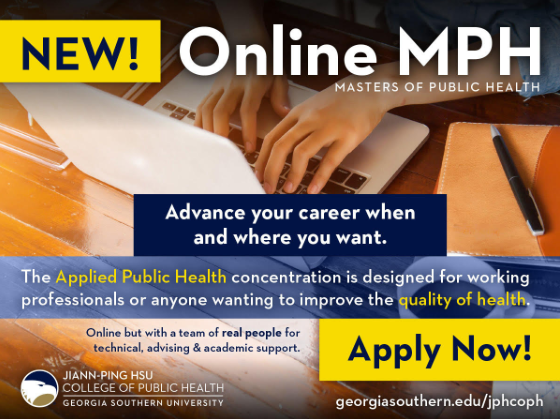
Beginning in Fall 2020 Georgia Southern University will offer its first fully online Master of Public Health (MPH) degree with a concentration in applied public health. “For those who do not have the ability to enroll in one of our on-campus MPH concentrations, the online applied public health option would be ideal for anyone passionate about improving health and making a difference in their community,” stated Interim Dean Stuart Tedders, Ph.D. Students will complete a broad-based program of study with a focus on public health education, information and advocacy, and with the flexibility to tailor their elective options. Students will apply their skills and knowledge to become front-line public health practitioners or public health leaders. Academic advisors and technical support will be provided to all students enrolled in the online master’s program. Additionally, the online program includes a field experience located within reach of the student’s location. Are you a journalist looking to cover this topic or learn more about Georgia Southern University and the programs it offers? Simply contact Melanie Simón at 912.344.2904 to arrange an interview or contact Karl Peace via his icon directly.


United Nations’ Sustainable Development Goals fall behind initial hopes, lacks needed funding
In 2000, United Nations member states adopted eight Millennium Development Goals (MDGs), which featured a number of ambitious global initiatives, such as eradicating extreme poverty and hunger, and achieving universal primary education in all countries around the world. As these goals were extremely aspirational, most were far from met by the target date. However, by 2015 significant progress was made in a few areas, such as increased official development assistance (foreign aid), reduced trade barriers for developing country exports, and new debt-reduction strategies for some of the heaviest indebted countries. By the target date of the MDGs, the most notable outcome was the number of people living in extreme poverty around the world had been reduced by 50% since 1990. To keep the sustainable development agenda moving forward, at the end of 2015, the United Nations member states adopted 17 new Sustainable Development Goals (SDGs) to be met by 2030. Since the adoption of the SDGs in 2015, some progress has been on two of the SDGs: eliminating preventable deaths among newborns and children under the age of 5, and getting children into primary schools. These are both important initiatives and progress should be celebrated, says Matt Bluem, assistant dean of graduate programs and MBA director of Saint Mary's University of Minnesota's School of Business and Technology. Unfortunately, progress on the other 15 goals has not kept pace. With just 10 years until the target date for meeting all 17 SDGs, it is becoming increasingly clear that most of these goals will not be met. According to the UN, the biggest challenge in meeting the SDGs is funding. An additional $2-3 trillion is needed to help meet funding requirements. A recent report by the Brookings Institution states that sub-Saharan Africa alone would need hundreds of billions of dollars in additional financial support every year in order to meet the SDGs by the target date of 2030, Bluem says. U.N. Secretary-General António Guterres has argued that public investment by governments is not enough, insisting that private industry is going to need to get involved. To meet the aggressive SDGs, the private and public sectors will need to work together to bring about the investment and policy change. In order to encourage governments and the private sector to put the resources and effort necessary into meeting the SDGs, it is imperative to let world leaders know that goals such as the SDGs are important to the international citizenry, Bluem says. Are you a journalist covering this topic and interested in an interview? That’s where we can help. Matt Bluem, Ph.D., assistant dean of graduate programs and MBA director, has taught business and marketing courses at Saint Mary’s University of Minnesota since 2008. Prior to Saint Mary’s, he worked in both the banking and the nonprofit sectors, most recently with a non-governmental organization (NGO) with operations in more than a dozen countries. Bluem is an expert in political and economic development and is available to speak with media. To arrange an interview with him, simply click below to access his contact information.


On average, teachers across the U.S. spend approximately $479 on classroom supplies each year, according to a 2018 study by the National Center of Education Statistics. The Institute for Interdisciplinary STEM Education (i2STEMe) at Georgia Southern University is helping reduce this burden for teachers in southeast Georgia with the School Outreach Program, a lending membership program that provides STEM and social studies materials for K-12 classrooms. i2STEMe, housed in the College of Education, serves as an outreach center for the university, regional educators and the broader community. The School Outreach Program provides STEM and social studies supplies, including consumable and non-consumable materials, equipment, and teaching aids to member teachers, schools and districts. Members can request items and materials that will be delivered to and picked up from their school location. Annual membership for the program can be purchased by entire school districts, schools or individual teachers. The project was recently featured on WTOC 11 where viewers were given a first-hand look at how local teachers and students are benefitting from the program. Alisa Leckie, Ph.D., the interim assistant dean of Partnerships and Outreach at Georgia Southern was on hand to explain how Georgia Southern is making sure students have access to the resources they need to further their learning in areas like STEM. Are you a journalist looking to learn more or cover the School Outreach Program and how institutions like Georgia Southern University are helping teachers, students, and schools across the state? If so – then let our experts help. Leckie's research is focused in the areas of education of language minority students, and analyzing policies impacting education. She is available to speak with media regarding this program – simply click on her icon to arrange an interview.


Interested in the Ethics of EdTech Apps? Let our Experts Help with Your Coverage
There’s been a lot of talk lately about EdTech apps. There’s a long list of benefits and advantages for students looking to succeed in these modern and digital times. However, with anything app-related – user privacy and what’s being done with all of your data that’s collected always comes to the forefront of the conversation. EdTech apps are a billion-dollar industry, and recently the experts from the University of Mary Washington were asked their opinions on the industry, the apps and privacy. Jesse Stommel, senior lecturer of Digital Studies at the University of Mary Washington, said that EdTech providers had a responsibility to do more than just legally protect themselves with terms and conditions. “The onus has to be on the tech companies themselves to educate the users about data security and data monetisation…say ‘here’s why I’m collecting it, here’s what I hope to do with it, here’s why it should matter to you’,” he said. For Dr. Stommel there was also still a danger when technologies were adopted widely across campuses and every student or lecturer was required to use them. “When certain companies become universal, staff and students don’t have a way to say ‘I won’t use it because I don’t want them to have my data’,” he said. The fact that certain products had become so widely adopted, such as plagiarism tracking software Turnitin, was another reason to be cautious about data protection, he said. Turnitin, which was sold last year for $1.8 billion (£1.4 billion), has been accused of monetising students’ intellectual property, since it works by checking submitted papers against an ever-growing database of previously submitted essays and detecting any similarities. “Companies can start off small and they say ‘we will be good stewards of this data, we’re small, we talk to each other,’ but then that company achieves more and more success and it doesn’t necessarily have the standards in place to maintain that,” said Dr. Stommel, speaking generally. “Then what happens when they are bought out? What are the ethics of the company that has purchased them? What happens to the student data then?” Dr. Stommel said that the most “moral” thing to do was for companies to collect as little data as possible but admitted “no company is approaching it in that way”. January 14 - TimesHigherEducation.com Are you a journalist covering how EdTech is now becoming a regular part of modern-day higher education? Then let our experts help with your stories. Jesse Stommel is a senior lecturer of Digital Studies at the University of Mary Washington and is an expert in faculty development, digital education and modern learning. He is available to speak with media regarding EdTech apps – simply click on his icon to arrange an interview.


Voters Split on Whether Trump Should be Removed from Office Former U.S. Vice President Joe Biden has widened his lead to 26 points among Florida voters in the race for the Democratic party’s nomination for president in 2020, according to a statewide survey by the Florida Atlantic University Business and Economics Polling Initiative (FAU BEPI). Among the Democratic candidates, Biden has increased his support to 42 percent, up from 34 percent in BEPI’s September 2019 poll. U.S. Sen. Bernie Sanders jumped into second place at 14 percent, while U.S. Sen. Elizabeth Warren fell to third at 10 percent, down significantly from 24 percent support in September. Former New York City Mayor Michael Bloomberg came in fourth at 7 percent, followed by U.S. Sen. Amy Klobuchar at 6 percent, entrepreneur Andrew Yang at 5 percent and South Bend, Indiana Mayor Pete Buttigieg at 3 percent. A majority of Democratic primary voters (54 percent) said they will definitely vote for their top choice, with 46 percent saying there is a chance they could change their minds and vote for someone else. The Florida Democratic primary is March 17. “Joe Biden continues to be in a very strong position in Florida,” said Monica Escaleras, Ph.D., director of the FAU BEPI. “However, it will be interesting to see what impact the early contests in New Hampshire and Iowa will have on voters in Florida regarding their support for Biden.” Sanders fared best among Florida voters in head-to-head matchups against U.S President Donald Trump, with a 53-to-47 percent advantage on the president. Biden and Warren have narrow two-point leads on Trump, 51 to 49 percent, while Buttigieg finished in a 50-50 dead heat with the president. In September, Trump held small leads in each of these head-to-head matchups. With an impeachment trial in the U.S. Senate looming, Florida voters are split on whether Trump should be removed from office, with 51 percent saying he should be removed while 49 percent are against removal. Voters are also split about how their Congress person’s decision whether or not to impeach Trump will affect their support for them as a candidate, with 40 percent saying it will make them less likely to support the candidate, 38 percent saying they would be more likely to support them and 21 percent saying it would have no effect. Florida Gov. Ron DeSantis, who has just completed his first year in office, is popular among voters with 48 percent approval and 28 percent disapproval, while 25 percent of voters were neutral or had no opinion. With tensions rising with Iran, 61 percent of voters do not think the U.S. is going to get into a war with Iran, while 39 percent think recent military action will lead to war. Trump’s approval rating is slightly above water among Florida voters, with 45 percent approval and 43 disapproval. He continues to be hugely popular among GOP voters, with a 66-point lead on his Republican rivals, former U.S. Rep. Joe Walsh and former Massachusetts Gov. Bill Weld. “Floridians are deeply divided on the president and on impeachment,” said Kevin Wagner, Ph.D., professor of political science at FAU and a research fellow of the Initiative. “Nonetheless, Mr. Trump continues to perform better in Florida than in national polls.” The survey was conducted Jan. 9-12 and polled 1,285 Florida registered voters. The survey has a margin of error of +/- 2.6 percentage points. The margin of error for both the Republican primary and the Democratic primary is +/- 4.4 percentage points. The data was weighted by ethnicity, age, education, party affiliation, region and gender based on a 2016 voter model. It is important to remember that subsets carry with them higher margins of error, as the sample size is reduced. Data was collected using both an Interactive Voice Response (IVR) system of landlines and an online panel provided by Dynata. Are you a journalist covering the role Florida will play in the upcoming election? If so, let our experts help with your coverage. Kevin Wagner's research and teaching interests include presidential and judicial politics, political behavior and legislative behavior. Monica Escaleras is the Director of the Business and Economics Polling Initiative at Florida Atlantic University. Both experts are available to speak with reporters - simply click on either icon to arrange an interview.


