
Experts Matter. Find Yours.
Connect for media, speaking, professional opportunities & more.

Baylor Gerontology Expert Shares Tips to Care for Aging Population During Coronavirus Pandemic
“This is not a vacation from caring; it is a time when caring is needed most of all,” social work professor says The Center for Disease Control and Prevention (CDC) has announced that older adults and people who have serious chronic medical conditions such as heart disease, diabetes and lung disease are at a high risk for the coronavirus. The virus hit hard in late January at a nursing facility in the state of Washington, where a number of residents died. As a result, the CDC has recommended strong restrictions on visitors to long-term care facilities, and the health organization continues to preach limited physical contact and “social distancing” – creating intentional space of six feet or more between each person – to stem the spread of the virus. James Ellor, Ph.D., The Dorothy Barfield Kronzer Endowed Professor in Baylor University’s Diana R. Garland School of Social Work, is an expert on working with older adults as well as disaster behavioral health. He said it’s important in this time of uncertainty to continue to support and minister to those older adults who are self-isolating in their homes and those in long-term care facilities. “Remember, no one stops caring about others just because germs are in the way,” Ellor said. “Express your caring in appropriate ways. This is not a vacation from caring; it is a time when caring is needed most of all. We also know that prayer is very important. Hold the person in prayer and let them know you are doing so.” In the following Q&A, Ellor shares tips on how to care for this population during this time. Q: What are some ways we can check on older relatives and neighbors without using physical touch and interaction? A: There is a fine line in this unknown time between caution and paranoia. Respect for each other’s boundaries is the critical value. It seems very awkward to want to affirm someone, yet not shake their hand. However, we need to use our words and ask what the other person is comfortable with, and by the same measure, let them know what you are comfortable with. At this point, the most obvious ways to check on people is through social media or paper and pencil. Drop them a note, call them on a phone, use other social media devices as appropriate. I would suggest that if you normally visit them, say on Fridays, be sure to continue to do that, albeit by phone or even just drop them a card. Q: If people have chosen to self-isolate or if they’re scared to venture out due to this health crisis, what are some ways people can help? A: Be consistent. If you have a pattern, continue the pattern. Remember the principles above. If the person is feeling out of control, talk quietly with them and offer them a card or other gesture of caring. Q: Can you explain the importance of personal interaction for people who are shut in? A: People with human contact simply live longer than those completely cut off from the world, with few exceptions. While about 15 percent of older adults are “shut in,” only about 5 percent are bed bound. That means that persons who are dependent on oxygen, for example, will be in their house, but not in bed. They depend on all of their outside contacts. Keep your normal visiting pattern, albeit with a card in the mail or phone call. If you are a member of a church, have the youth group use some of their extra “stay at home” time to make greeting cards intended to cheer up a person in your church or group that is home bound. Older adults like tactile things, particularly if they are sensory-impaired. If you make a card, put a feather in it, or some other feel-good item. If you are purchasing a card, there are some that have things in them that you can feel, or even hear. Some cards will allow you to record a short message. Q: Since so many long-term care facilities now have strict rules about visitors, are there any ways that people can interact or show support to residents in a safe manner? A: Most facilities are cutting off all contact from the outside. Only their own staff, physicians and hospice nurses are being allowed in. Even social workers, chaplains and other clergy are being kept out. In the Waco area, physicians are being screened for a fever or cough and could be turned away. As such, phone calls, cards and letters are all important. Several facilities in this area have begun to put room numbers on the windows of their facility, so that family can come by and wave through the window. Persons in long-term care facilities, even those with dementia, will pick up on the anxiety of the staff and especially the TV, which is often on all the time. A person with dementia may not be able to understand the anxiety but will be anxious when others are anxious. This makes the job of staff that much harder. Q: Anything else you’d like to share? A: The workers at these homes have a much harder job now. Don’t hesitate to send them a card or a treat if it can be obtained safely. Staff, even the people at the door telling you that you can’t come in to see your loved one, have a tough job now and need extra support from everyone. ABOUT JAMES ELLOR, PH.D. James Ellor, Ph.D., serves as professor and The Dorothy Barfield Kronzer Endowed Professor in Family Studies in Baylor University’s Diana R. Garland School of Social Work. works with older adults around issues of mental and spiritual health. He has served on the executive committee of the Midwestern Geriatric Education Center and provided education, counseling, and planning for individuals and groups who work with seniors. His research includes work in entrostomal therapy, hunger, the church as service provider, spiritual assessment, and intervention techniques with cognitively impaired older adults. ABOUT BAYLOR UNIVERSITY Baylor University is a private Christian University and a nationally ranked research institution. The University provides a vibrant campus community for more than 18,000 students by blending interdisciplinary research with an international reputation for educational excellence and a faculty commitment to teaching and scholarship. Chartered in 1845 by the Republic of Texas through the efforts of Baptist pioneers, Baylor is the oldest continually operating University in Texas. Located in Waco, Baylor welcomes students from all 50 states and more than 90 countries to study a broad range of degrees among its 12 nationally recognized academic divisions. ABOUT THE DIANA R. GARLAND SCHOOL OF SOCIAL WORK AT BAYLOR UNIVERSITY Baylor University’s Diana R. Garland School of Social Work is home to one of the leading graduate social work programs in the nation with a research agenda focused on the integration of faith and practice. Upholding its mission of preparing social workers in a Christian context for worldwide service and leadership, the School offers a baccalaureate degree (B.S.W.); a Master of Social Work (M.S.W.) degree available on the Waco or Houston campuses or online; three joint-degree options, M.S.W./M.B.A., M.S.W./M.Div. and M.S.W./M.T.S., through a partnership with Baylor’s Hankamer School of Business and George W. Truett Theological Seminary; and an online Ph.D. program. Visit www.baylor.edu/social_work to learn more.


Coronavirus: What Voices Should We Listen To In These Uncertain Times?
Our smartphones, social media accounts, televisions and radios are clogged with information about COVID-19. Some is good information. Much is bad. So which voices do we listen to during this uncertain time of pandemic? Baylor University’s Marlene Neill, Ph.D., APR, associate professor of journalism, public relations and new media, is an expert on public relations ethics and management, and integrated communications. In this brief Q&A, she shares some tips to discover which voices to trust and follow during a crisis. Q: In this time of confusion and mixed messages, what are some steps people should take to find credible and consistent content and updates regarding Coronavirus? A: I used to work in city government and worked very closely with public health district officials. I prefer to seek out information from official government agency sources such as the CDC, public health district officials, physicians and epidemiologists. A good example is the CDC's coronavirus site. Local newspapers also have set up informational pages regarding local closures and cancellations. I personally am very skeptical of information I see on social media claiming to be from someone who experienced the coronavirus in another country or others whose credentials are unknown. Q: What are some characteristics of trustworthy messages? A: I trust information from credible sources in the medical community and public health. The information should be consistent with that reported by these official government sources. If you are unsure, double check online rumor websites such as snopes.com or consult official government websites. We need to start with doctors, epidemiologists and public health officials. This is their area of expertise and they want people to be properly informed to protect themselves and our communities. ABOUT BAYLOR UNIVERSITY Baylor University is a private Christian University and a nationally ranked research institution. The University provides a vibrant campus community for more than 17,000 students by blending interdisciplinary research with an international reputation for educational excellence and a faculty commitment to teaching and scholarship. Chartered in 1845 by the Republic of Texas through the efforts of Baptist pioneers, Baylor is the oldest continually operating University in Texas. Located in Waco, Baylor welcomes students from all 50 states and more than 90 countries to study a broad range of degrees among its 12 nationally recognized academic divisions.

How to Find Quality Family Time During the Coronavirus Pandemic
Planning schedules, screen time and social connectedness during the coronavirus crisis can parents and children reduce stress, be productive and create meaningful family moments With many schools closed as a measure against the spread of coronavirus, and many parents working remotely, families can incorporate a variety of activities — including educational ones — to keep kids engaged and ready to continue learning when they return to school, say family experts at Baylor University. “Life will look a little different over the next few weeks” amid the social distancing recommend by the Centers for Disease Control and Prevention, said Karen K. Melton, Ph.D., assistant professor of child and family studies in Baylor’s Robbins College of Health and Human Sciences. “For the next few weeks, we are going to get to spend extra quality time with our loved ones at home, likely resulting in more laughs and tears. “A sense of routine can help us stay calm and keep moving forward,” she said. “As we all lean into the changes that surround us, we offer three S’s for being intentional while kids are home: schedules, screen time and social connectedness.” SCHEDULES Schedules can take time and effort to create, but once established, they will help reduce stress, Melton said. “You can create a full-day schedule or just a morning/afternoon schedule when you need to get other work done. By providing a family’s schedule, you will reduce boredom and anxiety while increasing a sense of belonging and competency. Some families may allow kids to watch TV in the morning and then work through their schedule. If they complete all their activities, then they can earn additional screen time in the late afternoon.” Some schedule suggestions: Art and/or music Outdoor play Free play Learning activities/educational worksheets Reading Chores Board games Screen time SCREEN TIME “Your kids will likely have more screen time than usual,” Melton said. “For older children, limit screen time so that it does not replace physical activity, sleep or other healthy behaviors. Parents also may want to consider that all screen time is not equal, not only by the ways we interact — smartphones, tablets, computers, gaming devices and televisions — but by different categories for screen time use.” Among those: Watching educational shows versus watching entertaining shows Playing educational games versus playing entertainment games Constructive social media versus destructive social media use SOCIAL CONNECTEDNESS Apps and other technology offer ways to stay connected with those outside the home. But each day of the week also provides opportunities for meaningful moments with family at home, said Nicole McAninch, Ph.D., clinical associate professor of child and family studies at Baylor, who co-directors the Intentional Family Project at Baylor. Some ideas: Dust off the board games. Teach your kids a family recipe. Have a family dance party. Play a video game as a family. Have a family movie night. “Life will be a little crazier than usual over the next few weeks,” Melton said. “Remember, we are all in this together. We will all need to sacrifice and be more flexible. If we spend a little time being intentional with schedules, screen time and social connections, then we can look back at this time, having created meaningful moments that help our family thrive.” ABOUT BAYLOR UNIVERSITY Baylor University is a private Christian University and a nationally ranked research institution. The University provides a vibrant campus community for more than 17,000 students by blending interdisciplinary research with an international reputation for educational excellence and a faculty commitment to teaching and scholarship. Chartered in 1845 by the Republic of Texas through the efforts of Baptist pioneers, Baylor is the oldest continually operating University in Texas. Located in Waco, Baylor welcomes students from all 50 states and more than 90 countries to study a broad range of degrees among its 12 nationally recognized academic divisions.


Baylor Sports Marketing Expert Discusses NBA, NCAA Coronavirus Decisions
On Wednesday, the NBA took the unprecedented step to suspend its season following the revelation that one of its players tested positive for coronavirus. In addition, the NCAA announced that the March Madness basketball tournaments will be played, but without fans present. Baylor University’s Dr. Kirk Wakefield is a nationally recognized expert on sports marketing, sports psychology and fan/consumer response. He has conducted research on the sports retail market – including the NBA and all major national organizations – for more than 20 years. In this brief Q&A, he shares his thoughts about these two decisions. Q: This was an unprecedented action by the NBA to suspend the season due to coronavirus. What does this mean for the teams? A: We’ve had work stoppage before with labor lockouts. Fans were angry then, but the majority won’t be now. Most won’t blame the league or the teams. We might see even more passion for the teams as fans are anxious for play to resume. Q: Based on your understanding of the decision-making process, does this seem to be an action that was done thoughtfully? A: It was carefully considered. No one wants to be the one who could have prevented a catastrophe and didn’t take prudent steps. Just like after lockout years, the leagues will recover. Q: The NCAA tournament will be played – but without fans. What does this mean for college sports teams and the NCAA? A: Obviously, viewership will increase – which is good for sponsors with heavy broadcast and digital assets. Sponsors and venues/teams who are reliant on gate revenue will be hit the hardest. ABOUT KIRK WAKEFIELD, PH.D. Kirk Wakefield, Ph.D., is the Edwin W. Streetman Professor of Retail Marketing and executive director of Sports Sponsorship & Sales at Baylor Unviersity's Hankamer School of Business. His research on retailing covers more than two decades and focuses primarily on sports psychology, team sports marketing, entertainment marketing, and fan and consumer response to pricing and promotional tools. He has conducted fan research in almost every venue in sports including the NBA, NFL, MLB, MLS, NHL and NASCAR. ABOUT BAYLOR UNIVERSITY Baylor University is a private Christian University and a nationally ranked research institution. The University provides a vibrant campus community for more than 18,000 students by blending interdisciplinary research with an international reputation for educational excellence and a faculty commitment to teaching and scholarship. Chartered in 1845 by the Republic of Texas through the efforts of Baptist pioneers, Baylor is the oldest continually operating University in Texas. Located in Waco, Baylor welcomes students from all 50 states and more than 90 countries to study a broad range of degrees among its 12 nationally recognized academic divisions. ABOUT HANKAMER SCHOOL OF BUSINESS AT BAYLOR UNIVERSITY At Baylor University’s Hankamer School of Business, integrity stands shoulder-to-shoulder with analytic and strategic strengths. The School’s top-ranked programs combine rigorous classroom learning, hands-on experience in the real world, a solid foundation in Christian values and a global outlook. Making up approximately 25 percent of the University’s total enrollment, undergraduate students choose from 16 major areas of study. Graduate students choose from full-time, executive or online MBA or other specialized master’s programs, and Ph.D. programs in Information Systems, Entrepreneurship or Health Services Research. The Business School also has campuses located in Austin and Dallas, Texas. Visit www.baylor.edu/business and follow on Twitter at twitter.com/Baylor_Business.

It’s here and it’s time America got serious about Covid-19, known as coronavirus. The CDC is working overtime, and leading government health officials are scrambling to ensure hospitals are equipped, front-line health providers are ready and the public is informed. But with any emergency, there comes the risk of misinformation and unnecessary worry. As the new coronavirus outbreak becomes an ever-looming threat in the United States, state infectious disease specialists say the first step to staying safe is this: Remain calm. Also, don’t worry about buying a mask. “You really have to make sure you get the accurate information and not … ‘Lock your doors, close the windows, buy a generator and hope for the best,’” said Dr. Peter Gulick, an infectious disease expert at the Michigan State University's College of Osteopathic Medicine and director of the MSU Internal Medicine Osteopathic Residency program. That’s not only alarmist and bad advice, he said, it’s a waste of energy. The best advice — like these tips from the U.S. Centers for Disease Control and Prevention — is tried-and-true, Gulick said: Wash hands often with soap and water for at least 20 seconds. It’s especially important after using the bathroom, before eating, and after blowing your nose, coughing or sneezing. No soap and water? Use an alcohol-based hand sanitizer with at least 60 percent alcohol. Avoid touching your eyes, nose and mouth with unwashed hands. Avoid close contact with people who are sick. If you’re sick, stay home. Cover your cough or sneeze with a tissue, then throw the tissue in the trash. Clean and disinfect frequently touched objects and surfaces using a regular household cleaning spray or wipe. If you think you’ve come in contact with someone with the virus (there have been no confirmed cases yet in Michigan) contact your health provider immediately. February 26 – The Bridge Regrettably, that too can often lead to financial reactions that can ripple across the economy. Lately, the surging stock market has plunged with worries from investors and Wall Street about how America’s workforce will be impacted if the virus spreads. Friday ended the worst week the stock market has had since 2008. NBC News 6 sat down with the Dean of the Broad College of Business at Michigan State University, Sanjay Gupta, to talk more about the stocks and what to expect after this week. “The stock market is clearly spooked, and it has become nervous with whatever is going on in the business world,” said Gupta. What has ‘spooked’ the business world, is COVID-19. “The coronavirus is quarantined lots of factories, in fact the whole country,” said Gutpa. Gutpa says the halt in Chinese manufacturing also limits businesses and goods here in the United States. “In our day to day lives, either there will be some things that we count on that may not be available. It might be that the priciest of those things that we count on change, or go up dramatically because we are so dependent on a foreign source,” said Gutpa. February 29 – WLNS TV Covering an outbreak like Covid-19 isn’t easy, there are multiple angles to explore and it is vital that only the correct facts are shared by media to the millions of viewers, readers and listeners that are waiting for the latest information – and that’s where our experts can help. Sanjay Gupta is the Eli and Edythe L. Broad Dean of the Eli Broad College of Business. He is an expert in the areas of corporate and individual tax policy issues and finance. Peter Gulick is currently an associate professor of medicine at Michigan State University, College of Osteopathic Medicine, and serves as adjunct faculty in the College of Human Medicine and the College of Nursing. Both experts have already been sought out by the media for their expert insight on this issue – if you are interested in arranging an interview, simply click on either expert’s profile to arrange a time today.


Entrepreneurship expert: New Americans vital to U.S. economy
In the United States, there is a long history of marginalized communities being extremely entrepreneurial. These communities were driven, in large part, by the desire to meet their own ethnic, religious, and cultural needs, according to Christine Beech, D.M., the Dr. Jon and Betty Kabara Endowed Chair in Entrepreneurship and Innovation at Saint Mary’s University of Minnesota. In the mid-19th century, more than 100 hospitals were founded by the Jewish community to fight anti-Semitism in medical school appointments and meet patient needs of having kosher options during the hospital stay.These opportunities were not available in the existing network of mainstream hospitals. Similarly, in the beginning of the 20th century, Irish Catholic immigrants began establishing a network of parochial elementary schools as a way to preserve their faith and culture and allow children to learn about their faith in school, Dr. Beech said. These two initiatives, led by immigrant groups, helped establish networks of schools and healthcare institutions that served a social good in their communities while generating jobs and stimulating the economy. In addition, there is a long line of entrepreneurs in the African-American community who combatted racial discrimination through new businesses because they were marginalized from the mainstream economy, Dr. Beech said. Examples of these entrepreneurs include Madam C.J. Walker, who invented a line of hair care products to serve the needs of her community, and Charles Clinton Spaulding, who developed the largest African-American business in the early 20th century specifically serving the insurance needs of the African-American community. In modern times, one of the largest marginalized communities in the U.S. is comprised of new Americans, many of whom are immigrants and have developed culturally responsive businesses. Although current policies are set in place to curtail U.S. immigrants, it is important to remember that the country could potentially lose an entire segment of the population that has been vital to the economy, Dr. Beech said. Beech pointed to a 2015 study from the Kauffman Foundation which mentioned that 40% of the Fortune 500 in 2010 were companies founded by an immigrant or the child of an immigrant. Nearly 30% of all new businesses started in 2014 were started by immigrants, Dr. Beech said, according to a related study from the same foundation. “We've been able to see constant growth and diversity within our economy that's been very healthy for us,” said Dr. Beech, who also serves as the executive director of the Kabara Institute for Entrepreneurial Studies at Saint Mary’s. “There's a narrative that says that the immigrant community is coming here to find work. But in fact, when we look at the data, a significant portion of them are actually creating jobs and starting businesses.” Dr. Beech added three primary reasons for these continued statistics indicating significant immigrant entrepreneurship: The drive to be independent A desire to meet their communities culturally specific needs A response to societal biases that hinder success within the mainstream workforce “Those migrant communities often develop their own businesses, almost like a subset of the economy, where they can't be marginalized, where they're actually taking charge of their own economic well-being,” said Dr. Beech. When it comes to knowing the overall impact of the immigration policies on the economy, there will be a natural lag in the data — possibly as long as five years — given how much time it typically takes for immigrants to establish businesses after arriving in a new country, Dr. Beech said. Are you a journalist covering this topic and interested in an interview? That’s where we can help. Christine Beech, D.M., has had a career that encompasses academics, entrepreneurship, military service, and consulting. She has been a faculty member in the business department at Saint Mary’s University since 2017 and is the executive director of the Kabara Institute for Entrepreneurial Studies. Before joining Saint Mary’s University, Dr. Beech owned her own consulting business in the Washington, D.C., area for many years. Before that, she worked as a corporate entrepreneur where she led the development of a multimillion-dollar business line for a global consulting firm. Dr. Beech is an expert in entrepreneurship, social entrepreneurship, and women entrepreneurs. She is available to speak with the media. To arrange an interview with her, simply click on her photo below to access her contact information.

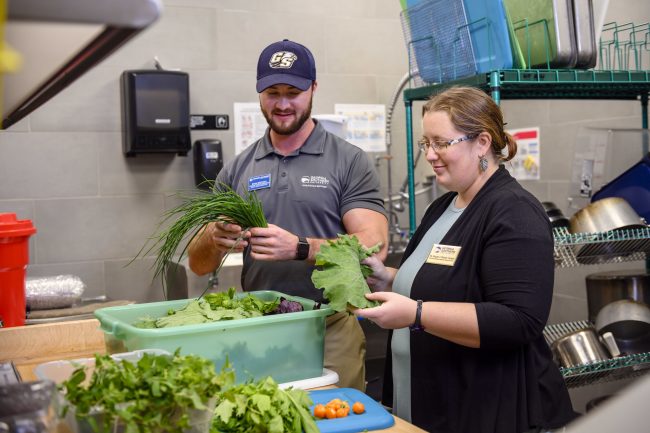
Find out how sustainable dining at Georgia Southern provides fresh options for students
As more and more people are eating out – the expectations of customers of restaurants to be environmentally friendly are ever increasing. However, operating with a reduced carbon footprint all the while being sustainable and profitable are no easy task. That’s where Georgia Southern University is making a difference. The newest restaurant on the Georgia Southern University Armstrong Campus offers diners comfort in knowing that some of the ingredients were grown just a few hundred yards away in the campus’ aquaponics farm in the Sustainable Aquaponics Research Center (SARC). The agriculture and food industry is one of the largest users of water and producers of greenhouse gas emissions, but growing food by using aquaponics, a system of growing produce by using water fertilized by fish, cuts down on both significantly. “SARC produce only travels a quarter mile from where it’s grown,” SARC curator Brigette Brinton said. “Locally grown food offers large advantages in terms of increased sustainability and freshness, and SARC produce is grown organically and using sound ecological principles that minimize water consumption.” Brinton said minimizing emissions and water use does not diminish the quality or taste of the produce. To the contrary, it makes the food taste better because aquaponics produce often has higher concentrations of various compounds that give the foods their flavor, and they are grown in more ideal environments. Brzycki said Georgia Southern wants to expand on using ultra-local, fresh produce and vegetables, as a part of the partnership with the aquaponics farm. “When we consider redesigns of existing or new dining locations on the Armstrong Campus in the future, we want to see how we can incorporate these same principles,” he said. “But for now, Southern Cafe is the flagship unit for the aquaponics partnership, as well as sustainability and healthy eating, of Eagle Dining.” Brinton said she hopes the Southern Cafe will inspire the students, faculty and staff who eat there to make healthier and more sustainable choices in other areas of their lives. “Showcasing local, sustainable produce increases students’ awareness that there are better options, and Georgia Southern is going the extra mile to show them how to start making better choices,” she said. “Each time students see they made a sustainable choice at the Southern Cafe, they’re more likely to choose sustainable options on their own.” Are you a journalist looking to cover this story or learn more about how Georgia Southern University is developing new programs that help traditional industries adapt to a more sustainable and environmentally friendly business model? If so – then let our experts help with your coverage. Simply contact Melanie Simón at 912.344.2904 to arrange an interview.


Interested in the Ethics of EdTech Apps? Let our Experts Help with Your Coverage
There’s been a lot of talk lately about EdTech apps. There’s a long list of benefits and advantages for students looking to succeed in these modern and digital times. However, with anything app-related – user privacy and what’s being done with all of your data that’s collected always comes to the forefront of the conversation. EdTech apps are a billion-dollar industry, and recently the experts from the University of Mary Washington were asked their opinions on the industry, the apps and privacy. Jesse Stommel, senior lecturer of Digital Studies at the University of Mary Washington, said that EdTech providers had a responsibility to do more than just legally protect themselves with terms and conditions. “The onus has to be on the tech companies themselves to educate the users about data security and data monetisation…say ‘here’s why I’m collecting it, here’s what I hope to do with it, here’s why it should matter to you’,” he said. For Dr. Stommel there was also still a danger when technologies were adopted widely across campuses and every student or lecturer was required to use them. “When certain companies become universal, staff and students don’t have a way to say ‘I won’t use it because I don’t want them to have my data’,” he said. The fact that certain products had become so widely adopted, such as plagiarism tracking software Turnitin, was another reason to be cautious about data protection, he said. Turnitin, which was sold last year for $1.8 billion (£1.4 billion), has been accused of monetising students’ intellectual property, since it works by checking submitted papers against an ever-growing database of previously submitted essays and detecting any similarities. “Companies can start off small and they say ‘we will be good stewards of this data, we’re small, we talk to each other,’ but then that company achieves more and more success and it doesn’t necessarily have the standards in place to maintain that,” said Dr. Stommel, speaking generally. “Then what happens when they are bought out? What are the ethics of the company that has purchased them? What happens to the student data then?” Dr. Stommel said that the most “moral” thing to do was for companies to collect as little data as possible but admitted “no company is approaching it in that way”. January 14 - TimesHigherEducation.com Are you a journalist covering how EdTech is now becoming a regular part of modern-day higher education? Then let our experts help with your stories. Jesse Stommel is a senior lecturer of Digital Studies at the University of Mary Washington and is an expert in faculty development, digital education and modern learning. He is available to speak with media regarding EdTech apps – simply click on his icon to arrange an interview.


Curious about who’s cashing in on Superbowl Sunday? Let our experts help!
The big day is almost here! Fans around the world are getting squares ready, chili cooked, and prop-bets placed. Superbowl Sunday is America’s biggest day for television and sports. This year, it will be all eyes on the Kansas City Chiefs and San Francisco 49ers as they land in Miami to prep and promote for Sunday’s kickoff. There’s big money to be made this week, and a lot of it is going around, according to CNBC – last year was a windfall and most expect this year to be even bigger. Super Bowl ad spots are the most expensive on commercial TV in the U.S. by far, with a 30-second slot costing $5.25 million. That works out at roughly $175,000 per second. Last year, the winners of the Super Bowl made an estimated $112,000 each, while their opponents made $56,000 each. Referees, meanwhile, make between $4,000 and $10,000 a game, according to an estimate by CBS, and their annual salary is about $201,000. Stores are set to make $14.8 billion in sales around the game, with most of that money spent on food and drink to consume while watching, according to a survey carried out by Prosper Insights & Analytics for the National Retail Federation last week. That equates to $81.30 per person, up from last year’s $81.17. Are you a journalist covering this Sunday’s big game? If you have questions about the marketing or economics of the Superbowl, the let our experts help with your stories and coverage. Professor Andrew Wonders joined the faculty of the School of Business Administration at Cedarville University in 2013 following a 13-year career in the sport industry. He is an expert in the areas of major sporting events and the business of sports. If you are looking to arrange an interview with Professor Wonders – simply click on his icon to arrange a time.


By early afternoon Friday, the Centers for Disease Control and Prevention had confirmed a second case of the new coronavirus on American soil. With cases now being detected in Europe and across Asia, the world is watching and worrying about the potential spread of this dangerous virus. There are 63 cases being monitored in the U.S. that stretch across 22 states, including the first patient in Washington state and the new case in Illinois, said Dr. Nancy Messonnier, director of the National Center for Immunization and Respiratory Diseases. Officials said the new patient, a woman in her 60s, is doing well and is in stable condition. She remains isolated in a hospital as a precaution, U.S. health officials said on a conference call with reporters. The Illinois patient traveled to China in late December and began experiencing symptoms when she returned to the U.S. last week, officials said. She did not have symptoms while flying, they said. “She was not symptomatic when flying. And based on what we know now about this virus, our concern for transmission before symptoms develop is low, so that is reassuring,” Dr. Allison Arwady, Chicago’s public health commissioner, said on the call. January 24 – CNBC As this story progresses – there are a lot of questions journalists are asking. How is this virus spread? How worried do Americans need to be about the coronavirus? Are there warning signs or methods to prevent the spread? And how far away are we from a vaccination? If you are a journalist covering this developing issue – let our experts help. Dr. Jian Zhang has worked with the Chinese Centers for Disease Control and Prevention, and the World Health Organization prior to moving to the United States. He obtained a Doctorate in Public Health from the Arnold School of Public Health, University of South Carolina before he joined the faculty of Jiann-Ping Hsu College of Public Health at Georgia Southern University. He is available to speak with journalists regarding the coronavirus and its origins and its potential to spread across America – simply click on his icon to arrange an interview.
