
Experts Matter. Find Yours.
Connect for media, speaking, professional opportunities & more.

Mosquito-borne disease research featured ahead of climate conference
University of Florida medical geographer Sadie Ryan, Ph.D. is among the international scientists whose work is featured in the forthcoming “10 New Insights in Climate Science” report, which will be presented at the United Nations COP30 Climate Conference on Nov. 10. Ryan’s research, which examines how climate change influences the spread of mosquito-borne diseases such as dengue, contributed to a newly generated global map illustrating where shifting temperatures and rainfall patterns are making conditions increasingly suitable for disease transmission. “A lot of my research is about how vector-borne diseases are going to move as the climate changes, and what that means for where and when transmission can happen,” Ryan said. “Climate change isn’t the only driver of dengue’s spread, but we are seeing the bleeding edge of climate shifting those distributions, where it’s warm enough for long enough and wet enough at the right times for outbreaks to take off.” According to Ryan, the map included in the report is based on the most recent generation of climate models and directly illustrates how climate suitability for dengue is changing around the world. Produced annually by Future Earth, the Earth League and the World Climate Research Programme, the report synthesizes the most important developments in climate research at the intersection of climate, health and policy on the world stage.


Aston University’s approach to a global challenge Across industries, companies face mounting pressure to cut carbon, improve resource efficiency, and contribute to the UN Sustainable Development Goals (SDGs). Yet many firms still struggle to move from vision statements to measurable action. At Aston Business School, Dr Breno Nunes, reader in sustainable operations management, is developing practical frameworks that help organisations embed sustainability at their core. His concept of 'sustainability fitness' captures how firms can build the capabilities they need to adapt, compete, and thrive in the transition to a net zero economy. “Many organisations want to be sustainable but struggle to operationalise what that means. My work is about bridging that gap — helping businesses translate strategies into practice.” — Dr Breno Nunes The sustainability fitness concept involves both meeting human needs and respecting environmental limits. While it can also be applied at the societal and individual level, Dr Nunes focuses on organisations, where capability building delivers the fastest, measurable change. Corporate sustainability fitness examines how a firm is able to survive and meet its own needs, while aligning itself to wider essential needs of society and operating within limits imposed by its surrounding natural environment. From research to real-world action Dr Nunes’ research examines how organisations design, implement, and monitor sustainability strategies across operations, supply chains, facilities, and product development. He is the main author of the book Sustainable Operations Management: Key practices and cases, which applies the issues of sustainability to all strategic decisions of operations. His work is already making a tangible difference, including international partnerships in Brazil, Canada, and the US, bringing cross-cultural insights into organisational transformation, as well as for various companies and organisations. In an Innovate UK Knowledge Transfer Partnership (KTP) with automotive supplier Metal Assemblies, Dr Nunes and Professor Alexeis Garcia Perez, professor of digital business and society at Aston University, are working to calculate and report the carbon cost of metal components used in car production, tackling one of the industry’s biggest sustainability challenges. The digitalisation of processes will allow Metal Assemblies to meet customers' requirements and position itself as a trusted and transparent supplier of low-carbon components. In another KTP with Brockhouse Group, a forging manufacturer in the West Midlands, Dr Nunes worked with Aston colleague Dr Muhammad Imran, reader in mechanical, biomedical and design engineering. Together they developed a sustainable manufacturing strategy centred on carbon reduction and process improvement. The work involved the development of an energy dashboard, allowing analysis of data on gas and electricity consumption. The project also included analysis of alternatives for energy recovery systems, and development of routines and procedures to improve the manufacturing process. As a result, Brockhouse group is more competitive to supply in non-captive markets. Dr Nunes has also been involved with a collaboration with Birmingham Botanical Gardens to integrate sustainability into policy and practice, expanding the use of business sustainability theories to nonprofit sectors. Sustainability can be embedded across different areas of organisations while seeking financial stability. As an environmental education charity, it is important to for Birmingham Botanical Gardens to 'practise what it preaches'. It was recently awarded almost £20m from various grants (including Heritage Lottery) in a capital project, thanks to having sustainability at the core of renovation plans. These projects highlight Aston University’s role in bridging academia, industry, and policy — ensuring research findings reach the boardroom as well as the factory floor. Key insights from the research Dr Nunes’ studies highlight several critical factors for turning sustainability from intention into measurable results: • Organisational capabilities are central to embedding sustainability. These include empowering sustainability “champions” (institutional entrepreneurs), supportive structures, superior technologies, and the ability to learn and balance economic, environmental, and social performance. • The tensions in implementing sustainability vary not just by function (supply chains, governance, innovation) but also by an organisation’s maturity level. • Start with the low-hanging fruit: tools like self-assessments, capability diagnostics, and learning games allow firms to act at lower cost before committing to full environmental impact assessments or formal reporting. • Collaboration between academia, industry, and policymakers accelerates real-world impact. Why this matters The stakes are high. Businesses worldwide are expected to reduce carbon emissions, demonstrate social responsibility, and remain competitive in a rapidly changing global economy. Aston University’s research shows that strengthening sustainability capabilities not only improves environmental outcomes but also boosts resilience and cost savings. In pilot projects, teams working with Dr Nunes have achieved up to 30% reductions in both cost and carbon emissions — proof that sustainability can drive operational performance as well as compliance. Looking ahead: expanding the Sustainable Growth Hub The next phase of Dr Nunes’ work centres on Aston’s Sustainable Growth Hub, which is being developed as a reference point for SMEs seeking sustainability solutions. In 2025, the Hub will: • Launch its first industry club cohort and expand its team. • Roll out new self-assessment tools to size sustainability needs and decarbonisation goals. • Introduce new learning formats and follow-up courses to Aston’s Green Advantage programme, alongside sessions to play a new corporate sustainability game. • Host events to bring together businesses, policymakers, and the wider sustainability management community. • Attract new research grants and publish results to share knowledge across both academic and practitioner circles. These initiatives aim to equip organisations not only to meet today’s challenges, but to anticipate tomorrow’s. Get involved Follow Dr Nunes via his profile below, and soon through the Sustainability Fitness website. Businesses can also attend Aston Business School events to explore workshops, tools, and courses first-hand. About Dr Breno Nunes Dr Breno Nunes is reader in sustainable operations management at Aston Business School and president of the International Association for Management of Technology (IAMOT). He serves as associate editor of the IEEE Engineering Management Review and has published widely on sustainability strategy execution and innovation. Aston University’s work in sustainable operations — shaped by researchers like Dr Nunes — is helping organisations worldwide move from ambition to action, building the 'sustainability fitness' needed for a net zero future.



Lighting the Fires of Memory: The History, Meaning and Modern Significance of Memorial Observances
In the United States, United Kingdom and Canada, special annual days of remembrance bring into focus a simple yet profound truth: societies mark the sacrifice of those who died in military service so that past and future generations will not forget. These observances are layered with history, symbolism and evolving practice. Origins & Historical Development United States – Memorial Day Memorial Day began in the aftermath of the American Civil War. One of the earliest national observances took place on May 30, 1868, when John A. Logan, Commander-in-Chief of the Grand Army of the Republic, proclaimed “Decoration Day” to honour the Union dead by decorating their graves. The date was chosen because spring flowers would be in bloom across much of the country. Over time, as the United States engaged in further conflicts, Decoration Day evolved into a broader day of honouring all U.S. military personnel who died in service. In 1971, Congress made Memorial Day a federal holiday observed on the last Monday of May. United Kingdom and the Commonwealth – Remembrance Day Remembrance Day, also known as Armistice Day, originated from the end of the First World War and is observed on November 11. It commemorates the armistice signed at the 11th hour of the 11th day of the 11th month in 1918. In Britain and the Commonwealth, the red poppy became the enduring symbol of remembrance, inspired by the poppies of Flanders fields and popularized in the years following the war. Canada – Remembrance Day Canada also observes Remembrance Day on November 11. The observance dates back to post-WWI traditions and was officially adopted by Parliament in 1931. It honours the more than 118,000 Canadians who have made the ultimate sacrifice among the 2.3 million who have served in uniform. Meaning and Symbolism At their core, Memorial Day and Remembrance Day are about memory, sacrifice, duty, and gratitude. They serve as communal rituals: visiting cemeteries and memorials, placing flowers or wreaths, holding moments of silence, and wearing symbols like the poppy. In the United States, the act of decorating graves carried not only personal remembrance but also civic pride—honouring those who laid down their lives for their country. In the United Kingdom and Canada, the poppy remains a powerful visual reminder of both the human cost of war and the enduring hope for peace. Modern Significance These observances offer societies a chance to pause, reflect, and connect past sacrifice with present freedoms and responsibilities. In the United States, Memorial Day has also come to mark the unofficial start of summer. Still, national initiatives such as the National Moment of Remembrance invite Americans to refocus on solemn reflection. In Canada and the United Kingdom, Remembrance Day remains deeply ceremonial, marked by two-minute silences, wreath-layings, and public education about the sacrifices of war. For all three nations, these days foster inter-generational understanding—educating younger people about service, sacrifice, and the peace that followed—while reminding governments and citizens alike of ongoing obligations to veterans. Why It Matters to U.S., British, and Canadian Peoples For Americans, Memorial Day symbolizes how unity, freedom, and democracy have been defended and preserved at great cost. For Britons and Canadians, Remembrance Day binds their shared histories of service in global conflicts, linking national identity with sacrifice and resilience. In Canada especially, the day has evolved into a moment not just of military remembrance, but of reflection on what it means to serve a country and commit to peace. Across all three nations, these observances allow public acknowledgment of loss and courage, while anchoring civic values of duty, freedom, and gratitude. Key Themes and Story Angles Continuity and Change: From Decoration Day to Memorial Day, from Armistice Day to Remembrance Day—how the meaning endures through time. Symbols and Rituals: Poppies, wreaths, silences, and ceremonies as expressions of collective memory. Commercialization vs. Solemnity: Balancing commemoration with modern traditions such as travel and leisure. Generational Awareness: Passing remembrance to younger audiences through schools, media, and veterans’ stories. Veterans and Contemporary Service: Linking remembrance with ongoing commitments to those who serve. Community Connection: How towns and cities mark remembrance through local parades, services, and shared stories. Memorial Day and Remembrance Day are more than calendar observances—they are living rituals of collective gratitude. They invite reflection on what has been given and what must be preserved. For the United States, the United Kingdom, and Canada, these days stand as enduring reminders of courage, unity, and the price of peace. Connect with our experts about the history, meaning and modern significance of memorial observances: Check out our experts here : www.expertfile.com


Op-Ed: Stablecoin 'rewards' are a risk to financial stability
Congress has long recognized that stablecoins should not function as unregulated bank deposits. The intent of the recently enacted GENIUS Act is clear: to prohibit stablecoin issuers from paying interest or yield to holders, maintaining a distinction between payment instruments and bank deposits which are not only used for payment purposes but also as a store value. Yet loopholes have already emerged. Some crypto exchanges and affiliated platforms now offer “rewards” to stablecoin holders that work much like interest, potentially undermining the stability of the traditional banking system and constraining credit in local communities. Terminology matters. Credit card rewards are funded by interchange fees and paid to encourage spending — you earn points for using your card. Stablecoin “rewards” are different. They’re funded by investing the reserves backing stablecoins, typically in Treasury bills or money market funds, and passing that interest income to holders. You earn returns for holding the stablecoin, not for using it. Economically, this is indistinguishable from a bank deposit paying interest. When a platform advertises “5% rewards” on stablecoin holdings, it’s generally backing those tokens with Treasuries yielding about 4.5%, then passing that yield to users. Whether labeled rewards, yield or dividends, the function is the same: interest on deposits. Banks perform a similar activity — taking deposits, investing in loans and paying depositors a return — but face far higher costs, including FDIC insurance, capital requirements and compliance obligations that stablecoin issuers largely avoid. This dynamic has a precedent. In the 1970s and early 1980s, Regulation Q capped bank deposit rates at 5.25% while inflation and Treasury yields soared above 15%. Money market funds filled the gap, offering market rates directly to consumers. Deposits fled smaller banks, which lost their funding base, while large money-center institutions gained reserves. The result was widespread disintermediation, the collapse of the savings and loan industry and the farm-credit crisis of the 1980s. Stablecoin “rewards” risk repeating that history. Just as money market funds exploited the gap between regulated deposit rates and market rates, stablecoin platforms exploit the difference between what banks can profitably pay and what lightly regulated issuers can offer by passing through Treasury yields with minimal overhead. Some ask why banks can’t just raise deposit rates. The answer lies in structure. Banks operate under a fundamentally different business model and cost framework. They pay FDIC premiums, maintain capital reserves and comply with extensive supervision — costs most stablecoin issuers don’t bear. Banks also use deposits to make loans, which requires holding capital against potential losses. Stablecoin issuers simply hold reserves in ultra-safe assets, allowing them to pass through nearly all the yield they earn. To match 5% “rewards,” banks would need to earn 6% to 7% on their loan portfolios — an unrealistic target in today’s environment, especially for smaller community banks. The consequence is not fair competition, but a structural disadvantage for regulated depository institutions. The Consumer Bankers Association warns this loophole could trigger a massive shift of deposits from community banks to global custodians. Citing Treasury Department estimates, the Association notes that as much as $6.6 trillion in deposits could migrate into stablecoins if yield programs remain permissible. Because the GENIUS Act’s prohibition applies narrowly to issuers, exchanges and intermediaries may still offer financial returns under alternate terminology. This opens the door to affiliate arrangements that replicate the essence of interest payments without legal accountability. Those reserves don’t stay in local economies. The largest stablecoin issuers hold funds at global custodians such as Bank of New York Mellon, in money market funds managed by firms like BlackRock or — if permitted — directly with the Federal Reserve. When a community-bank depositor moves $100,000 into stablecoins, that capital exits the local bank and concentrates at systemically important institutions. The community bank loses lending capacity; the megabank or the Fed gains reserves. The result is disintermediation with a concentrated risk profile reminiscent of the money-market fund crisis. The Progressive Policy Institute estimates that community banks — responsible for roughly 60% of small-business loans and 80% of agricultural lending nationwide — could be among the most affected. In Louisiana, where local banks finance small businesses and family farms, that risk is especially relevant. If deposits migrate to unregulated digital assets, community-bank lending could tighten, particularly in rural parishes and underserved communities. Research from the Brookings Institution reinforces the need for regulatory parity. The label “rewards” doesn’t change the fact that these payments are economically interest. Allowing intermediaries to generate yield without deposit insurance or prudential oversight could recreate vulnerabilities similar to those seen during the 2008 money market fund crisis. To preserve financial stability, policymakers should move to close the stablecoin-interest loophole. Clarifying that the prohibition on interest applies to all entities— not just issuers — would uphold Congress’ intent. Regulators such as the Securities and Exchange Commission, Commodities Futures Trading Commission and federal banking agencies could also treat “reward” programs as equivalent to deposit interest for supervisory purposes. Stablecoins offer genuine efficiencies in payments, but unchecked yield features risk turning them into unregulated banks. History shows what happens when regulatory arbitrage allows competitors to offer deposit-like products without oversight: deposit flight, institutional instability and capital flowing away from community lenders. Acting now could help sustain stability, protect depositors and preserve the credit channels that support community lending — especially in states like Louisiana, where community banks remain the backbone of Main Street.



Simple display changes in grocery stores could cut food waste while boosting profits
New research from the University of Florida suggests that supermarkets could significantly reduce food waste while increasing their profits through smarter product display and pricing strategies. The study found that retailers could cut food waste by more than 20% while increasing profits by 6% on average. “It’s rare to find solutions that benefit both business and the environment, but this appears to be one of them,” said Amy Pan, study co-author and associate professor at the UF Warrington College of Business. “Our findings highlight that strategically selling older products alongside fresh ones can simultaneously boost profits and minimize waste by leveraging the right product display, discounting rate and discount time.” The findings provide crucial insight into a growing global challenge. Recent estimates suggest that 17% of global food production goes to waste, with retail accounting for 13% of that waste. In the United States alone, up to 40% of food produced is wasted, while one in eight Americans faces food insecurity. The researchers identified two effective strategies for retailers, depending on the predictability of store traffic. When store traffic is predictable, the researchers find two optimal solutions: Unsold products are swapped with a new batch when the current products are due to be replaced, so that there is only one batch on shelves at a time Newer batch products are displayed on shelves alongside older products that are sold at a discount In contrast, when store traffic isn’t predictable, the product display depends on the characteristics of the product, store and consumers. Specifically, the researchers find: For products that spoil quickly and have a low disposal cost, like fresh pastries, the best approach is to remove unsold items when new stock arrives However, for items with longer shelf lives and high disposal cost, like dairy products, stores can sell older items at discounted prices at the front of shelves while keeping fresher items at their full price on the back of shelves Even stores that prefer not to discount their products can benefit from simply optimizing their display strategies. The study found that thoughtful product placement alone can significantly improve profits while reducing waste. The researchers emphasize that while their findings focus on retail-level waste, the benefits extend throughout the supply chain. Farmers benefit from increased orders, retailers save money by reducing waste and consumers get more affordable access to healthy food options. “What’s particularly exciting about these findings is that everyone wins,” Pan said. “Retailers make more money, consumers get more affordable options and we reduce the environmental impact of food waste.” Looking to know more about this topic or connect with Amy Pan? Simply click on her icon now to arrange an interview today.


On Sunday, October 19, at 9:34 a.m., four masked individuals surged into the Louvre’s Galerie d’Apollon from a severed, second-floor window. Hurriedly, they smashed open two display cases, seized eight pieces of jewelry, then shimmied down a ladder and sped off on motorbikes toward Lyons. In seven minutes’ time, in broad daylight, they absconded with an estimated $102 million in valuables from the world’s most famous museum. This past Saturday, October 25, French authorities announced the first arrests in connection with the daring heist. However, despite the police’s progress, the country continues to litigate the matter—embroiled in discussions of heritage, history and national identity. Recently, Roderick Cooke, PhD, director of French and Francophone Studies at Villanova University, shared his perspective on the situation as well as the artifacts lost. Q: The Louvre heist has been described as “brazen,” “shocking” and a “terrible failure” on security’s part. Is there any sort of precedent for this event in the museum’s history? Dr. Cooke: Nothing on this scale has ever happened to the Louvre since its founding as a museum during the Revolution. The closest equivalent is the 1911 theft of the Mona Lisa by a former employee who claimed it should be returned to Italy. However, that was one painting, the heist was not committed by organized crime, and the Mona Lisa did not have the renown it enjoys today. The impact of the theft was thus lower, although it did cause major outrage and a sweeping law-enforcement response at the time. Ironically, that theft is often credited with making da Vinci’s painting the global icon it continues to be. Q: What has the reaction to this event been among the French people? DC: It’s harder to get a sense of reactions across French society, because so much of the aftermath has focused on the intellectual milieux’s opinions. And in those realms, it has immediately become a political football. Individuals positioning themselves as anti-elite or anti-status quo, such as Jordan Bardella of the National Rally party, have called the theft a “humiliation,” immediately tying it to French national prestige. Former President François Hollande has conversely and vainly called for the event to be de-polemicized, citing national solidarity. This is happening because the Louvre is one of the most visible manifestations of French soft power—the most-visited museum anywhere on Earth. As such, anything attacking its integrity becomes an attack on the nation, and how individual French citizens feel about the theft is closely tied to their broader view of the nation. Q: Several of the items stolen from the Louvre once belonged to Empress Eugénie. Could you share a bit of information on her story? DC: Eugénie de Montijo was a Spanish aristocrat who married the Emperor of the French, who ruled as Napoleon III between 1852 and 1870. It was a time of authoritarian repression and sham democracy—Napoleon III installed the Empire through a coup. Its clearest legacy is that Paris looks the way it does today largely because of the thorough modernizations overseen by Napoleon III’s appointee Baron Haussmann. So, Eugénie and her now-lost jewels represent a complex point in French history, when culture and the economy developed quickly, but did so in a climate of fear for any French person who opposed the regime too loudly (like Victor Hugo, who went into exile on the Channel Islands and wrote poems savaging Napoleon III and his deeds). Some accused the Empress of being responsible for the more hardline and conservative stances taken by her husband’s government. On a different note, she was a diligent patron of the arts and arguably the most significant figure in the contemporary fashion world, famous for setting trends such as the bustle that radiated across Europe. This explains the mix of anger and admiration that followed her depending on the sphere she was operating in. A new English-language biography argues that far from being a traditionalist, she was a pioneering feminist by the standards of the time. It looks like her historical importance will continue to be debated. Q: Interior Minister Laurent Nuñez described the stolen items as “of immeasurable heritage value.” How significant of a cultural loss do you consider this theft? DC: These jewels are referred to in French as “les Joyaux de la Couronne” (the Crown Jewels), but of course that phrase lands very differently in republican France than it does across the water in the United Kingdom. The items actually represent several different dynasties of French rulers, some of whom came to power through direct conflict with others. The now-ransacked display at the Louvre smoothed over these historical divisions, for which many French people died over the centuries. President Macron referred to the stolen items as embodying “our history,” which is emblematic of the French state’s work to create a conceptual present-day unity out of the clashes of the past. At a time when France is arguably more divided than at any point since World War II, any unitary symbol of identity takes on greater significance. Q: Do you have any closing thoughts on the artifacts taken and what they represent? DC: I’d reemphasize the previous point about the smoothing effect of the museum display on the violent history that made it possible. Much of the reporting on the stolen jewels lists off the different queens and empresses who owned them, without giving readers a sense of the complicated succession of regime changes and ideologies that put those women in power in the first place. The relative stability of the last 60-odd years is an anomaly in modern French history. This set of jewels and the names of their original owners may seem far removed from the concerns of an ordinary French citizen today, but just beneath their surface is a legacy of changing governments and tensions between social classes that survives in new forms in 2025.


The Thrill of Fear: The History and Cultural Significance of Horror Movies
From flickering silent films to today’s big-budget blockbusters, horror movies have always tapped into humanity’s oldest emotion: fear. Across decades, they’ve reflected social anxieties, moral questions, and shifting definitions of what scares us. Yet behind every scream lies a story about culture, creativity, and the psychology of thrill. The Origins of On-Screen Fear Horror cinema began in the early 1900s with short silent films inspired by literature and folklore. One of the earliest, Le Manoir du Diable (1896), often considered the first horror film, introduced audiences to bats, ghosts, and the Devil himself. By the 1920s, German Expressionist films like Nosferatu and The Cabinet of Dr. Caligari used shadow and distortion to create unease, shaping the language of horror still used today. Hollywood’s Golden Age of Horror in the 1930s brought monsters to life — Dracula, Frankenstein, and The Mummy — giving audiences both fright and fascination during a time of global economic depression. These films helped people confront real-world fears symbolically, offering escape through imagination. Fear Evolves with the Times Each generation has reinvented horror to reflect its cultural moment. The 1950s’ atomic-age fears spawned giant monsters and alien invasions. The 1960s and ’70s shifted toward psychological and supernatural horror with classics like Psycho, The Exorcist, and The Texas Chain Saw Massacre — films that exposed anxieties about social change, faith, and violence. The 1980s and ’90s introduced slasher icons such as Halloween’s Michael Myers and A Nightmare on Elm Street’s Freddy Krueger, mixing terror with pop-culture spectacle. By the 2000s, horror had splintered into subgenres — from found-footage realism (The Blair Witch Project, Paranormal Activity) to elevated art-house films like Get Out and Hereditary, which use fear to explore race, grief, and identity. Why We Like to Be Scared Psychologists suggest people enjoy horror because it offers safe danger — a way to experience fear, adrenaline, and relief without real threat. Watching horror triggers the body’s fight-or-flight response, followed by catharsis once the tension resolves. Culturally, it provides a mirror to our collective psyche: what we fear, we face, and what we face, we sometimes conquer. Horror also brings people together — in theaters, at home, or online — to share an intense emotional experience. Whether screaming, laughing, or peeking through fingers, audiences participate in a ritual as old as storytelling itself. The Icons of the Genre Among the most popular and influential horror films of all time: Psycho (1960) The Exorcist (1973) Halloween (1978) A Nightmare on Elm Street (1984) The Silence of the Lambs (1991) The Ring (2002) Get Out (2017) Hereditary (2018) Each left a lasting mark on both cinema and culture — showing that horror, far from being niche, remains one of the most expressive and enduring genres in film history. Connect with our experts about the history and popularity of scary movies and horror flicks: Check out our experts here : www.expertfile.com

Everyone from farmers to Fortune 500 companies are now feeling the impact of Trump administration tariffs aimed primarily at reducing the trade deficit and reviving domestic manufacturing. University of Delaware experts offer insight into the economic, political and social impacts of these tariffs and what the future of U.S. trade policy may hold. Experts available: Alice Ba, associate professor, International Relations and Comparative Politics – Topic: Economic implications of tariffs on domestic industries and global supply chains. Dan Green, associate professor, International Relations and Political Theory – Topic: Political dynamics of U.S. trade policy and congressional responses. Dan Kinderman, professor, Comparative Politics and International Relations – Topic: Impacts on international business relationships and corporate strategy. Robert Denemark, professor, International Relations – Global geopolitical implications and international relations perspectives. Stuart Kaufman, professor, Political Science and International Relations – Historical context and comparative analysis of past U.S. trade policies. Journalists who would like to speak with these experts can click on their profiles or email mediarelations@udel.edu.




Cesar Dominguez, a fourth-year chemistry and physics double major at the University of Florida, may be on track to finding alternatives to plastic that could benefit the planet. His impactful work has helped him earn the title of Michelin Science Scholar, and he is now one of a select group of undergraduates connecting scientific research to real-world challenges at Michelin – a global leader in materials science and sustainability. “There’s always this misconception that academic research is completely separate from industry research,” Dominguez said. “Michelin has shown me it’s all one science. You can push discovery forward in both spaces.” Dominguez embarked this fall on a two-semester program of faculty-mentored research, with a $2,000 student stipend and $500 in support funding for his faculty mentor, UF chemistry professor Austin Evans, Ph.D. The program also invites students to present their findings at a spring symposium and tour a Michelin facility in South Carolina. Austin Evans' research aims to control macromolecular structure at all length scales concurrently and deploy materials in the real world. View his profile here Dominguez is furthering his study of how to process ultra-high molecular weight polymers – materials he compares to the scale of “an entire city” rather than a football stadium, through powerful electric fields. By adjusting electrospinning techniques, Dominguez and his team examine how polymers form fibers with different thermal and mechanical properties. These findings could lead to stronger, more sustainable materials, including alternatives to plastics like the major pollutant polyethylene. “All my life, I’ve been told chemistry and physics are separate fields,” Dominguez said. “But I’ve learned they come together in really elegant ways. Being able to unite concepts from both gives me a deeper understanding of how things work.” Dominguez attributes much of his development as a researcher to his work with Evans, who he describes as incredibly supportive, always accessible, and consistently encouraging him to focus on precision and detail. Dominguez also sees UF’s resources as pivotal to his journey. “I feel like what makes the research I'm doing really exciting is the fact that this can only be done at the University of Florida, because we're working with materials that have been developed by scientists here, using equipment that we're very fortunate to have access to here,” Dominguez said. As he prepares to apply to graduate school in analytical chemistry, Dominguez said the Michelin program has expanded his view of what is possible after his degree. “I used to think research only happened in academia,” he said. “Now I know industry is just as vital. It’s opened my mind to different paths for my future.” For now, he offers one piece of advice to other students considering the program: “Do it for the love of the game. If you put passion into your work, everything else will follow.” For more information on the Michelin Science Scholars Program, click here: To learn more about the research happening at UF and to connect with Austin Evans - simply click his icon now to arrange an interview today.

New path to combating global malnutrition found in soil
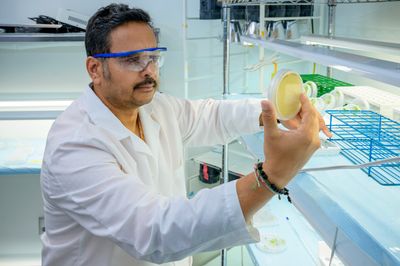
A new University of Delaware study has found that a naturally occurring soil microbe can boost protein-building amino acids in wheat. The finding by UD's Harsh Bais and others could pave the way for nutrient-rich staple crops — helping combat global malnutrition as fluctuations in weather reduce crop quality. In the study, published in the journal Frontiers in Microbiology, Bais and a team of researchers from UD, Stroud Water Research Center and the Rodale Institute investigated how a bacteria naturally found in the soil that is beneficial to human health can enhance the levels of the amino acid and antioxidant ergothioneine in spring wheat. The researchers grew the spring wheat — one of the most widely consumed cereal crops — in a laboratory. After letting the seeds germinate and grow for seven days, they added a strain of bacteria called Streptomyces coelicolor M145 to the spring wheat roots. After combining the bacteria and the plant, they separated the plant’s leaves and roots. Then, they extracted the amino acid ergothioneine from the samples, working to determine how much protein was in the plant’s roots and shoots. They found that 10 days after S. coelicolor had been added to the spring wheat roots, the bacteria was able to inhabit spring wheat’s roots and shoots, producing ergothioneine, bypassing the plant’s innate defense mechanisms, and fortifying the spring wheat. Wheat roots were inoculated with the benign bacteria Streptomyces coelicolor. The image shows the presence of bacteria on the root hairs on day 5. “It’s unusual," Bais said. “Unless there is a mutual advantage for either the plant or the microbe.” The findings suggest that an alternative plant breeding approach could be utilized to associate plants with benign microbes to increase protein content in staple crops. All of our cereal crops are very low in protein. Think rice and breakfast cereals, common foods people eat, derived from these crops. “This approach of harnessing a natural association of microbes with plants may facilitate fortifying our staple crops, enhancing global nutritional security,” Bais said. Bais said he believes using microbes to transport nutrients depends on the microbes’ relationship with plants’ roots. He continues to work to catalyze the colonization of plant roots by beneficial microbes. "Establishing a partnership with the appropriate types of microbes or microbial consortia for plants represents a method of engineering the rhizosphere — the region of the soil near plant roots — to foster a more favorable environment for either microbial associations that stimulate plant growth traits or enhance nutrient availability, which is the path forward,” Bais said. Bais, a professor of plant biology who was named a UD Innovation Ambassador earlier this year, said plants’ “below-ground” traits, such as how nutrient-dense they are, have long been overlooked. “As far as food security, we will have significant challenges by 2050 when the world’s population doubles,” Bais said. “We incentivize our farmers for crop yield; we don’t incentivize them for growing nutrient-dense crops. Growing nutrient-dense plants will enable the population to be fed better and avoid any potential nutrient deficiencies.” The study was funded by the U.S. Department of Agriculture and the Foundation for Food and Agriculture Research. Scientists have become more interested in soil bacteria as a means to solve issues with malnutrition and nutrient deficiencies. Alex Pipinos, the lead author and a UD Class of 2025 graduate with a master’s in microbiology, said environmental conditions are one factor diminishing protein content in plants. “Essentially, crops are becoming less nutrient-dense,” Pipinos said. “The more nutrients in crops, the more healthy humans can be.” Pipinos points to a strong link between soil microbes, plant health and human health. Ergothioneine, she said, has already been shown to lower the risk of cardiovascular disease. It’s also been shown to combat cognitive decline, with a strong link to healthy cognitive aging. “By enhancing ergothioneine in plants, we can improve human health,” Pipinos said. To reach Bais directly and arrange an interview, visit his profile and click on the contact button. Reporters can also contact UD's Media Relations Department.
