
Experts Matter. Find Yours.
Connect for media, speaking, professional opportunities & more.
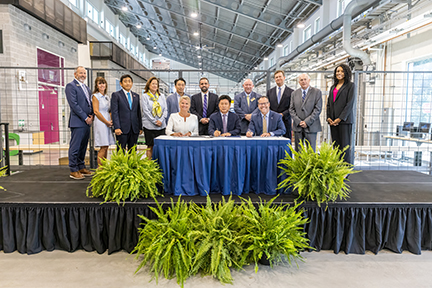
In a milestone collaboration aimed at fostering workforce development, innovation, and community enrichment, Hyundai Motor Group Metaplant America (HMGMA), Georgia Southern University and Ogeechee Technical College are signing a formal agreement to work together in addressing regional workforce needs while advancing academic excellence and technological innovation. Ogeechee Technical College President Lori Durden, HMGMA CEO and President Oscar Kwon, and Georgia Southern University President Kyle Marrero sign transformative agreement surrounded by officials from both institutions and HMGMA. The partnership will encompass a diverse range of initiatives that reflect the shared commitment HMGMA and its local education partners have to catalyze positive change for both the academic community and the broader society. Leveraging their respective strengths, this collaboration aims to address workforce demands, create transformative educational pathways, and drive impactful research endeavors. “Together, we are not just building cars; we are building futures, strengthening the community and driving progress,” said HMGMA CEO Oscar Kwon. “That is part of Hyundai’s mission: progress for humanity. Our partnership with these institutions reflects our shared vision for a brighter, more innovative future.” As part of this partnership, Georgia Southern University has committed to build on the success it has already seen in recruitment services for HMGMA. These services will include on-campus information sessions, dedicated company recruiting events, and on-campus interview days for graduating seniors. By bridging the gap between academia and industry, the University is ensuring that its students are well-prepared for the demands of the professional world. The university also will offer professional development certifications and courses for the company’s employees through its Continuing and Professional Education programs. “This partnership stands as a testament to the value of collaboration between academia and industry in driving holistic growth,” said Georgia Southern President Kyle Marrero. “By uniting forces, HMGMA and Georgia Southern University are forging a path that not only elevates educational opportunities but also cultivates a thriving community equipped to meet the challenges and opportunities of the future.” Georgia Southern also will strengthen its alliance with Ogeechee Technical College to create revised and expanded articulation agreements, pathway programs, and credit transfers. These initiatives will pave the way for the development of collaborative academic programs tailored to meet the specific workforce needs of the region. This includes exploring innovative degree pathways such as Advanced Manufacturing Engineering, as well as fostering additional academic collaborations that align with workforce-driven educational programs. Ogeechee Tech’s commitment includes continuing its record of providing training to local companies to include implementing the Electric Vehicle Professional Technical Certificate of Credit and Hybrid/Electric Vehicle Repair Technician Technical Certificate of Credit programs, and developing Industrial Maintenance Noncredit Training for HMGMA Employees. Additionally, Ogeechee Tech agrees to provide on-campus recruitment events and career fairs to current and past graduates. “Ogeechee Technical College is very excited about entering into this MOU with HMGMA,” said Lori Durden, president of Ogeechee Tech. “This has been several months in the making, and like other institutions and technical colleges in our region, we are going to do all that we can to support the efforts of our Governor to make Georgia the electric mobility capital of America. This is an exciting day for Ogeechee Technical College, and we look forward to supporting the evolving workforce development needs of this region.” With the Memorandum of Understanding, HMGMA will help promote educational opportunities in the region; develop internship, career pathway programs, and other appropriate work-based learning opportunities; and commit to exploring potential research, innovation, and commercialization projects. Interested in learning more or looking to talk with Georgia Southern President Kyle Marrero about this exciting new partnership ? Contact Georgia Southern's Director of Communications Jennifer Wise at jwise@georgiasouthern.edu to arrange an interview today.


UC Irvine expert on metacognition: Megan Peters
How do our brains take in complex information from the world around us to help us make decisions? And what happens when there’s a mismatch between how well your brain thinks it’s performing this function and how well it’s actually doing? UC Irvine cognitive scientist Megan Peters takes a deep dive into metacognition - our ability to monitor our own cognitive processing. To reach Prof. Peters, contact Heather Ashbach at hashbach@uci.edu or 949-284-1577. “Our brains are fantastically powerful information processing systems. They take in information from the world around us through our eyes, ears, and other senses, and they process or transform that sensory information into rich internal representations — representations that we can then use to make useful decisions, to navigate effectively without running into things, and ultimately, to stay alive. And interestingly, our brains also can tell us when they’re doing a good job with all this processing, through a process called metacognition, or our ability to monitor our own cognitive processing. My name is Megan Peters, and I’m an associate professor in the department of Cognitive Sciences at UC Irvine. I’m also a Fellow in the Canadian Institute for Advanced Research Brain, Mind, & Consciousness program and I am president and chair of the board at Neuromatch. My research seeks to understand metacognition — how it works in the brain, and how it works at a computational or algorithm level — and it also seeks to understand what this metacognitive processing might have to do with the conscious experiences we have of our environments, of each other, and of ourselves. So in our research group, we use a combination of behavioral experiments with humans, brain imaging (like MRI scans), and computational approaches like mathematical modeling and machine learning or Artificial Intelligence, to try to unravel these mysteries. I think my favorite overall line of research right now has to do with cases where our brains’ self-monitoring sometimes seems to go wrong. So what I mean is, sometimes your brain “metacognitively” computes how well it thinks you’re doing at this “sensory information processing” task, but this ends up being completely different from how well you’re actually doing. Imagine it this way: you’re driving down a foggy road, at night in the dark. You probably can’t see very well, and you’d hope that your brain would also be able to tell you, “I can’t see super well right now, I should probably slow down.” And most of the time, your brain does this self-monitoring correctly, and you do slow down. But sometimes, under some kinds of conditions or visual information, your brain miscalculates, and it erroneously tells you, “Actually you can see just fine right now!” So this is a sort of “metacognitive illusion”: your brain is telling you “you’re doing great, you can see very clearly!” when in reality, the quality of the information that it’s receiving, and the processing it’s doing, is really poor, really bad — in essence, that means that you can feel totally confident in your abilities to accurately process the world around you, when in fact you’re interpreting the world totally incorrectly. Now normally, in everyday life, this doesn’t happen of course. But we can create conditions in the lab where this happens very robustly, which helps us understand when and how it might happen in the real world, too, and what the consequences might be. So this is fascinating both because it is a powerful tool for studying how your brain constructs that metacognitive feeling of confidence, and also because — in theory — it means that your subjective, conscious feeling of confidence might be doing something really different than just automatically or directly reading out how reliably you brain is processing information. And that could eventually provide a better way to investigate how our so-called phenomenological or conscious experiences can arise from activity patterns in your brain at all.” To reach Prof. Peters, contact Heather Ashbach at hashbach@uci.edu or 949-284-1577.


ChristianaCare Launches a New Speakers Bureau: Is This the Future of Healthcare Communications?
Only just a few months after their win of an IABC Gold Quill Award (shared with ExpertFile), the ChristianaCare healthcare communications and digital team has once again made major moves to make their organization even more accessible to the community with the launch of their new ChristianaCare Speakers Bureau. As one of the leading healthcare systems in the United States, Delaware based ChristianaCare is home to a wide variety of medical experts. Now live, the ChristianaCare Speakers Bureau features 80 experts who are currently available for speaking engagements on a wide variety of health topics including: Aging and Senior Health, Cancer, Children’s Health, COVID-19, Diabetes, Pregnancy and Childbirth. Sports Medicine, Stroke, Weight Management and Women’s Health. Designed with the ExpertFile platform, the ChristianaCare Speakers Bureau provides easy discovery and access to experts, including their biographies, downloadable photographs, samples of past presentations, languages spoken and more. The site can be viewed here. Screenshot from the new ChristianaCare Speakers Bureau launched Aug. 2023. The site provides easy discovery and access to experts, with the ability to search by topics and keywords. Detailed profiles for experts include biographies, downloadable photographs, samples of past presentations, languages spoken and more. How a Speakers Bureau boosts thought leadership A Speaker's Bureau is an initiative within an organization that assembles a team of expert speakers who can represent the organization and speak authoritatively on its behalf. While media appearances are often the core focus for experts in organizations, a Speakers Bureau opens up additional opportunities to speak at events such as in-person conferences, webinars, podcasts. Speakers ideally represent a diverse group of professionals from within the organization, and can share their knowledge, insights, and experiences on a range of topics relevant to the organization's mission, values, and field of work. Through event appearances, these experts help to enhance the organization's visibility, foster community engagement, and solidify the organization's reputation as a thought leader in its field. Speakers Bureaus provide effective and efficient way to promote the organization's initiatives, achievements, and viewpoints to the wider public. Creating New Connections Between Experts and the Community Following a string of successes that followed the launch of their ChristianaCare Experts site that resulted in major increases in national media coverage and SEO performance, the formation of a Speakers Bureau was a smart move that will further extend the reach of the ChristianaCare brand. Events provide an excellent way to connect meaningfully with a wider audience to help ChristianaCare make progress on key goals such as delivering effective community health education and improving healthcare equity. “At ChristianaCare, our mission of service to the community includes a commitment to provide timely, accurate health information so that people can make informed decisions about their health,” said Karen Browne, vice president of marketing and communications. “Through our new speakers bureau, we’ve expanded our capacity to meet these needs in the community.” The Benefits of a Speakers Bureau Given the fragmentation of traditional media channels and the massive growth in events such as webinars and podcasts, Speakers Bureaus are fast gaining popularity as a proven way to personify your organization and build a stronger connection to your brand. So far the ChristianaCare Speakers Bureau appears to be off to a solid start. "We had a huge response to our media release when we launched earlier this week and in the first day alone we had multiple organizations sending speaking opportunities for our medical experts. We're also seeing a great response internally as more of our experts requested to join the Speakers Bureau once it went live," said Hiran Ratnayake, Senior Manager of Media Relations at ChristianaCare who played a key role in developing the Speakers Bureau with his colleagues Shane Hoffman, Communications Director and Tom Hendrich - Senior Digital Content Editor at ChristianaCare. Is a Speakers Bureau Right For Your Organization? Here are some key benefits to consider in determining if a speakers bureau makes sense for your organization: Bolsters Community Engagement: An active Speaker's Bureau helps create a bridge between your organization and the community you serve. Promotes Diversity and Inclusion: A Speaker's Bureau offers an exciting opportunity to showcase the diverse voices and unique experiences within your organization. Enhances Organizational Visibility: The increased exposure at events can lead to greater recognition in the industry, more opportunities for collaborations, and ultimately, a wider reach for your healthcare services. It also is a proven way to boost SEO pagerank and domain authority in search engines and also provides a lot of additional content for your social channels. Develops Professional Skills: For healthcare professionals who participate, a Speakers Bureau offers an excellent opportunity to develop public speaking skills, foster leadership abilities, and establish themselves as thought leaders in their respective fields. Facilitates Knowledge Sharing: A Speaker's Bureau cultivates a more dynamic learning environment, which can lead to new ideas, innovations, and improved patient care within your organization. Strengthens Crisis Management Readiness: Having a pool of trained speakers ready to contribute can be incredibly beneficial in times of crisis. These professionals can help your communications team more effectively communicate critical information to the public, media, and other stakeholders. Enhances Employee Engagement: Employees who are given the opportunity to share their knowledge and represent their organization publicly, often feel more valued and invested in their work. Going Beyond the Walls of Your Medical Facility In the constantly evolving world of healthcare, accurate and timely information is critical to informed patient decisions and effective treatments. Organizations such as ChristianaCare understand that their role as a prominent healthcare system is to deliver information that extends beyond their immediate medical responsibilities. It’s simply no longer adequate to provide care within the walls of a medical facility. Today there is a critical demand for a more engaged approach, requiring hospitals and healthcare systems to leverage their in-house expertise for community education. A more informed community, armed with knowledge, which can make empowered decisions about their healthcare. While the public has an abundance of medical information at their fingertips, to help them participate more actively in their healthcare, much of the information found on social media today often lacks clarity, context, and credibility, leading to confusion and misinterpretations. Healthcare experts, leaders, and executives can play a pivotal role in dispelling myths and offering credible, evidence-based insights. An engaged, approachable healthcare professional is a reassuring sight, reinforcing the community’s faith in the system. It’s a win-win for these experts and the healthcare institution they represent. And most importantly it's a win for the communities they serve, as people identify potential health issues earlier, adopt healthier lifestyles, and reduce emergency hospital visits. This puts less burden on the region’s healthcare system, and better utilizes resources to reach a broader audience. After all, healthcare is not just about curing the sick; it’s about educating, engaging, and empowering the community for a healthier future. Congratulations to the entire team at ChristianaCare for creating such a valuable resource for your community. And thank you for letting us be a part of this exciting journey.


It's as if it has been the biggest love story since Grace Kelley married Prince Rainer or when Harry met Meghan for that matter. But as much as fans, media and even the play-by-play callers are giving an enormous amount of attention to Taylor Swift every time she shows up and cheers on her new beau Travis Kelce, experts wonder...will it have a lasting impact on attracting new fans to the NFL? Recently, Bloomberg News explored if an entertainment powerhouse like Taylor Swift can move the yard-stick of a generation that is seeing a shrinking fanbase and serious decline in viewership. For expert insight, Bloomberg contacted Goizueta Business School's Mike Lewis to offer his opinion and perspective on the situation. Historically, leagues didn’t worry much about the transmission of passion for a sport and team. Homes typically had one screen — the family television — and if a parent was watching the Chiefs game, so were the kids. Fandom at home drove fandom outside of it. Kids wore NFL merchandise to school and bonded with their classmates. Youth sports participation, partly inspired by what was on TV, amplified the community solidarity and enthusiasm for all levels of a given sport. Those traditional forms of fan development are breaking down. "We've evolved to this situation where kids are getting their content via the smartphone and everyone going off to their corner," explains Michael Lewis, director of the marketing analytics center at Emory University. The consequences are striking. In 2021, Lewis published data on sports fandom among different generations. Millennials overwhelmingly identified themselves as the most avid fans (42%), followed by Gen X and Baby Boomers. Gen Z was a striking outlier. Though 23% identified themselves as passionate spectators, 27% identified themselves as "anti-sports." No other generation came close to that level of sports antipathy. However, Gen Z isn’t uninterested in competition. Rather, its media consumption habits are pushing it to different outlets. Survey data that Lewis published in August reveals that esports (competitive video gaming) is now more popular than traditional sports. Professional sports is a multi-billion dollar business and appealing to multi-generational audiences is no easy task. If you're covering or interested in learning more - we can help. Mike Lewis’s work focuses on the intersection of sports analytics and sports marketing. He studies issues ranging from player performance analytics to brand equity in sports. This approach makes Professor Lewis a unique expert on fandom as his work addresses the complete process from success on the field to success at the box office. Michael is available to speak with media - simply click on his icon now to arrange an interview today.



Today’s global business environment has led to rising demand for more advanced qualifications. Aston University’s Geoff Parkes explains how a DBA degree can help leaders meet employer demands and identify cutting-edge solutions to business problems. In recent years, the Doctor of Business Administration (DBA) has emerged as a prestigious qualification that equips aspiring business leaders with the skills and knowledge necessary to address complex challenges in the corporate world. Delivered online, Aston University’s Executive DBA programme is designed to accommodate professionals’ busy schedules and exemplifies the flexibility and relevance that DBA degrees offer in today’s dynamic business environment. Turning theory into practice DBA programmes, like their doctoral counterparts, require candidates to delve deeply into advanced business topics and contribute to their chosen field through original research presented in a thesis. What sets DBA graduates apart is their ability to bridge the gap between theory and practice. They are trained to apply their extensive knowledge directly to real-world business problems, making them invaluable assets to their employers. While DBA students are generally not inventing new theories, they are applying existing models in innovative and creative ways that contribute new knowledge both to academia and practice. Universities and business schools that offer DBA programmes will have a cadre of academic supervisors and faculty who can combine scholarly rigour with practical business experience. This is what students look for in their choice of institution. According to the Global DBA Survey from Compass, the typical DBA candidate boasts an impressive 15 years of professional experience on admission to the programme. It’s the norm for DBA students to complete their research while holding middle or senior management positions, showcasing their commitment to career advancement and expertise development. In fact, a DBA candidate’s thesis is usually directly related to a live work issue that requires this level of rigour. Rising educational expectations In the rapidly evolving business landscape of the 21st century, businesses worldwide are seeking leaders who can seamlessly navigate new challenges without extensive training. While a bachelor’s degree coupled with professional experience was once sufficient, the demand for more advanced qualifications has grown substantially. For many, the Master of Business Administration (MBA) has therefore supplanted the Bachelor of Business Administration (BBA) as the requisite ‘entry-level’ degree, with DBA degrees elevating candidates even further. A recent report from EFMD Global found that DBAs are on a growth trajectory, with 86 per cent of institutions offering the qualification expecting an increase in enrolments in the near future. Career advancement and reputation are key growth factors for those seeking to study the qualification. The main driving motivations are the transformation of careers (cited by 81 per cent of respondents), the ambition to achieve the recognition of ‘Doctor’ (cited by 76 per cent) and the need for research with managerial impact (71 per cent). Business as an international language The proliferation of DBA education globally is a relatively recent phenomenon, with many programmes established in the last decade. This trend is not confined to a specific geographic location – the aforementioned Global DBA Survey from Compass indicates that 42 per cent of programmes are based in Europe, 28 per cent in North America and 22 per cent in Asia. DBAs are demonstrating their ability to impart business knowledge that transcends borders. Moreover, the survey highlights an 80 per cent increase in demand for DBA programmes worldwide, with no region experiencing decreased interest and significant growth in the Middle East and Asia. Aston University’s Executive DBA programme, with its flexible distance learning approach, exemplifies this global trend. Taking an academic approach to business Contrary to popular culture perceptions, business leaders rely on a foundation of knowledge acquired through rigorous academic and professional development. A guide in US News & World Report outlines the various stages of a typical DBA online programme, emphasising that candidates undergo multiple phases of research and evaluation to become workplace-ready executives. The journey includes: Research methods: DBA programmes commence with research methods courses that equip students with essential skills for business research. These practical courses introduce students to valuable sources and questions, preparing them for their thesis projects. Thesis and defence: After completing research methods courses, DBA candidates propose their doctoral theses, refining them with faculty supervisors. Supervisors ensure that thesis topics are original and contribute knowledge to the field. Candidates then conduct research and present their findings in a viva, which determines whether they have met the required standard for a doctorate. Benefits of DBA completion DBA graduates stand to enjoy several benefits, including: 1. Increased salary: DBAs command significantly higher salaries compared to other business degrees. PayScale data reveals that while graduates of a bachelor’s degree in business earn an average of GBP£34,000, MBA graduates earn median salaries of £52,000. DBA degree holders stand to earn even more, in executive positions that might include operations director (£87,989), vice-president (£92,800) and finance director (£102,078). 2. Multiple career paths: Unlike PhD programmes that primarily prepare students for academic careers, DBAs offer participants the flexibility to pursue both academic and business careers. Aston University’s Executive DBA programme, in line with global trends, focuses on preparing students for senior management roles. DBA candidates align their research projects with their career paths, showcasing their advanced knowledge and expertise in specific domains. In conclusion, the rise of DBA programmes is driven by the growing demand for advanced business education, the globalisation of business knowledge and the need for leaders who can integrate academic rigour with practical expertise. DBA graduates are well-equipped to meet employer demands and explore innovative solutions to contemporary business challenges, making them invaluable assets in the ever-evolving world of business. Dr Geoff Parkes is DBA programme director and associate professor in marketing and strategy at Aston Business School, Aston University. Following a career in industry, he graduated with a DBA in 2015 Discover Aston University’s online Executive DBA programme Aston University is a public research university situated in Birmingham, England. In 2020, Aston University was named ‘University of the Year’ by the Guardian and ‘Outstanding Entrepreneurial University’ in the Times Higher Education Awards. Aston was also shortlisted for ‘University of the Year’ in the Times Higher Education Awards 2021


ChristianaCare has received a $100,000 grant from JPMorgan Chase & Co. to launch a youth employment program to build a more diverse and inclusive health care workforce. “At ChristianaCare, we embrace diversity and show respect to everyone,” said Dia Williams Adams, MPA, vice president of philanthropy at ChristianaCare. “Providing exposure to health care careers at an early age and building pipelines to employment are key components to building strong and healthy communities. We are deeply grateful to JPMorgan Chase for its generosity and commitment to inclusion and diversity.” The program, Health Impacts, is a year-long pilot program designed to connect youth ages 16 to 18 from low-to-moderate income households within the Greater Wilmington area to career opportunities in health care. Health Impacts will include an intensive training program, during which the teens will learn from ChristianaCare health professionals about workforce development skills and the characteristics essential for career success. The training program will be followed by a nine-month paid internship that culminates with employment opportunities at ChristianaCare. During the internship the teens will receive additional career coaching and participate in work-based learning assignments to help them develop skills, such as effective interviewing, relationship building and a strong work ethic. “There are fantastic opportunities in health care today that can match up with a wide variety of interests and provide young people with a career path that offers financial stability and growth – plus the personal rewards of doing work that helps others,” said Kamela Smith, M.Ed., manager of Community Education and Engagement at ChristianaCare. “This program is an exciting opportunity to expand our local health care workforce while inspiring young people in our community to be the next generation of caregivers.” JPMorgan Chase’s support of Health Impacts is part of a $30 billion Racial Equity Commitment by the global financial services provider to help close the racial wealth gap and advance economic inclusion among communities that are underserved in the United States. “As one of Delaware’s largest employers, we are incredibly focused on creating a more equitable and inclusive economy for more residents across the region,” said Jac Rivers, Vice President, Global Philanthropy Program Officer Eastern Region, JPMorgan Chase. “Building a skilled workforce and ensuring that all people, regardless of background, have access to the support they need is critical to these efforts. Together with a dynamic community partner like ChristianaCare, and the launch of their new Summer Youth Employment Program (SYEP) in Wilmington, we can truly help unlock opportunity for more Delaware residents to access meaningful jobs and lasting economic growth.” To learn more about ways to give to ChristianaCare, visit https://www.christianacare.org/donors.


Georgia Southern University to offer new executive master’s in criminal justice degree
Georgia Southern University is offering members of the law enforcement community a chance to boost their careers with a brand new executive master’s in criminal justice (EMCJ), a program specifically tailored for law enforcement professionals seeking career advancement. This program is certified by the Georgia Peace Officer Standards & Training Council (P.O.S.T.) and offers a comprehensive curriculum designed to accommodate the demanding work schedules of law enforcement agencies. Students in the program follow a unique schedule that features two, three-week modules per semester, requiring only one week of on-site attendance at the Armstrong Campus in Savannah, Georgia. Program participants can complete their degree in just two years. “I am excited about this new and innovative executive-style graduate program designed for law enforcement professionals across Georgia,” said Ryan Schroeder, Ph.D., Dean of the College of Behavioral and Social Sciences. “Students in the program will be exposed to current research in criminology and criminal justice and develop research skills to advance their careers. Graduates are prepared to be leaders in law enforcement organizations across the state.” The EMCJ program is especially beneficial for officers in county and city law enforcement, sheriff’s department personnel, Georgia Bureau of Investigation, Georgia FBI, University System of Georgia law enforcement agencies and more. Through the coursework, students will refine their analytical, research and critical thinking skills, foster a superior understanding of criminal justice and have the chance to network with fellow officers, build relationships and enhance connections nationwide. “We’re excited to offer this executive master’s program to all our law enforcement partners throughout the state,” said Laura Mcullough, director of Public Safety and Chief of Police for Georgia Southern. “This program is designed to work specifically with the agencies and for the upcoming leaders in law enforcement within Georgia. As an agency head, the ability to develop our future leaders while being able to provide for the demands of our communities is invaluable. This program will allow officers to develop into better officers and stronger leaders within their agencies and community without demanding large amounts of time away from work or home.” The program does not require a nomination, but candidates must hold a bachelor’s degree from a regionally accredited institution and be a certified, registered or exempt peace officer currently employed with a Georgia law enforcement agency recognized by the Georgia P.O.S.T. Interested in learning more? Contact Georgia Southern's Director of Communications Jennifer Wise at jwise@georgiasouthern.edu to arrange an interview today.

Among the casualties of the Ukraine war are the 2 million-plus children who have been forced to flee their homes, which has upended what should be a joyous time filled with laughing and learning. In an effort to restore some sense of normalcy to their education years, University of Delaware professor Roberta Michnick Golinkoff has developed a website with free interactive e-books, games and other resources to Ukrainian children. Golinkoff—a nationally known expert in childhood literacy—worked together with developers to stock the site, Stories with Clever Hedgehog, with materials in both Ukrainian and English. The multilingual platforms allows displaced families all over the world to engage in shared reading with their children, facilitate early literacy development and promote well-being during a time of stress. Golinkoff, who has appeared in numerous national outlets including NPR, ABC News and The Conversation, is available for interviews. Just click the "View Profile" button to get in touch.


Almost 30% of adults in the U.S. lack basic numeracy skills, meaning they don’t understand simple processes like counting, arithmetic and calculating percentages. Two professors from Georgia Southern University’s College of Education (COE) are part of a collaborative effort, funded by a $3 million National Science Foundation (NSF) grant, aimed at improving that number for upcoming generations. Sam Rhodes, Ph.D., assistant professor of elementary mathematics education, and Antonio Gutierrez de Blume, Ph.D., professor in curriculum, foundations and reading, were awarded almost $400,000 of the overall sum. In collaboration with researchers from the University of Minnesota and the University of Pennsylvania and CueThink, an online application focused on improving math problem-solving and collaboration skills, they will help middle school students better understand numerical and mathematical concepts. “The grant is important to me because I am passionate about helping students improve their abilities to engage in mathematical problem solving,” said Rhodes. “Collaborating with peers to tackle challenging problems is one of the most exciting parts of learning and doing mathematics. I want to work to bring these experiences to all students in ways that are engaging and that effectively support their learning of mathematics.” The four-year grant is part of NSF’s Discovery Research preK-12 program. Georgia Southern’s COE offers students multiple program opportunities, including undergraduate and more than 30 graduate program options that span campus locations in Savannah, Statesboro and Hinesville, and online. Programs offered by the COE prepare future teachers, school psychologists, counselors, school library media specialists, instructional technologists, researchers and leaders through intensive field experiences, cutting-edge technology and research-based instruction. Interested in knowing more? To arrange an interview with Sam Rhodes or Antonio Gutierrez de Blume simply connect with Georgia Southern's Director of Communications Jennifer Wise at jwise@georgiasouthern.edu to arrange an interview today.

The National Science Foundation announced a $2.5 million award supporting Georgia Southern University researchers in addressing high-demand workforce needs in information technology and computer science fields. The funded project, “Enabling Lifelong Success in an Information Technology Workforce,” adapts and evaluates evidence-based student support activities within the IT Department, one of the units in the Allen E. Paulson College of Engineering and Computing. The goal of the project is to identify a group of highly qualified students and to render 161 scholarships over a six-year period in an effort to increase student retention and graduation rates. “This is great news for the IT program at Georgia Southern, and it will provide a positive impact to the surrounding area as businesses’ needs for IT professionals increase,” said interim Vice President of Research and Economic Development Chris Curtis, Ph.D. Georgia Southern Professor and Department of Information Technology Chair Yiming Ji, Ph.D., is taking the lead on the grant, which, he noted, has the potential to have a profound impact on students. “This project will train a pool of talented students, especially those with financial needs, and prepare them for successful careers in IT,” said Ji. “With scholarships from the grant, students will have time to focus on studying, instead of having to work to make ends meet. These students will also receive dedicated support, including academic advising, research opportunities, internship and career service and much more. The result is that these students will become confident and have a greater future in IT careers.” The project involves four researchers, including Lei Chen, Ph.D., (co-PI), professor of IT; Hayden Wimmer, Ph.D., (co-PI), associate professor of IT; Elise Cain, Ph.D., (co-PI), assistant professor of leadership’ and Kania Greer, Ed.D., (external evaluator), program coordinator of the Center for STEM education. The project also received support from the Allen E. Paulson College of Engineering and Computing (CEC) and the Georgia Southern Office of Research. The national and regional demand for computer and IT professionals remains high. “This project will directly benefit our local, regional and national economies,” said CEC Dean Craig Harvey, Ph.D. “High-tech industries are already in and being attracted to the Savannah area, and the locations of Georgia Southern University’s campuses provide unique opportunities to train high-quality computing and IT professionals who are in high demand.” The Department of Information Technology offers a wide range of undergraduate and graduate computer and IT programs at Georgia Southern, in addition to a new Ph.D. program in applied computing. This grant is the first of its kind to be received by the IT department. The department hopes that through the use of this grant, they will build stronger partnerships with businesses and federal or state government organizations, among others. Interested in knowing more? To arrange an interview with Yiming Ji or Chris Curtis, simply connect with Georgia Southern's Director of Communications Jennifer Wise at jwise@georgiasouthern.edu to arrange an interview today.