
Experts Matter. Find Yours.
Connect for media, speaking, professional opportunities & more.

Inflation's on the rise - can it be reigned in for 2022?
It seems the cost of everything is going up. For most Americans, filling up your car and filling up your grocery cart are now noticeably more expensive. Costs of goods are going up and that's taking a toll on the cost of living for a lot of people across the country. But what's causing the prices of goods and services to creep upwards - and what will it take to tame the upward trend that has inflation at its highest rate in more than 30 years? Recently, Andrew Butters and Kyle J. Anderson from Indiana University’s Kelley School of Business sat down with Indiana NewsDesk to help explain what's going on. Inflation might be the one the leading news stories of 2022 - and if you are a reporter looking for answers - then let us help with your coverage. Andrew Butters is an Assistant Professor of Business Economics and Public Policy at Indiana University’s Kelley School of Business. He is also an expert in the areas of industrial organization, productivity, market integration, demand and business cycles. Kyle J. Anderson is a Clinical Assistant Professor of Business Economics. He is an is an economist researching business and pricing in online environments. Both Kyle and Andrew are available to speak with media regarding this important topic – simply click on either expert's icon now to arrange an interview today.

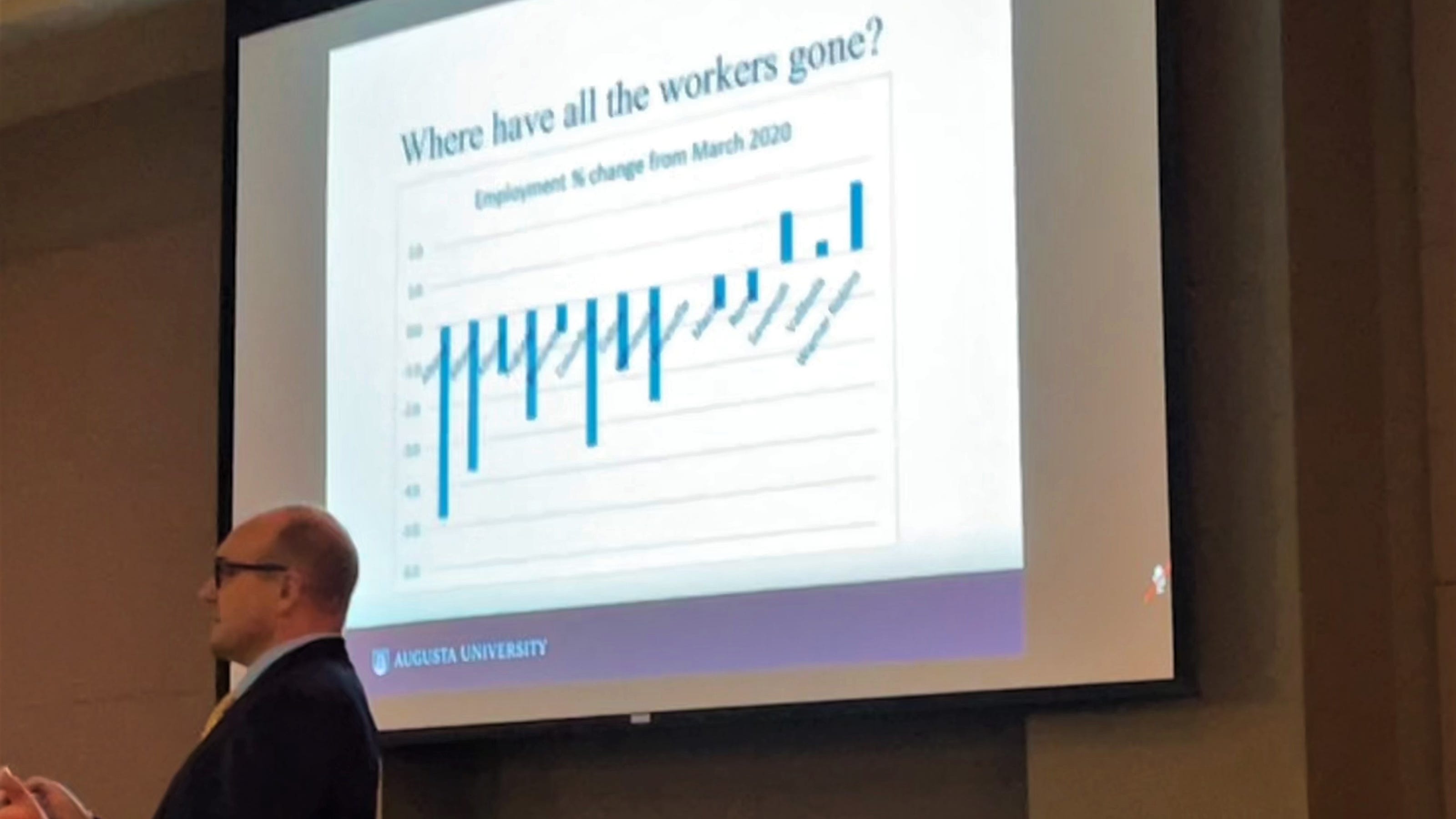
As the legendary political guru James Carville used to say, "It’s the economy, stupid." And these days with housing prices, inflation and the cost of living all pointing up in a very steep trajectory – the state of the economy is front and center for a lot of politicians, Americans and families as the year comes to a close. There’s a lot to be considered, and that’s where experts like Augusta’s Dr. Simon Medcalfe are being sought out to explain economic trends what is behind them. “U.S. retail sales are high,” explains Medcalfe “We had a lot of stimulus checks coming through the door and that’s really spurred extra spending and it’s across a whole range of retail sectors.” According to Medcalfe, household items are also seeing double-digit price increases. “What we’ve seen over the last 18 months during the pandemic, is a shift in our consumer preferences and consumer behavior.” • Furniture sales are up 29% • Used cars and cars in general are up 25-26% • Gardening and building supplies are up 14% • Electronics have seen an almost 30% increase • Clothing sales are up a whopping 50% But it’s not all good news - as the price of everything as we know is going up. “Inflation is running about 6.8% nationally,” Medcalfe explains. “It’s running about 7.2% in the south and it’s certainly a concern of policymakers and economists.” But theirs is sunshine behind those clouds as Medcalfe believes 2022 will see a return to normal. “I think next year inflation will come down. I know it won’t be at these high levels, but I still think it’ll be above the Feds target level of inflation, so look for those interest rate increases next year.” The economy and what to expect locally and nationally are hot topics – and if you are a reporter covering this topic – that’s where we can help. Dr. Simon Medcalfe is a highly regarded economics expert and the Cree Walker Chair in the Hull College of Business at Augusta University. Medcalfe is available to speak with media regarding the economy and its outlook – simply click on his icon now to arrange an interview today.


Christmas is here! And with the hustle and bustle of shopping and scouring the internet for that perfect gift or deal, odds are there are people lurking in the dark corners hoping to stuff their stockings with scams if you’re not too careful. At Thanksgiving, when the official start to the shopping season began – the experts from Indiana University’s Kelley School of Business were front and center answering media calls and doing interviews about this very topic Scott Shackelford, a professor at Indiana University specializing in cyber security, said there are some red flags to be on the lookout for while shopping online. “There’s some easy ones to spot right off the bat, including if on the URL,” said Schackelford. “If you see it just as HTTP and not HTTPS. That S stands for secure, which means your information is encrypted when you use that site.” Shackelford also said to be on the lookout for funny wordplay involved on the website. Maniscalo says most of these fake websites originate from outside the country. “English is not their native tongue, so they will a lot of times have misspellings, or say things in kind of an awkward way, not how we would say it, or how we would print it out there,” said Maniscalo. There is also the problem of what Shackelford calls Grinch Bots. These are automated bots that monitor major retail sites to see what items are the hottest and buy them out as soon as they are restocked. “There’s actually been bills that have been proposed in Congress to deal with example of that phenomenon. But of course, they’re not enacted yet, so it’s still up to consumers,” said Shackelford. November 25 – Fox News It’s going to be a busy holiday shopping season – and if you’re a journalist looking to cover this important top, then let us help. Scott Shackelford is an Assistant Professor of Business Law and Ethics at Indiana University’s Kelley School of Business. He’s an expert in the field of cybersecurity law and policy. Scott is available to speak with media about this subject – simply click on his icon now to arrange an interview today.

Have you finished your Christmas shopping yet? If not – waiting for last minute deals or just pushing off the pain of navigating a jam-packed shopping mall might result in some failed efforts, unhappy kids and even the potential for coal in your own stocking for letting some loved ones down. Recently, John Talbott, the director of the Center for Education and Research in Retailing at the Indiana University Kelley School of Business was interviewed on the IBJ podcast to explain how supply chain woes may be creating chaos this Christmas. Experts expect shoppers to drop a record amount of money this holiday season. The National Retail Federation forecasts sales for November and December to grow between 8.5% and 10.5% over the same months in 2020. In total dollars, that would be between $843.4 billion and $859 billion. At the same time, the supply-chain issues that have plagued commerce since the start of the pandemic are expected to complicate gift buying and limit stock for some products. The answer is to get your shopping done as soon as possible, because you might not get a second chance, says John Talbott, the director of the Center for Education and Research in Retailing at the Indiana University Kelley School of Business. In the latest edition of the IBJ Podcast, Talbott explores other big questions with host Mason King. Does Indy’s status as a leading U.S. logistics hub give Hoosiers a leg up on gift availability? What role might inflation play in this year’s shopping season? Why are gift cards even more valuable than usual this year? How can we avoid cybercrime? And are there any blockbuster, must-have gifts for this season? November 28 – IBJ Podcast And if you’re a journalist looking to know more or covert this subject – then let us help. John Talbott is the Director for the Center for Education and Research in Retail at Indiana University’s Kelley School of Business. He’s an expert in the areas of retailing, relating marketing activities to financial outcomes, and new media communication. John is available to speak with media regarding this important topic – simply click on his icon now to arrange an interview today.

In any disagreement or dispute, sides are taken - by those involved, by those invested or sometimes just by those most interested in the conflict that is occuring. And when it comes to the matter of superstar athletes squaring off against billionaire owners, it's often the fans that speak the loudest and media are doing their best to cover both sides - and get to the root of the matter. Lately, experts from IU's Kelley School of Business have been front and center - providing expert perspective, opinion and analysis. And earlier this month as players were locked out - Nathaniel Grow was getting calls by reporters for insight. “The players have been seeing their financial position deteriorate over the last few cycles, and the last few years in particular, when the average player salary has declined, which is unprecedented for MLB,” said Nathaniel Grow, an associate professor of business law and ethics at Indiana University’s Kelley School of Business who has written extensively on baseball’s CBA topics and issues for several years. “Within that bucket is the service-time manipulation, which helps feed into some of these salary issues.” “The players don’t think they’re getting a fair shake, is a fair general consensus. The question becomes, where do they go and how do they try to improve their financial position?” December 02 - Sporting News The ongoing labor dispute between players and owners will be long, protracted and at times tense - and if you are a reporter looking to cover this trending topic, then let us help with your stories and questions. Nathaniel Grow is an Associate Professor of Business Law and Ethics and the Yormark Family Director of the Sports Industry Workshop. He's also an expert in the areas of sports and labor law. Grow is frequently quoted by media outlets such as The Washington Post, The Wall Street Journal and ESPN regarding current legal issues in the sports industry. Nathianiel is available to speak with media regarding the MLB lockout - simply click on his icon now to arrange an interview today.

Brexit caused a large negative effect on UK trade pre-pandemic - new Aston University research
Professor Jun Du and Dr Oleksandr Shepotylo analysed the causal effect of Brexit on the UK’s services trade between 2016 and 2019 They found the UK experienced an average shortfall of £18.5 billion worth of services exports for each of those years Transport, Travel, Insurance and Telecom sectors experienced significant decline post-2016 No significant decline was found in other services including intellectual property, construction and financial. New research from economics experts at Aston University has found Brexit has caused a largely negative effect on UK services trade since the EU referendum. Professor Jun Du and Dr Oleksandr Shepotylo, from Aston Business School, analysed the causal effect of the Brexit referendum on UK’s services trade over the period between 2016 and 2019, in comparison to other major services exporters. They found the uncertainty associated with the UK-EU trade negotiations following the referendum caused harms to the UK services economy as a whole, reducing firms’ exports of services. This damages the competitiveness of services sectors which make up a lion’s share of the UK economy in terms of gross output, value-added and jobs. Professor Du and Dr Shepotylo used a Synthetic Difference in Differences (SDID) estimator to construct a counterfactual of the UK, had it not voted leave in 2016, to compare its services exports performance. This was done by comparing the actual performance of the UK with the modelled performance of a country that looks much like the UK, but did not vote to leave the European Union. They found Brexit resulted in the UK experiencing an average shortfall of £18.5 billion worth of services exports every year between 2016 and 2019 relative to what it would have been, had the UK remained in the EU. The impact varied considerably between different types of services. The UK’s exports in the category of transport, travel, insurance and telecom services saw a statistically significant decline following the referendum. No significant decline was found in business, intellectual property, construction, financial or personal, cultural and recreational services. In addition, Professor Du and Dr Shepotylo did not find evidence to suggest that UK businesses have redirected exports in services from the EU markets to those outside the EU, which is in contrast to exports in goods. The research suggested that Ireland has benefited significantly during this period, with growth in post-Brexit services exports up by £24 billion annually over 2016 to 2019 in the country compared to the counterfactual scenario if Brexit did not occur. This translates to 14.75% of Ireland’s 2019 total services exports, with growth clustered largely in the telecoms, business, intellectual property, and insurance sectors. Jun Du, professor of economics at Aston Business School, said: “Brexit marked a rupture in the highly integrated UK-EU services markets that had been developed during the UK’s membership of the single market. However, the UK’s strength in services was not reflected in the government’s ambitions for the sector in the EU-UK trade negotiations that followed the referendum. “There are other winners besides Ireland in some post-Brexit services areas. The Netherlands have increased considerably in ‘Business’ and ‘Intellectual Property’ exports. “Spain has seen growth in ‘Travel and transport’ services exports. Germany has gained in ‘Transport’, ‘Insurance’, ‘Telecom’ and ‘Intellectual Property’ services exports. While Ireland seems to have done exceptionally well in relation to the export of ‘Telecom’ services, a sharp contrast emerges to the lost exports not just from the UK, but also from the Netherlands, Switzerland and France.” Dr Oleksandr Shepotylo, a senior lecturer in economics, finance and entrepreneurship at Aston University, co-wrote the working paper and said: “UK services exports are 5.7% lower than they would be without Brexit. It reflects an overall decline of the UK as a place for doing business. “What economists tend to agree on is that the UK’s exit from the EU’s custom union and single market may have more significant impacts on services than goods, and more severe impact on post-Brexit regulated services than unregulated services. “It will take some time for the full impact of Brexit on UK services to emerge. Freedom of movement and data flow in some areas between the UK and EU could remain restricted. Stability, transparency and regulatory consistency in financial markets could be challenged. But new opportunities might surface. “Continued trade negotiations and dialogues regarding trade liberalisation are essential with the EU and large, fast-growing markets beyond Europe. Crucial to understanding these impacts will be reliable data and rigorous analysis. Our modelling of marked losers and winners in post-Brexit services trade provides new evidence for an open discussion of the post-Brexit trade in services.” You can read the full working paper HERE


Nathaniel Grow, a nationally recognized expert in the field of sports law and an associate professor of business law and ethics at the Indiana University Kelley School of Business, has published numerous articles on the application of federal antitrust and labor law to the professional sports industry, with a particular focus on Major League Baseball. He has been closely following developments and would glad to serve as an expert for reactions and analysis of developments. The author of 17 law review articles, as well as an award-winning book, Grow has received a number of prestigious research honors for his academic work. Grow is frequently quoted by media outlets such as The Washington Post, The Wall Street Journal and ESPN regarding current legal issues in the sports industry. He can be reached at grown@iu.edu and 812-855-8191.

The Case for Career Advocates: An Organization Is Not a Meritocracy
“This blog post is the first in a three-part series that summarizes the key messages I deliver to my students, in the hopes that it can catalyze and support the career success of a broader group of ambitious employees who aspire to make it to the C-Suite,” writes Renee Dye 94PhD, associate professor in the practice of Organization & Management. “Most of my lessons are derived from my own unlikely personal journey from literary scholar to top-tier management consultant to C-suite executive for a publicly traded company, but they are also heavily informed by leading researchers like Sylvia Anne Hewlett. In the final blog, I discuss the impact of remote work on career success.” One of the paradoxes of the Gen-Zs and Generation Alphas is their intuitive understanding of the phenomenon of social media…at the same time they maintain an almost ideological conviction that the workplace – apart from systemic biases – is otherwise a meritocracy, where talent is perfectly and objectively evaluated – and the best and most deserving rise to the top. Surely a cursory exploration of Instagram and TikTok would convince even the most skeptical of the fundamentally idiosyncratic nature of success in a networked world? The Real World is likewise characterized by outcomes in which success is imperfectly correlated with capability level. Someone whose capability level is less than yours may lap you in the race to the top of the organization. That may seem unfair, but that’s because you’re making the mistake of assuming that career success is predicated purely on capability. A survey of MBA graduates from my school a few years ago produced a startling insight: of all the skills that we provided to our students during their MBA tenures, our students felt most unprepared to navigate “organizational politics” in their careers. The reason that I found this fact so astonishing is that today’s students, who are Digital Natives and in part Social Media Natives, are the most connected and self-promoting generation the world has ever seen. Yet today I find that my students continue to exhibit little practical understanding of how career success is forged…so much so that I now devote an entire class session in my core Strategy class to demonstrating the importance of relationship management and advocacy cultivation. Capability is not unimportant; far from it. As I tell my students, though, capability is table stakes these days as the level of education and skill sets continues to advance among individuals. If you’re not smart and capable you’re not getting in the door. But once you’re in, your career path and ultimate career success will be more determined by (1) your level of aspiration and unflagging commitment to achieving your goals; (2) your performance outcomes in your individual roles; (3) your work ethic and conscientiousness; and (4) the relationships you have with other people within your organization. And the relationships that matter the most are the individuals with influence and power over your future career opportunities. Let me put it starkly: without career advocates (notice the plural), it will be much, much harder to make it to the senior management ranks. Full stop. Some facts to bear this assertion out: • People with advocates are 23% more likely to move up in the careers • Women with advocates are 22% more likely to ask for a stretch assignment to build their reputations as leaders Ultimately, having an advocate confers a career benefit of 22-30%, depending on who’s doing the asking and what they’re asking for. That’s increasing your odds of making it to the C-Suite by nearly a third! If anecdotal evidence is more your thing, here are a couple of quotations for you: • A lot of decisions are made when you are not in the room, so you need someone to advocate for you, bring up the important reasons you should advance” (Catalyst Survey, as quoted in Elizabeth McDaid, “Mentor vs. Sponsor,” September 3, 2019) • When you get to the level in your career when decisions are not just being made by an individual manager, feedback from other leaders becomes crucial. Rosalind Hudnell, Chief Diversity Officer, Intel. As quoted in Hewlett, Sylvia Ann, Melinda Marshall, and Laura Sherbin. “The Relationship You Need to Get Right,” HBR 2011) • “I was great at building businesses and had tons of cheerleaders, but I had that typical Asian keep-your-head-down-and-you’ll-get-taken-care-of mindset.” My boss had to take me aside and tell me that if I didn’t actively cultivate her as my sponsor, I would never progress beyond senior associate” (quoted in Hewlett, Sylvia Ann, Melinda Marshall, and Laura Sherbin. “The Relationship You Need to Get Right,” HBR 2011) To reiterate: an organization is not purely a meritocracy where talent and hard work speak for themselves; and it’s much, much harder to advance within an organization without effective advocates. Renee Dye is an Professor in the Practice of Organization & Management at Goizueta Business School. For more insight and to continue reading this article and series, please visit Dye’s blog. To arrange an interview – simply click on Dye’s icon now to book a time today.



When investors are deciding whether to put their capital into a company, they typically take a breadth of different factors into account. Earnings, performance, market share—all of these are critical, for sure. But equally important is belief in the talent and capabilities of the organization, and its most visible human face: its CEO. How a CEO comes across at key touchpoints such as earnings calls can significantly shape investors’ perceptions of his or her abilities. We know from research that even subtle things like tone of voice can increase—or diminish—shareholder confidence. So, too, can subliminal emotional or behavioral cues in speech. But what about something arguably more obvious and easier to quantify? What about accent? Until now, remarkably little attention has been given to how much sway a CEO’s accent has on investors’ impressions or attitudes. We simply don’t know whether chief executives with “foreign” accents fare better or worse with shareholders than native US-English speaking counterparts. And this subject matters. It’s estimated that as many as 9% of all companies in the US and more than 11% of Fortune 500 firms are run today by foreign-born chief executives. How investors perceive these CEOs relative to native speakers could have major implications for hundreds of thousands of organizations. Shedding compelling new light on this is new research by Goizueta PhD candidate Leonardo Barcellos, and Schaefer Chaired Professor of Accounting Kathryn Kadous. Together they have produced a study that suggests that accent does matter – though perhaps not in the way that many of us might think. That study and the entire article is attached – and well worth the read. And if you are a journalist looking to learn more about this topic – then let our experts help. Kathryn Kadous is the Schaefer Chaired Professor of Accounting and Director and Associate Dean of PhD Program at Goizueta Business School. She is available to speak with media – simply click on her icon now to arrange an interview.

/cloudfront-us-east-1.images.arcpublishing.com/gray/EQ34NHJNIVCAVDO6SOO4FDJHRE.jpg)
As America continues down the long road of adapting, adjusting, and advancing safety efforts in order to overtake COVID 19 – vaccinations have now been approved for children five and older. It’s welcome news for health care experts and epidemiologists – but there’s no doubt this most recent development has parents concerned about the safety and potential consequences children could face if they roll up their sleeves to get immunized. Since this next step was announced, it’s gotten the attention of media and parents from across the country. Augusta University experts have been front and center to help with the messaging. The vaccine rollout for kids ages 5 to 11 starts now. Right now, local hospitals and pediatric offices are working to get doses to the river region. For the past nine months, we’ve seen different rollouts for different age groups come through Augusta University Health’s mass vaccination site. AU Health says it’s still up in the air right now whether this will be the main site you’ll bring your kids to get vaccinated. But what we do know is that 1,200 doses are on the way. “Every single individual has been paramount in this response,” said Dr. Joshua Wyche, AU vaccine coordinator. AU Health officials say they aren’t even close to accomplishing their mission to get everyone vaccinated. “We’re very fortunate to have caregivers that care so much about their community that want to make this impact and continue to push through during this pandemic,” Wyche said. November 03 - WRDW/WAGT Augusta An update from the CDC: kids can start rolling up their sleeves to get their COVID-19 vaccine. This means nearly 30 million American children ages five to 11 are now eligible for the vaccine. That's a little under 1 million in Georgia and 450,000 in South Carolina. But some parents still have concerns about the vaccine's safety. “For the vast majority of people and for parents as they’re looking for how they can protect they’re children best from COVID-19, having access to the vaccine now gives them another tool to protect their child,” says Augusta University Strategic Planning & Pharmacy VP Dr. Joshua Wyche. November 03 – Fox News Child vaccinations are an important topic – and it is essential that accurate details and information are shared with media and parents across the country, and that’s where Augusta’s experts can help. Dr. Joshua Wyche is accomplished pharmacist with an extensive background in business management. He is an expert in strategic planning and pharmacy services. Dr. Wyche is available to speak with media regarding this important topic – simply click on his icon now to arrange an interview today.