
Experts Matter. Find Yours.
Connect for media, speaking, professional opportunities & more.
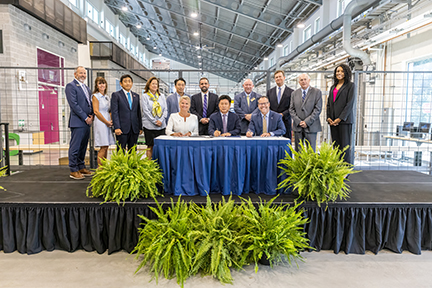
In a milestone collaboration aimed at fostering workforce development, innovation, and community enrichment, Hyundai Motor Group Metaplant America (HMGMA), Georgia Southern University and Ogeechee Technical College are signing a formal agreement to work together in addressing regional workforce needs while advancing academic excellence and technological innovation. Ogeechee Technical College President Lori Durden, HMGMA CEO and President Oscar Kwon, and Georgia Southern University President Kyle Marrero sign transformative agreement surrounded by officials from both institutions and HMGMA. The partnership will encompass a diverse range of initiatives that reflect the shared commitment HMGMA and its local education partners have to catalyze positive change for both the academic community and the broader society. Leveraging their respective strengths, this collaboration aims to address workforce demands, create transformative educational pathways, and drive impactful research endeavors. “Together, we are not just building cars; we are building futures, strengthening the community and driving progress,” said HMGMA CEO Oscar Kwon. “That is part of Hyundai’s mission: progress for humanity. Our partnership with these institutions reflects our shared vision for a brighter, more innovative future.” As part of this partnership, Georgia Southern University has committed to build on the success it has already seen in recruitment services for HMGMA. These services will include on-campus information sessions, dedicated company recruiting events, and on-campus interview days for graduating seniors. By bridging the gap between academia and industry, the University is ensuring that its students are well-prepared for the demands of the professional world. The university also will offer professional development certifications and courses for the company’s employees through its Continuing and Professional Education programs. “This partnership stands as a testament to the value of collaboration between academia and industry in driving holistic growth,” said Georgia Southern President Kyle Marrero. “By uniting forces, HMGMA and Georgia Southern University are forging a path that not only elevates educational opportunities but also cultivates a thriving community equipped to meet the challenges and opportunities of the future.” Georgia Southern also will strengthen its alliance with Ogeechee Technical College to create revised and expanded articulation agreements, pathway programs, and credit transfers. These initiatives will pave the way for the development of collaborative academic programs tailored to meet the specific workforce needs of the region. This includes exploring innovative degree pathways such as Advanced Manufacturing Engineering, as well as fostering additional academic collaborations that align with workforce-driven educational programs. Ogeechee Tech’s commitment includes continuing its record of providing training to local companies to include implementing the Electric Vehicle Professional Technical Certificate of Credit and Hybrid/Electric Vehicle Repair Technician Technical Certificate of Credit programs, and developing Industrial Maintenance Noncredit Training for HMGMA Employees. Additionally, Ogeechee Tech agrees to provide on-campus recruitment events and career fairs to current and past graduates. “Ogeechee Technical College is very excited about entering into this MOU with HMGMA,” said Lori Durden, president of Ogeechee Tech. “This has been several months in the making, and like other institutions and technical colleges in our region, we are going to do all that we can to support the efforts of our Governor to make Georgia the electric mobility capital of America. This is an exciting day for Ogeechee Technical College, and we look forward to supporting the evolving workforce development needs of this region.” With the Memorandum of Understanding, HMGMA will help promote educational opportunities in the region; develop internship, career pathway programs, and other appropriate work-based learning opportunities; and commit to exploring potential research, innovation, and commercialization projects. Interested in learning more or looking to talk with Georgia Southern President Kyle Marrero about this exciting new partnership ? Contact Georgia Southern's Director of Communications Jennifer Wise at jwise@georgiasouthern.edu to arrange an interview today.


Aston University fraud specialist continues ongoing engagement with UK Government
Dr Rasha Kassem advises UK government on countering fraud through the Government Counter Fraud Profession (GCFP) advisory group She shapes policies to combat £33 billion annual losses Dr Kassem influences fraud standards and shares vital research. Dr Rasha Kassem, a fraud specialist based at Aston Business School, remains actively engaged with the UK government through her advisory role in the Government Counter Fraud Profession (GCFP) advisory group. This advisory group, a vital component of the Government Counter Fraud Function, collaborates with cross-sector experts to shape policies and strategies aimed at countering fraud and other financial crimes. The Government Counter Fraud Profession Strategy 2023-25 underscores the severity of fraud within the public sector, estimating losses at a minimum of £33 billion annually due to fraud and error. As a dedicated member of the GCFP Cross Sector Advisory Group, Dr Kassem plays a pivotal role in advising and supporting the development of policies to combat these financial crimes. The GCFP serves as a professional body for counter-fraud experts within central government and beyond. Its mission is to unite the counter-fraud community under a common framework of standards, fostering growth and development to safeguard public services and combat economic crime. Dr Kassem's involvement in the advisory group holds significant impact, influencing the establishment of knowledge, skills and experience requirements for fraud professionals across various disciplines and levels. Additionally, she contributes to the publication of influential fraud research in the Public Sector Counter Fraud Journal and addresses UK government fraud conferences on recent research findings. Dr Kassem also collaborates with experts from diverse sectors to bridge training gaps, all while engaging in discussions through regular group meetings. The Government Counter Fraud Profession operates under the umbrella of the Public Sector Fraud Authority (PSFA), established in August 2022. The GCFP is positioned within the Practice, Standards, and Capability Function of the Authority. The PSFA, a collective effort by 17 public sector organisations, adheres to core principles of building capability, with the GCFP taking a lead role in advancing structures and services. Dr Kassem emphasises the critical nature of engaging with policymakers through knowledge exchange activities to amplify research impact. Her active participation in UK Government fraud conferences and contributions to the Public Sector Counter Fraud Journal serve to raise awareness on prevailing fraud issues. Furthermore, her feedback on existing and new fraud guidance aids the GCFP in crafting professional standards and guidance for countering fraud. Dr Kassem has been a valued member of the Cross-Sector Advisory Group of the UK Government Counter Fraud Profession since 2019. Dr Kassem said: “Collaborating with the UK government through the Government Counter Fraud Profession has been a rewarding journey. “It's through these engagements that we're shaping policies and standards to counter fraud and protect public resources. “The recent Annual GCFP conference was well attended by fraud investigators, law enforcement, and regulators from the public sector. My presentation was well received and some participants said it was wildly fascinating to hear the striking reality that insider fraud can be, especially in UK policing, given its impact on policing integrity and legitimacy. The presentation opened their eyes to the risk of insider fraud and its impact. “Together, we're making a significant impact on the battle against financial crime.” For further information and to explore Dr Kassem's recent research, click here.


Preparing the clean hydrogen workforce
The University of Delaware will play a leading role in workforce development efforts associated with the Mid-Atlantic Clean Hydrogen Hub (MACH2), which has been selected by the U.S. Department of Energy to receive up to $750 million in funding through the historic Regional Clean Hydrogen Hubs program. MACH2 was chosen as one of seven hydrogen hubs, totaling up to $7 billion in grants, announced by the Energy Department on Oct. 13. In stiff national competition, MACH2 ranked among the most pro-labor and greenest hubs in the nation, according to the Delaware Sustainable Chemistry Alliance (DESCA), which brokered the proposal, involving industries, academic institutions, local governments and community partners from across Delaware, southeastern Pennsylvania and South Jersey. Hydrogen is the most abundant element in the universe, and the Energy Department is working to accelerate its use as a clean energy source and as a means to decarbonize heavy industry, transportation and energy storage to meet President Biden’s goal of a 100% clean electrical grid by 2035 and net-zero carbon emissions by 2050, with the regional hydrogen hubs leading the way. MACH2 will encompass a network of hydrogen producers, consumers, local connective infrastructure for hydrogen deployment, and the education and training needed to develop the region’s clean energy workforce. UD will lead the higher education component of MACH2’s workforce development with Cheyney University, Rowan University and the University of Pennsylvania. MACH2 is projected to create 20,000 well-paying jobs in the production, delivery and use of zero-emission hydrogen to repower the region’s industrial facilities, transportation systems and agriculture sectors. What kinds of jobs will MACH2 help prepare people for? There will be a need for technicians for hydrogen-powered vehicles, construction workers for installing hydrogen pipelines, fuel cell power system operators, hydrogen production plant managers, and directors of research and development (R&D) programs, to name a few. Some of these roles may require a high school diploma and an apprenticeship or specific credential; others may require a college degree, from bachelor’s to master’s to Ph.D. Yushan Yan, the Henry Belin du Pont Chair in Chemical and Biomolecular Engineering at UD, will direct the hub’s higher education workforce development efforts. This work will complement high school, vo-tech and community college training programs in energy and construction that will be expanded through the hub, along with pre-apprenticeship programs, particularly those that recruit from underserved communities, offered by building trade unions. “The University of Delaware and our collaborators at Cheyney, Rowan and Penn are well-poised to prepare students for rewarding careers in the new hydrogen economy,” Yan said. “Several engineering, energy and hydrogen programs are already in place at our institutions and will be expanded through the hub, offering students exciting opportunities.” UD will enhance hydrogen technology training at the master’s level through a new “4+1” master’s degree in electrochemical engineering, which would allow highly qualified undergraduate students to earn a bachelor’s degree in an area such as chemical and biomolecular engineering or mechanical engineering and then continue on to earn a master’s degree in electrochemical engineering in the fifth year.


It's as if it has been the biggest love story since Grace Kelley married Prince Rainer or when Harry met Meghan for that matter. But as much as fans, media and even the play-by-play callers are giving an enormous amount of attention to Taylor Swift every time she shows up and cheers on her new beau Travis Kelce, experts wonder...will it have a lasting impact on attracting new fans to the NFL? Recently, Bloomberg News explored if an entertainment powerhouse like Taylor Swift can move the yard-stick of a generation that is seeing a shrinking fanbase and serious decline in viewership. For expert insight, Bloomberg contacted Goizueta Business School's Mike Lewis to offer his opinion and perspective on the situation. Historically, leagues didn’t worry much about the transmission of passion for a sport and team. Homes typically had one screen — the family television — and if a parent was watching the Chiefs game, so were the kids. Fandom at home drove fandom outside of it. Kids wore NFL merchandise to school and bonded with their classmates. Youth sports participation, partly inspired by what was on TV, amplified the community solidarity and enthusiasm for all levels of a given sport. Those traditional forms of fan development are breaking down. "We've evolved to this situation where kids are getting their content via the smartphone and everyone going off to their corner," explains Michael Lewis, director of the marketing analytics center at Emory University. The consequences are striking. In 2021, Lewis published data on sports fandom among different generations. Millennials overwhelmingly identified themselves as the most avid fans (42%), followed by Gen X and Baby Boomers. Gen Z was a striking outlier. Though 23% identified themselves as passionate spectators, 27% identified themselves as "anti-sports." No other generation came close to that level of sports antipathy. However, Gen Z isn’t uninterested in competition. Rather, its media consumption habits are pushing it to different outlets. Survey data that Lewis published in August reveals that esports (competitive video gaming) is now more popular than traditional sports. Professional sports is a multi-billion dollar business and appealing to multi-generational audiences is no easy task. If you're covering or interested in learning more - we can help. Mike Lewis’s work focuses on the intersection of sports analytics and sports marketing. He studies issues ranging from player performance analytics to brand equity in sports. This approach makes Professor Lewis a unique expert on fandom as his work addresses the complete process from success on the field to success at the box office. Michael is available to speak with media - simply click on his icon now to arrange an interview today.



Today’s global business environment has led to rising demand for more advanced qualifications. Aston University’s Geoff Parkes explains how a DBA degree can help leaders meet employer demands and identify cutting-edge solutions to business problems. In recent years, the Doctor of Business Administration (DBA) has emerged as a prestigious qualification that equips aspiring business leaders with the skills and knowledge necessary to address complex challenges in the corporate world. Delivered online, Aston University’s Executive DBA programme is designed to accommodate professionals’ busy schedules and exemplifies the flexibility and relevance that DBA degrees offer in today’s dynamic business environment. Turning theory into practice DBA programmes, like their doctoral counterparts, require candidates to delve deeply into advanced business topics and contribute to their chosen field through original research presented in a thesis. What sets DBA graduates apart is their ability to bridge the gap between theory and practice. They are trained to apply their extensive knowledge directly to real-world business problems, making them invaluable assets to their employers. While DBA students are generally not inventing new theories, they are applying existing models in innovative and creative ways that contribute new knowledge both to academia and practice. Universities and business schools that offer DBA programmes will have a cadre of academic supervisors and faculty who can combine scholarly rigour with practical business experience. This is what students look for in their choice of institution. According to the Global DBA Survey from Compass, the typical DBA candidate boasts an impressive 15 years of professional experience on admission to the programme. It’s the norm for DBA students to complete their research while holding middle or senior management positions, showcasing their commitment to career advancement and expertise development. In fact, a DBA candidate’s thesis is usually directly related to a live work issue that requires this level of rigour. Rising educational expectations In the rapidly evolving business landscape of the 21st century, businesses worldwide are seeking leaders who can seamlessly navigate new challenges without extensive training. While a bachelor’s degree coupled with professional experience was once sufficient, the demand for more advanced qualifications has grown substantially. For many, the Master of Business Administration (MBA) has therefore supplanted the Bachelor of Business Administration (BBA) as the requisite ‘entry-level’ degree, with DBA degrees elevating candidates even further. A recent report from EFMD Global found that DBAs are on a growth trajectory, with 86 per cent of institutions offering the qualification expecting an increase in enrolments in the near future. Career advancement and reputation are key growth factors for those seeking to study the qualification. The main driving motivations are the transformation of careers (cited by 81 per cent of respondents), the ambition to achieve the recognition of ‘Doctor’ (cited by 76 per cent) and the need for research with managerial impact (71 per cent). Business as an international language The proliferation of DBA education globally is a relatively recent phenomenon, with many programmes established in the last decade. This trend is not confined to a specific geographic location – the aforementioned Global DBA Survey from Compass indicates that 42 per cent of programmes are based in Europe, 28 per cent in North America and 22 per cent in Asia. DBAs are demonstrating their ability to impart business knowledge that transcends borders. Moreover, the survey highlights an 80 per cent increase in demand for DBA programmes worldwide, with no region experiencing decreased interest and significant growth in the Middle East and Asia. Aston University’s Executive DBA programme, with its flexible distance learning approach, exemplifies this global trend. Taking an academic approach to business Contrary to popular culture perceptions, business leaders rely on a foundation of knowledge acquired through rigorous academic and professional development. A guide in US News & World Report outlines the various stages of a typical DBA online programme, emphasising that candidates undergo multiple phases of research and evaluation to become workplace-ready executives. The journey includes: Research methods: DBA programmes commence with research methods courses that equip students with essential skills for business research. These practical courses introduce students to valuable sources and questions, preparing them for their thesis projects. Thesis and defence: After completing research methods courses, DBA candidates propose their doctoral theses, refining them with faculty supervisors. Supervisors ensure that thesis topics are original and contribute knowledge to the field. Candidates then conduct research and present their findings in a viva, which determines whether they have met the required standard for a doctorate. Benefits of DBA completion DBA graduates stand to enjoy several benefits, including: 1. Increased salary: DBAs command significantly higher salaries compared to other business degrees. PayScale data reveals that while graduates of a bachelor’s degree in business earn an average of GBP£34,000, MBA graduates earn median salaries of £52,000. DBA degree holders stand to earn even more, in executive positions that might include operations director (£87,989), vice-president (£92,800) and finance director (£102,078). 2. Multiple career paths: Unlike PhD programmes that primarily prepare students for academic careers, DBAs offer participants the flexibility to pursue both academic and business careers. Aston University’s Executive DBA programme, in line with global trends, focuses on preparing students for senior management roles. DBA candidates align their research projects with their career paths, showcasing their advanced knowledge and expertise in specific domains. In conclusion, the rise of DBA programmes is driven by the growing demand for advanced business education, the globalisation of business knowledge and the need for leaders who can integrate academic rigour with practical expertise. DBA graduates are well-equipped to meet employer demands and explore innovative solutions to contemporary business challenges, making them invaluable assets in the ever-evolving world of business. Dr Geoff Parkes is DBA programme director and associate professor in marketing and strategy at Aston Business School, Aston University. Following a career in industry, he graduated with a DBA in 2015 Discover Aston University’s online Executive DBA programme Aston University is a public research university situated in Birmingham, England. In 2020, Aston University was named ‘University of the Year’ by the Guardian and ‘Outstanding Entrepreneurial University’ in the Times Higher Education Awards. Aston was also shortlisted for ‘University of the Year’ in the Times Higher Education Awards 2021

For the second consecutive time, ChristianaCare has earned the Joy in Medicine™ recognition from the American Medical Association (AMA). ChristianaCare earned Gold Level recognition, the highest level of recognition in the Joy in Medicine™ Health System Recognition Program. It was one of only 10 health systems nationwide to achieve Gold Level. The recognition underscores ChristianaCare’s demonstrated commitment to the well-being of clinical care team members. “Receiving the Joy in Medicine Award the first time was certainly an honor, but achieving gold level status a second time is an even greater achievement, as the requirements are more exacting,” said ChristianaCare Chief Wellness Officer Heather Farley, M.D., MHCDS, FACEP. “It is a testament to the fact that at ChristianaCare and our Center for WorkLife Wellbeing, we are not comfortable resting on our laurels. We continue to raise the bar in our efforts to support the well-being of our caregivers, effectively respond to the changing health care landscape and foster an environment where each of our caregivers can thrive.” Continued Excellence in Support of Caregivers In 2022, ChristianaCare’s Center for WorkLife Wellbeing launched Psychological First Aid training to help organization leaders build skills to identify and support colleagues impacted by stress. More than half of ChristianaCare leaders completed the training in 2022. The training is now available to all caregivers. In addition, ChristianaCare’s peer support program, known as Care for the Caregiver, offers confidential individual peer support and group support following a range of stressful events at work. The program completed nearly 2,500 encounters from 2015 to 2022. ChristianaCare also has established the Workplace Civility Steer Team, which provides strategic direction in establishing an environment that is safe and free of violence for caregivers, patients and visitors. The team performs this through program and process development for the identification, prevention and response to workplace violence, a challenge increasingly faced by health care workers nationwide. “Health organizations that have earned recognition from the AMA’s Joy in Medicine Health System Recognition Program are leading a national movement that has declared the well-being of health professionals to be an essential element for providing high-quality care to patients, families and communities,” said AMA President Jesse M. Ehrenfeld, M.D., M.P.H. “Each Joy in Medicine recognized organization is distinguished as among the nation’s best at creating a culture of wellness that makes a difference in the lives of clinical care teams.” Burnout rates among the nation’s physicians and other health care professionals spiked dramatically as the COVID-19 pandemic placed acute stress on care teams and exacerbated long-standing systemic issues. While the worst days of the pandemic have passed, the lingering impact of work-related burnout remains an obstacle to achieving national health goals. Since its inception in 2019, the Joy in Medicine™ Health System Recognition Program has recognized more than 100 organizations across the country. In 2023, a total of 72 health systems nationwide earned recognition with documented efforts to reduce system-level drivers of work-related burnout and demonstrated competencies in commitment, assessment, leadership, efficiency of practice environment, teamwork and support.


Imposter Syndrome: Am I Good Enough? Am I Smart Enough?
Have you ever asked yourself any of the following questions: “Can I do this?” “Do I deserve this?” “What happens when others find out I don’t know what I’m doing?” If so, you’re not alone. More than 70% of people (including many great leaders!) have feelings of imposter syndrome. Alex Dunn, who teaches principles of management, organizational behavior, human resources, and life and career development at UMW, shows others how to recognize, redirect and overcome feelings of imposter syndrome to achieve success. Her recent workshop – “Do I Deserve This? Recognizing and Using Imposter Syndrome as Fuel for Your Future” – aimed to help participants rise above feelings of inadequacy when applying for, and carrying out, jobs and other opportunities. Looking to know more? Our experts can help. Alexandra Dunn is available to speak with media about imposter syndrome - simply click on her icon now to arrange an interview today.



Expert explainer - Storm Daniel and the Libya flooding
Expert: Dr Kiran Tota-Maharaj Reader in Civil & Environmental Engineering (Water and Environmental Engineering) College of Engineering and Physical Sciences, Aston University 1/ Do we have any basic measures on the volume of precipitation that triggered the collapse of the two dams that flooded Derna? How much rain over what period of time? Are there adequate records to put that in historical context? Were any records broken? Storm Daniel has the characteristics of a tropical depression, approximately 170 millimetres (6.7 inches) of rainfall occurred fell in Libya. Torrential rains of between 150 - 240 mm caused flash floods in several cities, including Al-Bayda, which recorded the highest rainfall rate of 414.1 mm. 2/ Do we know anything about the dams that failed? Where they old, near the end of their expected lifespan? Were they known to be fragile in any way? To what extent, in other words, might this have been a disaster waiting to happen? Flash floods, which is considered as one of the worst weather-related natural disasters are highly unpredictable following brief spells of heavy rain. This region in Libya is subjected to flash floods, where floods from the mountains causing heavy damage to hydraulic structures and features of Dams. These floods are made up of sudden, unexpected and heavy rains or a strong surge of water, which usually hit the steep sloped mountainous catchments and have inundated many regions in Libya. The sweeping flash floods also led to the death of many residents and great losses of property. Entire neighborhoods in Derna disappeared, along with their residents swept away by water after two ageing dams collapsed making the situation catastrophic and out of control, the city of Derna is surrounded by mountains, so the flash flooding occurred quite rapidly, taking over with surface-water levels rising as high as 3 metres (10 feet). Engineers have previously issued warnings about the risks of these dams bursting and the urgent need to strengthen their defenses, which unfortunately didn’t occur. Early Warning Systems (EWS)- which are effective ways to reduce the risks of flash floods have not been properly implemented. When EWS are issued before a flash flood event, additional time is created to take action and save lives and infrastructure. The unexpected arrival of a flash flood in Libya, combination with its force, limited understanding of the risks and small space-time scales provide explicit challenges for the development and implementation of an EWS system for flash floods. 3/ There is speculation about many thousands of deaths. Is this attributable almost entirely to the failed dams? Or was there massive and deadly flooding beside that? Thousands of people’s lives have been sadly lost after the massive flood ripped through the city of Derna as a result from the heave storm conditions and excessive rainfall. There have been several areas severely affected by widespread flooding, damage to infrastructure, and loss of life. The disastrous flooding event is likely the cause of the two dams’ collapses, making thousands of residents of the valley and the city of Derna, Libya vulnerable as a result of the storm. Entire neighbourhoods of Derna by the bank of the swollen river had been ravaged and washed away. For further details or to interview Dr Tota-Maharaj, contact Nicola Jones Press and Communications Manager, Aston University, Birmingham, UK n.jones6@aston.ac.uk or Mobile: (+44)7825 342091

Back to School: Expert Tips for a Smooth Transition in the New Academic Year
With the start of school now upon us, Gary Henry, dean of the University of Delaware’s College of Education and Human Development and professor in the School of Education and the Joseph R. Biden, Jr. School of Public Policy & Administration, is here to answer some common questions educators and parents may have. What are your three biggest concerns about K-12 education going into this academic year? I think the overarching concern for many K-12 teachers and administrators is creating a sense of continuity as children and young adults go back to school. The three big concerns that contribute to this issue are teacher turnover, school leader turnover and the number of long-term substitutes who are not fully prepared to teach in classrooms. These trends were already in place before the pandemic, but the pandemic heightened this crisis. For the last 20 years, we’ve seen a crisis in the enrollment in traditional teacher preparation programs. Between 2010 and 2018, we saw about a 35% reduction in the number of undergraduates who enroll in education majors across the U.S., but in Delaware, that reduction was 60%. Teacher shortages are affecting every state around the country right now. What is the best way to address these chronic teacher shortages? Chronic teacher shortages are a systemic problem, which means it’s largely a result of the system in which we educate and support teachers. We know, for example, that many alternative teacher preparation programs — where students come in with a bachelor’s degree outside of the field of education and take only a few courses in preparation for teaching — actually contribute to teacher shortages. So part of the answer is investing in traditional teacher preparation programs and in financial aid. Our team at CEHD’s Center for Excellence and Equity in Teacher Preparation is working directly with Delaware students from motivation to pursue teaching, through recruitment into UD teacher preparation programs, through graduation from those degree programs and into schools within Delaware, whenever possible. For example, our Teachers of Tomorrow program introduces underrepresented high schoolers to the field of education through an immersive, two-week summer institute at UD where they can learn about our programs, meet current students and talk with educators. In partnership with high-needs Delaware school districts and the Delaware Department of Education, our Teacher Residency program allows early childhood education, elementary teacher education and secondary STEM education students to pursue yearlong, paid teaching placements in Delaware schools. Overall, we find that 80% of the students we recruit from Delaware stay in our schools to teach. What recommendations do you have for school leaders who are struggling with turnover challenges? The first thing to do is to have a human resources professional conduct exit interviews with teachers who are leaving and for building leaders to pay attention to their responses so they can really understand the key causes of turnover in their school. In my research, I have analyzed exit interview data and I’ve found that teachers are often very straightforward about why they are leaving. The second step is to act on those reasons. And the third step is to constantly check in with the teachers. Ask, “how are things going? What can we do to help you address your instructional needs?” Developing relationships around instructional issues and the teachers’ work with students is fundamental to diagnosing and addressing issues before they lead to teacher turnover. What advice would you give a brand-new teacher about to start their first year in charge of a classroom? I believe that all educators should view students and their families for their assets and recognize that a student’s culture at home is an asset. A relationship with parents and students that recognizes and values the family’s culture allows you to unite with the family, unite with the student and give the student the confidence to take risks, to work hard and to want to come to school because that’s where they feel welcomed and honored. If parents are interested in supporting their child's education, how can they do so? I think the key ingredient for parents is working with teachers and principals to articulate the outcomes that they’re seeking for their children. It’s much easier to get everyone on the same page if you start from a position of common ground. I would also encourage parents to seek the person in the school system that’s closest to the issue. So if your child is struggling in math, reach out to your child’s math teacher first. If the teacher identifies other resources that may be helpful, then seek out additional support from the school principal. Gary T. Henry has much more to talk about as the school year gets underway. He is available for interviews. Click the "View Profile" button to get in touch with him.

ChristianaCare has received a $100,000 grant from JPMorgan Chase & Co. to launch a youth employment program to build a more diverse and inclusive health care workforce. “At ChristianaCare, we embrace diversity and show respect to everyone,” said Dia Williams Adams, MPA, vice president of philanthropy at ChristianaCare. “Providing exposure to health care careers at an early age and building pipelines to employment are key components to building strong and healthy communities. We are deeply grateful to JPMorgan Chase for its generosity and commitment to inclusion and diversity.” The program, Health Impacts, is a year-long pilot program designed to connect youth ages 16 to 18 from low-to-moderate income households within the Greater Wilmington area to career opportunities in health care. Health Impacts will include an intensive training program, during which the teens will learn from ChristianaCare health professionals about workforce development skills and the characteristics essential for career success. The training program will be followed by a nine-month paid internship that culminates with employment opportunities at ChristianaCare. During the internship the teens will receive additional career coaching and participate in work-based learning assignments to help them develop skills, such as effective interviewing, relationship building and a strong work ethic. “There are fantastic opportunities in health care today that can match up with a wide variety of interests and provide young people with a career path that offers financial stability and growth – plus the personal rewards of doing work that helps others,” said Kamela Smith, M.Ed., manager of Community Education and Engagement at ChristianaCare. “This program is an exciting opportunity to expand our local health care workforce while inspiring young people in our community to be the next generation of caregivers.” JPMorgan Chase’s support of Health Impacts is part of a $30 billion Racial Equity Commitment by the global financial services provider to help close the racial wealth gap and advance economic inclusion among communities that are underserved in the United States. “As one of Delaware’s largest employers, we are incredibly focused on creating a more equitable and inclusive economy for more residents across the region,” said Jac Rivers, Vice President, Global Philanthropy Program Officer Eastern Region, JPMorgan Chase. “Building a skilled workforce and ensuring that all people, regardless of background, have access to the support they need is critical to these efforts. Together with a dynamic community partner like ChristianaCare, and the launch of their new Summer Youth Employment Program (SYEP) in Wilmington, we can truly help unlock opportunity for more Delaware residents to access meaningful jobs and lasting economic growth.” To learn more about ways to give to ChristianaCare, visit https://www.christianacare.org/donors.