
Experts Matter. Find Yours.
Connect for media, speaking, professional opportunities & more.
New Star Wars, Same Political Landscape?
There’s been an enormous amount of hype leading into this Friday’s release of Solo: A Star Wars Story. Will the 10th installment of what is the most valuable franchise in film history live up to the lofty expectations of both fans and film executives? What does this latest epic tell us about current events here on Earth? The politics of Star Wars has proved to be an enduring fascination to many throughout the past 40 years. Equating current political events to the Star Wars saga is where the experts From the University of Connecticut can help. Stephen Dyson has dissected the politics of the "Game of Thrones," "Star Trek" and previous editions of "Star Wars." He can "read between the lines" of the movie dialogue and equate on-screen dialogue to what's happening now in the United States. Source:



Biodiversity on the brink? Is there any stopping the damage to the Pervuian Amazon?
There’s nothing new or breaking about the importance of the Amazon rain forest. For decades, politicians, celebrities and most recently – even the Pope called on the world to act against the deforestation and further protection of the region. The impacts of this devastation are being felt around the world. The massive forests absorb greenhouse gases, and as deforestation occurs at a staggering rate – so too does the increase in climate change and global warming. But agriculture, mining and development seem to be ignorant to those requests and consequences. While a lot of attention naturally goes to Brazil, Peru’s is in just as much trouble. According to the United Nations, the country is one of 17 "megadiverse" countries on the planet containing 70 percent of the world's biodiversity. There’s still a l lot to know about the affects of deforestation and how losing over a million hectares of rain forest has taken a toll on fish, the ecosystem and the vast flora and fauna that remain undiscovered. That’s where our experts can help. Anthony Mazeroll, PhD, Professor of Biology at Soka University of America, is also Executive Director and Board Chair for the Amazon Research Center for Ornamental Fishes, which is devoted to sustainable breeding and conservation of the rainforest ecology. Dr. Mazeroll is available to speak with media regarding this and many other issues affecting the Amazon - simply click on Anthony’s icon to arrange an interview. Source:


Another planet discovered by NASA – 2,545 light-years from Earth
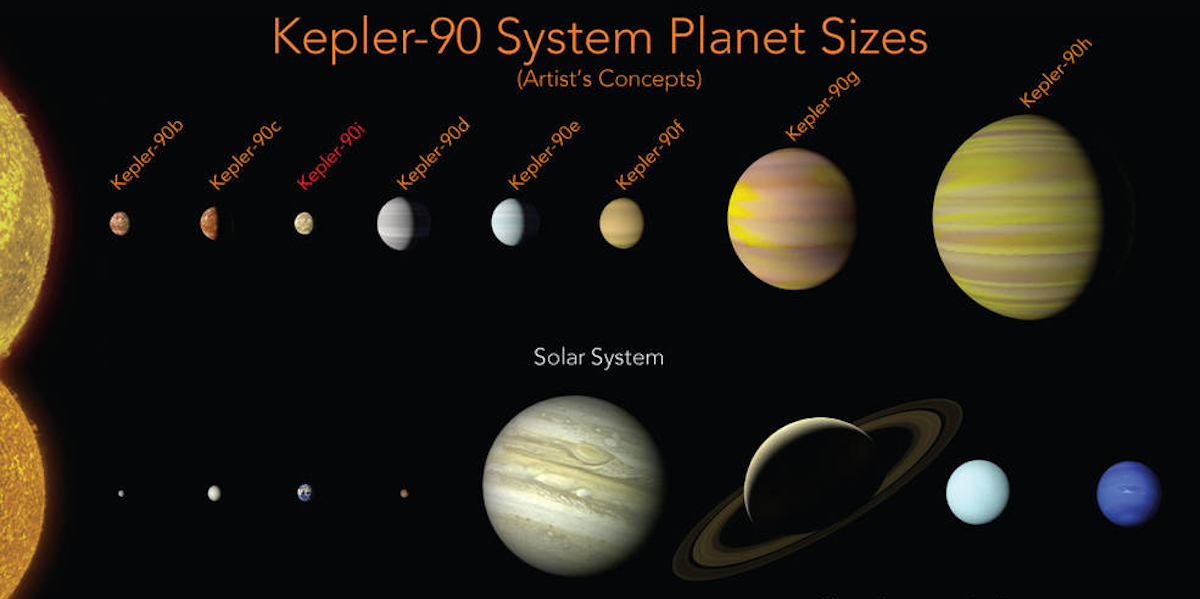
Today, the scientific world was watching as NASA made a big announcement. Its Kepler Space Telescope, which has been conducting an intensive planet-hunting mission since 2009, had new results to share with the public. A media release from NASA states: “Our solar system now is tied for most number of planets around a single star, with the recent discovery of an eighth planet circling Kepler-90, a Sun-like star 2,545 light years from Earth. The planet was discovered in data from NASA’s Kepler Space Telescope. The newly-discovered Kepler-90i – a sizzling hot, rocky planet that orbits its star once every 14.4 days – was found using machine learning from Google. Machine learning is an approach to artificial intelligence in which computers “learn.” In this case, computers learned to identify planets by finding in Kepler data instances where the telescope recorded signals from planets beyond our solar system, known as exoplanets." There are some very technical and scientific data and information here. As well, a lot of questions to be asked and answered. That’s where experts like Dr. Michael Reed from Missouri State University can help. Dr. Reed is a professor of astronomy at Missouri State. He researches extrasolar planets and pulsating stars. Dr. Reed is available to speak to the media and can explain what this all means for science, the study of space and if there might actually be life out there. Click on his icon to connect with him. Source:


Seeing the light of neutron star collisions
UNIVERSITY PARK, Pa. — When two neutron stars collided on Aug. 17, a widespread search for electromagnetic radiation from the event led to observations of light from the afterglow of the explosion, finally connecting a gravitational-wave-producing event with conventional astronomy using light, according to an international team of astronomers. Previous gravitational-wave detections by LIGO (Laser Interferometer Gravitational-Wave Observatory) and Virgo, a European observatory based in Pisa, Italy, were caused by collisions of two black holes. Black hole collisions generally are not expected to result in electromagnetic emissions and none were detected. "A complete picture of compact object mergers, however, requires the detection of an electromagnetic counterpart," the researchers report online today (Oct. 16) in Science. The Aug.17 detection of a gravitational wave from the collision of two neutron stars by gravitational wave observatories in the U.S. and Europe initiated a rapid cascade of observations by a variety of orbiting and ground-based telescopes in search of an electromagnetic counterpart. Two seconds after detection of the gravitational wave, the Gamma Ray Burst monitor on NASA's Fermi spacecraft detected a short gamma ray burst in the area of the gravitational wave's origin. While the Swift Gamma Ray Burst Explorer — a NASA satellite in low Earth orbit containing three instruments: the Burst Alert Telescope, the X-ray Telescope and the Ultraviolet/Optical Telescope — can view one-sixth of the sky at a time, it did not see the gamma ray burst because that portion of the sky was not then visible to Swift. Penn State is in charge of the Mission Operations Center for Swift. The satellite orbits the Earth every 96 minutes and can maneuver to observe a target in as little as 90 seconds. Once the Swift team knew the appropriate area to search, it put the satellite's instruments into action. Swift is especially valuable in this type of event because it can reposition to a target very quickly. In this case, the telescope was retargeted approximately 16 minutes after being notified by LIGO/Virgo, and began to search for an electromagnetic counterpart. Read more about Swift's involvement in detecting the neutron star collision here: https://www.eurekalert.org/pub_releases/2017-10/ps-stl101617.php To speak with Penn State's Swift researchers, contact Joslyn Neiderer at jms1140@psu.edu. Source:


These days, it doesn’t take much to turn a civil conversation into a full-blown catastrophe. Just mention the words “climate change” and feathers can start to ruffle. But it doesn’t have to be that way, says Dan Peppe, Ph.D., climate change expert and associate professor of geosciences at Baylor University. His research focuses on understanding how plant and animal communities have responded to changes in climate throughout Earth’s history. “Climate change is a fundamentally important issue to our society and is vital for us to have open and honest discussions about it and its potential impacts,” Peppe said. He said the best place to start such a dialogue is with scientific observation. Have a discussion about increases in temperature, he said. Understand what scientists are saying about those temperature changes and their effects. The trick to keeping this cordial? Keep politics out. “All of this conversation is a scientific one based on observation, and as such, shouldn't be a political one,” he said. “Once that baseline is established, we can then begin a conversation of the many possible ways to address those risks.” Peppe said there is often more than one solution to issues of climate change, but people need to listen to each other. “Hopefully there can be a respectful and civil conversation around those potential solutions,” he said. As part of Earth Science Week, Peppe is taking part in the Earth Science Symposium at The Mayborn Museum in Waco, Texas, where he will moderate a panel discussion on climate change. Panelists will discuss the science of climate change, the risks associated with it, and some of the potential solutions. “We hope that this will be a really productive discussion, and one in which the audience can participate,” Peppe said. Source:



On Thursday, President Donald Trump announced that the U.S. would abandon the Paris climate accord. During his speech, Trump cited disputed numbers showing that the accord would result in a minimal change in temperature over time. Daniel Peppe, Ph.D., associate professor of geosciences in Baylor University's College of Arts & Sciences, studies ancient terrestrial ecosystems and how they have been influenced by environmental perturbations, such as long- and short-term climate change events. He works to recreate those ecosystems. Peppe argues that one goal of the Paris accord -- developing a strategy to keep the average increase in global temperatures to less than 2 degrees Celsius above pre-industrial levels -- is integral to warding off future disaster. He said: "The Paris Agreement represents a really significant moment in history in which the countries of the world agreed that reducing greenhouse gas emissions was fundamentally important to help reduce the most significant effects of climate change around the world. The agreement developed a strategy to keep the average increase in global temperatures to less than 2 degrees Celsius above pre-industrial levels. Crossing that threshold of temperature increase is likely the point where warming will push the Earth to a climate state that last existed millions of years ago -- one that is fundamentally different from today. Reconstructions of climate, the Earth, and its biota from the last time Earth was in a similar climate state indicate that sea level was dramatically higher, which would mean that many major cities around the world would be flooded; and many places on Earth were hotter and drier and the distributions of plants and animals on the landscape were very significantly different, which would have catastrophic effects on modern agriculture, water use and society." Source:

Mission to Mars – Pack Light on Materials and Heavy on Innovation
On Tuesday May 09, the Humans to Mars Summit kicks off in Washington D.C. This will be a meeting of some of the most powerful, brilliant, creative, scientific and corporate minds on earth. Together they are working on a way that someday soon we will visit Mars. Since 2010 this expanding group is realizing that exploring the red planet is within their grasp and possible during our lifetime. To get there, it will take innovations in science, technology and engineering like we have not seen in generations. Virginia Commonwealth University’s School of Engineering is part of a team that is making this trip a reality. The NASA-sponsored multidisciplinary Space Technology Research Institute (STRI) is working on new a composite material that makes use of engineered carbon nanotubes and will be much lighter—but much stronger—than what is currently available. Space craft need to exit and re-enter atmospheres. To do so, they need to be strong or the results are disastrous. Space travel and the concept of exploring other planets is high science and not easy for most earthly mortals to comprehend. That’s where the experts at VCU’s School of Engineering can help. Ibrahim Guven, Ph.D., assistant professor in the VCU School of Engineering Department of Mechanical and Nuclear Engineering, is an expert on peridynamics, a branch of mechanics that looks at the effect of deformities and fractures. Peridynamics is essential to planning for space travel and to understanding what it takes to get from Earth to Mars. He can explain these concepts in a simple manner and is available to speak with media. Simply click on his profile to arrange an interview. Source:


Is there life out there? Our experts can provide some insight
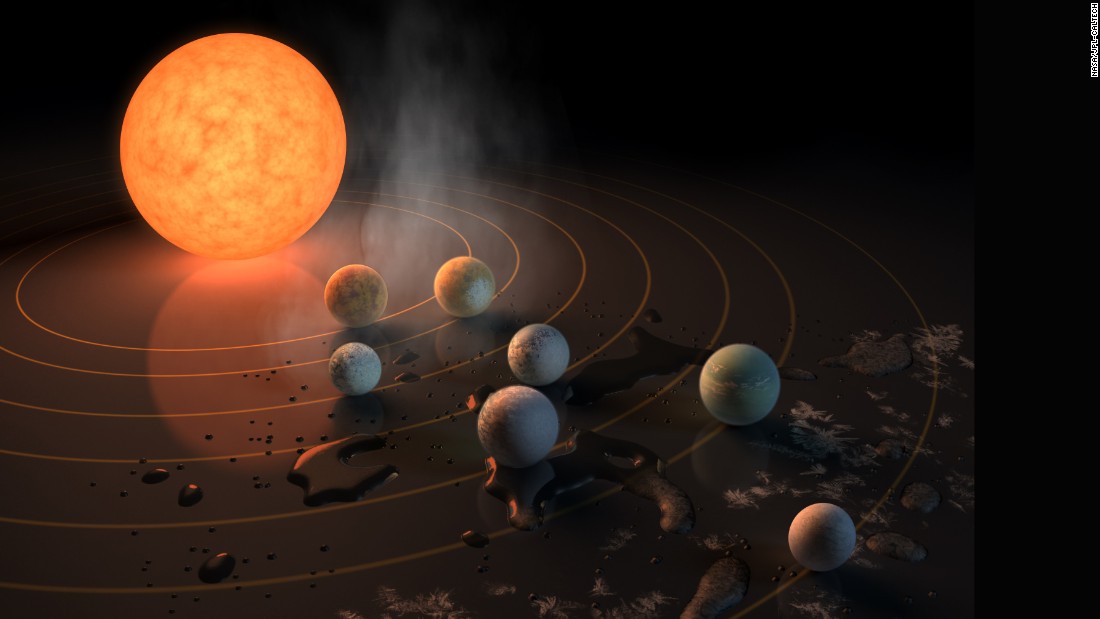
According to a study published Wednesday in Nature, and announced at a NASA news conference in Washington – a mere 40 light years away, astronomers have discovered seven planets similar in size and shape as Earth. As well, scientists believe these planets are made of rock and not gas – meaning if the conditions were right, they could support life. This is an amazing discovery and a great step for science but what does this mean? What’s next? And how will we ever find out if there’s life out there? How far away is 40 light years and how long would it take to make contact or for a satellite to get there? There are a lot of questions. And astronomy and physics are not simple fields to understand nor comprehend. That’s where Missouri State University can help. Dr. Peter Plavchan is an assistant professor of physics, astronomy and materials science at Missouri State. He researches the formation and frequency of exoplanets around solar-type and low-mass stars, and is an expert in astronomy and astrophysics. Dr. Michael Reed is a professor of physics, astronomy and materials science at Missouri State who specializes in asteroseismology, binary stars and extrasolar planets. Both experts are well-spoken, available to speak and can explain to the media what this all means for science, the study of space and if there might actually be life out there. Click on either of their icons to arrange an interview. Source: