
Experts Matter. Find Yours.
Connect for media, speaking, professional opportunities & more.

Leap Years and the Connection Between Astronomy and Our Lives
Most of us know February 29 as a whimsical anomaly—nothing more than a chance to tease our friends or colleagues born on this day as technically being a quarter of their purported age. But how often do we think about the origins of the day as we now know it? Or about the near-universal implementation of this specific way to keep track of time? Do we ever consider the impact a leap year could have on everyday life? Frank Maloney, PhD, an associate professor of astronomy and astrophysics at Villanova University, has been teaching for nearly 12 leap years (47 years). He is an expert in timekeeping and calendaring, calling them a “fundamental connection to our lives, ruled by the motion of objects in the sky,” because “everyone has to agree what day and time it is.” Dr. Maloney currently teaches a course called “Earth: Our Habitable World,” where he discusses this and other connections between astronomy and people’s lives. In the case of leap years, the astronomical phenomenon from which they originate—the Earth’s time to orbit the sun—is a very important one to accurately track. “You want your calendar to keep pace with the seasons,” Dr. Maloney explained. “There are all sorts of ways of measuring the pace of the Earth around the sun, but the way that [also] keeps pace with seasons is called the tropical year, and unfortunately, there’s not an integer number of days in that year. We can’t ignore it, because after the first year you’re off by a quarter of a day and after four years off by a full day, and so on.” Ancient civilizations were aware there were slightly more than 365 days in a solar year but didn’t know exactly how much more. Gradually, the seasons would become unsynchronized with the calendar, and those various civilizations added days back in at random times to realign. “In those days, it might be possible to leave one area in April, and arrive [somewhere else] the previous December,” Dr. Maloney joked. The concept of a leap year began with the Roman Empire’s implementation of Julius Caesar’s namesake calendar on January 1, 45 B.C.E., at his behest. The Julian calendar was a solar calendar, which consisted of a 365-day year, and a 366-day leap year every four years, without exception. It was often added as a duplicate day in the middle of February. “But a year is not exactly 365 and a quarter days. It’s a little bit less,” Dr. Maloney explained. “By the Middle Ages, it was 10 or so days out of whack with the tropical year. Astronomers would have seen that very easily... but the reason to change it was not there.” Not until the late 16th century, that is. And the reason it did change was because Easter had moved out of line with the vernal equinox. “Nearly all calendars have a mystical, religious or theological component,” Dr. Maloney said. “In the Roman Church, Easter is reckoned as the first Sunday after the first full moon on or after the vernal equinox, or first day of spring.” In order to have Easter fall back in line with the equinox, Pope Gregory XIII issued a papal bull in 1582, which declared a year to be a more accurate 365 days, 5 hours and 49 minutes in length (roughly). What that meant for leap years was that, instead of every four years without exception, they would now occur every four years except on century marks, unless that century mark was divisible by 400. For example, 1900 was not a leap year, but 2000 was. The years 2100, 2200 and 2300 will not be leap years. The global switch to a new calendar was not easy or done in haste. To enact the initial calendar change, 1582 went from October 4 to October 15 to eliminate extra accumulated days. Catholic countries mostly followed suit soon after, but many others resisted, as citizens feared it was a political trick. It took centuries to get to the near-universal use of the Gregorian calendar we have today. Great Britain and other Commonwealth nations did not adopt the Gregorian calendar until 1752. An individual such as George Washington could have been considered to be born on one day in the Julian calendar and have a different birthday in the Gregorian calendar. In the American colonies, September 1752 skipped to the 14th day of the month from the second. The most recent country to switch from the Julian to Gregorian calendar was Greece in 1923. By then, the calendar was roughly two weeks off from the tropical year. In the early 1900s, when globalization was commencing, this was a big deal. “You could get in an airplane and fly someplace, and not even know what day you’d be landing. According to the calendar, it’d be time travel,” Dr. Maloney said. Saudi Arabia still used a few elements of the Islamic calendar for fiscal purposes until 2016, and Afghanistan, Iran, Nepal and Ethiopia are the only countries in the world that do not officially use the Gregorian calendar currently. So, what does all this mean for people today? For starters, historians and genealogists must be careful when studying historical dates and events. For example, a country may have still been using the Julian calendar during a particular time period, or perhaps an event might have occurred during the time days were skipped to make the switch from the Julian to the Gregorian calendars. “If an infant were born [in the American colonies] on the second of September 1752, for example, and died on the 14th, they were not really 12 days old,” Dr. Maloney said. “Or if a war began in a country one day but started on a different day in a different country, it causes confusion.” Leap years and other adjustments to timekeeping can also cause a plethora of computing and software issues, impacting multiple industries. This is especially true in the digital age where time-stamping is so ubiquitous. Case in point, on occasion, we actually have to add a leap second to time to account for the slowing of Earth’s rotation. These leap seconds are added after 11:59:59 on either December 31 or June 30, when needed. “There’s a great deal of controversy about this particular practice,” Dr. Maloney said. “It really confounds software. A jet airplane, for example, can travel a fairly long distance in one second. Time has to be kept now to fractions of seconds, [even for things like] lawsuits and insurance policies. Timekeeping is a very important task for astronomers.” It seems those astronomers have it figured out... for now. Even the Gregorian calendar will eventually need an adjustment, as its margin of error is about 27 seconds per year. That means every 3,236 years—so sometime in the early 4800s—an additional extra day will need to be added somewhere to correct it. Luckily, we have some time to plan ahead.


Research: Add space salad to the risks astronauts face
University of Delaware researchers grew lettuce under conditions that imitated the weightless environment aboard the International Space Station and found those plants were actually more prone to infections from Salmonella. It’s been more than three years since the National Aeronautics and Space Administration made space-grown lettuce an item on the menu for astronauts aboard the International Space Station. Alongside their space diet staples of flour tortillas and powdered coffee, astronauts can munch on a salad, grown from control chambers aboard the ISS that account for the ideal temperature, amount of water and light that plants need to mature. But as the UD researchers discovered, there is a problem. The International Space Station has a lot of pathogenic bacteria and fungi. Many of these disease-causing microbes at the ISS are very aggressive and can easily colonize the tissue of lettuce and other plants. Once people eat lettuce that’s been overrun by E. coli or Salmonella, they can get sick. With billions of dollars poured into space exploration each year by NASA and private companies like SpaceX, some researchers are concerned that a foodborne illness outbreak aboard the International Space Station could derail a mission. In the new study by UD's team, published in Scientific Reports and in npj Microgravity, researchers grew lettuce in a weightless environment similar to that found at the International Space Station. Plants are masters of sensing gravity, and they use roots to find it. The plants grown at UD were exposed to simulated microgravity by rotation. The researchers found those plants under the manufactured microgravity were actually more prone to infections from Salmonella, a human pathogen. Stomata, the tiny pores in leaves and stems that plants use to breathe, normally close to defend a plant when it senses a stressor, like bacteria, nearby, said Noah Totsline, an alumnus of UD’s Department of Plant and Soil Sciences who finished his graduate program in December. When the researchers added bacteria to lettuce under their microgravity simulation, they found the leafy greens opened their stomata wide instead of closing them. “The fact that they were remaining open when we were presenting them with what would appear to be a stress was really unexpected,” Totsline said. Totsline, the lead author of both papers, worked with plant biology professor Harsh Bais as well as microbial food safety professor Kali Kniel and Chandran Sabanayagam of the Delaware Biotechnology Institute. The research team used a device called a clinostat to rotate plants at the speed of a rotisserie chicken on a spinner. “In effect, the plant would not know which way was up or down,” Totsline said. “We were kind of confusing their response to gravity.” Additionally, Bais and other UD researchers have shown the usage of a helper bacteria called B. subtilis UD1022 in promoting plant growth and fitness against pathogens or other stressors such as drought. They added the UD1022 to the microgravity simulation that on Earth can protect plants against Salmonella, thinking it might help the plants fend off Salmonella in microgravity. Instead, they found the bacterium actually failed to protect plants in space-like conditions, which could stem from the bacteria’s inability to trigger a biochemical response that would force a plant to close its stomata. “The failure of UD1022 to close stomata under simulated microgravity is both surprising and interesting and opens another can of worms,” Bais said. “I suspect the ability of UD1022 to negate the stomata closure under microgravity simulation may overwhelm the plant and make the plant and UD1022 unable to communicate with each other, helping Salmonella invade a plant.” To contact researchers from the team, visit the profiles for Bais or Kniel and click on the contact button.


Big shift coming to the EV industry
Already a pioneer in the industry, the University of Delaware has once again played a key role in taking electric vehicles to the next level. Researchers there helped bring about new automotive standards that will drive lower-cost charging and vehicle-to-grid (V2G) integration and standardize Tesla’s connector so that future U.S.-made EVs will have this technology on it. The two newest standards for electric cars, both approved this month by standards committees of SAE International (formerly the Society of Automotive Engineers), should bring EV drivers great joy, according to Willett Kempton, professor at the University of Delaware’s Center for Transportation Electrification on UD’s Science, Technology and Advanced Research (STAR) Campus. Center director Rodney McGee was chairman of the two SAE committees, while postdoctoral researcher Garrett Ejzak, Kempton and administrative assistant Becky Cox played key roles in the engineering, research and policy work undergirding the new EV standards. “These developments mark a big shift for the EV industry,” said Kempton, who is affiliated with research centers in both the College of Earth, Ocean and Environment and the College of Engineering at UD. “Drivers will gain access to more charging stations and lower-cost charging. They will have new options for using their EV to help fight climate change and even make money when plugged in. These changes are likely to spur even greater adoption of EVs for clean, affordable transportation.” The so-called “V2G standard” (SAE J3068) provides the missing link for widespread use of vehicle-to-grid (V2G) technology, which Kempton and his colleagues invented at UD more than two decades ago. “We’ve been doing V2G for 20 years here at the University of Delaware, wondering when the rest of the world would catch on,” Kempton said. “One key missing piece has been a complete standard for controlling and managing V2G, which now exists within SAE J3068.” V2G allows you to plug your EV into an electrical outlet and send power from the car battery back to your local energy utility, making a little income while helping the nation’s power grid. This is becoming increasingly more important as more renewable sources of energy come online. When the sun isn’t shining or the wind isn’t blowing, EV owners can plug in and “perform important energy-balancing services,” according to Kempton. The savings from V2G can add up. “Our V2G demonstrations show an EV can earn between $100 a year and $1,500 a year. The wide variation is due to different markets and to regulations in different utilities. It also depends on the EV’s capabilities,” Kempton explained. Current EVs need a substantial update or retrofit to be able to do V2G, while new EVs equipped with the signaling technology are expected to be available by 2025. This standard also will make it possible to use your EV as backup power for your house. As extreme weather increases with climate change, that’s a good energy reserve to have when the lights go out. It takes one-and-a-half kilowatts to power the average house, Kempton said. Your electric car can produce 80 kilowatts of power, enough to run a whole house and more. “So, your EV can both help fight climate change and keep your house going when extreme storms happen,” Kempton said. With SAE J3400 now approved, the connector system Tesla developed for EV charging will now be standardized and can be included on future EVs of any brand. The first non-Tesla cars with this technology, also known as the North American Standard Connector, are expected to hit the market in 2025. “This will eliminate Tesla’s monopoly on their charging stations, making them available for use by any new EV,” Kempton said. According to Statista, the U.S. had more than 53,000 public EV charging stations and over 138,000 public charging outlets in May 2023. Visit Kempton's profile and click on the contact button to arrange an interview.


Research explores recreational shark fishing's impact on protected species
In Delaware, recreational shark fishing is popular, with anglers taking part in half- and full-day shark fishing trips. However, they are prohibited from keeping protected species of sharks. A University of Delaware research team led by Aaron Carlisle, assistant professor in UD's School of Marine Science and Policy (SMSP), is studying the impact of releasing these sharks, aiming to understand their post-release survival and how fishing operations handle them. Carlisle, graduate student Bethany Brodbeck and Ed Hale, assistant professor and aquaculture specialist for Delaware Sea Grant, are conducting the field research for the study, riding along with recreational fishing vessels to better understand what happens to sharks when they are caught and released. Another component to the research is being led by George Parsons, E.I. du Pont Professor at UD’s College of Earth, Ocean and Environment, who is looking at the economic aspect, using survey-based research to value the shark fishery and study anglers’ perceptions and attitudes toward sharks and their management. Carlisle said the two concurrent studies will help gauge the biological and economic impacts of the shark fishery in Delaware. “We want to find out how much money the fishery is actually drawing to the economy,” Carlisle said. “We also want to find out how the fishery is actually impacting the populations of sharks in Delaware, especially the protected ones.” The research was funded by Delaware Sea Grant, which helps communities wisely use, manage and conserve coastal resources. To arrange an interview with Carlisle, simply click on the link to his profile. Pressing the contact button and using the form will send your request directly to him and a member of UD's media relations team.


UF astrobiologist partakes in her second NASA mission to Mars
By Halle Burton NASA’s Mars Perseverance rover mission is no easy task, yet its distinguished team has discovered signs of organic molecules, containing chemicals known for making life possible on Earth. One of these long-term planners is University of Florida astrobiologist, Amy Williams. “Organics make up life as we know it,” Williams said. “Seeing organic carbon on Mars sets us up to understand if the building blocks for life were present on the planet in the past through the lens of how life evolved on Earth.” Williams and the Perseverance team were published in November’s Science magazine for their organic molecules analysis, after finding numerous organic carbons on the Jerezo crater floor. Through NASA’s Jet Propulsion Laboratory, Perseverance is studying the crater with collected rock samples planned to be sent to Earth during the Mars Sample Return mission. Upon further research and testing on Earth, these rocks could determine compelling evidence of past life on Mars. Several of the rock samples indicate altercations by water, making scientists propose that a water-infused Mars could have supported ancient life. The Jerezo crater itself serves as an intriguing site to study past life on the terrestrial planet. The creation of the crater implies Mars contained a primitive river streaming into a lake billions of years ago. Now, Williams is no stranger to working with the detection of organic molecules on Mars. In 2015, she worked with the Curiosity rover which also found organic carbon on the inner planet. With her work diversified on the Perseverance team, evidence is closer than ever to proving the omnipresence of organic carbon on Mars. “Seeing a consistent story is always reassuring as a scientist,” Williams said.


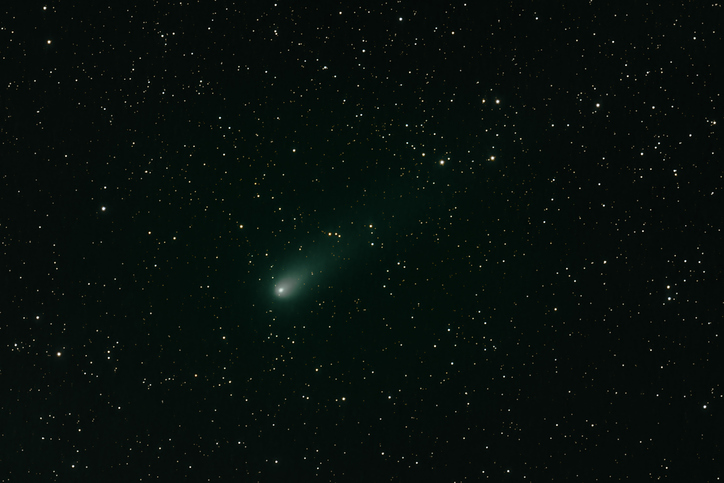
Looking to the skies over the next week or so, you may see something you will not see again for 50,000 years. This occasional visitor, C/2022 E3 (ZTF), also known the “green comet,” will make its closest approach to Earth Feb. 2. We asked Csaba Palotai, aerospace, physics and space sciences associate professor, and Amelia Brumfield, graduate research assistant, about the green comet, what we can learn from it, where to look for it and more. Q: Why is this comet green? Palotai: The composition of a particular comet determines what the color is. This one has most likely diatomic carbon in it, and then that carbon comes out and interacts with the sunlight. Certain photochemical processes take place and that gives it the green color. This is not for every comet. Q: Why haven’t we seen this comet in 50,000 years? Brumfield: It has a very eccentric orbit. Our orbit, we go around the sun every year, but this comet, its orbit is on a scale of thousands and thousands of years. There's a chance that no one's ever seen it. Dr. Palotai had mentioned that it might have come by during the ice age. It might not even have passed by Earth (to be visible) at that time, if it did. So, it won't be back and if it does even come back, we're going to be long gone. It's just a cool chance to see something that maybe no one's ever seen before and might never ever get to see again. What can we learn from this comet? Palotai: This comet has an interesting orbit and then people study this orbit after the discovery of the comet. They figure it out that this is coming from a part of the solar system called the Oort Cloud (named for the Dutch astronomer who first described it, Jan Oort). This region of the solar system is not well understood because it is very far from us, so actually we haven't seen any objects in this region. It is thought that there are about, give or take, a trillion icy objects in this region. Some of them are smaller ones, some of them are bigger ones. And the only way we know about these things is that whenever comets like this come from that region. Q: When is a good time to view this comet? Palotai: In the next few days, or maybe in the next couple of weeks or so is the greatest chance to observe it. You need several factors to have a comet to be visible with a naked eye, starting with clear, dark skies. Beyond the naked eye, if you have binoculars or a smaller telescope, you should also be able to see it. Q: Where can you view this comet? Brumfield: You can still see it between the Little Dipper and the Big Dipper, and then around Jan. 30 it should be closer to the North Star, so you can look for it in that area of the sky. And the best time to view it is very late at night, so between midnight and dawn. And then the closest approach is going to be Feb. 2, but that doesn't necessarily mean that's going to be the best time to view it. If you're a reporter covering the green comet, let us help with any of your questions about this rare celestial phenomenon. Csaba Palotai is available to speak with you. Simply click on his icon now to arrange an interview today.


Expert Q & A: Florida Tech faculty experts discuss the Artemis mission and why it matters
Artemis 1 Launch Starts New Lunar Exploration and Research The Artemis 1 mission has hit its halfway point. The uncrewed capsule Orion is orbiting the moon in the first spaceflight of NASA’s Artemis program. Over the entire Artemis program, NASA plans to establish the first long-term lunar presence via a base camp on the moon, then will use what was learned from the moon development for a mission to send the first astronauts to Mars. Founded as a school providing classes for the pioneering space technicians at what would become NASA, Florida Tech has been closely associated with the space program since its inception. The Artemis mission is no different, as over 25 Florida Tech alumni are working on the mission as part of the Exploration Ground Systems crew. We spoke with Florida Tech aerospace, physics and space sciences assistant professor Paula do Vale Pereira, Ph.D., and Don Platt, Ph.D., associate professor of space systems, about the Artemis mission, what it could mean for future missions and more. Q: What makes the Artemis rocket and mission significant? Pereira: The Space Launch System (or SLS for short) is the rocket that is central to the Artemis mission. The SLS will be the third rocket in history to be capable of launching humans to the Moon. Previously, the American Saturn V and Soviet N1 had that capability – none of the four N1 launch attempts were successful, though. Thus, the SLS could become the second rocket to ever fly humans to the Moon. The SLS has been under development for over a decade and one of its key technological differences from Saturn V is the focus on long-term, sustained access to the lunar surface. The SLS will power the Orion capsule to lunar orbit, where it will dock to the Lunar Gateway (currently under development). The Gateway will be a small space station orbiting the Moon and will have docking ports for the Orion capsule and different lander modules, such as SpaceX’s Starship. This coordinated infrastructure means that the SLS needs to carry only the Orion capsule and the crew, instead of having the carry the lander, command and service modules, as the Saturn V did. Because they don’t need to bring all these other modules with them, a larger quantity of useful equipment and extra crew members can be brought along, opening doors for a longer and even more productive human presence on the Moon. The SLS rocket also has other architectures which, instead of carrying humans, can carry large amounts of cargo to the Gateway, which can then be transferred to the lunar surface. This cargo capacity will be fundamental in building the infrastructure necessary for humans to strive on the Moon. Platt: Indeed, the SLS will be the largest launch vehicle ever flown and will put on a spectacular show on the Space Coast. This Artemis I mission will also test out the Orion capsule in deep space for an extended mission. The capability for the capsule to support human life in deep space will be demonstrated. As well, there are mannequins onboard Orion with radiation sensors in them. They will measure the radiation exposure in deep space and around the Moon to help verify how much radiation human astronauts may be exposed to. And I would add, much like the shuttle opened up Low Earth Orbit for all of humanity, Artemis will do the same for lunar exploration. Q: What is the significance of Artemis to NASA-sponsored space exploration? Platt: Artemis is the next major NASA human space program. It is also NASA’s first program to go back to the Moon since Apollo. It is designed to be the first in multiple efforts to expand human presence in space beyond Low Earth Orbit. It is also significant in that it has a goal to land the first woman and first person of color on the Moon. So, this is an inclusive program to hopefully involve all of humanity in future human space exploration and one day settlement. Q: How can moon-orbiting mission of Artemis help future space exploration? Platt: We need to demonstrate modern capabilities to get large spacecraft that can support human exploration to the Moon. The first step is to place them in orbit to test them out and soon to get astronauts experience in that environment as well. Much like Apollo 8 first orbited the Moon before humans landed on the Moon in Apollo 11 we are now testing and demonstrating new technology and capabilities first in lunar orbit. Pereira: I personally think the most important development in the Artemis mission is the coordination between different providers, especially the commercial partnership with companies such as SpaceX, Blue Origin and Lockheed Martin. The commercial partners will provide the lander systems which will take the astronauts from the Lunar Gateway to the lunar surface, a level of dependable trust that has only recently started to be common in NASA’s history. If you're a reporter looking to know more about this topic, let us help. Dr. Platt is available to speak with media regarding this and related topics. Simply click on his icon now to arrange an interview today. Contact Director of Media Communications Adam Lowenstein at adam@fit.edu to schedule an interview with Dr. do Vale Pereira.


Permanent magnets play an indispensable role in renewable energy technologies, including wind turbines, hydroelectric power generators and electric vehicles. Ironically, the magnets used in these “clean energy” technologies are made from rare earth elements such as neodymium, dysprosium and samarium that entail environmentally hazardous mining practices and energy-intensive manufacturing processes, according to Radhika Barua, Ph.D., mechanical and nuclear engineering assistant professor. Access to these rare earth magnets is also heavily reliant on China and demand for them is expected to grow as the U.S. seeks to meet net-zero carbon emissions by 2050. “That anticipated demand poses a challenge to U.S. decarbonization goals as the rare earth elements are characterized by substantial market volatility and geopolitical sensitivity,” Barua says. “This is where our project comes in.” Barua and fellow VCU professors Afroditi Filippas, Ph.D., and Everett Carpenter, Ph.D., are part of a team of VCU researchers working to create new types of magnets. By using additive manufacturing, more commonly known as 3D printing, they hope to create replacements for those permanent magnets composed of rare earth elements that are made from materials readily available in the U.S. China mines 58 percent of the global supply of rare earth elements used to make neodymium magnets that are widely used in consumer and industrial electronics, the U.S. Department of Energy (DOE) noted in a February 2022 report. That dominance grows throughout the manufacturing process with China accounting for 92 percent of global magnet production, the DOE estimates. “It would be ideal if we could manufacture the same magnets with the same characteristics without using rare earth elements,” says Filippas, who teaches electromagnetics at VCU. “It would be even better if we could make these magnets using additive manufacturing techniques.” VCU researchers are trying to do that in collaboration with the Commonwealth Center for Advanced Manufacturing (CCAM), which brings university, industry and government officials together to tackle manufacturing challenges. The professors are conducting much of their work at CCAM’s lab in Disputanta, Virginia. “We have access to equipment that we would not have access to at VCU,” Filippas says of the benefits of the CCAM partnership. “They provide that level of expertise using the equipment and understanding the process.” The project is funded by the VCU Breakthroughs Fund and CCAM. Barua is working with Carpenter, a chemistry professor, on the materials science part of the project. Filippas is focusing on data analytics and is helping develop a monitoring process to ensure the newly-crafted replacement magnets are viable. In addition to providing a more stable source of supply, Barua says the replacement magnets could also bring environmental benefits. Providing an alternative to rare earth magnets would involve less hazardous mining techniques while also reducing emissions and energy consumption. The replacement magnets are made by filtering particles of iron, cobalt, nickel and manganese through a nozzle where a laser fuses them together through a process known as direct energy deposition. That metal 3D printing approach can make complex shapes while minimizing raw material use and manufacturing costs, Barua says. “Right now, we’re printing straight lines just to see what we’re going to get and see if we can even print them,” Filippas says. “Are we getting the composition of the materials that we want? It’s a slow painstaking process towards freedom from reliance on rare earth materials.” Barua says using additive manufacturing allows researchers to create a unique microstructure layer-by-layer instead of simply making magnets from a cast. Researchers do not expect their replacements to mimic the full strength of rare earth magnets, but they hope to produce mid-tier magnets that are as close as possible to current magnets. Carpenter adds their new magnets could potentially be smaller and weigh less than rare earth magnets, which could lead to numerous benefits. “This reduction would be a big savings to the automobile manufacturing industry, for example, where every ounce matters,” Carpenter says. “In an S-Class Mercedes, there are over 130 magnets used in sensors, actuators or motors. This approach could save pounds of weight which translates into fuel efficiency.” Barua says the team is working to establish the feasibility of their new magnet-making process. They are trying to get the microstructure of the new magnets just right and are using additive manufacturing to fine-tune their magnetic properties, Barua says. “When artificial diamonds, cubic zirconia, was synthetically produced in the lab, it changed the entire diamond industry,” Barua says. “That’s exactly what we’re trying to do. We’re trying to make synthetic magnets.”




#Expert Research: New National Science Foundation and NASA-Funded Research Investigates Martian Soil
Studies have shown crops can grow in simulated Martian regolith. But that faux material, which is similar to soil, lacks the toxic perchlorates that makes plant growth in real Red Planet regolith virtually impossible. New research involving Florida Tech is examining how to make the soil on Mars useful for farming. Andrew Palmer, co-investigator and ocean engineering and marine sciences associate professor, along with Anca Delgado, principal investigator and faculty member at Arizona State University’s Biodesign Swette Center for Environmental Biotechnology, and researchers from the University of Arizona and Arizona State University, are participating in the study, “EFRI ELiS: Bioweathering Dynamics and Ecophysiology of Microbially Catalyzed Soil Genesis of Martian Regolith.” This National Science Foundation and NASA-funded project will use microorganisms from bacteria to remove perchlorates from Martian soil simulants and produce soil organic matter containing organic carbon and inorganic nutrients. Martian regolith contains high concentrations of toxic perchlorate salts that will impede plant cultivation in soil, jeopardizing food security and potentially causing health problems for humans, including cancer. Researchers will look at different bacterial populations and how well they are able to process and break down the perchlorates, as well as what kind of materials they produce when they do. They’ll also look at different temperatures and moisture conditions, as well as in the presence or absence of oxygen. Students in the Palmer Lab will receive the simulants after this process, try to replicate it, and then test how well the perchlorate-free regolith is able to grow plants. A challenge the researchers face is how they remove the toxic salts, as well as if they can remove all of them. Palmer cautioned that the possibility that removing the perchlorates does not necessarily mean the regolith is ready for farming. “You can’t make the cure worse than the disease, so we have to be ending up with regolith on the other side that’s better than when we started,” Palmer said. “We can’t trade perchlorates for some other toxic accumulating compound. Just because we’re removing the perchlorates doesn’t necessarily mean that we’re going to make the regolith better for plants. We might just make it not toxic anymore. How much does it improve is really what we’re trying to figure out.” Even without perchlorates, there are significant challenges to growing crops in Martian soil. While researchers have grown plants in simulated regolith, the regolith is not good for plant growth, as in addition to a lot of salts, it has a high pH and is very fine, which means it can ‘cement’ when wet, suffocating plant roots. Being able to grow in the soil instead of using hydroponics could also provide a more efficient, cost-effective solution. “There is always the option of hydroponic growth of food crops, but with a significant distance to Mars and the lack of readily available water, we need a different kind of plan,” said ASU’s Delgado. “If there is a possibility to grow plants directly in the soil, there are benefits in terms of water utilization and resources to get supplies to Mars.” Some of the microbial solutions the team is proposing could also help with studies of soils on Earth. “The best soils for agriculture on earth, they were taken up decades ago, and so now we’re trying to farm on new land that’s not really meant for agriculture, if you think about it,” Palmer said. “So, as we think about ways to convert it into better soil, I think this research helps teach us how to do that, but it also inspires.” The research will also allow Florida Tech students to get hands-on space agriculture experience. “We’re going to be training the grad students and the undergraduates who are going to be the researchers who take on those new challenges, so I think one of our most important products are going to be the students we train,” Palmer said. “We’ll deliver Mars soil, but we also deliver, I think, a future group of researchers.” If you're a reporter looking to know more about this topic - then let us help with your coverage. Dr. Andrew Palmer is an associate professor of biological sciences at Florida Tech and a go-to expert in the field of Martian farming. Andrew is available to speak with media regarding this and related topics. Simply click on his icon now to arrange an interview today.


Drop! Cover! Hold On! Are you prepared for International Shakeout Day this Thursday?
Drop! Cover! Hold On! That’s what the more than 43 million people around the world who participate in International Shakeout Day will do on Thursday, Oct. 20, at 10:20 a.m. The National Earthquake Information Center now estimates 20,000 quakes – an intense shaking of the Earth’s surface caused by the crust’s constantly moving tectonic plates – occur each year across the globe. That’s approximately 55 per day! The death toll – about 20,000 each year, according to Business Insider – is magnified by a lack of preparation for this natural but deadly phenomenon. Great Shakeout drills around the world – including the Great SouthEast ShakeOut, which consists of states along the East Coast from Maryland to Florida – aim to minimize the loss of human life. University of Mary Washington's Grant Woodwell, a Professor of Earth and Environmental Science at UMW’s Earth and Environmental Sciences Department, is an expert in seismology, the branch of science concerned with earthquakes and related phenomena. A structural geologist, he studies how the crust of the earth deforms, such as during earthquakes, and teaches a UMW class on plate tectonics. If you’re a journalist looking for an expert to speak about earthquakes for this year’s International Shakeout Day, contact Dr. Woodwell. Simply click his icon now and we'll arrange an interview today.

