
Experts Matter. Find Yours.
Connect for media, speaking, professional opportunities & more.
#Expert Insight: Political Fandom
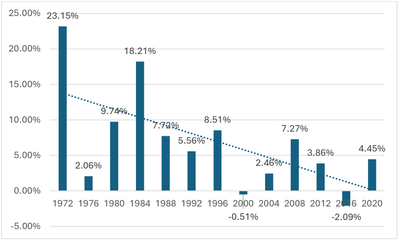
The 2024 Presidential campaign has been a roller coaster ride this summer. The upheavals are so fast and unprecedented that the reaction to each event often seems too muted. An assassination attempt and sudden pre-convention withdrawal? In a past generation, these events would be decisive, but in 2024, they seem like just the latest blip in the news cycle. The polls never seem to move more than a couple of points. In such an oddly volatile but also stable environment, our best bet to understanding what is going to transpire during the last 100 days of the election cycle is to look at data that gets to the heart of how voters view the candidates. My choice of fundamental data or essential metric is candidate fandom. Fandom is an unusual metric in politics, but it should be more common. Fandom is about passion for and loyalty to a cultural entity, be it a team, singer, university, or even politician. In fact, MAGA Trump supporters and Bernie Bros share many characteristics with Swifties and Lakers fans. Fans of all these things show up, spend, wear branded apparel, and fiercely defend the object of their fandom. The politicians who inspire fandom, such as AOC, Donald Trump, Barack Obama, and Marjorie Taylor Green, enjoy many advantages and are the celebrities of the political world. Fandom is critical in politics because fans are loyal, engaged, and resilient. Fans are not casual potential voters who may change preferences and are unlikely to make an effort to stand in line to vote. Fans are the voters who will show up rain or shine and who can’t be swayed. In 2024, a fan will interpret a conviction of their candidate as political “lawfare” rather than evidence of criminality. Also, in 2024, a fan will make excuses for signs of aging that would result in children taking a senior’s car keys. The flip side of fandom, anti-fandom, is also a powerful political force. Indeed, politics may be the cultural context in which anti-fandom has the most impact. Taylor Swift may have haters, but these anti-Swifties are not buying tickets to see Katy Perry in protest. But in politics, hatred of a candidate might be as powerful a tool for generating a vote as fandom. Joe Biden’s 2020 campaign was notoriously bad at drawing crowds, suggesting he inspired little passion. In contrast, Trump’s rallies looked like rabid sports crowds complete with matching hats. However, the hatred and fear of Donald Trump inspired sufficient anti-fandom to make Biden competitive. Of course, fandom doesn’t entirely decide elections. In most elections, there isn’t all that much fandom or passion. Beyond the presidency and senatorial contests, most candidates are barely known, and identity factors (race, gender, party affiliation) and candidate awareness are the determining factors. Even in presidential elections, get-out-the-vote efforts (ballot harvesting) and election regulations (voter suppression) combined with effective marketing to the few percent of swing (low information) voters are often the determining factors. Looking toward the future, fandom may be an increasingly salient political metric for multiple reasons. First, the last two decades have witnessed many candidates raised quickly from obscurity with somehow Hollywood-worthy origin stories (Barack Obama, AOC, JD Vance, etc.). In the modern media environment, candidates’ reputations (brands) are increasingly the product of marketing narratives rather than a lifetime of real-world accomplishments. In this new world of politics, fandom will be a critical metric. Second, with the increasing diversity of the American electorate, voting will be increasingly based on identity rather than ideology. Identity-based voting segments are likely to be driven by fandom (and anti-fandom) rather than policy. We see a form of this in 2024, as high inflation has barely made a dent in voters’ preferences for the two parties. A fragmented electorate comprised of racial and gender segments whose preferences are driven by fandom and anti-fandom will lead to increasingly negative campaigns featuring ads highlighting the threat of the non-preferred party’s candidates. When voters are focused on identity, negative advertising becomes the ideal method to use fear to create anti-fandom (hate) to motivate turnout. Kamala Harris versus Donald Trump Barring further disruptions, the matchup is set for the 2024 presidential contest (as of this writing, we do not know the Democratic VP). We do know the matchup between Donald Trump and Kamala Harris is a contest between polarizing figures. Donald Trump is a movement candidate who has redefined the Republican party. He inspires passionate fandom from his followers and amazing antipathy from major media and cultural outlets. Harris is also polarizing. In the immediate aftermath of Biden’s withdrawal, Harris received massive media and donor support. However, Harris has not demonstrated any significant national voter appeal, and her time as VP has generated ample blooper real material. My approach to assessing the race is to examine each candidate's fandom and anti-fandom. Fandom is the candidate’s core, resilient support, while anti-fandom is about antipathy. Fandom and anti-fandom are especially powerful metrics for a candidate because they are relatively fixed after a candidate gains high awareness. Once an individual identifies with the candidate (e.g., they are on the same team), an attack on the candidate is an attack on the individual. This means attack ads do not work because fans feel they are being attacked. Anti-fans are also important because they constrain a candidate’s support. A Trump anti-fan is unpersuadable by efforts from the Trump campaign because their identity is steeped in opposition to him. Fans and anti-fans are trapped in a cycle of confirmation bias where all information is processed to fit their fandom. I use data from the Next Generation Fandom Survey to assess candidate fandom and anti-fandom. The Next Generation Fandom Survey involves a nationwide sample of the U.S. population regarding fandom for sports and other cultural entities. In the 2024 edition, political figures such as Donald Trump, Joe Biden, Kamala Harris, and RFK Jr were included. The survey captured responses from 2053 subjects split evenly across the four primary generations (Gen Z, Millennials, Gen X, and Baby Boomers), and the sample is representative in terms of racial background. The survey does not focus on likely or registered voters, so the results reflect overall societal sentiments rather than the electorate's opinions. The critical survey question asks subjects to rate how much of a fan they are of a celebrity on a 1 to 7 scale. In the following discussion, individuals who rated their fandom a 6 or 7 on the 7-point scale are categorized as Fans, while those who rate their fandom a 1 or 2 are classified as Anti-Fans. Table 1 shows the Fandom and Anti-Fandom rates for the entire sample. Donald Trump has a 27% fandom rate compared to Harris's 21%. The fandom rate is crucial because it identifies the candidate's core support. It also indicates something important about the candidate’s potential likability. In terms of anti-fandom, Harris has a slightly higher Anti-Fandom rate. Anti-Fandom is also critical as it shows the percentage of people who hate a candidate. The data suggests that Americans find Harris to be more dislikable than Trump. Notably, the anti-fandom rates are significantly higher than the fandom rates. The American public has significant disdain for politicians. The high anti-fandom rates are both the product of past negative advertising and the cause of future negative campaign strategies. Table 1: Candidate Fandom and Anti-Fandom Table 2 reports fandom rates based of the two gender segments. Trump has a 7%-point advantage with men and a surprising 4% advantage with women. This is a stunning result as Trump is generally regarded as having weakness with female voters. However, this weakness shows up in the anti-fandom rates. In the male segment, Trump has a 5%-point advantage in anti-fandom (fewer anti-fans), but a 3% disadvantage in the female segment. This reveals that Trump is polarizing to women, and almost half of women find Trump to be highly dislikable. This finding is why the Harris campaign is likely to use advertising that casts Trump as misogynistic or a threat to women to motivate turnout by female voters. Table 2: Candidate Fandom by Gender Table 3 shows the fandom rates for the two younger demographic segments: Gen Z and Millennials. This Table also shows Trump’s relative performance versus Biden (in parentheses in the last column). Trump enjoys higher fandom and lower anti-fandom than Harris in both the Gen Z and Millennial segments. In terms of fandom, Trump is plus 6% in Gen Z and plus 11% with Millennials. Critically, Harris outperforms Biden. The Gen Z anti-fandom gap between Trump and Biden favored Trump by 6% points. However, this gap shrinks to just 1% point when Harris is the comparison. The data suggests that Harris is stronger with Gen Z than Biden. Table 3: Candidate Fandom in Younger Generations Table 4 reports the fandom rates based on a racial segmentation scheme. Specifically, the sample is divided into White and Non-White categories. This is a crude segmentation, but it illustrates some essential points. Trump enjoys a significant 14% positive fandom advantage in the White demographic. He also enjoys a 10-point edge in (lower) anti-fandom. The pattern essentially reverses in the Non-White segment, as Harris has a 10-point advantage in fandom and a 17-point edge in anti-fandom. Trump’s anti-fandom in the Non-White segment is critical to the campaign. Nearly half of this segment has antipathy or hate for Trump. This high anti-fandom suggests an opportunity for the Harris campaign to emphasize racial angles in their attacks on Trump. Table 4: Candidate Fandom by Race In addition to fandom and anti-fandom rates across demographic categories, insights can be gleaned by looking at segmentation variables that reflect cultural values or personality. Table 5 shows fandom and anti-fandom rates for Trump and Harris for segments defined by fandom for Taylor Swift (Swifties) and Baseball. The Swifties skew towards Harris. The implication is that young women engaged in popular culture have more positive fandom for Harris and more negativity toward Trump. This is unsurprising given the content of the popular culture and Swift’s personal liberalism. The Swiftie segment shows a much stronger skew for Harris than all but the Non-White segment. Examining the data at a cultural level is vital as it indicates that it isn’t necessarily youth or gender where Harris has an advantage but a combination of youth, gender, and a specific type of cultural engagement. The table also includes fandom rates for baseball fans. In the Baseball Fan segment, Trump enjoys an 8% point fandom advantage and a 7% anti-fandom advantage (lower anti-fandom). Like the case of the Swifties, the fandom rates of Baseball Fans reveal something about Trump’s core support. Baseball is a very traditional game with an older fan base, and traditionalism is probably the core value of Trump fans. Trump’s negative advertising is likely to focus on the threats to traditional values (i.e., Harris is a San Francisco liberal). Table 5: Candidate Fandom and Cultural Segments Commentary and Prediction Fandom is a powerful metric for predicting political success, but like most data points, it doesn’t tell the whole story. Fandom is a measure of unwavering core support while anti-fandom measures the group that will never support and is likely to show up to vote against a candidate. Examining fandom rates across multiple segments reveals that Harris’ core support is concentrated in specific cultural and racial segments. The analysis also suggests that Trump's core support is broader than is usually acknowledged and that his main problem is significant anti-fandom with women and minorities. Harris’ problem is a lack of love, while Trump’s is too much hate. Notably, I am not paying too much attention to the current wave of excitement and enthusiasm surrounding Harris. The recent enthusiasm is likely more a manifestation of the Democratic base’s hopes and a relentless media onslaught than an actual increase in passion for Harris. Maybe there will be a permanent shift upward in Harris’s fandom, but I don’t see any logic for why this would occur. Harris isn’t suddenly more likable or aspirational than she was last month. The argument that the American people are becoming more acquainted with her is dubious, given that she has been the Vice President or a major presidential candidate for almost five years. What are the implications for the upcoming election? Voting is not only about fandom or hate, so we must consider some additional factors. For instance, many potential voters lack passion and knowledge and are more prone to vote based on identity rather than ideology. If a region or demographic segment consistently votes for a party 75% of the time, that’s voting more based on fixed identities than current societal conditions. The American electorate has many of these types of fixed-preference voter segments. Furthermore, as the American electorate becomes more diverse, identity-based voting seems to be making presidential contests more predictable. The baseline seems to be that the Democratic candidate will win the popular vote by a few percentage points, and the Electoral College will come down to a few states, such as Michigan, Pennsylvania, and Wisconsin. Examining past electoral maps shows far more shifting of states across elections. Now, all but a handful of states are regarded as non-competitive. The Figure below shows the presidential popular vote margins for the last 50 years. It shows a trend towards smaller margins for the winning candidate, which is at least partly due to growing ethnic diversity and more fixed (at least in the near and medium terms) identity-based voting. Over the last 13 cycles, the margin of victory has dropped by about 1% every four years. Demographic change has also locked in a high baseline level of support for Democratic candidates. The last time a Republican won the popular vote was in 2004, with George Bush as the incumbent. Figure 1: Presidential Vote Margin 1972 to 2020 In addition to shrinking election margins, demographic change promises to change future campaign tones. The increasing relevance of fandom and anti-fandom, combined with the growing diversity of the electorate, will make 2024 an extremely negative campaign. The 2024 election will be determined by identity-based demographic trends and negative (anti-fandom) marketing campaigns. Demographics are destiny, and America is changing rapidly in ways that make it increasingly difficult for the Republicans to win the popular vote. It doesn’t matter if the Democrat is Harris, Newsom, Clinton, or Whitmer while the Republican is Rubio, Haley, Cruz, or Burgum. The baseline is probably 52% to 48%, D to R. Candidate fandom and anti-fandom probably shift the vote 2 or 3 percent in either direction. The correlation of demographic traits with voting behaviors creates incentives for campaign strategies that focus on identity. Republicans are eager to shift some percentage of Black or Hispanic voters to their cause because it simultaneously reduces the Democrats' base and grows Republican totals. In contrast, Democrats need to motivate marginal voters in the female, Black, and Hispanic segments to turn out. Fear-based appeals are the most effective tool for both parties' goals. Negative messaging is also prevalent because of the general view of politicians. Politicians tend to inspire more antipathy (anti-fandom) than admiration (fandom). The fandom data shows this, as both candidates have far more anti-fans than fans (this holds with other politicians) . The modern election calculus is, therefore, focused on aggressive negative ads that inspire marginal voters to take the initiative to vote against a hated candidate. Passion drives behavior, and it's far easier to drive fear and hatred of a candidate than to inspire passion and admiration. Considering the fandom data and the current electorate, I have two predictions. First, we will witness an incredibly nasty race. Harris’s best bet is to demonize Trump to motivate the anti-Trump voters to turn out. The American culture of 2024 includes constant repetition that many Democratic voting constituencies are marginalized and threatened. These segments are best motivated by using messages that cast the Republicans as the danger or oppressor. Women will fear losing reproductive rights, and African Americans will be primed with threats to voting rights. Trump will also employ negative messaging, but Trump’s adoption of a negative campaign comes from a slightly different motivation. Trump’s core support consists of conservatives who are frustrated by a lack of cultural power and representation. This group is looking for someone who will fight for their values. This desire for a “fighting advocate” explains much of Trump’s appeal, as his supporters are enthusiastic about his “mean tweets and nicknames.” There will also be fear-based advertising as Harris will be positioned as wanting to defund police and open the border. Second, Trump wins in a close contest. Comparing Trump’s and Harris’ fandom and anti-fandom suggests the Harris campaign faces an uphill challenge. Despite the current blitz of enthusiasm for Harris as a replacement for a failing Joe Biden, her “brand” has not shown an ability to stimulate passion, and her dislike levels exceed Trump's. It seems unlikely that she will be able to inspire fans. While Trump has a significant fanbase and weaknesses in terms of strong anti-fandom levels in minority and cultural segments, he probably beat Clinton in 2016 because her anti-fandom was equivalent to his. In contrast, he lost to Biden because Biden had less anti-fandom (in 2020). Kamala Harris seems more like Clinton than Biden, so look for a similar outcome as in 2016. The bottom-line prediction: An exceptionally negative campaign, with Trump’s greater baseline fandom and Harris’s charisma deficit leading to a narrow Trump victory. As in 2016,Trump wins the Electoral College while losing the popular vote. Addendum: Future Fandom Lesson The structure of the American electorate and the propensity of people to vote based on identity rather than ideology mean that negative campaigns are the standard in the near future. The essential observation is that demographic trends create an electorate that is more a collection of identity segments than a homogeneous population that varies in ideology. An increasingly diverse electorate likely means increasingly negative presidential campaigns as negative or fear-based appeals are especially effective when elections focus on threats to identity groups. The tragedy of this situation is that the negative messages of campaigns amplify racial division and acrimony. When the next election occurs, the electorate is even more polarized, and negative or fear-based appeals are again the most effective. Mike Lewis is an expert in the areas of analytics and marketing. This approach makes Professor Lewis a unique expert on fandom as his work addresses the complete process from success on the field to success at the box office and the campaign trail. Michael is available to speak with media - simply click on his icon now to arrange an interview today. Interested in following Future Fandom! Subscribe for free to receive new posts.



Forbes Ranks ChristianaCare Among America’s Best Employers for Women in 2024
ChristianaCare has been recognized as one of America’s Best Employers for Women by Forbes for 2024, marking the first time the company has received this prestigious recognition. In a survey of 150,000 women working for companies of at least 1,000 employees in the U.S., ChristianaCare ranked 150 on the list of 600 employers that were recognized. “This important recognition is a testament to our culture and the remarkable women who have chosen to build meaningful careers at ChristianaCare,” said Chris Cowan, MEd, FABC, ChristianaCare’s Chief Human Resources Officer. “Empowering women to succeed is integral to our culture and strengthens our organization. Together, we’ll continue to advance equity and inclusion in the workplace while transforming health and clinical care.” Forbes partnered with market research firm Statista, which surveyed employees on various aspects such as workplace environment, growth opportunities, compensation, diversity, parental leave, schedule flexibility and family assistance. ChristianaCare continues to cultivate a strong, inclusive, and diverse culture for women inside and outside the company by investing in professional development through its Women’s Employee Network (WEN) and providing a comprehensive benefits package that includes various flexible leave options for employees, including at least 12 weeks of paid parental leave. “Receiving this recognition from Forbes is an honor,” said Pamela Ridgeway, MBA, MA, SPHR, chief diversity officer and vice president of Talent and Acquisition at ChristianaCare. “In addition to offering workplace benefits such as paid maternity and paternity leave, ChristianaCare is firmly committed to empowering and advancing talented individuals within the workplace. Receiving this award for the first time signifies our unwavering dedication to ensuring that every individual has a voice and feels truly valued within our organization.” The Forbes recognition follows other national recognitions of ChristianaCare’s commitment to an inclusive workplace. Earlier this year, Forbes ranked ChristianaCare as one of the best employers for diversity in the U.S. Additionally, Forbes ranked ChristianaCare as the top health care employer for veterans in the United States. Both ChristianaCare’s Wilmington Hospital and Christiana Hospital have been named Leaders in LGBTQIA+ Healthcare Equality since 2012.



Sport and Study: Villanova University Faculty Offer Academic Lens to Paris Olympics Storylines
All eyes are on Paris: more than 10,000 athletes from 206 nations are set to compete in the Games of the XXXIII Olympiad, the third Olympics in the City of Love and the first since 1924. Below, Villanova University faculty members provide their academic expertise on the unique storylines and narratives already taking place as Paris 2024 gets underway. Portraying a National Image in the Opening Ceremony Étienne Achille, PhD Director of French and Francophone Studies After months of speculation, the daily Le Parisien has officially confirmed that renowned French-Malian singer Aya Nakamura will lend her vocals to an opening ceremony featuring an iconic backdrop steeped in history. “Nakamura is the most-streamed Francophone singer in the world, embodying France’s culture on a global stage, and she’ll be paying homage to one of the most cherished representatives of the chanson française,” said Dr. Achille, referring to reports she will sing one of beloved French crooner Charles Aznavour’s greatest hits. According to Dr. Achille, the pop star’s presence is significant and symbolic. “A performer, or even a flagbearer, can easily become the face of a global event like the Olympics,” he said. The details of the setting for the ceremony – in the heart of Paris, along the Seine – are just as intentionally symbolic. “Not only will this be the first opening ceremony to take place entirely outside of a stadium; its location along the river and the fact the delegations will be on boats are key. “It represents movement and connection to the world,” Dr. Achille said. “And Nakamura’s performance projects the image of a modern, multi-ethnic nation building on tradition while proudly marching into the future.” Swimming in the Seine: Safe or Not? Metin Duran, PhD Professor of Civil and Environmental Engineering It is, perhaps, the most-asked question of the last few weeks. Is the Seine River, set to host multiple swimming events, safe? The river has been illegal to swim in for a century due to the presence of harmful bacteria such as E. Coli, and recent testing has reaffirmed this concern. The Seine, which had undergone an expensive cleaning to mitigate this issue, received the endorsement of Paris Mayor Ann Hidalgo, who personally took a dip in the water herself to attest to its safety. The stunt did little to convince experts such as Dr. Duran, who studies wastewater, to abandon concern about the potential health risks of athletes being exposed to pathogens in the water. “When we have fecal pollution, there is a high likelihood of pathogens being present,” Dr. Duran said. “Those could be viral, like a norovirus, or protozoan. “If you’re swimming in that water, you run the risk of ingesting it. Once you ingest that polluted water, you’re likely to contract some of those disease-causing pathogens. Ingesting this water doesn’t mean you’re necessarily going to get sick, but based on the number of people in a big city like Paris, there is a very high likelihood of some of these pathogens existing now in the river.” Accommodations for Breastfeeding Athletes Sunny Hallowell, PhD, APRN, PPCNP-BC Associate Professor of Nursing The IOC and Paris 2024 Organizing Committee is providing support to all breastfeeding athletes competing in the Games. A few national governing bodies, like the French Olympic Committee, are going a step further and offering hotel rooms near the Village for their country’s breastfeeding athletes to share with their children and spouses. “A few decades ago, the idea of a female athlete who also wanted to breastfeed their child was so taboo it may have prevented an athlete from competing,” said Dr. Hallowell. “Now, many female athletes who choose to breastfeed their newborns or toddlers conceptualize breastfeeding as another normal function of their remarkably athletic bodies.” Accommodation for breastfeeding athletes and increased awareness are needed more than ever. Dr. Hallowell notes that in addition to changing views on breastfeeding, the needs for such accommodations are increasing as the age of peak athletic performance also increases. “Advances in sports nutrition, wellness and lifestyle have extended the longevity and performance of many athletes into adulthood,” she said. And while some athletes with rigorous training regimens might feel “frustrated incorporating breastfeeding into the routine,” Dr. Hallowell says that for others, “breastfeeding provides both physical and socio-emotional benefits for the mother and the infant that allow the athlete to focus on the job of competition.” Protecting Against the Parisian Heat Ruth McDermott-Levy, PhD, MPH, RN, FAAN Professor of Nursing The potential for extreme heat in Paris has been a topic of concern for athletes and organizers, prompting certain outdoor events to be proactively scheduled at times to avoid the day’s worst heat. Current forecasts predict temperatures in the 90s for several days early on in the Games, which could be exacerbated by Paris’ reputation as an urban heat island, unable to cool due to lack of green space and building density. Dr. McDermott-Levy says the athletes are inherently vulnerable, because “the added stress of physical exertion during their events puts them at greater risk of heat-related illness.” But she also notes that many of the athletes have likely undergone pre-competition training in extreme heat conditions to acclimate and will have trainers and health professionals monitoring them frequently. “The group of concern are the workers at the stadiums, outdoor workers and spectators who are there to enjoy or work at the events and may have had little to no acclimation,” Dr. McDermott-Levy said. “They need to follow local instructions and take frequent breaks from the heat, seek shade and maintain hydration by avoiding alcohol and sugary drinks and drinking water.” How Nature Can Inspire Future Use of Olympic Infrastructure Alyssa Stark, PhD Assistant Professor of Biology Gone, hopefully, are the days of abandoned Olympic Villages and venues, overrun with weeds and rendered useless soon after the Games conclude. The IOC’s commitment to sustainability has been transparently relayed ahead of the 2024 Games, featuring a robust range of initiatives and programs. Dr. Stark is particularly interested in one aspect of ensuring a sustainable Olympics. “How will the structures, materials and systems they developed for the Olympics be re-used, re-shaped or re-worked afterward?” she posed. “This could include re-using buildings to larger scale or re-working transportation systems set in place for the Games that could then integrate into day-to-day life post Olympics.” At the root of her interest is the concept of biomimicry. “A lot of the way we think about designing, if we’re using this biomimicry lens, is how do we learn from nature to solve problems that we have in a sustainable way, keeping in mind the environment we are in?” Dr. Stark said. In this case, consider how something like a dwelling of a living creature might be repurposed to fit the needs of another creature, or serve another natural purpose, without harming the ecosystem. Could that inspire a way to re-use the Olympic infrastructure? “There are a ton of examples of [biomimicry] being used and working in products,” Dr. Stark said. “But I would say the next step is looking at the social levels of these big ecosystems – building architecture, city planning, flow of information and, in this instance, repurposing what was created for the Olympics.” Paris Could Be a Transportation Model for Major City Events in the United States Arash Tavakoli, PhD Professor of Civil and Environmental Engineering Paris has invested 250 million Euro the last several years to transform the city to a 100% cycling city, making it one of the most bike-friendly municipalities in the world. Currently, more trips are being made by bicycles in Paris than by cars (11% vs. 4%), a trend that has permeated to the surrounding suburbs as well. With an influx of travelers in Paris for the Games, Dr. Tavakoli, an expert in human transportation, said, “The Olympics will be a test for how well these kinds of systems respond to high fluctuations in the population as compared to vehicle-centric systems.” While Paris is thousands of miles away from the United States, how bicycle, pedestrian and vehicle systems work during the Games could provide helpful insight ahead of major events in American cities. “With the World Cup coming to the U.S. in a few years, it will be interesting to compare [Paris] with how our own system responds to people’s needs,” Dr. Tavakoli said. “Not just based on traffic data and congestion, but also considering factors like how comfortable the transportation system is, how much it affects our well-being and how much it attracts a nonresident to enjoy the U.S. when their only option, for the most part, is a vehicle.”


States Most and Least Impacted by Natural Disasters
For a report on states with the most (and least) climate risk today, MoneyGeek interviewed Jase Bernhardt, associate professor and director of Sustainability Studies and Meteorology in the Department of Geology, Environment and Sustainability. Dr. Bernhardt talked about the biggest natural hazards that are affecting the country and how the population can prepare for events like flooding, extreme heat, and severe thunderstorms. Jase Bernhardt is also an expert on hurricane preparedness. He is available to speak with media about these topics - simply click on his icon now to arrange an interview today.


Global Technology Outage Raises Concerns About Ease of Future Cybersecurity Attacks
The world came to a standstill after a technology outage reported Thursday evening grounded airplanes, disconnected hospitals and shut down banks across the globe. A faulty software update was to blame, not cybercriminals, but Florida Tech assistant professor TJ O’Connor said the outage’s cascading effect points to larger concerns about our society’s reliance on the internet. The outage, which affected users’ ability to access Microsoft 365 applications, was traced back to a defect found in a software update from cybersecurity company CrowdStrike. CrowdStrike quickly released a statement confirming that the outage was “not a security incident or cyberattack.” The outage was nonetheless damaging, kicking institutions offline. Issues remained more than a day later. “Once those services go down, there’s this massive cascading effect,” O’Conner said. “If bank processing doesn’t work, then aviation doesn’t work. If aviation doesn’t work, shipping doesn’t work.” Ultimately, O’Connor explained, the biggest concern isn’t the glitch in the system; it’s the number of systems that broke because CrowdStrike wasn’t working. “I think what we’ll see a lot of people learn from this CrowdStrike incident is…that if they want to take the internet down in the future, all they have to do is hit one target,” O’Connor said. “It makes the threat landscape a lot smaller to attack for an adversary.” Over the course of several hours, a blue Microsoft error screen taunted companies worldwide. Airlines including Delta, American and Frontier grounded all flights. Several television news outlets, including the United Kingdom’s Sky News, were unable to hold live broadcasts. Some of the biggest concerns lie in the hospital industry, where planning, evaluation and continuous monitoring are essential, O’Connor noted. “[Hospitals] are constantly processing so much data, and for them to go out for a couple of hours means that decisions aren’t being made on an automated basis,” O’Connor said. “We’ve kicked over so much of our decision making to automated systems that we can’t let those networks fail.” According to the United Kingdom’s National Health Service (NHS), the outage disrupted its appointment and patient record system. Mass General Brigham in Boston, Massachusetts was also one of several U.S. hospitals that cancelled non-urgent surgeries, procedures, and medical visits because of the disruption. 911 outages were also reported in several states, including Phoenix, Arizona, whose computerized dispatch center was affected, the police department posted on social media. In Portland, Oregon, Mayor Ted Wheeler issued a citywide state of emergency due to the outage’s impact on city servers, computers and emergency communications. Although CrowdStrike confirmed the incident was not malicious, O’Connor said it raises questions about overall reliance on the internet to make decisions, as well as ineffectiveness in securing it. “We continually have these wake-up moments where something happens, it’s large scale, it’s a news blip, and then we forget about it… but our adversaries don’t,” O’Connor said. “Unfortunately, the attack infrastructure and the ability to attack is getting easier and easier.” O’Connor also expects future network attacks to get worse, calling the unstable global environment a “national-level issue to address.” While large-scale attacks and outages are mostly out the individuals’ control, O’Connor said, people can take action to protect themselves from personal cybersecurity attacks by using multi-factor authentication as much as possible. Looking to know more? Dr. TJ O’Connor’s research is focused on cybersecurity education, wireless protocols, software-defined radio and machine learning. If you're looking to connect with Dr. O'Connor - simply click on his icon now to arrange an interview today.


Decoding Hierarchies in Business: When is Having a Boss a Benefit for an Organization?
Most companies around the world have a leader, whether that title is a President, CEO, or Founder. There’s almost always someone at the very top of a corporate food chain, and from that position down, the company is structured hierarchically, with multiple levels of leadership supervising other employees. It’s a structure with which most people in the working world are familiar, and it dates back as long as one can remember. The word itself—leader—dates back to as far as the 12th Century and is derived from the Old English word “laedere,” or one who leads. But in 2001, a group of software engineers developed the Agile Workflow Methodology, a project development process that puts a priority on egalitarian teamwork and individual independence in searching for solutions. A number of businesses are trying to embrace a flatter internal structure, like the agile workflow. But is it necessarily the best way to develop business processes? That’s the question posed by researchers, including Goizueta Business School’s Özgecan Koçak, associate professor of organization and management, and fellow researchers Daniel A. Levinthal and Phanish Puranam in their recently published paper on organizational hierarchies. “Realistically, we don’t see a lot of non-hierarchical organizations,” says Koçak. “But there is actually a big push to have less hierarchy in organizations.” "Part of it is due to the demotivating effects of working in authoritarian workplaces. People don’t necessarily like to have a boss. We place value in being more egalitarian, more participatory." Özgecan Koçak, Associate Professor of Organization & Management “So there is some push to try and design organizations with flatter hierarchies. That is specifically so in the context of knowledge-based work, and especially in the context of discovery and search.” Decoding Organizational Dynamics While the idea of an egalitarian workplace is attractive to many people, Koçak and her colleagues wanted to know if, or when, hierarchies were actually beneficial to the health of organizations. They developed a computational agent-based model, or simulation, to explore the relationships between structures of influence and organizational adaptation. The groups in the simulation mimicked real business team structures and consisted of two types of teams. In the first type, one agent had influence over the beliefs of rest of the team. For the second type, no one individual had any influence over the beliefs of the team. The hierarchical team vs. the flat structured team. “When you do simulations, you want to make sure that your findings are robust to those kinds of things like the scale of the group, or the how fast the agents are learning and so forth,” says Koçak. "What’s innovative about this particular simulation is that all the agents are learning from their environment. They are learning through trial and error. They are trying out different alternatives and finding out their value." Özgecan Koçak Koçak is very clear that the hierarchies in the simulation are not exactly like hierarchies in a business organization. Every agent was purposefully made to be the same without any difference in wisdom or knowledge. “It’s really nothing like the kinds of hierarchies you would see in organizations where there is somebody who has a corner office, or somebody who is has a management title, or somebody’s making more than the others. In the simulation, it’s nothing to do with those distributional aspects or control, and nobody has the ability to control what others do in (the simulation). All control comes through influence of beliefs.” Speed vs. Optimal Solutions What they found in the simulation was that while both teams solved the same problems presented to them, they achieved different results at different speeds. "We find that hierarchical teams don’t necessarily find the best solution, but they find the good enough solution in the shorter term. So if you are looking at the really long term, crowds do better. The crowds where individuals are all learning separately, they find the best solution in the long run, even though they are not learning from each other." Özgecan Koçak For example, teams of scientists looking for cures or innovative treatments for diseases work best with a flat structure. Each individual works on their own timeline, with their own search methodologies. The team only comes together for status updates or to discuss their projects without necessarily getting influence or direction from colleagues. The long-term success of the result is more important in some cases than the speed at which they arrive to their conclusion. That won’t work for an organization that answers to a board of directors or shareholders. Such parties want to see rapid results that will quickly impact the bottom line of the company. This is why the agile methodology is not beneficial to large-scale corporations. Koçak says, “When you try to think about an entire organization, not just teams, it gets more complicated. If you have many people in an organization, you can’t have everybody just be on the same team. And then you have to worry about how to coordinate the efforts of multiple teams. "That’s the big question for scaling up agile. We know that the agile methodology works pretty well at the team level. However, when firms try to scale it up applied to the entire organization, then you have more coordination problems." Özgecan Koçak Özgecan Koçak (pronounced as ohz-gay-john ko-chuck) is associate professor of Organization & Management at Emory University’s Goizueta Business School. If you're looking to know more about this topic or connect with Özgecan for an interview - simply click on her icon today


Listen to the Insights of an Expert: Heat Wave Hits Long Island
Jase Bernhardt, associate professor and director of Sustainability Studies in the Department of Geology, Environment and Sustainability, was interviewed by Newsday about the recent heat wave Long Island experienced can be linked to climate change. “That dome is allowing hot, humid air to come up from the Gulf of Mexico and the southeast US straight into the Northeast and straight into New York,” said Dr. Bernhardt. “Also, given that we have direct sun angle, the longest days of the year, it’s allowing very hot days.” Jase Bernhardt is also an expert on hurricane preparedness. He is available to speak with media about these topics - simply click on his icon now to arrange an interview today.

Small Changes Can Save Lives: How a Police Officer’s First Words Can Transform Communities
Britt Nestor knew something needed to change. Nestor is a police officer in North Carolina. Unlike many in her field, who recite interview-ready responses about wanting to be a police officer since childhood, Nestor admits that her arrival to the field of law enforcement was a serendipitous one. Told by teachers to start rehearsing the line “do you want fries with that?” while in high school, Nestor went to college to prove them wrong—and even graduated with a 3.9 GPA solely to prove those same people wrong—but she had absolutely no idea what to do next. When a local police department offered to put her through the police academy, her first thought was, “absolutely not.” “And here I am,” says Nestor, 12 years into her career, working in Special Victims Investigations as an Internet Crimes Against Children detective. A Calling to Serve Community Brittany Nestor, New Blue Co-Founder and President Though she’d initially joined on a whim, Nestor stuck around and endured many growing pains, tasting some of the problematic elements of police culture firsthand. As a woman, there was particular pressure to prove herself; she resisted calling for back-up on dangerous calls for fear of being regarded as weak, and tried out for and joined the SWAT team to demonstrate her mettle. "It took time to realize I didn’t need to make the most arrests or get the most drugs and guns to be a good cop. What was important was recognizing that I was uniquely positioned and given opportunities every single shift to make a difference in people’s lives—that is what I wanted to focus on." Britt Nestor Nestor found she took great pleasure in interacting with different kinds of people all day. She’s deeply fond of her community, where she is also a youth basketball coach. One of her greatest joys is being on call or working an event and hearing someone hail her from the crowd by yelling, “hey, coach!” When she landed in the Juvenile Investigations Unit, Nestor truly felt she’d found her calling. Still, what she’d witnessed in her profession and in the news weighed on her. And she’s not alone; while there is continued debate on the urgency and extent of changes needed, 89% percent of people are in favor of police reform, according to a CBS/YouGov poll. A few weeks after George Floyd’s murder in 2020, Nestor’s colleague Andy Saunders called her and told her they had to do something. It felt like the tipping point. “I knew he was right. I needed to stop wishing and hoping police would do better and start making it happen.” Andy Saunders, New Blue Co-Founder and CEO That conversation was the spark that grew into New Blue. Founded in 2020, New Blue strives to reform the U.S. Criminal Justice system by uniting reform-minded police officers and community allies. The organization focuses on incubating crowd-sourced solutions from officers themselves, encouraging those in the field to speak up about what they think could improve relations between officers and the communities they serve. “Over the years I’ve had so many ideas—often addressing problems brought to light by community members—that could have made us better. But my voice was lost. I didn’t have much support from the police force standing behind me. This is where New Blue makes the difference; it’s the network of fellows, alumni, partners, mentors, and instructors I’d needed in the past.” Nestor and Saunders had valuable pieces of the puzzle as experienced law enforcement professionals, yet they knew they needed additional tools. What are the ethical guidelines around experimenting with new policing tactics? What does success look like, and how could they measure it? The Research Lens Over 400 miles away, another spark found kindling; like Nestor, Assistant Professor of Organization & Management Andrea Dittmann’s passion for making the world a better place is palpable. Also, like Nestor, it was an avid conversation with a colleague—Kyle Dobson—that helped bring a profound interest in police reform into focus. Dittmann, whose academic career began in psychology and statistics, came to this field by way of a burgeoning interest in the need for research-informed policy. Much of her research explores the ways in which socioeconomic disparities play out in the work environment, and—more broadly—how discrepancies of power shape dynamics in organizations of all kinds. When people imagine research in the business sector, law enforcement is unlikely to crop up in their mind. Indeed, Dittmann cites the fields of criminal justice and social work as being the traditional patrons of police research, both of which are more likely to examine the police force from the top down. Andrea Dittmann Dittmann, however, is a micro-oriented researcher, which means she assesses organizations from the bottom up; she examines the small, lesser-studied everyday habits that come to represent an organization’s values. “We have a social psychology bent; we tend to focus on individual processes, or interpersonal interactions,” says Dittmann. She regards her work and that of her colleagues as a complementary perspective to help build upon the literature already available. Where Dittmann has eyes on the infantry level experience of the battleground, other researchers are observing from a bird’s eye view. Together, these angles can help complete the picture. And while the “office” of a police officer may look very different from what most of us see every day, the police force is—at the end of the day—an organization: “Like all organizations, they have a unique culture and specific goals or tasks that their employees need to engage in on a day-to-day basis to be effective at their jobs,” says Dittmann. Theory Meets Practice Kyle Dobson, Postdoctoral Researcher at The University of Texas at Austin What Dittmann and Dobson needed next was a police department willing to work with them, a feat easier said than done. Enter Britt Nestor and New Blue. "Kyle and I could instantly tell we had met people with the same goals and approach to reforming policing from within." Andrea Dittmann Dittmann was not surprised by the time it took to get permission to work with active officers. “Initially, many officers were distrustful of researchers. Often what they’re seeing in the news are researchers coming in, telling them all the problems that they have, and leaving. We had to reassure them that we weren’t going to leave them high and dry. If we find a problem, we’re going to tell you about it, and we’ll work on building a solution with you. And of course, we don’t assume that we have all the answers, which is why we emphasize developing research ideas through embedding ourselves in police organizations through ride-alongs and interviews.” After observing the same officers over years, they’re able to build rapport in ways that permit open conversations. Dittmann and Dobson now have research running in many pockets across the country, including Atlanta, Baltimore, Chicago, Washington, D.C. and parts of Texas. The Rise of Community-Oriented Policing For many police departments across the nation, there is a strong push to build closer and better relationships with the communities they serve. This often translates to police officers being encouraged to engage with citizens informally and outside the context of enforcing the law. If police spent more time chatting with people at a public park or at a café, they’d have a better chance to build rapport and foster a collective sense of community caretaking—or so the thinking goes. Such work is often assigned to a particular unit within the police force. This is the fundamental principle behind community-oriented policing: a cop is part of the community, not outside or above it. This approach is not without controversy, as many would argue that the public is better served by police officers interacting with citizens less, not more. In light of the many high-profile instances of police brutality leaving names like Breonna Taylor and George Floyd echoing in the public’s ears, their reticence to support increased police-to-citizen interaction is understandable. “Sometimes when I discuss this research, people say, ‘I just don’t think that officers should approach community members at all, because that’s how things escalate.’ Kyle and I acknowledge that’s a very important debate and has its merits.” As micro-oriented researchers, however, Dittmann and Dobson forgo advocating for or dismissing broad policy. They begin with the environment handed to them and work backward. “The present and immediate reality is that there are officers on the street, and they’re having these interactions every day. So what can we do now to make those interactions go more smoothly? What constitutes a positive interaction with a police officer, and what does it look like in the field?” Good Intentions Gone Awry To find out, they pulled data through a variety of experiments, including live interactions, video studies and online experiments, relying heavily on observation of such police-to-citizen interactions. "What we wanted to do is observe the heterogeneity of police interactions and see if there’s anything that officers are already doing that seems to be working out in the field, and if we can ‘bottle that up’ and turn that into a scalable finding." Andrea Dittmann Dittmann and her colleagues quickly discovered a significant discrepancy between some police officers’ perceived outcome of their interactions with citizens and what those citizens reported to researchers post-interaction. “An officer would come back to us and they’d say it went great. Like, ‘I did what I was supposed to do, I made that really positive connection.’ And then we’d go to the community members, and we’d hear a very different story: ‘Why the heck did that officer just come up to me, I’m just trying to have a picnic in the park with my family, did I do something wrong?’” Community members reported feeling confused, harassed, or—at the worst end of the spectrum—threatened. The vast majority—around 75% of citizens—reported being anxious from the very beginning of the interaction. It’s not hard to imagine how an officer approaching you apropos of nothing may stir anxious thoughts: have I done something wrong? Is there trouble in the area? The situation put the cognitive burden on the citizen to figure out why they were being approached. The Transformational Potential of the “Transparency Statement” And yet, they also observed officers (“super star” police officers, as Dittmann refers to them) who seemed to be especially gifted at cultivating better responses from community members. What made the difference? “They would explain themselves right from the start and say something like, ‘Hey, I’m officer so-and-so. The reason I’m out here today is because I’m part of this new community policing unit. We’re trying to get to know the community and to better understand the issues that you’re facing.’ And that was the lightbulb moment for me and Kyle: the difference here is that some of these officers are explaining themselves very clearly, making their benevolent intention for the interaction known right from the start of the conversation.” Dittmann and her colleagues have coined this phenomenon the “transparency statement.” Using a tool called the Linguistic Inquiry & Word Count software and natural language processing tools, the research team was able to analyze transcripts of the conversations and tease out subconscious cues about the civilians’ emotional state, in addition to collecting surveys from them after the encounter. Some results jumped out quickly, like the fact that those people whose conversation with an officer began with a transparency statement had significantly longer conversations with them. The team also employed ambulatory physiological sensors, or sensors worn on the wrist that measure skin conductivity and, by proxy, sympathetic nervous system arousal. From this data, a pattern quickly emerged: citizens’ skin conductance levels piqued early after a transparency statement (while this can be a sign of stress, in this context researchers determined it to reflect “active engagement” in the conversation) and then recovered to baseline levels faster than in the control group, a pattern indicative of positive social interaction. Timing, too, is of the essence: according to the study, “many patrol officers typically made transparency statements only after trust had been compromised.” Stated simply, the interest police officers showed in them was “perceived as harassment” if context wasn’t provided first. Overall, the effect was profound: citizens who were greeted with the transparency statement were “less than half as likely to report threatened emotions.” In fact, according to the study, “twice as many community members reported feeling inspired by the end of the interaction.” What’s more, they found that civilians of color and those from lower socioeconomic backgrounds —who may reasonably be expected to have a lower baseline level of trust of law enforcement—“may profit more from greater transparency.” Talk, it turns out, is not so cheap after all. Corporate Offices, Clinics, and Classrooms The implications of this research may also extend beyond the particulars of the police force. The sticky dynamics that form between power discrepancies are replicated in many environments: the classroom, between teachers and students; the office, between managers and employees; even the clinic, between medical doctors and patients. In any of these cases, a person with authority—perceived or enforceable—may try to build relationships and ask well-meaning questions that make people anxious if misunderstood. Is my boss checking in on me because she’s disappointed in my performance? Is the doctor being nice because they’re preparing me for bad news? “We believe that, with calibration to the specific dynamics of different work environments, transparency statements could have the potential to ease tense conversations across power disparities in contexts beyond policing,” says Dittmann. More Research, Action, and Optimism What could this mean for policing down the road? Imagine a future where most of the community has a positive relationship with law enforcement and there is mutual trust. "I often heard from family and friends that they’d trust the police more ‘if they were all like you.’ I can hear myself saying, ‘There are lots of police just like me!’ and I truly believe that. I believe that so many officers love people and want to serve their communities—and I believe a lot of them struggle with the same things I do. They want to see our profession do better!" Britt Nestor “When I get a new case and I meet the survivor, and they’re old enough to talk with me, I always explain to them, ‘I work for you. How cool is that?’ And I truly believe this: I work for these kids and their families.” The implications run deep; a citizen may be more likely to reach out to police officers about issues in their community before they become larger problems. An officer who is not on edge may be less likely to react with force. Dittmann is quick to acknowledge that while the results of the transparency statement are very promising, they are just one piece of a very large story with a long and loaded history. Too many communities are under supported and overpoliced; it would be denying the gravity and complexity of the issue to suggest that there is any silver bullet solution, especially one so simple. More must be done to prevent the dynamics that lead to police violence to begin with. “There’s a common narrative in the media these days that it’s too late, there’s nothing that officers can do,” says Dittmann. Yet Dittmann places value on continued research, action and optimism. When a simple act on the intervention side of affairs has such profound implications, and is not expensive or difficult to implement, one can’t help but see potential. “Our next step now is to develop training on transparency statements, potentially for entire agencies,” says Dittmann. “If all the officers in the agency are interacting with transparency statements, then we see this bottom-up approach, with strong potential to scale. If every interaction you have with an officer in your community starts out with that transparency statement, and then goes smoothly, now we’re kind of getting to a place where we can hopefully talk about better relations, more trust in the community, at a higher, more holistic, level.” While the road ahead is long and uncertain, Dittmann’s optimism is boosted by one aspect of her findings: those community members who reported feeling inspired after speaking with police officers who made their benevolent intentions clear. "That was really powerful for me and Kyle. That’s what gets me out of bed in the morning. It’s worth trying to move the needle, even just a little bit." Andrea Dittmann Looking to know more? Andrea Dittman is available to speak with media about this important research. Simply click on her icon now to arrange an interview today.

The EPA Cracks Down on "Forever Chemicals" in Drinking Water
For many years, toxic per- and polyfluoroalkyl substances (PFAS) have contaminated drinking water supplies across the United States. But in April, the Environmental Protection Agency (EPA) announced major steps to rein in these stubborn "forever chemicals." In a groundbreaking move, the EPA set strict new limits on six types of PFAS that are currently present in drinking water. Permitted levels of these chemicals are now close to zero, as water suppliers will be required to reduce them to the lowest level that can possibly be measured. These are the first-ever nationwide drinking water regulations for PFAS issued by the federal government. "The EPA is asking water companies to try to get PFAS levels to zero because there's no safe level. It's very difficult to test below four parts per trillion with the equipment and the testing mechanisms we have right now, so the levels will be reduced as much as they possibly can," said Laura Anderko, PhD, co-director of the Mid-Atlantic Center for Children's Health and the Environment at Villanova University's M. Louise Fitzpatrick College of Nursing. So, what's driving this urgency to minimize exposure to PFAS? Our children's health is one big reason. As Dr. Anderko explains, "Children are more susceptible and vulnerable to the health impacts of PFAS because their bodies are still growing. Some of the health issues resulting from PFAS exposure are high cholesterol and a decrease in infant growth and fetal growth—so much so that there's a tendency towards low birth weight." Adults aren't spared either. PFAS has been linked to health issues including kidney cancer, liver problems and reduced antibody response from vaccines. For pregnant women, PFAS can increase the risk of high blood pressure. "These chemicals do impact pretty much every organ system of the body," Dr. Anderko said. With many different PFAS compounds used in products from fast food packaging to Band-Aids to carpeting, avoiding exposure to them can be difficult. Dr. Anderko's advice to reduce exposure is to educate yourself on what products contain PFAS and purchase alternative options when possible. She also cautions against relying solely on bottled water, which isn't necessarily safer than tap water. "We have this idea that bottled water is safe because it's packaged, but a lot of times that water is not tested, and we know for a fact that bottled water is filled with microplastics," she said. "You're better off not relying on bottled water unless you absolutely have to." Per Dr. Anderko, in the United States, chemicals can be inserted into some products without stringent testing for human health effects beforehand, so the EPA's new PFAS limits represent a major step toward putting human health first. While there is still a long road ahead to completely eliminate PFAS from our daily lives, these new regulations signal a welcome shift toward protecting public health in our country.

Naronda Wright elected President of NAGAP, the Association for Graduate Enrollment Management
Naronda Wright, Ed.D., associate dean of Graduate Student Services in Georgia Southern University’s Jack N. Averitt College of Graduate Studies, was recently elected president of NAGAP, the Association for Graduate Enrollment Management. She is the first African American to hold the role of president in the association. Wright, a seasoned professional in the field of graduate enrollment management, brings more than 15 years of experience to her new role. In her position at Georgia Southern, Wright has been instrumental in implementing innovative recruitment strategies and enhancing student services, contributing significantly to the growth and diversity of the graduate programs. Under her leadership for NAGAP, Wright plans to focus on expanding the association’s reach, enhancing member engagement and advancing the association’s strategic initiatives aimed at supporting its members’ professional development. “I am deeply honored to serve as the president of NAGAP and look forward to working closely with our members across the globe to foster an environment of knowledge sharing and professional growth,” said Wright. Wright’s election comes at a pivotal time as the association seeks to navigate the challenges of the ever-evolving educational landscape and harness opportunities to drive positive change in graduate enrollment practices worldwide. “We are thrilled to welcome Dr. Wright as the new president of NAGAP,” said Haley Brust, executive director of NAGAP. “Her extensive experience and dedicated leadership are vital as we continue to support our members and advocate for the importance of graduate enrollment management.” Wright holds a Doctor of Education in Higher Education Leadership from Clark Atlanta University and a Master of Education in Higher Education Administration from Georgia Southern. She has previously served NAGAP as vice president, secretary and conference committee chair. NAGAP is dedicated to the professional advancement and support of individuals in graduate enrollment management. NAGAP offers its members professional development opportunities, cutting-edge research and a community network to foster best practices in graduate education. For additional information about NAGAP and its services, please visit www.nagap.org. If you're interested in learning more or a reporter looking to speak with Naronda Wright - simply Contact Georgia Southern's Director of Communications Jennifer Wise at jwise@georgiasouthern.edu to arrange an interview today.
