
Experts Matter. Find Yours.
Connect for media, speaking, professional opportunities & more.
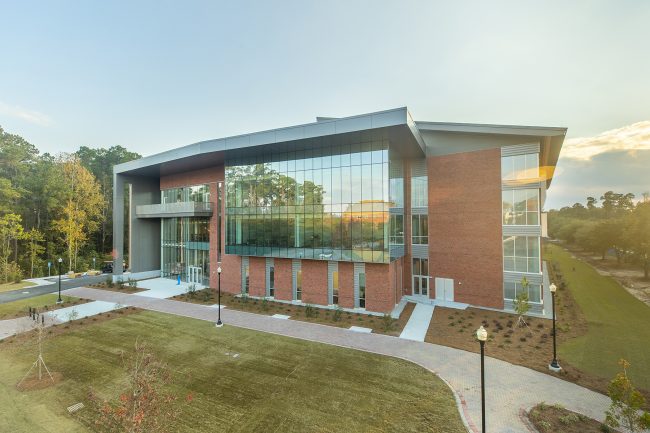
Last Friday, Georgia Southern officially opened its new Engineering and Research Building for students and researchers, a facility that will serve as the epicenter for engineering excellence and innovation in southeast Georgia. The building is designed to facilitate academic and institutional partnerships, inspire creative engineering and accelerate academic success for students in the College of Engineering and Computing. Through the instructional research labs and academic spaces that bridge theory and practice, students will be prepared to solve today’s challenges and to make tomorrow’s discoveries. “Today marks the culmination of years of forethought and investment from a number of state leaders, industry leaders and local advocates, who paved the way for us to be here,” said Georgia Southern President Kyle Marrero. “Leaders who, dating back to the 90s, could see the future of a growing industry, a state on the precipice of being a national leader in technology and innovation, and a critical need to develop talent in applied engineering across south Georgia.” The Engineering and Research Building’s sleek, contemporary environment defined by glass and natural light, soaring high-bay ceilings and modern, industrial feel is strengthened by new, industry-relevant equipment, instrumentation and technology that encourage active learning and sustainability. The highly efficient facility includes sustainable features that complements existing spaces on campus. The three-story building houses applied research spaces with a strong focus on manufacturing engineering, civil engineering, electrical and computer engineering, and mechanical engineering. The workspaces can be easily reconfigured for various uses, projects and applications and provide students with access to industry-grade equipment as well as expanded opportunities for undergraduate research. “The investment of the Engineering and Research Building solidifies Georgia Southern University’s commitment to students in providing a world-class education in the engineering field, while providing the space and resources necessary to facilitate such,” said student Kristifer Bell. “I am enthusiastic to continue my research work and look forward to the interdepartmental collaboration that will be encouraged through the housing of new student and faculty labs under one roof.” The full media release about this historic occasion is attached – and if you are a journalist looking to know more about this facility or Southern Georgia University -- simply reach out to Georgia Southern Director of Communications Jennifer Wise at jwise@georgiasouthern.edu to set and time and date.


Network Science Offers Key Insights into Polarization, Disinformation, and Minority Power
People tend to think of the arena of politics as being driven by human decision and emotions, and therefore unpredictable. But network scientists like Boleslaw Szymanski, a computer science professor at Rensselaer Polytechnic Institute, have found that the country’s political activity – from American society’s ever-growing partisan divide to its grappling with the spread of misinformation online – can be explained by abstract and elegant models. These models provide insights — and even answers — to a number of pressing questions: Is increasing access to information driving us apart? Can an entrenched minority ultimately prevail? Could structural changes be made that insulate us from misinformation and reduce the polarization that divides us? Szymanski studies the technical underpinnings of our choices, how we influence one another, and the impact of the algorithms we rely upon to navigate a growing ocean of information. His work has yielded fascinating insights, including research on how a committed minority will overcome less determined opposition and the development of a parameter to determine what drives polarization in Congress. Through his research on the influence of minority opinions, Szymanski found that when just 10 percent of the population holds an unshakable belief, it will ultimately be adopted by the majority of the society. “When the number of committed opinion holders is below 10 percent, there is no visible progress in the spread of ideas. It would literally take the amount of time comparable to the age of the universe for this size group to reach the majority,” said Szymanski, a computer science professor at Rensselaer Polytechnic Institute. “Once that number grows above 10 percent, the idea spreads like flame.” In his present work, Szymanski is researching tools for measuring the level of polarization in specific news sites, search engines, and social media services, and developing remedies, like algorithms that offer better data provenance, detect misinformation, and create internal consistency reasoning, background consistency reasoning, and intra-element consistency reasoning tools. “Informed citizens are the foundation of democracy, but the driving interest of big companies that supply information is to sell us a product,” Szymanski said. “The way they do that on the internet is to repeat what we showed interest in. They’re not interested in a reader’s growth — they’re interested in the reader’s continued attention.” With the political environment becoming increasingly bitter and dubious information becoming ever more prevalent, Szymanski is available to discuss his research on polarization, disinformation, and the power of a committed minority.


Lann Le, a senior in the Betty Foy Sanders Department of Art at Georgia Southern University, is drawing inspiration from public response to the COVID-19 pandemic for her senior thesis exhibition, “Good Without.” The interactive exhibition will explore what items people can live without, a choice many people have had to make due to the pandemic. Oct. 20th, a panel discussion related to the project took place over Zoom, featuring Professor of Art Rachel Green, Associate Professor of Education Katie Brkich, Ph.D., and Professor of Economics Richard McGrath, Ph.D. Audio from the discussion will be recorded and played throughout the exhibition. Le said she got the idea for the exhibition after seeing how society reacted to COVID-19 at the beginning of the pandemic in the U.S. “In March, I was told to stock up all necessities and saw shelves being emptied in hours,” she said. “I heard stories of struggles and issues associated with stores being closed, businesses paused, unemployment, stress, food shortage and boredom to name a few. I also saw some drop-off items at donation centers and also more online shopping. Here I question what we need and what we’re conditioned to need.” After getting approval from her professor, Bridget Conn, Le wanted to showcase items people believe they can live without. She approached students, professors and strangers on the internet and in person to ask what their choices would be. She also made a website and Instagram account to keep a log of images of the items. Both will continue to be updated until next August. Le’s exhibition, which will run from Nov. 9 to Dec. 4 in the Fine Arts Gallery on the Armstrong Campus, will feature physical items, photographs, audio and collages installed in an interactive environment. It has also been getting the attention of local media and was recently profiled in the Savannah Morning News. “Lann’s project is unique in that she is really embracing the practices of conceptual and interactive art,” Conn said. “This means that unlike traditional art media, where the artist is in control of making their own paintings or sculptures or the like, she is inviting strangers to direct the project by asking them to submit photographs or items that they have learned they are good without.” To learn more about the exhibition - simply visit the site below: If you are a journalist looking to learn more about this project or if you would like to arrange an interview - simply reach out to Georgia Southern Director of Communications Jennifer Wise at jwise@georgiasouthern.edu to set and time and date.

Researchers urge: Learn from (someone else’s) experience
Measuring your performance as a business is critical. If you want to grow and be successful, you need to understand what you do well—and not so well. To paraphrase a couple of old adages, we all learn from our mistakes and our experience. But in today’s bumpy and fast-changing business landscape, measuring performance can be tough; tougher still if yours is a complex organization or industry. Whatever you’re looking at to gauge your firm’s performance—whether it’s customer satisfaction, say, or repeat purchases—your measures might well be less than perfect. And that’s because of noise—abstruse or unreliable data that makes it hard to unpack key metrics accurately and to learn from them. How successful a firm is in negotiating this performance measure noise depends on how that firm learns, said Kristy Towry, John and Lucy Cook Chair and professor of accounting at Goizueta Business School. She has led a study that looks at the way organizations and the people in them manage their learning. And she finds that we’re way more adept at cutting through the noise when we learn from each other, rather than basing our learning on our own firsthand experience. What the study found: What Towry and her colleagues found was that when there’s a lot of noise in the data we’re working with, our strategic learning is considerably improved when our learning is vicarious—that’s to say, when we learn from each other. This is down to how much of the big picture we see, said Towry. And experiential learning can make us myopic. “We know from psychology and from the results of this study that experiential learning—basing what we learn mainly off our own firsthand experience—can limit us. Experience tends to make us over-focus on what is happening in the here and now or what has just happened. We forget what happened before and don’t build that into our decision-making.” Vicarious learning, on the other hand, helps us to see the bigger picture. “When we’re learning from each other, it’s also experiential, but the learning is augmented by other people’s experience, meaning that we have a broadened perspective," said Towry. "We’re better able to see the big-picture patterns and trends.” When there’s a lot of noise and complexity to negotiate, vicarious learning helps us make better decisions. And this has huge implications for businesses operating in today’s environment. “Our world is not cut and dried at the best of times. Right now we are dealing with the COVID-19 crisis and the fallout on world economies and trade. The business context for most firms operating in this context is very far from stable, so we can assume there’s a lot of complexity and noise affecting our performance indicators. And with so much change afoot, the experiences we are all having in the workplace are what I would call fairly idiosyncratic,” said Towry. “Business leaders should be very aware of this.” To optimize strategic learning and thrive in complexity, firms need to find ways to allow vicarious learning to happen, she said. That means thinking about how to break down barriers to knowledge sharing, be they organizational silos or emerging challenges associated with things like remote working. Sharing information, insight, and understanding is essential. Kristy L. Towry is John and Lucy Cook Chair and Professor of Accounting at Emory University's Goizueta Business School. To learn more about this research or to talk with Kristy – simply click on her icon now to arrange an interview today.



Businesses must have a strategy for a messy tomorrow
John Kim is a Senior Lecturer in Organization & Management at the Goizueta Business School at Emory University. He is a management consultant with more than 20 years of experience working with executives to make difficult decisions and implement sustainable change. Recently, John published a piece that details a ‘Strategy for a messy tomorrow’ where he outlines how businesses must have a strategy development and implementation for an unpredictable business world. The piece is attached and a must read, especially in these turbulent and unpredictable economic times. In the article, he focuses on three key points: 1.Beware of False Choices “One thing we try to teach here at the business school is to be careful of false choices. Business is incredibly dynamic. Every industry is now a technology business, and the corporate playbook that evolved to protect profits is quite outdated.” Kim notes that Thomas Friedman poetically described this new normal in his 2005 book The World is Flat, and over the last 15 years, competition has only accelerated because of the explosion of two resources: cheap money and data. Kim notes that it’s a great environment to start or fund a business because interest rates have been low for the last 10+ years. There are dozens of new entrants in all industries, and all parts of the value chain, who are often well-funded, flexible, and are not weighed down by legacy business models and assets. The big winners are the customers who have increasing choice, lower prices, and great value capture. 2.The Challenging Environment From his corporate experience, Kim sees two significant challenges to strategy implementation. First, senior leaders turn over quickly. “It’s hard to have consistency of vision and leadership and implementation when there is such a movement in the C-suite with someone moving in and someone moving out every 5–6 months. So, it’s not a surprise that a lot of strategies either don’t follow through or there are too many cooks in the kitchen, and strategy gets a little bit muddled as a result.” Secondly, when the strategy does eventually make it to the ground-floor and needs to be executed, things have often moved on, and the market responses are rarely the ones you expect. Riffing on Peter Drucker’s famous quote on uncertainty, Kim explains to his students that, “Instead of trying to think of something brilliant to do tomorrow, why don’t you think of something very actionable today that prepares us for what we know will be a totally messy, crazy, unpredictable tomorrow.” 3.A Business Executive’s Response The business executive’s job is to not only set the direction, build a climate of trust, and create the energy for change—but also to be willing to test the assumptions and constraints around a given problem. Increasingly the answers will lie outside of a given industry, and thus require leaders to be broader in their horizon-scanning and more open to alternative paths forward. If you are interested in learning more about why business do indeed need a a strategy for a messy tomorrow – the let us help. John Kim is available to speak regarding this topic – simply click on his icon now to arrange an interview today.


Taking SD-WAN QoS to the Next Level
Backhauling traffic to a corporate data center has been a defacto approach for ensuring full security treatment across all users and applications. But QoS took a hit when services started moving to the cloud. Michael Cooney, Senior Editor at Network World describes how SD-WANs have provided a solution for that in his article entitled "Fannie Mae’s journey to SD-WAN means less reliance on MPLS and VPNs." In that article, Ken Reddick, Director of Network Engineering at Fannie Mae says “What we are moving to is a cloud-edge environment where user traffic is now sent directly where it needs to go without hitting the data center, and what that has brought us is a four-fold increase in network performance and cut latency by 50%.” SD-WANs are providing a valuable new approach for delivering optimal connectivity between end-users and cloud services, however QoS is still ultimately determined by the underlying physical networks. To take QoS to the next level will require a next generation physical network that is designed to deliver highly predictable end-to-end bandwidth and ultra-low latency. Network designs such as AcceleRoute achieve this through a bufferless architecture that eliminates congestion in the network core. Low latency bandwidth can be dynamically scaled up or down in real-time based on traffic load. Networks such as AcceleRoute provide an ideal underlay network option for SD-WANs by delivering consistently superior service levels regardless of traffic and geography For more information about AcceleRoute, contact: Lesley Gent Director Client Relations, InventionShare™ lgent@InventionShare.com (613) 225-7236, Ext 131 Or visit our website at www.InventionShare.com


Georgia Southern University saw a significant increase in grant and contract funding awarded to its faculty for research in the 2020 fiscal year. Georgia Southern faculty and staff received 144 awards totaling $10.7 million, which represents nearly a 67% increase over the previous year. The University received $6.4 million in FY2019 and $5.6 million in FY2018. This year marks the first time that faculty-led research at Georgia Southern broke the $10 million threshold. Vice Provost for Research Christopher Curtis, Ph.D., praised the faculty for their achievements. “These are highly competitive awards from the state, the federal government and private enterprises,” he said. “To grow our research portfolio in a national environment of diminishing funding is truly remarkable and a testament to the intellectual firepower and creativity of our professors. Georgia Southern is a Public Impact Research university, which means that the success of these researchers will be felt well beyond the confines of the University and will extend across the region.” Faculty engage in research that contributes significantly to the University’s $1.4 billion economic impact on the coastal region and that makes Georgia Southern a leading Public Impact Research university in the Southeast. The Allen E. Paulson College of Engineering and Computing, the College of Science and Mathematics and the Jiann-Ping Hsu College of Public Health each received over $2 million in sponsored awards in FY2020. If you have any questions about the faculty research being conducted at Georgia Southern University, or if you are a journalist looking to cover this topic - let us help. Christopher Curtis is the Vice Provost for Research at Georgia Southern University. Simply click on his icon to arrange an interview today.


Environment-Friendly Compound Shows Promise for Solar Cell Use
A widespread transition to solar energy will depend heavily on reliable, safe, and affordable technology like batteries for energy storage and solar cells for energy conversion. Nikhil Koratkar, an endowed professor of mechanical, aerospace, and nuclear engineering at Rensselaer, has dedicated much of his research to exploring ways to make a wide-range of batteries more efficient, affordable, and safe. In research published in Advanced Functional Materials, Koratkar and a team of engineers, material scientists, and physicists demonstrated how a new material — a lead-free chalcogenide perovskite — that hadn’t previously been considered for use in solar cells could provide a safer and more effective option than others that are commonly considered. “The National Academy of Engineering has defined 14 grand challenges; one of those is to make harvesting energy from the sun cheaper and more widespread,” Koratkar said. "That’s the motivation of this work, to come up with new materials that could rival the efficiency of silicon, but bring down the cost of manufacturing solar cells, and that is the key to achieving this goal.” Koratkar is available to talk about this recent discovery, and his broader expertise and research in energy storage.

A record number of female candidates are running in 2020
It’s been a full century since the 19th Amendment was passed in the United States, giving women the right to vote. This year, women are not only casting their ballots - they're appearing on them in record numbers. A record number of women are running for Congress this year, boosted in part by a surge of Republican women seeking office in a party struggling to regain lost ground with female voters. The influx adds to the advances female candidates — mostly Democrats — made in the 2018 midterm election that helped reshape the makeup of Congress. It also has echoes in the presidential race, based on voting patterns from two years ago and Democrat Joe Biden’s lead in polls over President Donald Trump among female voters. Biden has vowed to pick a woman as running mate. As of July 1, 574 women had filed to run in primaries for U.S. House seats, topping the record 476 from two years ago, according to data compiled by the center. Another 58 women filed to run for the Senate, compared with 53 in 2018. In all, that’s a 20% increase in women making congressional bids. July 13 – Providence Journal It is an impressive number and one every American should be proud of. But there are a few questions that still need to be asked. With close to 220 GOP women vying for a seat in Congress – has the party that traditionally does not have the support of women voters finally changed its course? Are female candidates motivated by the need to change when it comes to key issues like health care, the environment, and the economy? If you are a journalist looking to cover the increased number of females running for elected office this November – then let our experts help. Dr. Rosalyn Cooperman, associate professor of political science at the University of Mary Washington and member of Gender Watch 2018, is an expert on women in politics. She is available to speak with media regarding this topic – simply click on her icon to arrange an interview.



Virtual Reality-Based Surgical Simulations Could Make Patients Safer
Suvranu De, the director of the Center for Modeling, Simulation, and Imaging in Medicine at Rensselaer, has dedicated more than a decade of research to making surgery safer by developing virtual reality-based surgical training simulations that closely mimic the optics and haptics a surgeon may encounter in the operating room. A new $2.3 million grant from the National Institute of Biomedical Imaging and Bioengineering of the National Institutes of Health will further his research in this space, by supporting the development of a collaborative virtual reality-based surgical simulation environment that allows medical professionals to practice technical, cognitive, and interpersonal skills as a team. “People will be wearing head-mounted displays, and they will be immersed in a virtual operating room working on a virtual patient as a team,” De said. “We want to have an expert team in the operating room focused on the treatment of a patient, and not just a team of experts.” Conceptually, this approach is similar to crew resource management practiced by aviation pilots, which has led to a significant reduction in aircraft accidents. The Virtual Operating Room Team Experience (VORTeX) simulation system will provide realistic distractions, interruptions, and other stressors that medical professionals may encounter in an operating room. Traditionally, this type of simulation training has required mannequins, instructors, and a dedicated space, as well as significant coordination and resources. In contrast, the VORTeX system will be both distributed and asynchronous – allowing participants to join the simulation from different locations, and instructors to review the simulation and provide feedback at their convenience. Machine learning algorithms will be used to crunch the data and provide feedback to participants, who will be able to return to the virtual environment to review their performance. De is available to discuss how this type of virtual training is developed and implemented.