
Experts Matter. Find Yours.
Connect for media, speaking, professional opportunities & more.

Is the bubble bursting – and does America need to prepare for an economic slowdown?
With every news story about trade, tariffs, interest rates, global instability and political chaos…comes with it a hint that each incident could take a toll on America’s economy. And it seems that sub-plot may be slowly becoming a self-fulfilling prophecy for the current administration in Washington. A recent article in Forbes pointed out that most key indicators seem to be pointing down. Trump’s monthly job results are decelerating Trump’s job growth falling short of Obama’s last six years Wage growth is the lowest in a year September quarter GDPNow forecast lower than June’s 2.0% result It seems as if all of these ingredients combined, a slow down and potential recession or worse could be looming. Are you a journalist covering the short and long-term outlook of America’s economy? If so, let our experts help with your stories and coverage. Jeff Haymond, Ph.D. is Dean, School of Business Administration and a Professor of Economics at Cedarville and is an expert in finance and trade. Dr. Haymond is available to speak with media regarding this topic – simply click on his icon to arrange an interview.


How to talk to your family about fake news
A recent segment hosted by ABC’s “The Debrief” examined fake news and how older generations are influenced by its use, with Professor of Cinema and Television Arts Naeemah Clark offering her insights. During the Aug. 2 show, Clark joined host Kimberly Brooks by video to discuss how to talk to your family about understanding what is and is not fake news. Specifically, the segment addressed why old generations more frequently share inaccurate news than other demographics. According to Clark, this trend is the result of the exponential growth in news media since the mid- to late-20th century. “In previous generations, the news … was trusted and it was believed because that is what they had,” Clark said during the interview. “There were three channels … and the 6 o’clock news was what you trusted, what you were dependent on. Now that there are so many more sources, it is more difficult" … to identify what is truthful. Watch the entire segment here. If Dr. Clark can assist with your reporting about these complex immigration issues, please reach out to Owen Covington, director of the Elon University News Bureau, at ocovington@elon.edu or (336) 278-7413. Dr. Clark is available for phone, email and broadcast interviews.


Are Germany’s economic walls crumbling? Let our experts explain the potential consequences.
As the saying goes … where there’s smoke, there is usually fire. And as trade wars, Brexit and overall global uncertainty crash like waves across the planet – there might be another sure sign we are headed for a global economic slowdown. Germany, the engine that runs Europe, may very well be in recession. “A technical recession is defined as two consecutive quarters of negative growth, and Germany saw a 0.1% drop in the April-to-June period. In its monthly report, the Bundesbank said that with falling industrial production and orders, it appears the slump is continuing during the July-to-September quarter. “The overall economic performance could decline slightly once again,” it said. “Central to this is the ongoing downturn in industry.” Deutsche Bank went further Monday, saying “we see Germany in a technical recession” and predicting a 0.25% drop in economic output this quarter.” August 20 – Associated Press So, what will this mean for the EU, and economies far and wide? Do Americans need to be concerned? Is this just a stumble or is the world about to fall into another economic collapse? If you are a reporter covering the economy and need an expert for your stories – let us help. Jeff Haymond, Ph.D. is Dean, School of Business Administration and a Professor of Economics at Cedarville and is an expert in finance and trade. Dr. Haymond is available to speak with media regarding this topic – simply click on his icon to arrange an interview.

Is Bipartisan Federal Budget Agreement a Good Deal?
In a rare display of bipartisan unity, the U.S. Congress and President Donald Trump have found common ground in hammering out a two-year budget agreement that suspends the debt ceiling until July 2021 while eliminating budget caps enacted in 2021. Villanova University economist David Fiorenza has serious concerns about the effect of the proposed agreement on the country’s exploding debt and Congress’ refusal to slow the rate of growth of expenses. “There is no fiscal austerity in this budget, as the budget will be presented to the president with an approximate increase of $320 billion in spending. Most economists are not as concerned about the debt as I am because they believe our country can make good on any debt that needs to be paid back,” Fiorenza said. “I believe the debt will hinder growth for the younger citizens of our country. We cannot continue to increase the debt. It is not prudent,” he added. A true budget, according to Fiorenza, should be presented that, at the very least, reduces the rate of growth of expenses. The additional spending in the proposed budget satisfies both sides of the aisle, giving Republicans increases for national defense and discretionary spending for the Democrats. And, even though the federal government is collecting more in tariff revenue and decreasing our trade deficit with China, it does not compare to the increase in debt of this new budget, Fiorenza pointed out. Particularly worrisome, he said, is that U.S. debt is exceeding our gross domestic product (GDP) by approximately six per cent. “In theory, GDP should be exceeding a country's debt, which has not been seen since the Clinton administration, he concluded.”

“Design thinking is a human-centered approach to innovation that draws from the designer's toolkit to integrate the needs of people, the possibilities of technology, and the requirements for business success.” - Tim Brown, CEO of IDEO I would add the following to Mr. Brown’s statement. This innovation approach requires more than a designer’s toolkit. It requires multiple departments within an organization to engage in the approach. If I’ve learned one thing in my more than 5 years in higher education it’s that companies continue to push for employees to become better problem solvers, more creative/critical thinkers, and ultimately stronger communicators. Why? Company growth is critical, and the aforementioned skills are how many companies will achieve growth. At Otterbein, we continue to provide education that addresses the development of these skills. We are designing a new focus in the MBA Program; Design Thinking. Otterbein University’s MBA Program is collaborating with the Master of Design (MDes) Program at the Columbus College of Art & Design (CCAD), to integrate a Design Thinking Area of Focus within the MBA program. Design Thinking combines design research, service design, studio & project course for prototyping/impression/artifact work, along with design thinking principles critical in succeeding in business and industry. It is designed for individuals who wish to pursue a career in business design, organizational change, and innovation, among other potential career paths. Are you a reporter covering stories that involve Design Thinking? Are you a student considering pursuing Design Thinking as a postsecondary option? If so, let our experts help with any of your questions. Eric is Director of the MBA Program at Otterbein University and is available to speak to the concepts of Design Thinking. Simply click on his icon to arrange an interview.


The political math behind the numbers - let our experts explain why a census is suddenly a hot topic
Usually, there’s nothing particularly interesting, let alone controversial, about a census. It’s an objective collection of data that allows the government and other organizations to use pure evidence to determine things like population growth and shift, income rates and education participation rates. For those who rely on metrics, it means a lot. For everyone else — it’s a form we fill out once a decade. However, these are not normal times. There's an ongoing debate among politicians and the courts regarding the request to add a question about citizenship to the 2020 census. Here’s the question: So, is it right to inquire about citizenship in a census? What are the benefits? What are the concerns And why is this such a big deal? That’s where our experts can help. Dr. Martha Ginn, professor of political science at Augusta University, is an expert on the judicial process, constitutional law and the U.S. Supreme Court. Dr. William Hatcher, associate professor of political science and director of the Master of Public Administration program at Augusta University, focuses on public administration and social, economic and political institutions in local communities. Both are available to speak with media regarding the census issue. To arrange an interview, click on either expert’s icon.


Do small businesses need to worry about the Canada Training Benefit?
The recent federal budget was supposed to be good news. The Canada Training Benefit would give workers money to help pay for training, provide income support during training, and offer job protection so that workers can take the time they need to keep their skills relevant and in-demand. Seems simple, but when you look deeper at the details – there may be some serious risks to small businesses in Canada. "Canada's skilled labour shortage is getting worse, and small firms are the hardest hit," CFIB president Dan Kelly. "Providing a training benefit to workers is a positive step, but the needs of employers need to be factored into the equation." Employers would be required to provide leave and job-protection to employees regardless of the type of training an employee wishes to pursue, such as Latin classes or interpretive dance. The program, well-intentioned, will have an impact on small businesses in Ontario and across Canada with a lot of scenarios and aspects to consider! We have an expert who can help. Corey Houle, Principal at Freelandt Caldwell Reilly LLP, is an expert in the areas of small business strategy. Contact Corey to arrange an appointment regarding this topic by clicking the contact button below. Sources:


New book reveals how to successfully navigate the uncertainties that sink most startups
INDIANAPOLIS – Research shows that the majority of startups fail. Even more never get off the ground. So how do you avoid the pitfalls that come with navigating the uncertainties of a startup? A new book entitled The Titanic Effect: Successfully Navigating the Uncertainties that Sink Most Startups, guides early-stage startups and their supporters through the challenges they will encounter as they begin building their venture. Startups are inherently uncertain. Decisions have to be made with incomplete information. These decisions result in unanticipated consequences –- problems that lurk beneath the surface. The book draws on lessons learned from the Titanic, which sunk in 1912 not only because it hit an iceberg, but because of a number of decisions that interacted to create one of the largest maritime disasters. A series of trade-offs and choices in the design, building and operating of the Titanic magnified the catastrophic consequences. Co-authors M. Kim Saxton, clinical professor of marketing at the IU Kelley School of Business, Todd Saxton, associate professor of entrepreneurship and strategy at the IU Kelley School of Business, along with serial entrepreneur Michael Cloran, who has founded multiple startups, leverage decades of startup experience to reveal the often-overlooked human, marketing and technical “hidden debts” that sink startups, while drawing parallels to little known parts of the original Titanic story. “The idea for this book came from a conversation about ‘technical debt,’ often used in a software development context, in which shortcuts taken early in a startup’s life limit potential later,” said Todd Saxton. “But this challenge isn’t unique to product development; it applies to other domains as well. That led us to broaden the idea to a more holistic one—That we call in our book ‘hidden debt,’ or debts that are beneath the surface but can limit growth or sink even the most promising startup.” “Most books about entrepreneurship and startups are ‘how-to’s,’ detailing all the things you have to do to succeed when creating your own venture. Our book tells you what not to do, and it shows you how to identify the potential issues that could keep you from being successful,” said Michael Cloran. The Titanic Effect explains that taking on these hidden debts is inevitable, but startups must be careful to recognize that debt and take steps to mitigate the risks. “Over our more than 20 years of working with student, alumni and venture community startups—and helping launch and investing in them as well--we have seen the same patterns of mistakes repeated over and over again,” explained Kim Saxton. “We made a list of the most common startup mistakes, and that’s the main focus of this book. Our goal is to bring these so-called ‘icebergs’—or ‘debt-bergs,’ as we call them—out of hiding. Debt is not necessarily bad as long as you recognize, measure and manage it.” “Entrepreneurs make a lot of decisions under uncertainty, and often, they don’t fully understand the consequences of those decisions,” Saxton added. “Each decision has the potential to either enable – or hamper – future potential. At best, the wrong decision could limit how the startup can grow. At worst, it could cause ventures to sink.” The Titanic Effect is available as an e-book and will be available June 2019 in print. For more information, head to the book’s website here.


Trump, tariffs and the long game
He said he’d get tough on China and make sure America was getting the better end of any trade deal – and President Trump seems bound and determined, despite the critics and advice from his own cabinet, that massive tariffs and a trade war with China is a good thing for America. Last week Trump more than doubled tariffs on $200 billion in Chinese goods. China reacted with tariffs on American agricultural and other products. The response, Trump is now looking at approximately $300 billion in import levies on more Chinese goods. As far as trade wars go, this one could be epic in its scale and economic proportions. But who will blink first, who will win and ultimately – who is paying the costs and taking on the burden of all the financial collateral damage at the end of the day? Is this a matter of short-term pain for long-term gain for America’s economy? Or is this political posturing that will at the end of the day hurt the country’s bottom line? There are a lot of questions to be asked and that’s where two of the experts from Cedarville can help. Dr. Glen Deurr's research interests include nationalism and secessionism, comparative politics, and international relations theory. Jeff Haymond, Ph.D. is Dean, School of Business Administration at Cedarville ad is an expert in finance and trade. Glen and are both available to speak to media regarding the current trade war with China – simply click on either expert’s icon to arrange an interview.

Working together to promote veteran education
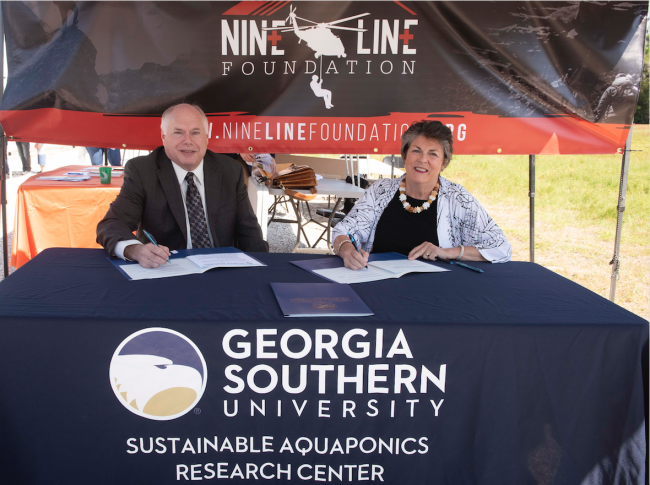
Georgia Southern University recently signed an agreement (see attached) with Nine Line Foundation that will assist veterans as they transition back into civilian life. Veterans will be enrolled in an aquaponics training program with the University’s Armstrong Campus’ Sustainable Aquaponics Research Center (SARC) at a compound at Nine Line Apparel in Savannah, Georgia. Aquaponics, or soilless farming, mixes aquaculture, the farming of fish, and hydroponics, to fuel the growth of plants in water. The SARC, a 4,100 square-foot greenhouse, has four independent recirculating systems, each containing 900-gallon tanks capable of holding more than 100 mature tilapia. Working within the College of Science and Mathematics, the SARC is focused on providing students, faculty and volunteers with the opportunity to conduct fundamental, interdisciplinary research in the area of aquaponics. The partnership with Nine Line Foundation will extend education opportunities to area homeless veterans and provide faculty and students an opportunity to engage with the veterans. Are you interested in learning more about his project and how Nine Line Foundation and Georgia Southern University are working together to provide opportunities and training to veterans? SARC’s director, Brent Feske available to speak with media – simply click on his icon to arrange an interview.

