
Experts Matter. Find Yours.
Connect for media, speaking, professional opportunities & more.

Independence Day: Baylor’s Benjamin Franklin Scholars Bring Light to Complex Figure
Founding Father Benjamin Franklin was a complex man. Among his many roles, he was a businessman, entrepreneur, inventor, journalist, author, printer, editor, politician, postmaster, statesman, ambassador and signer of the Declaration of Independence. And even with a treasure trove of accomplishments, sometimes the Franklin legends are bigger than Franklin the man – and it’s taken an army of historians and scholars throughout the centuries to sort it out. As July 4 Independence Day approaches, Baylor University's two Franklin scholars share different perspectives of Franklin, his faith and his business acumen: • Thomas Kidd, Ph.D., Distinguished Professor of History and associate director of Baylor’s Institute for Studies of Religion • Blaine McCormick, Ph.D., associate professor and chair of the management department in Baylor’s Hankamer School of Business Both have penned Franklin books and both have been featured nationally for their research on the Founding Father. Kidd’s 2017 book, “Benjamin Franklin: The Religious Life of a Founding Father,” has received high marks for its analysis of Franklin’s beliefs. From his Puritan upbringing to deism, skepticism and more, the book explores the influences and evolution of faith throughout Franklin’s life. “In today’s polarized political and religious environment, some pundits seek to remake the Founding Fathers in their own image. Benjamin Franklin’s example reveals that the historical truth is often more complicated,” Kidd wrote in a column for The Wall Street Journal. McCormick, who wrote “Ben Franklin: America’s Original Entrepreneur,” discovered a passion to study the Founding Father after listening to an audiobook of Franklin’s autobiography. “Franklin could do things as a statesman, and understand things, and achieve things as a statesman, because he had achieved things in the marketplace first,” he said. “I’ve yet to find a better book for businesspeople to learn about how to run a business in the American Experiment. He wrote the autobiography to help train people in the life of business. Many of the principles are still very robust.” And the way he shared those principles (many of which have been misquoted and made into memes through the decades) is important, McCormick said. “Franklin used sentences no longer than a Tweet to train generations of colonial businesspeople,” he said. “They were short. They were memorable. They were high-impact.” Source:


In his letter to Kim Jong Un and related statements, President Trump made not-so-veiled threats regarding U.S. military capabilities. Thus, many are asking: Is the Trump Administration, staffed with former military officers in prominent cabinet positions, chomping at the bit to unleash America’s military might? International security scholar Peter Campbell, Ph.D., is watching the situation. “Trump's cancellation gives both sides opportunity to claim that they pursued all diplomatic means. The conflict now enters a more dangerous phase because an opportunity to step back from the brink has been lost and diplomatic efforts have been somewhat discredited,” he said. “Trump’s comments regarding superior U.S. nuclear capability might be interpreted as a precursor to escalation, although the letter's tone was much less inflammatory than his earlier rhetoric.” Campbell said history – and, ironically, Trump’s staff of former U.S. military leaders in key positions – sides with those who prefer diplomacy over force. “The prominent role of former military officers has caused some to worry that the Administration is anxious to go to battle. This idea is problematic because it does not take into account that U.S. military leaders have often been more hesitant than their civilian superiors to use force,” he said. “As former Secretary of Defense Robert Gates wrote of his Cold War experiences under Presidents Reagan and George H. W. Bush: ‘In more than 20 years of attending meetings in the Situation Room, my experience was that the biggest doves in Washington wear uniforms.’ This makes sense because military officers often have an intimate understanding of how the decision to use force leads to major uncertainty and is plagued with often insurmountable friction and the fog of war. Gates observed: ‘Our military leaders have seen too many half-baked ideas for the use of military force advanced in the Situation Room by hairy-chested civilians who have never seen combat or fired a gun in anger.’ Thus, the fact that Trump has former military officers in his inner circle should decrease, rather than increase, fears of an ill-conceived use of military force to resolve this crisis. Secretary of Defense James Mattis made explicit mention of the key role diplomats are playing in the unfolding crisis. Numerous commentators have pointed out the immense influence that Mattis has in the current administration. This should calm rather than incite fears of a military solution." Source:

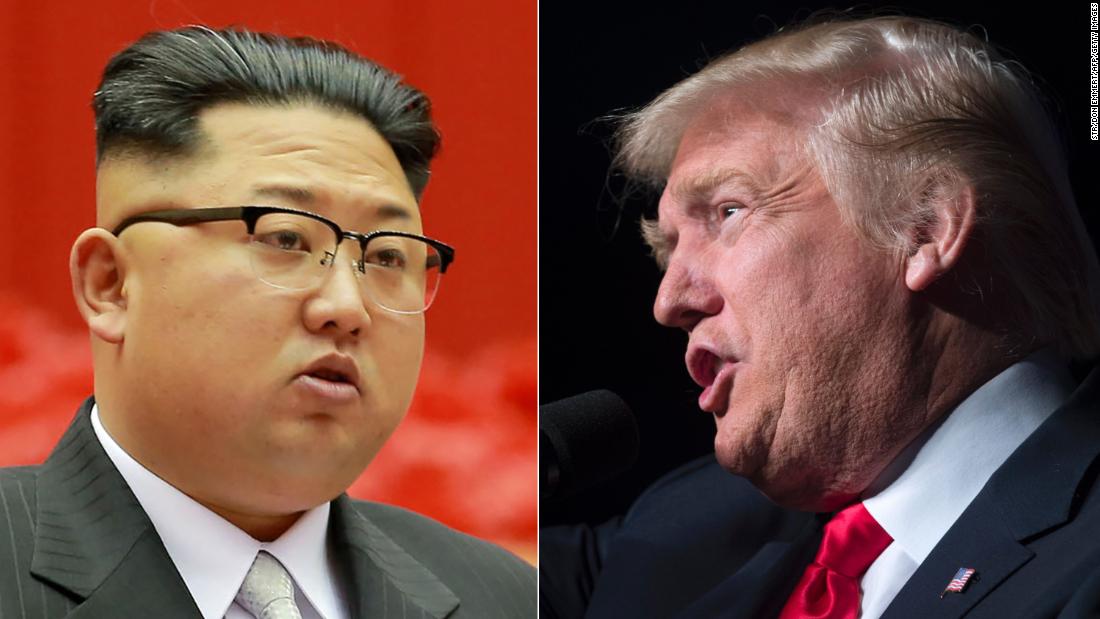
Definitely …Maybe? Donald Trump’s planned sit-down with Kim Jun Un
It was diplomacy that was almost out of a movie. Two bitter leaders, both unpredictable and avowed enemies who seemed on the brink of war … until suddenly they are friends, complimenting each other and arranging a meeting of historic proportions. There was even talk of a Nobel Prize. It seemed too good to be true. And now the world is back to reality. The surprisingly insta-warm relationship between American and North Korea seems to have once again chilled. And now it’s a battle of statements over who has upset who and why. According to North Korean media, Choe Son Hui, a vice-minister in the North Korean Foreign Ministry, said the summit is being reconsidered. And annihilation may follow. "Whether the US will meet us at a meeting room or encounter us at nuclear-to-nuclear showdown is entirely dependent upon the decision and behavior of the United States," Choe said. Vice President Pence responded in the media with a veiled threat of his own. "There was some talk about the Libya model," Pence told Fox News "As the President made clear, this will only end like the Libya model ended if Kim Jong Un doesn't make a deal." So where are we now? What’s next? Is this relationship over before it even started? Experts from the University of Connecticut may have some insight and deeper understanding of this issue. Alexis Dudden is a Professor of History specializing in modern Japan and Korea, and international history at the University of Connecticut. Dudden stresses the importance of understanding the complexity of modern Korea-Japan relations to better appreciate Korean resistance to U.S. demands. South Korea is a country where one in six families is directly affected by the North-South divide. It is “imperative that Washington planners take seriously South Korean desires for renewed engagement,” Dudden says. Professor Dudden is available to speak with media regarding the ongoing talks and threats between North Korea and America. Simply click on her icon to arrange an interview. Source:



New Star Wars, Same Political Landscape?
There’s been an enormous amount of hype leading into this Friday’s release of Solo: A Star Wars Story. Will the 10th installment of what is the most valuable franchise in film history live up to the lofty expectations of both fans and film executives? What does this latest epic tell us about current events here on Earth? The politics of Star Wars has proved to be an enduring fascination to many throughout the past 40 years. Equating current political events to the Star Wars saga is where the experts From the University of Connecticut can help. Stephen Dyson has dissected the politics of the "Game of Thrones," "Star Trek" and previous editions of "Star Wars." He can "read between the lines" of the movie dialogue and equate on-screen dialogue to what's happening now in the United States. Source:


Baylor Black Gospel Music Expert Pens Dallas Morning News Column Remembering MLK
Robert Darden, professor of journalism, PR and new media at Baylor University, is a gospel music expert. He penned this column to commemorate the death of Martin Luther King, Jr. and to remember the music that carried people through the grief of the time. He writes: "In the days of rage and grief that followed the assassination of the Rev. Martin Luther King Jr. in Memphis on April 4, 1968, many Americans found, at least for a time, relief in music. Rosa Parks, whose brave stand on a Montgomery, Ala., bus just 13 years earlier was the inciting incident in the slow build of the civil rights movement after World War II, watched as Detroit erupted in violence. She sat in her room playing Sam Cooke's "A Change is Gonna Come" over and over. She said the song 'saved her sanity.'" Darden is the author of two dozen books, most recently: Nothing But Love in God’s Water, Volume II: Black Sacred Music from Sit-In to Resurrection City (Penn State University Press, 2016); Nothing But Love in God’s Water, Volume I: Black Sacred Music from the Civil War to the Civil Rights Movement (Penn State University Press, 2014); Jesus Laughed: The Redemptive Power of Humor (Abingdon Press, 2008); Reluctant Prophets and Clueless Disciples: Understanding the Bible by Telling Its Stories (Abingdon Press, 2006); and People Get Ready! A New History of Black Gospel Music (Continuum/Bloomsbury, 2004). He founded the Black Gospel Music Restoration Project, the world’s largest initiative to identify, acquire, digitize, categorize and make accessible gospel music from gospel’s Golden Age (1945-1970). The BGMRP provides the gospel music for the Smithsonian’s new National Museum of African American History & Culture. Source:

Intermittent fasting is not for everyone
Intermittent fasting is a popular trend that is not without risk. The goal of intermittent fasting is to put your body in a state of ketosis where fats and ketones will be utilized, instead of carbohydrates. However, the process that occurs within your body when food is restricted is complicated. There is no set length of time that is needed in order for intermittent fasting to be successful, which may be confusing if you are not sure how long to fast or when to stop. It is important to listen to your body during this time as intermittent fasting is not for everyone. During the time of fasting, individuals may be prone to dehydration and hypoglycemia, or experience other adverse effects if trying to fast while on prescription or other medications. It isn’t just the medically fragile individuals who shouldn’t fast. Teenagers or those with altered metabolic rates (such as hypo and hyperthyroidism) may be putting more stress on the body than it can handle, resulting in a wide variety of symptoms: inability to concentrate, nausea, vomiting, headache, irritability, fatigue, fainting. Also, it is never a good idea to restrict calories during a time when your body is trying to grow or trying to heal. Anyone who gets irritable and symptomatic when skipping meals should not attempt to fast for prolonged periods of time. There are many different ways to fast and many different ways to eat during fasting. Prior to restricting calories for any reason, make sure that your body can handle the stress of not eating or limiting calories. I suggest consulting with a nutritionist who can work with you to help create a fasting plan that is best for your body and for your unique health history. A nutritionist can individualize an eating plan to make sure that you are maximizing your caloric intake with high density foods during the times when food is being restricted. Most importantly: Listen to your body! If something doesn’t feel right, then don’t do it or stop what you are doing. Source:

Misleading our children – is revisionist history harming the education of our nation’s students?
It’s astounding and almost as if it’s a scene from a movie – meddling, mid-level politicians trying to revise and alter curriculums to ensure children in classrooms are only getting certain points of few and perspectives when it comes to key moments in American history. It’s a level of petty-propaganda usually associated with paranoid regimes in far-away countries. But these days, it’s a homegrown problem. In Texas, the state Board of Education is being slammed for altering facts, twisting perspectives and intentionally omitting moments in history from it’s curriculum. According to USA Today, “The state is considering revisions to the 2010 standards, which a group of academics slammed in a report Thursday. Among their complaints: lessons downplaying slavery as the Civil War's cause, exaggerating the influence of Moses on U.S. democracy and applauding the National Rifle Association and Newt Gingrich's Contract with America. "The quibble over wording here could not be more misleading," said Emile Lester, a report co-author and political science professor at the University of Mary Washington in Virginia.” So how does this happen and how is it allowed in modern America? And how common is this throughput the country? Is it a matter of too much power in the hands of those with an agenda or a reflection on an education system in a sate of neglect by elected officials? There are a ton of questions that need to be asked. That’s where an expert from at the University of Mary Washington can help. Dr. Emile Lester, associate professor of political science at the University of Mary Washington, an expert in church and state issues is available to speak with media regarding this issue. Simply click on Emile’s icon to arrange an interview. Source:



Prose, prayers, palindromes and 45 presidents
If there’s one thing Colin Rafferty – a University of Mary Washington associate professor of English and teacher of creative nonfiction – knows better than prose, it’s the United States’ 45 presidents. His current manuscript, a collection of essays about each of them, includes pieces that range from “The Fear” about Martin Van Buren and “Bully” about Theodore Roosevelt to “What They Said About Him” about Barack Obama and “The Imagineer Considers Tomorrow” about Trump. Written as palindromes, death songs, prayers, movie scripts and more, Rafferty’s work has appeared in such prestigious publications as Brevity, Cobalt, Juked, Parcel and Waxwing, and he was recently featured on the Virginia Public Radio’s With Good Reason for a segment on “Getting to Know the Presidents.” “Reading and writing about the presidents has let me explore both American history and the expansiveness of creative nonfiction,” said Rafferty, who read a biography of each president before penning his essays. Colin is available to speak with media about his work and about President's Day. Simply click on his icon to arrange an interview. Source:


Robert F. Darden, professor of journalism and founder of Baylor’s Black Gospel Music Restoration Project, treasures the rich sounds of Christmas spirituals, which differ from Christmas carols. “So many of the spirituals are written in what has been performed as and what scholars call the ‘eternal now,’” Darden said. “If you read the lyrics as they were transcribed, many of them are in the present tense.” To illustrate his point, Darden referenced the spiritual “Were You There?” in which the lyrics read, “It causes me to tremble.” Darden said that since slaves in America were not book-educated and struggled with the concept of time, the Bible was a contemporary account of what was going on for them. In their minds, they conflated Abraham in the Bible with Father Abraham Lincoln who was going to free them, and associated Harriett Tubman with Moses and the Ohio River with the Jordan River. Darden said the powerful resonance in these spirituals is unmatched because of the passion of the people who sang them. “When you hear the Christmas spirituals, you’re hearing people who (believe) this is a real live event,” Darden said. “Go tell it on the mountain that Jesus Christ is born, not was born. That gives them more of an immediacy and a power than songs that are in the past tense.” Darden also said that slaves had a more intimate understanding of the nativity story because they identified with the conditions into which Christ was born. They understood what it was like to come from a foreign land to a place where they were despised and enslaved in the same way that Christ was born as a refugee child with people seeking to kill him. “The spirituals reflect a people who believe they’re in the middle of the Bible story. I think that gives them a power that’s hard for others to match and why the Gospel artists, who would later record these songs, tried to capture that and keep that immediacy and intimacy that I think a lot of Christmas carols don’t have,” Darden said. Darden said the modern world still needs Christmas spirituals. While commercialism gets people excited and inspired for the holidays, people in 2017 need something that will help them reflect on what truly matters about the season. They need something that will not only remind them of history but will also evoke the sensation of gratitude for a needed savior. “By noticing and listening to the words of the spirituals, you see how they focused on what really matters," he said. Source:

Done in by digital? What will the sale of Time mean for the industry?
On Monday, a once mighty media juggernaut was sold off for $2.8 billion dollars. Time Inc. – the publisher of Time, Fortune, Sports Illustrated and People was now property of the Meredith Corporation. The Des Moines, Iowa-based company better known for its Better Homes and Gardens, Family Circle, Parents and Family Fun magazines. It’s a bitter and sad end for Time. The company was once the industry leader in magazines and world-respected periodicals. The magazines were’ must-reads’ for the informed. But times have changed, and Time never did catch on or catch up with the digital wave that has transformed journalism as we know it. So, what will all of this mean? Can the world of print media survive and adapt to changing times and tastes? As well, with shrinking circles of media ownership – will regulators let this sale proceed? And what will this mean for the many journalists? More job cuts and shrinking news rooms? Will they move from NYC to Iowa? Has the lustre and allure of being a New York based journalist lost its shine? There are a lot of questions that still need to be addressed and answered. That’s where the experts from Cedarville University can help. Dr. Marc Clauson is a professor of history and law at Cedarville. Marc is an expert in the fields of anti-trust regulation and the economic impact of mergers and takeovers like this. Dr. Clauson is available to speak with media – simply click on his icon to arrange an interview. Source:
