Experts Matter. Find Yours.
Connect for media, speaking, professional opportunities & more.

The Double-Edged Scroll: Why Passive Screen Time Drains You More Than Active Use
Most conversations about “screen time” focus on hours. But newer research and what clinicians see in practice suggest how you use your phone may matter as much as how much you use it. A 2024 meta-analysis of 141 studies on active vs passive social media use found that, overall, effects are small, but there is a pattern: passive use (just scrolling and watching) is more consistently associated with worse emotional outcomes, while some forms of active use (commenting, messaging, posting) show small links to greater wellbeing and online social support. (OUP Academic) Other work from Frontiers in Psychology suggests that the emotional impact of passive use depends heavily on how you feel about the content: when it triggers envy, comparison or negativity, mental ill-being goes up; when it’s genuinely positive, the effect can be neutral or even slightly protective for some users. (Frontiers) Reviews also point to upward social comparison, FOMO and rumination as key pathways linking passive browsing to lower wellbeing. (ScienceDirect) Psychotherapist Harshi Sritharan, MSW, RSW works with teens and adults who feel “wiped out” by their feeds and draws a sharp line between passive and active tech use: “Don’t do passive tech use — that doom scrolling, or content just being thrown at you,” she says. “I want people to engage in active tech use. Go and search something up, choose the long-form video you actually want, talk to your friends. Don’t let the app decide everything you see — especially for kids, who are getting content they’re not ready for and didn’t sign up for.” She notes that many of her clients describe feeling “numb, anxious or wired” after long passive sessions, a sign that their nervous system is being pulled around by unpredictable, emotionally loaded content rather than chosen experiences. She also discussed the short term recall related to scrolling: "Some of my clients can't even remember what content they consumed right after scrolling. However, we know that what we pay attention to and what we show our brains has an impact on our thoughts, mindset, feelings and overall internal world." Offline.now founder Eli Singer frames this as a design problem, not a moral failing. The platform’s research shows people already spend about 10 of their 16 waking hours on screens; the realistic goal is to upgrade some of that time, not pretend we can all go offline. His advice: instead of vowing to “get off your phone,” start by swapping just 20 minutes a day from passive to active use; for example, messaging a friend to meet up, learning something specific, or planning an offline activity. “When people tell us they feel overwhelmed by their screen habits, it’s not laziness, it’s a crisis of confidence,” Singer says. “We don’t need perfect digital detoxes. We need small, winnable shifts, like taking one block of passive scrolling and turning it into something you actually chose.” For journalists, the story isn’t simply “screens are bad.” It’s that passive, algorithm-driven scrolling is where comparison, FOMO and emotional overload tend to pile up and that helping people change how they use their devices may be more realistic, and more effective, than focusing on raw minutes alone. Featured Experts Harshi Sritharan, MSW, RSW – Psychotherapist specializing in ADHD, anxiety, insomnia and digital dependency. She helps teens and adults understand how doomscrolling and passive feeds hijack dopamine and mood, and teaches practical shifts toward more intentional, “active” tech use. Eli Singer – Founder of Offline.now and author of Offline.now: A Practical Guide to Healthy Digital Balance. He brings proprietary data on digital overwhelm and the “confidence gap,” and shows how 20-minute “micro-wins” like upgrading one chunk of passive screen time can change people’s relationship with their phones without extreme detoxes. Expert interviews can be arranged through the Offline.now media team.




Aston University economists say Prime Minister can reduce UK trade vulnerability with China visit
Greenland episode exposed UK’s lack of effective response to economic coercion from allies Research shows tariff retaliation would have cost the average UK household up to £324 per year Economists say China visit is “portfolio risk management” – diversification reduces vulnerability. The Prime Minister’s visit to China – the first by a British PM since 2018 – is an opportunity to reduce the UK’s vulnerability to economic coercion, according to new research from Aston University. A policy paper from Aston Business School’s Centre for Business Prosperity analyses the January 2026 Greenland tariff episode, when President Trump threatened and then withdrew tariffs on eight European countries. The researchers found that the UK had no good options: retaliation would have made Britain worse off, while absorbing the tariffs left Europe without credible deterrence. Director of the centre for business prosperity, Professor Jun Du, said: “The Greenland episode was a wake-up call. When your principal security ally threatens economic coercion, the old assumptions about who is safe and who is dangerous no longer hold. “The PM’s China visit should be framed as portfolio risk management – building diversified trading relationships that reduce the UK’s exposure to any single partner. Just as investors don’t put all their money in one stock, countries shouldn’t put all their trade into one basket. A UK with multiple strong partnerships is harder to pressure, whether the pressure comes from Washington or Beijing.” The research found that coordinated UK–EU tariff retaliation would have cost British households up to £324 per year – the worst outcome modelled. But the authors argue that Europe has untapped leverage elsewhere: the US runs a €148 billion annual services surplus with the EU, and mutual investment exceeds €5.3 trillion. Associate professor of economics and co-author, Dr Oleksandr Shepotylo, said: “Tariff retaliation fails because it hurts consumers and distorts the economy – the retaliator suffers similarly to the target. But Europe has cards it isn’t playing. Services, investment screening, and regulatory access are pressure points where Europe can respond effectively.” UK exports to China fell by 10.4% in the year to Q2 2025, with goods exports down 23.1% – the sharpest decline among major trading partners. The researchers argue that this closes off the UK’s largest alternative market at precisely the moment US reliability is in question. The paper identifies three priorities for UK policy: Recognise the permanent incentives behind US tariffs. US tariff revenue hit $264 billion in 2025. Trade negotiations alone cannot resolve revenue-driven policy. Build UK–EU coordination on non-tariff instruments. Services, investment, procurement, and regulation offer leverage that tariffs do not. Treat China engagement as portfolio risk management. Concentration in any single market creates vulnerability. Diversification is not about picking sides – it’s about resilience. Professor Du added: “The question for the Prime Minister is whether to use this breathing space to build resilience – or wait for the next Greenland.” To read the policy paper in full, click on this link:



Domestic abuse affects millions of people every year, often in unseen and deeply personal ways, and online threats toward victims can be particularly harmful. To address this reality locally, the University of Florida’s Center for Privacy and Security for Marginalized and Vulnerable Populations, or PRISM, works with Gainesville-based domestic abuse support center Peaceful Paths to help people stay safe in the digital world. Kevin Butler, Ph.D., the director of PRISM and the Florida Institute for Cybersecurity Research at UF, has been researching issues related to security and privacy of technologies that affect survivors of intimate partner violence for years. He and his graduate students connected with Peaceful Paths in 2022, presenting their findings on cybersecurity and demonstrating how their research may help improve online safety for vulnerable populations. They developed a pilot study, a survey and interview protocols that are now helping those in need at the center. “[We aim to] develop principles of design that will allow for a robust technology design that really mitigates harms and improves benefits for all,” Butler said about PRISM. Educating abuse survivors has been a key component of the collaboration between UF and Peaceful Paths. For example, PRISM’s team has conducted research on the effects of stalkerware, also known as spyware, which is a type of software or app designed to be installed secretly on people’s devices to monitor their activities without their consent. Abusers may use this tool to track and harass victims, and stalkerware is regularly linked to domestic violence – a fact that is not widely known. "Even the first presentation [UF] gave enhanced our advocates' knowledge of security pieces, which helps them safety plan with survivors," said Peaceful Paths CEO Crystal Sorrow. “It actually increases the safety of everyone in the community we work with when we talk about red flags, digital dating abuse and healthy relationships.” While PRISM, which is supported by the National Science Foundation, is making an impact on the local community, its overall reach is much broader. PRISM was the first academic partner in the Coalition Against Stalkerware, which includes groups such as the National Network to End Domestic Violence, the Electronic Frontier Foundation, and law enforcement agencies throughout the United States and the world.



We Don’t Realize How Much Time We Spend With AI. Because It’s Hiding in Our Phones
If you ask most people how often they use AI, they’ll say something like: “I tried ChatGPT a couple of times” or “I don’t really use AI.” But look at their phone, and the story is completely different. Digital wellness platform Offline.now has found that we already spend about 10 of our 16 waking hours on screens, roughly 63% of our day. Founder Eli Singer calls AI “the shadow roommate inside those 10 hours”: invisible most of the time, but involved in more of our everyday taps and swipes than we realize. And we now have data to prove it. A recent Talker Research survey of 2,000 U.S. adults, commissioned by Samsung, found that 90% of Americans use AI features on their phones, but only 38% realize it. Common features like weather alerts, call screening, autocorrect, night-mode camera enhancements and auto-brightness are all powered by AI — yet more than half of respondents initially said they don’t use AI at all. Once shown a list of features, 86% admitted they use AI tools daily. (Lifewire) Singer sees this as a classic “confidence gap” problem applied to AI. Beyond the “invisible AI” on our phones, generative AI tools like ChatGPT, Claude and image generators are spreading fast. A nationally representative U.S. survey from Harvard’s Kennedy School and the Real-Time Population Survey found that by August 2024, about 39% of adults aged 18–64 were using generative AI. More than 24% of workers had used it at least once in the previous week, and nearly 1 in 9 used it every single workday. (NBER) Globally, usage is enormous. A World Bank backed analysis of online activity estimated that, as of March 2024, the top 40 generative AI tools attracted nearly 3 billion visits per month from hundreds of millions of users. ChatGPT alone commanded about 82.5% of that traffic. (Open Knowledge Repository) From a mental-health perspective, psychotherapist Harshi Sritharan, MSW, RSW says the issue isn’t just the number of visits, it’s the way AI subtly shapes the texture of our day. “Every autocorrect, every AI-sorted inbox, every ‘magic’ photo fix is a tiny cognitive hand-off,” she explains. “Individually they feel helpful. But taken together, they keep your brain in a constant state of micro-decisions and micro-rewards, which is exhausting, especially if you already struggle with ADHD, anxiety or overwhelm.” She points out that many of her clients only think of “AI time” as the hours they spend in a chatbot window. In reality, AI is involved when: Their phone decides which notifications to surface A map app reroutes them automatically Spam filters silently screen hundreds of emails “By the time they open a dedicated AI app, their nervous system has already been engaging with AI-driven features all day,” Sritharan says. “That’s part of why people end the day feeling tapped out but can’t quite explain why.” Singer worries that this “shadow AI” is quietly eating into the same finite resource Offline.now tracks with screens in general: attention. “We already know 10 hours a day on screens is unsustainable for our focus and our relationships,” he says. “Layer AI on top — systems designed to predict and nudge our behavior — and you’re not just losing time. You’re outsourcing micro-chunks of judgment, memory and choice without even noticing.” So how much time are people spending with AI? Right now, no one has a perfect number and that’s exactly the point. The best data we have suggests: Most smartphone users are already interacting with AI daily, whether they know it or not. (Lifewire) Roughly 4 in 10 U.S. adults now use generative AI, with a growing share using it at work every week or every day. (Harvard Kennedy School) Globally, billions of monthly visits are flowing into AI tools on top of our existing 10-hour screen days. (Open Knowledge Repository) “The future isn’t AI or no AI,” Singer says. “It’s: Can you be conscious about how you use it — instead of letting it hijack your attention and manage your life?” Featured Experts Eli Singer – Founder of Offline.now and author of Offline.now: A Practical Guide to Healthy Digital Balance. He brings proprietary behavioral data on screen time and digital overwhelm, and a framework (the Offline.now Matrix) for rebuilding confidence through 20-minute, real-world steps instead of all-or-nothing “detox” advice. Harshi Sritharan, MSW, RSW – Psychotherapist specializing in ADHD, anxiety and digital dependency. She explains how AI-assisted micro-tasks interact with dopamine, attention and overwhelm, and offers brain-friendly ways to renegotiate your relationship with both screens and AI. Expert interviews can be arranged through the Offline.now media team.

The AI Journal: UF and other research universities will fuel AI. Here’s why
In the global AI race between small and major competitors, established companies versus new players, and ubiquitous versus niche uses, the next giant leap isn’t about faster chips or improved algorithms. Where AI agents have already vacuumed up so much of the information on the internet, the next great uncertainty is where they’ll find the next trove of big data. The answer is not in Silicon Valley. It’s all across the nation at our major research universities, which are key to maintaining global competitiveness against China. To teach an AI system to “think” requires it to draw on massive amounts of data to build models. At a recent conference, Ilya Sutskever, the former chief scientist at OpenAI — the creator of ChatGPT — called data the “fossil fuel of AI.” Just as we will use up fossil fuels because they are not renewable, he said we are running out of new data to mine to keep fueling the gains in AI. However, so much of this thinking assumes AI was created by private Silicon Valley start-ups and the like. AI’s history is actually deeply rooted in U.S. universities dating back to the 1940s, when early research laid the groundwork for the algorithms and tools used today. While the computing power to use those tools was created only recently, the foundation was laid after World War II, not in the private sector but at our universities. Contrary to a “fossil fuel problem,” I believe AI has its own renewable fuel source: the data and expertise generated from our comprehensive public academic institutions. In fact, at the major AI conferences driving the field, most papers come from academic institutions. Our AI systems learn about our world only from the data we offer them. Current AI models like ChatGPT are scraping information from some academic journal articles in open-access repositories, but there are enormous troves of untapped academic data that could be used to make all these models more meaningful. A way past data scarcity is to develop new AI methods that leverage all of our knowledge in all of its forms. Our research institutions have the varied expertise in all aspects of our society to do this. Here’s just one example: We are creating the next generation of “digital twin” technology. Digital twins are virtual recreations of places or systems in our world. Using AI, we can develop digital twins that gather all of our data and knowledge about a system — whether a city, a community or even a person — in one place and allow users to ask “what if” questions. The University of Florida, for example, is building a digital twin for the city of Jacksonville, which contains the profile of each building, elevation data throughout the city and even septic tank locations. The twin also embeds detailed state-of-the-art waterflow models. In that virtual world, we can test all sorts of ideas for improving Jacksonville’s hurricane evacuation planning and water quality before implementing them in the actual city. As we continue to layer more data into the twin — real-time traffic information, scans of road conditions and more — our ability to deploy city resources will be more informed and driven by real-time actionable data and modeling. Using an AI system backed by this digital twin, city leaders could ask, “How would a new road in downtown Jacksonville impact evacuation times? How would the added road modify water runoff?” and so on. The possibilities for this emerging area of AI are endless. We could create digital twins of humans to layer human biology knowledge with personalized medical histories and imaging scans to understand how individuals may respond to particular treatments. Universities are also acquiring increasingly powerful supercomputers that are supercharging their innovations, such as the University of Florida’s HiPerGator, recently acquired from NVIDIA, which is being used for problems across all disciplines. Oregon State University and the University of Missouri, for example, are using their own access to supercomputers to advance marine science discoveries and improve elder care. In short, to see the next big leap in AI, don’t immediately look to Silicon Valley. Start scanning the horizon for those research universities that have the computing horsepower and the unique ability to continually renew the data and knowledge that will supercharge the next big thing in AI. Read more...


LI School District Faces Funding Cuts Over Mascot Name Change
Education Professor Alan Singer was interviewed by WCBS-TV News about the Connetquot School District on Long Island school being threatened with funding cuts if it does not reinstate its old mascot name, the Thunderbirds. The name change to T-Birds was made in 2022 to comply with a state ruling that mascot names like “Chiefs” and “Warriors” are demeaning and offensive to Native Americans. The U.S. Department of Education has ruled that these changes are a violation of federal law. Dr. Singer said Connetquot is “caught in the crossfire with the Trump administration, which is at war with blue states and diversity,” and the district’s mascot is part of a much larger political fight.


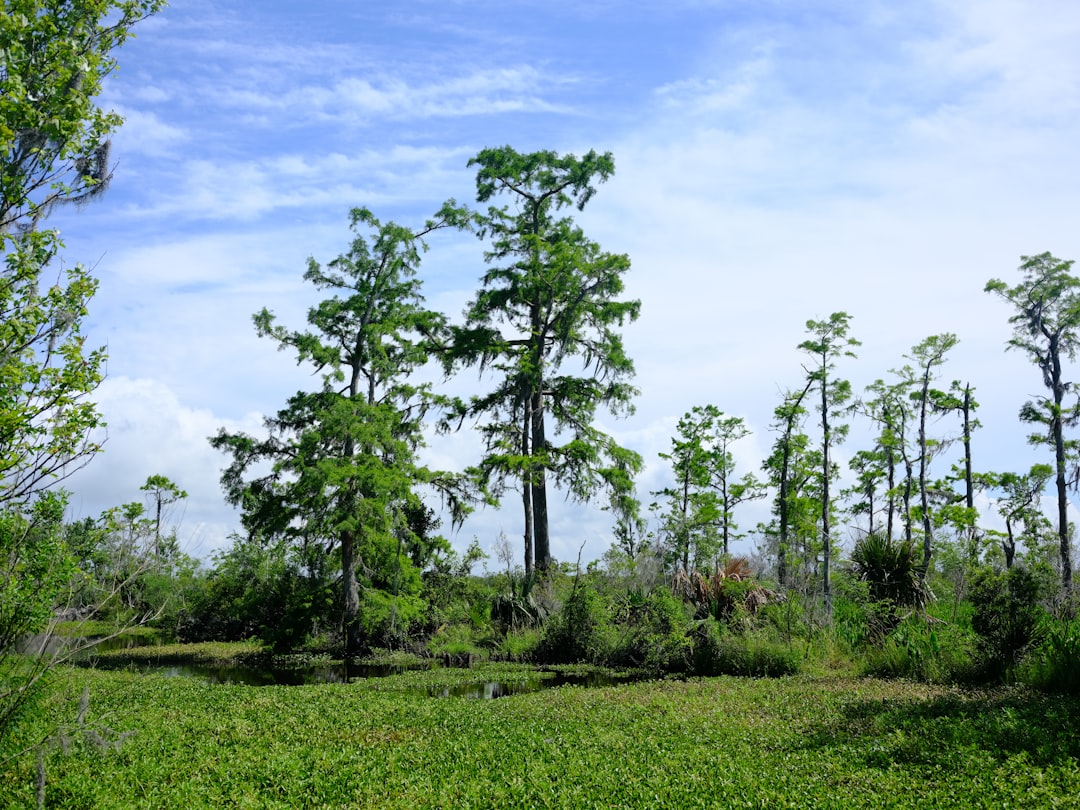
Wetlands: Nature’s First Line of Defense for Our Coast and Communities
Since the 1930s, Louisiana’s coastline has been reshaped by the relentless advance of the Gulf, with over 2,000 square miles of land disappearing beneath its waters and representing the largest loss of coastal land anywhere in the continental United States. This dramatic transformation has far-reaching consequences, threatening local economies, delicate ecosystems, and heightening the state’s exposure to hurricanes. In the face of these urgent challenges, LSU’s College of the Coast & Environment (CC&E) stands at the forefront, leading pioneering research and bold initiatives that not only protect Louisiana’s coast, but also build stronger, more resilient communities. Below are just a few examples of how CC&E is driving meaningful solutions for our coastal future. Wetlands are vital to protecting our coast, and CC&E researchers are actively investigating the role of both constructed and natural wetlands in reducing coastal flooding hazards. Through several projects funded through the US Army Corps of Engineers, Drs. Robert Twilley, Matthew Hiatt, and CC&E Dean Clint Willson, along with collaborators across campus, are conducting research on coastal ecosystem design - a framework that leverages the benefits of natural and nature-based coastal features, such as wetlands, environmental levees, and flood control gates – and how that could be integrated into engineering design and urban planning. Through the State of Louisiana’s ambitious Coastal Master Plan, administered by the Louisiana Coastal Protection and Restoration Authority, wetland construction and restoration play a huge role in managing the Louisiana coastal region. Such innovative techniques leveraging natural and nature-based features require evaluation to determine the success of such projects, and CC&E researchers are using cutting-edge science to advance this endeavor. Dr. Tracy Quirk and her students are investigating the success of marsh restoration by comparing structural and functional characteristics (e.g., vegetation, elevation, hydrology, accretion, and denitrification) between two created marshes and an adjacent natural reference marsh along the north shore of Lake Pontchartrain, Louisiana. Wetlands not only serve as a buffer from storms and sea level rise but also play a major role in regulating greenhouse gas emissions and contribute to productive vibrant ecosystems. In large collaborative project funded by the National Science Foundation, Dr. Giulio Mariotti is using computer models to forecast how coastal marshes may change in size, shape, and salinity in the future, and how these changes could affect methane emissions. As part of the same project, Drs. Haosheng Huang and Dubravko Justic are creating high-resolution hydrodynamic and biogeochemical models to predict changes in methane emissions in coastal Louisiana. In another project, with funding from Louisiana Center of Excellence, National Science Foundation, Louisiana Sea Grant, and the National Oceanic and Atmospheric Administration, Drs. Matthew Hiatt and John White have established a network of sensors to measure water levels and salinity throughout the wetlands in Barataria Bay, Louisiana, a region that has experienced significant land loss and storm impacts. The goal is to establish an understanding of the drivers of saline intrusion in marsh soils, and to ultimately determine what this means for the ecological resiliency of wetlands experiencing rapid change. CC&E’s leadership in wetlands science is recognized nationwide. It is the only college in the United States to have six faculty members—Drs. John White, John W. Day, Jr., Robert Twilley, William Patrick, James Gosselink, and R. Eugene Turner—honored with the prestigious National Wetlands Award. No other institution has had more than one recipient. Presented annually by the Environmental Law Institute, this award celebrates individuals whose work demonstrates exceptional innovation, dedication, and impact in wetlands conservation and education. CC&E’s unmatched record reflects decades of pioneering research and a deep commitment to safeguarding the nation’s most vulnerable coastal landscapes. Every day, CC&E channels this expertise into action—protecting Louisiana’s coast and, in turn, the communities, wildlife, and ecosystems that depend on it. Through bold research, collaborative partnerships, and a vision grounded in science, the college is shaping a more resilient future for coastal regions everywhere. CC&E is building teams that win in Louisiana, for the world. Article originally published here.


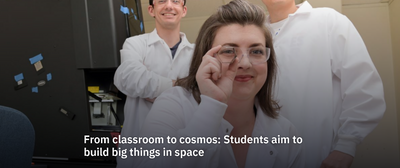
From classroom to cosmos: Students aim to build big things in space
In the vast vacuum of space, Earth-bound limitations no longer apply. And that’s exactly where UF engineering associate professor Victoria Miller, Ph.D., and her students are pushing the boundaries of possibilities. In partnership with the Defense Advanced Research Projects Agency, known as DARPA, and NASA’s Marshall Space Flight Center, the University of Florida engineering team is exploring how to manufacture precision metal structures in orbit using laser technology. “We want to build big things in space. To build big things in space, you must start manufacturing things in space. This is an exciting new frontier,” said Miller. An associate professor in the Department of Materials Science & Engineering at UF’s Herbert Wertheim College of Engineering, Miller said the project called NOM4D – which means Novel Orbital and Moon Manufacturing, Materials, and Mass-efficient Design – seeks to transform how people think about space infrastructure development. Picture constructing massive structures in orbit, like a 100-meter solar array built using advanced laser technology. “We’d love to see large-scale structures like satellite antennas, solar panels, space telescopes or even parts of space stations built directly in orbit. This would be a major step toward sustainable space operations and longer missions,” said team member Tianchen Wei, a third-year Ph.D. student in materials science and engineering. UF received a $1.1 million DARPA contract to carry out this pioneering research over three phases. While other universities explore various aspects of space manufacturing, UF is the only one specifically focused on laser forming for space applications, Miller said. A major challenge of the NOM4D project is overcoming the size and weight limitations of rocket cargo. To address these concerns, Miller’s team is developing laser-forming technology to trace precise patterns on metals to bend them into shape. If executed correctly, the heat from the laser bends the metal without human touch; a key step toward making orbital manufacturing a reality. “With this technology, we can build structures in space far more efficiently than launching them fully assembled from Earth,” said team member Nathan Fripp, also a third-year Ph.D. student studying materials science and engineering. “This opens up a wide range of new possibilities for space exploration, satellite systems and even future habitats.” Miller said laser bending is complex but getting the correct shape from the metal is only part of the equation. “The challenge is ensuring that the material properties stay good or improve during the laser-forming process,” she said. “Can we ensure when we bend this sheet metal that bent regions still have really good properties and are strong and tough with the right flexibility?” To analyze the materials, Miller’s students are running controlled tests on aluminum, ceramics and stainless steel, assessing how variables like laser input, heat and gravity affect how materials bend and behave. “We run many controlled tests and collect detailed data on how different metals respond to laser energy: how much they bend, how much they heat up, how the heat affects them and more. We have also developed models to predict the temperature and the amount of bending based on the material properties and laser energy input,” said Wei. “We continuously learn from both modeling and experiments to deepen our understanding of the process.” The research started in 2021 and has made significant progress, but the technology must be developed further before it’s ready for use in space. This is why collaboration with the NASA Marshall Space Center is so critical. It enables UF researchers to dramatically increase the technology readiness level (TRL) by testing laser forming in space-like conditions inside a thermal vacuum chamber provided by NASA. Fripp leads this testing using the chamber to observe how materials respond to the harsh environment of space. “We've observed that many factors, such as laser parameters, material properties and atmospheric conditions, can significantly determine the final results. In space, conditions like extreme temperatures, microgravity and vacuums further change how materials behave. As a result, adapting our forming techniques to work reliably and consistently in space adds another layer of complexity,” said Fripp. Another important step is building a feedback loop into the manufacturing process. A sensor would detect the bending angle in real time, allowing for feedback and recalibration of the laser’s path. As the project enters its final year, finishing in June of 2026, questions remain -- especially around maintaining material integrity during the laser-forming process. Still, Miller’s team remains optimistic. UF moves one step closer to a new era of construction with each simulation and laser test. “It's great to be a part of a team pushing the boundaries of what's possible in manufacturing, not just on Earth, but beyond,” said Wei.


Long proclaimed Italy’s “moral capital,” Milan is renowned worldwide for its significant contributions to fashion, design and the arts. Soon, another point of pride will be added to the city’s storied history, when the regional hub—and partnering town Cortina d’Ampezzo—plays host to the 2026 Winter Olympics in February. Luca Cottini, PhD, is a professor of Italian Studies and an expert on the evolution of Italian culture, particularly through the 19th and 20th centuries. Recently, he shared some thoughts concerning Milan and Cortina’s successful joint bid for the Olympics, the themes and iconography expected to define this year’s opening ceremony and the symbolic significance of Italy’s selection as a host nation. Question: What was the role of past major events in Milan and Cortina—like the 2015 World’s Fair and the 1956 Winter Olympics—in helping to elevate their appeal for these games? Luca Cottini: I’ll start by saying that although people notice world’s fairs less than the Olympics, they are more impactful to a city and country because they generate more revenue, business, political relationships and positive reputation. They are events in which all the world comes together and each country exposes its excellence, while the host nation brings a visibility that it would not carry otherwise. In 2015, Milan hosted the world’s fair, which generated a completely new fairgrounds area and a visibility of politics, industry, technology and modernity in a way that brings the city to a global stage. I would say that is when the ascent of Milan really started, especially as a desirable destination. With Cortina, after the 2015 World’s Fair—and especially after the COVID-19 pandemic—the Dolomites became really a popular region for travelers to visit. Cortina is also symbolic to Olympic history, because it's the site of the first Olympics that took place in Italy, in 1956 during the reconstruction era. That was the Dolce Vita period, in the middle of the 1950s economic boom, and those games were followed by Rome’s Summer Olympics in 1960. They both represented a way in which Italy, coming out of the war destroyed, was reaffirming its rebirth. Over the years, fewer cities have wanted to host the Olympics because they tend to carry a lot of economic burden, financial debt and little return on investment. In this sense, Milan and Cortina, helped by increased popularity after the world’s fair, sold themselves as a sustainable Olympics. Ninety percent of the buildings were refurbished from older buildings, and they will serve purposes after the Olympics. It’s difficult to tell whether it’s economically sound or not, but it is a way to promote two cities that are in big moments of growth. Q: These Olympic Games will be celebrating Milan’s contributions to fashion. What is the city’s significance to the fashion world? LC: Milan is certainly the capital of fashion in Italy, and is one of the capitals of fashion in the world, along with Paris, New York and London. The fashion heritage that the city carries now in iconic brands like Armani, Versace, Moschino and Dolce & Gabbana is the outcome of a process that took shape in the late 1970s. Until then, fashion in Italy was mainly related to Rome, through cinema, and Florence, as that city represented a new Renaissance in the postwar years. But in the 1970s, much of this fashion world moved from those cities to Milan, because there was a conglomeration of labor, skills, capital and creativity that generated a complex productive and cultural system, or the so-called “Sistema Moda.” This is a particular approach to the industry in Italy that coordinates management and creativity around the figures of a big creative director and a big manager who work together in creating not just nice styles, but also sustainable outlets and markets in and outside Italy. In turn, with its reputation, Milan gives the Olympics that seal of grandeur and coolness. The connection with fashion and promotion of uniqueness is part of the national rhetoric that surrounds what we call “Made in Italy,” this idea of luxury, styling, beauty, order and measure that is endowed in the Italian DNA. Q: Andrea Bocelli—who also appeared in Torino’s 2006 closing ceremony—is supposed to sing once again in this year’s opening ceremony. Aside from his popularity, what is the symbolic significance of his selection as a performer? LC: Bocelli is an interesting case. He is a prototypical Italian success story, which is born in the peninsula but is then ratified outside of Italy. As Bocelli became a global sensation in the U.S., he then came back to his roots in Italy, where his voice has become a symbol of national unity, as epitomized in his solo concerto of Milan, during the pandemic, when he sang in front of the empty Piazza del Duomo, facing the city’s cathedral. In his Catholic faith and secular operatic repertoire, he symbolizes Italian culture as a similar piazza or open space where different voices can converge in a temperate balance. When you put together Bocelli, Mariah Carey and whoever else will be part of the ceremony, that same Italian identity will give rise to a new synthesis, as the encounter of tradition and novelty, grounded-ness and openness. Q: The Olympic flames are supposed to be lit in two cauldrons—one in Milan and one in Cortina—each with a design inspired by Leonardo da Vinci. What was da Vinci’s importance to Milan, specifically? LC: Da Vinci is part of the fabric of Milan. He spent 20 years in the city, painting “The Last Supper” and working at Castello Sforzesco, as well as many other places. His footprint is all over Milan, in its design, walls, canal system and more. He is an archetype of the Italian mind in as much as it represents the combination of engineering and beauty. The word Ingenium in Latin, meaning “genius,” overflows in English into the word “engineering” and also “ingenuity,” which reflects the creative mind. Da Vinci represents the synthesis of Italian Ingenium as a combination of aesthetics and problem solving, which you still see in the city today.



Do Teens Secretly Want Phone Boundaries More Than Adults Think?
Ask a parent about phones and teens, and you’ll hear the same story: “They’re glued to that thing and don’t care.” But when you ask teens themselves, a different picture emerges. A recent Pew Research Center study found that about 95% of U.S. teens have access to a smartphone — and around 4 in 10 say they spend too much time on it. (Pew Research Center) Coverage of the same data notes that over 70% of teens say they feel happiness or peace when they’re not tethered to their device, even as they rely on it for social life. (KTUL) Psychotherapist Harshi Sritharan, MSW, RSW, who works with teens and young adults on digital dependency, sees that ambivalence every day. “I have 12- to 15-year-olds who come in and say, ‘I know I’m kind of addicted to my phone,’” she says. “When a teenager says that, I’m relieved — it means we have something to work with.” She stresses that most young people don’t actually want to be left alone with endless scrolling — they want help making sense of it. Teen Limits Work Better Than Parents Think New data suggests that reasonable limits can help and that many teens benefit when parents set them thoughtfully. A tool parents can use is collaborative problem solving. This involves parents and teens working together to come up with a plan for the best strategies that combat everyone’s concerns while compromising. A 2024 Springtide Research Institute survey of 1,112 13-year-olds found that teens whose parents limit their screen time are less likely to be heavy users: only 32% of those with limits use their phone 5+ hours a day, compared with 55%of those with unlimited time. Just 24% of teens with limits said they’d felt like they had a mental health problem, versus 32% with no limits.(Springtide Research Institute) In other words, boundaries are mildly protective, not cruel, especially when they’re explained instead of imposed. Sritharan cautions against “no phones ever” rules that ignore school and social realities: “We can’t make blanket statements of ‘no screens’,” she says. “We shape how kids use devices so they can still get things done and spend more time engaging with their family.” That might mean agreeing on tech-free windows (like family dinners or the hour before bed) and tech-friendly ones (like a 45-minute bus ride where a teen can listen to music or message friends). Teens Are Leading a Quiet “Cutback” Movement Parents often feel like the only ones craving less screen time, but surveys show Gen Z is already trying to dial things down. A global survey cited by Tech Times and ExpressVPN found that about 46% of Gen Z are actively taking steps to limit their screen time, more than older generations.(Tech Times) Another U.S. poll commissioned by ThriftBooks found half of respondents are cutting back on screens, with Gen Z and millennials leading — and 84% adopting analog habits like printed books, paper planners and board games.(New York Post) Reporting on the “board game revival” among Gen Z echoes the same trend: young people are consciously seeking offline, face-to-face ways to connect.(Woke Waves) For Offline.now experts, this adds up to a simple message: teens aren’t fighting all boundaries — they’re fighting feeling controlled or misunderstood. Parents as Co-Pilots, Not Phone Police Executive Function Coach Craig Selinger, M.S., CCC-SLP says the real leverage point isn’t just new rules; it’s how parents model and co-create them. “If you want behavior change in kids, start with the parent model,” he says. “A 12-year-old will not put their phone away at dinner if their parents won’t.” He encourages families to focus on “little moments” where phones quietly block connection — especially car rides and in-between times when kids might naturally open up: “In the car, your kid is trapped with you,” Selinger says. “That’s when they start talking. If they’re on their phone the whole time, you lose those big conversations hiding in the boring moments.” Both experts emphasize co-designing boundaries with teens: agreeing together on tech-free times and how late-night scrolling affects mood and school performance. When teens feel heard — and see adults following the same rules — boundaries feel less like punishment and more like shared protection. For journalists, the story isn’t “teens vs phones” or “parents vs teens.” It’s that both sides are quietly overwhelmed, and many young people are more open to limits than adults realize — if those limits are built with them, not against them. Featured Experts Harshi Sritharan, MSW, RSW – Psychotherapist specializing in ADHD, anxiety, insomnia and digital dependency. She helps teens and young adults understand dopamine cycles, distinguish passive vs active tech use, and build realistic phone boundaries that support sleep, school and mental health. Craig Selinger, M.S., CCC-SLP – Executive Function Coach and child development specialist (Brooklyn Letters). He focuses on how tech use shapes learning, attention and family dynamics, and how parents can model healthy habits and co-create screen rules that actually stick. (Expert interviews can be arranged through the Offline.now media team.)