
Experts Matter. Find Yours.
Connect for media, speaking, professional opportunities & more.

Companies Big and Small Can Benefit From a Clear Remote Work Strategy
As remote work evolves into a regular work mode that satisfies employment needs for both employer and employee, it is important for businesses to have a well-thought-out remote work strategy, says Timothy Golden, professor at Rensselaer Polytechnic Institute. Golden, who teaches in the Lally School of Management, believes that creating the right norms and expectations from the start provides an important boost for achieving success in remote work. “If these norms — informal and often unspoken expectations for how people should act and behave — are not set correctly right from the start, then remote work can be much more challenging than it needs to be,” Golden said. In many companies, creating a position of a Chief Remote Officer (CRO) — a position similar to a CFO or COO but with a focus on leading remote work programs — can be a step toward future stability. According to Golden, other aspects to consider range from methods of employee communication and performance assessments, to the compatibility of a combination of hybrid, in-person, and remote work modes in the framework of an organizational business model. Remote work and telecommuting have been the focus of Golden’s body of research for more than 20 years. He is available to discuss remote work strategies and other aspects of working from home from the business perspective as well as the viewpoint of the remote workers.


Supply Chain Disruption Continues Due to the Pandemic
During the pandemic, the global supply chain began experiencing major disruptions. Kathleen Iacocca, PhD, an associate professor of management and operations in the Villanova School of Business, says that this issue is currently more severe than at the beginning of COVID's spread. Per the professor, the supply chain relies on effective forecasting, inventory control and logistics of supply and demand. At the start of the pandemic, the supply and demand scale became off-balance due to panic purchasing. Today, one reason it's much worse is that the supply went down. "You can try and push supply back up, which is what President Biden is doing with having ports operating 24/7. [But] Costco or Target can make as many phone calls as they want to Hasbro asking for Barbies, and if they don't have them, they can't just wave a wand and get them," says Dr. Iacocca. One option, if there's an imbalance, is to push demand down. "As a retailer, you can raise prices. That will help bring the supply and demand into a balance until the logistics part can catch up," says Dr. Iacocca. "But that can lead to dangerous issues. The people that can afford things are going to continue buying product, and it will exaggerate the differences in socioeconomic status." Dr. Iacocca predicts, with the upcoming holiday season, supply will simply not be able to meet demand. "In a normal world, retailers can forecast and build up inventory. In the future, demand will continue to go up while the supply doesn't get any larger and will just increase the gap between the two." In the meantime, small businesses can expect challenges. "If there's a short supply of lumber, Home Depot can afford it more than Mom and Pop's Lumberyard. Raising prices are a risk for those that can't necessarily afford things, but also the small businesses," says Dr. Iacocca. Ultimately, Dr. Iacocca predicts that supply could catch up with demand by March (at the earliest), depending on two things: "First, that the labor force doesn't remain as is. If you're playing the game of catchup, you’re working overtime. Second, you’re counting on factories not shutting down again because of COVID. March is the assumption that you have the means—and you just need the time and a period where demand does not continue to go up."


How rabbits help restore unique habitats for rare species
European wild rabbits are a ‘keystone species’ that hold together entire ecosystems – according to researchers at the University of East Anglia. Our campus is home to hundreds of rabbits and Prof Diana Bell, from our School of Biological Sciences, has been researching them for more than 30 years. Now, she is one of the lead researchers on a new report which aims to restore and protect at-risk wildlife habitats which are rabbit dependent. The report shows how their grazing and digging activity keeps the ground in a condition that is perfect for sustaining other species that would otherwise move on – or die out. But their numbers are declining regionally, nationally and globally. And they are even being classed as endangered in their native region, the Iberian Peninsula. The findings come as efforts to save England’s most threatened species from extinction are turning the tide for wildlife in Norfolk and Suffolk thanks to the Shifting Sands project. Shifting Sands is one of 19 projects across England that make up the national Back from the Brink initiative. Together, these projects aim to save 20 species from extinction and benefit over 200 more. Lead partner of the rabbit work-stream and rabbit expert Prof Diana Bell, from UEA’ School of Biology, said: “The Breckland-based Shifting Sands project was set up to save some of the region’s rarest wildlife. “After several years of hard work by this multi-partner project, the fortunes of species classed as declining, rare, near-threatened or endangered are now improving in the Brecks. “The project has seen species recover in record numbers – including endangered beetle and plants, one of which is found nowhere else in the world. “Rabbits are incredibly important because their grazing and digging activity keeps the ground in a condition that is perfect for sustaining other species. “Sadly, rabbit populations have declined dramatically in the UK and across Europe, and the European wild rabbit is now listed as endangered in its ancestral Iberian Peninsula range. Their decline is largely due to a spill-over of new viruses from commercially bred rabbits. “The Shifting Sands project has shown us how important rabbits are to entire ecosystems, and it is vital that these habitats are conserved and protected. “We encouraged a rabbit revolution in the Brecks and we have produced a toolkit in partnership with Natural England to help landowners of similar rabbit-dependent habitats to do the same.” “Simple cost-effective ways of encouraging rabbits include creating piles of felled branches, known as brush piles, and banks of soil.” Monitoring over the past three years has shown the interventions are working, with evidence of significantly higher amounts of rabbit activity. Prof Bell said: “Our work resulted in evidence of rabbit activity in significantly higher numbers. 91 per cent of brush piles showed paw scrapes and 41 per cent contained burrows. Even when burrows did not form, the brush piles helped expand the range of rabbit activity.” The UEA research team worked in collaboration with Natural England, Forestry England, Plantlife, Breckland Flora Group, Norfolk Wildlife Trust, Suffolk Wildlife Trust, Butterfly Conservation, Buglife, the Elveden Estate and the RSPB to deliver this ambitious partnership project. It has seen five kilometres of ‘wildlife highways’ created, more than 100 specimens of rare plants re-introduced, habitat created and restored across 12 sites, species encouraged, and landscape-management practices improved. As a result, seven species of plant, bird and insect are increasing in number and many more are benefiting in turn. Among those species recovering are rare plants such as the prostrate perennial knawel that is unique to the Brecks, basil thyme and field wormwood. The endangered wormwood moonshiner beetle, lunar yellow underwing moth and five-banded digger tailed wasp are also increasing. All these species are identified in the UK’s Biodiversity Action Plan as being priorities for conservation. The open habitat maintained by rabbits supports two rare plants: the prostrate perennial knawel – found nowhere else in the world – and field wormwood. Pip Mountjoy, Shifting Sands project manager at Natural England, said: “The Brecks were described by Charles Dickens as “barren”. They are anything but. Their 370 square miles of sandy heathland, open grassland and forest support almost 13,000 species, making it one of the UK’s most important areas for wildlife. “That wildlife is under threat. Felling trees and encouraging a species that is often considered a pest may seem a strange solution. But in this instance, carefully managed ‘disturbance’ is exactly what this landscape and its biodiversity needs.” “The project’s interventions have provided a lifeline for this unique landscape, and shown how biodiversity can be promoted by ‘disturbing’ places – not just by leaving them alone. “ “These rare habitats are becoming overgrown and species are declining as a result of changing land management practices and human impacts. It’s our responsibility to restore and maintain these spaces for nature. Some of these species exist only here and, if lost, will be lost forever.” Established in 2017 with £4.7m from the Heritage Lottery Fund and £2.1m from other bodies, Back from the Brink was the first nationwide co-ordinated effort to bring together charities, conservation organisations and government bodies to save threatened species. More information about the Brecks, Shifting Sands, Back from the Brink and a toolkit to help rabbit conservation is available via www.naturebftb.co.uk.


Emory Experts - Ad-blockers Shave $14.2 Billion Off Consumer Spending, Says New Research
Digital advertising is big business. So big, in fact, that it is well on track to become the most dominant form of advertising. Estimates suggest that spending on digital ads in the U.S. alone will reach a staggering $201 billion by 2023 – more than two-thirds of total spend. And it makes sense. With consumers increasingly shopping online, advertisers continue to ramp up their use of data and technologies to find innovative new ways to reach target audiences. The Flip Side to Digital Advertising Success The sheer ubiquity of online advertisements is driving a corollary upswing in the use of another digital technology. Ad blockers are easy-to-install and free-to-use software that consumers can deploy to hide unwanted ads on their screens, and they are gaining huge popularity worldwide. The numbers are hard to determine, but some evidence points to anywhere from 600 million to two billion Internet users having downloaded some form of ad-blocking in the last three years or so – well over 11% of the global internet population. Also hard to gauge is the impact on advertising revenue that ad-blockers are having – that is, until now. A new paper by Vilma Todri, assistant professor of information systems and operations management at Goizueta, sheds stunning light on the effect of ad-blocking on online search and purchasing behaviors among internet users. And what she has found should give advertisers serious pause for thought. According to her analysis, ad-blockers decrease consumer online spending by an average of 1.45%. Now, assuming that around 615 million internet users have downloaded some kind of ad-blocking software in recent years, the actual impact puts the loss in revenue from digital advertising around the $14.2 billion mark, year over year. And that’s not all. Todri also finds that ad-blocking seems to have the effect of limiting consumer spending disproportionally on certain brands over others. Users who opt out of seeing digital ads tend to continue to purchase mostly those products or services they are already familiar with, and not engage with new brands; they are less likely to use different search channels or visit new e-commerce websites as a result of ad-blocking. Analyzing Customer Engagement from 300 Million Internet Visits To get at these insights, Todri analyzed data from a U.S. web behavior dataset spanning a three-year period, from January 2015 to December 2018. She looked at web-wide visits, transaction behaviors and demographic identifiers across a total of 92,000+ users and more than 300 million internet visits. To measure the effect of ad-blocking, Todri matched all of this data with an ad-blocker dataset from the same source – a well-known U.S. measurement and analytics company – which shows that around 10% of users had installed an ad-blocker at some point during this three-year window. Crunching the numbers, Todri finds that the effect of using ad-blocking software on these users is to reduce their online search engine sessions by 5.6%. They also spend 5.5% less time visiting e-commerce websites. In other words, consumers who opt out of seeing ads end up browsing and shopping significantly less than others. And in terms of what these users are buying, the data shows that they are much less likely to spend on brands they don’t know or have not experienced before (and conversely, more likely to stick to familiar brands.) Digging even deeper, Todri also finds that this negative effect penalizes the brands that invest most heavily in advertising online more that those that don’t. In other words, ad-blockers are hurting those who advertise online most. Todri’s paper is the first to expose the quantitative, negative impact of ad-blocking on consumer spending. And her findings should be on the radar of any company looking to market its products and services online, she says. “The data clearly shows that ad-blockers reduce online spending by 1.45%, which amounts to something in the order of $14.2 billion in lost revenue given that about 600 million people around the world have installed this kind of software,” she says. “And the figures suggest that it’s the brands that heavily invest on online advertising who are bearing the brunt of this drop-off in consumer spending.” Search Behaviors, Interrupted “Advertisers also need to look at the fact that ad-blockers inhibit search behaviors,” adds Todri. “The figures point to a drop of around 5% when users have installed ad-blockers, which in turn means that they are not discovering and spending on new brands. They’re sticking with what they already know.” There’s an imperative here for companies to interpret these findings and reflect on what they say about ad-blocking, and also about what constitutes “acceptable advertising practices,” she says. “It’s reasonable to assume that people who use ad-blockers simply don’t like ads and aren’t influenced by them. Yet the data points to a different conclusion: if consumer purchasing falls after installing ad-blockers, it would suggest that advertising does work – seeing advertisements does drive searching and purchasing behaviors. So taken together, there’s a likely imperative here for advertisers to find new formats in terms of reaching their targets, and to strengthen their organic channels and social presence online.” Digital advertising clearly does impact search and purchasing behaviors, says Todri, so firms need to get creative while being cognizant of the fact that some consumers find current advertising practices annoying. Vilma Todri is an Assistant Professor of Information Systems & Operations Management at Emory University’s Goizueta Business School. Previously, she worked for Google where she was developing integrated cross-platform advertising strategies for large business clients that partnered with tech giant. Vilma is available to speak with media about this subject – simply click on her icon now to arrange an interview today.



Indebted Chinese Real Estate Developer Could Become Systemic Risk
Recent speculation surrounding the property developer China Evergrande Group caused the S&P 500 to have its worst day since May. But what we should look out for is systemic risk, according to John Sedunov, PhD, associate professor of finance at Villanova University. Evergrande currently has the biggest debt out of all publicly traded real-estate management or development companies. “The big issue seems to be Evergrande’s ability to repay its debt. The bigger issue is a potential for systemic crises or contagion to unfold,” said Dr. Sedunov. Another possibility is that Beijing could allow Evergrande to default. “Evergrande is a large Chinese developer, and the Chinese government may allow it to fail. It owes a lot of money to financial institutions and other market participants,” says Dr. Sedunov. With these risks, assets were moved from stocks, oil and Bitcoin to much safer options. “What’s potentially at stake is a contagion event where institutions with large exposure to Evergrande experience distress or fail as a result of lost cash flows they are expecting from Evergrande. This scenario is exacerbated if the company is allowed to fail,” said Dr. Sedunov. Does this present any other future concerns? Per Dr. Sedunov, Evergrande’s collapse could also impact the housing market. “More at issue is also that the real estate sector in China looks to be quite overheated (and it may be here as well), and this could be a signal of a collapse in real estate values, which again can bleed back into the financial system,” he said.


The Case for Career Advocates: An Organization Is Not a Meritocracy
This blog post is the first in a three-part series by Renee Dye 94PhD, associate professor in the practice of Organization & Management that summarizes the key messages she delivers to students in the hopes that it can catalyze and support the career success of a broader group of ambitious employees who aspire to make it to the C-Suite One of the paradoxes of the GenZs and Generation Alphas is their intuitive understanding of the phenomenon of social media…at the same time they maintain an almost ideological conviction that the workplace – apart from systemic biases – is otherwise a meritocracy, where talent is perfectly and objectively evaluated – and the best and most deserving rise to the top. Surely a cursory exploration of Instagram and TikTok would convince even the most skeptical of the fundamentally idiosyncratic nature of success in a networked world? The Real World is likewise characterized by outcomes in which success is imperfectly correlated with capability level. Someone whose capability level is less than yours may lap you in the race to the top of the organization. That may seem unfair, but that’s because you’re making the mistake of assuming that career success is predicated purely on capability. A survey of MBA graduates from Emory University's Goizueta Business School a few years ago produced a startling insight: of all the skills that we provided to our students during their MBA tenures, our students felt most unprepared to navigate “organizational politics” in their careers. The reason that I found this fact so astonishing is that today’s students, who are Digital Natives and in part Social Media Natives, are the most connected and self-promoting generation the world has ever seen. Yet today I find that my students continue to exhibit little practical understanding of how career success is forged…so much so that I now devote an entire class session in my core Strategy class to demonstrating the importance of relationship management and advocacy cultivation. Capability is not unimportant; far from it. As I tell my students, though, capability is table stakes these days as the level of education and skill sets continues to advance among individuals. If you’re not smart and capable you’re not getting in the door. But once you’re in, your career path and ultimate career success will be more determined by (1) your level of aspiration and unflagging commitment to achieving your goals; (2) your performance outcomes in your individual roles; (3) your work ethic and conscientiousness; and (4) the relationships you have with other people within your organization. And the relationships that matter the most are the individuals with influence and power over your future career opportunities. Let me put it starkly: without career advocates (notice the plural), it will be much, much harder to make it to the senior management ranks. Full stop. Some facts to bear this assertion out: • People with advocates are 23% more likely to move up in the careers • Women with advocates are 22% more likely to ask for a stretch assignment to build their reputations as leaders Ultimately, having an advocate confers a career benefit of 22-30%, depending on who’s doing the asking and what they’re asking for. That’s increasing your odds of making it to the C-Suite by nearly a third! If anecdotal evidence is more your thing, here are a couple of quotations for you: • A lot of decisions are made when you are not in the room, so you need someone to advocate for you, bring up the important reasons you should advance” (Catalyst Survey, as quoted in Elizabeth McDaid, “Mentor vs. Sponsor,” September 3, 2019) • When you get to the level in your career when decisions are not just being made by an individual manager, feedback from other leaders becomes crucial. Rosalind Hudnell, Chief Diversity Officer, Intel. As quoted in Hewlett, Sylvia Ann, Melinda Marshall, and Laura Sherbin. “The Relationship You Need to Get Right,” HBR 2011) • “I was great at building businesses and had tons of cheerleaders, but I had that typical Asian keep-your-head-down-and-you’ll-get-taken-care-of mindset.” My boss had to take me aside and tell me that if I didn’t actively cultivate her as my sponsor, I would never progress beyond senior associate” (quoted in Hewlett, Sylvia Ann, Melinda Marshall, and Laura Sherbin. “The Relationship You Need to Get Right,” HBR 2011) To reiterate: an organization is not purely a meritocracy where talent and hard work speak for themselves; and it’s much, much harder to advance within an organization without effective advocates. "This blog post is the first in a three-part series that summarizes the key messages I deliver to my students, in the hopes that it can catalyze and support the career success of a broader group of ambitious employees who aspire to make it to the C-Suite,” writes Renee Dye 94PhD, associate professor in the practice of Organization & Management. “Most of my lessons are derived from my own unlikely personal journey from literary scholar to top-tier management consultant to C-suite executive for a publicly traded company, but they are also heavily informed by leading researchers like Sylvia Anne Hewlett. In the final blog, I discuss the impact of remote work on career success.” For more insight and to continue reading this article and series, please visit Dye’s blog. To arrange an interview – simply click on Dye’s icon now to book a time today.


Millennials at Work – Let our experts offer insight into the next generation of employees
Millennial workers now total 56 million, representing 35% of the total US labor force. How can organizations harness their unique talents and strengths? Goizueta Professor Andrea Hershatter recently joined the Goizueta Effect to explore this generation’s use of technology as a “sixth sense,” their inherent trust in organizations, and their tendency toward an extrinsic sense of fulfillment. In the interview Hershatter uses her expertise and years of experience to discuss a wide variety of topics such as: Defining Generations What Makes a Millennial? Exploring Boomers, GenX and Zoomers Millennials’ Relationship with Technology & Organizations How COVID-19 Has Impacted Millennials Dynamics & Interplay Between Generations The Next Generation and The Future Andrea Hershatter is Senior Associate Dean and Director of the BBA Program in Emory’s Goizueta Business School. She regularly provides consultation to corporations and academia on the Millennial generation and has been an outside expert to the Graduate Management Admission Council in enhancing undergraduate student outreach. She is a frequent presenter on the topics of entrepreneurship, generational workplace culture, and management education. Andrea is available to speak with media about this topic – simply click on her icon now to arrange an interview today.

UCI experts can discuss unfolding crisis in Afghanistan
UCI faculty members Dr. Heidi Hardt, associate professor of political science, and Dr. Mark LeVine, professor of modern middle eastern history, are available to speak about the crisis in Afghanistan. Dr. Heidi Hardt Dr. Hardt can talk about NATO's contribution to Afghanistan, implications for NATO's legitimacy, security concerns for Afghan women and provide broader context on military interventions and operations. She can address more specific questions related to the two decades long allied operation. About Dr. Hardt: Dr. Hardt has expertise in transatlantic security, national security and European security and defense, including NATO, the EU and OSCE. Issue areas include transatlantic security cooperation, collective defense, crisis management, military operations (e.g. Afghanistan), coalition warfare, strategy, learning, adaptation, organizational change, gender and diplomacy. She's the author of two books: NATO's Lessons in Crisis: Institutional Memory in International Organizations (Oxford UP, 2018) and Time to React: The Efficiency of International Organizations in Crisis Response (Oxford UP, 2014). She's the recipient of a 2021-2022 Council on Foreign Relations International Affairs Fellowship and will soon be working as a foreign policy fellow for the Office of Congresswoman Katie Porter. Contact: hhardt@uci.edu Dr. Mark LeVine Dr. Levine was in Kabul in 2019. His point of view on Afghanistan includes: • “Why did the US abandon the embassy when the agreement with the Taliban specifically allowed to diplomatic staff to remain in Afghanistan and there was no imminent threat by the Taliban to the embassy and in fact the US was coordinating with them. They could have certainly kept the lights on and not looked like cowards running, which set the tone for everything else.” • “It seems pretty clear that there was an internal military coup. The Taliban did not just waltz into Kabul without coordination with senior military people who are already handing over parts of the country to them in the days before. Some kind of deal had been worked out behind the scenes and without the knowledge of the president, which is why he felt he had no choice but to flee.” About Dr. LeVine: Dr. LeVine completed his Ph.D at NYU’s Dept. of Middle Eastern Studies in 1999, after which he held postdoctoral positions at Cornell University's Society for the Humanities and the European University Institute's Robert Schuman Centre for Advanced Studies, in Florence, Italy before coming to UCI. His research and teaching focus on the following issues: histories, theologies and political and cultural economies of the Middle East and Islam in the modern and contemporary periods; Palestine/Israel; cultural production, revolution and resistance in the Middle East and Africa; modern and contemporary Iraq, Egypt, Tunisia and Morocco; art and conflict in West Africa (especially Ghana and Nigeria, but also Senegal, Mali and Kenya); comparative studies of imperialism and colonialism, urban planning and architecture (history and theory); critical theory and globalization studies with a comparative focus on popular cultures and religion in Europe and the Muslim world; peace and conflict studies; and comparative nationalisms. Contact: mlevine@uci.edu


Podcast: 3D printing’s vital solution to medical problem caused by COVID-19
"They were looking to solve a problem and I was able to use my additive manufacturing knowledge to help them out, and the result of that was that we developed a new technology and span a company out of it." Dr Mark Prince Senior Lecturer in Mechanical Engineering Aston University New device created in Aston University lecturer's home during coronavirus lockdown Aston Business School expert explains how 3D printers are already used to make hearing aids, dental crowns and hips ‘Imagination is the only limit’ for additive manufacturing’s future, according to Dr Ahmad Beltagui A senior lecturer at Aston University is helping ear, nose and throat (ENT) clinics around the world by using the hi-tech ingenuity of 3D printing. Dr Mark Prince used 3D printing to prototype and produce a valve for a mask so that ENT surgeons could continue to examine and treat patients without fear of spreading the virus. Dr Prince, a senior lecturer in mechanical engineering at Aston University, was talking about his experiences in the latest episode of the 'Aston means business' podcast, presented by journalist Steve Dyson. The podcast also features Dr Ahmad Beltagui from Aston Business School, who talks about the wider benefits, some downsides and future potential of 3D printing in successfully disrupting traditional manufacturing. Dr Prince said his interest in additive manufacturing, or 3D printing, peaked after meeting two consultant ENT surgeons in the West Midlands. He said: "They were looking to solve a problem and I was able to use my additive manufacturing knowledge to help them out, and the result of that was that we developed a new technology and span a company out of it. "The company is Endoscope-i Ltd, founded in 2012 and now with an annual turnover of £200,000. The idea was simple: can we get medical endoscopic images of the ears and throat using a smartphone and we came up with a technique to do that." He said that, traditionally, he would have used large, expensive equipment to prototype the systems and new products. However, that wasn't possible with most of the university closed down at the height of the pandemic last year. He, therefore, had to look at other technologies that were safe to use in the home without breaking lockdown restrictions. Dr Prince explained: "When we are looking at diseases or concerns of the throat and nose we often stick an endoscope up the nose and down the throat, but of course you can't do that through a mask. "One of the founding members, Mr Ajith George, suggested that we could put a valve in the mask that allowed an endoscope to pass through it and allow the procedure to go ahead without breaking containment." "Work on the device started in mid-March 2020 and was ready for free supply to the NHS in November. Dr Prince added: "What that has allowed the NHS to do is any ENT clinic was able to fit it to a mask, put the mask on the patient, and carry on with an endoscopy procedure without all of the concerns of the pandemic." Meanwhile, Dr Ahmad Beltagui, a lecturer in operations and information management at Aston Business School, said you could get 3D printers from as little as £200 all the way up to expensive versions working with "exotic materials" like titanium. He said there were four main benefits to manufacturers: "Compared to traditional manufacturing methods you can produce shapes that are harder to produce; you can produce things in very small volumes; you can innovate faster and produce lots of prototypes, and you can produce things nearer to where they are required so you don't have to produce in a factory in one place and transport somewhere else." Dr Beltagui said: "The COVID-19 pandemic saw 3D printers used in homes to produce equipment such as cheap face visors for their local hospitals. The great thing about 3D printing is anyone can produce anything they want. "That's also the biggest risk – there is no control over what people produce or how safely they produce it. "At the beginning of the pandemic, someone in Italy found that they could produce some spare parts to keep the ventilators in their local hospital going. But then a few days later the manufacturer of those ventilators was considering whether or not it should take legal action." However, he said the printing machines had gradually become more reliable and there was a better level of quality, while the cost was coming down. Dr Beltagui added: "As to the future, the only limit is your imagination."


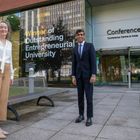
Rishi Sunak kickstarts Help to Grow scheme at Aston Business School
"It was a pleasure to host the chancellor at Aston Business School today. As a small business leader you have to know about all the key business functions and how to optimise them to drive high performance in your business." Paula Whitehouse, Aston Business School Paula Whitehouse (L) & Rishi Sunak (R) The Chancellor of the Exchequer met with Aston University’s deputy vice-chancellor engagement and associate dean enterprise of the College of Business and Social Sciences to launch Help to Grow: Management The scheme will support senior managers of small and medium-sized businesses to boost performance, resilience, and long-term growth The 12-week programme is 90% funded by the Government and participants can complete it alongside full-time work. The Chancellor has called on the leaders of small and medium-sized businesses to sign up to a new programme designed to hone their expertise as he attended one of the first courses in the UK today (August 2). Rishi Sunak joined a class taking part in the government-funded Help to Grow: Management scheme at Aston Business School, Aston University, alongside small business owners, to see first-hand how it is giving them the tools they need to innovate, grow and help drive the recovery from the pandemic. The Chancellor delivered a talk to participants at Aston Business School on the critical role small businesses can play in boosting UK productivity. He then took part in a group activity and led a discussion about their own business models and opportunities for growth. The scheme, which was announced at the March Budget and opened for applications in May, will give 30,000 SMEs access to world-class business expertise on everything from financial management to marketing and is a pivotal part of the government’s Plan for Jobs. Rishi Sunak, the chancellor of the exchequer, said: “Small businesses are key to our innovation and economy and will therefore be an essential part to our recovery from the pandemic, which is why we are levelling up their skills through the Help to Grow schemes. “I want to bring some of the best bits of management training from around the world to help boost productivity here in the UK. “Help to Grow: Management will ensure our brilliant SMEs seize every opportunity to grow, fuelling our Plan for Jobs by boosting productivity in all corners of the UK.” Experts in small business and entrepreneurship from Aston University have played a significant role in developing the programme. Paula Whitehouse, curriculum director for Help to Grow: Management and associate dean enterprise of the College of Business and Social Sciences, said: "It was a pleasure to host the chancellor at Aston Business School today. As a small business leader you have to know about all the key business functions and how to optimise them to drive high performance in your business. “Help to Grow: Management will combine this essential business education with the creation of a like-minded business network and support for the practical application of the learning to ensure businesses get immediate results. “I am excited to be working with Small Business Charter business school colleagues all over the country to roll out the Help to Grow: Management curriculum and ultimately to be introducing many more business leaders from the West Midlands into Aston's vibrant entrepreneurial community." Mark Hart, professor of small business and entrepreneurship at Aston University and associate director of Aston Centre for Growth, said: “The launch of the Government’s Help to Grow: Management programme for SMEs is a welcome addition at a critical time to the range of support available to small business leaders across the UK. “Small firms will drive the recovery as they have always done in previous economic downturns and equipping their leaders with the leadership and management skills from the UK’s leading business schools will ensure that they will build even more resilient, innovative and sustainable businesses capable of responding to the emerging opportunities in their chosen markets. “This is a practical, intensive 12-week programme designed by some of our top academics to provide the skills required to improve the performance and productivity of small firms across all sectors of the economy”. Mark Hart (L) & Rishi Sunak (R) take part in a class at Aston Business School