Experts Matter. Find Yours.
Connect for media, speaking, professional opportunities & more.

Friends or enemies? Is there any solving the ancient secret that is Chinese diplomacy?
When it comes to trade, investment and trillions of dollars of opportunity for American companies – it would appear that China and the United States should be close-knit allies. However when it comes to military escalation, an emerging global bull and national security – China is also a country that the U.S. government is very concerned about. NPR recently got in touch with UMW Professor of Political Science and International Affairs Elizabeth Larus to lend her expertise when it comes to the politics of China. Elizabeth Larus, who teaches Chinese studies at the University of Mary Washington in Virginia, says any economic "de-coupling" between the U.S. and China will be very difficult. "You can't just say you're going to pick up your factory and move all your resources and have a consistent, reliable energy source and the shipping port to get your stuff out at a decent price, and the logistics. China has nailed that down," said Larus, the author of Politics and Society in Contemporary China. China's President Xi Jinping uses this as leverage, she noted. "One of the goals of this Xi Jinping regime is to make the world really reliant on China for its supply chain, but not to have China reliant on the rest of the world," she added. "So that makes it difficult for the businesses." Is there a way out of this downward spiral? "I do not see a de-escalation anytime soon," she said. October 08 - NPR There will be no easy or immediate solution to the hot-and-cold relationship between the United States and China. But if you are covering this ongoing story – then let our experts help with your questions and coverage. Dr. Elizabeth Larus is an expert in the politics of China. She is available to speak to media, simply click on her icon to arrange an interview today.


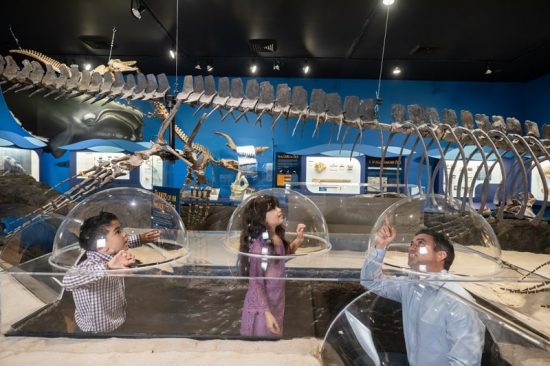
Georgia Southern University Museum reopens just in time to celebrate Earth Sciences Week
After nearly three years and following extensive architectural renovations, the Georgia Southern Museum, one of the longest-standing educational centers on the University's Statesboro Campus, has reopened. "It has been a long project, but well worth the journey," said Georgia Southern Museum Director Brent Tharp, Ph.D. "The upgraded facility and newly designed galleries represent a new era for the museum. Visitors will still find old friends, like the mosasaur, but exhibited in new more exciting ways, and will make new discoveries with never before exhibited artifacts in expanded permanent exhibits preserving the area's culture. We are really excited to be back open to the public." The Georgia Southern Museum serves as the premier institution interpreting the natural and cultural history of Georgia's coastal plain. The museum displays permanent exhibits and changing exhibits curated by the University's faculty and students, and provides a place where researchers can explore its collections and students of all ages can learn. As part of its reopening celebration, the Museum will recognize Earth Sciences Week with events featuring social media videos and interactive displays by Georgia Southern students, faculty and alumni. Highlighted events for Earth Sciences Week include: Oct. 12 - Earth Observation Day Oct. 13 - National Fossil Day Oct, 14 - Geoscience for Everyone Day Oct. 15 - Geologic Map Day Oct. 16 - International Archaeology Day Admission to the museum is $4 per person; however, for a limited time the museum also will accept donations for admission. Children 3 years of age and younger, museum members, and Georgia Southern students receive free admission. If you’re a journalist looking to cover Earth Sciences Week or talk to any of the many experts at the museum – then let us help. The researchers behind this study are available, simply reach out to Georgia Southern Director of Communications Jennifer Wise at jwise@georgiasouthern.edu to arrange an interview today.


Cyber-attacks are rising to the top of American concerns
With the rising occurrence of cyber-attacks across America, institutions, banks, government agencies and top-tier companies are now either falling victim or feeling vulnerable to attack from online enemies abroad. It’s a topic that is now front and center that has most leaders regardless of poltical party in agreement - and media across the country are starting to cover with more depth and seriousness. Most Americans across party lines have serious concerns about cyberattacks on U.S. computer systems and view China and Russia as major threats, according to a new poll. The poll by The Pearson Institute and The Associated Press-NORC Center for Public Affairs Research shows that about 9 in 10 Americans are at least somewhat concerned about hacking that involves their personal information, financial institutions, government agencies or certain utilities. About two-thirds say they are very or extremely concerned. Roughly three-quarters say the Chinese and Russian governments are major threats to the cybersecurity of the U.S. government, and at least half also see the Iranian government and non-government bodies as threatening. October 11 – Associated Press "I am really interested in the security of our critical infrastructure systems," said Dr. Michael Nowatkowski. " If an attacker were able to shut those systems down, great harm would result. This is a national security issue." If you’re a journalist look to know more or have been assigned to cover any aspect of cyber-security in the country, then let our experts help with your coverage. Dr. Michael Nowatkowski is an Associate Professor with the School of Computer and Cyber Sciences at Augusta University. He also serves as the Head of the Cyber Program of Study. Nowatkowski is available to speak with media regarding the emerging threat of cyber-security in America, simply click on his icon now to arrange an interview today.



Aston University’s Dr Ozlem Arikan looked at the impact of the style of corporate information on investor decisions Companies arguably avoid being specific by using ‘boilerplate language’ to avoid negative reactions of the investors Dr Arikan’s research suggests that boilerplate information is not useful for investment decisions and investors lose trust in managers who use boilerplate language New research from Aston University has found boilerplate language used by managers is preventing their non-professional investors from making sound decisions. Dr Ozlem Arikan examined the impact of the style of corporate information on non-professional investor decisions. The term ‘boilerplate’ refers to standardised text, copy, documents, methods or procedures that may be used over again without making major changes to the original. In the context of risk disclosures as studied by Dr Arikan, boilerplate description of risks entails a generic list of risks that are common to all industry, rather than including details relating to risks specific to that entity. Regulators are concerned about generic disclosures which they label as boilerplate; they warn that disclosures which do not have enough details do not help investors to make sound decisions. An example of a boilerplate can be found in Google’s risk disclosure which cites social media companies as its main competitors without specifying Facebook, an obvious competitor to Google in terms of generating online advertising revenues. Dr Arikan found that although some investors are less likely to invest in a company when its disclosure is specific, this only happens when they had some knowledge about the issue disclosed. However, when the disclosed risk materialises, investors rate boilerplate managers as less credible than specific managers and are less likely to invest in these companies. Dr Ozlem Arikan, senior lecturer in accounting at Aston Business School, said: “My research suggests the Financial Reporting Council has been right all along about ‘boilerplate language’ preventing non-professional investors from making sound decisions, and it is not good for companies either. “When companies are evasive about their risks, they neither help themselves nor their investors. “Companies arguably avoid being specific to avoid negative reactions of the investors. For example, Google presumably avoids mentioning Facebook as it does not want to make Facebook’s threat to its business too explicit. However, my research suggests that companies do not necessarily avoid negative reactions by being boilerplate. “Regulators may wish to guide companies in how to make more specific disclosures, which are more useful to investors in their decision-making than their boilerplate counterparts. “Importantly boilerplate language does not give enough warnings to investors as those who read a boilerplate risk warning are more surprised when the risk materialises and they correct their previous decisions to a greater extent than investors who read the specific information” You can read the full paper, The effect of boilerplate language on nonprofessional investors’ judgments, HERE. You can find out more about Dr Arikan’s previous research HERE.


Corporate Social Responsibility Builds Investor Trust
There’s little doubt that corporate social responsibility (CSR) is a good thing for businesses. Whether it’s taking positive action on society, communities, the climate, or the planet, strong corporate citizenship tends to play well with the public, the media, and consumers alike. And that can translate into wins in terms of brand equity and reputation. What is perhaps less clear are the concrete business returns that ethical business practices may or may not generate. Or, whether doing the right thing can create value for firms beyond image, brand, and customer or employee engagement. To shed light on this, Goizueta Assistant Professor of Accounting Suhas A. Sridharan, has taken a rather novel approach. Together with colleagues from the universities of LUISS Guido Carli, Nazarbayev University, and IDC Herzliya, Sridharan has published a new study using measures of disclosure credibility to understand whether CSR builds investor trust and drives tangible benefits for corporations. Corporate Social Responsibility Does Reap Rewards “Disclosure credulity refers to how much your investors trust the information your organization provides – how much faith they have in your company’s ability to accurately convey opportunities for growth, and perhaps more critically, to navigate risk and uncertainty,” says Sridharan. “Because CSR and responsible business practices have a role in addressing a range of risks–from climate change and environmental factors to socio-economic or political uncertainty and the impact on supply chains, talent and so on–we reasoned CSR can impact investor trust and disclosure credibility. And disclosure credibility, in turn, can impact investor decision-making and business outcomes.” To study disclosure credibility, and capture shifts in investor sentiment towards firms, Sridharan and her colleagues decided to use the link between share prices and company earnings announcements–the public statements on profitability that firms are obliged to make over different periods. “Earnings announcements are among the most salient and recurring areas of corporate disclosure, and managers and investors pay very close attention to them,” Sridharan says. “Because of the nature of the information they contain, they have a direct link to security price discovery – the price that firms and investors will agree to buy and sell shares in the company. Simply put, earnings announcements can be used to examine how much investors value a firm.” As reports, earnings announcements are also highly complex and typically time-consuming to process. Because of this, Sridharan and her colleagues opted to look at just how quickly or slowly investors were reading announcements and responding to them – and how quickly or slowly stock prices were adjusting to reflect earnings news within a five-day window after earnings announcements, as well as a longer period to allow for potential overreaction or error. More Disclosure Credibility Equals Faster Results Sridharan explains, “The intuition we brought to the study was that the more investors trust a firm’s disclosures, the more efficient or faster they will be to process its earnings report; in other words, the more they will be likely to take the report on face value and less inclined to dig into the finer minutiae or question its findings.” Adopting this approach, she and her colleagues then compared and contrasted investor response to earnings reports from different firms, with greater or less involvement in CSR activities. In total, they looked at a large-scale sample of more than 19,000 annual earnings announcements from just under 3,000 U.S. firms over a 25-year period, between 1992 and 2017. Using Morgan Stanley Capital International environmental, social, and governance ratings, they were also able to determine the degree of firm-level CSR across their dataset during this period. Crunching the numbers, Sridharan and fellow researchers were able to arrive at a concrete conclusion: CSR measurably increases investor trust and disclosure credibility. “When we estimated our regression models, we found clear evidence that corporate social responsibility does indeed contribute to the average speed of price discovery around earnings announcements; and it does so positively. Our results reveal that CSR increases the speed with which stock prices incorporate earnings news. Breaking it right down, we see that a one unit increase in CSR activities corresponds to 1.96 percent increase in the average timeliness or efficiency of reported earnings.” In other words, investors are reacting more quickly and favorably to performance reports made by organizations with more demonstrated social responsibility. “We know that these types of announcements are lengthy and dense; they take time to process,” Sridharan says. “So, the intuition here is that when your firm plants a flag on responsibility and accountability, investors are more likely to take your disclosures at face value – they’re more likely to trust what you’re saying.” Organizations would do well to take this finding on board, says Sridharan; especially in today’s climate of high volatility and uncertainty. Having investors on board is critical in weathering the bad times along with the good, she adds, and CSR can be a game-changing tool in building that necessary trust. The Wild West of the Regulatory Landscape Sridharan’s paper also informs the regulatory landscape around corporate responsibility which is still in its infancy and which she likens to something of a “Wild West.” “The U.S. Securities and Exchange Commission (SEC) and other regulators are increasingly focused on improving the functioning of capital markets and understanding the role of CSR,” she says. “The SEC has included an examination of climate and ESG-related risks among its 2021 examination priorities which also underscores a growing investor interest in these issues. At the same time, research is showing that CSR can be misused or simply deployed to benefit managers looking to score reputational points with stakeholders–at the expense of shareholders. By demonstrating that investor perceptions of firms are materially shaped by firms’ CSR activities, our study highlights the importance of–and helps build the case for–monitoring and regulating firms’ CSR activities.” Suhas A. Sridharan is an Assistant Professor of Accounting at Emory University's Goizueta Business School. Sridharan studies investors' use of information to assess risk and resolve uncertainty, particularly around issues of political economy. She is available to speak with media about the importantance of CSR - simply click on her icon now to arrange an interview today.


Emory Experts - Ad-blockers Shave $14.2 Billion Off Consumer Spending, Says New Research
Digital advertising is big business. So big, in fact, that it is well on track to become the most dominant form of advertising. Estimates suggest that spending on digital ads in the U.S. alone will reach a staggering $201 billion by 2023 – more than two-thirds of total spend. And it makes sense. With consumers increasingly shopping online, advertisers continue to ramp up their use of data and technologies to find innovative new ways to reach target audiences. The Flip Side to Digital Advertising Success The sheer ubiquity of online advertisements is driving a corollary upswing in the use of another digital technology. Ad blockers are easy-to-install and free-to-use software that consumers can deploy to hide unwanted ads on their screens, and they are gaining huge popularity worldwide. The numbers are hard to determine, but some evidence points to anywhere from 600 million to two billion Internet users having downloaded some form of ad-blocking in the last three years or so – well over 11% of the global internet population. Also hard to gauge is the impact on advertising revenue that ad-blockers are having – that is, until now. A new paper by Vilma Todri, assistant professor of information systems and operations management at Goizueta, sheds stunning light on the effect of ad-blocking on online search and purchasing behaviors among internet users. And what she has found should give advertisers serious pause for thought. According to her analysis, ad-blockers decrease consumer online spending by an average of 1.45%. Now, assuming that around 615 million internet users have downloaded some kind of ad-blocking software in recent years, the actual impact puts the loss in revenue from digital advertising around the $14.2 billion mark, year over year. And that’s not all. Todri also finds that ad-blocking seems to have the effect of limiting consumer spending disproportionally on certain brands over others. Users who opt out of seeing digital ads tend to continue to purchase mostly those products or services they are already familiar with, and not engage with new brands; they are less likely to use different search channels or visit new e-commerce websites as a result of ad-blocking. Analyzing Customer Engagement from 300 Million Internet Visits To get at these insights, Todri analyzed data from a U.S. web behavior dataset spanning a three-year period, from January 2015 to December 2018. She looked at web-wide visits, transaction behaviors and demographic identifiers across a total of 92,000+ users and more than 300 million internet visits. To measure the effect of ad-blocking, Todri matched all of this data with an ad-blocker dataset from the same source – a well-known U.S. measurement and analytics company – which shows that around 10% of users had installed an ad-blocker at some point during this three-year window. Crunching the numbers, Todri finds that the effect of using ad-blocking software on these users is to reduce their online search engine sessions by 5.6%. They also spend 5.5% less time visiting e-commerce websites. In other words, consumers who opt out of seeing ads end up browsing and shopping significantly less than others. And in terms of what these users are buying, the data shows that they are much less likely to spend on brands they don’t know or have not experienced before (and conversely, more likely to stick to familiar brands.) Digging even deeper, Todri also finds that this negative effect penalizes the brands that invest most heavily in advertising online more that those that don’t. In other words, ad-blockers are hurting those who advertise online most. Todri’s paper is the first to expose the quantitative, negative impact of ad-blocking on consumer spending. And her findings should be on the radar of any company looking to market its products and services online, she says. “The data clearly shows that ad-blockers reduce online spending by 1.45%, which amounts to something in the order of $14.2 billion in lost revenue given that about 600 million people around the world have installed this kind of software,” she says. “And the figures suggest that it’s the brands that heavily invest on online advertising who are bearing the brunt of this drop-off in consumer spending.” Search Behaviors, Interrupted “Advertisers also need to look at the fact that ad-blockers inhibit search behaviors,” adds Todri. “The figures point to a drop of around 5% when users have installed ad-blockers, which in turn means that they are not discovering and spending on new brands. They’re sticking with what they already know.” There’s an imperative here for companies to interpret these findings and reflect on what they say about ad-blocking, and also about what constitutes “acceptable advertising practices,” she says. “It’s reasonable to assume that people who use ad-blockers simply don’t like ads and aren’t influenced by them. Yet the data points to a different conclusion: if consumer purchasing falls after installing ad-blockers, it would suggest that advertising does work – seeing advertisements does drive searching and purchasing behaviors. So taken together, there’s a likely imperative here for advertisers to find new formats in terms of reaching their targets, and to strengthen their organic channels and social presence online.” Digital advertising clearly does impact search and purchasing behaviors, says Todri, so firms need to get creative while being cognizant of the fact that some consumers find current advertising practices annoying. Vilma Todri is an Assistant Professor of Information Systems & Operations Management at Emory University’s Goizueta Business School. Previously, she worked for Google where she was developing integrated cross-platform advertising strategies for large business clients that partnered with tech giant. Vilma is available to speak with media about this subject – simply click on her icon now to arrange an interview today.


‘The Murder Book: Understanding Homicide Today’
Augusta professor’s latest book is out now The grisly details of murder and true crime fascinate Americans. Whether it’s the current news about the horrific homicide of 22-year-old Gabby Petito, who disappeared while traveling in Wyoming with her boyfriend, Brian Laundrie, or the unsolved killing of child beauty queen JonBenét Ramsey in her home in Boulder, Colorado, almost 25 years ago, people are intrigued by murder. People’s obsession with true crime has also taken the entertainment industry by storm, leading to numerous popular documentaries, movies about murders, television series on cold case investigations and podcasts dedicated to homicide. The genre is so prolific that Hulu’s latest hit — Only Murders In the Building, starring Steve Martin, Martin Short, and Selena Gomez — centers on Upper West Side neighbors and true crime podcast fans who sleuth out a murder podcast on their own. “Murder captures our attention,” said Dr. Kim Davies, dean of Pamplin College of Arts, Humanities, and Social Sciences, who is also a sociologically trained criminologist with an academic focus on homicide and violence. “For a lot of people, I think it’s the idea of solving a mystery. And many people who find murder so fascinating, haven’t ever seen an autopsy and they haven’t seen a death. “When I taught my Sociology of Murder class here at Augusta University, I used to take students to autopsies and it’s gruesome. It’s not like what you see on television or in the movies.” Just last month, Oxford University Press published Davies’ new book, The Murder Book: Understanding Homicide Today. Back in 2007, Prentice Hall published The Murder Book: Examining Homicide by Davies, which was the only comprehensive textbook to focus on homicide. Her new textbook explores additional topics such as the increase in mass murders, the change in Stand Your Ground laws across the country and police shootings as it relates to the Black Lives Matter movement. “Probably the biggest difference in the two books is the chapter on mass murder,” Davies said. “Unfortunately, there have been a number of huge mass murders since the last book such as Sandy Hook, Virginia Tech and the Las Vegas shooting that killed 58 people. In fact, our society and our news media has focused on mass murders much more. “When I wrote the last book, students were fascinated by serial murder, and a lot of students still are, but now it seems like we are more focused on mass murder.” The full release about Davies’ book release is attached, and well worth the read. If you’re a journalist covering true crime or any other aspect of this fascinating topic – then let us help with your stories. Dr. Kim Davies is a sociologically trained criminologist with academic focus is on homicide and violence. Kim is available to speak with media about this subject – simply click on her icon now to arrange an interview today.


History was made at Arlington – and UConn’s expert was recruited to help with national news coverage
For the first time in the 84 years that soldiers have stood watch over the Tomb of the Unknowns at Arlington National Cemetery, the duty was carried out by three women. UConn's Micki McElya, a professor in the Department of History and the author of The Politics of Mourning: Death and Honor in Arlington National Cemetery, offered her perspective and insight into the significance of the moment: The images of the three female soldiers were a “visual marker” of the often unrecognized sacrifices that women and other marginalized people in the United States have made for the military, Professor McElya said. “Women have served either officially or unofficially in every single war this country has ever waged, but they have never been drafted,” she said. “So if we want to talk about sacrifice and honor, women have done that because they wanted to.” The changing of the guard was also an important moment in military history, one that showed that women are serving in “the most revered positions,” said Kara Dixon Vuic, a professor of war, conflict and society in 20th-century America at Texas Christian University in Fort Worth. “These are the rituals that the nation holds dear,” she said. “Some might call it militaristic and some might say it represents the best of us. But to have women at the heart of it, whatever your perspective is, is important because it shows that women are at the heart of these debates now.” If you are a journalist covering the historic aspects of this occasion or other events taking place, then let our experts help with your stories. Professor McElya is an expert in the histories of women, gender, sexuality, and race in the U.S., with a focus on politics and memory. She’s available to speak with media regarding these topics – simply click on her icon now to arrange an interview today.


It’s a topic that gets a lot of attention, people getting out of prison and returning to normal life. It’s a hard story to tell as there are so many challenges, obstacles to overcome and stigmas to break as those who have served their time and are looking to fit back into the life they used to know. Recently, Georgia Southern’s Maxine Bryant, Ph.D., was interviewed by the Savannah Morning News for "When is the debt paid? Formerly incarcerated individuals face challenges with re-entry." Here’s an excerpt: According to Rehabilitation Enables Dreams, or RED, a nonprofit restorative justice program based in Atlanta, Georgia, two out of three people released from prison in Georgia are rearrested within three years. Landing employment is only one of the issues formerly incarcerated people face in efforts to reintegrate into society. Finding shelter and earning an education are, in many cases, equally difficult, said Maxine Bryant, Ph.D., assistant professor in Georgia Southern University's Department of Criminal Justice and Criminology. “What I think is missing is addressing the trauma that many people find themselves behind bars have been subject to before going to prison,” Bryant said." October 04 - Savannah Morning News If you are a journalist and would like to learn more about this program or this topic – then let our experts help. Maxine Bryant’s research interests focus on factors contributing to the successful community reintegration of released prisons. Specifically, she has written and presented on transitional jobs for newly released prisoners, the role of the Black church in successful offender reintegration, the impact of unaddressed childhood trauma and barriers to successful offender reintegration. She is available to speak with media any time – simply click on her icon to arrange an interview today.

It is in the news daily the awareness campaigns are everywhere – but for Spanish-speaking Americans, a lot of the information on COVID-19 and vaccination efforts against the disease weren’t reaching home. That was leaving a large swath of the population unprotected against the virus. Pastor Angel Maestre takes to the airwaves for his radio show, 97 Oasis, each week, speaking about faith to his Spanish-speaking audience. When COVID-19 vaccines rolled out, he began including teachings about health and science. “It was my duty as a leader,” Maestre says. Vaccination rates among the Hispanic population were extremely low at the time. In Richmond County, less than 10 percent of this community was vaccinated. Maestre partnered with Dr. Jose Vaszquez, an infectious diseases physician at Augusta University Health. Vazquez began appearing on Maestre’s radio show. He also spoke and answered questions at Maestre’s church, Centro Cristiano Oasis de Bendicion. “The Hispanic community has been one of the toughest communities to get vaccinated,” Vasquez says. “They’re not anti-vaxxers. But, most of the education put out there is in English. A lot of it is not in Spanish. So, they didn’t understand.” According to Vazquez, the top three concerns among the Hispanic community were that the COVID-19 vaccine contained fetal tissue, caused infertility and could result in undocumented immigrants encountering problems with immigration authorities. “They thought if we took their name and number, that ICE or immigration would come and take them, which is not true.” Vazquez eased concerns, and vaccination rates increased quickly. “I’m proud to say because of our outreach programs with some of our partners, specifically going through the churches, that it has actually increased to 30 to 35 percent.” Are you a journalist looking to know more about how COVID-19 is impacting Hispanic communities and what else can be done to ensure every person in America has access to vaccines? That’s where Augusta University can help. Dr. Jose Vazquez, division chief and professor of medicine in the Medical College of Georgia, is an expert in the realm of infectious diseases. He studies and treats infectious diseases, including antibiotic-resistant superbugs and fungal infections. He has been a reliable source for local, statewide and national media regarding the coronavirus outbreak. Dr. Vazquez is available to speak with media regarding this topic – simply click on his icon to arrange an interview.