
Experts Matter. Find Yours.
Connect for media, speaking, professional opportunities & more.

Antimicrobial resistance now causes more deaths than HIV/AIDS and malaria worldwide – new study
Antimicrobial resistance is spreading rapidly worldwide, and has even been likened to the next pandemic – one that many people may not even be aware is happening. A recent paper, published in Lancet, has revealed that antimicrobial resistant infections caused 1.27 millions deaths and were associated with 4.95 million deaths in 2019. This is greater than the number of people who died from HIV/AIDS and malaria that year combined. Antimicobial resistance happens when infection-causing microbes (such as bacteria, viruses or fungi) evolve to become resistant to the drug designed to kill them. This means than an antibiotic will no longer work to treat that infection anymore. The new findings makes it clear that antimicrobial resistance is progressing faster than the previous worst-case scenario estimates – which is of concern for everyone. The simple fact is that we’re running out of antibiotics that work. This could mean everyday bacterial infections become life-threatening again. While antimicrobial resistance has been a problem since penicillin was discovered in 1928, our continued exposure to antibiotics has enabled bacteria and other pathogens to evolve powerful resistance. In some cases, these microbes are resistant even to multiple different drugs. This latest study now shows the current scale of this problem globally – and the harm it’s causing. Global problem The study involved 204 countries around the world, looking at data from 471 million individual patient records. By looking at deaths due to and associated with antimicrobial resistance, the team was then able to estimate the impact antimicrobial resistance had in each country. Antimicrobial resistance was directly responsible for an estimated 1.27 million deaths worldwide and was associated with an estimated 4.95 millions deaths. In comparison, HIV/AIDS and malaria were estimated to have caused 860,000 and 640,000 deaths respectively the same year. The researchers also found that low- and middle-income countries were worst hit by antimicrobial resistance – although higher income countries also face alarmingly high levels. They also found that of the 23 different types of bacteria studied, drug resistance in only six types of bacteria contributed to 3.57 million deaths. The report also shows that 70% of deaths that resulted from antimicrobial resistance were caused by resistance to antibiotics often considered the first line of defence against severe infections. These included beta-lactams and fluoroquinolones, which are commonly prescribed for many infections, such as urinary tract, upper- and lower-respiratory and bone and joint infections. This study highlights a very clear message that global antimicrobial resistance could make everyday bacterial infections untreatable. By some estimates, antimicrobial resistance could cause 10 million deaths per year by 2050. This would overtake cancer as a leading cause of death worldwide. Next pandemic Bacteria can develop antimicrobial resistance in a number of ways. First, bacteria develop antimicrobial resistance naturally. It’s part of the normal push and pull observed throughout the natural world. As we get stronger, bacteria will get stronger too. It’s part of our co-evolution with bacteria – they’re just quicker at evolving than we are, partly because they replicate faster and get more genetic mutations than we do. But the way we use antibiotics can also cause resistance. For example, one common cause is if people fail to complete a course of antibiotics. Although people may feel better a few days after starting antibiotics, not all bacteria are made equal. Some may be slower to be affected by the antibiotic than others. This means that if you stop taking the antibiotic early, the bacteria that were initially able to avoid the effect of the antibiotics will be able to multiply, thus passing their resistance on.



Ask an Expert - Are American Fan-Based Businesses at Risk for Decreased Revenue?
Modern fandom, according to Mike Lewis, is about having a passion for something—a sports team, entertainer, politician, fashion brand, a university—something. Lewis, professor of marketing and faculty director, Emory Marketing and Analytics Center (EmoryMAC) and host of the podcast, Fanalytics, considers fandom important because what people are fans of defines a modern culture. We can laugh at the sports fan with the painted face and the open shirt and the spikes on the sleeves, but the reality is, the traits that drive that level of enthusiasm and commitment are the traits that change the world outside of the arena. Mike Lewis, professor of marketing and director of EmoryMAC To better understand modern fandom and its effect on culture, Lewis, along with Yanwen Wang, Associate Professor of Marketing and Behavioral Science, and Canada Research Chair in Marketing Analytics, University of British Columbia, created EmoryMAC’s “Fandom Analytics Initiative.” The Fandom Analytics Initiative’s first report, Next Generation Fandom Survey, Generation Z: The Lost Generation of Male Sports Fans, published in September 2021, examines the results of a national survey the initiative commissioned. Nearly 1,400 people across four demographic groups—Generation Z, Millennials, Generation X and Baby Boomers—participated in the survey. Is Gen Z the Lost Generation of Male Sports Fans? The results reveal a somewhat troubling trend: Generation Z males (those born between 1990 and 2010) “seem to be increasingly indifferent and negative to traditional sports,” Lewis and Wang write in their report. “Generation Z’s relative lack of passion for sports and other categories is troubling for fandom-based businesses and a curiosity for those interested in the state of American society.” While only 23 percent of Generation Z defined themselves as “avid sports fans,” 42 percent of Millennials did, along with 33 percent of Gen Xers and 31 percent of Baby Boomers. Perhaps even more revealing is the percentage of respondents who considered themselves “anti-sports fans”—a startling 27 percent of Generation Z tagged themselves as “anti-sports” compared to 7 percent of Millennials, 5 percent of Gen X, and 6 percent of Baby Boomers. “That was unexpected,” says Lewis, who thought Generation Z would line up similar to Millennials, given that both groups are digital natives. “I’m still more and more surprised at how different Generation Z is than Millennials and, frankly, everyone else.” When Lewis and Wang took a look at the differences between male and female Generation Zers, things got even more interesting. In traditional sports categories (football, basketball, hockey, baseball, soccer), more Generation Z females defined themselves as “avid sports fans” than did their male counterparts. When it came to football, 20 percent of both Generation Z males and females described themselves as avid fans (the lowest percentage of all the demographic groups). But in every other traditional sport, Generation Z “avid sports fan” females outnumbered males by a discernable margin. Only when it came to eSports did Generation Z males outnumber Generation Z females. “I think there’s a very deep issue going on,” says Lewis. “Something fundamental has shifted.” The survey included questions about fandom-related psychological traits, specifically, community belonging and self-identity. On both, Generation Z males scored lower than Millennials. “The findings related to sports are particularly germane from a cultural perspective,” states the report. “Part of the lack of Generation Z fandom is due to younger individuals having less intense feelings of group belonging in general.” Beyond the Playing Field, How Does Loyalty Shine? While the report doesn’t take a deep dive into the psychology behind Generation Z’s fandom differences, it does note that Generation Z came of age during a time of “ubiquitous social media, dramatic demographic changes, and a hyper-partisan political environment,” they write. “These dramatic changes may fundamentally alter how members of Generation Z engage with cultural industries.” Overall, Millennials were shown to have the “highest preference across all sports,” according to the report. Millennials are not only willing to watch games, but they also enthusiastically wear team gear. Baby Boomers are up for watching games but are less interested in following teams on social media. As it turns out, note the authors, Generation Z isn’t totally disconnected. Across the entertainment categories, Generation Z is similar to other generations. “Sports fandom is the outlier,” they state. In addition to sports, Lewis and Wang looked at six other fandom segments: new and now celebrities, social justice culture, athletic excellence, old school personalities, brand fanatics, and Trump Fans. Lewis points to the fact that whatever one thinks of Donald Trump, he does generate fandom. “That passion for whatever it is—sports, politics, movies, music—that’s really what drives the world,” says Lewis. Because of its importance, fandom is, notes the study, “increasingly actively managed,” whether to garner viewers, money, or votes. Recent trends such as streaming across devices, the ubiquity of social media, an increase in demographic diversity (not to mention a once-in-a-lifetime pandemic), have affected mainstream sports and entertainment. As a result, Lewis believes it’s important to study how fans are changing across generations. Leagues, teams, networks, studios, celebrities, and others need to understand why there is less engagement to formulate strategies for acquiring the next generation of fans. Authors Mike Lewis and Yanwen Wang As sports leagues and teams see more growth opportunities with women and increasingly diverse fan bases, Lewis wonders if some sports teams may alienate their current fan bases by marketing to non-traditional groups. “If you’re a league or a team, you’ve got a real dilemma at this point,” he explains. “If the NFL wants positive press, it has to market to the non-traditional fan segments. If they do that, are the traditional fan segments going to be less interested? Perhaps.” EmoryMAC’s research on fandom in the modern age is ongoing. A study into how eSports’ fandom differs from traditional sports fandom is also in process—as is research on how younger demographic groups see colleges and universities as institutions worthy of fandom. EmoryMAC will continue to make data and insights available on its fandom analytics website. “Looking at the fandom and passion of young groups now will tell you a lot about what the world will look like in 20 years,” says Lewis. I suspect that the era of sports being a mass marketing product and also a cultural unifier is probably going to end. Mike Lewis While that strikes Lewis as sad, he and EmoryMAC are merely following the data. “It may be the reality of where this is going,” he adds. If you're a reporter looking to know more - then let us help. Professor Michael Lewis is an Associate Professor of Marketing at Emory University’s Goizueta Business School. In addition to exploring trends in the overall marketing landscape, Lewis is an expert in sports analytics and marketing. He is available for interview - simply click on his icon to arrange a discussion today.



What it will take to overcome supply chain disruptions
The supply chain disruptions sparked by the pandemic highlight the need for behavioral shifts by both consumers and companies. Asoo Vakharia, McClatchy Professor and director of the Supply Chain Center at UF’s Warrington College of Business, says supply chain disruptions are — and will continue to be — a way of life. But the degree of the turmoil experienced recently demonstrates the need for some change. “Demand dropped so quickly and at such a high volume that it created a problem for us,” Vakharia said in an episode of the From Florida podcast. Approximately 20% of imports to the United States come from Asia with the biggest share off-loaded in Los Angeles, followed by Long Beach, California. Those ports, along with other large centers, can accommodate the Ultra Large Vessels often used for trans-Pacific shipping. But they’ve been severely impacted by inflow/outflow imbalances caused by a range of factors including truck driver shortages and poor infrastructure. In response, companies such as Amazon, have purchased smaller vessels that can access a larger number of smaller ports, including those that may require passage through the Panama Canal. The move will enable the commerce giant to side-step some of the bottlenecks slowing down larger ports, but it will also add to expense. This is where Professor Vakharia says companies, and consumers, will need to make choices. He cautions companies to play the long game. “Consumers have long memories and they will reward people who have a little bit of recognition of our conditions,” he said. And he says buyers should always be on the lookout for deals. “There is lots of opportunity out there,” Vakharia said. “Maybe you won’t get the brand you want, but you will get a good brand. Let’s moderate our wants a little bit. Let’s think logically.” Professor Vakharia also sees opportunity for Florida ports, with the caveat that the complexity of the issue will require significant planning — and investment. “We need to have an infrastructure, which is rail or trucks, which are going to visit these ports and take the goods away from them because otherwise we’re going to do the same thing as Long Beach.” The added expense of smaller ships will also need to be managed. To hear more about the supply chain issues currently at play, and possible solutions for the future, listen to the episode on From Florida at this link. Read the recent article that Professor Vakharia has been quoted in: Listen to other episodes in the "From Florida" series from the link below.


Function – not fashion. What masks are the best to get behind when facing the risk of Omicron?
Omicron is here and it is spreading like wildfire across America and most of the globe. It’s highly transmissible and easily caught. For more than a year, most Americans have been taking on the simple approach of ‘masking up’ to contain any possible spread. People were using anything from surgical masks, N95s, cloth masks and even gators. Whatever could be used to provide a barrier around one’s nose and mouth. Cloth masks caught on, some even became fashion pieces – but as this most recent wave of COVID has shown, the type of mask is now just as important as the idea of simply covering up and looking good. “Cloth masks and things like that are very comfortable and they have good coverage on the face,” says Rodger D. MacArthur from the Medical College of Georgia. “But they don’t fit so tight and so air and any virus that’s in the air and come through the sides.” MacArthur who brings 20 years experience in the Division of Infectious Diseases at Augusta University says medical surgical masks are best for getting the most protection. "It’s not simply being so close to somebody that you sneeze on them, you splatter them with droplets. It’s in the air we’re breathing.” He just keeps a disposable one folded up in his pocket, but encourages the highest forms of protection you can find. Masks have been a popular and contentious topic during this pandemic and there’s a lot to know about this important topic – and if you are a reporter looking to cover this story – then let our experts help. Dr. Rodger MacArthur is a widely recognized expert in COVID-19, HIV antiretroviral therapy, resistance to antiretroviral drugs, and sepsis. He is available to speak with media – simply click on his icon now to arrange an interview today.


New £1.5 million healthcare simulation facilities to open at Aston University
New clinical simulation facilities for medical, pharmacy and optometry students are set to open in 2022 Including an ocular simulation unit facility which will be the only one in Europe, as part of further investment in clinical facilities in the College of Health and Life Sciences at Aston University. The facilities are part funded by the Office for Students which awarded the University £806,226 to set up a ‘high fidelity’ simulation A&E room with further expenditure by Aston University on an ocular simulation unit. Aston Medical and Pharmacy School students will be able to practise in emergency settings using high quality manikins where they will simulate treating patients for acute conditions such as a heart attack or learning how to intubate a patient onto a ventilator. The high-fidelity acute care simulation room will be equipped with recording facilities, a debrief room and control room. The funding will allow for the purchase of other training equipment such as a hospital grade bed and single task trainer simulation equipment. For example, male and female catheterisation models, pelvic and rectal trainers, venepuncture arms, breast trainers and abdominal trainers. Professor Liz Moores, deputy dean of the College of Health and Life Sciences, said: “We are really excited to have the support from both the Office for Students and Aston University in building these state-of-the-art facilities for our students and can’t wait to start using them. “The acute care simulation room will allow us to simulate a variety of emergency resuscitation scenarios that are very difficult to teach in real life situations, such as heart attacks, acute breathlessness and severe allergic reaction and will be of great value in training students of medicine and pharmacy.” Students in the School of Optometry will also be equipped with simulation facilities to carry out treatment on patients. Professor James Wolffsohn, head of the School of Optometry said: “The ocular simulation facility at Aston University will be unique in Europe, allowing students to refine their skills in examining the health of the front and back of the eyes and to experience a wide range of eye disease. “One of the simulators even allows them to utilise their smartphone to practice at home. They can gain direct feedback and be assessed by the simulators, allowing more flexible, diverse and intensive learning than can be achieved with clinical practice placements.” It is hoped these facilities will help plug some of the gaps in clinical placements that are currently affecting students since the COVID-19 pandemic. As a result of the pandemic, alternative ways are being explored to gain high quality authentic ‘clinical’ experiences, whilst not exposing patients, staff, or students, to risk. The health crisis has also increased pressure on the NHS creating a need for alternative but appropriate training facilities, to ensure that students are fully prepared for the medical profession. The simulation facilities are due to be open in time for the September 2022 intake of students.
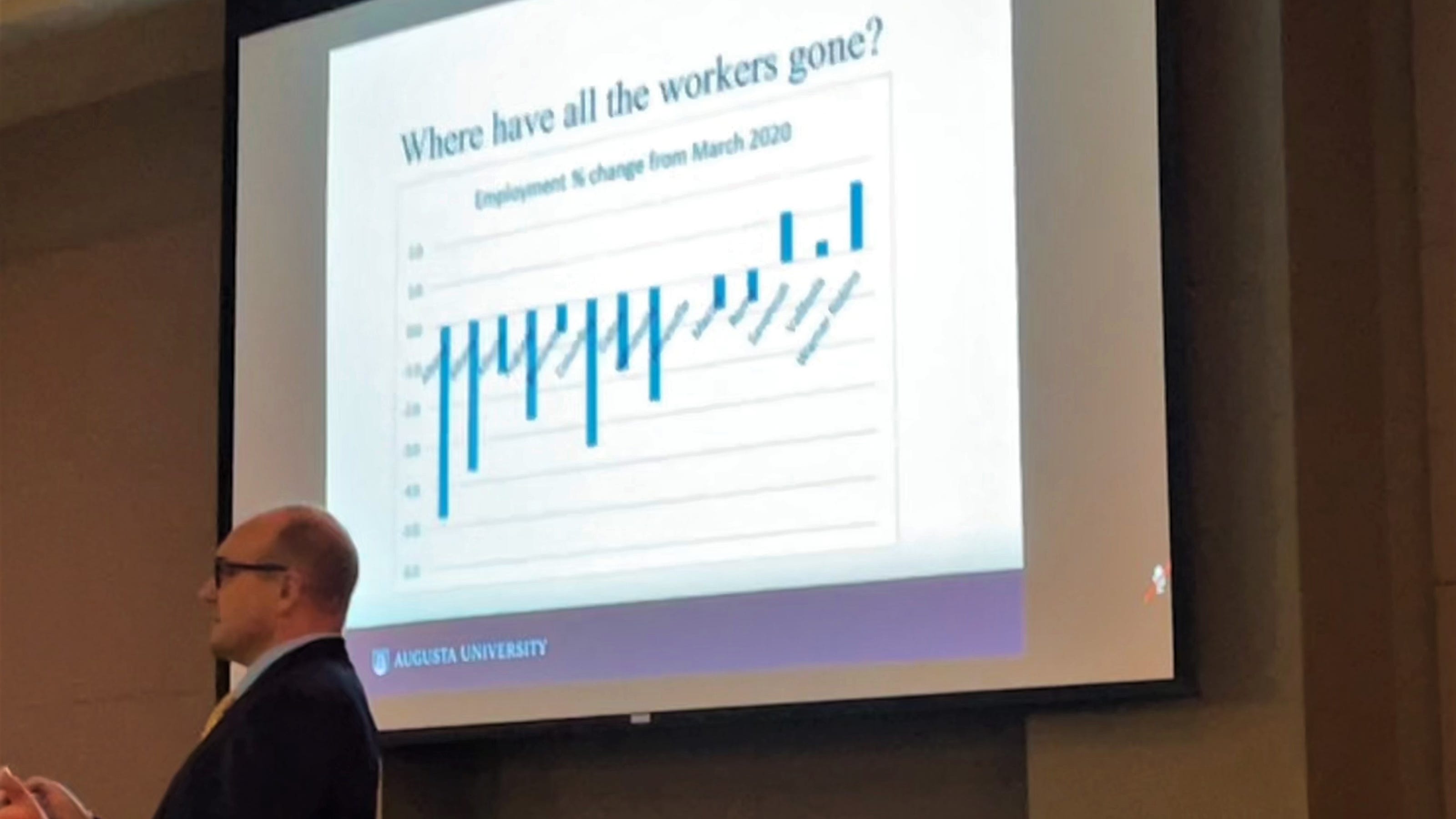
As the legendary political guru James Carville used to say, "It’s the economy, stupid." And these days with housing prices, inflation and the cost of living all pointing up in a very steep trajectory – the state of the economy is front and center for a lot of politicians, Americans and families as the year comes to a close. There’s a lot to be considered, and that’s where experts like Augusta’s Dr. Simon Medcalfe are being sought out to explain economic trends what is behind them. “U.S. retail sales are high,” explains Medcalfe “We had a lot of stimulus checks coming through the door and that’s really spurred extra spending and it’s across a whole range of retail sectors.” According to Medcalfe, household items are also seeing double-digit price increases. “What we’ve seen over the last 18 months during the pandemic, is a shift in our consumer preferences and consumer behavior.” • Furniture sales are up 29% • Used cars and cars in general are up 25-26% • Gardening and building supplies are up 14% • Electronics have seen an almost 30% increase • Clothing sales are up a whopping 50% But it’s not all good news - as the price of everything as we know is going up. “Inflation is running about 6.8% nationally,” Medcalfe explains. “It’s running about 7.2% in the south and it’s certainly a concern of policymakers and economists.” But theirs is sunshine behind those clouds as Medcalfe believes 2022 will see a return to normal. “I think next year inflation will come down. I know it won’t be at these high levels, but I still think it’ll be above the Feds target level of inflation, so look for those interest rate increases next year.” The economy and what to expect locally and nationally are hot topics – and if you are a reporter covering this topic – that’s where we can help. Dr. Simon Medcalfe is a highly regarded economics expert and the Cree Walker Chair in the Hull College of Business at Augusta University. Medcalfe is available to speak with media regarding the economy and its outlook – simply click on his icon now to arrange an interview today.


Have you finished your Christmas shopping yet? If not – waiting for last minute deals or just pushing off the pain of navigating a jam-packed shopping mall might result in some failed efforts, unhappy kids and even the potential for coal in your own stocking for letting some loved ones down. Recently, John Talbott, the director of the Center for Education and Research in Retailing at the Indiana University Kelley School of Business was interviewed on the IBJ podcast to explain how supply chain woes may be creating chaos this Christmas. Experts expect shoppers to drop a record amount of money this holiday season. The National Retail Federation forecasts sales for November and December to grow between 8.5% and 10.5% over the same months in 2020. In total dollars, that would be between $843.4 billion and $859 billion. At the same time, the supply-chain issues that have plagued commerce since the start of the pandemic are expected to complicate gift buying and limit stock for some products. The answer is to get your shopping done as soon as possible, because you might not get a second chance, says John Talbott, the director of the Center for Education and Research in Retailing at the Indiana University Kelley School of Business. In the latest edition of the IBJ Podcast, Talbott explores other big questions with host Mason King. Does Indy’s status as a leading U.S. logistics hub give Hoosiers a leg up on gift availability? What role might inflation play in this year’s shopping season? Why are gift cards even more valuable than usual this year? How can we avoid cybercrime? And are there any blockbuster, must-have gifts for this season? November 28 – IBJ Podcast And if you’re a journalist looking to know more or covert this subject – then let us help. John Talbott is the Director for the Center for Education and Research in Retail at Indiana University’s Kelley School of Business. He’s an expert in the areas of retailing, relating marketing activities to financial outcomes, and new media communication. John is available to speak with media regarding this important topic – simply click on his icon now to arrange an interview today.


Brexit caused a large negative effect on UK trade pre-pandemic - new Aston University research
Professor Jun Du and Dr Oleksandr Shepotylo analysed the causal effect of Brexit on the UK’s services trade between 2016 and 2019 They found the UK experienced an average shortfall of £18.5 billion worth of services exports for each of those years Transport, Travel, Insurance and Telecom sectors experienced significant decline post-2016 No significant decline was found in other services including intellectual property, construction and financial. New research from economics experts at Aston University has found Brexit has caused a largely negative effect on UK services trade since the EU referendum. Professor Jun Du and Dr Oleksandr Shepotylo, from Aston Business School, analysed the causal effect of the Brexit referendum on UK’s services trade over the period between 2016 and 2019, in comparison to other major services exporters. They found the uncertainty associated with the UK-EU trade negotiations following the referendum caused harms to the UK services economy as a whole, reducing firms’ exports of services. This damages the competitiveness of services sectors which make up a lion’s share of the UK economy in terms of gross output, value-added and jobs. Professor Du and Dr Shepotylo used a Synthetic Difference in Differences (SDID) estimator to construct a counterfactual of the UK, had it not voted leave in 2016, to compare its services exports performance. This was done by comparing the actual performance of the UK with the modelled performance of a country that looks much like the UK, but did not vote to leave the European Union. They found Brexit resulted in the UK experiencing an average shortfall of £18.5 billion worth of services exports every year between 2016 and 2019 relative to what it would have been, had the UK remained in the EU. The impact varied considerably between different types of services. The UK’s exports in the category of transport, travel, insurance and telecom services saw a statistically significant decline following the referendum. No significant decline was found in business, intellectual property, construction, financial or personal, cultural and recreational services. In addition, Professor Du and Dr Shepotylo did not find evidence to suggest that UK businesses have redirected exports in services from the EU markets to those outside the EU, which is in contrast to exports in goods. The research suggested that Ireland has benefited significantly during this period, with growth in post-Brexit services exports up by £24 billion annually over 2016 to 2019 in the country compared to the counterfactual scenario if Brexit did not occur. This translates to 14.75% of Ireland’s 2019 total services exports, with growth clustered largely in the telecoms, business, intellectual property, and insurance sectors. Jun Du, professor of economics at Aston Business School, said: “Brexit marked a rupture in the highly integrated UK-EU services markets that had been developed during the UK’s membership of the single market. However, the UK’s strength in services was not reflected in the government’s ambitions for the sector in the EU-UK trade negotiations that followed the referendum. “There are other winners besides Ireland in some post-Brexit services areas. The Netherlands have increased considerably in ‘Business’ and ‘Intellectual Property’ exports. “Spain has seen growth in ‘Travel and transport’ services exports. Germany has gained in ‘Transport’, ‘Insurance’, ‘Telecom’ and ‘Intellectual Property’ services exports. While Ireland seems to have done exceptionally well in relation to the export of ‘Telecom’ services, a sharp contrast emerges to the lost exports not just from the UK, but also from the Netherlands, Switzerland and France.” Dr Oleksandr Shepotylo, a senior lecturer in economics, finance and entrepreneurship at Aston University, co-wrote the working paper and said: “UK services exports are 5.7% lower than they would be without Brexit. It reflects an overall decline of the UK as a place for doing business. “What economists tend to agree on is that the UK’s exit from the EU’s custom union and single market may have more significant impacts on services than goods, and more severe impact on post-Brexit regulated services than unregulated services. “It will take some time for the full impact of Brexit on UK services to emerge. Freedom of movement and data flow in some areas between the UK and EU could remain restricted. Stability, transparency and regulatory consistency in financial markets could be challenged. But new opportunities might surface. “Continued trade negotiations and dialogues regarding trade liberalisation are essential with the EU and large, fast-growing markets beyond Europe. Crucial to understanding these impacts will be reliable data and rigorous analysis. Our modelling of marked losers and winners in post-Brexit services trade provides new evidence for an open discussion of the post-Brexit trade in services.” You can read the full working paper HERE


With mask wearing and social distancing on the decline and the cold and flu season upon us, researchers have developed a viral panel that enables the simultaneous testing for SARS-CoV-2 along with numerous common respiratory viruses, that tells us whether other viruses also are at play in patients hard hit by COVID. This new genetic epidemiology tool that provides detailed genetic information about the viruses present when packaged with a molecular immunology model called Nextstrain also enables researchers to assess the novel viral variants that are circulating in a state or nation and patterns for their spread with the goal of helping predict and mitigate future outbreaks, says Dr. Ravindra Kolhe, director of the Georgia Esoteric and Molecular Laboratory, or GEM Lab, at the Medical College of Georgia at Augusta University. Deficits in SARS-CoV-2 monitoring and keeping tabs on other co-circulating respiratory viruses have been public health challenges during the pandemic, Kolhe and his colleagues report in the journal Viruses. Coinfection is a reality, Kolhe says with these respiratory viruses that we unwittingly transmit through the air when we cough, sneeze, even talk, particularly when we are in close quarters for long periods like hospitals, nursing homes, schools and potentially even our workplace. Another reality is that coinfections can have the compounding effect of worsening symptoms and outcomes, much as we have all heard that co-morbid conditions like diabetes and hypertension can do, he says. Particularly when patients are not doing well, looking for other respiratory viruses with the new panel could help provide insight on why and possibly new directions on how to help, he says. The more expansive panel is more expensive than straight COVID testing, which will remain the frontline test in this pandemic, Kolhe predicts. While the cold and flu season were essentially a wash last year because of COVID precautions like mask wearing — in fact the coinfection rate in the group they studied was under 1% — he and others are concerned the cold and flu season now upon us will be very different even with vaccination initiatives for both COVID and the flu. We’ve attached the full article – and it is well worth reading given the timing of flu season and another potential wave of COVID emerging globally. This is a fascinating topic and if you are a journalist covering the latest advancements in the effort to contain and eradicate COVID-19 – then let our leading experts help with your coverage and questions. Ravindra Kolhe is a Molecular and Genetic Pathologist, involved in identifying and validating cutting-edge platforms for diagnostic medicine. He’s also the Director of the Georgia Esoteric & Molecular Laboratory at Augusta University. If you are looking to arrange an interview with Dr. Kolhe – simply click on his icon now to find a time to talk today.


The health and safety of their children is the top priority of every parent. And after more than a year and a half of enduring a pandemic, mothers and fathers across America have been inundated with news, information and debate about what’s best for all of our health and how to avoid contracting COVID-19. And now, as America is seeing vaccines approved for children five and over, parents and the media are relying on leading experts to provide honest guidance, advice, and clarity on what parents need to know about what’s best for the health of America’s kids. It’s why Dr. Jody Terranova, a physician at UConn Health and the president-elect for the Connecticut chapter of the American Academy of Pediatrics, is getting the word out to parents: The state of Connecticut is already rolling out vaccinations for children ages five to eleven. This move comes on the heels of the CDC's formal recommended emergency use authorization. Within hours of the announcement, children here have rolled up their sleeves. One UConn School of Medicine pediatrician says she understands why parents have questions and hopes to clarify a few important details. Not only is Dr. Jody Terranova the president-elect for the Connecticut chapter of the American Academy of Pediatrics, she was also a member of the scientific sub-group of the state of Connecticut governor’s COVID-19 vaccine advisory group. “At this point, we are really recommending that all five to eleven-year-olds get vaccinated. There are very few children that should not get vaccinated right now," Dr. Terranova explained. Dr. Terranova admits the topic of vaccines for children ages five to eleven is a sensitive issue. That’s why in order to make an informed decision for your family, it's critical to ask important questions, like how does the vaccine work to protect the pediatric population from COVID-19? “The vaccine that we are giving for COVID works very similar to other vaccines, where it’s really activating your immune system to mount a response to recognize that virus when it invaded your body and create antibodies that will attack it so that it can’t replicate and infect you or your child," continued Dr. Terranova. November 4 - Eyewitness News If you are a journalist looking to know more about the COVID vaccine for children and the important information parents need to know, let us help with your coverage. Dr. Terranova is available to speak with media – simply click on her icon to arrange an interview today.
