
Experts Matter. Find Yours.
Connect for media, speaking, professional opportunities & more.
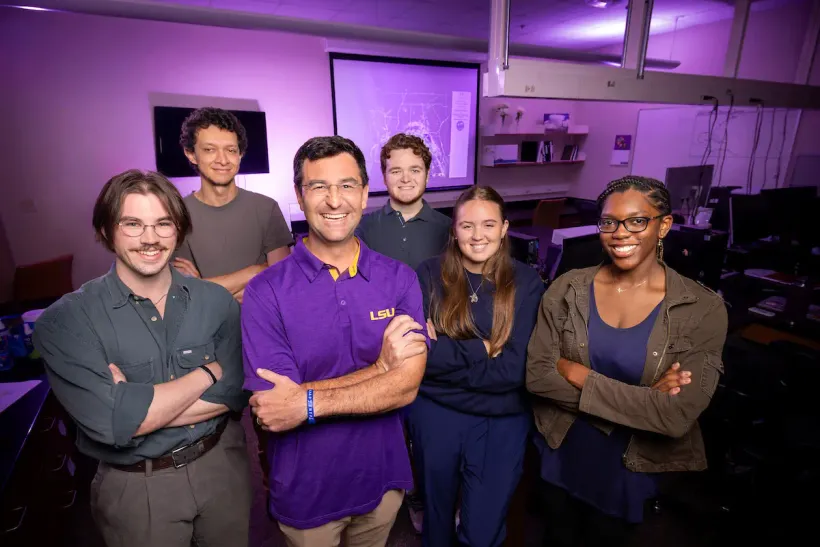
LSU Lab Helps Louisiana Prepare for Hurricanes, Drought, even Saharan Dust
Any hurricane that forms in the Gulf of America is a direct threat to Louisiana and its neighboring states. But most seasonal forecasts focus on the entire North Atlantic Basin, including areas where storms may never come close to any land, much less the U.S. Gulf Coast. A Gulf-specific forecast developed at LSU’s Coastal Meteorology (COMET) Lab addresses that issue by providing storm information specifically geared toward the Gulf region. The lab is run by Paul Miller, an associate professor at LSU who founded it in 2019. “We decided that a Gulf-specific forecast could help state officials and Gulf-area residents better understand how active the upcoming season might be in their part of the Atlantic,” said Miller, who teaches in the Department of Oceanography & Coastal Sciences in the College of the Coast & Environment. Miller said the LSU-Velocity Risk Gulf Hurricane Outlook is one example of how the COMET Lab delivers real benefits to Louisiana. “A lot of forecasts tend to align with each other each year. But ours works a lot differently than some of the other forecasts that are geared towards larger areas of the ocean,” he said. “We’re not the world’s leading hurricane research lab—and we don’t try to be. Instead, we prioritize meeting the largest research gaps relevant to Louisiana residents, spanning a wide variety of weather hazards. “We want to make sure Louisianans experience a clear return-on-investment from our lab’s activities.” Ways the lab supports the state also include: Helping forecast storm surge in real time and informing the decision on when to close flood barriers before a tropical system hits land. Developing rainfall models to support flood prevention efforts. Studying weather patterns that cause drought and low coastal water levels that can lead to marsh loss during dry spells on the Gulf Coast. Saharan Dust Research One area of study that incorporates both air quality and tropical weather is the lab’s research on Saharan dust clouds, which are blown across the Atlantic in an air mass called the Saharan Air Layer, or SAL. “So, this sort of far-off distant concept of Saharan dust is actually something that is kind of important to folks here in Louisiana,” Miller said. This dust can shut down thunderstorm activity in the U.S. Caribbean territories, a key area of research in the COMET Lab, and cause respiratory problems when it reaches the Southeast U.S. The SAL can also suppress hurricane activity in the Atlantic. “Our lab just launched a new project with the Office of Naval Research to determine how dust-dimmed sunlight can affect ocean temperatures in the Atlantic’s most active hurricane breeding grounds,” Miller said. Read the full story here.



Georgia Southern researchers survey flood-stricken area of Bangladesh
Cox’s Bazar is a bustling tourist destination located on the southeastern coast of Bangladesh. It’s home to more than 3 million people living along the longest naturally occurring sea beach in the world, extending into the Bay of Bengal. But during the monsoon season, the area is prone to flooding and frequent landslides due to its geographical location and low altitude. More than 7,000 people living in the region were displaced in 2024 after a particularly severe season that destroyed thousands of shelters, leaving three dead. Georgia Southern University Assistant Professor Munshi Rahman, Ph.D., knows the dangers and devastation monsoon season can bring to this area. As a native of Bangladesh, he has witnessed firsthand how environmental changes, urbanization and deforestation contribute to the devastation. This is why he is actively working to help his home country identify the most disaster-prone areas through the use of geographic information systems and surveys. In January, Rahman and junior geoscience major Emma Robinson traveled to Cox’s Bazar to survey and identify the areas most prone to landslides and flooding with a goal of providing data to local government and nongovernmental organizations that could help address disaster risks. Robinson says she was thrilled to gain experience in field research and engage in work she’s passionate about. “Dr. Rahman’s project really inspired me because I’ve always had a drive to help the environment,” she said. “I thought this would be a great first step into research, especially since geology and geography are so closely related.” The two used geographic information systems, GPS and community input to pinpoint vulnerable spots near residential areas and population centers. Specifically, they found that many homes and refugee camps were built on slopes. Aside from being geographically vulnerable, they observed that many of these dwellings, built from bamboo poles, tarps, and corrugated metal, lacked the infrastructure to withstand flooding. “The key findings reveal a serious environmental degradation on local landscapes exacerbating the frequency and severity of landslides and flooding events in the region,” Rahman said. He added that these insights highlight the urgency for sustainable ecosystem management and the adoption of inclusive disaster management to reduce social and environmental vulnerabilities Rahman and Robinson suggest that their findings, combined with additional socioeconomic research, could provide a more comprehensive understanding of the situation on the ground. This would enhance disaster preparedness while promoting sustainable land use. “Not too many undergrads have opportunities like this,” she said. “I know this will help me get a jump-start on my senior thesis and give me a whole new perspective for future research projects. It’s made me more confident overall as a student and researcher.” Rahman is similarly grateful for the opportunity to give his students experience in the field. “As a professor, I’ve always wanted to give my students as much real-world experience as possible,” he said. “I also give Emma full credit. Prior to this trip, she had never traveled outside the U.S. She showed incredible courage and a real talent for research.”


Georgia Southern professor receives national faculty mentor award
The Council on Undergraduate Research (CUR) named Georgia Southern University English Professor Olivia Carr Edenfield, Ph.D., the winner of the 2025 Arts and Humanities Faculty Mentor Award. The award recognizes faculty who go above and beyond to nurture undergraduate research, scholarship and creative work. Edenfield’s record of taking student research to new heights set her apart from a nationwide field of candidates. After joining Eagle Nation as a professor in 1986, Edenfield has helped her students become published researchers and presenters at local and national conferences. She said seeing those hardworking students excel has been her real reward. “Receiving this award is deeply personal,” Edenfield wrote in her CUR nomination statement. “My greatest joy in teaching has come from my students’ successes.” During her time as associate dean for Student Affairs in the former College of Liberal Arts and Social Sciences (CLASS), she launched the college’s undergraduate research symposium, now known as CURIO. She also helped establish a Center for Undergraduate Research for CLASS and set up residential interest groups to encourage students to share their love of different subjects with each other. Edenfield has helped her students achieve access to opportunities on a national level. She has served as director of the American Literature Association (ALA) since 2019, where she started a unique program that places Georgia Southern English majors in high-level administrative roles for ALA conferences. Seven of Edenfield’s students have had their work published in The Richard Macksey Journal at Johns Hopkins University. Many of her students have also presented their research at national and international conferences. Georgia Southern student Maegan Bishop’s presentation at the 2023 American Literature Association Annual Conference, based on research from Edenfield’s undergraduate class, was so impressive that she was invited to present her work at a conference on the short story at the University of Mainz, which covered all of her expenses. “My own experiences with Dr. Edenfield are only a small example of the work she has done to mentor undergraduates at Georgia Southern,” said Bishop. “She is constantly doing everything in her power to assist her students with whatever they need, extending every opportunity to those who express interest in becoming more involved in literary scholarship and campus activities.” David Owen, Ph.D., dean of the College of Arts and Humanities, emphasized how much Edenfield cares for her students, noting that her passion to help them succeed is second to none. “Mentoring is not a side note to Edenfield’s career, it is the throughline,” said Owen. “Her students succeed not just because of her guidance, but because she teaches them how to believe in their own voices.” The Faculty Mentor Award is the latest in a distinguished line of recognition for Edenfield. In 2016, she was named both the CURIO Mentor of the Year and the Wells-Warren Professor of the Year at Georgia Southern. She is a three-time recipient of her college’s Award for Distinction in Teaching, winning in 2016, 2020 and 2024. Edenfield was also a member of the inaugural class of the Governor’s Teaching Fellows program in 1995. ___ If you're interested in learning more about Georgia Southern's College of Arts and Humanities and want to book time to talk or interview, let us help - simply contact Georgia Southern's Director of Communications Jennifer Wise at jwise@georgiasouthern.edu to arrange an interview today.

Vitamin D in pregnancy may boost kids’ brainpower
You don't need a scientist to tell you that milk is good for babies. But a new study led by the University of Delaware's Melissa Melough sheds light on the power of prenatal nutrition — specifically vitamin D— as a key contributor to children’s brain development. The research found that children whose mothers had higher vitamin D levels during pregnancy scored better on tests of memory, attention and problem-solving skills at ages 7 to 12 compared with those whose mothers had lower levels. Melough wrote about the study in a piece for The Conversation. Vitamin D deficiency affects 42% of U.S. adults and about a third of pregnant women, but the average American woman consumes just 168 international units of vitamin D daily (the recommended amount is 600 ID). Many prenatal vitamins contain only 400 IU. One promising finding could result in the solution of a racial disparity in nutrition. The study found a link between prenatal vitamin D levels and childhood cognition was strongest among Black families, who also face higher rates of vitamin D deficiency. Therefore, vitamin D supplementation could be a low-cost strategy to support brain development while reducing racial disparities. Melough is available for interviews about the study, and can also speak to the following topics: • Nutritional and environmental factors influencing human health. • Populations at risk for nutritional inadequacies or harmful environmental exposures. • The roles of endocrine disruptors in the development of obesity. • The influences of maternal nutrition on childhood outcomes • Novel dietary approaches to reduce chemical exposures or their associated health consequences. To arrange an interview with Melough, visit her profile page and click on the "contact" button, or send an email to MediaRelations@udel.edu.


A Virginia Commonwealth University researcher has developed an alternative method of producing semiconductor materials that is environmentally friendly. Semiconductors are crucial to modern electronics and displays, but they are constructed from toxic solvents. They also are created at high temperatures and pressures, resulting in both environmental damage and high production costs. The new technique has been introduced by Leah Spangler, Ph.D., assistant professor in the VCU College of Engineering’s Department of Chemical and Life Science Engineering, and Michael Hecht, a professor of chemistry at Princeton University. It demonstrates an alternative method to produce semiconductor materials called quantum dots using proteins at room temperature in water, resulting in a more environmentally friendly synthesis method. “This research uses de novo proteins, which are not taken from natural organisms but instead made by design for specific purposes,” Spangler said. “Therefore, this work shows that protein design can be leveraged to control material properties, creating an exciting new direction to explore for future research.” This work builds on natural examples of proteins creating materials, known as biomineralization. But this is the first example that uses de novo proteins made by design to control the synthesis of quantum dots. The study, “De Novo Proteins Template the Formation of Semiconductor Quantum Dots,” was published in the journal ACS Central Science. The work is related to a recent Department of Defense grant to Spangler to test an eco-friendly approach for separating rare earth elements into a refined final product using de novo proteins.



Immigrants in the United States earn 10.6% less than similarly educated U.S.-born workers, largely because they are concentrated in lower-paying industries, occupations and companies, according to a major new study published July 16 in Nature, co-authored by a University of Massachusetts Amherst sociologist who studies equal opportunity in employment. The research—one of the most comprehensive global comparisons of immigrant labor market integration to date—analyzes linked employer-employee data from over 13 million people across nine advanced economies in Europe and North America. The U.S. results, drawn from a unique combination of Census Bureau, earnings and employer data, reveal that only about one-quarter of the wage gap is due to pay inequality within the same job and company. Instead, the majority stems from structural barriers that limit immigrants’ access to better-paying workplaces. “These findings are important because they show that most of the immigrant wage gap isn’t about being paid less for the same work—it’s about not getting into the highest-paying jobs and firms in the first place,” says Donald Tomaskovic-Devey, professor of sociology and founding director of the Center for Employment Equity at UMass Amherst Key U.S. Findings First-generation immigrants with legal status in the U.S. earn 10.6% less than comparable native-born workers. 3.4%, a third of that gap, is attributable to unequal pay for the same job at the same employer. No data was available on second-generation immigrants in the U.S., but other countries showed persistent but smaller gaps into the next generation. The study suggests that efforts to close immigrant wage gaps should focus on increasing immigrants’ access to better jobs and firms. Promising approaches include: Language and skills training Recognition of foreign credentials Access to professional networks Employer anti-bias interventions “Improving job access is essential,” says co-author Andrew Penner, professor of sociology at the University of California, Irvine. “This means addressing the barriers that keep immigrants out of the highest-paying firms and occupations.” As of 2023, immigrants constituted approximately 14% of the U.S. population, totaling over 47 million people. There are approximately 1 million new long-term permanent residents annually. U.S. immigration policy encompasses diverse pathways, including family-based migration, employment-based visas, the Diversity Visa Lottery and humanitarian protection. Immigration has been a defining feature of the U.S. population since its founding, with distinct waves shaped by economic needs, political developments and global conflicts. “For almost 250 years, we have been a nation of immigrants, and this pay gap indicates that we can do more as a country to help people following the paths of our forebears realize the American dream,” Tomaskovic-Devey adds. Global Comparison The study includes 13.5 million individuals in nine immigrant-receiving countries: the U.S., Canada, France, Germany, Denmark, Netherlands, Norway, Spain and Sweden. The U.S. had one of the smallest pay gaps (10.6%) among the nine countries studied. By contrast, Canada showed a 27.5% gap and Spain a 29.3% gap. The most favorable outcomes for immigrants were in Sweden (7% gap) and Denmark (9.2%). The authors identify two main sources of the immigrant-native pay gap: Sorting—Immigrants are more likely to work in lower-paying industries, occupations and firms. Within-job inequality—In all countries immigrants are paid less than natives doing the same job for the same employer, but these gaps are relatively small. Across the nine countries, three-quarters of the 17.9% average wage gap for immigrants was due to sorting; just one-quarter stemmed from unequal pay within jobs. In the U.S., this pattern was consistent: structural job access—not wage discrimination—was the dominant force. The study also exposes persistent disadvantages for immigrants from certain world regions, including Sub-Saharan Africa, Latin America and the Middle East. Across all countries, immigrants from these regions faced larger wage gaps than immigrants from Western or Asian countries. The international research is the latest in a series of high-profile publications from a team spanning over a dozen countries in North America and Europe that has been investigating the dynamics of workplace earnings distributions for the last decade.


Pets and the Texas floods: Owners faced difficult decisions and loss during and after disaster
One of the more overlooked aspects of any disaster is the loss of pets. Many of them become separated from their owners, are badly injured or perish as the result of a hurricane, flood, earthquake or other major event. This was the case in the recent flooding of the Guadalupe River in central Texas, said Sarah DeYoung, core faculty with the University of Delaware's Disaster Research Center. DeYoung can talk about the following aspects related to the tragedy: • The decisions that people have to make during evacuation, particularly for those with companion animals. • The amount of horses along the Guadalupe River, which could be found at the camps and recreation areas. • Pets that go missing after a flash flood, and the role that key organizations play in response and tracking and managing logistics. • The psychological impact on people whose pets were injured or died, who are mourning and making memorials. DeYoung can also discuss maternal and child health in crisis and disaster settings with a focus on infant feeding in emergencies. To set up an interview with DeYoung, visit her profile page and click on the contact button; or send an email to MediaRelations@udel.edu.


If the first few frames are any indicator of a blockbuster movie, hold the 2035 Best Picture Oscar for the Vera C. Rubin Observatory and its ambitious new 10-year project. On June 23, 2025, scientists at the state-of-the-art facility in the mountains of north-central Chile gave the public its first glimpses into the capabilities of its 8.4-meter Simonyi Survey Telescope, equipped with the world’s largest digital camera—a 3.2 megapixel, 6,600-pound behemoth that can photograph the whole southern sky every few nights. Its task is a decade-long lapse record-called the Legacy Survey of Space and Time (LSST). The first shots on that journey have left both the general public and astronomical community in awe, revealing in rich detail a mind-boggling number of galaxies, stars, asteroids and other celestial bodies. “The amount of sky it covers, even in just one image, is unprecedented,” said David Chuss, PhD, chair of the Department of Physics, who viewed the first images with colleagues at an organized watch party. “It’s such high-precision, beautiful detail,” added Kelly Hambleton Prša, PhD, associate professor of Astrophysics and Planetary Sciences. “It’s just mind-blowing.” What Makes Rubin and LSST So Unique? Simply, this revolutionary instrument, embarking on an equally revolutionary initiative, will observe half the sky to a greater depth and clarity than any instrument ever has before. Consider this: "The Cosmic Treasure Chest" image released by Rubin contains 1,185 individual exposures, taken over seven nights. Each one of those individual exposures covers 10 square degrees of night sky, which is about the same as looking up at 45 full moons positioned around one another. It may seem like a small size, but click the image yourself, and zoom in and out. The amount of sky captured in that range—enough to show roughly 10 million galaxies—is astounding. Per the Observatory, “it is the only astronomical tool in existence that can assemble an image this wide and deep so quickly.” “At the end of 10 years, Rubin will have observed 20 billion galaxies, and each night in that time frame it will generate 20 terabytes of data,” Dr. Hambleton Prša said. “And, because Rubin has so many different filters, we get to see the same objects in so many different ways.” According to Dr. Hambleton Prša and Dr. Chuss, the power and precision of the Rubin LSST, combined with the shear area of the sky that will be observed, will allow for an incredibly in-depth study of myriad objects, processes and events in ways nobody has ever studied them before. “For example, in our galaxy, we expect to observe only two supernovae per century,” Dr. Hambleton Prša said. “But we're observing 20 billion galaxies. For someone studying this phenomenon, the number of supernovae that they’re going to observe will be off the charts. It is an exquisite survey.” It will also provide insight into the universe’s oldest and most puzzling enigmas. “Rubin is able to look back into our universe at times when it was much smaller during its expansion and really address some of these incredible mysteries out there, like dark energy,” Dr. Chuss said. “We know the universe is expanding and that this expansion is accelerating. Rubin will trace the history of that acceleration and, from that, provide insight into the physics of the mysterious dark energy that appears to be driving it.” To enhance the technological capabilities of its instrument, scientists were invited to contribute towards the selection of the observing strategy of the telescope. The Rubin team took into consideration continual input from the astrophysics community, separated into what they call “science collaborations.” To achieve this, the Rubin team generated proposed simulations for collecting observations, which the science collaborations then assessed for their specific science goals. “The Rubin team then iterated with the science collaborations, taking into account feedback, to ultimately obtain the best strategy for the largest number of science cases,” Dr. Hambleton Prša said. Dr. Hambleton Prša is the primary contact for the Pulsating Star Subgroup, which is part of the Transients and Variable Stars Science Collaboration, the science collaboration that focuses on objects in the sky that change with time. She was the lead author among 70 co-authors on the roadmap for this science collaboration, underscoring the significant scale of community participation for each of these areas. Joined Under One Sky Dr. Hambleton Prša, Dr. Chuss and other members of the Astrophysics and Planetary Sciences Department and Department of Physics at Villanova have a vested interest in Rubin and the LSST project. In April, the two departments joined forces to launch The Villanova One Sky Center for Astrophysics, co-directed by the two faculty members. With goals to elevate the University's longstanding record of research eminence in astronomy and astrophysics and create opportunities for more students to access the disciplines, the Center partnered with the Rubin Observatory to help realize the mission. Both Villanova and Rubin share a similar vision on expanding access to this broad field of study. Fortuitously, the launch of The Villanova One Sky Center coincided with the initial data released from Rubin. What will result, Dr. Chuss says, will be a “truly awesome impact on both our Center and institution.” Dr. Hambleton Prša will advance her own research of pulsating stars, and Andrej Prša, PhD, professor of Astrophysics and Planetary Science and the primary contact for the Binary Star Subgroup, will broaden his study of short-period binary stars. Joey Neilsen, PhD, associate professor of Physics, will expand his research in black hole astrophysics. Becka Phillipson, PhD, an assistant professor of Physics, who recently led a proposal for Villanova to join the Rubin LSST Discovery Alliance, aims to increase the scope of her study of chaotic variability of compact objects. Dr. Chuss, who generally works on infrared and microwave polarimetry, which is “outside the wavelength ranges of Rubin” is interested in its complementarity with other observations, such as those of the cosmic microwave background—the oldest light in the universe—and the evolution of the large-scale structure of the universe. Subjects, he says, which are “exactly in the wheelhouse for Rubin.” Other faculty members are interested in topics such as how Rubin’s observations may change the knowledge of both the history and structure of our solar system and the population of Milky Way satellite galaxies. That is not to mention, Dr. Hambleton Prša points out, the daily 20 terabytes of data that will become available for students and postdoctoral researchers under their tutelage, who will be heavily involved in its analysis for their own projects and ideas. “This partnership is going to greatly increase our opportunities and elevate our profile,” Dr. Chuss said. “It will make our program even more attractive for faculty, postdocs and students to come and to share their knowledge and expertise. “Together, we will all have access to an incredible movie of this epoch of our universe, and the knowledge and surprises that come with it along the way.”




L to R: Professor Helen Wood, Annika Allen and Nadia Afiari (Image: Simon Roberts Photography) Aston University’s Professor Helen Wood led the research for Black Leaders in TV, a company championing Black TV professionals Black in Focus is the first report of its kind and highlights the prevalence, with 92% of respondents reporting prejudicial or discriminatory experiences Recommendations for improvements include mid-career support, changing how Black stories are commissioned and tackling racism and bullying. Black television professionals in the UK’s television industry continue to face persistent barriers to career progression, with progress towards equity and inclusion very slow, according to new research led by Aston University academics. The report, Black in Focus, was produced in partnership with Black Leaders in TV, a company set up to champion Black professionals in the UK television and content creation industry, committed to bridging the representation gap and creating a more inclusive and innovative industry. The research group was led by Professor Helen Wood, a professor of media and cultural studies at Aston University. It also included Aston University’s Dr Killian Mullen and Dr Priya Sharma, alongside Dr Jack Newsinger, associate professor in cultural industries and media at the University of Nottingham. The researchers surveyed 164 Black mid-career television professionals to learn about their experiences. While entry-level diversity efforts have sparked positive change, the researchers say that respondents generally see this as performative, with little genuine progress at mid and senior levels. Of those surveyed, 92% reported experienced microaggressions at work, defined as subtle, often unintentional, comments or actions that express prejudice or discrimination towards them, such as being mistaken for a taxi driver or colleagues continually mispronouncing a name. 80% stated that their careers in television have negatively impacted wellbeing. Almost three-quarters (74%) of respondents said they had been ignored or excluded at work One of the biggest problems highlighted is a persistent ‘club’ culture with career progression often based on informal networks and hires. 91% of the survey respondents reported having no friends or family in the industry, blocking wider access and opportunity. Many Black television professionals still report being labelled as ‘diversity hires’, which negatively impacts their confidence and feeling of belonging in the industry. Black-Caribbean respondents and those from working-class backgrounds report heightened feelings of exclusion. Another major problem found by the report is in programme commissioning, with Black stories often viewed as commercially risky, leading to missed opportunities for richer, more authentic storytelling. The recommendations for improvement are grouped into four categories - breaking the mid-career bottleneck, commission, diversity initiatives, and racism, bullying and inclusion failures. To help with career bottlenecks, the authors’ suggestions include developing a national fellowship scheme to offer structured leadership training, shadowing, and commissioning exposure for Black professionals, setting up a centralised database for Black talent and supporting Black creatives though industry showcases. The television industry could tackle the problems with commissioning for example by incentivising Black-led narratives and requiring commissioning teams to complete anti-bias training. Diversity initiatives should move away from entry-level programmes towards structural change. This includes moving away from informal, network-based recruitment to structured, clear processes, and formalising promotion pathways. The television industry can tackle racism and bullying through zero-tolerance harassment policies, independent reporting mechanisms and sanctions, inclusive leadership training and developing mental health resources specifically tailored to Black professionals. Professor Wood said: “We can hear the voices of frustration in this survey and the data is clear about the problems. It’s time for the industry to use this evidence to take the next steps to deliver real, systemic change.” Black Leaders in TV founders Nadia Afiari and Annika Allen Gray said: “The findings make clear that, for UK television to truly reflect its diverse audiences and unlock creative innovation, the industry must move beyond surface-level diversity efforts. There needs to be support in place for Black professionals, greater transparency in recruitment and progression, and a fundamental shift towards inclusive, equitable workplace cultures.” Visit https://www.aston.ac.uk/sites/default/files/2025-07/Black_in_Focus_report.pdf to read Black in Focus in full.


Taming "The Bear": Villanova Professor Examines Workplace Toxicity in FX's Acclaimed Series
In the latest season of FX’s award-winning series “The Bear,” lead character and chef Carmen “Carmy” Berzatto finds himself at a crossroads. A culinary genius, Carmy has successfully overseen the reinvention of his family’s Italian beef shop as a high-end restaurant—shepherding a dedicated, if unpolished, crew of sandwich makers into a world of haute cuisine, fine wine and elevated service. However, over the course of this transition, his exacting standards have contributed to a culture of anxiety, dysfunction and resentment in the workplace. Despite staff members’ professional and personal growth, tempers still flare like burners on a range, with Carmy’s obsessive attention to detail and single-minded pursuit of perfection spurring conflict. By season’s end, grappling with the fallout from a mixed review seemingly influenced by the back-of-house “chaos,” the chef is forced to confront a complicated and thorny question: Am I getting in the way of my own restaurant’s success? Carmy’s dilemma, while fictional, reflects the very real challenges many modern businesses face when excellence is prioritized at the expense of psychological safety and workplace harmony. Per Manuela Priesemuth, PhD, who researches toxic work climates, aggression on the job and organizational fairness, the warning signs are all too frequently overlooked in high-pressure environments like restaurants. “Some high-stakes industries have a characteristic of having toxic behavior more accepted,” says Dr. Priesemuth. “When it’s more accepted or normed, it’s a real problem.” As she explains, workers in the food service industry, much like medical professionals in an operating room or military personnel in a combat zone, have a tendency to view measured communication and thoughtful interaction as a luxury or even, in some cases, a hindrance. Essentially, there’s a common misconception that working with an edge—yelling orders, avoiding dialogue and berating “underperformers”—gets the job done. “In all of these high-stakes environments where it’s thought there’s leeway to talk negatively or disparagingly, people are mistaken in the productivity result,” Dr. Priesemuth says. “It actually changes for the better in positive climates, because people who are treated with dignity and respect are better performers than those who are mistreated.” To Dr. Priesemuth’s point, research increasingly shows that workplace culture, not just talent or technical ability, is an essential driver of organizational success. In an environment like Carmy’s kitchen, where pride and passion often give way to personal attacks and shouting matches, the on-the-job dynamic can effectively undermine productivity. What may begin as an intended push for excellence can instead result in burnout, high turnover and weakened trust—outcomes that are especially problematic in collaborative, fast-paced industries like hospitality. “There’s even evidence that abusive behavior in restaurant settings can lead to food loss,” shares Dr. Priesemuth. “So, there is a sort of retaliation from the employees who are going through this experience, whether it’s measured [in profit margins] or impact on the customer.” In order to prevent these less-than-ideal outcomes, businesses should take steps proactively, says Dr. Priesemuth. More specifically, they should clearly articulate their values and expectations, considerately engage with their staff’s opinions and concerns and consistently invest in their employees’ growth and development. In the world of “The Bear,” a few of Carmy’s managerial decisions in the second season could be seen as moves in the right direction. At that juncture, he was leveraging his industry connections to provide his restaurant’s staff with the tools and training necessary to thrive in Chicago’s fine dining scene, building skills, confidence and goodwill. “If you give people voice—such as input on the menu, for example, or more autonomy in completing a certain task—it boosts morale,” says Dr. Priesemuth. “It helps people feel that they have input and that they are valued members of the team; it’s this sort of collaborative, positive relationship that increases commitment and performance.” Establishing this type of work culture, grounded in open communication, mutual respect and a shared sense of mission, takes concerted effort and constant maintenance. In situations in which toxicity has already become an issue, as it has in Carmy’s kitchen, the task becomes decidedly more difficult. Typically, it demands a long-term commitment to organizational change at the business’ highest levels. “Adjusting the tone at the top really matters,” says Dr. Priesemuth. “So, if the owner were to treat their chefs and waiters with the dignity and respect that they deserve as workers, that also trickles down to, for example, the customer.” A leader’s influence on workplace morale, she contends, is nuanced and far-reaching. When those in charge model a lack of empathy or emotional distance, for instance, a sort of toxicity can take root. Likewise, when they repeatedly show anger, animosity or frustration, those same feelings and attitudes can have an ingrained effect—regardless of a staff’s talent or ability. Given the outsized role owners, supervisors and managers play in shaping organizational culture, Dr. Priesemuth further notes, “Leaders must also feel that they’re being supported. You can’t have someone who’s exhausted, works 80 hours a week and has relationship and money issues and expect them to say, ‘What are your problems? What do you need?’” In many ways, her insights speak directly to the struggles Carmy faces and prompts throughout “The Bear’s” run. At every turn, he’s dogged by family and relationship troubles, mounting financial pressures and unresolved trauma from a past role. Ultimately, as would happen in real life, his difficulty in healthily processing and addressing these issues doesn’t just harm him; it affects his staff, manifesting itself as a need for control and a crusade for perfection. “There are spillover effects from your own personal life into your job role. In the management field, that has become increasingly clear,” says Dr. Priesemuth. “Whatever you’re going through, whether it’s from an old job or something personal, it will automatically spill over into your current work life and your interactions. And, vice versa, what’s happening to you at work will [impact you off the clock].” In dramatic fashion, the fourth season of “The Bear” concludes with Carmy acknowledging as much. Determining that there are other aspects of his life desperately in need of attention, he surrenders the reins of his business to chef de cuisine Sydney “Syd” Adamu and maître d’hôtel Richard “Richie” Jerimovich, appointing them part-owners. While the soundness of this decision remains a subject for the show’s next season, Carmy justifies the move with a blunt admission: “It’s the best thing for the restaurant. We have to put the restaurant first… I don’t have anything to pull from.” In the end, in both “The Bear” and management studies, there’s an understanding that building healthy and productive work environments requires active engagement and positive reinforcement on the part of leadership. In a sense, creating a strong work culture is shown to be a lot like preparing a phenomenal meal; it’s a matter of attentiveness, patience and care. Without those ingredients, the result could very well be a recipe for disaster.