
Experts Matter. Find Yours.
Connect for media, speaking, professional opportunities & more.

Recognizable companies including Google, Twitter and Eli Lilly all are encouraging their employees to work at home to prevent spread of the coronavirus. Research on the benefits and drawbacks of “working from home is still in its infancy, but researchers have generally found that telecommuting can function as a double-edged sword, said Erik Gonzalez-Mulé, assistant professor of organizational behavior and human resources at the Indiana University Kelley School of Business. “On the one hand, telecommuting can increase productivity because it enhances employees’ feelings of control and autonomy. With the freedom to choose when and how to do their work, employees generally experience greater motivation and satisfaction,” Gonzalez-Mulé. “Of course, there is a caveat here, in that managers should take care to maintain the same performance management systems they use for ‘in-residence’ employees, such as setting specific goals, ‘checking in’ on goal progress, using regular performance evaluations, and the like. “The idea is to communicate to employees that, as long as the work gets done -- which managers can assess with performance management systems -- they can choose when and how to do it,” he added. “On the other hand, recent studies show that telecommuting can increase feelings of isolation. This is because telecommuting workers have significantly less face-to-face contact with their manager and colleagues, which can lead telecommuters to feel alone and socially disconnected. One way to ameliorate these effects is to use technologies that involve virtual face-to-face contact, like Zoom or Skype, or to have at least some ‘real’ face-to-face contact, such as some meetings that are conducted in-person.”


March 6 is the National Day of Unplugging. Communications Professor Joni Siani at Manhattanville College is spearheading a unique project, the “No App For Life” challenge, to address the unintended consequences affecting the first digitally socialized generation. The challenge encourages a week of refraining from social media apps and reminds students that they are human and have all the apps they need to feel connected. “Our college students are considered the first digitally socialized generation,” said Siani. “We've seen the decline in soft skills along with a rise in anxiety, affecting their success in college and both their professional and personal lives. We're dedicated to giving students the skills they need.” Siani has dedicated her research to creating effective solutions to reverse the effects of growing up online. Beginning with the award-winning documentary “Celling Your Soul,” the No App For Life challenge evolved over a ten-year period into a comprehensive project, meeting students where they are with a deep level of compassion that focuses on empowerment. This portion of the curriculum from her classes was so well received, students encouraged Siani to expand it campus-wide. Siani discovered the benefits of the project were not about "going without, but, going within." This is "not anti-technology, but pro-human." Many educators encourage some type of digital abstinence, but Siani created a more comprehensive curriculum that works in a positive approach. The No App For Life challenge provides a writing activity and observational tasks that teach specific skills to practice and hone. Students report these strategies as "life changing" and incorporate the new behaviors into their daily lives with a positive effect on their relationships and mental health. As Siani explains, "Nobody wants to hear that the thing they love isn't good for them. The No App For Life challenge provides students with the skills they need to navigate their world using their ‘human apps.’ Going without their digital default methods, they build self-esteem and confidence while their phones are on the back burner. When students learn how to communicate to have their needs met and address anxiety and stress, they actually are excited to test out their new skills. They want to learn about themselves. This is a personal motivation strategy." If you are a journalist covering the National Day of Unplugging or looking to know more about how technology is impacting society, let the experts from Manhattanville College help with your stories.


FAU Experts Available to Speak on Coronavirus and its Impact Worldwide
Coronavirus has now earned global attention and Florida Atlantic University experts are available to speak with media about the impact of coronavirus on areas related to this worldwide epidemic, including hospitality, tourism, employment sick leave, and politics. If you are a journalist covering the progress of this virus and how it is impacting various sectors and segments of society – then let us help with your stories, questions and ongoing coverage. LeaAnne DeRigne, Ph.D., MSW, associate professor in FAU’s Phyllis and Harvey Sandler School of Social Work LeaAnne DeRigne is an expert on paid sick leave and its impact on the health and financial security of individuals, families and public health in general. Her recent research on the importance of paid sick leave benefits has received wide press coverage,and has been cited around the country by policy makers, lobbyists, and advocates pushing cities and states to mandate sick leave coverage. Key findings from the study, which are representative of the nation, showed that regardless of income, age, race, occupation, full-time or part-time work status, health status or health insurance coverage, workers without paid sick leave were three times more likely to delay medical care than were workers with paid sick leave. She also conducts research on other workplace benefits such as flexible work, vacation time and pensions. Peter Ricci, clinical associate professor and director of the Department of Marketing and Hospitality Management in FAU’s College of Business Peter Ricci is a hospitality industry veteran with more than 20 years of managerial experience in segments including food service, lodging, incentive travel, and destination marketing. While filling the role of hotel general manager for almost a decade, Ricci served as a part-time educator before entering academia full time as both a clinical associate professor and administrator. Kevin Wagner, Ph.D., professor and chair of FAU’s Department of Political Science in the Dorothy F. Schmidt College of Arts and Letters Kevin Wagner’s research and teaching interests include presidential and judicial politics, political behavior and legislative behavior. He is also a research fellow of the FAU Business and Economics Polling Initiative (BEPI). Wagner has lectured extensively on American politics and has served as an expert in many leading newspapers including the New York Times, Boston Globe, New York Newsday, the Dallas Morning News, and the Miami Herald. He has been featured as the political analyst for CBS 12 in West Palm Beach and on national television including NBC’s “Today.” All of the experts listed above are ready and available to speak with media. To arrange an interview simply click on an expert’s profile or email Lisa Metcalf at lmetcalf@fau.edu.




Following Israel’s third election in a year? Let our experts help with your coverage
It looks like the third time might be a charm for Israeli Prime Minister Benjamin Netanyahu. Despite facing corruption charges and failure to form government two previous times, it appears he might have finally secured power to lead the Knesset. However, as results are slow to come in, what comes after winning might be a different matter. A Netanyahu victory would set the stage for a possible constitutional showdown between Israel’s political and judicial power centers over whether he is able to form a government while under indictment. Since Mr. Netanyahu is facing felony prosecution, it is unclear whether the president, Reuven Rivlin, can legally invite him to form a government. The situation has no precedent and the Supreme Court, perhaps hoping a third election would render the question moot, avoided ruling on the subject in January. But the court will almost certainly now be asked to intervene, forcing its unelected judges to choose between disqualifying an elected leader from taking power or allowing a leader who is accused of bribery, fraud and breach of trust to form a new government. At a minimum, Mr. Netanyahu, Israel’s longest-serving premier, could use the electoral result to bolster his hand in negotiating a plea bargain. A new term for Mr. Netanyahu would also clear away domestic political impediments to annexing territory in the occupied West Bank, a move endorsed by the Trump administration and considered illegal by most of the world. The New York TImes - March 02 So, what comes after the election could be as stress filled and unpredictable as the campaign itself and if you are a journalist covering this ongoing story – the let our experts help. Dr. Glen Duerr's research interests include comparative politics and international relations theory. Glen is an expert on this subject and is available to speak to media regarding this topic– simply click on his icon to arrange an interview.


Does the height of a person really matter? In America, if you are running for office, it might. Augusta’s Dr. Gregg Murray was on CNN this weekend discussing how height can play an advantage in American politics. Murray does confirm how a candidate’s height (or perception of) does make a difference in the minds of voters. "Yes, there does seem to be some sort of relationship between an elected leader's height and how her or she is perceived, "says Murray. Here’s the segment: As the long road to November winds and weaves along the campaign trail, there are going to be many, many different factors that candidates look to capitalize on to gobble up every available vote. And if you are a journalist covering the election – that’s where our media-ready experts can help. Dr. Gregg R. Murray, professor of political science at Augusta University, is available to talk about the upcoming election and all aspects surrounding each campaign. Murray’s research focuses on political behavior and psychology with specific interests in voter mobilization and turnout. He is also executive director of the Association for Politics and the Life Sciences.


After New Hampshire - What’s next for Bernie and is it time for Biden to bail?
As we all know, you can’t win a presidential primary with only two states, but you sure can lose one. And after a long summer and fall of campaigning, the results from Iowa and New Hampshire are revealing the frontrunners of who will most likely lead the Democrats in the quest to unseat President Donald Trump. Coming into the New Hampshire primary, Augusta’s Dr. Gregg Murray offered this insight, “It looks like Sanders is comfortably in the lead, which is not surprising given he comes from a neighboring state. Mayor Pete is surprisingly staying strong and Klobuchar is hanging in there. Other than Sanders, this is not the leader board that most people would have expected before the start of the primary season. Biden and Warren, who many people not too long ago would have thought would be making strong showings, are surprisingly a good distance back in the pack.” But now that the first crucial two states have been heard and the primaries shift focus toward South Carolina and Nevada – what’s next? Joe Biden is ‘all in’ on South Carolina, but after two abysmal showings, is it enough? Amy Klobuchar seems to be surging – can she capitalize on that momentum? And, Pete Buttigieg and Bernie Sanders are neck and neck – what will it take for one to emerge as the frontrunner? As the next phase of primaries approach – there’s a lot to cover, and that’s where our experts can help. Dr. Gregg R. Murray, professor of political science at Augusta University, is available to talk about the current race to lead the DNC. Murray’s research focuses on political behavior and psychology with specific interests in voter mobilization and turnout. He is also executive director of the Association for Politics and the Life Sciences.
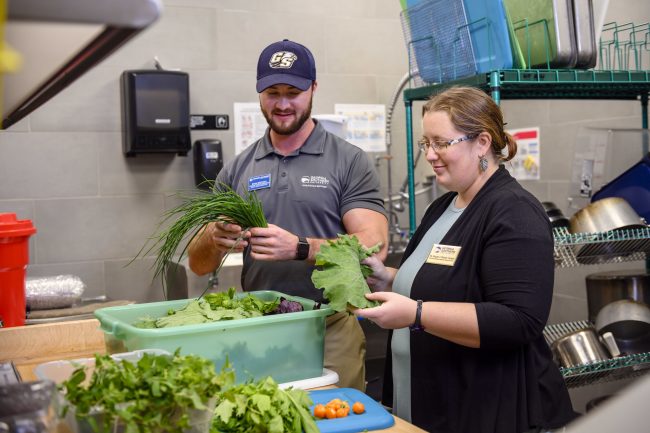
Find out how sustainable dining at Georgia Southern provides fresh options for students
As more and more people are eating out – the expectations of customers of restaurants to be environmentally friendly are ever increasing. However, operating with a reduced carbon footprint all the while being sustainable and profitable are no easy task. That’s where Georgia Southern University is making a difference. The newest restaurant on the Georgia Southern University Armstrong Campus offers diners comfort in knowing that some of the ingredients were grown just a few hundred yards away in the campus’ aquaponics farm in the Sustainable Aquaponics Research Center (SARC). The agriculture and food industry is one of the largest users of water and producers of greenhouse gas emissions, but growing food by using aquaponics, a system of growing produce by using water fertilized by fish, cuts down on both significantly. “SARC produce only travels a quarter mile from where it’s grown,” SARC curator Brigette Brinton said. “Locally grown food offers large advantages in terms of increased sustainability and freshness, and SARC produce is grown organically and using sound ecological principles that minimize water consumption.” Brinton said minimizing emissions and water use does not diminish the quality or taste of the produce. To the contrary, it makes the food taste better because aquaponics produce often has higher concentrations of various compounds that give the foods their flavor, and they are grown in more ideal environments. Brzycki said Georgia Southern wants to expand on using ultra-local, fresh produce and vegetables, as a part of the partnership with the aquaponics farm. “When we consider redesigns of existing or new dining locations on the Armstrong Campus in the future, we want to see how we can incorporate these same principles,” he said. “But for now, Southern Cafe is the flagship unit for the aquaponics partnership, as well as sustainability and healthy eating, of Eagle Dining.” Brinton said she hopes the Southern Cafe will inspire the students, faculty and staff who eat there to make healthier and more sustainable choices in other areas of their lives. “Showcasing local, sustainable produce increases students’ awareness that there are better options, and Georgia Southern is going the extra mile to show them how to start making better choices,” she said. “Each time students see they made a sustainable choice at the Southern Cafe, they’re more likely to choose sustainable options on their own.” Are you a journalist looking to cover this story or learn more about how Georgia Southern University is developing new programs that help traditional industries adapt to a more sustainable and environmentally friendly business model? If so – then let our experts help with your coverage. Simply contact Melanie Simón at 912.344.2904 to arrange an interview.


Ants and plants, a mutually beneficial relationship
Ant-plant interactions are really common in nature, and while people might most often picture ants as carrying pieces of leaves cut from tropical plants, ant behavior in the Midwest is less appreciated. Moni Berg-Binder, Ph.D., associate professor of biology at Saint Mary’s University, finds ant mediated seed dispersal, called myrmecochory, fascinating and says that the temperate deciduous forests here in North America have many examples of plants that engage with the native plant community. “In myrmecochory, these plants, often spring ephemerals, which are early blooming spring plants, produce seeds with a nutritious structure that sticks off the seed called an elaiosome,” she said. “Typically what happens is the seeds fall to the ground which is called primary dispersal. The Ants forage and find the seeds on the ground and then pick up seeds and carry them to their nest. This is secondary dispersal. Then, once they get the seeds into their nests, those seeds are brought to places where developing larvae eat the elaiosome. But the seed is unharmed.” From there, she said the seeds are then deposited in a chamber inside of their nests or they may take the seeds and put them in a refuse pile or a garbage dump just outside the nest. Ants, apparently, keep a very clean nest. And oftentimes the ground soil around ant activity, is elevated in organic matter, nitrogen, phosphorous, possibly moisture — all really good things for plants and essentially the same thing as fertilizer. So the seed flourishes. “It’s a beautiful example of mutualism,” she said. “The seed is taken and has effectively been planted inside this nest with nature’s fertilizer. The win from the ant perspective is that they received food.” Dr. Berg-Binder and her students have focused their research on a plant called bloodroot. Local ants disperse the seeds of bloodroot. Dr. Berg-Binder became interested in plant interactions while in graduate school when she became intrigued by the win-win scenario of mutualism. For her graduate work, she had been interested in conservation and how invasive species are introduced to a natural area where they did not typically belong. These invasive species can engage in mutualism with native species. She said there is much more studying to be done on the relationship native ants have with both native plants and invasive plants. Are ants helping the invasive species become more invasive? “They’re a great study system, and I find them really fascinating,” she said. Are you looking to know more about invasive species or ant and plant interactions? Or, are you a journalist covering this topic and looking to book an interview? That’s where we can help. To book an interview with Dr. Moni Berg-Binder, simply click below to access her contact information. Connect with: Moni Berg-Binder, Ph.D. Associate Professor, Biology Expertise: Invasive plant species and native plants; ecology and animal-plant interactions View profile https://expertfile.com/experts/moni.bergbinderphd/moni-bergbinder-phd


On average, teachers across the U.S. spend approximately $479 on classroom supplies each year, according to a 2018 study by the National Center of Education Statistics. The Institute for Interdisciplinary STEM Education (i2STEMe) at Georgia Southern University is helping reduce this burden for teachers in southeast Georgia with the School Outreach Program, a lending membership program that provides STEM and social studies materials for K-12 classrooms. i2STEMe, housed in the College of Education, serves as an outreach center for the university, regional educators and the broader community. The School Outreach Program provides STEM and social studies supplies, including consumable and non-consumable materials, equipment, and teaching aids to member teachers, schools and districts. Members can request items and materials that will be delivered to and picked up from their school location. Annual membership for the program can be purchased by entire school districts, schools or individual teachers. The project was recently featured on WTOC 11 where viewers were given a first-hand look at how local teachers and students are benefitting from the program. Alisa Leckie, Ph.D., the interim assistant dean of Partnerships and Outreach at Georgia Southern was on hand to explain how Georgia Southern is making sure students have access to the resources they need to further their learning in areas like STEM. Are you a journalist looking to learn more or cover the School Outreach Program and how institutions like Georgia Southern University are helping teachers, students, and schools across the state? If so – then let our experts help. Leckie's research is focused in the areas of education of language minority students, and analyzing policies impacting education. She is available to speak with media regarding this program – simply click on her icon to arrange an interview.


The election is on. In fact, it’s as if the campaign of the 2016 election has never come to a finish. U.S. President Donald Trump’s strategy of constant rallies, speeches and campaign stops has essentially meant the Republican incumbent has been on the stump for the better part of almost five years now. On the other side, at one time last year, there were more than two dozen contenders vying for the right to represent the Democrats. That field has been whittled down to about half of that, and it is expected to continue shrinking now that primaries are in play and the financial costs of keeping up will become a reality. So, if there were to be an actual starting point for the November election – this week could be it. On Monday, the Iowa Caucus kicks off what could be months of rigorous and aggressive campaigning for Democrats. The winner Monday will have a huge boost, but after that it’ll be all eyes on New Hampshire, Nevada, South Carolina and then Super Tuesday. Also, this week, the President will deliver the State of the Union. The timing of this speech could be the change of channel the President needs as the clouds of impeachment linger. As well, the speech and the huge audience it gathers could set the tone of what's to come on the campaign trail. For political junkies and journalists – it is going to be a busy nine months. And if you are a reporter covering the primaries, politics and the presidential election – then let our experts help. The team from FAU can help with a variety of topics that will inevitably be part of or influence the policies and platforms of each party and candidate. Kevin Wagner's research and teaching interests include presidential and judicial politics, political behavior and legislative behavior. He is also a research fellow of the FAU Business and Economics Polling Initiative (BEPI). Robert Rabil is an expert in political Islam, terrorism, U.S. foreign policy, and U.S.-Arab relations. Kelly Shannon specializes in the history of U.S. foreign relations, with particular attention to the Middle East and the 20th century. Colin Polsky is trained as a geographer, specializing in the human dimensions of global environmental change. He also oversees FAU's quarterly environmental poll. All of these experts from Florida Atlantic University are available to help with any of your questions or coverage – simply click on an expert’s icon to arrange an interview today.


