
Experts Matter. Find Yours.
Connect for media, speaking, professional opportunities & more.
The Sky’s the Limit: Researching surface impacts to improve the durability of aircraft
Associate professor Ibrahim Guven, Ph.D. from the Department of Mechanical and Nuclear Engineering is conducting a research project funded by the Department of Defense (DoD) that explores building aircraft for military purposes and civilian transportation that can travel more than five times the speed of sound. Guven’s role in this project is to consider the durability of aircraft surfaces against elements such as rain, ice, and debris. His research group is composed of Ph.D. students who assist with the study and has collaborated with other institutions, including the University of Minnesota, Stevens Institute of Technology and the University of Maryland. Why did you get involved with this research project? The intersection of need and our interests decides what we research. I’m interested in physics and have been working on methods to strengthen aircraft exteriors against the elements for 12 years. We started with looking at sand particle impact damage, and then we graduated from that to studying raindrop impact because that’s a more challenging problem. Sand impact is not as challenging in terms of physics. A liquid and a solid behave differently under impact conditions. The shape of the raindrop changes prior to the impact due to the shock layer ahead of the aircraft. Researching this impact requires simulating the raindrop-shock layer interaction that gives us the shape of the droplet at the time of contact with the aircraft surface. Unlike with sand, analyzing raindrop impact starts at that point, which requires accurate modeling of the pressure being applied. As the aerospace community achieves faster speeds, there’s a need to understand what will affect a flight’s safety and the aircraft’s structural integrity. That need is what I’m helping to fulfill. Were there any challenges you and your research group faced while working on this study? How did you overcome them? Finding data was hard. I’m a computational scientist, meaning I implement mathematical differential equations that govern physics to write computer code that predicts how something will behave. My experiments are virtual, so to ensure that my models work well, I need experimental data for validation. However, conducting experiments on this problem is extremely challenging. That’s the roadblock. Currently, we refer to data from the seventies and eighties. Beyond that, this kind of information is not available. We are working to generate data that my computational methods need for their validation. An example is the nylon bead impact experiment. Some researchers found that if you shoot a nylon bead at a target, it leads to damage similar to that from a raindrop of the same size. It is much easier and cheaper to shoot nylon beads compared to the experiments involving raindrops. However, this similarity vanishes as we go into higher velocities. How do you typically gather data for a project of this nature? We are working with a laboratory under the U.S. Navy. They can accelerate specimens to relevant speeds, meaning they can shoot them into the air at the desired velocity. A colleague at Stevens Institute of Technology also came up with a droplet levitator. He uses acoustic waves emitted by tiny speakers to play a certain sound at a certain frequency to create enough air pressure to suspend droplets midair. To an untrained eye, it looks like magic. They levitate droplets and use a railgun to shoot our samples at the droplets. Our samples hitting the droplets are stand-ins for the aircraft surface material. Once this is done successfully, they shoot a sample with high-speed cameras that can take ten million frames per second. As a result, we get a good, high-fidelity picture of this impact event. That is the type of data I’m seeking, and this is how I get it from my collaborators. What was your overall experience working with the students in your research group? I like to think it was positive. I try to be a nice advisor and give them space to explore, fail, and bring their own ideas. Even if I feel like we’re at a dead-end, I step back and let them figure it out. My role is to help them grow. Teach them, train them and help them along the way. That’s the experience. Did you notice any personal changes in your students during this project? Yeah, I have. When they’re just out of their undergraduate programs, confidence is lacking sometimes. You see them become more sure of themselves as they learn more and more. Often, regardless of whether English is their native language or not, writing is a big issue for every student. How one presents ideas in written form is a persistent problem in engineering. I see the most growth in that area. Again, an advisor has to be a guide and also have patience. Eventually, after working on multiple paper drafts, I can see tremendous improvement. You must allow them to see their shortcomings. It’s important to work with students to refine how they frame a problem, explain it to a wide audience in concise terms, and use neutral language without leading them to certain conclusions. Why do you think that this research is important? Somebody has to do it, right? I believe that I’m the right person because of my background. Personally, I think if this research makes for safer travel conditions, and if I have something to offer, then why not? If we can accurately simulate what happens in these conditions, we can use our methods to test out designs for damage mitigation. For example, we can perform simulations with different surface materials for the aircraft to see if using a different material or layered coating system leads to less damage. In a bigger picture, we’re working on a very narrow problem in our field, but we don’t know how useful that’s going to be in 10, 15 or 30 years from now. Whatever we study and put out there in terms of publications, it may help some other researcher in a different context many years later. This could be space research, modeling an atmosphere on a different planet, or something that is related to our bodies. There are parts of physics in this problem that do not necessarily only apply to high-speed flight. It could be many different things. One has to understand that what is studied may seem obscure today, but because the universe is more or less governed by the same physics, everything should be put in a theoretical framework, done right and shared with the community. People may learn things that could become relevant in the future. It’s not uncommon. What is another subject that you plan to study? The next natural step is coming up with strategies to mitigate damage in these scenarios. If avoiding a risk is not an option, can we actually come up with a solution? We have to determine how to modify an aircraft’s design to prevent a catastrophe. Another extension of my research would be to examine the landing of spacecraft on dusty planetary bodies. During landing on Earth, aircraft approach and reach the ground very smoothly. On the other hand, a spacecraft comes down slowly and needs a lot of reverse propulsion for a soft landing. As it does, it kicks up a large amount of dust, which blows back and hits the spacecraft. Taking into account the damage that occurs due to particle impact is a direct connection to my work. This again is an open area, and because we have ambitions to have a permanent presence on dusty places like the moon and Mars, we have to nail down the concept of landing safely. That is where my research could help.


University of Delaware, in close collaboration with Delaware State Police, the Delaware Association of Chiefs of Police, the Office of Highway Safety, and the Delaware DMV, has co-developed the Blue Envelope Program – now launched statewide as of Aug. 26, 2025. The program offers no-questions-asked, no-ID-required, free envelopes that drivers with disabilities (including communication differences, sensory needs, mobility limitations, or other differences) can keep in their vehicle. The envelope includes space for emergency contact or medical notes, instructions for law enforcement and tips to ensure safe, respectful, clear exchanges during traffic stops. The University of Delaware Center for Disabilities Studies helped review and approve the content and design to ensure inclusivity and accessibility. UD experts – including Sarah Mallory (Associate Director of the Center for Disabilities Studies) and Alisha Fletcher (Director, Delaware Network for Excellence in Autism) – are available to speak about how the program supports an underserved and underrepresented group and improves outcomes in law enforcement encounters. Why This Matters: Traffic stops can be stressful for drivers with disabilities and can lead to misinterpretations or heightened risk. The Blue Envelope helps reduce misunderstandings while preserving dignity and safety. Delaware joins around 10 other states (including Maine, Massachusetts, New Jersey, New York, Rhode Island, and Vermont) in adopting a traffic-stop communication aid for drivers with disabilities This is a practical, no-barrier solution that promotes equity, accessibility, and respectful law enforcement practices. To speak with either Mallory or Fletcher to learn more about the program's development, impact and what’s next, email mediarelations@udel.edu.


Unexpected A-Level results? Here’s advice from a psychologist
On 14 August young people across England, Northern Ireland and Wales will receive their A Level results. Many will receive the grades they hoped for however those who receive results that aren’t as expected, either worse or better, there is the option of entering Clearing, the period when universities advertise remaining places on undergraduate courses Aston University is offering guidance to help secure a place on a degree course and those who already have their results can enter Clearing from 5 August. There is more information about the process on the Aston University website at https://www.aston.ac.uk/clearing/guide Going through the process of waiting for and receiving A Level results can be overwhelming Dr Natalia Stanulewicz-Buckley is a social health psychologist and is a lecturer in the School of Psychology and Aston Medical School at Aston University. She has the following advice for anyone who doesn’t get the grades for which they hoped: “What if your A-level results are not what you hoped for? Breathe. Feel. Regroup. The path ahead still holds endless possibilities. “As people get older and gain more life experience, they often realise that what once seemed like a humongous failure or disappointment, with time, bears a lighter load. So, what advice would I share with young people facing A-level results that may not have aligned with their expectations and hopes, and who might be facing Clearing or having to consider other options? “First of all, take a few long inhales and even longer exhales (for 3-4 minutes). This kind of breathing exercise can help you feel calmer when facing a stressful situation. “Next, acknowledge your feelings. It’s okay to feel disappointed, disheartened, or even angry when life doesn’t go according to plan. These emotions show that this outcome matters deeply to you. But they don’t mean that all is lost. “Take time to sit with your emotions and try to share your concerns with people who might be going through a similar experience, or with those you trust to support you - friends, siblings, family members, or teachers. There is truth in the saying, ‘A problem shared is a problem halved.’ “Once you've made space for your emotions and worked through them - remember, emotions are like waves; they arise, reach a peak, and then subside - you might feel more ready to consider your options. Believe me, there will be many, Clearing, taking a year out to travel or volunteer, doing an internship, and more. “Ask yourself, 'What path is most aligned with my plans and ambitions for the future?' Follow that answer. And who knows - perhaps in time, you’ll look back on this stressful moment and the decisions you made in response to it and realise that having to re-adjust your university plans was the best thing that could have happened. “As the saying goes, ‘When one door closes, another one opens.’ But most importantly, please be kind to yourself. Treat yourself as you would a close friend—with understanding, support, and compassion. It may be reassuring to remember that you did the best you could in the situation you were in, with the resources you had. That is all anyone could ever ask of you.” To interview Dr Stanulewicz-Buckley or for other media enquiries contact Nicola Jones, Press and Communications Manager, on (+44) 7825 342091 or email: n.jones6@aston.ac.uk To find out more about Dr Stanulewicz-Buckley’s work visit https://research.aston.ac.uk/en/persons/natalia-stanulewicz-buckley Courses available through clearing at Aston University can be viewed at https://www.aston.ac.uk/clearing/vacancies and anyone who is waiting for their results can register for Priority Clearing at https://www.aston.ac.uk/clearing#register to receive vacancy alerts, advice and tips. From 8am Thursday 14 August there will be three easy ways to apply for courses at Aston University through Clearing, either call 0800 917 5923 to speak with an adviser, submit a Clearing application form at https://www.aston.ac.uk/clearing/guide or use the online live chat service. Finally, students can message on Instagram at https://www.instagram.com/AstonUniversity/


Inflation: It’s Not Just for Prices Anymore
Lately, headlines are full of talk about inflation — a response to the economy and the looming tariffs. I’ve experienced many inflationary periods, but it feels different in retirement. When I was earning a paycheque, inflation was just an annoyance, something I needed to pay attention to and maybe buy a cheaper cut of steak. Now, as someone on a “fixed income,” it feels like a real threat. Recently, Ben McCabe, CEO of Bloom Financial, appeared on Breakfast Television and delivered a truth bomb: “We’re approaching a perfect storm. Longer life expectancy, fewer defined benefit pensions, and rising inflation.” Well, that storm has arrived — and it’s inflating more than just prices. It’s also expanding our waistlines, prescription lists, and emotional baggage. Inflation, at its core, means “the condition of being inflated.” And it turns out that definition applies to more than the grocery bill. So, grab a cup of green tea (or a celery stick if you’re feeling virtuous). Let’s explore the three sneaky forms of inflation threatening your retirement — and what you can do about them. This blog will appeal to individuals who have retired or aspire to retire in the future. Let’s light this candle! 1. Financial Inflation: The Usual Suspect Let’s start with the obvious: inflation means your money won’t stretch as far as it used to. In 2022, Canada’s Consumer Price Index increased by 6.8% — the highest rise in 40 years. Although it slowed down a bit in 2023, essentials such as food, rent, and fuel continue to grow. Your retirement income might be fixed, but prices definitely aren’t. Retirement Risks from Financial Inflation: • Longer lives mean longer bills. A 65-year-old woman today has a 50% chance of living past 90 years old. That’s over 25 years of expenses. • Vanishing pensions. Defined benefit pensions are disappearing faster than good manners on Twitter. • Healthcare creep. Public healthcare doesn’t cover everything, especially if you want care that wasn’t designed in 1978. As Ben McCabe aptly put it: “We need to stay healthy so our health span matches our lifespan,” huh?— “otherwise, inflation will affect us through the cost of medications, home care, and long-term care facilities.” What You Can Do: • Review your income sources. Prioritize indexed income sources, such as CPP, OAS, and annuities with COLA (Cost of Living Adjustment) riders. • Use home equity sensibly. If you’re house-rich but cash-poor, consider a reverse mortgage or other equity release products. • Adjust your spending habits. Host themed nights, like “Tuna Tuesdays” — a nostalgic, fun, and budget-friendly option. How to Support Others: • Discuss money matters with kindness. Many retirees feel ashamed of their finances. Show compassion, listen more, talk less. • Bring food, not judgment. A regular Saturday brunch with Sadie can make a significant difference, not just financially. • Foster social connections. Financial stress can cause isolation. Encourage hosting potlucks, card nights, or joining a community group. 2. Physical Inflation: The Expanding Middle Retirement brings more free time… and more room. Waistlines, cholesterol, and prescriptions all seem to rise in tandem. Signs you’re experiencing physical inflation: • Pants that used to be snug are now aspirational • Your Fitbit died months ago — and so did your motivation • Your pharmacy knows you by name... and birthday The bad news? Poor physical health is expensive. Chronic illness can deplete savings faster than a grandchild with your credit card. What You Can Do: • Keep moving. Walk, garden, spin — whatever gets you vertical and vibrant. • Lift weights. Muscle mass starts declining at 40. Resistance training isn’t just for 20-somethings. Strong is the new sexy, pass it on! • Meal plan smart. Grocery inflation peaked at 8.9% — eat better, waste less, save more. Consider shopping daily and buying only the amount of food needed for that day. Your health span should align with your lifespan. Stay strong, stay mobile, and yes, stretching counts — but not if you’re reaching for the TV remote. Inflammation — The Silent Saboteur If inflation is bad, inflammation is worse. Chronic inflammation contributes to: • Heart disease and stroke • Type 2 diabetes • Alzheimer’s disease and brain fog • Arthritis, osteoporosis, and varicose veins • Mood disorders such as anxiety and depression • Certain Cancers Even CNN and Al Jazeera recently reported that Donald Trump was diagnosed with chronic venous insufficiency (CVI) — a common, often overlooked condition among those over 55. Small veins, big problem. (Insert your own “tiny vein, tiny…” joke — I’m staying classy.) Inflammation is the unwelcome guest that never departs. If inflammation had a personality, it would be the dinner guest who drinks all your wine, insults your cat, and brings up politics at dessert. Whether it's fueling joint pain, causing swelling in your ankles, or messing with your metabolism, chronic inflammation is one of the biggest saboteurs of aging gracefully. It often hides in plain sight, presenting itself as: • Low-grade fatigue • Weight gain (especially belly fat) • Mood swings or brain fog • Increased pain and stiffness • Slow healing. What You Can Do: • Eat anti-inflammatory foods, such as leafy greens, whole grains, and healthy fats. Cut out the sugar. • Move each day. Yes, again. It’s that important. • Lower stress to improve sleep. Stress and poor sleep fuel inflammation. • Maintain social and emotional bonds. Loneliness and inflammation are frequently connected — break the link. De-Inflation — The Great Slowdown • So, we’ve discussed inflation... but what about its quieter, sneakier cousin: deflation? • No, not the economic kind. We’re talking about the physical “poof” that occurs when we reach our late 70s and 80s — when the padding diminishes, posture declines, and everything else… well, just seems a little less buoyant. • Suddenly, you’re shrinking. Your weight drops — but not in a sexy, "I’ve been intermittent fasting" kind of way. More like "my pants are falling down and my doctor says I’m 2 inches shorter" sort of vibe. Welcome to the gravitational pull of aging. Signs of De-Inflation: • Pants fit strangely, but not in a bragging way • You’re hunched over as if you’re forever bowing to the Queen • Your arms and legs have that crepey, crinkly look — like tissue paper with a gym membership • And let’s not forget the wrinkles on your face — a stunning topographical map of your life Let’s be honest: gravity always wins. Biology always wins. And yes, our skin thins — insert your own joke about being “thin-skinned” here. But we are not entirely powerless. Here’s How to Push Back (Gently — you don’t want to break a hip): • Check your posture monthly. Have a friend take a quick side photo. Are you upright and confident — or resembling a question mark? • Stretch regularly. Yoga, fascia stretching, and massage can help combat the hunch. • Move intentionally. Gentle strength training and balance exercises can maintain muscle and stability. • Moisturize and hydrate. For your skin, your joints, and your soul. • Celebrate your lines. They’re not “flaws” — they’re proof you’ve felt joy, sorrow, surprise, and a few good martinis. They’re not signs of aging; they’re signs you’ve been living. Remember: frowning only causes more wrinkles. So, smile — or better yet, laugh. Loudly. Often. Preferably at inappropriate moments. Oh — and take my advice on this: never (and I mean never) open your eyes during downward-facing dog. Some things just can’t be unseen. 3. Emotional Inflation: When Grudges Accumulate Like Interest Here’s the sneaky one. Emotional inflation appears as: • Bitterness over who got what in Mom’s will • Inflated egos and “right-titis” (a chronic need to be right) • Replaying 1983 arguments in your head like they’re Oscar contenders. • Giving not-so-nice nicknames to your former coworkers (and using them… publicly) • Keeping a mental spreadsheet of injustices — now colour-coded for quick reference (who says seniors are not tech-savvy?) Here’s the thing: emotional inflation isn’t just about what others have done. It’s also about how we interpret our role in those stories. Ready for a bold idea that can free you from decades of emotional baggage? What if we stopped keeping score and instead focused on how we want to show up in our relationships? What if you chose, intentionally, to be a generous sister, a supportive friend, a gracious parent, or a collaborative co-worker — not because they "deserve it," but because that's who you want to be? It’s not easy. It may require deep breathing and the occasional muttering in the car. However, for those willing, this mental reframe can be a total game-changer. What to do: • Let go. You can’t carry joy and a grudge at the same time — and joy is lighter. Lighten the emotional load. You don’t need to wait for someone to say sorry to feel free. • Choose your character. Think of it as casting yourself in the movie of your life. Be the wise one, the peacemaker, the person who breaks the cycle, not the one still angry about a forgotten birthday in 1996. • Write your own story. Present yourself as the person you want to be, even if others haven’t read the same script. You can’t control other people, but you can control how much space they occupy in your mind (especially if they’re not even paying for snacks). • Reframe your perspective. Instead of keeping score, focus on who you want to be: a generous sibling, a gracious friend, or a person at peace. Let go of the scorekeeping. It rarely results in a tie, and even if you win… You still feel empty. • Define your role. Be the big-hearted sibling, the calm presence, the one who lets go, not the person who stores bitterness in Tupperware containers. • Invest in joy. Dance classes, martinis, laughter — choose your remedy. • Talk it out. Therapy is more affordable than wine-fuelled Facebook rants and far more effective. Take the high road. There’s less traffic and better scenery. You can’t always avoid emotional hurt, but you can avoid living in a constant state of emotional inflation. And trust me, nothing deflates retirement faster than a bloated list of resentments. And if you’re feeling weighed down by the bloat of what life has thrown at you, remember: you can’t control inflation, but you can choose your response. Choose grace over grudges. Choose strength over stagnation. Choose the version of yourself that makes you proud. Because guess what? You’re still becoming who you are. Trust me — it’s better than a juice cleanse and more affordable than therapy. Some people age like fine wine; others age like vinegar. Emotional inflation is the burden you carry that doesn't show on the scale, but it weighs everything down. You can’t rewrite someone else’s story, but you can decide how to present yourself in your own. Taking the high road is less crowded and provides better perspectives. Inflation May Be Inevitable — But Misery? That’s Optional. Inflation has seeped into our lives like glitter at a craft table — impossible to contain and popping up in the most unexpected spots. It’s not just your budget that’s swollen (thanks to blueberries and Botox), but also your belly, your prescription drawer, and — if you’re not careful — your resentment list. But here’s the good news: While you can’t control how high prices go, how slow your metabolism becomes, or how long Uncle Jerry holds a grudge… You can control your response. So, here’s your call to calm, intentional, fabulous action: 1. Reclaim your power — in your spending, your body, and your mindset. 2. Choose curiosity instead of crankiness. Move more instead of staying still. Salad rather than salt (well… sometimes). 3. Be the kind of person who ages like disco — a little dramatic, slightly sparkly, and always ready to dance. And if you absolutely must inflate something… make it your sense of humour. Because in the grand game of Retirement Inflation Nation, laughter is your best hedge — and it’s fully indexed to joy. Oh — and if you're wondering whether I practice what I preach: I'm a certified fitness instructor and teach 5 jam-packed fitness classes a week at Canada’s largest gym. Movement isn’t just medicine — it’s music, community, and yes, a fabulous way to earn the right to your next martini. So, take it from someone still riding the rhythm of life — gravity is real, but so is joy. And we’re still dancing under the stars. (Here’s proof from the Coldplay concert — yes, I was the one yelling “Fix You” with both hands in the air and not a single regret.) Keep inflating the things that matter: your laugh lines, your playlist, and your purpose. With love, lunges, and a little glitter, Sue Don’t Retire... Rewire!


If the first few frames are any indicator of a blockbuster movie, hold the 2035 Best Picture Oscar for the Vera C. Rubin Observatory and its ambitious new 10-year project. On June 23, 2025, scientists at the state-of-the-art facility in the mountains of north-central Chile gave the public its first glimpses into the capabilities of its 8.4-meter Simonyi Survey Telescope, equipped with the world’s largest digital camera—a 3.2 megapixel, 6,600-pound behemoth that can photograph the whole southern sky every few nights. Its task is a decade-long lapse record-called the Legacy Survey of Space and Time (LSST). The first shots on that journey have left both the general public and astronomical community in awe, revealing in rich detail a mind-boggling number of galaxies, stars, asteroids and other celestial bodies. “The amount of sky it covers, even in just one image, is unprecedented,” said David Chuss, PhD, chair of the Department of Physics, who viewed the first images with colleagues at an organized watch party. “It’s such high-precision, beautiful detail,” added Kelly Hambleton Prša, PhD, associate professor of Astrophysics and Planetary Sciences. “It’s just mind-blowing.” What Makes Rubin and LSST So Unique? Simply, this revolutionary instrument, embarking on an equally revolutionary initiative, will observe half the sky to a greater depth and clarity than any instrument ever has before. Consider this: "The Cosmic Treasure Chest" image released by Rubin contains 1,185 individual exposures, taken over seven nights. Each one of those individual exposures covers 10 square degrees of night sky, which is about the same as looking up at 45 full moons positioned around one another. It may seem like a small size, but click the image yourself, and zoom in and out. The amount of sky captured in that range—enough to show roughly 10 million galaxies—is astounding. Per the Observatory, “it is the only astronomical tool in existence that can assemble an image this wide and deep so quickly.” “At the end of 10 years, Rubin will have observed 20 billion galaxies, and each night in that time frame it will generate 20 terabytes of data,” Dr. Hambleton Prša said. “And, because Rubin has so many different filters, we get to see the same objects in so many different ways.” According to Dr. Hambleton Prša and Dr. Chuss, the power and precision of the Rubin LSST, combined with the shear area of the sky that will be observed, will allow for an incredibly in-depth study of myriad objects, processes and events in ways nobody has ever studied them before. “For example, in our galaxy, we expect to observe only two supernovae per century,” Dr. Hambleton Prša said. “But we're observing 20 billion galaxies. For someone studying this phenomenon, the number of supernovae that they’re going to observe will be off the charts. It is an exquisite survey.” It will also provide insight into the universe’s oldest and most puzzling enigmas. “Rubin is able to look back into our universe at times when it was much smaller during its expansion and really address some of these incredible mysteries out there, like dark energy,” Dr. Chuss said. “We know the universe is expanding and that this expansion is accelerating. Rubin will trace the history of that acceleration and, from that, provide insight into the physics of the mysterious dark energy that appears to be driving it.” To enhance the technological capabilities of its instrument, scientists were invited to contribute towards the selection of the observing strategy of the telescope. The Rubin team took into consideration continual input from the astrophysics community, separated into what they call “science collaborations.” To achieve this, the Rubin team generated proposed simulations for collecting observations, which the science collaborations then assessed for their specific science goals. “The Rubin team then iterated with the science collaborations, taking into account feedback, to ultimately obtain the best strategy for the largest number of science cases,” Dr. Hambleton Prša said. Dr. Hambleton Prša is the primary contact for the Pulsating Star Subgroup, which is part of the Transients and Variable Stars Science Collaboration, the science collaboration that focuses on objects in the sky that change with time. She was the lead author among 70 co-authors on the roadmap for this science collaboration, underscoring the significant scale of community participation for each of these areas. Joined Under One Sky Dr. Hambleton Prša, Dr. Chuss and other members of the Astrophysics and Planetary Sciences Department and Department of Physics at Villanova have a vested interest in Rubin and the LSST project. In April, the two departments joined forces to launch The Villanova One Sky Center for Astrophysics, co-directed by the two faculty members. With goals to elevate the University's longstanding record of research eminence in astronomy and astrophysics and create opportunities for more students to access the disciplines, the Center partnered with the Rubin Observatory to help realize the mission. Both Villanova and Rubin share a similar vision on expanding access to this broad field of study. Fortuitously, the launch of The Villanova One Sky Center coincided with the initial data released from Rubin. What will result, Dr. Chuss says, will be a “truly awesome impact on both our Center and institution.” Dr. Hambleton Prša will advance her own research of pulsating stars, and Andrej Prša, PhD, professor of Astrophysics and Planetary Science and the primary contact for the Binary Star Subgroup, will broaden his study of short-period binary stars. Joey Neilsen, PhD, associate professor of Physics, will expand his research in black hole astrophysics. Becka Phillipson, PhD, an assistant professor of Physics, who recently led a proposal for Villanova to join the Rubin LSST Discovery Alliance, aims to increase the scope of her study of chaotic variability of compact objects. Dr. Chuss, who generally works on infrared and microwave polarimetry, which is “outside the wavelength ranges of Rubin” is interested in its complementarity with other observations, such as those of the cosmic microwave background—the oldest light in the universe—and the evolution of the large-scale structure of the universe. Subjects, he says, which are “exactly in the wheelhouse for Rubin.” Other faculty members are interested in topics such as how Rubin’s observations may change the knowledge of both the history and structure of our solar system and the population of Milky Way satellite galaxies. That is not to mention, Dr. Hambleton Prša points out, the daily 20 terabytes of data that will become available for students and postdoctoral researchers under their tutelage, who will be heavily involved in its analysis for their own projects and ideas. “This partnership is going to greatly increase our opportunities and elevate our profile,” Dr. Chuss said. “It will make our program even more attractive for faculty, postdocs and students to come and to share their knowledge and expertise. “Together, we will all have access to an incredible movie of this epoch of our universe, and the knowledge and surprises that come with it along the way.”




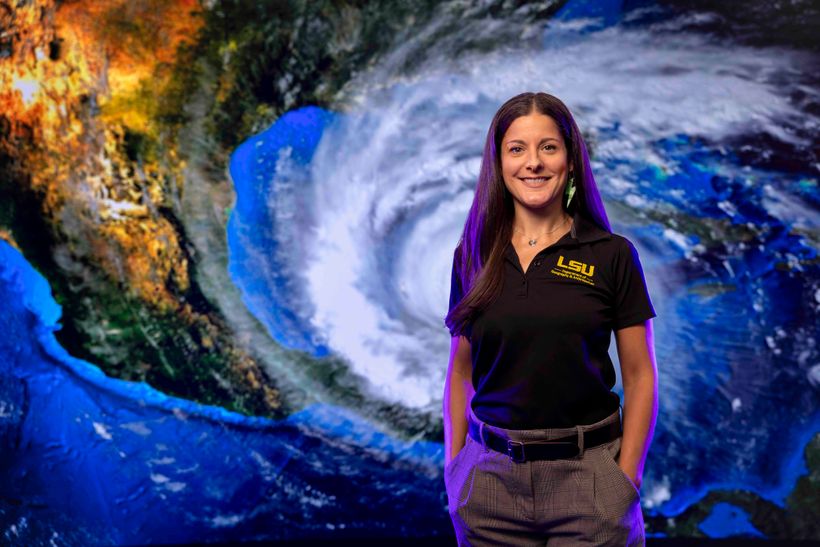
LSU’s Jill Trepanier Educating K-12 Louisiana Students About the Environment
What began in 2018 as a single rooftop weather station on LSU’s campus as a tool to help freshmen connect to the science happening around them, has grown into an educational network in the southern part of the state, connecting K-12 students with the sky through real-time data, interactive technology, and hands-on learning. Trepanier, a professor and department chair in LSU’s Department of Geography & Anthropology, leads a project that now includes 10 weather stations installed at or near K–12 schools from Lake Charles to Grand Isle. “The environment is harsh in Louisiana. Beautiful, but harsh,” Trepanier said. “The more students know about it, the better they can protect themselves and their families. For me, that’s what it is all about.” The project all started to help college students in Trepanier’s meteorology and physical geography classes connect more deeply with the material by using weather data collected from the air around them. “These were 400 freshmen every semester who were not geography majors, so they didn't really love the science of the atmosphere. But they were able to connect with the information because they could see the data on an app on their phone as they were living in it.” Installed across South Louisiana, each weather station is solar-powered and connected to a console that uploads data to an online web platform and displays it on a dashboard. Then an app shows the local students the current conditions and records for the day. “When we look at data from the community, it might be many miles from where you are. And most people live within a few miles or less of their schools. It allows them a close-up view of what is happening, instead of relying on something miles away,” she said. Teachers can use the data with certain lessons or during a passing storm. But the available data also educates them on things like solar radiation, “It also helps aid things like seasonality and our relationship with the sun. It extends well beyond just rain.” The material is also aligned with the Louisiana Student Science Standards for environmental and Earth sciences. “By allowing students to compare real data across space and time, it helps them to understand how systems are connected. And most of these science standards have them focusing on system theory, in one way or another,” Trepanier said. Read the full story here.


The Impact of Counterfeit Goods in Global Commerce
Introduction Counterfeiting has been described as “the world’s second oldest profession.” In 2018, worldwide counterfeiting was estimated to cost the global economy between USD 1.7 trillion and USD 4.5 trillion annually, as well as resulting in more than 70 deaths and 350,000 serious injuries annually. It is estimated that more than a quarter of US consumers have purchased a counterfeit product. The counterfeiting problem is expected to be exacerbated by the unprecedented shift in tariff policy. Tariffs, designed as an import tax or duty on an imported product, are often a percentage of the price and can have different values for different products. Tariffs drive up the cost of imported brand name products but may not, or only to a lesser extent, impact the cost of counterfeit goods. In this article, we examine the extent of the global counterfeit dilemma, the role experts play in tracking and mitigating the problem, the use of anti-counterfeiting measures, and the potential impact that tariffs may have on the flow of counterfeit goods. Brand goods have always been a target of counterfeits due to their high price and associated prestige. These are often luxury goods and clothing, but can also be pharmaceuticals, cosmetics, and electronics. The brand name is an indication of quality materials, workmanship, and technology. People will pay more for the “real thing,” or decide to buy something cheaper that looks “just as good.” In many cases, “just as good” is a counterfeit of the brand name product. A tariff is an import tax or duty that is typically paid by the importer and can drive up the cost of imported brand name products. For example, a Yale study has shown that shoe prices may increase by 87% and apparel prices by 65%, due to tariffs. On the other hand, counterfeit products don’t play by the rules and can often avoid paying tariffs, such as the case of many smaller, online transactions, shipped individually. Therefore, we expect to see an increase in counterfeit products as well as a need to increase efforts to reduce the economic losses of counterfeiting. The Scale of the Counterfeit Problem In their 2025 report, the Organisation for Economic Co-operation and Development (OECD) and the European Union Intellectual Property Office (EUIPO), estimated that in 2021, “global trade in counterfeit goods was valued at approximately USD 467 billion, or 2.3% of total global imports. This absolute value represents an increase from 2019, when counterfeit trade was estimated at USD 464 billion, although its relative share decreased compared to 2019 when it accounted for 2.5% of world trade. For imports into the European Union, the value of counterfeit goods was estimated at USD 117 billion, or 4.7% of total EU imports.” In a 2020 report, the US Patent and Trademark Office (USPTO) estimated the size of the international counterfeit market as having a “range from a low of USD 200 billion in 2008 to a high of USD 509 billion in 2019.” According to the OEDC / EUIPO General Trade-Related Index of Counterfeiting for economies (GTRIC-e), China continues to be the primary source of counterfeit goods, as well as Bangladesh, Lebanon, Syrian Arab Republic, and Türkiye. Based on customs seizures in 2020-21, the most common items are clothing (21.6%), footwear (21.4%), and handbags, followed by electronics and watches. Based on the value of goods seized, watches (23%) and footwear (15%) had the highest value. However, it should be noted that items that are easier to detect and seize are likely to be overrepresented in the data. Although the share of watches declined, and electronics, toys, and games increased, it remains unclear whether this represents a long term trend or just a short term fluctuation. In general, high value products in high demand continue to be counterfeited. Data from the US Library of Congress indicates that 60% – 80% of counterfeit products are purchased by Americans. The US accounts for approximately 5% of the world’s consumers; however, it represents greater than 20% of the world’s purchasing power. Though it is still possible to find counterfeit products at local markets, a large number of counterfeit goods are obtained through online retailers and shipped directly to consumers as small parcels classified as de minimis trade. This allows for the duty-free import of products up to USD 800 in value. Counterfeit items may be knowingly or unknowingly purchased from online retailers and shipped directly to consumers, duty-free. Purchased products can be shipped via postal services, classified as de minimis trade. Approximately 79% of packages seized contained less than 10 items. Given the size and volume of the packages arriving daily, many or most will evade scrutiny by customs officials. This means of import is increasing over time. In 2017-19 it was 61% of seizures. By 2020-21, it was 79%. Economic Impact of Counterfeiting The scale of the counterfeiting problem has significant impacts on the US economy, US business interests, and US innovations in lost sales and lost jobs. Moreover, counterfeit products are often made quickly and cheaply, using materials that may be toxic. The companies producing these goods may not dispose of waste properly and may dump it into waterways, causing significant environmental consequences. Counterfeit products from electrical equipment and life jackets to batteries and smoke alarms may be made without adhering to safety standards or be properly tested. These products may fail to function when you need it and may lead to fire, electric shock, poisoning, and other accidents that can seriously injure and even kill consumers. Counterfeit cosmetics and pharmaceuticals can also lead to injuries by either including unsafe ingredients or by failing to provide the benefits of the real product. The Tariff Counterfeit Connection Tariffs may be seen as a tax on consumers and raise the price of imported products that are already the target of counterfeiters such as luxury leather products and apparel. It’s commonly understood that raising prices on genuine products can only drive up the demand for counterfeit goods. In general, consumers will have less disposable income and the brand goods they desire will cost more which is bound to increase the demand for counterfeit goods. Although recent changes removing the USD 800 tax exemption on de minimis shipments from China and Hong Kong will make it more expensive for counterfeiters to ship their goods internationally, tariffs are typically applied as a percentage of the cost of an object. This will cause the price of more expensive legitimate goods to increase even more than the cheaper counterfeit goods and likely make the counterfeit products even more attractive economically. Therefore, we expect to see an increase in counterfeit products as well as an increase in efforts to reduce the economic losses of counterfeiting. The Role of Technical Experts in Counterfeit Detection Technical experts play an important role in both the prevention and detection of counterfeits and helping to identify counterfeiting entities. Whether counterfeit money, clothing, shoes, electronics, cosmetics or pharmaceuticals, the first step in fighting counterfeits is detecting them. In some cases, the counterfeit product is obvious. A leather product may not be leather, a logo may be wrong, packaging may have a spelling mistake, or a holographic label may be missing. These products may be seized by customs. However, some counterfeit products are very difficult to detect. In the case of a counterfeit memory card with less than the stated capacity or a pharmaceutical that contains the wrong active ingredient, technical analysis may be needed to identify the parts. Technical analysis may also be used to try and identify the source of the counterfeit goods. For prevention measures, manufacturers may use radio frequency identification (RFID) or Near Field Communication (NFC) tags within their products. RFID tags are microscopic semiconductor chips attached to a metallic printed antenna. The tag itself may be flexible and easy to incorporate into packaging or into the product itself. A passive RFID requires no power and has sufficient storage to store information such as product name, stock keeping unit (SKU), place of manufacture, date of manufacture, as well as some sort of cryptographic information to attest to the authenticity of the tag. A simple scanner powers the tag using an electromagnetic field and reads the tag. If manufacturers include RFID tags in products, an X-ray to identify a product in a de minimis shipment (perhaps using artificial intelligence technology) and an RFID scanner to verify the authenticity of the product can be used to efficiently screen a large number of packages. Many products also may be marked with photo-luminescent dyes with unique properties that may be read by special scanners and allow authorities to detect legitimate products. Similarly, doped hybrid oxide particles with distinctive photo-responsive features may be printed on products. These particles, when exposed to laser light, experience a fast increase in temperature which may be quickly detected. For either of these examples, the ability to identify legitimate products, or – due to the absence of marking – track counterfeit products, allows authorities to map the flow of the counterfeit goods through the supply chain as they are manufactured, shipped, and are exported and imported to countries. For many years, electronic memory cards such as SD cards and USB sticks have been counterfeited. In many cases, the fake card will have a capacity much smaller than listed. For example, a 32GB memory card for a camera may only hold 1GB. Sometimes, these products may be identified by analyzing the packaging for discrepancies from the brand name products. In other cases, software must be used to verify the capacity and performance of each one, which is time-consuming when analyzing a large number of products. Forensic investigators, comprised of forensic accountants and forensic technologists, are heavily involved in efforts to combat this illicit trade. By analyzing financial records, supply-chain data, and transaction histories, they trace the origins and pathways of counterfeit products. Their work often involves identifying suspicious procurement patterns, shell companies, and irregular inventory flows that signal counterfeit activity. Forensic investigators often begin by mapping the counterfeit supply chain, an intricate web that often spans continents. Using data analytics, transaction tracing, and inventory audits, they identify anomalies in procurement, distribution, and sales records. These methodologies help pinpoint the origin of counterfeit goods, the intermediaries involved, and the final points of sale. By reconstructing the flow of goods and money, forensic investigators can begin to unmask activities. Cross-border partnerships are essential for tracking assets, sharing insights, and coordinating with financial regulators. Public-private partnerships further enhance the effectiveness of anti-counterfeiting efforts. Forensic investigators often serve as bridges between government agencies, brand owners, and financial institutions, facilitating the exchange of key information. These partnerships increase information-sharing, streamline investigations, and amplify the impact of enforcement actions. A promising development in this space is the World Customs Organization’s Smart Customs Project, which integrates artificial intelligence to detect and intercept counterfeit goods. Forensic investigators can leverage this initiative by analyzing AI-generated alerts and incorporating them into broader financial investigations, which allows for faster and more accurate identification of illicit networks. Jurisdictional complexity is a major hurdle in anti-counterfeiting efforts. Forensic investigators work closely with legal teams to navigate these challenges to ensure that investigations comply with local laws, and evidence is admissible and can withstand scrutiny in court, especially when dealing with offshore accounts and international money laundering schemes. Forensic investigators follow the money, tracing illicit profits through bank accounts, shell companies, and cryptocurrency transactions. Their findings not only help recover stolen assets but also support disputes by providing expert testimony that quantifies financial losses and identifies the bad actors. Conclusion Imitations of brand name products have become more convincing, harder to detect, and the sources of the counterfeit goods more difficult to identify. While counterfeiting clearly has evolved because of technological advancements, e-commerce, and the growing sophistication of bad actors, the process has now been complicated even further by the unpredictable tariff and trade policies that are affecting businesses worldwide. Consequently, companies need to take a multi-faceted approach to these new challenges introduced into the counterfeiting of products by tariffs. By engaging high-tech product authentication measures, utilizing technology-based alerts about counterfeits, and retaining the specialized skills of forensic investigators and other experts, companies will be able to navigate the risks posed by the complex and changing relationship between tariffs and counterfeit goods. To learn more about this topic and how it can impact your business or connect with James E. Malackowski simply click on his icon now to arrange an interview today. To connect with David Fraser or Matthew Brown - contact : Kristi L. Stathis, J.S. Held +1 786 833 4864 Kristi.Stathis@JSHeld.com


Neutrons by the trillions: Using computational physics to understand nuclear reactors
Zeyun Wu, Ph.D., associate professor in the mechanical and nuclear engineering department at VCU Engineering, is reshaping the future of nuclear power. Nuclear reactors are among the most complex engineered systems on earth, with different physical processes interacting simultaneously across various scales. Even the world's most powerful computers cannot simulate every detail of an operating reactor at once. With a background in computational reactor physics, Wu’s research develops modeling and simulation techniques crucial to understanding next-generation nuclear reactors. By creating these advanced tools, his research eliminates the need for costly physical experimentation while ensuring the safety, efficiency and environmental sustainability of future nuclear power plants. Wu's research focuses on understanding reactor behavior through two aspects: multi-physics and multi-scale modeling. The multi-physics approach integrates various physical phenomena, such as nuclear physics reactions, fluid dynamics, heat transfer and structural mechanics, into a unified simulation framework. The multi-scale modeling technique addresses the vast range of physical scales involved, from subatomic neutron interactions to meter-sized reactor components. Wu’s research can simulate the complex phenomena within reactors at different scales. These models, developed using advanced numerical methods, help predict reactor behavior under various conditions. One of the models Wu uses tracks neutron behavior, a fundamental aspect to understand nuclear reactions. His simulations track trillions of neutrons as they move through various reactor materials, cause fission events and generate power. "What drives power is actually the neutron," explained Wu. "Once an atom splits, along with the nuclear energy release, lots of neutrons come out. We're talking about 1012 to 1013 neutrons per second. Our code tracks each neutron to understand where it comes from and where it goes." By understanding neutron distribution across space, time and energy domains, Wu's team can predict power distribution throughout the reactor core. This helps identify potential hotspots – areas of heightened thermal activity that could pose safety challenges. Beyond neutron behavior, Wu's research also explores how cooling fluids interact with neutrons and carry away thermal energy, a field known as thermal hydraulics, because how the reactor components are cooled significantly affects the neutron behavior as well. This also explains why the multi-physics modeling becomes essential for nuclear reactor simulations. Wu founded the Computational Applied Reactor Physics Laboratory (CARPL) to continue his research in nuclear reactor modeling and simulation. Undergraduate and master’s students learn to use established nuclear simulation codes to analyze reactor problems – skills highly valued in the industry and national labs. Ph.D. students build on theoretical foundations to deepen their understanding, enhance existing models, and develop new ones. “My area of research has been continually evolving for the past 60 years or so,” said Wu. “Most of the codes we use have been developed by national labs, like Oak Ridge National Lab, but these codes aren’t perfect. National labs hire Ph.D. level students with this niche to identify deficits in the code, correct errors and even add new functions and improve them.” Looking forward, Wu hopes his research will have a real-world impact on the upcoming shift in nuclear power in America. Over the next 20 to 30 years, the nation's approximately 90 light-water-cooled nuclear reactors reach the end of their operational lifetimes. Light water refers to ordinary water (H₂O), used in most existing reactors to both cool the system and slow down neutrons to sustain the nuclear reaction. To replace them, experts are looking toward advanced, non-light-water-cooled reactors, such as the Molten Uranium Breeder Reactor (MUBR) shown in the figure. Computational methods and tools like Wu’s research lab developed will be essential to their development and implementation. Non-light-water cooled reactors offer significant advantages over the older designs. Some can operate at higher temperatures while others produce substantially less nuclear waste, addressing one of the industry's persistent challenges. "Unlike traditional water reactors, where we have decades of operational experience and established analysis tools, these new designs present unique challenges," explained Wu. "Companies like Dominion employ large teams of analysts who use well-tested computational tools to maintain their existing reactors, but those same tools aren't calibrated for these next-generation reactors. Our research is developing the computational methods and simulations these advanced reactors will need. When these new reactors come online, the methodologies we're creating now can be quickly converted into production-level nuclear codes, providing immediate practical value to industry.”


ChristianaCare Charts New Course With Nurse Robotics Research Fellowship
ChristianaCare, the first hospital system in the region to deploy collaborative robots, has once again broken new ground, this time with a nationally unique initiative that puts bedside nurses at the helm of robotics research and innovation. At a graduation ceremony April 30, ChristianaCare celebrated the first four clinical nurses completing the Nursing Research Fellowship in Robotics and Innovation — the first program of its kind in the nation. The fellowship was part of a larger three-year, $1.5 million grant from the American Nurses Foundation’s Reimagining Nursing Initiative. The grant supports ChristianaCare’s broader study on how collaborative robots impact nursing practice. Over eight months, nurses from different units and specialties participated in immersive research training and lectures designed to expand their knowledge, curiosity and professional growth. Their work culminated in national conference presentations and preparations for journal submissions. The inaugural Nursing Research Fellows in Robotics and Innovation are: Briana Abernathy, BSN, RN, CEN – case management, Christiana Hospital emergency department Elizabeth Mitchell, BSN, RN-BC – Christiana Hospital surgical stepdown unit Hannah Rackie, BSN, RN, C-EFM – Union Hospital maternity unit Morgan Tallo, BSN, RN, CCRN – Christiana Hospital cardiovascular critical care unit A ‘real seat at the table’ “When you create programs that empower nurses to lead, innovate and tackle meaningful challenges, you see real impact — not just in new skills and knowledge, but in job satisfaction, well-being and retention,” said Susan Smith Birkhoff, Ph.D., RN, program director of Technology Research & Education at ChristianaCare. “This fellowship is built on the belief that when nurses are given the space to learn and lead, they bring fresh ideas and collaborative solutions back to their clinical practice areas.” Created and led by Smith Birkhoff, the fellowship is a standout in the U.S. health care landscape: It gives bedside nurses the chance to step away from their daily routines and gain advanced research experience, an opportunity rarely available at the clinical level. While the fellowship directly trained four nurses, its reach extended well beyond thazt. Fellows shared what they were learning along the way, sparking wider interest in research across the health system. The research program was highlighted as a new knowledge and innovation exemplar in the latest evaluation by the American Nurses Credentialing Center, which in March awarded ChristianaCare its fourth Magnet designation — the gold standard for nursing excellence. Adriane Griffen, DrPH, MPH, MCHES, vice president of programs at the American Nurses Foundation, praised ChristianaCare’s responsiveness in shaping the program around nurses’ needs and building a model for future innovation. “What makes this fellowship stand out is its focus on giving bedside nurses a real seat at the table,” Griffen said. “When nurses are trusted to lead and have the right support, they develop solutions that are practical, sustainable and transformative. This fellowship shows how nurse-led innovation can grow from a local pilot into a model for improving care across the country.” Through the fellowship, nurses gained a deeper understanding of applying research methodology to advance robotics science at the intersection of nursing and hospital operations, which is groundbreaking and novel. “This is such an exciting and important moment for our profession,” said Danielle Weber, DNP, RN, NEA-BC, chief nurse executive at ChristianaCare. “Innovation is about improving care, easing the burdens on our teams and finding smarter ways to meet the complex needs of our patients. Tools like collaborative robots don’t replace the human touch, they help protect and elevate it.” Mitchell said she was initially intimidated when she saw the fellowship application because it had been years since she last engaged in formal research. Learning everything from literature reviews to abstract writing pushed her outside her comfort zone and gave her practical tools to take new ideas forward. The experience inspired her to return to school this fall to pursue a graduate degree. A ‘ripple effect’ “This fellowship reignited my enthusiasm for learning and gave me the skills and confidence to keep growing,” Mitchell said. “It’s been amazing to collaborate with other fellows and mentors, and I’m excited to apply what I’ve learned to improve patient care and strengthen our teams.” In addition to Smith Birkhoff, Kate Shady, Ph.D., RN, OCN, RN IV, served as a mentor to the fellows, bringing expertise from her hematology/oncology background. Kati Patel, MPH, provided key administrative coordination and support throughout the program. ChristianaCare continues its broader research into robotics integration, with findings from the multi-year collaborative robot study expected to be shared later this year. Shady said the fellowship is already influencing ChristianaCare’s nursing culture by expanding interest in research and evidence-based practice well beyond the initial group. The program’s ripple effect is helping build lasting infrastructure for nurse-led innovation across departments. “One of the most rewarding parts of this fellowship has been seeing these nurses step into new confidence and capability,” Shady said. “They began unsure about research, but by the end, they were reading studies, writing abstracts and mentoring peers — laying the groundwork for bigger change in how we advance nursing practice.” Learn more about nursing at ChristianaCare.



Could China Beat America in the Race to Get Boots Back on the Moon?
Call it a matter of pride, national security or a desire for astronomical dominance; there's a sense of urgency within the U.S. government to return to the moon, sparked by China's team of taikonauts, who could land there before American astronauts get back to the lunar surface. The latest space race is a topic that is making national news. Florida Tech's experts are lending their opinions and insights about the likelihood of a lunar return, and what it might mean. NASA, with the urging of many politicians, has been racing to get astronauts back to the moon — before the Chinese land taikonauts on the lunar surface. But what’s the rush to return to a place the United States has already been and left 53 years ago? Especially when Mars looms as an enticing option for interplanetary travel. Space experts say there’s plenty of reasons for the urgency: national pride and national security. But also returning to the moon and building habitats would mean long term dominance in space and ensure access to resources that NASA didn’t know where there when the Apollo missions flew. Now with the Chinese making significant progress in human space exploration, the clock is ticking. “The Chinese in the last 20 years have made amazing strides in all aspects of space. They’re sending robots to the moon on a very regular basis. Now they’re doing some pretty amazing activities even on the far side of the moon, and they have a Chinese space station now in Earth orbit,” said Don Platt, associate professor of space systems at Florida Tech. Can China beat NASA to the moon? “The Chinese have really caught up,” said Platt. “I do believe that the Chinese are definitely advancing their efforts on the moon, and are identifying it as a critical aspect of their strategic future in space." When asked about the prospect of Chinese astronauts making it to the moon before NASA's planned Artemis III mission, Platt said he believes it’s a possibility and he cited the efforts China is making to highlight the importance of the nation's space efforts to its own populace. “They have some amazing videos. They’re really engaging the Chinese public, and really using it to do what what we’ve always done in space, and that is to inspire the next generation and to show the world the technical abilities of the Chinese,” said Platt. May 21 - USA Today The race is on, and it's getting a lot of attention. If you're a journalist following this ongoing story, let us help with your coverage. Dr. Don Platt's work has involved developing, testing and flying different types of avionics, communications and rocket propulsion systems. He also studies astrobiology and biotechnology systems and human deep space exploration tools. Don is available to speak with media anytime. Simply click on the icon below to arrange an interview today.

