
Experts Matter. Find Yours.
Connect for media, speaking, professional opportunities & more.

England’s identity: fans sing football’s coming home, but what is home?
Sport matters to national identity. The pageantry of flags, emblems and anthems (both official and unofficial) load sport with symbolism and imagery of the nation. One of the key reasons governments spend billions of dollars to host sporting mega events is to build or reinforce a sense of national identity. However, national identity is fluid, not fixed. Sport offers an arena in which national identity can adapt and change. In England, where many civic institutions represent Britain as a whole, the men’s national football team is particularly important to English identity. In 1996, the country hosted the European Championships tournament. This coincided with the so-called awakening of English national identity, symbolised by the supplanting of the union flag with the waving of the Saint George’s cross at Wembley football stadium and the singing of a new fans’ anthem, Three Lions (Football’s Coming Home). In recent years, celebrating Englishness has often been linked to a narrow and exclusive imagery, which is said to marginalise ethnic minorities and those with a more socially liberal perspective, and has been tied to a football culture often associated with hooliganism. Yet now, as England have reached the finals of the Euros for the first time, the team and its manager, Gareth Southgate, have put football at the centre of a debate about English identity for the opposite reason. Is a more proud, inclusive version of Englishness emerging? Multicultural teams in a globalised world A recent graphic promoted by the UK’s Museum of Migration shows a stark picture of what England’s starting 11 would look like without immigration over the past two generations. With only three players without a parent or grandparent born overseas, the national team is held up as a microcosm of a diverse, multicultural population (although the absence of England’s significant Asian communities is glaring). To paraphrase historian Eric Hobsbawm, the imagined community of multicultural England seems more real as a team of eleven named people. As Southgate said before the 2018 World Cup: “In England we have spent a bit of time being a bit lost as to what our modern identity is. I think as a team we represent that modern identity and hopefully people can connect with us.” In many ways, this is old news. Sport in England and the UK (akin to national identity) has always been a multinational affair, owing to its colonial ties with the countries of the former British Empire. Whether it was Jamaican-born John Barnes scoring against Brazil in 1984, Kevin Pietersen (South African born) winning the Ashes in 2005, or Greg Rusedski (Canadian born), Johanna Konta (Australian born) or, more recently, Emma Raducanu (Canadian born) performing at Wimbledon, British sport has long reflected its colonial history and the tensions and contingencies that brings. Nor is this issue unique to England or the UK. In 1998, the French World Cup-winning team was both celebrated and attacked by pro- and anti-migrant voices for the multiracial makeup of their “rainbow team”, as a large proportion of its players – including its star Zinedine Zidane – had ethnic backgrounds in former French colonies in Africa and the Caribbean. The imperial legacies of Belgium, Netherlands and Portugal are also evident in the diversity of their respective squads. Beyond former colonial powers, most national teams are now more ethnically diverse than they were 30 years ago, due to globalisation and the naturalisation of foreign athletes. England’s quarter-final opponents Ukraine have fielded Brazilian born players Júnior Moraes and Marlos this year, and their captain Andriy Yarmolenko was born in Russia. In addition to historical, cultural and linguistic connections, there is a clear performance imperative: teams that embrace ethnic diversity often outperform teams that don’t. ‘Englishness’ and immigration What is significant about this moment is the wider political context in the UK – particularly the uncertainty over what is “English” national identity and, critically, what should it be. All this comes amid the fray of polarised debate over the issues of immigration and race in England, and the UK more generally. The prospect of a tighter, points-based system of immigration, which has now been introduced, was one of the key themes of the Leave campaign in the 2016 EU referendum. Had such a system been installed several decades ago, the graphic about the English team’s immigration history may well have been approaching reality. And without the talents of Raheem Sterling, Kalvin Phillips, Kieran Trippier and others, England fans may well have been lamenting another disappointing tournament campaign. Amid the euphoria of reaching a final, there remains much soul-searching, as well as division, among the English on the key questions of “who are we” and “what exactly do we want to celebrate”? Fans, quite rightly, are celebrating the achievements of the whole English team, as well as the activism of individual heroes like Sterling and Marcus Rashford. Yet while many fans embrace the diversity of the team, the booing of their own players taking the knee against racism – a gesture that originated in the US – shows that identity politics can still divide, on and off the pitch. In spite of the positive image of diverse modern England projected by this group of players and manager, it is unrealistic to expect football to navigate the current “culture war” and be able to consolidate a more progressive, inclusive vision of Englishness – at least on its own. Other civic, and possibly political, institutions are needed if England is going to mean more than “the 11 men in white shirts at Wembley”. Notwithstanding how people identify themselves in terms of their nationality, research shows that both hosting a football tournament and making successful progression through it can have a positive impact on national feelings of happiness and well-being. If England beat Italy at Wembley on Sunday and win Euro 2020, a feel-good factor will inevitably abound, which may be a springboard to unite a country that is still deeply divided.


Juneteenth is this Saturday? Our experts can help with your coverage and questions
June 19 — Juneteenth — marks the day in 1865 that the Union Army announced in Texas that the African American slaves were free. Black Americans since then have honored the day, even as it has gone unnoticed by many others. In 2020, Jessica Millward, an associate professor of history at UCI, appeared on the UCI Podcast to discuss the history behind Juneteenth, the decades upon decades of continued struggle, and the hope she feels in this moment. And if you’re a reporter covering this important date in American history – then let our experts help with your stories. Dr. Jessica Millward is an Associate professor in the Department of History at the University of California, Irvine. Her research focuses on comparative slavery and emancipation, African American history, gender and the law. Dr. Millward is available to speak with media about Juneteenth – simply click on her icon now to arrange an interview today.


Baylor Expert Shares Four Keys to Leadership from Ulysses S. Grant’s Reflections on Civil War
Near the end of his life, as he battled spiraling health and an empty bank account, former United States President – and iconic Civil War General – Ulysses S. Grant penned his memoirs and gave the world a glimpse into the mind of one of the nation’s most celebrated figures. The book, “Personal Memoirs of U.S. Grant,” was published in 1885 and has been pored over for more than 135 years. Peter Campbell, Ph.D., author, associate professor of political science at Baylor University and a nationally recognized scholar on military strategy and international security, recently wrote an essay about Grant and his memoirs for Classics of Strategy and Diplomacy. He said Grant’s personal reflections provide valuable insights into his view and practice of leadership, specifically as he led Union forces in the Civil War. Below, Campbell offers four keys to leadership that he found in Grant’s writings. 1. Know Yourself. Grant was a careful observer of himself. He was able to reflect on his experience, see where he had made errors and learn from them. In July 1861, moments before what Grant thought would be his first engagement as a commander in the Civil War, he was terrified. His heart was in his throat. When he and his forces crested a rise that they thought would reveal the enemy force, they saw that the enemy had fled. “My heart resumed its place,” Grant wrote. “It occurred to me at once that [the enemy] had been as much afraid of me as I had been of him. This was a view of the question I had never taken before; but it was one I never forgot afterwards.” Grant absorbed this lesson and it transformed him as a leader and planner. 2. Know Your Enemy. The great Chinese strategists counseled that commanders must know their enemies. Grant shows us what this looks like in practice. Rather than dwelling on his fears, those things that his opponent might do that would spell disaster, Grant put himself in the shoes of his adversary and asked himself: What would my gravest fears be, were I in his position? He then designed his plan of campaign to raise the specter of his enemy’s fears, knowing that this would compel the enemy to be blinded by fear and compel them to react. To be fair, this was easier for Grant because in the Civil War he was fighting against fellow graduates of West Point and veterans of the Mexican War, including Robert E. Lee. Grant was not in awe of Lee. “I had known [Lee] personally,” Grant wrote, “and knew that he was mortal; and it was just as well that I felt this.” This does not diminish, but rather reinforces, the importance on studying one’s adversary carefully in any kind of competition. 3. Know Your People. As Grant rose in the ranks of the Union Army, he was pulled away from the sound of the guns and the command of troops in battle. This is true in any organization – the higher one rises the further one gets from the ground truth, whether in an army or a Fortune 500 company. Grant recognized that to influence the battles he could no longer superintend, he had to select the right subordinates for the job and then give them the authority to exercise the initiative in their area of responsibility. This meant that Grant also had to be a careful observer of the strengths and weaknesses of his subordinates. Even a hero of the Battle of Gettysburg like Major General Gouverneur Warren was not spared Grant’s penetrating character assessments. Warren’s weakness, Grant wrote, was that he could not trust his subordinates to carry out his orders, which meant that he could not be give a large command. “[Warren’s] difficulty was constitutional and beyond his control,” Grant wrote. “He was an officer of superior ability, quick perception, and personal courage to accomplish anything that could be done with a small command.” When you know your people, you know where to place them where their strengths will reinforce success and their weaknesses will be least disastrous. 4. Unleash the Power of Humility. The most decisive virtue that Grant practiced was humility. As a leader he did not allow pride in his own designs to blind him to the wisdom of his subordinates. Late in the war, Grant wrote up a campaign plan for attacking the Shenandoah Valley, the key source of supply to the Confederacy. He brought the plan to General Philip Sheridan for execution. However, when he met with Sheridan, the cavalry officer presented Grant with his own plan. Grant wrote that Sheridan “was so clear and so positive in his views and so confident of success, I said nothing about [my campaign plan] and did not take it out of my pocket.” When you lead, don’t let pride get in the way of the best ideas bubbling up from your subordinates. ABOUT PETER CAMPBELL, PH.D. Peter Campbell, Ph.D., is an associate professor of political science in Baylor University’s College of Arts & Sciences. He is the author of two books: “Military Realism: The Logic and Limits of Force and Innovation in the U.S. Army” and “Farewell to the Marshal Statesman: The Decline of Military Experience Among Politicians and its Consequences.” Campbell studies international security, civil-military relations, strategy and national security decision-making, international relations scholarship and policy relevance, insurgency and counterinsurgency, the just war tradition, unconventional warfare and advanced military technology, military culture, and the effects of cyber capabilities on conflict escalation. ABOUT BAYLOR UNIVERSITY Baylor University is a private Christian University and a nationally ranked research institution. The University provides a vibrant campus community for more than 19,000 students by blending interdisciplinary research with an international reputation for educational excellence and a faculty commitment to teaching and scholarship. Chartered in 1845 by the Republic of Texas through the efforts of Baptist pioneers, Baylor is the oldest continually operating University in Texas. Located in Waco, Baylor welcomes students from all 50 states and more than 90 countries to study a broad range of degrees among its 12 nationally recognized academic divisions. ABOUT THE COLLEGE OF ARTS & SCIENCES AT BAYLOR UNIVERSITY The College of Arts & Sciences is Baylor University’s largest academic division, consisting of 25 academic departments and eight academic centers and institutes. The more than 5,000 courses taught in the College span topics from art and theatre to religion, philosophy, sociology and the natural sciences. Faculty conduct research around the world, and research on the undergraduate and graduate level is prevalent throughout all disciplines. Visit baylor.edu/artsandsciences.


Could Smarter Guns Be the Key To Stopping Mass Shootings and Other Violence?
“Gun violence in this country is an epidemic, and it’s an international embarrassment,” President Biden recently said. At least 45 mass shootings have occurred in America in the last month, according to reports. In the same time period, news of police officers killing unarmed Black men and boys, including 20-year-old Daunte Wright in Minneapolis and 13-year-old Adam Toledo in Chicago, sparked waves of protest around the country. These all-too-common tragedies could be significantly reduced — and even eliminated — without any of the partisan rancor and gridlock typically associated with gun-related debates, says Selmer Bringsjord, an expert in artificial intelligence and reasoning and a professor of cognitive science at Rensselaer Polytechnic Institute. “There is a solution,” Bringsjord, the director of the Rensselaer AI and Reasoning Laboratory, wrote in the Times Union. “A technological alternative to the fruitless shouting match between politicians: namely, AI — of the ethical sort. Guns that are at once intelligent and ethically correct can put an end to the mass-shooting carnage.” Rather than an endless debate over whether the public should have more guns or less, Bringsjord’s novel – and, he says, plausible – proposal is to shift to “smart and virtuous guns, and intelligent restraining devices that operate in accord with ethics, and the law.” Along with his coauthors, Bringsjord detailed his ideas in a recent paper, “AI Can Stop Mass Shootings, and More.” Anticipating some counterarguments, the authors urge readers “to at least contemplate whether we are right, and whether, if we are, such AI is worth seeking.” Bringsjord and his collaborators have created simulations showing how, in only 2.3 seconds, ethical AI technology can perceive a human’s intent and environment and then, if necessary, prevent their gun from firing. Importantly, he notes, the same technology that could prevent a criminal from opening fire in a public area could also prevent a police officer from shooting a person who posed no threat. “Ultimately research along this line should enable humans, in particular some human police, to simply be replaced by machines that, as a matter of ironclad logic, cannot do wrong,” Bringsjord said in a recent public radio segment. The AI capabilities discussed by Bringsjord are the product of prior work over seven years of funding from the Office of Naval Research devoted to developing moral competence in robots. Bringsjord has spoken about robots and logic at TEDxLimassol. He is the author of What Robots Can and Can’t Be and Superminds: People Harness Hypercomputation. He is also the co-author of Artificial Intelligence and Literary Creativity: Inside the Mind of Brutus, a Storytelling Machine. Bringsjord is available to speak about his recent proposals around AI-enabled guns, as well as other aspects of AI, human and machine reasoning, and formal logic.


Power Grid Expert Weighs in on Texas Outages And How to Build a Better System
Having run countless simulations and experiments aimed at building a more resilient power grid, Luigi Vanfretti is well acquainted with the weaknesses in the nation’s current system. This expertise was recently featured in a report about the factors that caused massive, ongoing power outages in Texas. Frozen well heads, gas pipes, and other factors contributed to a “perfect storm” of conditions, Vanfretti said. Some politicians and pundits have floated the notion that the catastrophe was primarily due to frozen wind turbines, but according to Vanfretti, an associate professor of electrical, computer, and systems engineering at Rensselaer Polytechnic Institute, the problem is far more complex. Additionally, the electrical grid in Texas is unique in that it has limited connections to neighboring states, which means there are limitations to how much assistance it can receive during a crisis. “It’s about the ability to route the power,” Vanfretti recently told the Times Union. Vanfretti is an expert in power grid modeling, simulation, stability, and control. His research focuses on creating a smarter, cleaner, more reliable power grid that is capable of integrating renewable energy. Within his Analysis Laboratory for Synchrophasor and Electrical Energy Technology (ALSET) Lab, Vanfretti and his team model the power grid and run simulations in order to develop, test, and improve smart inverters, software, and hardware that will be needed to create the smart grid of the future. You can watch him discuss his research here. Vanfretti is available to speak about what contributed to the devastating outages in Texas, as well as the changes and research necessary to create a more resilient power system.


Best-selling author Peter Singer talks with the Brunswick Review about winning the increasingly crowded and contentious war for attention What do Isis and Taylor Swift have in common? According to author and digital-security strategist Peter Singer, both the terrorist organization and pop star are fighting for your attention online and employing similar tactics to try and win it. ISIS kicked off its 2014 invasion of Mosul with the hashtag, “#AllEyesonISIS.” More recently, the terror group posted photos of its members holding cute cats in an effort to make them more relatable – tactics familiar to most celebrities and online marketers around the world. These online battles, the rules governing them, and their real-world impact are the focus of Mr. Singer’s latest book, LikeWar, which he coauthored with Emerson T. Brooking, at the time a research fellow with the Council of Foreign Relations. “A generation ago people talked about the emergence of cyber war, the hacking of networks. A ‘LikeWar’ is the flip side: the hacking of people and ideas on those networks. Power in this conflict is the command of attention,” says Mr. Singer, who in addition to his writing is also a strategist and Senior Fellow at the New America Foundation. Pretty much everyone who posts online – from governments to marketers to reality TV stars – is a combatant in this fight for virality, according to Mr. Singer. Triumph in a “LikeWar” and you command attention to your product or propaganda or personality. Lose and you cede control of the spotlight and the agenda. Mr. Singer recently spoke with Brunswick’s Siobhan Gorman about the trends he’s seeing in LikeWars around the world, and what companies can do to avoid being on the losing end. What were you most surprised by in researching LikeWar? One of the more interesting characters in the book was at one time voted TV’s greatest villain: Spencer Pratt, a reality TV star on MTV’s “The Hills.” He’s basically one of these people who became famous almost for nothing. But what Pratt figured out really early was the power of narrative, which allowed him to become famous through, as he put it, “manipulating the media.” In the same week, I interviewed both Pratt and the person at the US State Department who’s in charge of the US government’s efforts to battle ISIS online. And Pratt, this California bro who’s talking about how to manipulate the media to get attention, understood more of what was playing out online than the person at the State Department. Spencer Pratt, a reality TV star… understood more of what was playing out online than the person at the State Department.” How much have online conflicts changed the rules in the last few years? First, the internet has left adolescence. It’s only just now starting to flex its muscles and deal with some of its responsibilities. The structure of the network changes how these battles play out. So, it’s this contest of both psychological but also algorithmic manipulation. What you see go across your screen on social media is not always decided by you. The rule makers of this global fight are a handful of Silicon Valley engineers. Another aspect of it is that social media has effectively rendered secrets of any consequence almost impossible to keep. As one CIA person put it to us, “secrets now come with a half-life.” Virality matters more than veracity; the truth doesn’t always win out. In fact, the truth can be buried underneath a sea of lies and likes. And the last part is that we’re all part of it. All of our decisions as individuals shape which side gets attention, and therefore which side wins out. But you highlight that this is playing out differently in China. Exactly. There are two different models shaping the internet, and shaping people’s behavior through the internet, playing out in the West and in China. Essentially, internet activity in China is all combined. Look at WeChat, which is used for everything from social media to mobile payment; it’s Amazon meets Facebook meets Pizza Hut delivery. And you combine that with an authoritarian government that’s had a multi-decade plan for building out surveillance, and you get the social credit system, which is like Orwellian surveillance crossed with marketing. The social credit system allows both companies and the government to mine and combine all the different points of information that an online citizen in China reveals of themselves, and then use that to create a single score – think of it as your financial credit score of your “trustworthiness.” For example, if you buy diapers your score goes up, because that indicates you’re a parent and a good parent. If you play video games for longer than an hour your score goes down because you’re wasting time online. And it’s all networked. Your friends and family know your score. It creates a soft form of collective censorship; if your brother posts something that’s critical of the government, you’re the one who goes to him and says, “Knock it off ’cause you’re hurting my score.” And you do that because the score has real consequences. Already it’s being used for everything from seating on trains and job applications to online dating. Your score literally shapes your romantic prospects. So, you have this massive global competition between Chinese tech companies and other global tech companies not only for access to markets, but also for whose vision of the internet is going to win out. How can companies win a “LikeWar”? Everyone’s wondering: What are the best ways to drive your message out there and have it triumph over others? The best companies I’ve seen create a narrative, have a story and have emotion – in particular, they have emotion that provokes a reaction of some kind. It’s all about planned authenticity. That sounds like a contradiction, but it’s about acting in ways that are genuine, but are also tailored because you’re aware that the world is watching you. A good comparison here is Wendy’s versus Hillary Clinton. Wendy’s is a hamburger chain – not a real person – but it acts and comes across as “authentic” online and has developed a massive following. They’re funny, irreverent. Yet Hillary Clinton – a very real person – never felt very authentic in her online messaging. And that’s because it involved a large number of people – by one account, 11 different people – all weighing in on what should be tweeted out. Inundation and experimentation are also key. Throwing not just one message out there, but massive amounts of them. Treating each message as both a kind of weapon, but also an experiment that allows you to then learn, refine, do it again, do it again, do it again. How do you measure and gauge battles online now? Is it just volume? It all depends on what your battle is, what your end goal is. Is it driving sales? Is it getting people to vote for you, to show up to your conference? This is what the US gets wrong about Russian propaganda and its disinformation campaigns. We think they’re designed to make people love or trust a government. From its very start back in the 1920s, the goal of propaganda coming from the Soviet Union, and today Russia, has been instead to make you distrust – distrust everything, disbelieve everything. And we can see it’s been incredibly effective for them. First, we need to recognize that we’re a part of the battle. In fact, we’re a target of most of the battles. How effective have disinformation campaigns actually been in the US? What can be done? One of the scariest and maybe saddest things we discovered is that the US is now the story that other nations point to as the example of what you don’t want to have happen. There’s no silver bullet, of course. But one example was something called the Active Measures Working Group, a Cold War organization that brought together the intelligence community, diplomats and communicators to identify incoming KGB disinformation campaigns and then develop responses to them. We’re dealing with the modern, way more effective online version of something similar, and we haven’t got anything like that. There are also digital literacy programs. I find it stunning that the US supports education programs to help citizens and kids in Ukraine learn about what to do and how to think about online disinformation, but we don’t do that for our own students. What can people like you or me do? First, we need to recognize that we’re a part of the battle. In fact, we’re a target of most of the battles. And we need to better understand how the platforms work that we use all the time. A majority of people actually still don’t understand how social media companies make money. The other is to seek out the truth. How do we do that? And the best way is to remember the ancient parable of the blind man and the elephant – don’t just rely on one source, pull from multiple different sources. That’s been proven in a series of academic studies as the best way to find the facts online. It’s not exactly new, but it’s effective. Where will the next online war be fought? The cell phone in your pocket, or if we’re being futuristic, the augmented reality glasses that you wear as you walk down the street. It’ll come from the keepsake videos that you play on them. If you want to know what comes next in the internet there have always been two places to go: university research labs and the porn industry. That’s been the case with webcams, chat rooms and so on. What we’re seeing playing out now are called “deep fakes,” which use artificial intelligence to create hyper-realistic videos and images. There’s also “madcoms,” which are hyper-realistic chat bots that make it seem like you’re talking to another person online. Combine the two, and the voices, the images, the information that we’ll increasingly see online might be fake, but hyper-realistic. The tools that militaries and tech companies are using to fight back against the AI-created deep fakes are other AI. So, the future of online conflict looks like it’ll be two AIs battling back and forth. Let me give you a historic parallel, because we’ve been dealing with these issues for a very long time. The first newspaper came when a German printer figured out a way to monetize his press’s downtime by publishing a weekly collection of news and advice. And in publishing the first newspaper, he created an entire industry, a new profession that sold information itself. And it created a market for something that had never before existed – but in creating that market, truth has often fallen by the wayside. One of the very first newspapers in America about a century later was called the New England Courant. It published a series of letters by a woman named Mrs. Silence Do-good. The actual writer of the letters was a 16-year-old apprentice at the newspaper named Benjamin Franklin, making him the founding father of fake news in America. In some sense it’s always been there, using deception and marketing to persuade people to your view.



Paper ballots, risk-limiting audits can help defend elections and democracy, IU study finds
BLOOMINGTON, Ind. -- With just over two months before the 2020 election, three professors at the Indiana University Kelley School of Business offer a comprehensive review of how other nations are seeking to protect their democratic institutions and presents how a multifaceted, targeted approach is needed to achieve that goal in the U.S., where intelligence officials have warned that Russia and other rivals are again attempting to undermine our democracy. But these concerns over election security are not isolated to the United States and extend far beyond safeguarding insecure voting machines and questions about voting by mail. Based on an analysis of election reforms by Australia and European Union nations, they outline steps to address election infrastructure security -- such as requiring paper ballots and risk-limiting audits -- as well as deeper structural interventions to limit the spread of misinformation and combat digital repression. "In the United States, despite post-2016 funding, still more than two-thirds of U.S. counties report insufficient funding to replace outdated, vulnerable paperless voting machines; further help is needed," said Scott Shackelford, associate professor of business law and ethics in the Kelley School, executive director of the Ostrom Workshop and chair of IU's Cybersecurity Program. "No nation, however powerful, or tech firm, regardless of its ambitions, is able to safeguard democracies against the full range of threats they face in 2020 and beyond. Only a multifaceted, polycentric approach that makes necessary changes up and down the stack will be up to the task." For example, Australia -- which has faced threats from China -- has taken a distinct approach to protect its democratic institutions, including reclassifying its political parties as "critical infrastructure." This is a step that the U.S. government has yet to take despite repeated breaches at both the Democratic and Republican national committees. Based on an analysis of election reforms by Australia and European Union nations, they outline steps to address election infrastructure security -- such as requiring paper ballots and risk-limiting audits -- as well as deeper structural interventions to limit the spread of misinformation and combat digital repression. "In the United States, despite post-2016 funding, still more than two-thirds of U.S. counties report insufficient funding to replace outdated, vulnerable paperless voting machines; further help is needed," said Scott Shackelford, associate professor of business law and ethics in the Kelley School, executive director of the Ostrom Workshop and chair of IU's Cybersecurity Program. "No nation, however powerful, or tech firm, regardless of its ambitions, is able to safeguard democracies against the full range of threats they face in 2020 and beyond. Only a multifaceted, polycentric approach that makes necessary changes up and down the stack will be up to the task." For example, Australia -- which has faced threats from China -- has taken a distinct approach to protect its democratic institutions, including reclassifying its political parties as "critical infrastructure." This is a step that the U.S. government has yet to take despite repeated breaches at both the Democratic and Republican national committees. The article, "Defending Democracy: Taking Stock of the Global Fight Against Digital Repression, Disinformation and Election Insecurity," has been accepted by Washington and Lee Law Review. Other authors are Anjanette "Angie" Raymond, associate professor of business law and ethics, and Abbey Stemler, assistant professor of business law and ethics, both at Kelley; and Cyanne Loyle, associate professor of political science at Pennsylvania State University and a global fellow at the Peace Research Institute Oslo. Aside from appropriating sufficient funds to replace outdated voting machines and tabulation systems, the researchers said that Congress should encourage states to refuse to fund voting machines with paperless ballots. The researchers also suggest requiring risk-limiting audits, which use statistical samples of paper ballots to verify official election results. Other suggested steps include: Congress requiring the National Institute of Standards and Technology to update their voting machine standards, which state and county election officials rely on when deciding which machines to purchase. Australia undertook such a measure. Creating a National Cybersecurity Safety Board to investigate cyberattacks on U.S. election infrastructure and issue post-elections reports to ensure that vulnerabilities are addressed. Working with universities to develop training for election officials nationwide to prepare them for an array of possible scenarios, and creating a cybersecurity guidebook for use by newly elected and appointed election officials. "With regards to disinformation in particular, the U.S. government could work with the EU to globalize the self-regulatory Code of Practice on Disinformation for social media firms and thus avoiding thorny First Amendment concerns," Raymond said. "It could also work to create new forums for international information sharing and more effective rapid alert and joint sanctions regimes. "The international community has the tools to act and hold accountable those actors that would threaten democratic institutions," added Stemler, who also is a faculty associate at Harvard University's Berkman Klein Center for Internet and Society. "Failing the political will to act, pressure from consumer groups and civil society will continue to mount on tech firms, in particular Facebook, which may be sufficient for them to voluntarily expand their efforts in the EU globally, the same way that more firms are beginning to comply with its General Data Protection Regulation globally, as opposed to designing new information systems for each jurisdiction."


Black Gospel Music Expert Shares 10 of the Most Powerful, Enduring Freedom Songs, Protest Spirituals
By Robert F. Darden, Professor of Journalism, Public Relations & New Media, Founder and Director of the Black Gospel Music Restoration Project at Baylor University WACO, Texas (June 19, 2020) – As the protests following the death of George Floyd began to roil the country, it was only a few days before the demonstrators began to sing an array of freedom songs and protest spirituals, as well as a few new adaptations, including Bill Withers’ “Lean on Me.” Some of these songs have been sung by people fighting nonviolently for freedom and justice for hundreds of years. Many have been sung continually in the United States since the 1800s, right through the #blacklivesmatter and #metoo movements. Others have been adopted by freedom fighters in the Arab Spring, at Tiananmen Square and even now in Hong Kong. The Black Gospel Music Restoration Project at Baylor University has the world’s largest collection of digitized vinyl songs and sermons from gospel’s “golden age.” Not surprisingly, there are hundreds of freedom songs and protest spirituals in the collection as well. Below is a list of some of the most influential, most powerful, most enduring and beloved songs that have inspired and encouraged sings for two centuries. Each song is available for listening in the digital collections of the Black Gospel Music Restoration Project. (Assistance provided by Baylor Libraries’ Digitization and Digital Preservation Services.) 10. “We Shall Not Be Moved” and “Which Side Are You On?” When labor unions admitted African Americans in the 1930s and '40s, labor protesters quickly absorbed and adapted the great protest spirituals. These two old union songs were quickly adopted and expanded by the civil rights movement of the '50s and '60s. Listen to “I Shall Not Be Moved” by the Mighty Wonders of Aquasco, Maryland. 9. “A Charge to Keep Have I” In the days before hymnals, a song-leader would sing or speak a line and the congregation, whether in a church or at a mass meeting, would sing it back, called “lining out.” One of the most popular lined-out hymns during the movement was the old hymn, “A Charge to Keep Have I.” Listen to “A Charge to Keep” by Betty Simmons. 8. “Up Above My Head, I Hear Freedom in the Air” This old spiritual became a favorite in the great singing protests of Albany, Georgia, and quickly spread throughout the South. Listen to “Up Above My Head, I Hear Freedom in the Air” by Sister Rosetta Tharpe. 7. “If I Can Help Somebody” Not all freedom songs were defiant in tone. Some provided comfort in difficult times. Some helped encourage those in despair. This is one of those songs. Listen to “If I Can Help Somebody” by Dorothy Love Coates and the Gospel Harmonettes from the LP, Till My Changes Come. 6. “Freedom Highway” Some original songs were composed during the movement that were not only quickly adopted by the civil rights activists, they’ve remained in the repertoire of freedom fighters everywhere. One such song is “Freedom Highway” by the Staple Singers who themselves marched many miles with Dr. Martin Luther King Jr. Listen to “Freedom Highway” by the Staple Singers. 5. “Keep Your Eyes on the Prize”/“Hold On” There are dozens of variations of this civil rights-era favorite. Most include the couplet about Paul and Silas in jail, but all were sung to bolster spirits in tough times. Listen to “Keep Your Hands on the Plow” by The Famous Ward Singers from the LP on Vista Records. 4. “This Little Light of Mine” Fannie Lou Hamer made this old children’s song one of the most popular and righteous of the freedom songs. It was easily adaptable to every situation and good for naming the names of your oppressors. Listen to “The Little Light of Mine” by the Ward Singers. 3. “99 ½ Won’t Do” “99 ½ Won’t Do” was one of the most powerful songs to come out of the Birmingham freedom movement, sung by choirs and soloists alike, and it has since become a staple for many gospel singers, along with “I’m a Soldier in the Army of the Lord.” Listen to “99 ½ Won’t Do” by the Greater Sabathani Baptist Church Mass Choir. 2. “Don't Let Nobody Turn You Around” This freedom song has been sung repeatedly during the George Floyd protests – and has been sung for a hundred years or more. It lends itself well to a tone of defiance against great odds and was another freedom song that was infinitely adaptable to the situation. Listen to “Don't Let Nobody Turn You Around” by the Five Trumpets. 1. “We Shall Overcome” Few songs can match the majesty and soulful power of “We Shall Overcome,” always sung standing, with arms crossed clasping the hands of those on either side. It is at its most powerful -- then and now -- when the lines “black and white together” are included. Listen to “We Shall Overcome” from the 45 by Alice McClarty and the Traveling Echoes. ABOUT BAYLOR UNIVERSITY Baylor University is a private Christian University and a nationally ranked research institution. The University provides a vibrant campus community for more than 18,000 students by blending interdisciplinary research with an international reputation for educational excellence and a faculty commitment to teaching and scholarship. Chartered in 1845 by the Republic of Texas through the efforts of Baptist pioneers, Baylor is the oldest continually operating University in Texas. Located in Waco, Baylor welcomes students from all 50 states and more than 90 countries to study a broad range of degrees among its 12 nationally recognized academic divisions.
The road back – how long will it take for America’s economy to recover?
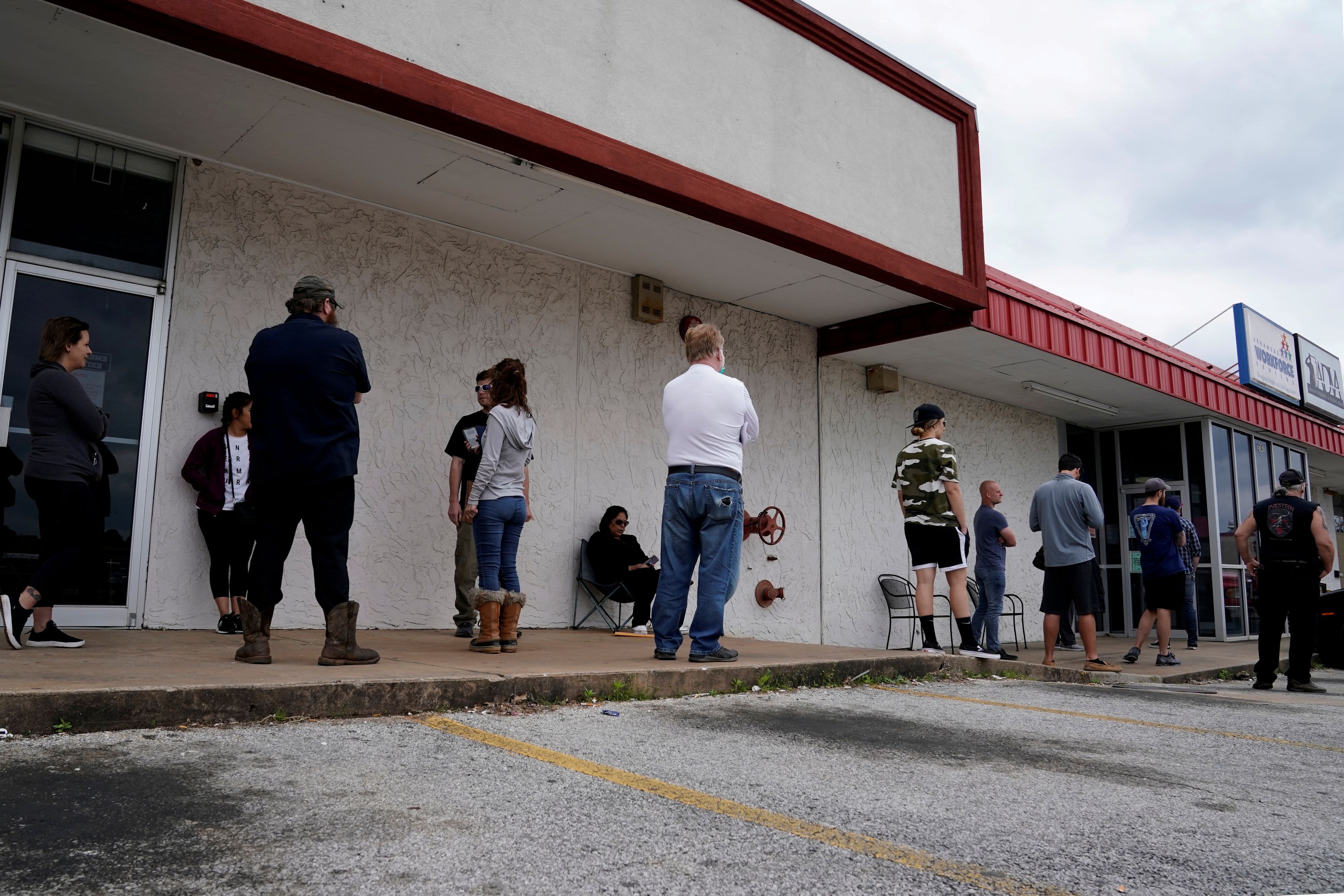
With unemployment at a staggering 14 percent, America’s economy looks as if it is in freefall. With COVID-19 forcing factories to shut down, small businesses to shutter and restaurants to close their doors, there is anxiety at every level of government about when the country’s economy will get back in motion. Economists surveyed by Dow Jones had been expecting payrolls to shed 21.5 million and the unemployment rate to go to 16%. April’s unemployment rate topped the post-war record 10.8% but was short of the Great Depression high estimated at 24.9%. The financial crisis peak was 10% in October 2009. The bleak numbers paint a “pretty dismal picture, but April may be it for job losses going forward with the country starting to reopen,” said Chris Rupkey, chief financial economist at MUFG Union Bank. “If there is a silver-lining in today’s dismal jobs report, it is in the realization that the economy cannot possibly get any worse than it is right now.” CNBC – May 08 Bleak indeed, but there are still many questions to be answered. How long will it take until people are back to work? What industries and businesses are impacted or lost forever? Is there a safe way to get back to work? Are there worries of inflation? And who is paying for all this stimulus funding and bailouts. If you are a journalist covering the economy, let one of our experts help. Jeff Haymond, Ph.D. is Dean, School of Business Administration and a Professor of Economics at Cedarville and is an expert in finance and trade. Dr. Haymond is available to speak with media regarding this topic – simply click on his icon to arrange an interview.


Unprecedented levels of partisanship vitriol threatens the health of democracy in U.S., globally
Voter-based political parties have played an integral role in American politics since their formation in the 1790s, yet it is difficult to remember any other time in history — other than perhaps the 1850s — when the level of divisiveness was this high and the polarity this profound between Republicans and Democrats. To add more fuel to the fire, the anti-democratic actions against the rule of law by President Donald Trump have become a primary threat to democracy in the U.S., said David Lynch, Ph.D., a professor of History and Social Sciences and Political Science program coordinator at Saint Mary’s University of Minnesota. The same action are also threatening how the government works and delegitimizing and undermining institutions that make and enforce laws,Lynch added. Those institutions include formal ones such as Congress and the political parties themselves, as well as less formal entities, such as the traditional news media. “You have to have free, fair, open media in order to have a democracy. If you do not have a free press, you do not have a democracy,” Dr. Lynch said. “And similarly, you need to have the rule of law where laws are carried out not for political ends, but based on the laws.” The recent impeachment proceedings were an attempt to curtail these actions, but the partisan response to the Senate’s impeachment trial allowed the violation of democratic norms to be rewarded, said Dr. Lynch. Furthermore, politicians who react strongly to anti-democratic actions threaten to further delegitimize the government, such as Trump’s refusal to shake the hand of House Speaker Nancy Pelosi, a Democrat, at his most recent State of the Union address and her subsequent action of tearing up his speech. “That helps both sides reinforce their own position that the other side is less legitimate and that we shouldn't cooperate with somebody like that,” Dr. Lynch said. Dr. Lynch pointed to how the indices that measure the health of democracy both in the U.S. and abroad have all gone down since Trump won the 2016 election. In addition, the most recent Economist Intelligence Unit’s Democracy Index reflected the worst registered global democracy score since its inception in 2006. In that report, the U.S. received a score of “flawed democracy.” Traditionally, the U.S. democratic system has been able to regulate such extreme partisanship before election day by not nominating candidates that violate democratic norms or are far from the ideological center. On election day, overly partisan candidates are vulnerable in swing districts and swing states. That ability for the public to express its collective voice, though, has eroded over the years as the number of swing districts has dwindled. "When people view through a partisan lens, it changes the incentives that elected officials have because they may be rewarded for partisan but anti-democratic actions,” Dr. Lynch said. “It also changes how average people view this whole debate.” To demonstrate the current political scene in the U.S., Dr. Lynch alluded to a 2017 study conducted by a group of political scientists at Yale University in which experimental surveys were sent to Venezuelans to see to what degree they would be willing to accept a less democratic candidate if he or she was a member of the political party they affiliated themselves with. The answer was quite a large degree. “The big message here is you can't necessarily rely on the public just to vote out an anti-democratic candidate because they might get a partisan advantage from that anti-democrat,” Dr. Lynch said. Are you a journalist covering this topic and interested in an interview? That’s where we can help. David Lynch, Ph.D., professor of History and Social Sciences and Political Science program coordinator, has taught political science at Saint Mary’s University of Minnesota since 1996. Dr. Lynch has also written over a dozen chapters on international relations, international political economy, and American foreign policy, including the chapter on trade in the United Nations Association of the USA’s “A Global Agenda” from 1996 to 2005. Dr. Lynch is an expert in political science, political economies, and international relations. He is available to speak with the media. To arrange an interview with him, simply click on his photo below to access his contact information.
