
Experts Matter. Find Yours.
Connect for media, speaking, professional opportunities & more.

Covering the Conclave? Our Expert Can Help.
The world is watching the Vatican as cardinals from across the globe gather for the papal conclave. The monumental event, which involves cardinals closing themselves off in the Sistine Chapel to elect a new pope, is steeped in history, mystery, and speculation. The new pontiff will be expected to make difficult decisions about the future direction of the Catholic church, which has almost 1.4 billion followers worldwide, and address the Vatican's strained finances and its sexual abuse scandals. If you're a reporter looking for an expert who can provide valuable insight, perspective and opinion on any angle of the events unfolding in Vatican City, consider reaching out to Jack Downey, the John Henry Newman Professor of Roman Catholic Studies at the University of Rochester. Downey and his scholarship have been featured in media outlets such as The Washington Post, National Public Radio, and Time Magazine. Simply click on his icon now to arrange an interview today.



President Trump Marks 100 Days in Office
Dr. Meena Bose, Hofstra University professor of political science, executive dean of the Public Policy and Public Service program, and director of the Kalikow Center for the Study of the American Presidency, was interviewed by multiple media outlets about President Donald Trump’s first 100 days in office. Dr. Bose spoke to CBS Radio; WNYW-TV Fox 5; and Newsday.


Hidden History of Bermuda is Reshaping the Way We Think About Colonial America
Early colonialism in the Americas tends to conjure images of Jamestown and Plymouth Colony. But long before settlers there acclimated to the New World’s growing conditions and overcame starvation conditions, an English settlement established in Bermuda in 1612 was wealthy and prosperous. University of Rochester historian and archaeologist Michael Jarvis has been uncovering the hidden history of Smith’s Island in Bermuda and its pivotal role in reshaping the understanding of colonial America. Nicknamed “Chainsaw Mike” by his students, he has spent 14 years excavating Smith’s Island and one of the first English settlements in the New World. Jarvis argues that Bermuda’s role in supplying Jamestown with food and influencing early colonists make it a cornerstone of America’s origin story rather than the historical footnote to which it has largely been relegated. His research on Smith’s Island was recently the cover story of Smithsonian magazine and was featured on the History Unplugged podcast. Jarvis is an expert on colonial America, the international and intercolonial networks of trade at the time, and settlement patterns in eastern North America, Bermuda, the Bahamas, and the communities surrounding European gold- and slave-trade forts in West Africa. He can be reached at 585-275-4558 and michael.jarvis@rochester.edu.

Education expert: Delaware needs to reform its education funding system
In the next year, residents of Delaware will have the opportunity to voice their opinions about school funding in support of the students and teachers in the state's public schools. School funding reform is urgently needed. Delaware has an unusually high number of students requiring additional resources to succeed — including students with disabilities, students living in poverty, and English learners. While Delaware spends more than the national average on public education, the funding is not sufficient to meet the needs of these students and their teachers. The evidence is clear. Compared to other states, Delaware ranks near the bottom in reading and math performance, according to the Nation’s Report Card (the National Assessment of Educational Progress). Reading and math scores have been declining for the past decade, with 8th grade reading reaching an all-time low in 2024. Delaware’s spending has not kept up with student needs, and the state struggles to compete with neighboring states for top teaching talent. Beginning teacher salaries are the lowest among nearby states, with even lower salaries in less wealthy communities. Unlike every other state, Delaware does not allocate more funds to districts with less property wealth, further deepening disparities. The stakes are high. Delaware’s students and teachers deserve strong support, and the state’s economy — including businesses, employers, and universities — depends on graduates who are well-prepared for careers and higher education. Delaware’s current school funding system, largely unchanged for 80 years, lags behind reforms enacted in other states. Many states have shifted funding to prioritize student needs and address inequities, resulting in measurable improvements in academic achievement, graduation rates, school climate, and college and career readiness. In the coming months, the Public Education Funding Commission will complete its review and present recommendations to update the funding system. When Governor Matt Meyer — a champion for Delaware’s public schools — sends his recommendations to the General Assembly for consideration, public understanding and engagement will be crucial. –––– Gary Henry is a professor at the University of Delaware and a commissioner on the Public Education Funding Commission. He specializes in education policy, educational evaluation, educator labor markets, and quantitative research methods. He is available for interviews on education funding, accountability and related policy changes, helping ensure Delawareans are fully informed as they prepare to voice their views on this important investment in the state’s future. He has advised various states on education funding including Virginia, North Carolina, Georgia and Texas.



Research Matters: Targeting ‘jumping genes’ holds promise for treating age-related diseases
A growing number of clinical trials gauging the effects of inhibiting transposons, so-called “jumping genes,” have yielded encouraging results for treating Alzheimer’s and a wide range of other conditions. Vera Gorbunova, a molecular biologist at the University of Rochester whose research on the causes of aging and cancer is widely regarded as pioneering, says researchers tackling aging “need something new, and inhibiting transposons shows great promise.” Gorbunova’s comments were recently featured in Science magazine, a leading news outlet for cutting-edge research in all areas of science. Researchers say clinical trials of transposon inhibitors are important not just to identify potential treatments, but also to test whether jumping genes do, in fact, drive human diseases, as many suspect. Transposon genes are found in a diverse variety of organisms, from miniscule bacteria to humans, and they are known in biological terms as “transposable elements” because they literally jump around the genome. Their vagrancy has been implicated in illnesses such as lupus, Parkinson’s disease, cancer, and aging. Gorbunova is a recognized expert in aging and cancer whose research has been featured in high-profile publications ranging from Nature to The New York Times. Reach out to Gorbunova by clicking on her profile.


Research Matters: Physics Magic with a Twist
University of Rochester scientists have discovered that twisting together two atom-thin flakes of molybdenum diselenide at high angles produces artificial atoms that can act as quantum information bits, or qubits. The discovery was made in the laboratory of Nickolas Vamivakas, the Marie C. Wilson and Joseph C. Wilson Professor of Optical Physics, who says he hopes the artificial atoms can be used like memory or nodes in a quantum network. “These could be the backbone for devices like the next generation of lasers or even tools to stimulate quantum physics,” Vamivakas says. The revelations built on experiments that found twisting a pair of one-atom-thick layers of graphene at the “magic” angle of 1.1 degrees created a superconductive material. Molybdenum diselenide, like graphene, is a 2D material. When monolayers of it are twisted at angles up to 40 degrees, they produce excitons, or artificial atoms, that retain information when activated by light. The discovery was recently published in Nano Letters. To learn more about Vamivakas’s research, read about it at the University of Rochester News Center and contact him at nick.vamivakas@rochester.edu.
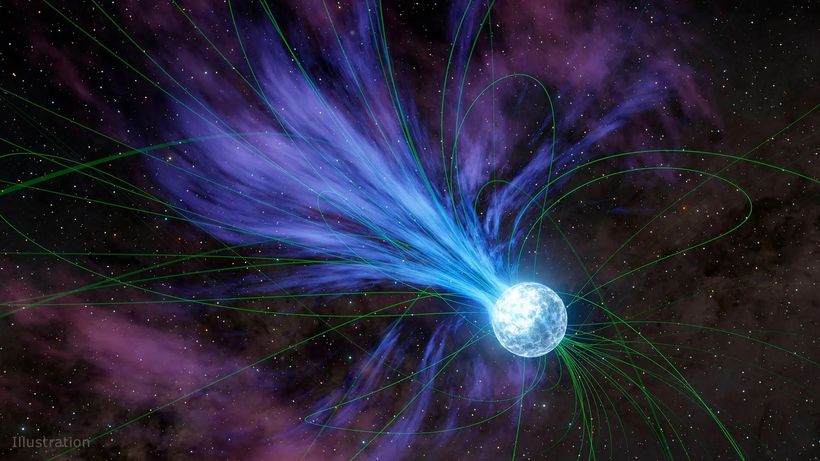
BATON ROUGE – Since the Big Bang, the early universe had hydrogen, helium, and a scant amount of lithium. Later, some heavier elements, including iron, were forged in stars. But one of the biggest mysteries in astrophysics is: How did the first elements heavier than iron, such as gold, get created and distributed throughout the universe? A new answer has come from an unexpected place – magnetars. Neutron stars are the collapsed cores of stars that have exploded. They are so dense that one teaspoon of neutron star material, on Earth, would weigh as much as a billion tons. A magnetar is a neutron star with an extremely powerful magnetic field. On rare occasions, magnetars release an enormous amount of high-energy radiation when they undergo “starquakes,” which, like earthquakes, fracture the neutron star’s crust. Starquakes may also be associated with powerful bursts of radiation called magnetar giant flares, which can even affect Earth’s atmosphere. Only three magnetar giant flares have been observed in the Milky Way and the nearby Large Magellanic Cloud, and seven from other nearby galaxies. Astrophysicist Eric Burns and his team of researchers at Louisiana State University in Baton Rouge study magnetars extensively through the observation of gamma-rays. These are the most energetic photons, most famous for turning Bruce Banner into the Incredible Hulk. Burns joined with researchers at Columbia University and other institutions to see if we could use gamma-rays to understand if magnetar giant flares forge the heaviest elements, and unexpectedly found the smoking-gun signature in decades-old data. The study, led by Anirudh Patel, a doctoral student at Columbia University in New York, is published in The Astrophysical Journal Letters. “It’s answering one of the questions of the century and solving a mystery using archival data that people had just forgotten about, demonstrating something that occurred when the Universe was younger,” said Burns. “Giant flares should occur just after the first stars died, meaning we have identified what could be the origin of the first gold in the universe.” How could gold be made at a magnetar? Patel and colleagues, including his advisor Brian Metzger, Professor at Columbia University and senior research scientist at the Flatiron Institute in New York, have been thinking about how radiation from giant flares could correspond to heavy elements forming there. This would happen through a “rapid process” of neutrons forging lighter atomic nuclei into heavier ones. Protons define the element’s identity on the periodic table: hydrogen has 1 proton, helium has 2, lithium has 3, and so on. Atoms also have neutrons which do not affect identity, but do add mass. Sometimes when an atom captures an extra neutron the atom becomes unstable and a nuclear decay process happens that converts a neutron into a proton, moving the atom forward on the periodic table. This is how, for example, a gold atom could take on an extra neutron and then transform into mercury. In the unique environment of a disrupted neutron star, in which the density of neutrons is extremely high, something even stranger happens: single atoms can rapidly capture so many neutrons that they undergo multiple decays, leading to the creation of a much heavier element like uranium. When astronomers observed the collision of two neutron stars in 2017 using NASA telescopes and the gravitational wave observatory LIGO, they confirmed that this event could have created gold, platinum, and other heavy elements. “LIGO tells us there was a merger of compact objects, and Fermi tells us there was a short gamma-ray burst. Together, we know that what we observed was the merging of two neutron stars, dramatically confirming the relationship,” said Burns. But neutron star mergers happen too late in the universe’s history to explain the earliest gold and other heavy elements. Finding secrets in old data At first, Metzger and colleagues thought that the easiest signature to study from the creation and distribution of heavy elements at a magnetar would appear in the visible and ultraviolet light, and published their predictions. But Burns in Louisiana wondered if there could be a gamma ray signal bright enough to be detected, too. He asked Metzger and Patel to work out what that signal could look like. Burns looked up the gamma ray data from the last giant flare that was observed, which was in December 2004. He realized that while scientists had explained the beginning of the outburst, they had also identified a smaller signal from the magnetar, in data from ESA (European Space Agency)’s INTEGRAL, a retired mission with NASA contributions. “It was noted at the time, but nobody had any conception of what it could be,” Burns said. Metzger remembers that Burns thought he and Patel were “pulling his leg” because the prediction from their team’s model so closely matched the mystery signal in the 2004 data. In other words, the gamma ray signal detected over 20 years ago corresponded to what thought it should look like when heavy elements are created and then distributed in a magnetar giant flare. "This is my favorite discovery I've contributed to,” said Burns. “My colleagues found this signal in the past, but nobody knew what it could be at the time. Once these models were ready, everything fit like a perfect puzzle, which is extremely rare in science." Researchers supported their conclusion using data from two NASA heliophysics missions: the retired RHESSI (Reuven Ramaty High Energy Solar Spectroscopic Imager) and the ongoing NASA Wind satellite, which had also observed the magnetar giant flare. Other collaborators on the new study included Jared Goldberg at the Flatiron Institute. Next steps in the magnetar gold rush Patel’s study estimates that magnetar giant flares could contribute about 10% of the total abundance of elements heavier than iron in the galaxy. Since magnetars existed relatively early in the history of the universe, the first gold could have been created this way. LSU PhD candidate Aaron Trigg, a NASA FINESST (Future Investigators in NASA Earth and Space Science and Technology) fellow, who works with Burns, is responsible for finding more magnetar giant flares to study. “These are gargantuan outbursts of energy from the strongest magnets in the Universe, which are powerful enough to affect Earth’s atmosphere,” said Burns. Trigg’s work will help us better understand these sources.” NASA’s forthcoming COSI (Compton Spectrometer and Imager) mission can follow up on these results. COSI, a wide-field gamma ray telescope, is expected to launch in 2027 and will study energetic phenomena in the cosmos, such as magnetar giant flares. COSI will be able to identify individual elements created in these events, providing a new advancement in understanding the origin of the elements. LSU is one of the lead science institutes for COSI. Burns and LSU Assistant Professor Michela Negro have key responsibilities in the mission, and Trigg is working through how best to study giant flares with COSI. These LSU astrophysicists will be growing their research group as they approach launch in 2027. “I have so many questions about the cosmos and our place in it,” said Trigg. “This research allows me to explore those questions and share the answers with the world.”



Should I use AI to write my college entrance essay?
With the rapid advancement of artificial intelligence tools such as generative pre-trained transformers, or GPTs, high school students may be tempted to use the tools to perfect their college applications, particularly their entrance essay. Robert Alexander, a vice provost and the dean of enrollment management at the University of Rochester, cautions prospective college students from relying too heavily on AI tools in their applications. “The sentiment among college admissions professionals is that while AI tools may be helpful in generating essay topics and refining or editing students’ writing, we discourage their use to compose application essays or short answers because AI stifles an applicant’s authentic voice,” Alexander says. That personal voice becomes paramount when admissions officers are sifting through applications and considering how each student will contribute to the campus community and fit into the incoming class. “No college or university is trying to admit perfectly identical automaton students,” Alexander says. “At the University of Rochester, for instance, we’re not looking for 1,300 perfect students. We’re trying to craft the perfect class of 1,300 very different and highly-imperfect, but great-fit students.” The goal, he says, is to invite great students, inclusive of their imperfections, and guide them on a transformative journey through their next four years. “Colleges want students to come in with a growth mindset and potential,” Alexander says. “So, if students think they can use AI to help make their application ‘perfect,’ I think they’re chasing the wrong brass ring.” Alexander is an expert in undergraduate admissions and enrollment management who speaks on the subjects to national audiences and whose work has been published in national publications. Click his profile to reach him.


James Sample Called Upon for Constitutional Law Expertise
Maurice A. Deane School of Law at Hofstra University Professor James Sample was called upon to provide his feedback and expertise in constitutional law for ABC News, CBS News, and MSNBC.


Pope Francis, leader of the Roman Catholic Church, dies at 88
The world woke up to breaking news that Pope Francis had died at the age of 88. Media across the globe are scrambling to discuss a wide variety of angles ranging from the history of the papacy, the purpose and process of the conclave and the future faced by the next pope leading the Catholic Church. Bruce Morrill, a Roman Catholic priest and fellow Jesuit, is available to share his unique perspective on topics, including Pope Francis' legacy, the significance of this loss and the likely direction of the Catholic Church moving forward. Dr. Bruce Morrill focuses his theological scholarship in the area of liturgy and sacraments, drawing upon a range of interdisciplinary resources in the fields of systematic and historical theology, ritual studies, cultural anthropology, and biblical studies. His other primary and strongly related interest is in political theologies, as they investigate the problems of suffering in social contexts. Pope Francis died at the age of 88. We look back at his life, time as pope, and his legacy with Bruce Morrill, Distinguished Professor of Theology at Vanderbilt University and holds the Edward A. Malloy Chair in Roman Catholic Studies and a Jesuit priest - WWL First News

