
Experts Matter. Find Yours.
Connect for media, speaking, professional opportunities & more.
UConn Expert, 10 Years after Sandy Hook, on the Lies that 'Plague the U.S.'
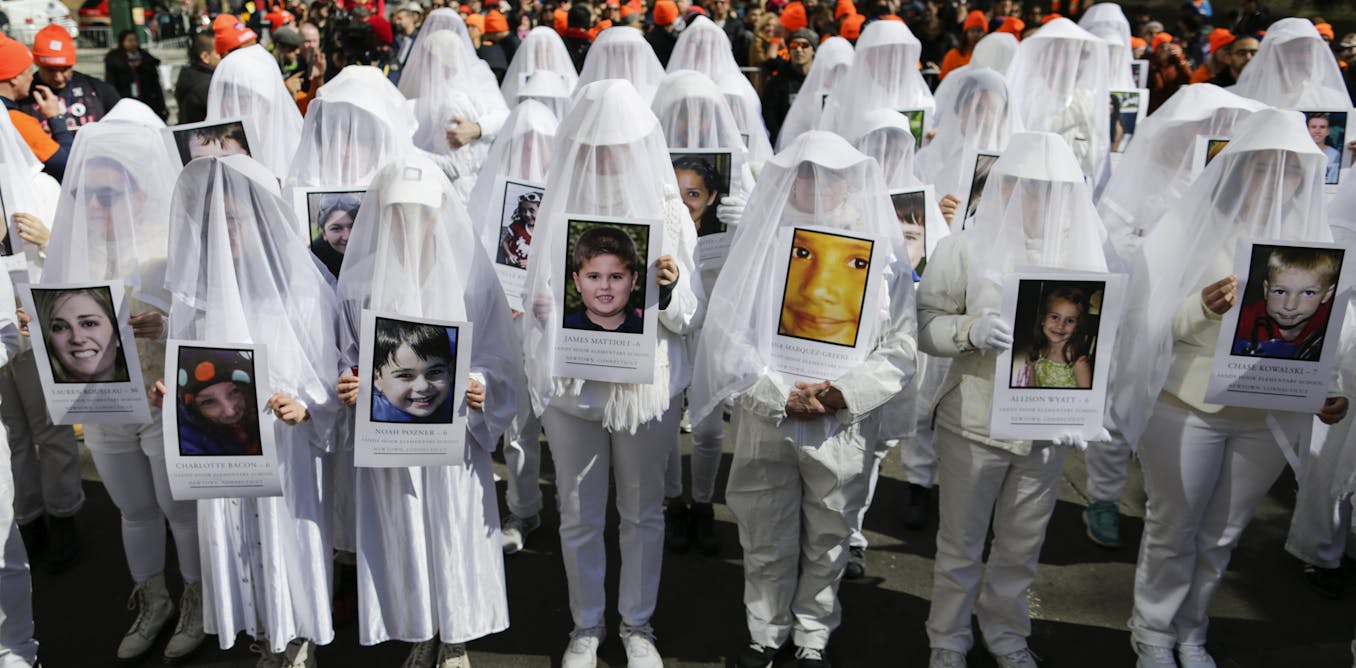
UConn professor and journalist Amanda J. Crawford considers the misinformation that spread like wildfire after tragic school shooting at Sandy Hook Elementary School to be "the first major conspiracy theory of the modern social media age." Ten years after 26 young students and school staff were killed in the massacre, the impact of that day in 2012 continues to reverberate in America today. On this solemn anniversary, Crawford writes about the aftermath of Sandy Hook misinformation in a new essay for The Conversation: Conspiracy theories are powerful forces in the U.S. They have damaged public health amid a global pandemic, shaken faith in the democratic process and helped spark a violent assault on the U.S. Capitol in January 2021. These conspiracy theories are part of a dangerous misinformation crisis that has been building for years in the U.S. While American politics has long had a paranoid streak, and belief in conspiracy theories is nothing new, outlandish conspiracy theories born on social media now regularly achieve mainstream acceptance and are echoed by people in power. Recently, one of the most popular American conspiracy theorists faced consequences in court for his part in spreading viral lies. Right-wing radio host Alex Jones and his company, Infowars, were ordered by juries in Connecticut and Texas to pay nearly $1.5 billion in damages to relatives of victims killed in a mass shooting at Sandy Hook Elementary School a decade ago. Jones had falsely claimed that the shooting was a hoax. As a journalism professor at the University of Connecticut, I have studied the misinformation that surrounded the mass shooting in Newtown, Connecticut, on Dec. 14, 2012 – including Jones’ role in spreading it to his audience of millions. I consider it the first major conspiracy theory of the modern social media age, and I believe we can trace our current predicament to the tragedy’s aftermath. Ten years ago, the Sandy Hook shooting demonstrated how fringe ideas could quickly become mainstream on social media and win support from various establishment figures – even when the conspiracy theory targeted grieving families of young students and school staff killed during the massacre. Those who claimed the tragedy was a hoax showed up in Newtown and harassed people connected to the shooting. This provided an early example of how misinformation spread on social media could cause real-world harm. Amanda J. Crawford is a veteran political reporter, literary journalist, and expert in journalism ethics, misinformation, conspiracy theories, and the First Amendment. Click on her icon now to arrange an interview with her today.


Students studying medicine, pharmacy, nursing, optometry and audiology to benefit from the investment in a new simulation facility over the next three years The Office for Students has granted Aston University £4.8 million to develop future healthcare professionals The investment in digital clinical equipment and health simulation facility will better prepare students for the future of work. Students in the College of Health and Life Sciences at Aston University are to benefit from a major £4.8 million investment in new facilities funded by the Office for Students to further expand and develop the University’s suite of state-of-the-art healthcare simulation and laboratory facilities. Students studying medicine, pharmacy, nursing, optometry and audiology will benefit from capital funding to support new equipment and facilities over the next three years. This latest funding follows on from an initial £1.5 million investment into healthcare simulation facilities on the University campus which were officially opened in December 2022 by Paulette Hamilton MP. The funds will be used to create and equip a simulated hospital ward facility and a simulated patient home environment for healthcare students. Nursing Studies is now recruiting for its first intake of students in September 2023. Pharmacy students will also gain a new wet lab and asepsis suite. The optometry simulation suite, unique in Europe, will be further enhanced with augmented reality simulation, allowing students to learn and refine their skills in a realistic instrument environment, with simulated patients with a wide range of eye conditions. Investment in other additional optometry equipment, including an additional optomap retinal screening device, will also allow the eye clinic to triage patients for the eye hospital, reducing patient waiting times, particularly in assessing conditions such as macular degeneration. Aston Medical School will be equipped with the creation of an immersive room and an anatomy and physiology teaching facility. Professor Liz Moores, Deputy Dean of the College of Health and Life Sciences, said: “The College of Health and Life Sciences is thrilled with this investment. The enhanced facilities will help to support many of our healthcare students, including those now applying for our new nursing degree. It will also support us with the introduction of the new pharmacy and optometry education standards, providing a step change in our ability to simulate a wide range of clinical scenarios.” Professor Aleks Subic, Vice-Chancellor at Aston University, said: “This strategic investment will ensure that our students are learning in the very best facilities with access to state-of-the-art digital technologies. The new facilities will enable us to prepare students fully for future careers that are strategically important to the healthcare sector and society. This is about bringing Industry 4.0 to healthcare.” Professor James Wolffsohn, Head of the School of Optometry and Audiology at Aston University, said: “With the huge hospital waiting lists, particularly post-COVID, with those in ophthalmology being the highest, it is essential that primary care can take more of the patient load to allow hospitals to focus on surgery and complex cases. This investment will allow us to better train our optometry and audiology students to be able to triage patients and to manage more conditions within community practice.” Jiteen Ahmed, Head of Technical Services in the College of Health and Life Sciences at Aston University, said: “It is fantastic to see such a large investment in our facilities to support many of our healthcare programmes. Technical staff at Aston University will be playing a key role in the design of the facilities, ensuring that we provide the most up to date and innovative technologies to meet the needs of the programmes. “I am very excited to see the involvement of technical staff as they will play a significant role in ensuring our students meet key learning outcomes in our facilities at the University.” For more information about studying in the College of Health and Life Sciences please visit our website.


Professor Corinne Spickett will explain how oxygen can cause damage to cells and lead to diseases Her inaugural lecture will take place on Thursday 26 January 2023 at 6.30 pm Members of the public may attend in person or online. A leading biochemist at Aston University is to give an inaugural lecture on the concept of oxidative stress and how failure to control it leads to diseases on Thursday 26 January 2023. During her public lecture, ‘Oxygen: can’t live without it, but stressful to live with it’, Professor Corinne Spickett will explain how oxygen can cause damage to cells, how damaged molecules such as “sticky lipids” can be measured using advanced technology, and what their biological effects are. Corinne moved to Aston University in 2011 from the University of Strathclyde. Her first degree was in biochemistry at Oxford University and she went on to gain a DPhil from Oxford on the application of NMR to study yeast bioenergetics in vivo. After postdoctoral work using NMR to investigate stress responses in plants and glutathione metabolism in pre-eclamptic toxaemia, she became a Glaxo-Jack research lecturer in the Department of Immunology at the University of Strathclyde and subsequently a senior lecturer in the Department of Biosciences. Since then, she has been working on the analysis of phospholipid oxidation by mass spectrometry and the biological effects of oxidized lipids, especially as relating to atherosclerosis and inflammation, and has published extensively in this field. She has also applied her expertise in analysis of phospholipids to lipidomic studies of LDL in chronic kidney disease and the study of changes in yeast membranes in biotechnology applications. More recently, she expanded her research to include analysis of protein oxidation and formation of lipoxidation products during inflammation. She is an internationally recognized researcher in the field of redox biology with extensive involvement in international research. Professor Spickett said: “We tend to take oxygen for granted as something essential for life, but actually it is highly reactive and its role in biochemistry poses a challenge for organisms from yeast to man. “Through a synopsis of my career, I will explain how oxygen can cause damage to cells and, in parallel, I will illustrate how academic research careers are often non-linear and often depend on serendipity.” The lecture will take place at Aston University at 6.00 pm for 6.30 pm on Thursday 26 January 2023. It will be followed by a wine reception from 7.30 pm to 8.00 pm. It is open to the public and free to attend, but places must be booked in advance via Eventbrite.

Social media engagement style may be linked with perceived social connectedness – new research
A novel experimental task measuring behaviour on a social networking site identifies key differences between passive, reactive and interactive usage 526 users were observed on the mock platform to monitor usage according to frequency of likes, shares, and scrolling More interactive users reported greater social connectedness and social capital Researchers at Aston University have developed a new experimental task, involving a mock social networking site, which grouped people into three distinct styles of social media use—passive, reactive and interactive. Led by Dr Daniel Shaw and Dr Charlotte Pennington in the School of Psychology, at Aston University, the new findings also suggest that interactive users reported greater feelings of social connectedness than passive or reactive users. Despite the wealth of research into the psychological impact of social networking site (SNS) usage, inconsistent findings have prevented any firm conclusions from being drawn. While some studies have concluded that social media usage was associated with increased social connectedness and reduced loneliness, others reported detriments to loneliness and wellbeing with greater use of such platforms. In their new work, published in the journal PLOS ONE, the researchers administered the Social Networking SiteBehavior Task (SNSBT) online to 526 individuals, who also completed questionnaires on their levels of loneliness, sense of belonging, social connectedness, online social capital and answered questions about their Facebook usage and friendship network. The SNSBT grouped users into three discrete groups depending on how often they clicked “Next,” “Like,” or “Share” on 90 images presented to them on the mock SNS. On average, passive users, about 39% of those in the study, clicked “Next” most often (on 85% of images). Reactive users, 35.4% of the study, most often clicked either “Next” (59% of the time) or “Like” (36% of the time). Interactive users, 25.7% of participants, mostly clicked “Like” (51% of the time) or “Share” (20% of the time). Analysis of the data revealed that interactive users had, on average, more Facebook friends, spent more time on Facebook, and reported greater feelings of social connectedness and social capital than passive or reactive SNS users. However, this study could not determine if any causal or directional link between these factors exists. The researchers are planning to carry outfurther work in this area. The authors concluded that the simple SNSBT tool they developed, now publicly available, could help researchers quantitatively differentiate between different SNS usage styles and overcome the limitations of self-report data, enhancing future research in the field of cyberpsychology. Dr Daniel Shaw said: “This study introduces a new tool with which researchers can measure different styles of engagement on social networking platforms and indicates that our style of engagement can be more important for our psychological wellbeing than the amount of time we spend on social media.” Dr Charlotte Pennington added: “Individuals displaying more interactive styles of usage on our platform reported stronger feelings of social connectedness and social capital compared with those who showed more reactive or passive behaviour. Our team has developed the first mock social networking site that can be used to measure natural styles of usage, free from the ethical concerns that arise when people log into their own phones.”

Brexit changes caused 22.9% slump in UK-EU exports into Q1 2022 - research
Researchers at Aston assessed the impact of the Trade and Cooperation Agreement between the EU and the UK UK exports fell by an average of 22.9% in the first 15 months following the deal Variety of UK products exported to EU down by 42% Research by the Centre for Business Prosperity at Aston University has shown that UK exports to the EU fell by an average of 22.9% in the first 15 months after the introduction of the EU-UK Trade and Cooperation Agreement, highlighting the continuing challenges that UK firms are facing. Building on earlier work funded through Aston University’s Enterprise Research Centre, the researchers found that a negative effect on UK exports persisted and deepened from January 2021-March 2022. According to the research, the UK has also experienced a significant contraction in the variety of goods being exported to the EU, with an estimated loss of 42% of product varieties. The researchers say this, combined with an increased concentration of export values to fewer products, has serious implications for the UK’s future exporting and productivity. The authors are calling for an urgent national debate from politicians about the UK’s post-Brexit trade arrangements. The researchers assessed the impact of the TCA, which allows goods to continue to be bought and sold between the UK and EU without tariffs in the wake of Brexit, by creating an ‘alternative UK economy’ model, based on the case that the UK had remained within the European Union. By comparing the model UK’s exports and imports with actual figures for the UK, they could accurately isolate the impact which the new trade rules were having. “What we are seeing is the effect of Brexit on exports; and that is persisting. It’s not diminishing, and exports have yet to show signs of recovering,” says Professor Jun Du of Aston University. “Until this serious problem with exports is openly acknowledged and discussed, we won’t see any necessary actions being taken.” Unlike exports, an initially significant drop on EU imports to Britain has recovered during the same period, suggesting that UK businesses and consumers have quickly adjusted to new rules. This stands in contrast to the persistent decline in UK exports, which the researchers believe is caused by more fundamental factors. Professor Du said: “It seems that the UK can buy, but it can’t sell – and that’s reinforcing the problem of Brexit. A reduction in import bottlenecks might help exports to rebound, but this recovery is likely to be offset by the rising costs of imports.” Researchers found that as many as 42% of the product varieties previously exported to the EU have disappeared during the 15 months after January 2021. This, they say, is principally caused by a large number of exporters simply ceasing to export to the EU, while the remaining exporters are streamlining their product ranges. Co-author, Dr Oleksandr Shepotylo, says: “The product varieties that have disappeared are mostly those with low export value – we know this because the average export value increased as the number of varieties declined. These products are the ones typically exported by small firms or new exporters, or are exported to new markets. And It’s those smaller businesses that would normally export much more in future, as they grow their volumes and products – so that’s the UK’s future export pipeline being affected, which has bleak implications.” Professor Du says: “The evidence we present here shows the real loss of Brexit, the overall competitiveness of the UK as a global trader. The considerable contraction of the UK trade capacity, combined with an increased concentration of export values to fewer products, signify some serious long-term concerns about the UK’s future exporting and productivity. Debate is essential so that the UK can start to address its current challenges. Of course, no one is suggesting going back into the EU, but there are collaborations, conversations and discussions that must be had. If the UK’s political leaders don’t acknowledge the facts, they are setting the course towards even longer-term problems.”


Aston Institute for Forensic Linguistics (AIFL) is part of the project to infer authorship of uncredited documents based on writing style AIFL’s Professor Tim Grant and Dr Krzysztof Kredens are experts in authorship analysis Applications may include identifying counterintelligence risks, combating misinformation online, fighting human trafficking and even deciphering authorship of ancient religious texts. Aston University’s Institute for Forensic Linguistics (AIFL) is part of the AUTHOR research consortium which has won an $11.3 million contract to infer authorship of uncredited documents based on the writing style. The acronym stands for ‘Attribution, and Undermining the Attribution, of Text while providing Human-Oriented Rationales’. Worth $1.3 million, the Aston University part of the project is being led by Professor Tim Grant and Dr Krzysztof Kredens, who both are recognised internationally as experts in authorship analysis and who both engage in forensic linguistic casework as expert witnesses. In addition to their recognised general expertise and experience in this area, Professor Grant has specific expertise in using linguistic analysis to enhance online undercover policing and Dr Kredens has led projects to develop authorship identification techniques involving very large numbers of potential authors. The AUTHOR team is led by Charles River Analytics and is one of six teams of researchers that won The Human Interpretable Attribution of Text Using Underlying Structure (HIATUS) programme sponsored by the Intelligence Advanced Research Projects Activity (IARPA). The programme uses natural language processing techniques and machine learning to create stylistic fingerprints that capture the writing style of specific authors. On the flip side is authorship privacy - mechanisms that can anonymize identities of authors, especially when their lives are in danger. Pitting the attribution and privacy teams against each other will hopefully motivate each, says Dr Terry Patten, principal scientist at Charles River Analytics and principal investigator of the AUTHOR consortium. “One of the big challenges for the programme and for authorship attribution in general is that the document you’re looking at may not be in the same genre or on the same topic as the sample documents you have for a particular author,” Patten says. The same applies to languages: We might have example articles for an author in English but need to match the style even if the document at hand is in French. Authorship privacy too has its challenges: users must obfuscate the style without changing the meaning, which can be difficult to execute.” In the area of authorship attribution, the research and casework experience from Aston University will assist the team in identifying and using a broad spectrum of authorship markers. Authorship attribution research has more typically looked for words and their frequencies as identifying characteristics. However, Professor Grant’s previous work on online undercover policing has shown that higher-level discourse features - how authors structure their interactions - can be important ‘tells’ in authorship analysis. The growth of natural language processing (NLP) and one of its underlying techniques, machine learning, is motivating researchers to harness these new technologies in solving the classic problem of authorship attribution. The challenge, Patten says, is that while machine learning is very effective at authorship attribution, “deep learning systems that use neural networks can’t explain why they arrived at the answers they did.” Evidence in criminal trials can’t afford to hinge on such black-box systems. It’s why the core condition of AUTHOR is that it be “human-interpretable.” Dr Kredens has developed research and insights where explanations can be drawn out of black box authorship attribution systems, so that the findings of such systems can be integrated into linguistic theory as to who we are as linguistic individuals. Initially, the project is expected to focus on feature discovery: beyond words, what features can we discover to increase the accuracy of authorship attribution? The project has a range of promising applications – identifying counterintelligence risks, combating misinformation online, fighting human trafficking, and even figuring out the authorship of ancient religious texts. Professor Grant said: “We were really excited to be part of this project both as an opportunity to develop new findings and techniques in one of our core research areas, and also because it provides further recognition of AIFL’s international reputation in the field. Dr Kredens added: “This is a great opportunity to take our cutting-edge research in this area to a new level”. Professor Simon Green, Pro-Vice-Chancellor for Research, commented: “I am delighted that the international consortium bid involving AIFL has been successful. As one of Aston University’s four research institutes, AIFL is a genuine world-leader in its field, and this award demonstrates its reputation globally. This project is a prime example of our capacities and expertise in the area of technology, and we are proud to be a partner.” Patten is excited about the promise of AUTHOR as it is poised to make fundamental contributions to the field of NLP. “It’s really forcing us to address an issue that’s been central to natural language processing,” Patten says. “In NLP and artificial intelligence in general, we need to find a way to build hybrid systems that can incorporate both deep learning and human-interpretable representations. The field needs to find ways to make neural networks and linguistic representations work together.” “We need to get the best of both worlds,” Patten says. The team includes some of the world’s foremost researchers in authorship analysis, computational linguistics, and machine learning from Illinois Institute of Technology, Aston Institute for Forensic Linguistics, Rensselaer Polytechnic Institute, and Howard Brain Sciences Foundation.

Podcast: UK’s first non-white prime minister is ‘big moment’ – but can Rishi Sunak survive?
Academic focuses on importance of UK having its first prime minister of Indian descent Rishi Sunak’s personal family history could be seen as a testament to the ‘British dream’, as he is also ‘richest man’ ever to sit in the House of Commons But his ability at restoring economic stability and tackling cost-of-living crisis will decide his fate at the polls Having the first non-white leader of the UK is undoubtedly a “big moment” in the history of British politics, according to an academic at Aston University. But, although he may be able to count on the British Asian vote at the next general election, Rishi Sunak faces a major challenge to remain in No 10 due, in part, to the growing number of Conservative MPs intending to stand down. Mr Sunak’s rise to become Britain’s first Asian and first Hindu leader has been discussed by Dr Parveen Akhtar, a senior lecturer and deputy head of politics, history and international relations at Aston University. Dr Akhtar, who has studied across Europe and authored a book on British Muslim politics, was speaking as part of the latest episode in the 'Society matters' podcast series, presented by journalist Steve Dyson. She said Rishi Sunak benefitted from a “privileged upbringing”, but also married into wealth in the form of the daughter of Indian billionaire N R Narayana Murthy, co-founder of information technology company Infosys. With the couple having a combined wealth of £730 million, Parveen said Rishi Sunak can “allegedly lay claim to another title – the richest man to ever sit in the House of Commons”. A “scandal” over his wife’s non-domiciled tax status had even threatened to end Sunak’s career less than a year ago. But she added: “Whatever the mixed feelings are around his personal fortune, this is nevertheless a big moment. Becoming the first non-white leader of the UK is important. It’s important for the country and it’s important for the UK’s ethic minority communities too.” Dr Akhtar, who is currently writing a new book on the politics of Pakistan and Pakistanis abroad, said Rishi Sunak’s paternal grandparents were from Gujranwala, which is in present-day Pakistan. Sunak, himself, was born in Southampton, but his father Yashvir, a family doctor, and mother, Usha, a pharmacist who studied at Aston University, were born and brought up in present-day Kenya and Tanzania respectively.However, they joined an exodus of Asians from East Africa in the second half of the last century, fuelled by Idi Amin’s wholesale expulsion of Asians from Uganda in 1972. Sunak’s “cultural affinity” lies with his Indian roots, Dr Akhtar said, including being a practising Hindu, and he himself had said that ‘British Indian’ is what he ticks on the census. She added: “The Sunaks’ personal family history could be read as a testament to the British dream: the idea that the UK is a land of opportunity where, no matter who you are, if you work hard, you can make it right to the top. The formula for success is simple: head down, hard work perseverance.” While Sunak was privately educated at Winchester, and went on to study at both Oxford University in England and Stanford University in the US, he has spoken about various jobs, including being a waiter in an Indian restaurant. Dr Akhtar said that, in some ways, the Conservative Party has a “lot to be proud of” when it comes to promoting ethnic minority colleagues, as reflected by three key posts in Liz Truss’s short-lived administration, and Suella Braverman as the current Home Secretary. Sunak’s own heritage could prove to be an asset in strengthening ties and negotiating trade deals with other countries, with India’s Prime Minister referring to him as the ‘living bridge’ of UK Indians, and US President Joe Biden describing his success as a ‘ground-breaking milestone’. But can an unelected Sunak win the next election amidst soaring inflation and the cost-of-living crisis? Dr Akhtar replied: “These are challenging times to be at the helm of the ship, a ship which many in his party appear to be jumping off, given the number of Conservative MPs who have announced their intention not to stand at the next general election. “If, in the coming months, people feel further fiscal pain, if there are prolonged strikes by teachers and nurses, firefighters and railway workers, if the NHS is overwhelmed this winter, then no matter how slick Sunak’s PR messaging, he will not be elected come election time.”

Aston University partners with paediatric pharmaceutical company to facilitate student research
• Aston University MSc Pharmaceutical Sciences, Drug Delivery and MPharm students work with industry professionals on research projects • Proveca pharmaceutical specialises in the development and licensing of medicines for children • Students will attend workshops led by Proveca and receive coaching on their research proposals. Aston University has partnered with pharmaceutical company Proveca to help support and facilitate final research projects being undertaken by its MSc Pharmaceutical Sciences, Drug Delivery and MPharm students. The partnership between the College of Health and Life Sciences at Aston University and Proveca began with a contract research project during which Professor Afzal Mohammed worked with Proveca to explore the development of drug formulation. Proveca is a pharmaceutical company specialising in the development and licensing of medicines for children. The company has now come on board to support and supervise at least five final year research projects and will help steer the students in the next steps in their lab research. The company will also support a wider number of students by running workshops, educating them on the current challenges of drug formulation development and providing coaching on how to write a research proposal. Professor Afzal Mohammed, associate head of pharmacy at Aston University, said: “This is a fantastic opportunity to enhance the student experience and build on our excellent industry focused teaching and research”. The projects are due to start in January 2023 and Proveca has agreed to sponsor the final project prize open to all of our MSc Pharmaceutical Sciences, Drug Delivery and final year MPharm students. Dr Simon Bryson, CEO and founder of Proveca Ltd, said: “We are delighted to be building on our relationship with Aston University, having collaborated over several years on a range of successful projects including PhD sponsorship and supervision, visiting lecturing and MPharm research awards. “The partnership brings together the academic excellence of Aston University with the paediatric pharmaceutical expertise of Proveca which will ultimately drive innovation in paediatric medicines to improve child health.” For more information about the School of Pharmacy at Aston University please visit our website.


Interested in the true pursuit of greatness? Take a look at what Florida Tech has to offer
If you are up for the challenge and want to begin your own relentless pursuit of greatness, let us help. The Florida Tech campus is located in the heart of Florida’s Space Coast. That means proximity to key agencies and operations, such as NASA-Kennedy Space Center, SpaceX, Embraer, L3Harris Corporation, Northrop Grumman and more. Oh, and did we mention there are miles and miles of Atlantic Ocean beaches just moments away? Learn more about all Florida Tech has to offer. Get in touch today! Simply contact: Adam Lowenstein Director of Media Communications (321) 674-8964 adam@fit.edu


Expert Opinion: Real Fur? It’s Just Not in Vogue Anymore!
Back in 1994, animal rights organization PETA launched what would become one of the most iconic campaigns of the decade – and beyond. “I’d rather go naked than wear fur,” sparked a slew of headlines internationally and won support from celebrities such as Naomi Campbell, Gillian Anderson, Pamela Anderson, and others; many of whom agreed to pose nude or semi-naked in support of the anti-fur movement. Three decades on, in February 2020, PETA announced it was retiring the campaign, saying it was “no longer necessary” and citing the “demise of the trade.” Evidence suggests they are right. Since the early noughties, the use of fur among the world’s foremost luxury fashion houses has steadily declined. The production of mink and other pelts–an industry valued at $1.8 billion in the late 80s–has declined in America by around 45 percent in the last 20 years, according to the Department of Agriculture. Meanwhile, high-end fashion brands like Gucci, Vivienne Westwood, and Stella McCartney have pledged to go fur-free, with Fendi, Saint Laurent, and others set to follow suit in 2022. Fur has never been less fashionable. But can activism alone claim victory in the fight for more ethical fashion practices? Emory’s Giacomo Negro, professor of Organization & Management and professor of sociology (by courtesy), has released new research that suggests another major factor played a key role in the process that led to the abandonment of fur; and it’s none other than perennial style bible, Vogue. When Vogue Speaks, People Listen We know that the use of fur has been dropping off steadily on the supply side, on the part of producers and manufacturers themselves, in the last two decades. What we didn’t know was how much of this was down to pressure from PETA and other highly-visible activism. Or whether there might be other forces at play–industry intermediaries that have a gatekeeping function, such as the fashion press, exerting a more subtle but just as powerful influence on the producers of fur. - Giacomo Negro, professor of Organization & Management Hypothesizing this to be the case, Negro teamed up with INSEAD’s Frederic Godart and Greta Hsu of the University of California. First off, they had to determine the most important and global of fashion’s gatekeepers. “There are other publications, but Vogue is undoubtedly a significant force in fashion. The magazine has long occupied a unique position that is neither an insider nor an outsider in the sense that its editors are intimately connected to the top designers and decision-makers in the industry; simultaneously, it’s an external, independent publication with global reach and singularly powerful influence on fashion’s views and tastes.” If Vogue were to take a certain view of the use of fur in clothing over time, would fashion houses take note and follow suit, the researchers wondered? To test this, Negro et al put together a largescale dataset integrating data from more than 18 years of Vogue’s runway reports: features covering fashion shows in Paris, Milan, London, and New York between Spring 2000 and Fall 2018. The set included 670 fashion houses hosting at least two runway shows in this period, focusing on women’s prêt-à-porter designs. Next, the researchers ran an analysis across the texts published by Vogue after each show. They coded words relating to the moral and ethical dimensions of fur use. “When Vogue publishes a report, you don’t just get a review of the collections,” says Negro. “You also get the magazine’s opinion and appraisal of the clothing.” Fur Ethics and the Decline of a Centuries-Old Industry Parsing the attention to fur ethics expressed in these reports and looking at the frequency of the appearance of fur on runways over time, he and his colleagues found something striking: a clear, quantitative correlation between the magazine’s coverage of fur ethics and a drop off in its use by fashion houses, starting in 2011. “From around 2009, Vogue starts referencing the ethical and social concerns around fur and this continues through to 2014. In 2011, you begin to see a steady decline that follows in the use and appearance of fur on catwalks in the major fashion capitals of the world.” But could this simply be credited to an increase in activism at the same time? Unlikely, says Negro. He and his colleagues also looked at data on media coverage of anti-fur events in France, Italy, the United Kingdom, and the U.S. and failed to establish any meaningful correlation with Vogue’s editorial position over the same period. “What seems most plausible is that as an influential industry gatekeeper, Vogue was driving a change in views on fur ethics and fur use, alongside its own changing position on the ethics of fur,” says Negro. And it’s interesting to remember that fashion, like other creative industries, tends to operate in accordance with its own set of rules and its ‘artistic freedom.’ When activists targeted Jean Paul Gaultier’s Fall Show of 2009, he simply announced that he loved fur and would continue using it. However, when Vogue starts weighing in with an opinion, that’s when designers start following suit. - Giacomo Negro, professor of Organization & Management Which isn’t to say that activism did not have a critical role, he adds. In leading and reshaping the conversation around fur over the last three decades, PETA and others have brought the key issues to the attention of the world’s media like no other, says Godart: “Our findings also suggest that specific forms of anti-fur activism such as advertising campaigns, and legal maneuvers, became effective in influencing fashion houses’ decisions to move away from fur when amplified by Vogue’s references to moral concerns around fur use.” For any business or industry looking to navigate changing perceptions, tastes, or sentiments, gatekeeper entities–intermediaries like experts, media publications, and others–can provide useful signals that can help strategic decision-making, say Negro, Godart, and Hsu. Though in the age of social media, it may become that much more difficult to distinguish signals from noise. Proactive organizations might do well to identify and engage with social movements and gatekeepers ahead of change, they say, rather than bide their time until pressure forces their hand. Interested in learning more? Then let us help with your questions or coverage. Giacomo Negro is a professor of Organization & Management and Professor of Sociology at the Goizueta Business School at Emory University. Simply click on his icon now to connect and arrange an interview.

