
Experts Matter. Find Yours.
Connect for media, speaking, professional opportunities & more.

Just how big of a deal is AI? At this year’s Directions 2019, IDC Canada experts will be speaking to a variety of topics that are reshaping the digital visions and tactics modern companies are using to compete. Explore how AI encompasses a huge spectrum of technologies for the enterprise and how at the center of it all is data. On May 02, join Warren Shiau, Research Vice-President with IDC Canada as he presents a highly anticipated talk on AI: Process Animation at 11:20 AM. Warren will look at what’s being adopted by Canadian enterprise under the banner of AI; and why AI can generate significant business value even in the absence of large data science teams and enterprise-wide high-quality data. Deep learning may rule the future but “small AI” targeting things like process automation rules the day. Organizations are rethinking digital transformation – join us May 02 to learn more. Location: St. James Cathedral Centre: Snell Hall, 65 Church Street | Toronto Date: May 2, 2019 Time: 8:00 AM - 8:30 AM - Registration & Networking Breakfast | 8:30 AM - 3:30 PM Conference Program Register Today before it's too late! If you're a member of the media and would like to attend this event, please contact Cristina Santander at csantander@idc.com

Is it Time to Rethink Digital Transformation? Join our experts May 02 to Find Out!
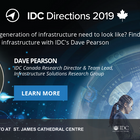
Organizations are rethinking digital transformation. After some high-profile failures, innovation being treated as a sideshow, and elusive ROIs, organizations are reshaping their digital visions and their tactics for getting there. With greater clarity about what the future enterprise will look like and what it will take to compete in redefined industries, companies are pivoting away from digital for the sake of innovation to digital for the sake of the business. Join us and catch Dave Pearson, Research Director and Team Lead for IDC Canada's Infrastructure Solutions Research Group presenting: ‘The New Infrastructure Data World ’ at IDC Directions 2019 in Toronto on May 02. Data growth and capacity concerns continue to the be the number one stress on data centers in Canada. At the same time, IT is expected to support Digital Transformation (DX) and new business initiatives at nearline speed. What will your next generation of infrastructure need to look like to support the variety of workloads, applications, and data sources your organization requires, from core to cloud to edge? Find out in Dave's breakout session at IDC Directions in Toronto Location St. James Cathedral Centre: Snell Hall 65 Church Street | Toronto Date May 2, 2019 Time 8:00 AM - 8:30 AM - Registration & Networking Breakfast 8:30 AM - 3:30 PM Conference Program Register Today before it's too late! If you're a member of the media and would like to attend this event, please contact Cristina Santander at csantander@idc.com

Will Apple shine or is a little too late to be dipping its toe into the streaming game?
It was the big unveil a lot of tech insiders, analysts and Apple followers had been anticipating. With Oprah, Steven Spielberg and other members of the entertainment elite on-hand to lend a hand – Apple TV Plus was finally revealed. The service, coming this fall, will be subscription based and will bring exclusive original shows, movies, and documentaries to rival the likes of Amazon, Netflix and Crave. While it is unlikely Canada will see the inclusion of "Apple TV Channels" in all its US-like glory, it is certain that Apple's arrival to the streaming space would further put the squeeze on traditional TV service providers. With yet another premium content streaming service to choose and a finite budget, consumers will have to start making tougher choices between letting go of something or shaving off cost somewhere – unfortunately, the traditional TV cord may be the first in consideration. Here are the questions some insiders are pondering: Will a loyal customer base and strong partner relationships prove advantageous in luring content creators and viewership alike as Apple TV Plus breaks through the boundaries of Apple hardware? Where does the real opportunity lie for companies like Apple? How will they fare as consumers are challenged to make tougher decisions on who gets a share of their wallet? Will it be traditional TV or OTT Video service that gets the boot? According to Manish Nargas "Currently, consumer intent to continue to subscribe to TV services remains relatively stable year over year in Canada and consumers are happy to complement TV with other OTT video services". IDC's latest survey, Canadian Consumer Survey Indicators, 2019: Wireless, Internet, TV, and OTT Video Services shows that "those who do plan to reduce or stop their TV service, do so in order to save money, not on account of dissatisfaction in quality of service." There are a lot of questions to be answered between now and when Apple TV Plus launches and that’s where our experts can help. Manish Nargas is a research analyst specializing in consumer and mobile research. He is an expert in emerging consumer technologies with a focus on usage trends and adoption. Simply click on Manish’s icon to learn more about this survey or to arrange an interview.

Extremism on the rise – Let our experts tell you just how concerned you need to be
Incidents across America and the planet are happening regularly. Protests are turning ugly with damage, violence and even death. Shootings and attacks on mosques, churches and public institutions are now happening at such a pace that the public is barely only one tragedy and another one strikes. Extremism is on the rise. The calls for thoughts and prayers are now common. The world, it seems, is fraying. What can be done about the rise of extremism? Is extremism being driven by economic, political or other factors? What role is social media and the Internet playing in fanning the flames of hatred and extremism? What can be done to police, prevent and ideally extinguish extremism? To begin with – we probably need to understand what’s actually going on and what’s the root of the issue? And that’s where the experts from Cedarville University can help. Dr. Glen Deurr's research interests include nationalism and secessionism, comparative politics, and international relations theory. Glen is available to speak to media regarding the rise of extremism – simply click on his icon to arrange an interview.



Goizueta information systems and operations management professor Benn Konsynski on the 30th birthday of WWW: "... Many of us were on the internet before WWW -- researchers, academic, military, libraries, etc. The operating protocols on top of the basic Internet protocols were useful, but often specialized. The world of commerce and social interchange needed a simple standard to offer creative outlet beyond specific applications and closed systems. "Sir Tim Berners-Lee brought that with common protocols for describing content (HTML), moving/referencing content (HTTP) and browser technologies for viewing and manipulating content. Over the next few years, commerce and social exchange exploded after these protocols took root. By 1995 the internet world opened to business and the general market with expectations and promise."



Is there a storm coming in the South China Sea?
There’s trouble brewing in the South China Sea and there doesn’t seem to be a any way to calm the waters. Taiwan, the small island country that has been persistently seeking independence is pushing toward that goal at a fevered pace. Meanwhile China disagrees, wants Taiwan back in the fold and has stated that the country is seeking one unified China - and soon. At a recent speech, Chinese President Xi threatening to use force to bring Taiwan under its control, though said China would strive to achieve this peacefully. And with a military budget this year of 177 billion dollars (US), China will be able to dictate its definition of the term ‘peacefully’ to suit any of its likely goals. So, what’s next? Can international intervention or pressure call China off its mission to absorb Taiwan? Can China be stopped? Does Taiwan have the political capital at the UN to find actual support or protection and from who? And what would the consequences be in China took Taiwan with force? There are a lot of questions to be asked and that’s where we can help. Professor Elizabeth Larus was recently featured on CNBC Asia and updated their audience on the most recent developments and outlined what seems to be China’s next steps. Professor Larus teaches political science at the University of Mary Washington and is an #expert on China and the field of Asian studies. She is available to speak to other media pursuing this this subject – simply click on her icon to arrange an interview.


This Valentine’s Day, give the gift of great conversation
When is the last time you and your partner made time to talk? Or, more important, made time to really listen to one another. The newness of getting to know our partner – that interest we had in the beginning of a relationship – begins to take a back seat to the everyday busyness of life. And while the days, months and years pass by, it is easy to assume that the one we love is essentially the same person with the same needs, interests, values and goals. "People think that ‘change is the only constant’ doesn’t apply to our relationships. We forget that we are always growing and learning new things about ourselves and so is our partner,” says Wake Forest University communication professor Jennifer Priem. “As we and our partners grow, we need to learn how to best make adjustments in our relationship so that our relationships grow with us. That happens when we listen.” Priem studies relationships and conducts research that explores the connection between supportive conversations and physiological signs of stress reduction. She recently launched a blog on Psychology Today, Stressing Communication, and is sharing a series of posts called, “Conversations That Will Save Your Relationship.” Priem offers these tips to help set the stage for meaningful conversation. Ask your partner if it’s a good time talk. “After work or when your partner is tired is usually not the best time to talk,” says Priem. “If your partner says ‘no’ it doesn’t mean forever. Rather than force a conversation because you’re ready, wait for a time that will be good for you both to engage.” When it is time to talk, listen first. Be a supportive listener. Don’t allow yourself to be distracted by your cell phone, other things happening around the conversation, or tangential thoughts that pop into your mind. Listen to understand, rather than to respond. Try not to interrupt your partner. Wait to respond until your partner has completed his or her thought. It may be that by waiting to respond, you will learn something new that will change how you respond. Conversations don’t require “work,” says Priem, but they do require that we recognize how we maintain our relationships, assess if it is in line with what is best for us and our partner, and adjust our strategies to create the best possible relationship over time. Priem is available for phone, email and broadcast interviews. Broadcast Television and Radio Studio Information Wake Forest operates a fully-equipped, professional television and radio studio to connect experts with global news media. Video interviews can be coordinated through LTN Global Communications’ Smartcloud IP video transport service that provides regular high-quality video transport connections to most major broadcast networks. Audio interviews are coordinated through ipDTL, an IP codec used for remote radio broadcasts as well as voice-overs. ipDTL replaces classic ISDN audio codecs and has backward compatibility. Details available here.


Valentines Day thoughtfulness has intrinsic rewards, says University of Rochester professor
We’ve all heard that it’s better to give than to receive. When it comes to Valentines Day, there’s empirical evidence to show that being thoughtful to a spouse is rewarding in and of itself. A 2017 study by University of Rochester Psychology Professor Harry Reis shows that when we show compassion toward our partner—when we put aside personal wishes in order to meet the partner’s needs—it makes us feel better, even if—and this was a surprise—those acts of compassion go unrecognized by the recipient. Over the course of 14 days, husbands and wives reported giving and receiving an average of .65 and .59 compassionate acts each day—with husbands perceiving more such acts than did their partners. The acts included such things as changing personal plans for the partner’s sake, doing something that showed the partner was valued, and expressing tenderness for the spouse. For Reis, the results suggest that acting compassionately may be its own reward, or in this case, its own Valentines gift. Professor Reis’s research interests involve social interaction and close relationships. He studies the factors that influence the quantity and closeness of social interaction, and the consequences of different patterns of socializing for health and psychological well-being.



MEDIA RELEASE: Road safety in the cannabis era
At CAA South Central Ontario, what we're focused on, day in and day out, is how to keep our roads and road users safe. One of our objectives is dispelling common myths about cannabis. This includes the claim that driving under the influence of cannabis is safer than driving after consuming alcohol or the belief that cannabis can sharpen one's ability behind the wheel. The potential for a collision increases in direct proportion to THC levels (the main intoxicant in cannabis) in our body. This means that cannabis significantly impacts the driver's cognitive and motor functions, which in turn affects decision-making and judgment. We must remember that driving is a privilege, not a right. The legal response to impairment is strict and swift. But we must also keep in mind that, much like our education around seatbelts and alcohol, it will take time to change habits. It's important to be smart with our choices and to tap into the lessons we've already learned. This includes appointing a designated driver if you're planning on using cannabis, finding an alternative to get to your destination and ensuring we have conversations around the dangers of cannabis with new drivers in our families. Communities across Ontario are working hard to keep our roads safe. Today we face tremendous opportunity to ensure we continue on that path, but our goal is only possible if we make public education key to our efforts. We hope you join us.




Big trouble in Little Taiwan? Our experts weigh in.
It won’t be just America that faces a heated and high-stakes election in 2020, the small country of Taiwan is also at political cross-roads and its future could hang in the balance. To look back, just over two years ago, the pro-independence Democratic Progressive Party (DPP) won a major victory in both the presidential and the legislative elections over the Nationalist Party or Kuomintang (KMT) in Taiwan. KMT’s pro-China approach was thoroughly rejected by voters. However, recent elections saw a serious shift back in opinions toward the KMT’s favor, delivering a severe blow to Taiwanese President Tsai Ing-wen. In a recent Financial Times piece, added her perspective. “Elizabeth Freund Larus, a Taiwan expert at the University of Mary Washington in Virginia, said China would probably seek to capitalize on a series of DPP losses in local elections in November to sow discontent among Taiwanese and boost support for the China-friendly opposition party, the Kuomintang, ahead of the 2020 presidential election. “China’s leaders are like sharks in the water: they smell blood,” she said.” Taiwan seeks to bolster international support after China threats (Financial Times) So, what lies ahead for Taiwan? Will China meddle or push for KMT support? Can it be stopped? Will there be international support against Chinese interference? How will China react? And is this a political hot potato that could play into the upcoming US primaries and elections? There’s a lot out there that just not known, and that’s where our experts can help. Elizabeth Larus is a professor of political science at the University of Mary Washington and is an #expert on China and the field of Asian studies. She is available to speak to media regarding this topic – simply click on her icon to arrange an interview.
