Experts Matter. Find Yours.
Connect for media, speaking, professional opportunities & more.

Need to understand trade wars and tariffs? Goizueta's Jeff Rosensweig can explain. "These foreign nations that we're going to put these import taxes on, these tariffs, are not stupid," he tells NPR. "They're going to retaliate against our exports, and they're going to hit us where it hurts, which is often our farm exports." Source:



Baylor Professor, Public Relations Ethics Expert Shares Thoughts on Resignation of ICE Spokesman
James Schwab, spokesman for the U.S. Immigration and Customs Enforcement (ICE) in San Francisco, recently resigned his position -- alleging that Trump administration officials, including U.S. Attorney General Jeff Sessions, made false public statements after the agency’s recent Northern California sweep to arrest undocumented immigrants. Marlene Neill, Ph.D, APR, an expert on public relations ethics and coauthor of the new book "Public Relations Ethics: Senior PR Pros Tell Us How to Speak Up and Keep Your Job," said it's incredibly challenging for PR professionals when they feel their integrity is at stake or when they are at odds with their supervisors. If Schwab's accusations are founded, Dr. Neill said she feels he made the best decision. "I applaud James Schwab for his moral courage and willingness to stand firm in his values despite a high personal cost. From news accounts, it appears he tried to persuade other executives to be more forthright and truthful in their communication, but was unsuccessful in his efforts. That left him no choice but to resign. In our new book, we discuss different persuasive approaches senior executives can use to advocate for ethical communication. However, when those efforts fail, it leaves communication executives with few options to maintain their integrity. That is why it is so important to have a personal crisis plan." Dr. Neill, Ph.D., APR, is an assistant professor at Baylor University. She teaches courses in public relations and advertising. She also serves as the faculty adviser for the Baylor PRSSA chapter. Her research interests include public relations management and ethics. She has published research in the following journals: Journal of Mass Media Ethics, Public Relations Review, Journal of Communication Management and Journal of Advertising Education. Neill is an accredited member of the Central Texas Chapter of the Public Relations Society of America. She served as the chair for the Southwest District of PRSA in 2011. At the national level, Neill served a three-year term on the Universal Accreditation Board, which administers the examination for Accreditation in Public Relations; the Nominating Committee, which selects national board officers in 2012; and was appointed to the Board of Ethics & Professionals Standards in January of 2013. Dr. Neill is available to comment. Source:



National Nutrition Month - Eat better, save money, live longer
March is National Nutrition Month and it couldn’t come any quicker. After a long winter and spring around the corner, many Americans are ready to start eating healthier. Healthy eating is not merely about shedding pounds. Good nutrition often leads to financial savings and enables us to reduce waste. One way to eat healthier is by cooking at home instead of eating out. Unfortunately, according to the Bureau of Labor Statistics, the average household spends about $3,008 per year on dining out and the food consumed is usually high in trans-fats, sodium and calories. Eating out is an expensive and often times unhealthy habit. That habit is also becoming an addiction – in 1900, only two percent of U.S. meals were eaten outside the home. Recently, that number has climbed to more than 50. It’s not always easy forgoing eating out, but the reward is truly worth the effort. Cost savings aside, cooking at home and eating as a family has proven to make people happier and feel more connected. RD Natalie Allen, clinical instructor of biomedical science at Missouri State University, can share insights about cooking home-cooked meals that are tasty, healthy, cost-effective and don't take a lot of time. Contact her for an interview. Source:


What will Donald Trump’s National Defense Strategy mean for Americans and its citizens?
The Department of Defense recently published an unclassified synopsis of the Trump administration’s first National Defense Strategy (NDS). The document, is missing the usual and sometimes expected Trump-like rhetoric of ‘America First’ and instead focuses on a balanced and cooperative approach among nations. At Augusta University, our experts have been examining the strategy, they have found that within the NDS the following stood out: • More money will be spent on military, private military contracting firms and cyber firms. This could benefit the local economy but does show that we’re worried. • Our military is growing more high-tech with artificial intelligence and robotics. The future of warfare could start to resemble something out of Hollywood. • For the last two decades, we were concerned with small-scale wars, counter-insurgency and counter-terrorism. Now, we are preparing our military for a Great Power War. In other words, we are preparing for a WWII type engagement, versus Iraq or Afghanistan. • Trump’s policy is very assertive whereas Obama’s policy was more conciliatory and forgiving in nature. • We are clearly focused on reasserting ourselves as the superpower. But what will this mean for every-day Americans? Will it be a boost to our economy as we invest in our military or will it mean other programs suffer as a result? Are we on the verge of another cold war? There are a lot of questions to answer – and that’s where our experts can help. Dr. Craig Albert is an expert on American politics and political philosophy. He was recently appointed director of Augusta University’s new Masters of Arts in Intelligence and Security Studies. Dr. Albert has experience with all forms of national and local news organizations and is available to speak to media regarding Donald Trump’s National Defense Strategy. Simply click on his icon to arrange an interview. Source:


For many, this Christmas will be the first holiday without a special loved one. The loss of a family member or a friend brings obvious grief. And for those who have the opportunity to interact with a bereaved person, there are often questions: What do I do? What do I say? Grief expert Helen Harris, Ed.D., associate professor in Baylor University’s Diana R. Garland School of Social Work, suggests the following: 1. Listen more than talk. 2. Acknowledge the loss and express your caring. 3. Find a way to include the lost loved one in the holidays. “I recommend families find a way to include the lost loved one in the holidays: to light a candle on the mantel to burn through the day as a symbol of his continued presence, to make an ornament with her name and place it on the tree, to talk about their roles and be intentional about who will assume those roles now of carving the turkey, etc., to use at least one of their favorite recipes for a holiday dish.” 4. Take time to tell stories and look through old photos. But don’t push it. “If folks find it too painful, there should be no pressure to do it,” Harris said. “There will be other holidays, other times and other gatherings.” 5. Ask what helps and be open to what doesn’t. 6. Avoid “helpful” actions that are actually hurtful. “When you stay away, pretend it didn’t happen or walk the other way in a store so you don’t have to say anything – those things hurt,” Harris said. 7. Understand that there’s no set time frame for someone who suffers a loss to be “over it” or “move on.” Harris said adjustment to loss is a long process and tends to get worse before it gets better. Those not closely connected to the loss will move on with their busy lives while the person who has lost a spouse or child or parent will experience fresh loss over and over again for the first year while facing the first Thanksgiving, birthday, anniversary, Christmas, vacation, etc. without the person with whom they had always shared those moments. “There is a time when we manage our grief more than it manages us, and a time when the healing becomes strength, like a healed broken bone is stronger at the point of healing than the bone around it. But we are always changed, different because of both the life and the death of the person we loved and lost,” Harris said. Source:

Sabres are rattling. What’s next for North Korea?
On Wednesday, North Korea launched another missile. This is the 15th launch this year, but this one appears different. North Korea claims this is new type of intercontinental ballistic missile with a "super-large heavy warhead" — which is capable of striking the US mainland. America is on alert. New sanctions are being implemented and every effort seems to be in play to avoid conflict. But can conflict be avoided? Has North Korea over-played its hand with a Trump administration that has already vowed ‘the situation will be handled.’ What is left to do and what can be done? That’s where the experts from Cedarville University can help. Dr. Glen Duerr is an associate professor of International Studies at Cedarville University. His research and expertise includes nationalism and secession, comparative politics, and international relations theory. Dr. Frank Jenista is a political science professor at Cedarville University. Before returning to the academic world, Frank spent 25 years of service as a U.S. diplomat working as a Senior Foreign Service Officer at U.S. embassy in Japan, Indonesia, New Zealand, South America, and the Philippines. Dr. Jenista is an expert on foreign relations, international issues and diplomacy. Both experts are available to speak with media regarding this issue. Simply click on either icon to arrange an interview. Source:


Looks Like ‘X’ Marks the Spot as Apple Cashes in on a $1300 Smartphone
No doubt there were worries and concerns about Apple’s latest offering - the iPhone X; it’s a smartphone like no other, but one that also comes with a hefty price tag of C$1,319 for the 64GB and C$1,529 for the 256GB model. The phone features some very serious upgrades including facial recognition technology and an edge-to-edge screen. For Apple, it appears the bet has paid off. The demand for this luxury item has so far exceeded expectations. Around the globe from Tokyo, to Toronto to Toledo – customers showed up early, lined up and handed over close to a thousand dollars US for the device. But what will this mean for the industry? Has a new price-point been set? Instead of competition driving down costs – can customers expect premium prices for must have items? Can we expect Samsung, LG and others to step up with a first-class product as well? Or, will there buyer’s remorse? The bells and whistles of the iPhone X are impressive – but is it really worth it? There are a lot of questions people need to ask before buying – and that’s where the experts from the IDC Canada can help. Steve Yang is the Senior Analyst, Communications & Mobility for IDC Canada. He’s an expert in the Canadian communications market, specifically focusing on mobility. He provides insights to Canadian wireless players around mobile phones and tablets, along with related communications from a unique Canadian perspective. Steve is available to speak with media regarding the new iPhone X and what this means for the mobile industry. Simply click on either of their icons to arrange an interview. Source:

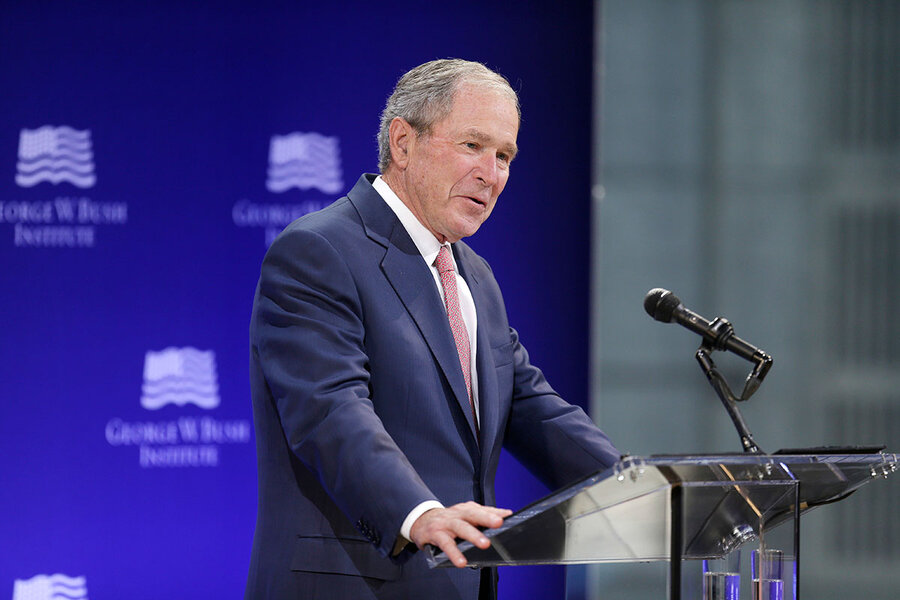
Presidential Rhetoric Expert Shares Thoughts on Bush's Speech
Presidential rhetoric expert Martin J. Medhurst, Ph.D., Distinguished Professor of Rhetoric and Communication and professor of political science in Baylor’s College of Arts & Sciences, is quoted in this article about speeches given last week by two former U.S. presidents and a former presidential candidate that warned of the dangers to the nation and the world if divisive politics continues to cleave the American electorate into thoughtlessly hostile warring camps. “They ... talk about American ideals, they ... talk about the story of America, the American creed and the need to reinvigorate democracy and continue to be the exemplar to the world of democratic values,” Medhurst said. Source:

These days, it doesn’t take much to turn a civil conversation into a full-blown catastrophe. Just mention the words “climate change” and feathers can start to ruffle. But it doesn’t have to be that way, says Dan Peppe, Ph.D., climate change expert and associate professor of geosciences at Baylor University. His research focuses on understanding how plant and animal communities have responded to changes in climate throughout Earth’s history. “Climate change is a fundamentally important issue to our society and is vital for us to have open and honest discussions about it and its potential impacts,” Peppe said. He said the best place to start such a dialogue is with scientific observation. Have a discussion about increases in temperature, he said. Understand what scientists are saying about those temperature changes and their effects. The trick to keeping this cordial? Keep politics out. “All of this conversation is a scientific one based on observation, and as such, shouldn't be a political one,” he said. “Once that baseline is established, we can then begin a conversation of the many possible ways to address those risks.” Peppe said there is often more than one solution to issues of climate change, but people need to listen to each other. “Hopefully there can be a respectful and civil conversation around those potential solutions,” he said. As part of Earth Science Week, Peppe is taking part in the Earth Science Symposium at The Mayborn Museum in Waco, Texas, where he will moderate a panel discussion on climate change. Panelists will discuss the science of climate change, the risks associated with it, and some of the potential solutions. “We hope that this will be a really productive discussion, and one in which the audience can participate,” Peppe said. Source: