
Experts Matter. Find Yours.
Connect for media, speaking, professional opportunities & more.

Aston University establishes new independent investment company
Aston University is part of a group of eight universities which has established a new investment company Midlands Mindforge will accelerate the commercialisation of university research It aims to raise up to £250 million from investors. Aston University is one of eight research intensive universities in the Midlands to establish a new investment company to accelerate the commercialisation of university spinouts and early-stage IP rich businesses in the region. Midlands Mindforge Limited has been co-founded by Aston University, University of Birmingham, Cranfield University, Keele University, University of Leicester, Loughborough University, University of Nottingham and University of Warwick, collectively Midlands Innovation. This ambitious, patent capital investment company plans to raise up to £250 million from strategic corporate partners, institutional investors and qualifying individuals. It aims to transform ground-breaking science and technology into successful businesses with real-world impact. Midlands Mindforge will help to address the significant funding deficit for early-stage technology businesses in the region. Through the combination of additional capital and company-building skills, Midlands Mindforge will lay the foundations of a more vibrant ecosystem for emerging science-backed companies in areas such as Clean Technology, AI and Computational Science, Life Sciences and Health Tech. Professor Aleks Subic, Vice-Chancellor of Aston University, said: "Aston University has a strong track record in bringing together industry and academia to solve real world problems and drive innovation through applied and translational research. Â Investment raised through Midlands Mindforge will enable a step change that will ensure we get the very best outcomes for our research. "The impact of increased investment in research translation will be felt widely, with Midlands Mindforge supporting the growth of high value added businesses and jobs in the region and creating the right conditions to build future global companies. This is a hugely exciting time for Aston University and the wider Midlands Innovation group of universities, and I look forward to seeing the benefits that this strategic development will bring." Collectively, the eight founding universities have the most postgraduate students, the highest levels of annual income, more research disclosures and patents generated per unit of research spend in the last three years, in comparison to any other UK university grouping. Minister of State for Science, Research & Innovation George Freeman MP said: "Commercialising UK science & technology for global industrial adoption has never been more urgent for both the UK economy and the global resource challenges facing us. The Midlands Innovation universities are driving a new era of innovation from robotics and advanced manufacturing to life science and autonomous vehicles and much more. "As we in Government increase UK public R&D to a record £20 billion a year, the key is private finance backing spinouts and scale-ups. The Midlands is rapidly becoming a world class UK cluster of excellence and Midlands Mindforge will play a key role in bringing global investors to help back world class companies." Chairman of the Midlands Engine Partnership, Sir John Peace, said: "The Midlands has always been associated with exceptional invention and creativity, but has long experienced significant underinvestment and consequently productivity levels have lagged behind the rest of the UK. "This bold and ambitious initiative led by the Midlands Innovation universities has the potential to help close the investment gap, supporting our region to reach its true potential for sustainable economic growth. Midlands Mindforge will help to further fast-track commercialisation of research ideas, creating a more resilient economy and playing an important role in levelling up the Midlands." Andy Street, Mayor of the West Midlands, said: "A key part of my mayoral mission is to drive our regional recovery forward and help generate the high-quality jobs of the future in order to improve quality of life for local people. This exciting new investment vehicle will very much support that mission planting the seeds for long-term sustainable economic growth here in the West Midlands. "Many brilliant ideas and top businesses have spun out from Midlands universities and this new venture will help us to advance that agenda and retain more of our innovative success stories within our region. "Together we can better nurture the enterprising talent on our doorstep and this new endeavour creates a wonderful opportunity to do just that." For more information about Midlands Mindforge visit www.midlandsmindforge.com


Is America's banking system in trouble once again?
Nerves are rattled and many are worried as the markets opened Monday to news of another US bank collapse, making that two large banks shuttered in less than a week. It's news that's rocking the financial world on a massive scale. Federal regulators announced on Sunday that another bank had been closed and that the government would ensure that all depositors of Silicon Valley Bank — which failed Friday — would be paid back in full as Washington rushed to keep fallout from the collapse of the large institution from sweeping through the financial system. The Federal Reserve, Treasury and Federal Deposit Insurance Corporation announced in a joint statement that “depositors will have access to all of their money starting Monday, March 13.” In an attempt to assuage concerns about who would bear the costs, the agencies said that “no losses associated with the resolution of Silicon Valley Bank will be borne by the taxpayer.” March 12 - New York Times With an economy already on edge as Americans feel the grip of inflation and worries of recession - this is frightening news and media are scrambling for answers. What is causing the closures of these big banks and how many more will follow? How much money is lost and how much has been protected? Is this 2008 all over again? Is the federal government doing enough to stop the damage from spreading? What measures need to be put in place by government to assure citizens that their savings, retirement plans and mortgages aren't at risk? And will anyone be held accountable for the billions already lost? There's a lot to explain - and that's where our experts can help. Rebel Cole, Ph.D., a Lynn Eminent Scholar Chaired Professor of Finance, has expertise in global financial institutions, commercial banking and small business finance. He spent 10 years working in the Federal Reserve System and has experience at the the International Monetary Fund and the World Bank. Cole has been interviewed by numerous national media outlets, such as The Wall Street Journal, The New York Times, The Washington Post and Fox Business. Rebel is available to speak to media regarding the current state of banking and what Americans need to watch for or worry about. Simply click on his icon now to arrange an interview today.


Georgia Southern recognized as top 100 degree producer for diverse students
Georgia Southern University has ranked in the top providers nationally for degrees conferred to diverse students among higher education institutions. For several years, Diverse Issues In Higher Education has produced the Top 100 Degree Producers rankings of the institutions that confer the most degrees to diverse students. The data was reported at the end of 2022 for the previous year of 2020-2021. Georgia Southern ranked highly in the following categories: #2 for international (temporary resident) students receiving doctoral degrees in public health #3 for African American and total minority students receiving doctoral degrees in public health #5 for African American students receiving bachelor’s degrees in the physical sciences #6 for African American students receiving bachelor’s degrees in communications disorder sciences #6 for African American students receiving bachelor’s degrees in parks and recreation “We are proud to be ranked in the top 20 in a variety of disciplines and categories,” said Dominique A. Quarles, Ph.D., associate vice president for inclusive excellence and chief diversity officer. "Along with our designations as a First-gen Forward Institution and Military Friendly School, this highlights the University’s success in providing education to students in our diverse state and region, and it reaffirms the importance of inclusion as a value at Georgia Southern.” The number of combined bachelor’s, master’s and doctoral degrees awarded increased by over 55,000 degrees from 2019-2021 to 2021-2022 for diverse students nationwide. Underrepresented students of color received 35% of the combined degrees. The data comes from the Integrated Postsecondary Education Data system survey known as IPEDS, which are collected by the U.S. Department of Education. Georgia Southern detailed diversity rankings: Rank Category Degree Level Discipline #2 Temporary Resident Doctorate Public Health #3 African American Doctorate Public Health #3 Total Minority Doctorate Public Health #5 African American Bachelor’s Physical Sciences #6 African American Bachelor’s Communication Disorders Sciences #6 African American Bachelor’s Parks, Recreation, Leisure #8 African American Bachelor’s Engineering #9 African American Bachelor’s Marketing #10 African American Bachelor’s Rehabilitation and Therapeutic Sciences #13 African American Bachelor’s Finance #13 African American Master’s Parks, Recreation, Leisure #14 African American Bachelor’s Family And Consumer Sciences #14 Two or More Races Bachelor’s Communication Disorders #15 African American Bachelor’s Education #19 African American Bachelor’s All Disciplines Combined View the Top 100 Diverse Report Here For more information about the Top 100 Diverse Report or to speak with Dominique A. Quarles — simply reach out to Georgia Southern Director of Communications Jennifer Wise at jwise@georgiasouthern.edu to arrange an interview today.


It reflects the University’s strong and longstanding relationship with the accounting industry The University’s graduates achieved the fourth highest global pass rate in CIMA Operational Level exams It is the second year in a row the University has been recognised in this way. Aston University’s Accounting Department has won a Chartered Institute of Management Accountants (CIMA) Global Excellence Award at the CIMA Excellence Awards for the second year running. The annual Awards recognise institutions and individuals across the world going above and beyond to shape the next generation of Chartered Global Management Accountants and lead the accounting profession into the future. The Accounting Department has been awarded Global High Distinction - CGMA Campus of the Year 2022, reflecting the strong and longstanding relationship it has with the accounting industry and the professional bodies in accounting which benefits students throughout Aston Business School. The award reflects the University’s graduates achieving the third highest number of CIMA exams taken over the previous 12 months per university campus globally with above average global pass rate as well as the fourth highest global pass rate in CIMA Operational Level exams. Andy Lymer, professor of taxation and personal finance and head of department of accounting in Aston Business School, said: “Ensuring our graduates are well prepared for long and successful careers in the accounting profession is a key focus of our approach to designing and delivering our accounting degrees, and where we work on other degrees with our accounting teaching. “To be recognised for doing this at the level of one of the top three or four Universities in the world by one of the major global accounting professional bodies is clearly great news for our students - current, past and future. “It is also wonderful recognition for the great teaching team we have here that this award underlines are genuinely world class at what they do.”


Expert Podcasts: In Corporate Valuation, Customers are King
From investors to managers, business leaders need to understand the true value of companies, but many of the traditional methods are outdated and incomplete. Emory University Goizueta Business School's Professor Dan McCarthy joins to discuss customer-based corporate valuation, including the critical role customer lifetime value plays in driving a company’s success. For more insight and if you're interested in knowing more, then check out Dan's conversation that includes why customer data points are most important to monitor and how investors and managers stand to benefit from this approach. It's right here on the Goizueta Effect podcast. Dan is an Assistant Professor of Marketing at Goizueta Business School. His research centers on customer lifetime value, limited data problems, data privacy, and the marketing-finance interface. He is regularly featured as a key expert, with recent coverage in the Harvard Business Review, Wall Street Journal, Fortune, The Economist, and CNBC. If you're looking to connect or arrange an interview – simply click on his icon now to book a time today.


Tokyo International Conference on African Development
Aston University co-hosted parts of the eighth Tokyo International Conference on African Development (TICAD8). There was a total of six talks hosted by the University, five of which are available to catch up on below. TICAD8 is the eighth event of TICAD, having been initiated by Japan in 1932. The conference brings together international organisations and business representatives from African countries and Japan to promote the digitalisation of African nations to keep pace with other leading economies. Cyber security and data privacy were two of the main topics up for discussion as well as central bank digital currencies (CBDC). CBDC is a government-issued fiat currency, that is, a currency not backed by a commodity such as gold. The use of an ideal CBDC will eliminate over 100,000 armoured cars carrying cash for ATM machines all over the world, reducing CO² emissions. Experts say transitioning to fiat currency requires the highest level of cyber security. The digitalisation of the healthcare sector in Africa Professor Georg Holländer of Oxford University speaks with Aston University visiting professor - and GVE founder - Koji Fusa. The discussion focuses on the benefits of an electronic health record for both an individual and the health care provider but will also relate these benefits to issues of public health and research. The technical challenges of providing the conventional infrastructure to establish health care records will be touched on with a focus placed on data security. Reasons will be pointed out that impede the uptake of electronic health records, especially in low and middle income countries, and possible solutions are presented to overcome this problem. CBDC and private sector digital currency will facilitate the digitalisation of nations of African countries CBDC will require the highest security and privacy protection. Professor Koji Fusa, Cyber Security Innovation Centre, Aston University, CEO of GVE Ltd discusses the benefits of a comprehensive digitalisation of fiat currency. This will become a powerful digital infrastructure which could expand into other areas like healthcare. The cyber security issue pointed by the US NIST in 2016 could be solved by having a different set of systems which could reduce the risks being presented by international hacking groups having quantum computers in the future. The World Bank's support for digitalisation of Africa Takashi Miyahara, the Executive Director of the World Bank Group, presents this talk in his personal capacity. Mr. Miyahara introduces the World Bank’s contribution to date, and Japan’s collaboration with the Bank, for digital development of Africa. Mr. Miyahara worked for the Ministry of Finance of Japan since 1986 before he took the current position in January 2021. Vaccine and climate transition in Africa René Karsenti, senior adviser and honorary president of the International Capital Market Association (ICMA), former board chair of the International Finance Facility for Immunisation (IFFIm), honorary director general of the European Investment Bank (EIB) and member of the Global Advisory Board of GVE Ltd, talks to Aston University's Koji Fusa about vaccine and climate transition in Africa: two major challenges, lessons from innovative ESG financing and future endeavours. Health and vaccine finance, climate transition and sustainable finance have sparked a revolution in thinking about innovative solutions leading to implementing successfully new humanitarian finance such as IFFIm, financing GAVI, the Vaccine Alliance, as well as other new ESG investments to achieve a positive impact. He says: "Needs remain huge in Africa. "We are now at a decisive moment in such ESG investments. We have evolved in a few years from a situation where investors knew - and cared - little about what their investments were supporting, to one where purpose matters more than ever. "But only by recognizing the urgency for action particularly in Africa and the power of ESG investment, collaboration, technology and innovation would get us there." Cyber security, financial integrity and developments Professor George Feiger is the executive dean of the College of Business and Social Sciences at Aston University. He suggests truly secure data transfer has the capability to transform more than medicine and finance in the efficiency sense and also holds out the promise of helping to clean up the even more consequential problem of looting of the state.

What does Joe Biden's forgiveness of student loans mean for debt relief?
President Joe Biden has made progress on a campaign promise to provide relief for those burdened with student debt. This plan offers targeted debt relief as part of a comprehensive effort to address the burden of growing college costs and make the student loan system more manageable for working families. The President is announcing that the Department of Education will: Provide targeted debt relief to address the financial harms of the pandemic, fulfilling the President’s campaign commitment. The Department of Education will provide up to $20,000 in debt cancellation to Pell Grant recipients with loans held by the Department of Education, and up to $10,000 in debt cancellation to non-Pell Grant recipients. Borrowers are eligible for this relief if their individual income is less than $125,000 ($250,000 for married couples). No high-income individual or high-income household – in the top 5% of incomes – will benefit from this action. To ensure a smooth transition to repayment and prevent unnecessary defaults, the pause on federal student loan repayment will be extended one final time through December 31, 2022. Borrowers should expect to resume payment in January 2023. -- White House Fact Sheet, Aug. 25 The announcement made big waves politically and news coverage is still heavy with reactions to the plan and just who it will benefit. “For some students, they will be completely debt-free afterward," said Wendy Habegger, a lecturer of finance in the James M. Hull College of Business at Augusta University. "The majority are still not going to be debt-free but instead of you having to pay an extra year, it might cut your pay time down. What this is going to do is give you money to start doing some of the other things that you have put off. You can now focus on building up an emergency fund, building up a savings account. You can put it toward your retirement.” The announcement also includes extending the student loan pause a final time through Dec. 31, 2022. “One of the good things about this debt reduction and debt forgiveness is that the Biden administration is making some very firm attempts to go in and fix some of the payment programs that are broke. So when individuals have to start paying in January, they will be able to pay a reduced amount,” said Habegger. “What’s not going to stop is the accrual of future debt. So we really need to look at the underlying problem and the costs of higher education and see if we can bring that down.” This topic will require ongoing coverage, so if you’re a reporter looking to know more, then let us help. Wendy Habegger is a respected finance expert available to offer advice on making the right money moves during volatile times. To arrange an interview, simply click on her icon now.



Expert Sources for Federal Reserve interest rate increase: UCI faculty members available to comment
On June 15, the Federal Reserve announced its largest interest rate hike in 28 years to try to regain control over elevated consumer prices. The Fed raised its benchmark interest rate by three-quarters of a percentage point – the biggest increase since 1994 – following a quarter-point jump in March and a half-point increase in May. “We’re strongly committed to bringing inflation back down and we’re moving expeditiously to do so,” said Federal Reserve Chairman Jerome Powell. Eric Swanson – professor of economics. Swanson’s research focuses on monetary policy, interest rates and the effects on economy, including output, unemployment and inflation. Swanson previously worked at the Federal Reserve Board and Federal Reserve Bank of San Francisco from 1998-2014 as an economist and research advisor. Email: eric.swanson@uci.edu Aaron James – professor of philosophy. James co-authored the book Money from Nothing: Or, Why We Should Stop Worrying About Debt and Learn to Love the Federal Reserve, which explains the nature of money and a number of alternatives the Federal Reserve can legally employ to curb inflation other than increasing interest rates. Email: aaron.james@uci.edu Jack Liebersohn – assistant professor of economics. Liebersohn’s research focuses on banking, banking risk taking, mortgages and the housing market and he can speak to how increasing the Federal Reserve interest rate affects any of those elements of the economy. Email: cjlieber@uci.edu Christopher Schwarz – associate professor of finance and faculty director of the Center for Investment and Wealth Management. Schwarz can discuss how far the Federal Reserve will have to go and its impact on the economy and financial markets moving forward. Email: cschwarz@uci.edu Media Contact: Cara Capuano, Communications Officer, UCI | 949-501-9192 | ccapuano@uci.edu


The EU-UK Trade and Cooperation Agreement is costly, what does the UK need to do? | Aston Angle
As far as trade is concerned, the EU exit has been rather costly to the UK. At the Centre for Business Prosperity, we have been tracking the performance of UK trade in recent years. The UK’s trade dropped sharply during COVID. Like other nations, this was due to the global recession and supply chain disruptions. However, the UK failed to recover and enjoy the boom, despite the tariff-free terms of trade in goods set out in the EU-UK Trade and Cooperation Agreement (TCA). The UK now trades less with the EU, its largest trading partner, than in 2019. During the same period, Germany and the Netherlands grew trade with the EU by nearly a quarter, and US trade with the EU has also grown considerably. Reports suggest, including those from the British Chambers of Commerce, that exporting to the EU has become much more costly and in some cases, unviable. It appears that the “certainty” provided by the TCA has not reversed the declining trend of the UK-EU trade so far. Our new paper for the Enterprise Research Centre (ERC) has found that UK exports experienced a large, negative, statistically significant decline in 2021 at the end of the transition after the EU-UK Trade and Cooperation Agreement (TCA) was put into force. We estimate that this amounts to a 22% reduction in exports to the EU and a 26% reduction in imports from the EU over the first half of 2021, relative to the counterfactual scenario of the UK remaining in the EU. How did this happen? After all, the TCA ensures that goods moving between the UK and the EU have no tariffs or quotas, so long as the rules of origin are complied with. Rules of origin help you work out where your goods originate from and which goods are covered in trade agreements. Our research found that non-tariff measures (NTMs) were responsible for the adverse TCA effect on UK trade with the EU and that the magnitude of loss was significant. It was equivalent to a reduction of £12.4 billion in UK exports over the first six months period of 2021. This equals 16% of UK total exports in the first half of 2019 and 70% of the documented total reduction in the EU exports in the same period. A number of factors can be attributed to the decline of UK exports to the EU. In particular, the increased trade frictions that occurred mainly due to sanitary and phytosanitary (SPS) and technical barriers to trade (TBT) as a result of entering the TCA. Sanitary and Phytosanitary (SPS) measures refer to the EU controls to protect animal, plant or public health. And technical barriers to trade (TBT) refers to mandatory technical regulations and voluntary standards that define specific characteristics that a product should have, such as its size, shape, design, labelling/marking/packaging, functionality or performance. On average, for the first six months of 2021, a 1% increase in SPS resulted in a 13–15% reduction in exports to the EU, most notably in the food and drink, wood and chemicals sectors. Furthermore, a 1% increase in TBT led to a 2–3% reduction in exports, especially in metals, equipment, machines and miscellaneous industrial products. What next? Since the post-Brexit dysfunctions are now diagnosed, in theory we could move on. The UK can directly tackle the trade challenges, so long as other things, such as politics, do not stand in the way. Fundamentally, what needs to happen is the removal or relief of the root causes coded by the TCA – the trade barriers newly erected. This is a key task; it is challenging but not impossible. Trade frictions due to the SPS measures are an acute problem of Brexit. Reducing some of the non-tariff measures between the EU-UK would help by exploring other mechanisms such as equivalent SPS measures or other ways to reduce businesses burden to a minimum. The technical barriers to trade are more complicated and challenging and they could potentially cause significant damage to the UK economy. Despite its limitation, maintaining and broadening the established arrangements of the current TCA provision, through some form of mutual recognition of specific practices or international regulations for selected sectors, should be the ambition of UK government to help ease the TBT trade barriers. Future EU-UK co-operation is critical and mutually beneficial but requires political will and strong leadership. In the short and medium term, supporting firms should be the priority, especially small- and medium-sized firms that are productive enough to have exported to the EU in the past, but now face hurdles to continue exporting. These firms tend to be limited on resource but have the infrastructure and ambition to internationalise. Targeted support for specific challenges could be also fruitful. The UK Department for International Trade Export Support Service, the British Chambers of Commerce and local growth hubs have the expertise and experience to help firms export. Therefore, resources should be made available to allow for customised and responsive support with exports, as well as taking advantage of technologies that can identify and reach businesses who require support. Provision should also be made to collect feedback on the quality of the support provided, to enable further improvement. Helping businesses continue to access EU markets, while enabling the economy to take advantage of welfare-enhancing benefits from trade, remains imperative. Given the economic benefits of the roll-out, the new free trade agreements are expected to be limited and effective only in the long term. UK domestic policies should be the focus to improve the competitiveness of exporters and their ecosystem. By Professor Jun Du Director of the Centre for Business Prosperity Professor of Economics, Finance and Entrepreneurship, Aston Business School Lecturer in Politics and International Relations School of Social Science and Humanities Dr Oleksandr Shepotylo Senior Lecturer, Economics, Finance and Entrepreneurship, Aston Business School

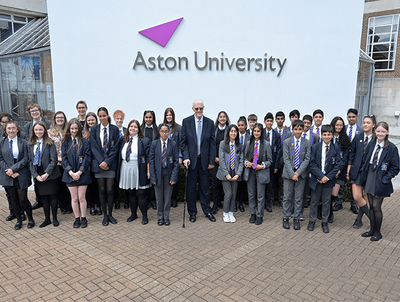
Dr Keith Bradshaw OBE and the West Midlands Mayor met students on the Introduction to Healthcare programme at Aston University ‘NHS outbreak’ experience day The Introduction to Healthcare programme is generously funded by Keith Bradshaw 55 local school students attend the one-day event on Aston University campus. Dr Keith Bradshaw OBE and West Midlands Mayor Andy Street have visited Aston University to meet Year 9 students who were attending a healthcare experience day on campus as part of the University’s Introduction to Healthcare programme. 55 school students took part in a full day of activities experiencing some areas of the healthcare professions. In one activity, the students acted as NHS finance directors during a disease outbreak, where they were asked to make financial decisions, such as choosing which departments in a hospital would be allocated funds from a £1 million budget. The students listened to pitches from different NHS departments before creating a presentation outlining which areas would get some of the budget and the reasons why. The exercise allowed them to develop their teamwork, as well as reasoning and presentation skills. Keith Bradshaw, a prominent businessman and philanthropist, generously funds the Keith Bradshaw Introduction to Healthcare programme, which is designed to increase students' awareness of the various careers within the healthcare sector and support students with their journeys into higher education. Working with students in Years 8, 9 and 10 from schools within the Solihull, Birmingham and Black Country area, the programme aims to educate young people about opportunities within healthcare and the importance of achieving the right GCSE grades to pursue those professions. The programme was launched in 2018 following the success of Aston University’s Pathway to Healthcare Programme. Keith said: “It’s been a pleasure to meet students attending the healthcare programme and hearing more - through their presentations - about their ideas on how they might manage an NHS budget and in which areas they would choose to allocate funds. “One of the key objectives of this programme is to support young people so they can develop and deploy their skills for the benefit of the local community. “We must get the most out of our young people, so they can support our health and welfare and live fulfilling and rewarding lives, which is why this programme – intended to widen participation into healthcare – is so very important.” Andy Street, Mayor of the West Midlands, said: “I was pleased to have the chance to visit the Introduction to Healthcare experience day, to learn more about the programme and to hear directly from the participating students. “A key part of my mayoral mission is to help young people from across our region to raise their aspirations and support the creation of high-quality job opportunities for them here in the West Midlands. “So, I congratulate Aston University on their wonderful widening participation efforts and will certainly play my part in advocating to Government the merits of funding and expanding these sorts of pathway programmes that do so much to help young people from all backgrounds to not only aspire to brilliant jobs but also be practically supported on the best possible route into these professions.” For more information about the Introduction to Healthcare Programme at Aston University please visit our website.