
Experts Matter. Find Yours.
Connect for media, speaking, professional opportunities & more.
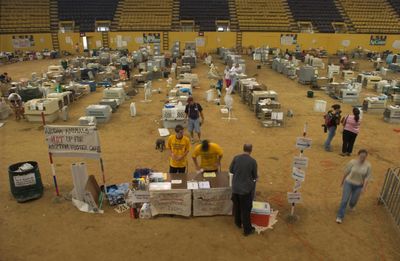
LSU Veterinary Teams Recall Courage, Loss, and Lasting Change from Hurricane Katrina Animal Rescues
From that tragedy came transformative change, with new animal evacuation protocols and policies, including the creation of the federal Pet Evacuation and Transportation Standards (PETS) Act, which requires state and local disaster plans to include provisions for pets and service animals. LSU School of Veterinary Medicine played a pivotal role in this evolution. In the days and months after Katrina, LSU Vet Med faculty, staff, and students worked alongside state officials, military units, and volunteers from across the nation to rescue, treat, and shelter thousands of animals. Two decades later, Katrina’s scars remain, but so does the resilience of the people and animals who lived through it. Their stories serve as a reminder that in even the darkest moments, compassion can spark lasting change. Rescue in a War Zone Dr. Jenny Sones (then veterinary student): I had been working at LSU Vet Med for five years when Katrina hit. LSU Vet Med put out an ‘all hands on deck’ call to employees. All of our hospital wards were turned into an ER. We opened our homes to complete strangers who came to help. It was organized chaos. Many animals came to us looking like corpses with a heartbeat because they’d been in the flood waters so long. I worked all day at LSU Vet Med, where we saw the sickest, most injured patients, and worked at Lamar Dixon evenings and weekends. Twenty years later, the images are so vivid in my mind. I took a horse trailer on a rescue mission into New Orleans with two students and a state veterinarian escort one week after Katrina hit. The scene looked like a war zone, helicopters everywhere, buildings burning, gunshot sounds. Every area we saw was looted. The stench was awful. There were people on the overpasses who had been there for a week. We were there to rescue animals. Military, Louisiana National Guard, and police brought the animals to us where our trailer was parked on an overpass. We picked up a few strays on our way out. The animals we rescued were so scared. Some had been in the flood waters a long time and were soaking wet and foul smelling. Their skin was sloughing off and they were emaciated. Amazingly, none of the dogs, cats, or horses were aggressive—maybe because they were in shock or they were grateful. We treated them all at Lamar Dixon, washed them with Dawn dishwashing soap and applied betadine. Sick ones were transported by trailer to LSU Vet Med. They were very dark times and very good times too. We were able to get the New Orleans French Quarter mules out to Lamar Dixon. Their caretaker crew stayed with them. They hooked up the mules, still in good shape because they weren’t in the flood waters, and they gave workers short rides around the Lamar Dixon grounds. It was such rewarding work. We were exhausted but in the best way. It would have been easy to get caught up in the devastation if we didn’t focus on our purpose to help animals. You can’t fix everything, but you can fix what’s in front of you. If you can survive the devastation of Katrina, you can survive anything. From Classroom to Crisis Dr. Jenny Sones (then veterinary student): In August 2005, I was starting my second year of veterinary school at LSU. I had no idea that life was about to change so drastically. School was cancelled, and electricity was out most places except at the vet school. My colleagues set up temporary housing in our study rooms and other places throughout the vet school. We then began to learn of the effects of Katrina on our veterinary species—dogs, cats, horses, and more. These precious creatures were the reason why we studied, crammed, and signed up to endure the rigors of veterinary school. It was time to close the books and help! Although we were not licensed veterinarians yet, we were keen to provide aid in any way we could. I, along with lots of my classmates, volunteered at Parker Coliseum on the LSU campus, where displaced small animals were seeking refuge, and at Lamar Dixon, which became the shelter for large animals and small animals. We spend many hours doing anything we could, cleaning litter boxes, refilling water bowls, changing bedding, administering medications, and assisting the heroic volunteer veterinarians working tirelessly to treat the injured, sick, and rescued. Lots of important lessons were learned during Katrina. Many animals were not reunited with their owners. That's when I learned the value of microchipping to permanently identify animals, gained an appreciation for animal search and rescue, and the value of quick response. (Sones is now CSU Equine Reproduction Laboratory reproduction specialist.) Mapping Rescues by Hand Ashley Stokes (former faculty member): It was unlike anything I’ve ever experienced. I was researching and teaching at LSU Vet Med in 2005. LSU Vet Med stepped up in so many ways. We started receiving calls from citizens and local authorities at the vet school almost immediately after the storm. They needed help with resources—animal rescue, food, and water. They had to leave New Orleans quickly. I particularly remember a call from someone from south of Belle Chase, La., who had left horses, cattle, and two dogs in the house and needed help. It was surreal to see the devastation, houses floating, there in the Delta. We were making real-time decisions to help their animals. They’d lost so much, and for some, their animals were all they had left. We put a paper map of Louisiana on the wall and put pins in the locations that called for assistance. We covered all of New Orleans and surrounding areas, including the north shore and extending west to Baton Rouge. We took the callers’ information and sent teams of staff, students, and volunteers to different locations with donated trailers, hay, water, and other resources for rescue. We continued rescues for months after the storm. We were there for people for the long haul. The whole experience was transformational in my life. What I learned from Katrina became part of my own career and what I continue to do. There were beautiful moments, especially seeing how resilient and helpful people could be. I saw every day how the community came together and were absolute bright lights. Positive came from tragedy. (Stokes is now dean of UC Davis College of Agricultural & Environmental Sciences.) The Boxer on the Third Floor Dr. Neil Henderson (alumnus): When Katrina hit, the Louisiana Veterinary Medical Association sent out a request for help from veterinarians. I got to the Lamar Dixon Center on Day 5 after Katrina hit. St. Bernard Parish was where I spent most of my time helping. It was literally destroyed. One day, while we were making our rounds, a man came running up to me and said that he just remembered that while the storm was coming through—he was on the third story of a building looking out of the window—he noticed a dog swimming around frantically with nowhere to go. He opened a window for it with the hopes that it would swim inside the building to safety. Seven or eight days later, with the temperature well into the upper 90s, the man came up to me and asked me to go into the building to see if I could find the dog. I did not have much hope but went anyway. There, on the third floor of the building, I found the dog, a boxer, alive. She was in surprisingly good shape. The man was ecstatic to see the dog and could not believe that it made it inside the building to safety. I stayed for five days helping animals, and my late father (Dr. Robert Henderson, class of 1977) came after that for five more days. (Henderson is the owner of the Pine Ridge Veterinary Center in Stonewall, La.) Article originally posted here.


Record-breaking heatwaves are plaguing the U.S. this summer, making it difficult to stay cool. However, the scorching temperatures aren't just affecting us at the ground level — they're disrupting air travel, too, with increasing flight delays and aircraft weight restrictions. Visiting assistant professor of aeronautics Shem Malmquist, a recognized expert in aviation safety and operations, spoke with FOX 35 Orlando about how extreme temperatures can directly impact aircraft performance, particularly at high-traffic airports during the summer. "Temperatures are probably not something people think about," said Shem Malmquist, a graduate lecturer in aviation at Florida Tech. "But the delays just compound on each other. If you start getting delayed because people need more time to take breaks to stay cool, now that flight’s late, and that has a snowball effect." These limitations can affect passenger loads, cargo capacity and overall flight scheduling. As temperatures continue to climb, Malmquist warned that these disruptions could become the new normal — not just a seasonal inconvenience, but a growing challenge for the aviation industry in the face of climate change. A seasoned Boeing 777 captain and accident investigator, Malmquist has spent decades researching aircraft operations and emergency scenarios. He’s also contributed to global conversations on aviation safety policy and climate-related infrastructure resilience. If you’re covering this topic or looking to speak with an expert on the intersection of climate and air travel, Malmquist is available for interviews. Click the icon below to connect with him.


Disaster Reduction: Key Insights for Risk Managers & Corporate Executives
The need for comprehensive disaster risk management has never been more evident. In recent years, major storms, earthquakes, wildfires, tornados, derechos, and other destructive large-scale events have been significant. According to the United Nations Office for Disaster Risk Reduction (UNDRR) 2025 Global Assessment Report, disaster costs now exceed over $2.3 trillion annually when cascading and ecosystem costs are taken into account. What can be done to minimize both the damaging effects and significant costs associated with these types of events? In this article, J.S. Held EHS experts John Dulude and Bill Zoeller examine the critical components of disaster resilience – preparedness, mitigation, and resilience – and delve into the insights that can empower risk managers and corporate executives to safeguard their organizations. What’s covered : • Proactive Disaster Planning and Preparedness • Case Study: Hurricane Hilary 2023 | Western United States • Tailoring Resilience to Geographic Risks • Learning from Disaster for Continuous Improvement The insights shared in this article underscore the critical importance of proactive planning, meticulous preparation, and resilience in the face of inevitable disasters. For media inquiries, contact : Kristi L. Stathis, J.S. Held +1 786 833 4864 Kristi.Stathis@JSHeld.com


Yes, Ringo Starr just turned 85. Let that sink in. I read this in the Washington Post and felt like a bag of Beatles vinyl had walloped me. How is this possible? How can the mop-top drummer be 85 when I was dancing to “Yellow Submarine” in bell-bottoms with a brush for a microphone? More urgently: how old does this make me?! Ringo isn’t slowing down. He’s still touring with two bands, making music, flashing that cheeky Liverpudlian smile, and preaching peace and love as if he’s got nowhere else to be. No plans to retire. No plans to fade away. Just a rockstar with a great attitude... and maybe a titanium hip (unconfirmed). This made me realize that, as the birthday candles on my cake now need a fire permit, “attitude” plays a huge role in how we age. Based on the feedback I received from my last post, “What’s Your Brand, Boomer?”, it’s clear that many people are genuinely interested in managing their personal brand as they age. This week, I want to go deeper—because whether you’re 45 or 85, you are Old People in Training. That’s right. Every one of us is aging in real-time, and understanding the stages ahead—either for ourselves or our aging loved ones—helps us walk this path with humour, grace, and fewer surprises. So, here they are: The 8 (Unofficial but Uncannily Accurate) Stages of Aging 1. The Stand-Up-and-Forget-Why Stage (Kicks in around mid-to-late 50s) You walk into a room with purpose, then wonder: was I here to fold laundry, pay a bill, or practice my slow blink? Bonus points if you’re already wearing the glasses you’re hunting for. How it helps: Eases forgetfulness. It’s not early dementia; it’s early distraction. Keep a notebook or use Voice Memos. Or do what I do: shrug, laugh, and keep walking until something jogs the memory (usually coffee). 2. The “Senior? Not Unless There’s a Discount” Stage (Hits in your early 60s) You bristle at the word “senior,” unless it saves you $2.50 at the movies or 15% at Shoppers. Suddenly, age becomes a tool, not a label. How it helps: Celebrate the advantages! You’ve earned them. And remember: owning your age is the new anti-aging remedy. Confidence looks good on everyone. Remember, you are still that age, whether you admit it or not. You might as well save some money! 3. The “Yes, I Really Am That Age” Reminder Stage (Kicks in around 65) You find yourself saying your age out loud like it’s a riddle. "I’m 65. Sixty-five! Isn’t that wild?" You’re still trying to catch up with the numbers, or maybe you’re worried you’ll forget your age. How it helps: Accept the number without letting it define you. It’s not a limit — it’s a launchpad. Bonus: Use it as an excuse to do something you’ve always put off. 4. The Replacement Parts Stage (Hits in the early to mid-70s) Welcome to orthopedic roulette: knees, hips, maybe a shoulder. You collect joint replacements like frequent-flyer miles. Fortunately, modern medicine allows for joint replacements to be performed more quickly than ordering takeout. Still waiting for Staples to offer 3D-printed hips. How it helps: Embrace science instead of fighting it. Biology always prevails! Mobility equals independence. And nothing embodies “active aging” like beating your grandkids at pickleball with a shiny new titanium knee. 5. The “I’ve Run Out of F*cks to Give” Stage (Kicked in the late 70s into the early 80’s) You’ve earned the right to speak your mind—and wear socks with sandals. You say what you want, mean what you say, and anyone who doesn’t like it can take a number. Opinions? Too many! Filters? Deleted. Freedom? Glorious. Friends? Running for cover! How it helps: This is peak freedom. Use it wisely. Advocate, participate, mentor, and model what unapologetic living looks like. You’re the elder statesperson now—be bold, not bitter. 6. The Cataract Conspiracy Stage (Kicks in mid-to-late 70s) Lights appear like halos, and reading menus becomes an Olympic event. But don’t worry—cataract surgery is so common it’s practically an oil change. And voilà: brighter colours, more precise lines, less squinting. Spoiler Alert: You will now be able to see how poor your housekeeping skills are! How it helps: Get your eyes checked. Don’t delay. Seeing clearly again can literally brighten your outlook—and maybe even your attitude. 7. The “Say What?” Stage – The Hard-of-Hearing Stage (Late 70’s+) This one sneaks up like a whisper… which is ironic, because you probably won’t hear it. At some point, for most of us, hearing begins to decline like old payphones and eight-track tapes. It might start with missing parts of conversations in noisy restaurants or asking people to repeat themselves (just once… or five times). Eventually, it’s full-blown “Say what?” territory. Many avoid wearing hearing aids because—let’s face it—they feel like a flashing neon sign that says, "I’m old!" But here’s the real issue: pretending to hear is much worse. It can lead to social withdrawal, isolation, and even strained relationships. And we’re not just making this up for dramatic effect—studies at John Hopkins School of Medicine show that untreated hearing loss is linked to a higher risk of dementia, depression, and cognitive decline. There’s also the loud TV effect—when your neighbours across the street can hear your Netflix queue, it’s time to see an audiologist, not to mention the safety concern: driving with impaired hearing is risky; sirens, honking horns, or even a warning from a passenger might go unnoticed. So, if your “What?” count is rising and your TV volume is climbing towards aircraft-engine decibels, take action. Getting your hearing tested doesn’t mean you’re old—it means you’re informed (and honestly, more enjoyable to be around). Because nothing celebrates “vibrant aging” more than staying connected to the world—and actually hearing it. Stage 8: The Long Goodbye – When Friends Start to Leave the Stage I’ve heard from seniors about Stage 8… and without exception, they say it’s one of the toughest parts of aging. This is the stage when the long goodbye starts—quietly at first, then with increasingly frequent moments. Your phone rings less often. The chairs at the coffee group gradually empty. One day, you realize you’re not just losing friends—you’re outliving them. It’s part of the circle of life, for sure—but no Lion King soundtrack can ease the heartbreak. This stage exposes some of our deepest fears: Will I be next? Who will mourn me? Does anyone even know I’m still here? It’s a time of grief, loneliness, and silent despair. And while you can’t fast-forward through it, you don’t have to walk it alone. If you’re an “Old Person in Training” (which, reminder: we all are), listen up. This stage isn’t just something that happens to others—it’s your future self, waving from down the road. Learning about it now prepares you to guide others through it with grace and to soften your own landing when the time arrives. And if someone you love is already there? This is your cue. Show up. Don’t wait to be invited—grief rarely sends formal RSVPs. Phrases or clichés like “they’re in a better place” won’t suffice here. These are nothing burgers—all bun, no meat—empty calories in a moment that needs nourishment. Show up. Stay steady. Be the evidence that they are still recognized, still cared for, still part of something meaningful. What they truly need is presence, not presents. Time, not timelines. They need to feel they are not alone. Sit with them. Walk with them. Watch Jeopardy in silence if that’s what the day calls for. But whatever you do, don’t disappear. Because one of the most profound gifts we can give in this stage isn’t a cure—it’s companionship. Science Confirms It: Attitude Is a Lifespan Strategy Tongue-in-cheek aside, these aging observations are backed by science: Positive beliefs about aging can extend life by 7–8.5 years. (Source: PubMed – Levy et al.) Optimism correlates with lower heart disease, stroke, and a 70% greater likelihood of reaching age 85. (Source: Harvard Health) Positive mindset boosts recovery, brain health, and resilience after illness. (Source: Harvard Health) So, what can we learn from Ringo? Keep creating – Music, art, businesses, bad poetry. It keeps the brain limber and the soul alight. Stay curious – Sign up for that course. Take the trip. Ask questions. Enrol in the MBA. (Looking at you, 69-year-old rockstars.) Lean into joy – Laugh like nobody’s judging. Dance like your knees aren’t watching. Surround yourself with good vibes – Optimism costs nothing and glows brighter than Botox. Remember, it’s not your age—it’s your outlook. So next time you stand up and forget why you did, just grin and say: ‘I’m aging like a Beatle. Still standing. Still grooving. Still fabulous.” And if you ever need a pep talk, ask yourself: “What would Ringo do?” Don’t’ Retire Re-wire Sue


Picture this: a group of women in their 50s and 60s who've collectively decided to stop caring about chin hairs, laundry schedules, and everyone else's opinions. Sound liberating? It should. The New York Times recently profiled Melani Sanders, founder of the "We Do Not Care Club"—a crew of perimenopausal and menopausal women living by one fabulous rule: NO RULES! Their motto might as well be "Chin Hair, Laundry, Your Opinion: We Don't Care." While targeted at a younger demographic, the spirit of this movement resonates loudly among retirees, especially those dancing into their 70s and 80s, with less concern for public opinion and a greater commitment to living life to the fullest. But here's the thing—this "liberation" isn't just about attitude. There's actual neuroscience behind why we become more authentic versions of ourselves (and sometimes more blunt) as we age. Brain Aging & Inhibitory Control Let’s start with the science before we move into sass. Frontal lobe shrinkage: Researchers, including Stephanie Wong, a Research Fellow and Clinical Neuropsychologist, are studying how changes in the brain impact inhibitory control and social cognition as we age. Research shows that as we age, the prefrontal cortex—the brain’s internal social bouncer—begins to shrink. That means less inhibition, more "Oops, did I say that out loud?" moments. Inhibition deficits: Research published in the APA Journal of Neuropsychology shows that older adults find it more challenging to ignore distractions or hold back their impulses. Tasks like "stop-signal" tests reveal a clear decline in impulse control. Disinhibition causes behaviour shifts. Sometimes charming, sometimes awkward. If it's just being unusually honest, that’s one thing. If it's full-on undressing in the produce aisle, it might be time to see a doctor. Particularly with frontotemporal dementia, disinhibition can be a serious warning sign. Emotional Wisdom: Who Cares? Here’s the upgrade part of aging: • Less shame, more self-acceptance. Turns out, as you get older, you care less if Karen from yoga thinks you talk too much. • Socioemotional selectivity theory. As we become aware that time is limited, we stop pretending. Why waste valuable hours pretending to enjoy kale chips or dull book clubs? When to Be Concerned • Normal aging: Some verbal slips, occasional public flatulence, and quirky jokes. • Red flags: Rude outbursts, memory lapses, risky behaviour, and dramatic personality shifts. That might signal more than "aging into your truth." • Impulsivity warning: High impulsivity in older adults can sometimes be associated with early-stage cognitive decline. When uncertain, discuss it—preferably with a professional. TL;DR • Physical: Brain shrinkage leads to fewer filters. • Emotional: Less time means less pretending. • Caution: Disinhibition and cognitive issues suggest it's time for a check-up. Crafting Your Identity After 60 (Before Someone Else Does It for You) Let’s be honest: You already have a brand. Even if you never wrote a tagline or hired a designer, your brand is what people whisper (or shout) about you when you leave the room. It’s how you show up, how you age, and whether you become known as: "The Cranky Codger Complaining About the Price of Lettuce" or "The Glamorous Grandma with a TikTok Following." If you don’t brand yourself, trust me—someone else will. And they might not be as flattering. The Branding Trap of Aging Aging often loosens the filter and tightens the waistband. That’s just biology. But if we’re going to become more blunt, forgetful, and comfortable saying whatever pops into our head, shouldn’t we decide who we want to be first? Instead of becoming The Know-It-All, The Debbie Downer, or The Hovering Grandparent, why not become: • The Mentor • The Lifelong Learner • The Sexy Sensei with Killer Dance Moves And let’s not forget: most of us swore we’d never become our parents. Spoiler alert: unless you act intentionally, you’re heading in that direction, with even worse tech skills. Timing Is Everything (And Also Totally Forgiving) The best time to plant a tree? 30 years ago. The second best? Right after you finish this blog, brush Dorito dust off your fingers, and take action. It’s never too early or too late to develop your personal brand. Think of it as building compound interest, but for your character. Start now before you need a doctor’s note for skinny jeans. Build a Brand That Outlasts Your Wi-Fi Password The goal? Shape a brand that becomes your legacy. Something grandkids remember, communities admire, and mirrors reflect with pride. I’m aiming for Hip, Fit & Financially Free. That means: • Eating like I care • Moving daily • Sleeping like it’s my side hustle • Managing money like I want it to stick around • And fiercely guarding my energy from sugar crashes and toxic people Avoid These Unintentional "Elder Brands" • The Cranky Codger: Complains constantly, hates oat milk, gives paper cuts with sarcasm. • The Sweet Old Lady: Harmless and charming—and almost invisible. So sweet, she could give you cavities. Stands for nothing, falls for everything. • The Know-It-All: Believes Google exists solely to confirm their opinions. • The Nona/Nono: Helicopter grandparenting, over-involved, uses spit to clean your face in public. Attract These Brands Instead: 1. Glammy or Glampa 2. Wise Old Owl 3. Sexy Sensei 4. Unstoppable Opa Tips for Maintaining Youth in Mind, Body & Spirit 1. Hang out with younger people—use their slang, apps, and playlists. 2. Volunteer—Gratitude is more effective than Botox. 3. Mentor—your wisdom is not meant for hoarding. 4. Move every day—your joints might protest now, but they'll thank you later. 5. Protect your energy—eat healthy, sleep well, say no to nonsense. 6. Be mindful of your screen time—doomscrolling drains your spirit. 7. Keep learning—new languages, new tech, and new ways to be awesome. Legacy is the Long Game You don’t need to run marathons at 85 (though if you do, I’ll cheer wildly). But you should ask: "How do I want to be remembered?" Learn Italian at age 70. Take a gap year at 65. Get an MBA at 69 (worked for me!). Write your eulogy and then live it. Age isn’t a liability. It’s your proof of resilience. Now’s your opportunity to demonstrate that to the world. So, what’s your brand, Boomer? Because like it or not, you’ve got one. It’s showing up in every family dinner, work Zoom, golf game, and passive-aggressive Facebook post. The only question is — did you choose it… or did you just inherit the ‘We Do Not Care Club’ starter pack? Maybe we don't care about chin hair, laundry, or your opinion — but we do care about how we’re remembered. That’s your real brand, Boomer. So, you can either define it — or let your grandkids do it for you… and trust me, they’ve already got the group chat ready! So go ahead. Print those business cards that say something fabulous. Brand Strategy at Any Age: Intend it. Live it. Leave it behind. Stay hip. Stay fit. Stay financially free. And stay tuned. There’s more coming next week. Spoiler: There will be laugh lines and a squat rack. Don’t Retire … Re-Wire! Sue

Artificial Intelligence Makes Energy Demand More Complex — And More Achievable
In a 2024 paper, researchers from Carnegie Mellon University and machine learning development corporation Hugging Face found that generative AI systems could use as much as 33 times more energy to complete a task than task-specific software would. “The climate and sustainability challenge can be overwhelming in the amount of new clean technology that we have to deploy and develop, and the ways that the energy system has to evolve,” said Costa Samaras, head of the university-wide Wilton E. Scott Institute for Energy Innovation. “The scale of the challenge alone can be overwhelming to folks.” However, Carnegie Mellon University’s standing commitment to the United Nations' Sustainable Development Goals and its position as a nationally recognized leader in technologies like artificial intelligence mean that it is uniquely positioned to address growing concerns around energy demand, climate resilience and social good.


LSU AgCenter Research Enables Better Flood Protection for Homes
The American Society of Civil Engineers (ASCE) recently released its new standard for flood-resistant design and construction, ASCE/SEI 24-24, which provides new minimum requirements that can be adopted for all structures subject to building codes and floodplain management regulations. The new elevation standard was directly supported by LSU research and should help reduce flood risk and make flood insurance more affordable. “Without the research by the LSU AgCenter, the advancements made to the elevation requirements would not have been possible,” said Manny Perotin, co-chair of the Association of State Floodplain Managers’ Nonstructural Floodproofing Committee, who helped update the standard. “Dr. Carol Friedland’s research shows there are better ways to protect communities from flooding than adding one foot of additional freeboard.” The research team, led by Friedland, an engineer, professor, and director of LSU AgCenter’s LaHouse, showed how previous standards were failing to protect some homeowners. They mapped the impact of moving from a standard based on a fixed freeboard amount to being based on real risk in every census tract in the U.S. In response to these findings, they developed a free online tool to help builders, planners, managers, and engineers calculate the elevation required under the new standards. “Many on the committee said it would be too hard to do these complex calculations,” said Adam Reeder, principal at the engineering and construction firm CDMSmith, who helped lead the elevation working group for the new ASCE 24 elevation standards. “But the LSU AgCenter’s years of research in this area and the development of the tool makes calculations and implementation simple. This allowed the new elevation standard to get passed.” Flooding, the biggest risk to homes in Louisiana, continues to threaten investments and opportunities to build generational wealth. On top of flood losses, residents see insurance premiums increase without resources to help them make informed decisions and potentially lower costs. In response to this problem, Friedland is working on developing a whole suite of tools together with more than 130 partners as part of a statewide Disaster Resilience Initiative. When presenting to policy makers and various organizations, Friedland often starts by asking what percentage of buildings they want to flood in their community in the next 50 years. “Of course, we all want this number to be zero,” Friedland said. “But we have been building and designing so 40% will flood. People have a hard time believing this, but it’s the reality of how past standards did not adequately address flood risk.” Designing to the 100-year elevation means a building has a 0.99 chance of not flooding in any given year. But when you run that probability over a period of 50 years (0.99 x 0.99 x 0.99… 50 times, or 0.99 ^ 50), the number you end up with is a 60.5% chance of not flooding in 50 years. This means a 39.5% chance of flooding at least once. “We’ve been building to the 100-year elevation while wanting the protection of building to the 500-year elevation, which is a 10% chance of flooding in 50 years,” Friedland said. “Now, with the higher ASCE standard, we can finally get to 10% instead of 40%.” As the AgCenter’s research led to guidelines, then to this new standard, Friedland has also been providing testimony to the International Code Council to turn the stronger standard into code. In May, Friedland helped lead a workshop at the Association of State Floodplain Managers’ national conference, held in New Orleans. There, she educated floodplain managers about the new standard while demonstrating LSU’s web-based calculation tool, which was designed for professionals, while her team also develops personalized decision-making tools such as Flood Safe Home for residents. At the conference, Friedland received the 2025 John R. Sheaffer Award for Excellence in Floodproofing. More than two-thirds of the cost of natural hazards in Louisiana comes from flooding, according to LSU AgCenter research in partnership with the Governor’s Office of Homeland Security and Emergency Preparedness for the State Hazard Mitigation Plan. That cost was recently estimated to rise to $3.6 billion by 2050. “Historically, we have lived with almost a 40% chance of flooding over 50 years, which in most people’s opinion is too high—and the number could be even higher,” Reeder said. “Most building owners don’t understand the risk they are living with, and it only becomes apparent after a flood. The work done by the LSU AgCenter is critical in improving resilience in communities that can’t afford to be devastated by flooding.” “This may be the most significant upgrade in the nation’s flood loss reduction standards since the creation of the National Flood Insurance Program minimums in 1973, and it could not come at a better time as annual flood losses in the country now average more than $45 billion per year,” said Chad Berginnis, executive director of the Association of State Floodplain Managers. In addition to LaHouse’s work to prevent flooding, Friedland’s team is also working to increase energy efficiency in homes to help residents save money on utility bills. Their HEROES program, an acronym for home energy resilience outreach, education, and support, is funded by the U.S. Department of Agriculture and has already reached 140,000 people in Louisiana. Article originally posted here.


Mental health risks spike for young LGBTQ+ men of color, new study shows
As Pride Month shines a spotlight on the progress and resilience of LGBTQ+ communities, it also serves as a reminder of the ongoing challenges — especially the toll that stigma continues to take on mental health. A new in Developmental Psychology study from the University of Delaware’s Eric Layland, assistant professor in the College of Education and Human Development, reveals just how urgent the need for tailored mental health support is — particularly for Black, Latinx and Afro-Latinx gay, bisexual and other sexual minority young men. Published during a time when national attention turns toward LGBTQ+ visibility, the study tracks the mental health trajectories of over 400 cisgender men between the ages of 18 and 29, focusing on how experiences of racism, heterosexism, or both — what Layland terms compound stigma — influence patterns of depression and anxiety. The results are stark: participants who experienced frequent racism and heterosexism across relationships and settings showed the earliest and most severe symptoms of anxiety and depression, with mental health challenges peaking during late adolescence and early adulthood. While symptoms tended to decline by age 24, these years — critical for education, identity formation and economic independence — were marked by emotional strain. "This study emphasizes how multiple sources of discrimination converge to impact the mental health of sexual minority men of color," Layland said. The research calls for early, culturally responsive mental health interventions that help young sexual minority men of color cope with stigma and build resilience. Layland’s team points to interventions that not only teach coping skills but also foster connection, celebrate cultural identity and create peer networks for support. Layland, who specializes in LGBTQ+ development and affirmative interventions, underscores the importance of systemic change as well. “We need clinical and community resources that are adapted to address the intersecting discrimination experienced by sexual minority men of color, especially in their late teens in early twenties,” said Layland. Supported by the National Institute on Drug Abuse, the National Institute on Mental Health and UD, this study arrives at a crucial time for researchers, educators and community organizations working to create more inclusive and supportive environments. For journalists covering Pride, mental health, or intersectional equity, Layland’s work offers a powerful, data-driven look at what young LGBTQ+ people of color are facing — and how communities can act to change that story. Journalists can reach Layland by clicking on his profile.


Kyle Davis wins NSF CAREER Award for pioneering research on climate-resilient food systems
University of Delaware assistant professor Kyle Davis has received a National Science Foundation (NSF) CAREER Award—one of the most competitive and prestigious honors for early-career faculty—for his work advancing the climate resilience of global food systems. Davis, who holds joint appointments in the College of Earth, Ocean and Environment and the College of Agriculture and Natural Resources, leads cutting-edge research at the intersection of agriculture, sustainability and global environmental change. His focus? Making food production more efficient, climate-smart and socially equitable—especially in regions grappling with limited water resources. With a growing global population and increasing pressure on land and water, Davis’s research is helping to answer one of the most critical questions of our time: How can we feed the world without destroying the planet? His lab’s work recently led to the development of MIRCA-OS, a groundbreaking open-source dataset that offers high-resolution global data on irrigated and rain-fed croplands across 23 crop types. The tool, co-created with UD doctoral student Endalkachew Kebede and published in Nature Scientific Data, allows researchers, farmers and policymakers to assess how crop choices, rainfall and irrigation interact with water systems and food security. Some of the thirstiest crops are grown in the most water-stressed areas Davis said. Shifting crop mixes to crops that require less water but still ensure farmer profits is a promising way to reduce the amount of water needed to irrigate crops and to avoid conditions of water scarcity. Davis’s research spans continents, with active projects in the United States, India, China and Nigeria, where his team is exploring solutions to water scarcity, crop nutrition and agricultural sustainability. His work has appeared in Earth.com, Phys.org and major scientific journals. In 2023, he was recognized with the American Geophysical Union’s Global Environmental Change Early Career Award. In addition to research, Davis is a dedicated mentor, guiding graduate students from around the world. “So much of my research is the result of their passion, abilities, drive and creativity,” Davis said. Davis is available for interviews on topics including sustainable agriculture, water use, climate adaptation, food systems and the power of data science in global development. He can be contacted by clicking the "View Profile" button.


Reclaiming 'Spend': A Retirement Rebellion
June is Pride Month—a celebration of identity, resilience, and the powerful act of reclaiming. Over the years, LGBTQ+ communities have reclaimed words that once marginalized them. “Queer” used to be a slur. Now, it’s a proud badge of honor. Similarly, the Black community has transformed language once used to oppress into expressions of cultural pride and connection. So, here's a thought: What if retirees approached the word “spend” similarly? Yes, you read that right. The psychological Tug-of-War This isn't just about numbers; it’s about narratives. Most retirees have spent their entire adult lives in accumulation mode: save, earn, invest, delay gratification, rinse, and repeat. But retirement flips that formula on its head, and most people weren’t provided with a “mental user guide” for the transition. Now, instead of saving, they’re expected to spend? Without a paycheck? It triggers everything from guilt to fear to a low-grade existential crisis. The Challenge of Saving for an Extended Period Let’s get serious for a moment. The data tells a troubling story: - Canadians over 65 collectively hold $1.5 trillion in home equity (CMHC, 2023) - The average retiree spends just $33,000 per year, despite often having far more resources (StatsCan, 2022) - Nearly 70% of retirees express anxiety about running out of money—despite having significant savings (FCAC, 2022) We’re talking about seniors who could afford dinner out, a trip to Tuscany, or finally buying that electric bike—and instead, they’re clipping coupons and debating the cost of almond milk. Why? Because spending still feels wrong. I Know a Thing or Two About Reclaiming Words As a proud member of the LGBTQ2+ community and a woman who has worked in the traditionally male-dominated world of finance, I’ve had a front-row seat to the power of language, both its ability to uplift and its tendency to wound. There were many boardrooms where I was not only the only woman but also the only gay person, and often the oldest person in the room. I didn’t just have a seat at the table; I had to earn, protect, and sometimes fight to keep it. I’ve learned that words can be weapons, but they can also be amour—if you know how to use them. Reflect on Your Boundaries Take a moment. Have you ever felt prejudged, marginalized, or dismissed? Perhaps it was due to your gender, sexuality, accent, skin colour, culture, or age. It leaves a mark. One way to preserve your dignity is by building a mental toolkit in advance. Prepare a few lines, questions, or quiet comebacks you can use when someone crosses the line—whether they intend to or not. Here are five strategies that helped me stand tall—even at five feet nothing: 1. Humour – A clever remark can defuse tension or highlight bias without confrontation. 2. Wit – A precisely timed comeback can silence a room more effectively than an argument. 3. Over-preparation – Know your stuff inside and out. Knowledge is power. 4. Grace under fire – Not everything deserves your energy. Rise above it when it matters. 5. Vulnerability – A simple “Ouch” or “Did you mean to hurt me?” can be quietly disarming—and deeply human. Let’s Talk About Microaggressions The term microaggression may sound small, but its effects are significant. These are the subtle, often unintentional slights: backhanded compliments, dismissive glances, and “jokes” that aren’t funny. They quietly chip away at your sense of belonging. Dr. Robin DiAngelo’s book White Fragility is a brilliant read on this topic. She explains how early socialization creates bias— “Good guys wear white hats. Bad guys wear black hats.” These unconscious associations become ingrained from an early age. Some people still say, “I’m not racist—I have a Black friend,” or “I’m not homophobic—my cousin is gay.” The truth? Knowing someone from a marginalized group doesn’t exempt you from unconscious bias. It might explain the behaviour, but it doesn’t excuse it. And no, there is no such thing as reverse discrimination. Discrimination operates within systems of power and history. When someone points out a biased comment or unconscious microaggression, they’re not discriminating against you—they’re holding up a mirror. That sting you feel? It’s not oppression. It’s shame—and it’s warranted. It signals that your intentions clashed with your impact. And that’s not a failure; it’s an invitation to grow. Calling it “reverse discrimination” is just a way to dodge discomfort. But real progress comes when we sit with that discomfort and ask: Why did this land the way it did? What am I missing? Because the truth is, being uncomfortable doesn’t mean you’re being attacked. It often means you’re being invited into a deeper understanding—and that’s something worth showing up for. Let’s Reclaim 'Spend' What if we flipped the script? What if spending in retirement was viewed as a badge of honour? Spending on your grandkids’ education, your bucket list adventures or even a high-end patio chair should not come with any shame. You’ve earned this. You’ve planned for this. It’s time to reclaim it. Let’s make “spend” the new “thrive.” Let’s make super-saver syndrome a thing of the past. Let the Parade Begin Imagine it: a Seniors’ Spend Parade. Golden confetti. Wheelchairs with spoilers. Luxury walkers with cupholders and chrome rims. T-shirts that say: - “Proud Spender. Zero Shame.” - “I’m not broke—I’m retired and woke.” - “My equity funds my gelato tour.” Dreams Aren’t Just for the Young What’s the point of spending decades building wealth if you never enjoy it? Reclaiming “spend” isn’t about being reckless—it’s about being intentional. So go ahead—book the trip. Upgrade the sofa. Take the wine tour. You’re not being irresponsible; you’re living the life you’ve earned. And if anyone questions it? Smile and say: “I’m reclaiming the word spend. Care to join the parade?” Sue Don’t Retire…Rewire! 8 Guilt-Free Ways to Spend in Retirement A checklist to help you spend proudly, wisely, and joyfully: ☐ Book the Trip – Travel isn’t a luxury; it’s a memory maker. ☐ Upgrade for Comfort – That recliner? That mattress? Worth every penny. ☐ Gift a Down Payment – Help your kids become homeowners. ☐ Fund a Grandchild’s Dream – Tuition, ballet, a first car—you’re building a legacy. ☐ Outsource the Chores – Pay for help so you can reclaim your time. ☐ Invest in Wellness – Healthy food, massage therapy, yoga. Health is wealth. ☐ Pursue a Passion – From pottery to piloting drones, go for it. ☐ Celebrate Milestones – Anniversaries, birthdays… or Tuesdays. Celebrate always! Want More? If this speaks to you, visit www.retirewithequity.ca and explore more: - From Saver to Spender: Navigating the Retirement Mindset - Money vs. Memories in Retirement - Fear Of Running Out (FORO) Each piece explores the emotional and psychological aspects of retirement—the parts no one talks about at your pension seminar.