Experts Matter. Find Yours.
Connect for media, speaking, professional opportunities & more.
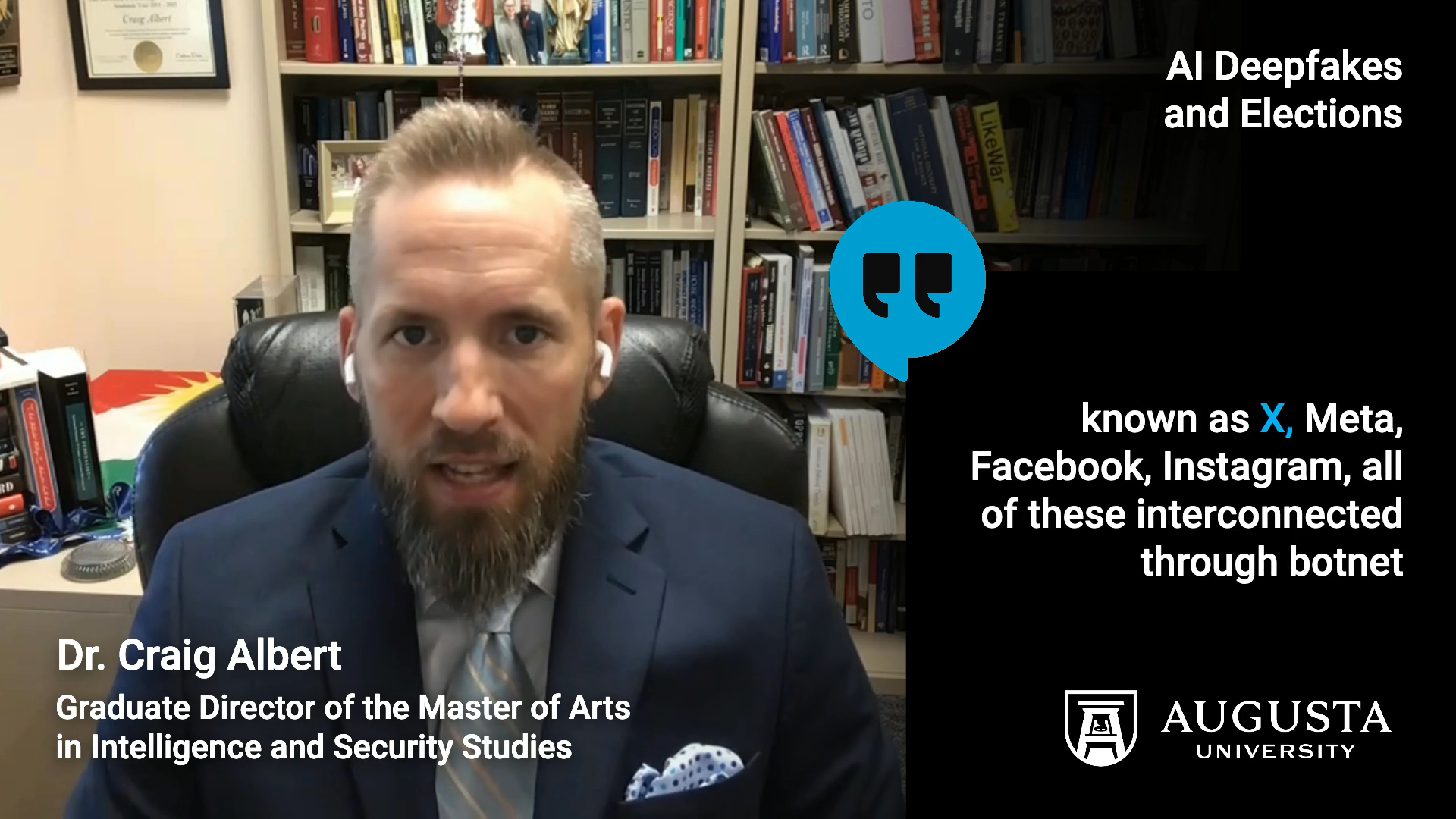
#ExpertSpots: AI, Deepfakes and Elections
The election in November is coming fast. And with voters divided and with what could be a small margin of Americans deciding who wins or loses in the race for the Whitehouse - the worry over misinformation and election interference has never been higher. It's why Dr. Craig Albert is here to break down just how AI and deepfakes might be used against any of the candidates leading up to November 05. Craig Albert, PhD, is director of the Master of Arts in Intelligence and Security Studies at Augusta University. He is a leading expert on war, terrorism and American politics. AI and the upcoming election is a serious topic. Albert is available to speak with media – simply click on his name to arrange an interview today.


Artificial Intelligence (AI) has emerged as a pivotal force driving innovation and reshaping our societal landscape. Its transformative potential spans across sectors, touching upon crucial global challenges such as ethics, privacy, and the future of employment. As AI continues to permeate various aspects of our lives, its intersection with pressing issues like climate change takes center stage. The upcoming launch of the Corporate Climate Responsibility Monitor by the NewClimate Institute in collaboration with Carbon Market Watch presents an invaluable opportunity to explore the symbiotic relationship between AI and corporate climate responsibility. Why This Matters to the Public: The Corporate Climate Responsibility Monitor 2024 serves as a beacon of insight into the nexus between corporate actions and environmental sustainability. Here are key sub-topics that offer intriguing story angles for a broad audience: Corporate Accountability in Climate Mitigation: Delve into how corporations are leveraging AI technologies to enhance their climate mitigation strategies. Highlight case studies of companies pioneering innovative approaches to reduce carbon emissions and promote sustainable practices. Transparency and Reporting Standards: Investigate the role of AI-driven data analytics in facilitating transparent reporting on corporate carbon footprints and environmental impact. Explore how enhanced transparency fosters accountability and drives corporate responsibility. Emerging Trends in Carbon Markets: Explore the evolving landscape of carbon markets and the role of AI in optimizing carbon trading mechanisms. Examine how AI-powered algorithms are revolutionizing carbon pricing strategies and incentivizing emission reductions. Collaborative Initiatives for Climate Action: Showcase collaborative efforts between corporations, NGOs, and government bodies in tackling climate change. Highlight partnerships forged to develop AI-driven solutions for environmental monitoring, renewable energy adoption, and sustainable supply chain management. The Economics of Climate Responsibility: Analyze the economic implications of corporate climate responsibility initiatives. Investigate how AI technologies are reshaping business models, driving cost savings through energy efficiency measures, and unlocking new revenue streams in the transition to a low-carbon economy. Impacts on Global Sustainability Goals: Assess the contribution of corporate climate responsibility efforts to achieving international sustainability targets such as the Paris Agreement and the United Nations Sustainable Development Goals (SDGs). Highlight success stories and challenges faced in aligning corporate strategies with broader environmental objectives. Connect with an Expert about Corporate Climate Responsibility For journalists with questions or looking to cover the the Corporate Climate Responsibility Monitor here is a select list of experts. To search our full list of experts visit www.expertfile.com Pamela Grothe Assistant Professor · University of Mary Washington Michael Vandenbergh Professor of Law · Vanderbilt University Sara Harris Professor of Teaching, Department of Earth, Ocean and Atmospheric Sciences · University of British Columbia Tom Rand Managing Director at MaRS Cleantech Fund I, L.P. · MaRS Cleantech Michael Rawlins Extension Associate Professor and Associate Director, Climate System Research Center · University of Massachusetts Amherst Photo Credit: Markus Spiske


The Power of Impartiality: Exploring the Benefits of VisiLeap AI's Relevancy Assessment for Acceleroute's Patent Portfolio Unlocking Patent Portfolio Potential Acceleroute's patent portfolio is a treasure trove of innovative ideas and concepts. However, the challenge lies in identifying which patents are truly valuable and relevant in today's fast-paced technological landscape. With InventionShare's VisiLeap AI's relevancy assessment scorecarding, Acceleroute can now unlock the full potential of its patent portfolio organized by companies that could benefit as well as major data center considerations and new demands such as virtual and augmented reality, AI LLMs and AGI. Efficient Opportunity Identification By leveraging VisiLeap AI and human dataset creation and scorecarding, patent portfolios such as Acceleroute can be unbiasedly assessed as to their relevancy to global corporations or new high growth enterprises. This eliminates the guesswork and allows the AcceleRoute to fairly represent their portfolio without any bias. Maximizing ROI One of the key benefits of VisiLeap AI's relevancy assessment tool is its ability to maximize return on investment for Acceleroute's patent portfolio. By strategically identifying high-value patents in the context of leading technology companies and use case, the company can prioritize companies for licensing or acquisition of the portfolio. Staying Ahead of the Competition In today's competitive business landscape, staying ahead of the competition is crucial for long-term success. VisiLeap AI's assessment software gives Acceleroute the competitive edge by helping them identify the relevancy of each of the individual patents in the portfolio in the context of industry competitors and emerging technology trends. The portfolio currently has 39 US patents (with many equivalent Canadian patents) and two continuation's in process. In conclusion, the VisiLeap AI's relevancy assessment presents a solid opportunity for Acceleroute to unleash the full potential of its patent portfolio. To explore how this technology can benefit your organization contact us today for a personalized consultation. About InventionShare About VisiLeap About Acceleroute


Aston University research centre to focus on using AI to improve lives
• New centre specifically focuses on using AI to improve society • Current research is designed to improve transport, health and industry • “There have been a lot of reports focusing on the negative use of AI...this is why the centre is so important now.” Aston University researchers have marked the opening of a new centre which focuses on harnessing artificial intelligence (AI) to improve people’s lives. The Aston Centre for Artificial Intelligence Research and Application (ACAIRA) has been set up to become a West Midlands hub for the use of AI to benefit of society. Following its official opening, the academics leading it are looking to work with organisations and the public. Director Professor Anikó Ekárt said: “There have been a lot of reports focusing on the negative use of AI and subsequent fear of AI. This is why the centre is so important now, as we aim to achieve trustworthy, ethical and sustainable AI solutions for the future, by co-designing them with stakeholders.” Deputy director Dr Ulysses Bernardet added: “We work with local, national and international institutions from academia, industry, and the public sector, expanding Aston University’s external reach in AI research and application. “ACAIRA will benefit our students enormously by training them to become the next generation of AI practitioners and researchers equipped for future challenges.” The centre is already involved in various projects that use AI to solve some of society’s challenges. A collaboration with Legrand Care aims to extend and improve independent living conditions for older people by using AI to analyse data collected through home sensors which detect decline in wellbeing. This allows care professionals to change and improve individuals’ support plans whenever needed. A project with engineering firm Lanemark aims to reduce the carbon footprint of industrial gas burners by exploring new, more sustainable fuel mixes. Other projects include work with asbestos consultancy Thames Laboratories which will lead to reduced costs, emissions, enhanced productivity and improved resident satisfaction in social housing repairs and a partnership with transport safety consultancy Agilysis to produce an air quality prediction tool which uses live data to improve transport planning decisions. The centre is part of the University’s College of Engineering and Physical Sciences and its official launch took place on the University campus on 29 February. The event included a talk by the chair of West Midlands AI and Future Tech Forum, Dr Chris Meah. He introduced the vision for AI within the West Midlands and the importance of bringing together academics, industry and the public. Current research in sectors such as traffic management, social robotics, bioinformatics, health, and virtual humans was highlighted, followed by industry talks from companies Smart Transport Hub, Majestic, DRPG and Proximity Data Centres. The centre’s academics work closely with West Midlands AI and Future Tech Forum and host the regular BrumAI Meetup. About Aston University For over a century, Aston University’s enduring purpose has been to make our world a better place through education, research and innovation, by enabling our students to succeed in work and life, and by supporting our communities to thrive economically, socially and culturally. Aston University’s history has been intertwined with the history of Birmingham, a remarkable city that once was the heartland of the Industrial Revolution and the manufacturing powerhouse of the world. Born out of the First Industrial Revolution, Aston University has a proud and distinct heritage dating back to our formation as the School of Metallurgy in 1875, the first UK College of Technology in 1951, gaining university status by Royal Charter in 1966, and becoming The Guardian University of the Year in 2020. Building on our outstanding past, we are now defining our place and role in the Fourth Industrial Revolution (and beyond) within a rapidly changing world. For media inquiries in relation to this release, contact Nicola Jones, Press and Communications Manager, on (+44) 7825 342091 or email: n.jones6@aston.ac.uk


Cancer Diagnosis and Prevention Breakthroughs | Media Advisory
With two cancer diagnoses in the Royal family - cancer is regrettably a trending topic but also a vitally important one for everyone. In the ongoing battle against cancer, recent advancements in diagnosis and prevention offer promising avenues for both medical practitioners and the general public. With cancer being one of the leading causes of death globally, developments in this field not only hold significant importance for healthcare but also for individuals and families impacted by the disease. Here's why this matters and potential story angles: Why it Matters: Health Impact: Improved diagnostic tools and preventive measures can lead to earlier detection and more effective treatment options, potentially saving lives. Economic Implications: The economic burden of cancer treatment on individuals, families, and healthcare systems underscores the importance of preventative measures and early detection. Public Health: Addressing cancer at the diagnostic and prevention stages contributes to broader public health initiatives, reducing the overall incidence and mortality rates. Story Angles: Breakthrough Technologies: Explore innovative diagnostic technologies such as liquid biopsies or AI-driven imaging systems transforming cancer detection. Lifestyle and Prevention: Investigate lifestyle factors, from diet and exercise to environmental exposures, and their role in cancer prevention. Genetic Research: Cover advancements in genetic testing and personalized medicine, offering insights into individual risk factors and tailored prevention strategies. Access to Care: Examine disparities in access to cancer screening and prevention measures, particularly among underserved communities. Survivor Stories: Highlight stories of individuals who have benefited from early detection or preventive interventions, offering hope and inspiration. Policy and Advocacy: Discuss the role of policy initiatives and advocacy efforts in promoting cancer prevention strategies and ensuring equitable access to screening and diagnostic services. Connect with an Expert about Cancer Diagnosis and Prevention Breakthroughs For journalists seeking research or insights for their coverage about Cancer Diagnosis and Prevention Breakthroughs here is a select list of experts from our database. To search our full list of experts, visit www.expertfile.com Anna McDaniel Dean of the College of Nursing – University of Florida Jorge Cortes Director, Georgia Cancer Center – Augusta University Nicholas J. Petrelli Bank of America endowed medical director of the Helen F. Graham Cancer Center and Research Institute – ChristianaCare Katherine Reeves Professor of Epidemiology and Associate Dean of Graduate and Professional Studies, School of Public Health and Health Sciences – University of Massachusetts Amherst Nicole Onetto Deputy Director and Chief Scientific Officer – Ontario Institute for Cancer Research Photo Credit: National Cancer Institute

Tackling Tik Tok - Our expert explains what the problem is and what's next for the Chinese owned app
TikTok is one of the most popular social media sites in the world. In the United States, more than 170 million people and businesses use the app on a regular basis. Now, the federal government has taken the first step in banning the China-based app unless the ownership group, ByteDance, sells TikTok. The House of Representatives passed a bipartisan bill in support of the ban, and now it awaits Congress to act. President Joe Biden has indicated he would sign the bill banning TikTok unless it’s sold, but whether it reaches his desk remains to be seen. This stems from the fear that China uses user information to their advantage. According to Lance Hunter, PhD, associate professor of political science in Pamplin College of Arts, Humanities and Social Sciences, the concern is well deserved. “Even if it’s a privately-owned enterprise, China can still control it, they can still manipulate it to some degree as if it was a state -owned enterprise,” said Hunter. Hunter’s research focuses on how informational warfare attacks influence politics worldwide. He said the algorithm TikTok uses can play a major role in informational warfare on two fronts. “One, it’s the data gathering, and that can be used for micro targeting because basically what TikTok can do is collect the data and provide information as to what certain individuals respond to an this is exactly how you can persuade them.” “Also, there is empirical evidence that China has used TikTok before to try to influence elections to some degree. One example in the 2022 midterm elections in which some candidates from both parties were targeted by TikTok accounts that were controlled by a propaganda agency operating within the Chinese government.” Hunter added the TikTok algorithm is more advanced than some other social media platforms and more effective in knowing what people like and why they like it. With so many AI-generated posts, it can be difficult for the consumer to decipher what is legitimate, and what isn’t. There are some red flags for people to be on the lookout for. “One thing the average person can do is be very wary of what you’re seeing and ask yourself does this seem legitimate?” he added. “If everyone is saying the exact same thing, that’s a tell sometimes. Also, where does this information originate from, and what are the timestamps on the posts? Something else is to look at the individual who made the post. Who are these people and who’s following them? You may be able to see if they are legitimate accounts.” While China, and Russia for that matter, are trying to influence people in several ways, Hunter said they are also trying to cause division among the American people. “They do want to influence elections at times, absolutely. But one of their other goals, and sometimes even more predominant goals for them, is to increase division, increase polarization, and that’s a great way to do that,” Hunter said. “Even if you have a temporary reaction, you’ve increased that division which could have longer term effects.” Are you covering this important and ongoing story? Then let us help with your stories and questions. Lance Hunter is an assistant professor of political science with a background in international relations. His research focuses on how terrorist attacks influence politics in democratic countries and how political decisions within countries affect conflicts worldwide. He is available to speak with media about this important topic - simply click on his icon to arrange an interview today.


#Expert Q&A: NJIT’s David Bader on AI, Data Science, Quantum Computing
Artificial intelligence, data science and the emerging field of quantum computing are among the hottest research topics in computing today. David Bader, a distinguished professor at New Jersey Institute of Technology’s Ying Wu College of Computing and the director of the university’s Institute for Data Science, offers his take on each. The Computer History Museum has recognized you for developing a Linux supercomputer using commodity hardware. Was that a life-shaping lesson? It was a venture into the unknown, leveraging the emerging potential of Linux and commodity hardware to build something that was both accessible and powerful. This experience taught me the importance of embracing risk and the value of resilience. There were technical hurdles, skepticism from peers and the daunting task of venturing beyond established norms. Also, the Linux supercomputer project was not just about the technology. It was about building a community around an idea. How do user-friendly AI systems like ChatGPT impact your work? It enriches the palette of methodologies and technologies at our disposal, enabling us to tackle more ambitious projects with greater efficiency and creativity. By integrating these AI systems into our research and educational programs, we're not just enhancing our ability to process and analyze data. We're also empowering students and researchers with the means to innovate and explore new horizons in data science without being hindered by the technical complexities that once acted as barriers. Some information workers fear that AI will make their careers obsolete. But tech progress can’t be stopped, so how should people adapt? By embracing these technologies, learning to work alongside them and leveraging their capabilities to enhance our own skill sets and productivity. Also, it's important to focus on the uniquely human skills that AI cannot replicate, such as creativity, emotional intelligence and critical thinking. By honing these abilities, workers can ensure they remain irreplaceable components of the workforce, capable of tasks that require a human touch — from complex decision-making to empathetic interactions with customers or clients. What should non-programmers learn about AI? It’s important to be aware of how AI decisions are made, the potential biases in AI systems and the ethical considerations of AI use. Additionally, developing data literacy is crucial, as it enables individuals to evaluate AI outputs and understand the importance of data quality and biases. A basic grasp of AI and machine learning concepts — even without programming skills — can demystify AI technologies and reveal their potential applications. Staying informed about AI advancements across various sectors can also inspire innovative ideas and foster interdisciplinary collaborations. There’s a sci-fi plot where computers get so smart that people lose control. The new class of user-friendly AI is making people excited but also nervous. Should we be afraid? While it’s natural to harbor concerns about the rapid progression of AI, allowing fear to dominate the discourse would be a disservice to the potential benefits these technologies can offer. Instead, this moment calls for proactive engagement with AI and an investment in understanding its inner workings, limitations and the ethical dilemmas it presents. By advocating for responsible AI development, emphasizing education and promoting transparency, we can foster an environment where AI serves as a tool for societal advancement. This approach ensures that we remain at the helm of AI's trajectory, steering it toward outcomes that uplift humanity rather than scenarios that fuel dystopian fears. What other emerging technologies excite you in their potential to transform computing? Quantum computing. This technology, with its potential to solve complex problems exponentially faster than classical computers, could revolutionize fields ranging from cryptography to drug discovery, climate modeling and beyond. Quantum computing's promise to tackle challenges currently beyond our reach, due to its fundamentally different approach to processing information, represents a leap forward in our computational capabilities. Its convergence with AI could lead to unprecedented advancements, making this era an incredibly thrilling time to be at the forefront of computing and data science. Looking to know more? We can help. David Bader is available to discuss AI, quantum computing and data science with media. Simply click on his icon to arrange an interview.



Aston University to train the UK’s next generation of decarbonisation experts
Consortium led by the University is to receive almost £11 million to open doctoral training centre Will focus on use of biomass to replace fossil fuels and removal of CO2 “…part of the UK’s biggest-ever investment in engineering and physical sciences doctoral skills”. Aston University is to train the next generation of scientists tasked to remove greenhouse gases from the environment. A consortium led by the University is to receive almost £11 million to open a doctoral training centre which will focus on leading the UK towards net zero. The centre, based at Aston University, will bring together world-leading research expertise and facilities from the University of Nottingham, Queens University Belfast and the University of Warwick and more than 25 industrial partners. The funding has been announced by the UK science, innovation and technology secretary Michelle Donelan. The centre is to receive almost £8 million of government money while the remainder will be made up through match funding and support from industry and the four universities. The government has described it as part of the UK’s biggest-ever investment in engineering and physical sciences doctoral skills, totalling more than £1 billion. The Aston University centre will focus on the use of biomass to replace fossil fuels and removal (or capture) of CO2 from the atmosphere, with the potential to create new sources of fuels and chemicals. Integration of these two areas will lead to significant cost and energy savings. Called NET2Zero, the centre will train PhD students across the full range of engineered greenhouse gas removal techniques including direct air capture, CO2 utilisation (including chemical and material synthesis), biomass to energy with carbon capture and storage, and biochar. The students will work in the centre’s laboratories exploring the conversion of feedstock into alternative energy, improving conversion processes and measuring how the new technologies will impact the economy. Supported by a range of relevant industrial, academic and policy partners the centre will equip students to develop the broad range of skills essential for future leaders in decarbonisation. NET2Zero will be led by Professor Patricia Thornley, director of Aston University’s Energy and Bioproducts Research Institute (EBRI). She said: “I am delighted that this centre for doctoral training has been funded. The climate emergency is so stark that we can no longer rely on demand reduction and renewables to meet our decarbonisation targets. “If we are to have greenhouse gas removal options ready in time to be usefully deployed, we need to start now to expand our knowledge and explore the reality of how these can be deployed. This partnership of four leading UK universities with key industrial and policy partners will significantly augment the UK’s ability to deliver on its climate ambitions.” “We are absolutely delighted to be working with our partners to deliver this unique and exciting programme to train the technology leaders of the future. Our students will deliver research outcomes that are urgently needed and only made possible by combining the expertise and resources of all the centre’s academic and industry partners.” Science and technology secretary, Michelle Donelan, said: “As innovators across the world break new ground faster than ever, it is vital that government, business and academia invests in ambitious UK talent, giving them the tools to pioneer new discoveries that benefit all our lives while creating new jobs and growing the economy. “By targeting critical technologies including artificial intelligence and future telecoms, we are supporting world class universities across the UK to build the skills base we need to unleash the potential of future tech and maintain our country’s reputation as a hub of cutting-edge research and development.” Centres for doctoral training have a significant reputation in training future UK academics, industrialists and innovators who have gone on to develop the latest technologies. The University of Nottingham’s Dr Eleanor Binner said: “We are absolutely delighted to be working with our partners to deliver this unique and exciting programme to train the technology leaders of the future. Our students will deliver research outcomes that are urgently needed and only made possible by combining the expertise and resources of all the Centre’s academic and industry partners.” Her colleague Professor Hao Liu added: “We look forward to providing our best support to the NET2Zero CDT, including using our past and existing successful experience in leading other centres, to make this an exemplar.” Overall, there will be 65 new Engineering and Physical Sciences Research Council (EPSRC) centres for doctoral training which will support leading research in areas of national importance including the critical technologies AI, quantum technologies, semiconductors, telecoms and engineering biology. The funding is from a combination of £500 million from UK Research and Innovation and the Ministry of Defence, plus a further £590 million from universities and business partners. Notes to Editors EPSRC and BBSRC Centre for Doctoral Training in Negative Emission Technologies for Net Zero (NET2ZERO) Led by: Professor Patricia Thornley, Aston University The Engineering and Physical Sciences Research Council (EPSRC) is the main funding body for engineering and physical sciences research in the UK. Our portfolio covers a vast range of fields from digital technologies to clean energy, manufacturing to mathematics, advanced materials to chemistry. EPSRC invests in world-leading research and skills, advancing knowledge and delivering a sustainable, resilient and prosperous UK. We support new ideas and transformative technologies which are the foundations of innovation, improving our economy, environment and society. Working in partnership and co-investing with industry, we deliver against national and global priorities. The Biotechnology and Biological Sciences Research Council (BBSRC) invests in world-class bioscience research and training on behalf of the UK public. Our aim is to further scientific knowledge, to promote economic growth, wealth and job creation and to improve quality of life in the UK and beyond. Funded by government, BBSRC invested £451 million in world-class bioscience in 2019-20. We support research and training in universities and strategically funded institutes. BBSRC research and the people we fund are helping society to meet major challenges, including food security, green energy and healthier, longer lives. Our investments underpin important UK economic sectors, such as farming, food, industrial biotechnology and pharmaceuticals. About Centres for Doctoral Training A CDT trains doctoral students with each centre focused on a specific theme or topic. Most CDTs will support five cohorts (a new cohort starting each academic year) with a cohort supporting an average of thirteen students. Fourteen of the centres will have four cohorts rather than five. EPSRC supports doctoral students through three training routes (Doctoral Training Partnerships, ICASE awards and CDTs), and in the last 30 years has supported over 50,000 doctoral students. About Aston University For over a century, Aston University’s enduring purpose has been to make our world a better place through education, research and innovation, by enabling our students to succeed in work and life, and by supporting our communities to thrive economically, socially and culturally. Aston University’s history has been intertwined with the history of Birmingham, a remarkable city that once was the heartland of the Industrial Revolution and the manufacturing powerhouse of the world. Born out of the First Industrial Revolution, Aston University has a proud and distinct heritage dating back to our formation as the School of Metallurgy in 1875, the first UK College of Technology in 1951, gaining university status by Royal Charter in 1966, and becoming The Guardian University of the Year in 2020. Building on our outstanding past, we are now defining our place and role in the Fourth Industrial Revolution (and beyond) within a rapidly changing world. For media inquiries in relation to this release, contact Nicola Jones, Press and Communications Manager, on (+44) 7825 342091 or email: n.jones6@aston.ac.uk


It's going to be a busy week in America when it comes to politics. And if you're covering - we have experts who can help with any of your questions or stories. Tom Smith - Professor in the Practice of Finance - Professor Smith is an expert in labor economics, entertainment and healthcare economics, as well as real estate and urban economies. David Schweidel - Professor of Marketing - Professor Schweidel has been closely researching the impact of AI in society, especially elections. He can speak on the impact AI is expected to have in this year’s elections. Professor Schweidel also has extensive work in election marketing. He researched negative campaign advertising and if a negative tone has a positive impact on election results. Ramnath Chellappa - Professor of Information Systems & Operations Management - Professor Chellappa is available to discuss the economics of information security and privacy. He can also discuss the economics and impact of AI. Raymond Hill - Professor Emeritus Hill is available to discuss any issues on the economy related to energy. If you are looking to arrange an interview - simply click any of the listed expert's icons to set up a time today or email Kim Speece for assistance.





Leap year: Tips for using extra day on career and professional development
Having an extra day in a leap year provides you with a unique opportunity to invest time in your career and professional development. Jill Gugino Panté, director of the Lerner Career Services Center at the University of Delaware, offers six ideas to maximize the day. Dedicate time to enhance your skills. It is easy to find free courses, workshops and training videos on just about anything. Take five minutes to reflect on a skill you wish you had or were better, such as, say, Excel. YouTube, TikTok and LinkedIn Learning have hundreds of thousands of videos that can teach shortcuts, visual design, formulas and more. Use the day for networking. Reach out to professionals in your industry and schedule informational interviews. Reconnect with old classmates, former bosses or colleagues from another department and invite them to meet for coffee or lunch. Spend the day talking with someone about your career/professional development goals. Reflect on your career goals. Many of us do not take the time to articulate where we want to be this time next year or even four years from now. Start with three months, then move to six months, then a year. Do you want to learn a new skill? Meet with someone whose career you’ve admired? Change jobs? Ask for a raise? Career development can be thought of as a series of projects because thinking four years ahead can seem a little daunting. However, making goals for the next six months makes the process more manageable and tangible. Update your career documents. This means not only your resume but your LinkedIn profile and professional bio. If you don’t have access to a Career Coach, use Generative AI (like Chat GPT) to help you write better bullet points or update your “About” section on LinkedIn. Keep in mind that AI should be viewed as a supportive tool rather than a replacement for your active involvement in the process. Maintain a personal touch and let your unique personality shine through in your application materials and interviews. Focus on your well-being. How often do we get an extra day to focus on ourselves? And on this particular leap year, you may be feeling stressed and overwhelmed so focusing on career goals isn’t an option. Take the opportunity for self-care – go for a leisurely walk, engage in meditation or stretching exercises, or schedule an online session with a therapist or counselor. Investing time in personal wellness is important to address before you leap into professional development. Make deliberate choices that not only contribute to your career growth but also foster a sense of well-being. Here's a pro tip: mark a "professional/personal development boost" block on your calendar for each leap year, ensuring you fully capitalize on the extra day. This strategic scheduling will serve as a reminder to prioritize both your professional growth and personal wellness. To set up an interview with Gugino Panté, visit her profile and click on the contact button.