
Experts Matter. Find Yours.
Connect for media, speaking, professional opportunities & more.

How LSU is Helping Keep Louisiana at the Center of the Nation’s Seafood Map
1. Strengthening the Seafood Workforce Through outreach programs like Louisiana Fisheries Forward, a partnership between Louisiana Sea Grant and the Louisiana Department of Wildlife and Fisheries, LSU helps fishers and processors modernize their operations. These voluntary programs teach best practices in handling, traceability, and sustainability — directly improving product quality and market reputation. LSU’s extension agents also provide hands-on disaster recovery assistance after hurricanes and market disruptions, helping ensure Louisiana’s seafood workforce remains resilient and ready for the next season. 2. Building Seafood Resilience The total economic value for oysters in 2018 was more than $180 million. Resilience defines LSU’s seafood science. Researchers at the LSU AgCenter and Louisiana Sea Grant are leading selective breeding programs and developing genetic tools to combat disease, temperature changes, and salinity stress. With a powerful combination of hatchery capacity, genetics expertise, and industry collaboration, LSU is helping Louisiana’s seafood industry adapt faster and smarter — protecting both the food supply and the economic backbone of coastal communities. 3. Powering Economic Growth Every part of LSU’s seafood research and outreach ties directly to Louisiana’s economy. AgCenter economists analyze market data and advise state and federal partners on strategies to grow the seafood sector. Meanwhile, Sea Grant specialists help entrepreneurs develop value-added seafood products, from branded lines to ready-to-eat options, that increase profit margins and create new jobs in coastal towns. By helping Louisiana seafood businesses stay competitive, LSU keeps more of the industry’s economic benefits right here at home. 4. Supporting Communities Louisiana’s seafood industry faces constant challenges. LSU’s coastal extension agents and Sea Grant programs provide on-the-ground support to help communities recover and rebuild after disasters. Whether assisting with dock repairs, connecting fishers to relief programs, or helping restart operations, LSU’s commitment ensures that Louisiana’s coastal workforce can weather any storm. 5. Preparing the Next Generation LSU’s work extends from the lab to the dock — and into the classroom. New research and education programs are training future scientists, producers, and entrepreneurs to continue Louisiana’s seafood legacy. For new LSU students interested in the coast, Bayou Adventure, a trip created by the College of the Coast & Environment (CC&E), was designed specifically to educate incoming freshmen about some of the challenges and marvels of the Louisiana coastline. The trip stops at sites that showcase "not just the significance of these areas to the state and nation, but the important work that is being done to sustain and preserve them," said Clint Willson, dean of CC&E. Through workforce development, hands-on learning, and applied research, LSU is shaping the next wave of innovators who will protect Louisiana’s coast and ensure its seafood remains world-renowned. Looking Ahead As the seafood industry faces new challenges and opportunities, LSU’s mission remains clear: to protect Louisiana’s coast, empower its seafood workforce, and ensure the state remains synonymous with the best seafood in America.


The e-learning resource, Supporting people living with long COVID, was developed by the Centre for Pharmacy Postgraduate Education (CPPE) It is designed to help community pharmacy teams build their skills, knowledge and confidence The programme offers video and audio resources, practical consultation examples and strategies for supporting individuals. Professor Ian Maidment at Aston Pharmacy School has been involved in a project with the Centre for Pharmacy Postgraduate Education (CPPE) to develop a new e-learning programme for community pharmacists, called Supporting people living with long COVID. The programme is designed to help community pharmacy teams build their skills, knowledge and confidence to support people managing the long-term effects of COVID-19. It was developed with researchers undertaking the National Institute for Health and Care Research (NIHR)-funded PHARM-LC research study: What role can community PHARMacy play in the support of people with long COVID? During the development of the e-learning resource, as well as with Professor Maidment, CPPE worked in collaboration with researchers from Keele University, the University of Kent, Midlands Partnership University NHS Foundation Trust and lechyd Cyhoeddus Cymru (Public Health Wales). The research draws on lived experience of long COVID, as well as the views of community pharmacy teams on what learning they need to better support people living with the condition. This new programme offers video and audio resources, practical consultation examples and strategies for supporting individuals through lifestyle advice, person-centred care and access to wider services. Professor Maidment said: “As an ex-community pharmacist, community pharmacy can have a key role in helping people living with long COVID. The approach is in line with the NHS 10 Year Health Plan, which aims to develop the role of community pharmacy in supporting people with long-term conditions.” Professor Carolyn Chew-Graham, professor of general practice research at Keele University, said: “Two million people in the UK are living with long COVID, a condition people are still developing, which may not be readily recognised, because routine testing for acute infection has largely stopped. For many, the pharmacy is the first place they seek advice about persisting symptoms following viral infection. The pharmacy team, therefore, has the potential to play a really important role in supporting people with long COVID. This learning programme provides evidence-based information to develop the confidence of pharmacy staff in talking to people with long COVID. Developed with people living with long COVID, the programme’s key message is to believe and empathise with people about their symptoms.” Visit www.cppe.ac.uk/programmes/l/covid-e-01 to access the e-learning programme. This project is funded by the National Institute for Health Research (NIHR) under its Research for Patient Benefit (RfPB) Programme (Grant Reference Number NIHR205384).


A global team of researchers using the new X-ray Imaging and Spectroscopy Mission (XRISM) telescope, launched in fall 2023, discovered something unexpected while observing a well-studied neutron star system called GX13+1. Instead of simply capturing a clearer view of its usual, predictable activity, their February 2024 observation revealed a surprisingly slow cosmic wind, the cause of which could offer new insights into the fundamental physics of how matter accumulates, or “accretes,” in certain types of binary systems. The study was one of the first from XRISM looking at wind from an X-ray binary system, and its results were published in Nature—the world's leading multidisciplinary science journal—in September 2025. Spectral analysis indicated GX13+1 was at that very moment undergoing a luminous super-Eddington phase, meaning the neutron star was shining so brightly that the radiation pressure from its surface overcame gravity, leading to a powerful ejection of any infalling material (hence the slow cosmic wind). Further comparison to previous data implied that such phases may be part of a cycle, and could “change the way we think about the behavior of these systems,” according to Joey Neilsen, PhD, associate professor of Physics at Villanova University. Dr. Neilsen played a prominent role as a co-investigator and one of the corresponding authors of the project, along with colleagues at the University of Durham (United Kingdom), Osaka University (Japan), and the University of Teacher Education Fukuoka (Japan). Overall, the collaboration featured researchers from dozens of institutions across the world. GX13+1 is a binary system consisting of a neutron star orbiting a K5 III companion star—a cooler giant star nearing the end of its life. Neutron stars are small, incredibly dense cores of supergiant stars that have undergone supernovae explosions. They are so dense, Dr. Neilsen says, that one teaspoon of its material would weigh about the same as Mount Everest. Because of this, they yield an incredibly strong gravitational field. When these highly compact neutron stars orbit companion stars, they can pull in, or accrete, material from that companion. That inflowing material forms a visible rotating disk of gas and dust called an accretion disk, which is extremely hot and shines brightly in X-rays. It’s so bright that sometimes it can actually drive matter away from the neutron star. “Imagine putting a giant lightbulb in a lake,” Dr. Neilsen said. “If it’s bright enough, it will start to boil that lake and then you would get steam, which flows away like a wind. It’s the same concept; the light can heat up and exert pressure on the accretion disk, launching a wind.” The original purpose of the study was to use XRISM to observe an accretion disk wind, with GX13+1 targeted specifically because its disk is persistently bright, it reliably produces winds, and it has been well studied using Chandra— NASA’s flagship X-ray observatory—and other telescopes for comparison. XRISM can measure the X-ray energies from these systems a factor of 10 more precisely than Chandra, allowing researchers to both demonstrate the capabilities of the new instrument and study the motion of outflowing gas around the neutron star. This can provide new insights into accretion processes. “It's like comparing a blurry image to a much sharper one,” Dr. Neilsen said. “The atomic physics hasn't changed, but you can see it much more clearly.” The researchers uncovered an exciting surprise when the higher-resolution spectrum showed much deeper absorption lines than expected. They determined that the wind was nearly opaque to X-rays and slow at “only” 1.4 million miles per hour—surprisingly leisurely for such a bright source. Based on the data, the team was able to infer that GX13+1 must have been even brighter than usual and undergoing a super-Eddington phase. So much material was ejected that it made GX13+1 appear fainter to the instrument. “There's a theoretical maximum luminosity that you can get out of an accreting object, called the Eddington limit. At that point, the radiation pressure from the light of the infalling gas is so large that it can actually hold the matter away,” Dr. Neilsen said, equating it to standing at the bottom of a waterfall and shining light so brightly that the waterfall stops. “What we saw was that GX13+1 had to have been near, or maybe even above, the Eddington limit.” The team compared their XRISM data from this super-Eddington phase to a set of previous observations without the resolution to measure the absorption lines directly. They found several older observations with faint, unusually shaped X-ray spectra similar to the one seen by XRISM. “XRISM explained these periods with funny-shaped spectra as not just anomalies, but the result of this phenomenally strong accretion disk wind in all its glory,” Dr. Neilsen said. “If we hadn’t caught this exact period with XRISM, we would never have understood those earlier data.” The connection suggests that this system spends roughly 10 percent of its time in a super-Eddington phase, which means super-Eddington accretion may be more common than previously understood—perhaps even following cycles—in neutron star or black hole binary systems. “Temporary super-Eddington phases might actually be a thing that accreting systems do, not just something unique to this system,” Dr. Neilsen said. “And if neutron stars and black holes are doing it, what about supermassive black holes? Perhaps this could pave the way for a deeper understanding of all these systems.”

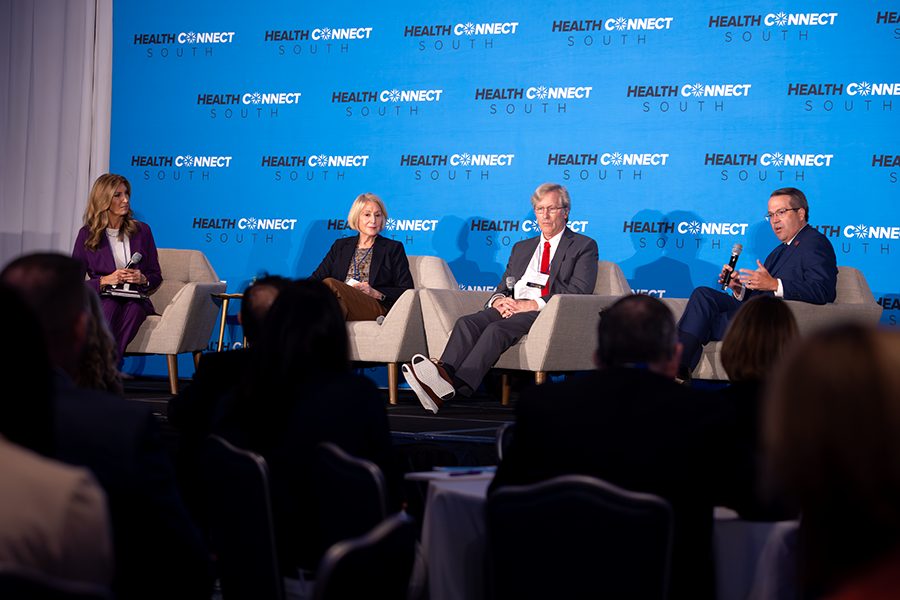
In the two years since Augusta University and Wellstar Health System formally signed an agreement on August 30, 2023, the historic partnership has continued to evolve into a truly collaborative alliance. At its heart, the mission hasn’t changed: improving the health and wellbeing of all Georgians while educating and preparing the next generation of health care providers through access to world-class training. That was the message shared by Augusta University President Russell T. Keen, Medical College of Georgia at Augusta University Dean David C. Hess, MD, and former Wellstar President and CEO Candice L. Saunders at the recent Health Connect South conference held at the Georgia Aquarium in Atlanta. During their panel “Advancing Healthcare Through Public-Private Partnerships,” the three leaders – each instrumental in helping to create, implement and mold the historic partnership – shared with close to 1,100 attendees their insight into what makes the partnership beneficial for all and how it can be a model for advancing health care and health care education in Georgia and beyond. The full panel discussion is available for viewing here: It was an important event, and a full article is attached below as well. And if you're interested in learning more about the partnership between Augusta University and Wellstar, or connect with Augusta's President Russell T. Keen - simply click on his icon now to arrange an interview today.


Delaware study reveals higher rates of anxiety, substance use among LGBT+ youth
A new study has found that LGBT+ youth in Delaware are experiencing disproportionately high rates of anxiety, depression and substance use compared to their cisgender heterosexual peers. University of Delaware’s Eric Layland, assistant professor in the College of Education and Human Development, and his coauthors reported that nearly one in four Delaware teens identifies as LGBT+, a dramatic increase from earlier state surveys that put the figure closer to 5%. More than one in 20 identified as transgender or nonbinary, reflecting national trends of increased visibility among Generation Z. The study revealed stark mental health differences. About half of cisgender heterosexual youth reported recent anxiety, compared to 75 to 80% of LGBT+ youth. These rates exceed both their heterosexual peers in Delaware and national averages for LGBT+ youth. Substance use patterns also raised concerns. By 8th grade, LGBT+ students reported higher rates of drinking, smoking, vaping and prescription drug misuse. Researchers noted that their substance use looked more like that of 11th grade heterosexual students than their peers in the same grade, pointing to early onset of risky behaviors. These disparities, established in middle school, largely persisted into high school. While substance use increased among all students over time, LGBT+ youth consistently reported higher rates. Based on state population data, the findings suggest there may be 18,000 to 20,000 LGBT+ youth in Delaware, including up to 5,000 transgender and nonbinary youth. The authors say this underscores the importance of ensuring that schools, healthcare providers and community programs have the resources to meet the needs of this population. This is one of the first Delaware-specific studies on youth health disparities by sexual orientation and gender identity using data collected after the height of the COVID-19 pandemic. The results, researchers say, highlight an urgent need for early intervention and affirming support systems for LGBT+ youth across the state. Layland, who specializes in LGBTQ+ development and affirmative interventions, can speak more about specific interventions. He is available by clicking his profile.


Recently, Craig Albert, PhD, was published in the Journal of Political Science Education. The article, 'Cyber-Enabled Education Operations: Towards a Strategic Cybersecurity Curriculum for the Social Sciences,' looks into how U.S. cyber intelligence training is overly technical and should integrate political science and social science courses to build strategic thinkers who understand adversaries’ motives and policies, ultimately strengthening U.S. national security. Craig Albert, PhD, is a professor of Political Science and the graduate director of the PhD in Intelligence, Defense, and Cybersecurity Policy and the Master of Arts in Intelligence and Security Studies at Augusta University. His areas of concentration include international security studies, cybersecurity policy, information warfare/influence operations/propaganda, ethnic conflict, cyberterrorism and cyberwar, and political philosophy. View his profile here. Here's the abstract from the paper in Research Gate: Most cyber intelligence analysts within the United States Intelligence Community (USIC) typically enter the field with strong technical expertise, often derived from degrees in computer science or extensive technical training. However, a critical gap exists in education and training on the strategic dimensions of cyber threats. This paper advocates for the integration of cybersecurity-focused courses within social science disciplines, particularly political science, to cultivate strategic thinkers who can contribute effectively to the USIC. The inclusion of strategic policy coursework in political science curricula, as well as more broadly across social science programs, would better prepare students for careers in the USIC by deepening their understanding of the motivations, capabilities, and intentions of the United States’ strategic adversaries in cyberspace—specifically Russia, China, Iran, and North Korea. Such training would equip analysts with critical insights to improve their effectiveness in identifying, attributing, and mitigating cyber intrusions. Moreover, a stronger emphasis on the human behavior and policy dimensions of cybersecurity would enhance the overall competency of the USIC workforce, thereby strengthening U.S. national security policy. Looking to know more? Let us help. Craig Albert, PhD, is available to speak with media. Simply click on his icon now to arrange an interview today.


University Communications Needs a Bigger Role in the Research Conversation
While attending the Expert Finder Systems International Forum (EFS), several notable themes emerged for me over the 2-day event. It's clear that many universities are working hard to improve their reputation by demonstrating the real-world impact of their research to the public and to funders, but it's proving to be a challenging task - even for the largest R1 universities. Many of these challenges stem from how institutions have traditionally organized their research functions, management systems, and performance metrics. Engaging faculty researchers in this process remains a significant challenge, despite the need for rapid transformation. While this EFS conference was very well-organized and the speakers delivered a great deal of useful information, I appeared to be one of the few marketing and communications professionals in a room full of research leaders, administrative staff, librarians, and IT professionals. There's a certain irony to this, as I observe the same phenomenon at HigherEd marketing conferences, which often lack representation from research staff. My point is this. We can't build better platforms, policies, and processes that amplify the profile of research without breaking down silos. We need University Communications to be much more involved in this process. As Baruch Fischhoff, a renowned scholar at Carnegie Mellon University, notes: Bridging the gap between scientists and the public “requires an unnatural act: collaboration among experts from different communities” – but when done right, it benefits everyone. But first, let's dive in a little more into RIM's and Expert Finder Systems for context. What are Research Information Systems (RIMs) Research Information Management systems (aka Expert Finder Systems) are the digital backbone that tracks everything researchers do. Publications, grants, collaborations, patents, speaking engagements. Think of them as massive databases that universities use to catalog their intellectual output and demonstrate their research capacity. These systems matter. They inform faculty promotion decisions, support strategic planning and grant applications, and increasingly, they're what institutions point to when asked to justify their existence to funders, accreditors, and the public. But here's the problem: most RIM systems were designed by researchers, for researchers, during an era when academic reputation was the primary currency. The game has fundamentally changed, and our systems haven't caught up. Let's explore this further. Academic Research Impact: The New Pressure Cooker Research departments across the country are under intense pressure to demonstrate impact—fast. State legislators want to see economic benefits from university research. Federal agencies are demanding clearer public engagement metrics. Donors want stories, not statistics. And the general public? They're questioning whether their tax dollars are actually improving their lives. Yet some academics are still asking, “Why should I simplify my research? Doesn’t the public already trust that this is important?” In a word, no – at least, not like they used to. Communicators must navigate a landscape where public trust in science and academia is not a given. The data shows that there's a lot of work to be done. Trust in science has declined and it's also polarized:. According to a Nov. 2024 Pew Research study, 88% of Democrats vs. 66% of Republicans have a great deal or fair amount of confidence in scientists; overall views have not returned to pre-pandemic highs and many Americans are wary of scientists’ role in policymaking. While Public trust in higher education has declined, Americans see universities having a central role in innovation. While overall confidence in higher education has been falling over the past decade, a recent report by Gallup Research shows innovation scores highest as an area where higher education helps generate positive outcomes. Communication is seen as an area of relative weakness for scientists. Overall, 45% of U.S. adults describe research scientists as good communicators, according to a November 2024 Pew Research Study. Another critique many Americans hold is the sense that research scientists feel superior to others; 47% say this phrase describes them well. The traditional media ecosystem has faltered:. While many of these issues are largely due to research being caught in a tide of political polarization fueled by a significant rise in misinformation and disinformation on social media, traditional media have faced serious challenges. Newsrooms have shrunk, and specialized science journalists are a rare breed outside major outlets. Local newspapers – once a reliable venue for highlighting state university breakthroughs or healthcare innovations – have been severely impacted. The U.S. has lost over 3,300 newspapers since 2005, with closures continuing and more than 7,000 newspaper jobs vanished between 2022 and 2023 according to a Northwestern University Medill Report on Local News. Competition for coverage is fierce, and your story really needs to shine to grab a journalist's attention – or you need to find alternative ways to reach audiences directly. The Big Message These Trends are Sending We can’t just assume goodwill – universities have to earn trust through clear, relatable communication. Less money means more competition and more scrutiny on outcomes. That's why communications teams play a pivotal role here: by conveying the impact of research to the public and decision-makers, they help build the case for why cuts to science are harmful. Remember, despite partisan divides, a strong majority – 78% of Americans – still agree government investment in scientific research is worthwhile. We need to keep it that way. But there's still a lot of work to do. The Audience Mismatch Problem The public doesn't care about your Altmetrics score. The policymakers I meet don't get excited about journal impact factors. Donors want to fund solutions to problems they understand, not citations in journals they'll never read. Yet our expert systems are still designed around these traditional academic metrics because that's what the people building them understand. It's not their fault—but it's created a blind spot. "Impact isn't just journal articles anymore," one EFS conference panelist explained. "It's podcasts, blogs, media mentions, datasets, even the community partnerships we build." But walk into most research offices, and those broader impacts are either invisible in the system or buried under layers of academic jargon that external audiences can't penetrate. Expert systems have traditionally been primarily focused on academic audiences. They're brilliant at tracking h-Index scores, citation counts, and journal impact factors. But try to use them to show a state legislator how your agriculture research is helping local farmers, or explain to a donor how your engineering faculty is solving real-world problems? There's still work to do here. As one frustrated speaker put it: "These systems have become compliance-driven, inward-looking tools. They help administrators, but they don't help the public understand why research matters. The Science Translation Crisis Perhaps the most sobering observation came from another EFS Conference speaker who said it very plainly. "If we can't explain our work in plain language, we lose taxpayers. We lose the community. They don't see themselves in what we do." However, this feels more like a communication problem masquerading as a technology issue. We've built systems that speak fluent academic, but the audiences we need to reach speak human. When research descriptions are buried in jargon, when impact metrics are incomprehensible to lay audiences, when success stories require a PhD to understand—we're actively pushing away the very people we need to engage. The AI Disruption Very Few Saw Coming Yes, AI, like everywhere else, is fast making its mark on how research gets discovered. One impassioned speaker representing a university system described this new reality: "We are entering an age where no one needs to click on content. AI systems will summarize and cite without ever sending the traffic back." Think about what this means for a lot of faculty research. If it's not structured for both AI discovery and human interaction, your world-class faculty might as well be invisible. Increasingly, you will see that search traffic isn't coming back to your beautifully designed university pages—instead, it's being "synthesized" and served up in AI-generated summaries. I've provided a more detailed overview of how AI-generated summaries work in a previous post here. Keep in mind, this isn't a technical problem that IT can solve alone. It's a fundamental communications challenge about how we structure, present, and distribute information about our expertise. Faculty Fatigue is Real Meanwhile, many faculty are experiencing serious challenges managing busy schedules and mounting responsibilities. As another EFS panelist commented on the challenges of engaging faculty in reporting and communicating their research, saying, "Many faculty see this work as duplicative. It's another burden on top of what they already have. Without clear incentives, adoption will always lag." Faculty researchers are busy people. They will engage with these internal systems when they see direct benefits. Media inquiries, speaking opportunities, consulting gigs, policy advisory roles—the kind of external visibility that advances careers and amplifies research impact. And they require more support than many institutions can provide. Yet, many universities have just one or two people trying to manage thousands of profiles, with no clear strategy for demonstrating how tasks such as profile updates and helping approve media releases and stories translate into tangible opportunities. In short, we're asking faculty to feed a system that feels like it doesn't feed them back. Breaking Down the Silos Which brings me to my main takeaway: we need more marketing and communications professionals in these conversations. The expert systems community is focused on addressing many of the technical challenges—data integration, workflow optimization, and new metadata standards — as AI transforms how we conduct research. But they're wrestling with fundamental communication challenges about audience, messaging, and impact storytelling. That's the uncomfortable truth. The systems are evolving whether we participate or not. The public pressure for accountability isn't going away. Comms professionals can either help shape these systems to serve critical communications goals or watch our expertise get lost in translation. ⸻ Key Takeaways Get Closer to Your Research: This involves having a deeper understanding of the management systems you use across the campus. How is your content appearing to external audiences? —not just research administrators, but the journalists, policymakers, donors, and community members we're trying to reach. Don't Forget The Importance of Stories: Push for plain-language research descriptions without unnecessarily "dumbing down" the research. Show how the work your faculty is doing can create real-world benefits at a local community level. Also, demonstrate how it has the potential to address global issues, further enhancing your authority. And always be on the lookout for story angles that connect the research to relevant news, adding value for journalists. Structure Expert Content for AI Discoverability: Audit your content to see how it's showing up on key platforms such as Google Gemini, ChatGPT. Show faculty how keeping their information fresh and relevant translates to career opportunities they actually care about. Show Up at These Research Events: Perhaps most importantly, communications pros need to be part of these conversations. Next year's International Forum on Expert Finder Systems needs more communications professionals, marketing strategists, and storytelling experts in the room. The research leaders, administrators and IT professionals you will meet have a lot of challenges on their plate and want to do the right thing. They will appreciate your input. These systems are being rapidly redesigned - Whether you're part of the conversation or not. The question is: do we want to influence how they serve our institutions' communications goals, or do we want to inherit systems that work brilliantly for academic audiences but get a failing grade for helping us serve the public?



LSU Ranked #1 University in Louisiana, Climbs in National WSJ Ranking
Louisiana State University has been named the #1 university in Louisiana and climbed to No. 179 in the nation in the Wall Street Journal's 2026 Best Colleges in the U.S. Rankings. This marks a steady rise from LSU's No. 188 ranking in 2025. The Wall Street Journal ranking evaluates universities on several measures, including student outcomes, campus experience, and financial value, with LSU earning an overall score of 69.4. Among the highlights: Student Outcomes: LSU scored a 75 for graduation rate and a 71 for salary impact, underscoring strong student success and career readiness. Value: The report highlights LSU's affordability and return on investment, with an average net price of $20,015 and graduates experiencing a value-added average wage increase of $37,023. Efficiency: LSU graduates, on average, are projected to pay off their education in just 2 years and 1 month. Student Experience: LSU earned strong marks for learning facilities (69), career preparation (67), and recommendation score (72). "Given the exceptional year LSU has had, it's no surprise we're rising in national rankings. LSU is recognized as the top university in Louisiana, and that's exactly what you should expect from an institution whose mission is to serve this state. That recognition tells me we're delivering on our promise to our students and to the people of Louisiana," said LSU Interim President Matt Lee. The ranking builds on LSU's Scholarship First Agenda, which focuses on advancing research, improving student success, and fueling Louisiana's workforce and economy. For the full rankings, visit Wall Street Journal Best Colleges 2026.

How well-meaning parents sink their child's chances of college admission
"What's the number one parent behavior that will hurt a child's chance of admission?" The question was posed to Robert Alexander, the University of Rochester vice provost and dean of enrollment management, on the podcast "College Knowledge." He was quick to answer. "Parents needs to be empowering the student and not driving the conversation" when it comes to choosing a college and engaging with college admissions professionals, Alexander replied. He explained that too many parents have a narrow view of what they deem as "acceptable" institutions of higher education for their child. They come by it honestly, he said, with most of their knowledge derived from their own college searches and dreams a generation ago. They tend to home in on 20 or 30 schools when, in reality, the universe of quality colleges and universities has expanded exponentially since the days these parents were considering where to study, Alexander said. "Widening that lends and thinking beyond the 20 or 30 schools they know a lot about or think they know a lot about or see a lot of bumper stickers for, that's really important," Alexander said. "There are many more really great institutions and what's important is not your child getting into 'the best college' that they can, but instead their child finding the best fit at one or maybe a range of different institutions." Alexander is an expert in undergraduate admissions and enrollment management who speaks on the subjects to national audiences and whose work has been published in national publications. Click his profile to reach him.



Teaching the Holocaust Part of New NYS Curriculum
Dr. Alan Singer, professor of education, talked to Newsday about the introduction of a new school curriculum teaching New York State students about the Holocaust and other mass murders. “Teaching the Holocaust and Other Genocides” was unveiled at a meeting in Albany of the state Board of Regents, which oversees New York’s educational institutions. The new resources will be optional for educators. Dr. Singer said the goal of Holocaust education is not to guide students to a particular conclusion, but to “engage students in research, in discussion, examining data, trying to reach conclusions about the past and present.”

