
Experts Matter. Find Yours.
Connect for media, speaking, professional opportunities & more.

With an estimated 1.5-million faculty in the US and a near 50,000 growth in UK-based academics in the last decade (to 225,000), universities and colleges have a whole range of interests and expertise on offer. In fact, despite rumours to the contrary, academia is a large and growing global ‘industry’. If you’re responsible for external relations, communications, marketing, civic engagement, knowledge exchange - or any other aspect of external engagement or “connectedness” in a university or college - then the ability to choose which faculty experts you selectively promote and publicise can be a very tough assignment. I’ve had first-hand experience with this. I was once in that very position - trying to keep up with the opportunities and the expectations afforded by 800 academics at just the one mid-sized UK institution where I worked. With the benefit of that firsthand experience and having since worked with more than 100 higher education institutions in the UK, Europe and North America, here are a few observations and also a few tips on how to organize your expertise: Approach #1: The Focus on Expertise Clusters An approach taken by some universities nowadays is to promote their expertise as a group of “grand challenges” or “beacons of excellence” - drawing together as many areas of research expertise under (usually) three or four headings. While identifying “token clusters” of expertise for focus and prioritisation may seem logical, this approach doesn’t really work. It may help with internal politics but it fails to generate enough precision to be relevant to various communities such as the media and industry. Approach #2: Selectively Promoting Key Experts One trap that universities can also fall into is to focus on a small group of academics who appear to be more suitable to promote. The reasoning for this approach is often driven by the need to have a manageable number for internal communications/press office staff to work with. The easy route to take is to just work with academics who are more keen to work with comms staff in promoting their work and who are already at ease in speaking to the media. Selection of experts on these factors, while important, isn’t the optimal way to build up the profile for the institution with key audiences. First off, this approach often doesn’t yield the diversity that audiences such as journalists and potential student and faculty recruits want to see represented. This approach will also miss the mark if it just plays to popular disciplines or hot topics. Being more inclusive to promote a wider range of disciplines and specialized topics is better value all round. Approach #3: The Faculty “Expertise Audit” I’ve seen institutions make many mistakes in positioning their faculty as experts, given it’s a proven way to differentiate brand, build profile and reputation. That’s why I’ve started to work with several universities on what I refer to as a “faculty expertise audit”. This brings a more structured process that helps prioritize key areas of research expertise and identify specialist experts. The audit also looks at the resources and overall capacity that universities have available to support an “expertise marketing” program that optimizes all these elements to significantly boost performance. Start with The Business Case for Expertise At the heart of this more structured, targeted audit approach is ensuring you are generating “return-on-investment” and “value-for-effort.” A good starting point is to ask: Where is the budget coming from? Where is current and expected demand for your programs? When starting this assessment, you have to think longer than a year out. Instead, look very hard and in detail at the next three to five years (the typical cycle of research investment and university strategies) and identify which expertise is most likely to solve the problems and consequential explorations that governments, industry, benefactors/donors, and funding agencies will want to support. I’m not saying that research areas without such sizable levels of predicted investment should be ignored - far from it - but we are in a competitive climate and universities now have to secure ‘orders’ (for applied and contracted expertise) that will ensure institutional sustainability and success. In turn, that success will allow investment in other areas that are socially vital but financially a weaker bet as regarded by funding sources. Having proven where research funding is most available, pressing and externally directed, then the audit is designed to identify and match the institution’s research talent to these requirements. These audits involve shortlisting, enlisting and then coaching the appropriate academic experts. The best results come from one-to-one sessions with academics which create buy-in and yield a more detailed marketing plan to leverage your experts. While more inclusive, this is an efficient process designed to create a “shared roadmap” for where the university and the academic both want to take their expertise. A large part of this roadmap then covers off other important activities such as creating a more discoverable and engaging online presence with enriched academic profiles that perform far better than the traditional “faculty directory.” Keeping online academic profiles fresh, content-rich, jargon-free, and compelling makes the job of expert ‘mining’ so much easier. Developing a sustained program of content with an organized lead generation process is also necessary. These extra steps are where many universities miss the mark. The result is a significant loss of inbound opportunities for research grants, consulting revenues, academic collaborations as well as local and global media coverage. I recently spoke with a Vice Chancellor of a prominent UK University who admitted that they as an institution deserved a failing grade when it came to promoting their faculty research achievements, saying that he “doubted any of their academics would be happy with the way their work was being promoted online.” This is an important aspect of the faculty audit. As a consultative process, it is non-threatening and we’re listening to staff and academics. That not only enriches the information the University has to promote its brand better, it also helps to enlist the support of the academic community who see that the university cares and that it is getting their input to put together a plan – both for the university and for individual academics. The academic is happy (they understand the value for them personally and for their institution); the University is happy (it is able to focus and prioritise its expertise in an evidence-based manner), and Communications and press office staff are happy (they have so more to work with in connecting the work of the University to a variety of local and global communities). The Benefits of A Faculty Audit Having completed many of these, I’ve seen very clearly, the results of a well run Faculty Audit process that without exception yield an excellent return on investment. Here are just some of the benefits to consider: Greater Insights: Gain a deeper understanding of the hidden strengths and opportunities within your academic ranks. Better Planning: A detailed report from a Faculty Audit enables a more strategic approach to planning where faculty research and expertise can support various programs within the University - such as industry engagement, media coverage and recruitment. Building Trust: When conducted by a third-party, a Faculty Audit is seen as more credible and less prone to perceptions of internal bias. More Engaged Faculty: Increased collaboration with faculty is gained through a more consultative process that builds “shared awareness” and enables more proactive support of their research. Increased Capacity: Producing more proactive content with faculty yields better results in terms of media coverage, research engagements, etc. Demonstrate Diversity: A better understanding of expertise that goes beyond the “usual suspects” to engaging a more diverse set of faculty to promote the University. News Coverage: Positioning your faculty and their research in a more relevant way aligns with the interests of the outside world and what's on the mind of outsiders. Less Stress: A more proactive, well structured plan helps everyone to synchronise activities better versus scrambling too much to meet deadlines in the “here and now.” Is a Faculty Audit Right for Your Institution? Here are some key considerations when evaluating the value of a Faculty Audit for your institution. You are ideally suited to undertake a faculty expertise audit if: You have a stretched workload where there's little capacity for proactive comms. You're tending to turn to the same academics for expert commentary in the media or elsewhere. You tend to get complaints (or mild mutterings) about not supporting academics enough. You don't have time to get to know the range of academic experts in your institution - especially new arrivals or eager early career academics. You've adopted an 'inside out approach' rather than one that engages with the interests of the outside world and what's on the mind of outsiders. There's weak management of expectations with the academic community - and a need for clarity and shared pathways for publicity. You're operating too much in the here and now and don't have the time to plan for future events, milestones and opportunities. You want to be more strategic in your comms and engagement - and make a real difference via attracting interest, income and investment. You don't have an integrated approach to comms (where content can be repurposed and recycled). You want more global reach and presence and can exploit digital tools to enable this. Additional Resources Academic Experts and the Media (PDF) This report, based on detailed interviews with some of the most media-experienced academics across the UK and United States draws on their experiences to identify lessons they can share in encouraging other academics to follow in their path. Download the UK Report Here Download the US Report Here The Complete Guide to Expertise Marketing for Higher Education (PDF) Expertise Marketing is the next evolution of content marketing. Build value by mobilizing the hidden people, knowledge and content you already have at your fingertips. This win-win solution not only gives audiences better quality content, but it also lets higher ed organizations show off their smarts. Download Your Copy Click Here for Additional Resources



Why pollen season arrives earlier each year: Q&A with Georgia Southern biology professor Alan Harvey
As a seasonal allergy sufferer, Alan Harvey, Ph.D., biology professor in Georgia Southern University's College of Science and Mathematics, was curious what types of pollen were causing his sniffles and sneezes. As a scholar and educator, Harvey did what any curious mind would do — he began exploring the types of pollen in the region while trying to narrow down the culprit of his symptoms. What he didn’t expect to find was an interesting narrative that led to a collaborative art-science project and soon a full exhibit on pollen at the Georgia Southern Museum. Read on to learn more about Harvey’s research on pollen, upcoming exhibit, “Pollen Nation,” and why pollen season begins earlier each year. Q: Tell us about yourself — Who are you? What do you teach? How long have you been a professor here? A: I’m a professor and faculty member at Georgia Southern. This is my 23rd year here and I teach a variety of biology courses including field biology, invasive species and evolutionary ecology. Q: How long have you studied pollen and what interested you in studying this? A: I’ve not actually studied pollen for that long. I really wanted to figure out how to deal with my own severe allergies to it. Q: What is the most common pollen in our region? A: The most common pollen depends on the time of year. Any plant that produces flowers will produce pollen. But if you’re looking at a plant with nice, pretty flowers, that pollen is not going to be what you’d normally encounter or notice causing your allergies because that pollen is being transmitted by insects or other pollinators who are specifically being attracted by the pretty flowers. The kind of pollen that you do encounter is from plants that you wouldn’t even notice have flowers like pine, oak, maple and birch trees. Those are all wind-pollinated, so they don’t need pretty flowers. They’re not trying to attract anybody, they just have to produce a lot of pollen for the wind to blow around. This time of year, pine and oak are going to be the two common pollens. Q: When does pollen season usually begin in our region? A: It starts in the early spring and ends in late fall. And again, it’s different plants blooming during the course of that year. So this time of year, as I mentioned, is going to be pines and oaks. In the middle of the year, it will be more grasses, and toward the end of the year, it’s going to be things like ragweed. What scientists have discovered is that every year the pollen season starts earlier and lasts longer. Q: Why will it begin early this year? A: This is where we get into a sort of controversial subject, but basically, climate change issues are the main culprit in a couple of ways. First of all, plant growth is tied to temperature. So the earlier temperatures get warmer, the earlier in the year the plant is going to start actively growing and producing pollen. So, warmer temperatures are leading to earlier seasonal starts. Temperatures are warmer than they were at this time a few decades or 100 years ago. Q: Why is pollen important? A: It’s an essential component of sexual reproduction in plants, so in the absence of pollen, we would lose many, if not virtually all of the plants around us that we depend upon. It’s fundamentally important to life on Earth that those plants are able to continue to reproduce. In terms of its impact on known pollinators, when a bee visits a flower, it is, of course, looking for nectar that the plants produce, but they also are looking for pollen. So it’s a food source for a lot of animals as well. Q: What is an interesting fact or little-known fact about pollen? A: Pollen plays a role in some various religious ceremonies of other cultures. The one I’m most familiar with is in the Navajo Nation. In particular, corn pollen is at the core of a great many, if not virtually all, of the Navajo religious ceremonies. It’s also been used to solve crimes and there is a whole field of forensic pollen analysis. It’s also an important tool for paleontologists, anthropologists and archaeologists who are trying to understand past civilizations. Because pollen is incredibly resilient, it may be small, but it is darn near indestructible. You would need a pretty powerful microscope to see any of these, but with that tool, you can study pollen grains that are hundreds of millions of years old. They will last that long. They’re so, so tough. Q: Tell us about the new mural in the Biological Sciences Building — What inspired it? Who helped work on it? A: A number of years ago, a colleague in the Betty Foy Sanders Department of Art, Jeff Shmucki, and his wife Wendy Deschene and I came together and started collaborating on art-science projects because we realized we both are observers of the natural world, we just approach it from somewhat different ways. One of those projects was creating a mural of ecologically or environmentally important organisms surrounding students that they may not be aware of. For the first mural, we looked at salamanders of Georgia. We got a bunch of photographs of the salamanders and we cut them away from the background, blew them up and installed the murals. It was a big community project and students got involved in all phases of it. So I thought, ‘Well, that was really successful.’ What can we do next? And because I was in the middle of allergy attacks, I thought, ‘Well, what about pollen?’ Q: Tell us how the mural inspired your upcoming exhibit, “Pollen Nation,” at the Georgia Southern Museum. A: There are a lot of interesting layers to this basic idea of pollen that can’t really be shown in a mural, and the Georgia Southern Museum is a perfect place to explore those kinds of ideas in one common theme. Q: What can people expect to see at the “Pollen Nation” exhibit? A: There’ll be a lot of big, spectacular images of pollen and the plants that produce them. It’s going to be a mix of striking imagery and some interactive sort of game-like activities. You’ll also have the opportunity to look at some of the pollen in a microscope. Interested in learning more? Let us help. Allan Harvey, Ph.D., is available to answer your questions - simply reach out to Georgia Southern Director of Communications Jennifer Wise at jwise@georgiasouthern.edu to arrange an interview today.

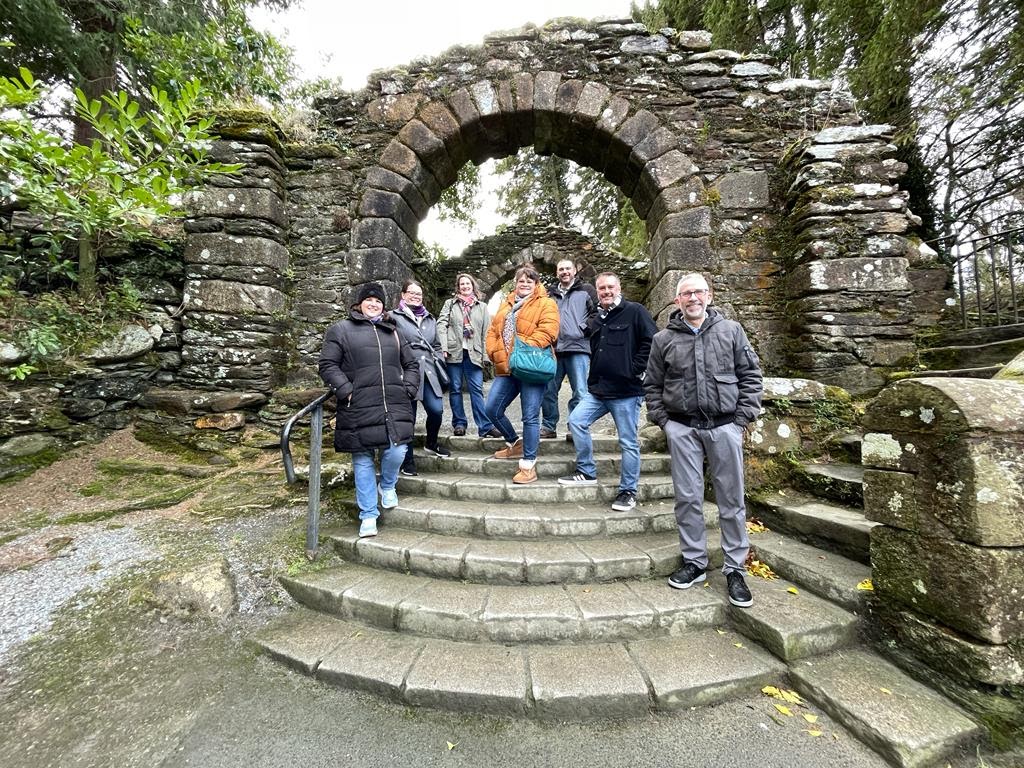
$100K student scholarship pool available for 2022 summer courses in Ireland Six professors from Georgia Southern University’s College of Education (COE) recently broadened their horizons during a trip to Ireland as they learned from and shared insight with instructors and educational leaders in the Wexford County community. Led by Howard Keeley, Ph.D., director of the University’s Center for Irish Research and Teaching, COE faculty traveled to Georgia Southern’s learning center in Wexford, Ireland, to observe Irish educational settings and exchange ideas with local leaders just ahead of a summer study abroad program opportunity for Georgia Southern students in which $100,000 of scholarship funding is available. “The main thing we did was get in front of leaders in the education space in Ireland,” stated Keeley. “We spoke to a number of folks who are either principals or vice principals or, in some way, senior administrators in a variety of schools including all-boys, all-girls, religious, secular and mixed schools.” The group included Catherine Howerter, Ph.D., associate professor of elementary and special education; Kip Sorgen, Ph.D., assistant professor of leadership, technology and human development; Alex Reyes, Ph.D., assistant professor of middle grades and secondary education; Amanda Wall, Ph.D., associate professor of middle grades and secondary education; Betsy Barrow, Ed.D., assistant professor of middle grades and secondary education; and Dan Calhoun, Ph.D., professor of leadership, technology and human development. Reyes, who trains pre-service and in-service teachers to work with culturally and linguistically diverse students, was excited to travel to Wexford after a study abroad program in Czech Republic she spearheaded with Wall was canceled in March 2020 due to the pandemic. Intrigued by Ireland, a plurilingual country, she was curious to see how Wexford’s environment might benefit students culturally. “I thought it was really exciting,” said Reyes. “All of the street signs are in Irish, even though English is the main language spoken. That prioritizing of that cultural heritage is fascinating. It was great to learn that the students in their primary and secondary schools take Irish language and culture as a subject every year.” She was especially motivated by a field trip to an Irish-language school, Meanscoil Gharman, which serves middle and high school students. With the exception of one daily class in English, teachers and students conducted all lessons in Irish. “It was really interesting to see that perspective,” she said. “There has been a revitalization of that culture. I thought that was fascinating to see how that can be handled in school.” In addition, Reyes was duly impressed with the country’s prioritization of social and emotional literacy for children, and the mandated well-being hours that are incorporated into daily school routines as a result of the pandemic. A program that promotes hygiene and an anti-bullying campaign also fit into the wellness curriculum. “It really impressed me that as a nation they prioritize the wellness of students, and how language and cultures can really be supported in a meaningful way,” Reyes said. “It’s affirming to see a proactive approach that has positive outcomes. Now, thinking ahead, we can look at how we can create opportunities for our students to experience this kind of approach.” Sorgen, who teaches in the educational leadership program at Georgia Southern, was interested in Ireland’s professional preparation. “None of them had advanced degrees, like what we offer at Georgia Southern,” noted Sorgen. “Learning about how to be a principal in Ireland is on-the-job training. In Georgia, there are specific educational requirements for our school administrators guided by professional standards. In Ireland, they generally ascend through the ranks, which makes professional mentoring essential to their success. We are exploring ways our educational leadership students could learn from Irish administrators about their experience, specifically with mentoring.” He also foresees the international partnership as a two-way exchange. “Given educational leadership programs are not common in Ireland, our faculty are considering ways in which we could use our expertise to foster leadership development of principals and teachers in Wexford,” said Sorgen. “We would utilize the Georgia Southern Wexford campus to host some of these sessions, furthering Georgia Southern’s relationship within the Wexford community.” Keeley also arranged meetings with education policy makers, including an extended meeting with an Irish congressman who is a representative for the County of Wexford in the Irish national parliament and chairs the joint committee for the Irish equivalent of the House and Senate Committee on education and higher education. “That was a tremendous opportunity for our faculty to talk to somebody at the highest level of government in Ireland, creating Irish state policy on education,” said Keeley. “And I know from the feedback we got from our College of Education colleagues that particularly for those in higher education, that to them was a really useful, next-step experience.” The trip exceeded expectations. “It was a fantastic learning experience for everyone,” said Keeley. “We had lots of high-level and also very practical experiences, and I could see our College of Education team thinking, ‘How can I bring what I’m learning, what I’m experiencing in this moment, into my classroom, into my curriculum, into my prospective study abroad courses in a way to build student success for our Georgia Southern folks.’ I think it was a great visit.” Complementing the faculty’s trip, a COE Irish study abroad program on diverse education in Ireland was recently approved for Summer 2022 and will give education students the opportunity to take one or two courses with the study abroad component. This will be a part of a broader study abroad program in Wexford, presented by the Honors College and the Center for Irish Research and Teaching, with assistance from the Office of the Provost and the Office of Global Engagement. The costs for undergraduate students at Georgia Southern’s Wexford campus will be offset by a $100,000 scholarship fund with awards of $1,000 for each student accepted into the program. “For students traveling to Wexford, Ireland, this summer, we will be able to defray the cost of the program through a generous travel scholarship through the Georgia Southern University Foundation,” said Dustin Anderson, Ph.D., associate provost for Student Success. “The donation makes these the most affordable multi-week programs that we ever have been able to offer.” Keeley is thrilled the gifts from generous donors will enable a number of students to earn valuable global experiences. “For students to have an opportunity to have international lives is powerful, and it’s powerful in ways that sometimes we can’t even predict,” he said. “Just the very fact of being abroad is going to change any of us, right? It can have a really transformative effect to feel a sense that, you know, as a student, ‘I can do this,’ and then a sense after the fact, ‘I did this,’ and just that in itself is educational. Giving students a safe space in Wexford, Ireland, to grow and feel that they are in a sense global citizens and bring the best of America, bring the best of Georgia, bring the best of the states from Savannah to Ireland, and learn to be an ambassador. That’s wonderful.” In addition to the education courses, students will also be able to choose from a Wexford-Savannah honors inquiry and an interdisciplinary program open to all students on human migration with courses in geography, religious studies, public health and a CORE study abroad course. Students interested can learn more about the program by clicking here and can email Kristin Karam in the Office of Global Engagement for more information about the scholarships. Georgia Southern University-Wexford is a global hub for learning housed in a historic building constructed in 1812. The space now features state-of-the-art classrooms and student apartments. Georgia Southern is the first public university in the United States to open an outreach learning facility in Ireland. If you're a reporter looking to know more about this initiative, then let our experts help. Howard Keeley, Ph.D., is the director of the Center for Irish Research and Teaching at Georgia Southern University. He is available - simply click on his icon now to arrange an interview today.


Georgia Southern now one of nation’s Top Ten Military Friendly® Schools
Georgia Southern University has earned a 2022-2023 Top Ten Military Friendly® distinction by Viqtory. Georgia Southern ranked at number nine on the Top Ten list. Being named a Military Friendly School is nothing new for Georgia Southern University, having earned a gold-level distinction for the past 10 years. “We are extremely proud to be recognized as being among the 10 most military friendly universities in the country, especially after learning that more than 1,800 schools participated in the survey,” said Georgia Southern University President Kyle Marrero. “With our connections to Fort Stewart, and the fact that about 10% of our student body is military-connected, we have a responsibility to ensure our people and our processes are attuned to the needs of those who are serving selflessly, who are retired or who are related to a veteran or active-duty service member. My thanks to all our faculty and staff who have worked hard to earn this recognition.” Institutions earning the Military Friendly® School designation were evaluated using both public data sources and responses from a proprietary survey. More than 1,800 schools participated in the 2022-2023 survey with 665 earning special awards for going above the standard. Georgia Southern University has a strong and proud history of supporting veterans, current-serving military personnel and their families, and has accumulated many awards for its dedication to the military community. Information and resources are available on the Military and Veteran Services webpage. “We are honored to receive such a significant recognition as a Top Ten Military Friendly® institution,” said retired Col. George Fredrick, Ed.D., director of Military and Veteran Services. “Georgia Southern University maintains strong ties to the military forces in our region, specifically Fort Stewart, Hunter Army Airfield, the Marines, the Georgia National Guard, the Air Force, and the Coast Guard. We proudly serve our veterans and their families while on their academic journeys. We are indebted to our faculty, staff, students and communities for their continued support of our military-connected student population.” Methodology, criteria and weightings were determined by Viqtory with input from the Military Friendly® Advisory Council of independent leaders in the higher education and military recruitment community. Final ratings were determined by combining the institution’s survey scores with the assessment of the institution’s ability to meet thresholds for student retention, graduation, job placement, loan repayment, persistence (degree advancement or transfer) and loan default rates for all students and, specifically, for student veterans. “Military Friendly® is committed to transparency and providing consistent data-driven standards in the designation process,” said Kayla Lopez, national director of Military Partnerships, Military Friendly®. “Our standards provide a benchmark that promotes positive outcomes and support services that better the educational landscape and provide opportunity for the Military Community. This creates a competitive atmosphere that encourages colleges to evolve and invest in their programs consistently. Schools who achieve awards designation show true commitment in their efforts, going over and above that standard.” The 2022-2023 Military Friendly® Schools list will be published in the May and October issue of G.I. Jobs magazine and can be found at www.militaryfriendly.com. Retired Col. George Fredrick is available to answer your questions - simply reach out to Georgia Southern Director of Communications Jennifer Wise at jwise@georgiasouthern.edu to arrange an interview today.

An Opening Day Predicament—Will Baseball Fans Side with Billionaire Owners or Millionaire Players?
A percolating labor showdown between well-heeled Major League Baseball team owners and well-paid baseball players threatens spring training and Opening Day. For the time being, it is an amicable negotiation to carve a new Collective Bargaining Agreement in time for the 2022 season, but it could turn sour, as these things tend to do. As usual, the fans are in that empty, helpless space between billionaire owners and millionaire players. “There’s still a little bit of time here before panic and pressure set in,” said Mike Lewis, Goizueta professor of marketing and a national expert on fandom who also serves as the faculty director of the Emory Marketing Analytics Center (EmoryMAC). “If we get to Opening Day and there is no baseball that is going to be a major shock to the system, and it is going to have major ramifications.” Lewis explains, “Fandom is built by the epic moment, the walk-off home run and the spectacular catch, but fandom is also hurt by the epic failure, such as canceling Opening Day. You might not see it in the data for this season, but it is going to be a hit on the fans’ long-term appreciation for their team.” So, whose side should fandom be on? The billionaire owners or the many millionaire players? The Baseball Collective Bargaining Agreement, Explained Lewis spells out the current baseball dilemma. Players want to reduce the time they have to wait to enter full free agency, which is currently six seasons. The players also want teams to be able to spend at least $245 million a season, per team, on salaries before MLB hits the clubs with a luxury tax, which is a way to keep rich teams from buying all the talent. The luxury tax ceiling is currently $210 million. Players are not happy with the luxury tax because it resembles a “soft” salary cap, or a limit on their pay. “A lot of what the players are looking for is the freedom for the owners to spend,” Lewis says. “And more freedom for the owners to spend is going to make the competitive balance issues in Major League Baseball worse.” Do the fans really want that the players to win this labor fight? Major League Baseball instituted a luxury tax system in 2002 with a new Collective Bargaining Agreement that charged a fee to teams whose payrolls passed a certain threshold. It was done to keep clubs like the Yankees, Red Sox, Dodgers, and Cubs with their massive local television revenues from stockpiling all the stars, Lewis explains. He goes on to say that the luxury tax penalty has slowly lost its effectiveness because revenues have grown in MLB. The rich teams shrug at the tax and the results have been awful for competitive balance in the game. Fans of less wealthy teams despair in this state of oligopoly in baseball. There have been as many 100-loss teams in the past three full seasons (2018, 2019, 2021) as there were from 2007-2017 combined (11). Good players flee the less wealthy teams, losses pile up, and fans are put off. If we move back to the wild west with the market it is going to be harder to keep the franchise superstar in town. “We know what the system’s going to look like with a more open market. It’s going to look like the New York Yankees dominating, as they did in the late 90s and early 2000s. It’s going to look like Alabama in college football.” If the players have their way in this latest bargaining, they will be “stuck” for just three or four years with the team that drafts them, not six, before they hit free agency. Morgan Ward, Goizueta assistant professor of marketing with a research focus on consumer behavior, said the labor tussle between wealthy owners and wealthy players is a “rich people problem” that threatens the “folklore” of the game. “I think it could have a really alienating effect overall on the general public just because it changes the focus of the game, it takes something very communal and familial and makes it very transactional,” Ward says. “It can be very distancing for the fans and, if anything, illustrates the schism between the fans and these players. These are not your friends or neighbors. They are in a very different place in life.” So, Will Fans Side with the Owners? It’s more complicated than that. “The fans have an emotional attachment with the players and no real emotional attachment with the owners,” Ward says. What the Major League Baseball Players Association, or the union, better not count on, Ward notes, is the fandom rallying to the players just because we have seen a national shift toward worker’s rights that arrived with the COVID-19 pandemic. One of those shifts was college athletes, at last, being able to make money off their name, image, and likeness. Labor has been humanized on a certain level, but even though the baseball players are “labor” and in a “union,” Ward says there is no comparison between the fight for college athletes against the majordomo NCAA, the governing body of college athletics, and baseball players against baseball owners. “The public is sympathetic with people in low-wage, high-service industries that finally have the ability to negotiate,” Ward says. “But it’s hard for me to see the same victimization of baseball players that happened with college athletes.” The last time there was a prolonged labor dispute between the owners and players, which was in 1994, it was disastrous for baseball. The players went on strike in August that season, which canceled the World Series. Average attendance per game that season was a then-record of 31,256. It took 10 years for baseball to average more than 30,000 fans to a game because fans became disgusted with the owners and players. “How much should we expect fans to endure this time?” Lewis asks. “They just came off Covid when there were restrictions on attendance and a shortened season,” Lewis said. “This stuff adds up. The fan is going to say, ‘Why am I loyal to these guys?’” If you're a reporter looking to know more - then let us help. Professor Mike Lewis is an Associate Professor of Marketing at Emory University’s Goizueta Business School and is an expert in sports analytics and marketing. Morgan Ward is an Assistant Professor of Marketing at Emory University’s Goizueta Business School and is an expert in consumer behavior. Both experts are available to speak with media - simply click on an icon to arrange a discussion today.


UCI expert sources for the Russia/Ukraine Conflict
On Friday, Feb. 25, 2022, UCI’s School of Social Sciences hosted a webinar titled, “Understanding the Russia-Ukraine Crisis.” Several of the experts below offered perspective on key issues surrounding the escalating conflict between Russia and Ukraine. You can watch or listen to the webinar here: https://www.socsci.uci.edu/newsevents/news/2022/2022-02-25-understanding-the-russia-ukraine-crisis.php UCI faculty members available to comment, and their areas of expertise, are found below. Matthew Beckmann, Associate Professor, Political Science. Professor Beckman studies the organizational structures and operational strategies presidents can use to pick their team, invest their time, focus their attention, channel their effort, discipline their thinking, coordinate their subordinates, and, most importantly, make decisions. Contact: beckmann@uci.edu Jeffrey Kopstein, Professor, Political Science. In his research, Professor Kopstein focuses on interethnic violence, voting patterns of minority groups, and anti-liberal tendencies in civil society, paying special attention to cases within European and Russian Jewish history. As pertains to the Russia/Ukraine conflict, he can speak to politics in Russia and Ukraine, Authoritarianism, NATO and the transatlantic alliance, and European Union policy. Contact: kopstein@uci.edu Erin Lockwood, Assistant Professor, Political Science. Professor Lockwood’s research areas include international political economy and global financial politics. She can speak to questions related to economic sanctions, financial sanctions/financial infrastructure and payments systems more generally (for example, the prospect of cutting off Russian access to the SWIFT financial communications system.) Contact: eklockwo@uci.edu David Meyer, Professor, Sociology, Political Science and Planning, Policy & Design. Professor Meyer’s research examines the relationships between social movements and the political contexts in which they emerge. Topics surrounding the Russia/Ukraine conflict that align with his expertise include sanction strategy; the resistance strategy that might emerge in Ukraine in the face of occupation; the history of the Cold War and its influence today; and the possibility of a powerful peace/isolationist movement emerging in the U.S. Contact: dmeyer@uci.edu Gustavo Oliveira, Assistant Professor, Global & International Studies. Professor Oliveira is a specialist in global political economy and critical geopolitics, focusing on the BRICS countries (Brazil, Russia, India, China, and South Africa) and international commodity markets, especially agricultural trade and natural resource governance. He can speak to the basis of the Russia/Ukraine conflict on natural resources, and the repercussions of the conflict for international commodity markets, inflation, and disruptions to global food supply chains. He can also speak about the anti-war movements in Russia, Europe, the United States, and broader political repercussions of the conflict in Brazil, Latin America, and the U.S. Contact: gustavo.oliveira@uci.edu Stergios Skaperdas, Professor, Economics and Director of the Center for Global Peace and Conflict Studies. His general area of research is political economy, the interaction of economics and politics. Among other issues, he has studied conflict and wars, the role of the modern state in economic development, and the interaction of globalization and geopolitics. Contact: sskaperd@uci.edu Etel Solingen, Distinguished Professor, Political Science and Thomas T. and Elizabeth C. Tierney Chair in Peace and Conflict Studies. Solingen studies the reciprocal influence between international political economy and international security, globalization and its discontents. She can discuss the crisis in terms of historical precedents (of international crises), the utility of sanctions, bargaining in crisis, Russia’s economic decline and how it bears on the current crisis. Contact: etel.solingen@uci.edu Media Contacts: • Tom Vasich, Communications Officer, UCI | 949-285-6455 | tmvasich@uci.edu • Heather Ashbach, Executive Director of Marketing and Communications, School of Social Sciences | 719-651-3224 | hashbach@uci.edu


Tony Cocker is senior independent director at SSE plc and chair of Infinis Energy Management He was CEO and chair of E.ON UK from 2011 to 2017, and was also chair and non-executive director at various organisations, including Affinity Water Ltd, EIC, and the Energy & Utilities Industrial Partnership Professor Cocker will work within Aston University’s College of Business and Social Sciences focussing on energy operations, innovations and sustainability. Independent Director at SSE and Infinis and former CEO of E.ON UK has joined Aston University as a Visiting Professor within the College of Business and Social Sciences. Tony Cocker will work closely with the director of the Centre for Circular Economy and Advanced Sustainability (CEAS), Dr Luciano Batista, and the director of the Energy and Bioproducts Research Institute (EBRI), Professor Patricia Thornley, to develop connections between Aston University and the energy industry over the next three years. In the next 12 months, Tony will engage with undergraduate and postgraduate students across Aston Business School and with researchers at CEAS and EBRI. He will support the development the CEAS Advisory Board, give programme specific and public talks, and participate in networking events that will appeal to a wide range of key stakeholders such as students, academics, industry, and government partners across Aston University. The potential to support Aston student placements opportunities and mentoring for students will also feature as part of Tony’s engagement. Professor Cocker will also work with colleagues at Aston Business School and EBRI to expand research connections in common areas of interest associated with energy innovations, business strategies and sustainability. Professor Cocker said: “I am excited and motivated to join Aston University as a visiting professor. I am looking forward to supporting the teaching and research agenda of the university, capitalising on the knowledge and industry connections I have built over the years in the energy sector and related industries.” Dr Luciano Batista, head of CEAS at Aston Business School, said: “I am looking forward to working with Tony. His professional experience and vast industrial connections will add considerable value to the teaching activities and research collaborations we develop across key programmes and research projects in the business school. It is a great privilege to have an experienced business leader in the faculty team at Aston Business School. This well-deserved appointment recognises the notable contribution Tony has made, and continues to make, to the industry over the years.” Professor Patricia Thornley, director of the Energy and Bioproducts Research Institute (EBRI), said: “Tony brings a wealth of knowledge and experience which will be really valuable to Aston University. We already have a long list of areas where we will be working together so that our students can benefit from his expertise and I look forward to working with him to expand the relevance of our research and engagement, particularly in energy”.



Scholarship opportunities for international students in Canada
Pursuing a university or college education in Canada can open many career doors, but unfortunately tuition usually doesn’t come cheap. Tuition fees alone can cost tens of thousands of dollars per year, depending on your school and program of choice. In addition, international students in Canada spend anywhere between $27,000 CAD and $64,000 CAD per year on living expenses. Luckily, there are many fully-funded scholarships available to help international students manage the costs of a post-secondary education in Canada. To get you started, we’ve compiled a list of some of the top scholarships for newcomers that can help you achieve your academic goals in 2022 and beyond. It’s important to note that the application process and deadlines for the various scholarship options vary. For scholarships that are offered by universities or colleges, you’ll usually only be able to apply after you’ve been accepted into a study program. In some cases, you may be automatically considered for scholarships based on your academic or extracurricular achievements, without having to submit a separate application. For graduate-level scholarships awarded by schools, you may also need to be recommended or selected by your department. Be sure to keep track of the scholarships you’re planning to apply for, so you don’t miss out on application deadlines. Undergraduate scholarships for international students Lester B. Pearson International Scholarships This scholarship program at the University of Toronto assists international students who’ve demonstrated significant academic potential, creativity, and leadership. Around 37 international students receive this scholarship each year. Eligibility: You must be an international student (a non-Canadian who requires a study permit), currently in your final year of secondary school or have graduated no earlier than June 2021, and begin your studies at the University of Toronto in September 2022. What it covers: Tuition, books, incidental fees, and full residence support for four years. Deadline to apply: January 17, 2022 Other criteria: To become a Lester B. Pearson Scholar, you must be nominated by your school and apply to undergraduate studies at the University of Toronto. For more information on the application process, visit the Lester B. Pearson International Scholarships webpage. University of British Columbia International Scholars Program These scholarships are distributed based on both merit and need. UBC offers fifty scholarships each academic year, spread across four categories: the Karen McKellin International Leader of Tomorrow Award, the Donald A. Wehrung International Student Award, the International Impact Award, and the Vantage One Excellence Award. Eligibility: You must be an international student on a Canadian study permit entering UBC from a recognized secondary school or transferring from your first year at another college or university. You must have graduated from high school no earlier than June 2021 and be applying for your first undergraduate degree. In addition, you must demonstrate a level of financial need that would otherwise prevent you from pursuing a degree at UBC. What it covers: Awards are based on need, with the university dedicating approximately $10 million CAD a year to the fifty recipients in the program. Recipients also gain access to unique learning opportunities, annual retreats, dedicated advisors, and more. Deadline to apply: December 1, 2021 Other criteria: You only submit one application and don’t choose which award you’d like to receive. Rather, UBC will automatically consider you for all awards you’re eligible for. For more information on the application process, visit the UBC’s International Scholars Program webpage. Carleton Entrance Awards for International Students This program awards international students entering their first year of study at Carleton University with a record of high academic achievement. Eligibility: You must be admitted to Carleton with an average of 80 per cent or higher in high school, as well as meet the university’s language requirements. What it covers: Award amounts vary based on your grade average, but begin at a total of $4,000 CAD ($1,000 x four years) and go up to $16,000 CAD ($4,000 x four years) for the 2022 academic year. Deadline to apply: No separate application required. If you’ve been admitted to Carleton, you’ll automatically be considered for a scholarship. Other criteria: Scholarship value is calculated on your grade average at time of admission and won’t be recalculated based on your final marks. For more information, visit the Carleton’s Entrance Awards for International Students webpage. University of Calgary International Entrance Scholarship This program awards international students beginning their studies at the University of Calgary who have a track record of stellar accomplishments inside and outside the classroom. Currently, this scholarship is awarded two students each year, based on merit. Eligibility: You must be an international student registered full-time in an undergraduate degree program at the University of Calgary that commences in the Fall 2022 term. You must be a new student and present a minimum GPA of 3.20. You also must meet the university’s English Language Proficiency requirement. What it covers: The scholarship is $15,000 CAD, renewable annually in the second, third and fourth years at the University of Calgary, provided you achieve a GPA of 2.60 or more over a minimum of 24.00 units in the previous fall and winter terms. The total award amount is $60,000 CAD. Deadline to apply: December 1, 2021. You can apply for scholarships directly through the UCalgary portal. For more information, visit the University of Calgary’s International Entrance Scholarship webpage. Humber International Entrance Scholarships This program helps new international students enrolled in Graduate Certificate, Diploma, and Advanced Diploma programs at Humber College achieve their academic goals. This scholarship is awarded to ten undergraduate and ten graduate students each year. Eligibility: You must be enrolling at Humber College directly from a recognized secondary school, be a non-transfer student, and have a minimum final admission average of 85 per cent. In addition, you’ll need a 6.5+ score in IELTS (or equivalent) to qualify. What it covers: $2,000 CAD, over the first two semesters of your study Deadline to apply: September intake: the last day of May prior to Fall semester. January intake: the last day of September prior to Winter semester. May intake: the last day of January prior to Spring/Summer semester Other criteria: Even if you receive this scholarship, you’ll still have to pay the full tuition amount up front. The scholarship amount will be credited to your account after the tenth day of classes. In order to be eligible, you’ll need to provide the following: Your Humber Student ID number Confirmed Letter of Acceptance from Humber College for full-time program commencing in the appropriate Semester Personal statement of interest, including your Grade Point Average 2 reference letters Humber College also offers Bachelor’s Degree scholarships to all meritorious international students coming directly from high school with a grade of 75 per cent and above. If you qualify, you’ll automatically be awarded the scholarship without filing a separate application. For more information, visit the Humber International Entrance Scholarships webpage. Graduate scholarships for international students University of Manitoba Graduate Fellowship This program awards more than $2 million each year to full-time masters and PhD students at the University of Manitoba who have a history of academic excellence. Eligibility: All students accepted into these programs without provisions are welcome to apply, regardless of citizenship, given they have a minimum GPA of 3.0 at the time of admission. What it covers: UMGF master’s awards are valued at $14,000 CAD per year for 12 or 24 months, for up to a total of $28,000 CAD. UMGF doctoral awards are valued at $18,000 CAD per year for 12, 24, 36, or 48 months, for up to a total of $72,000 CAD. Deadline to apply: Students must be recommended by their department or unit to the Faculty of Graduate Studies for a UMGF. Consult your department for information on the application process and deadline. For more information, visit the University of Manitoba Graduate Fellowships webpage. Waterloo International Master’s Award of Excellence This scholarship recognizes international students who wish to undertake research-based Masters degree programs at the University of Waterloo. Eligibility: Applicants must be international students with a valid Canadian study permit who are registered full time. The scholarship is awarded to Masters degree students in research-based programs, and only students entering the first term of their program are eligible. Additional academic criteria will be decided upon by the faculty and you must not have any outstanding academic or probation issues. What it covers: The scholarship award is valued at $2,500 CAD per term for a maximum of five terms. Deadline to apply: You’ll be automatically considered for this scholarship with the submission of your regular application. The application deadline for most Masters programs commencing September 2022 fall within January to February 2022. For more information, visit the Waterloo International Master’s Award of Excellence webpage. Pierre Elliott Trudeau Leadership Scholarships This three-year scholarship program provides funding and other opportunities to twelve full-time doctoral students, and is not tied to one specific learning institution. Eligibility: Non-Canadians can be either permanent residents or foreign nationals enrolled in a doctoral program at a recognized Canadian institution. Field of study should be related to the humanities or human sciences with direct relevance to Canada’s future. You must already be accepted into years one or two of a doctoral program and expected to complete your studies by 2025. What it covers: Up to $40,000 CAD per year for three years to cover tuition and reasonable living expenses to focus on their doctoral studies and the Foundation’s leadership program. Additionally, up to $20,000 CAD per year for three years, for the learning of languages, for travel and accommodations for the Foundation’s leadership program, and for research, networking, and travel related to their doctoral research. There will also be access to opportunities to acquire greater proficiency in Canada’s official languages (French and English) as well as Indigenous languages. Deadline to apply: December 21, 2021 at 5 p.m. EST Other criteria: The selection process is a rigorous one involving multiple rounds of interviews. If successful, you’ll be expected to participate in and organize activities related to the Foundation outside your normal course of study. For more information, visit the Trudeau Leadership Scholarships webpage. Ontario Graduate Scholarship (OGS) This scholarship recognizes students enrolled in graduate studies at 19 publicly-funded Ontario universities, including the University of Toronto, University of Guelph, McMaster University, University of Ottawa, Queen’s University, Ryerson University, University of Waterloo, Western University, and York University. Each award is jointly funded by the Province of Ontario (two thirds) and the school offering the award (one third). Eligibility: International students who are studying or plan to study a full-time graduate program (master’s or doctoral level) at one of the 19 participating universities in Ontario under a valid temporary resident visa (student study permit) are eligible for OGS awards (valid study permits must be effective as of the graduate units’ OGS international application deadline). Currently registered international graduate students who have not yet been able to obtain a study permit due to COVID-19 circumstances are also temporarily eligible to apply. Applications are assessed on merit and must meet the criteria set by the participating schools. What it covers: The value of the OGS is $5,000 CAD per term. Thus, awardees may receive $10,000 CAD for two consecutive terms or $15,000 CAD for three consecutive terms. Deadline to apply: Date will be set by your graduate department or unit, who will then forward selected applications to OGS for final consideration. Other criteria: Applicants must submit an OGS application to their proposed graduate unit using their school’s centralized OGS application portal. If you’re applying to multiple participating schools, you’ll need to submit a different OGS application for each school. For more information, visit the Ontario Graduate Scholarships webpage. Where to find more information about scholarships for international students in Canada This list of scholarships is by no means comprehensive, so make sure to do your own research and see what else is out there! Start by checking if your academic institution offers any international student scholarships that you qualify for. You may also be eligible for program-specific or independent scholarships to fulfill your dream of studying in Canada. Educanada, studentawards.ca and scholarshipscanada.com are great resources to help you get started. Other ways to fund your university or college education in Canada While scholarships are a helpful tool, they’re far from the only way to fund a post-secondary education in Canada. Even if you do receive a scholarship, it may have to be supplemented with other sources. As an international student, you may be able to rely on student loans or lines of credit to fund your education in Canada. You may also qualify for student grants or bursaries that are offered by universities, colleges, and other organizations. Alternatively, many international students choose to work while studying to cover their living expenses in Canada. As an international student, studying in Canada can be expensive. However, the Canadian government and universities offer many scholarships to help international students achieve their academic goals. This resource will provide you with a starting point to research scholarship options to fund your education in Canada. Original article located here, published by Arrive. About Arrive Arrive is powered by RBC Ventures Inc, a subsidiary of Royal Bank of Canada. In collaboration with RBC, Arrive is dedicated to helping newcomers achieve their life, career, and financial goals in Canada. An important part of establishing your financial life in Canada is finding the right partner to invest in your financial success. RBC is the largest bank in Canada* and here to be your partner in all of your financial needs. RBC supports Arrive, and with a 150-year commitment to newcomer success in Canada, RBC goes the extra mile in support and funding to ensure that the Arrive newcomer platform is FREE to all. Working with RBC, Arrive can help you get your financial life in Canada started – right now.


The landscape of college athletics has changed greatly in the past year. For the first time ever, student athletes can now profit from the use their name, image and likeness. It’s been a hot topic subject for years, and now it’s come to fruition. Dr. David Hunt is an associate professor at Augusta University’s Pamplin College of Arts, Humanities, and Social Sciences and also the faculty athletics representative at AU. “It’s different for Division I and for Division II. For DI, there’s bigger audiences and they have bigger followings. But it isn’t D1, D2 and D3 specific; it just seems like people are willing to put more money into programs at the D1 level,” said Hunt. While some may think NIL deals go to the most popular athletes, that’s not always the case. “There are a lot of NIL opportunities for people who don’t have a huge number of followers, because it tends to hit a particular niche,” added Hunt. It’s not just the notoriety on the court or playing field that can garner an NIL deal, but also a player's social media activity and number of followers. These can be a big tool for student athletes receiving compensation for outside business ventures. “It can be cash or it can be in-kind payments. So for some influencers, companies just send them stuff in an effort to get them wearing it on their social media channels.” Some schools and athletic programs have already negotiated deals for an entire team where all the players can benefit from it, but Hunt said it could lead to legal questions over potential conflict of interest deals. “If a basketball program gets a NIL deal for the whole program with Adidas, can an individual player wear Under Armour? Can an athletic department even do that? It can be helpful and beneficial and monetarily advantageous for those students, but it’s not the students doing that,” said Hunt. All the NIL deals, especially those where schools negotiated them, can be used as a recruiting tool to entice athletes to come play for their program. This could create a recruiting advantage for some states over other states. “One university received NIL deals for every single female athlete. That is a huge advantage compared to other universities. So now some universities can recruit students based on the NIL opportunities and if the university has a support program for it, they can say we have a structure in place that you can take advantage of.” This is an important and emerging topic happening in schools and athletic programs across America, and if you’re a journalist looking to know more, then let us help with your questions and coverage. Dr. David Hunt is available to speak with media regarding student athletes now being able to profit from their name, image and likeness – simply click on his icon now to arrange an interview today.


Ask an Expert - Are American Fan-Based Businesses at Risk for Decreased Revenue?
Modern fandom, according to Mike Lewis, is about having a passion for something—a sports team, entertainer, politician, fashion brand, a university—something. Lewis, professor of marketing and faculty director, Emory Marketing and Analytics Center (EmoryMAC) and host of the podcast, Fanalytics, considers fandom important because what people are fans of defines a modern culture. We can laugh at the sports fan with the painted face and the open shirt and the spikes on the sleeves, but the reality is, the traits that drive that level of enthusiasm and commitment are the traits that change the world outside of the arena. Mike Lewis, professor of marketing and director of EmoryMAC To better understand modern fandom and its effect on culture, Lewis, along with Yanwen Wang, Associate Professor of Marketing and Behavioral Science, and Canada Research Chair in Marketing Analytics, University of British Columbia, created EmoryMAC’s “Fandom Analytics Initiative.” The Fandom Analytics Initiative’s first report, Next Generation Fandom Survey, Generation Z: The Lost Generation of Male Sports Fans, published in September 2021, examines the results of a national survey the initiative commissioned. Nearly 1,400 people across four demographic groups—Generation Z, Millennials, Generation X and Baby Boomers—participated in the survey. Is Gen Z the Lost Generation of Male Sports Fans? The results reveal a somewhat troubling trend: Generation Z males (those born between 1990 and 2010) “seem to be increasingly indifferent and negative to traditional sports,” Lewis and Wang write in their report. “Generation Z’s relative lack of passion for sports and other categories is troubling for fandom-based businesses and a curiosity for those interested in the state of American society.” While only 23 percent of Generation Z defined themselves as “avid sports fans,” 42 percent of Millennials did, along with 33 percent of Gen Xers and 31 percent of Baby Boomers. Perhaps even more revealing is the percentage of respondents who considered themselves “anti-sports fans”—a startling 27 percent of Generation Z tagged themselves as “anti-sports” compared to 7 percent of Millennials, 5 percent of Gen X, and 6 percent of Baby Boomers. “That was unexpected,” says Lewis, who thought Generation Z would line up similar to Millennials, given that both groups are digital natives. “I’m still more and more surprised at how different Generation Z is than Millennials and, frankly, everyone else.” When Lewis and Wang took a look at the differences between male and female Generation Zers, things got even more interesting. In traditional sports categories (football, basketball, hockey, baseball, soccer), more Generation Z females defined themselves as “avid sports fans” than did their male counterparts. When it came to football, 20 percent of both Generation Z males and females described themselves as avid fans (the lowest percentage of all the demographic groups). But in every other traditional sport, Generation Z “avid sports fan” females outnumbered males by a discernable margin. Only when it came to eSports did Generation Z males outnumber Generation Z females. “I think there’s a very deep issue going on,” says Lewis. “Something fundamental has shifted.” The survey included questions about fandom-related psychological traits, specifically, community belonging and self-identity. On both, Generation Z males scored lower than Millennials. “The findings related to sports are particularly germane from a cultural perspective,” states the report. “Part of the lack of Generation Z fandom is due to younger individuals having less intense feelings of group belonging in general.” Beyond the Playing Field, How Does Loyalty Shine? While the report doesn’t take a deep dive into the psychology behind Generation Z’s fandom differences, it does note that Generation Z came of age during a time of “ubiquitous social media, dramatic demographic changes, and a hyper-partisan political environment,” they write. “These dramatic changes may fundamentally alter how members of Generation Z engage with cultural industries.” Overall, Millennials were shown to have the “highest preference across all sports,” according to the report. Millennials are not only willing to watch games, but they also enthusiastically wear team gear. Baby Boomers are up for watching games but are less interested in following teams on social media. As it turns out, note the authors, Generation Z isn’t totally disconnected. Across the entertainment categories, Generation Z is similar to other generations. “Sports fandom is the outlier,” they state. In addition to sports, Lewis and Wang looked at six other fandom segments: new and now celebrities, social justice culture, athletic excellence, old school personalities, brand fanatics, and Trump Fans. Lewis points to the fact that whatever one thinks of Donald Trump, he does generate fandom. “That passion for whatever it is—sports, politics, movies, music—that’s really what drives the world,” says Lewis. Because of its importance, fandom is, notes the study, “increasingly actively managed,” whether to garner viewers, money, or votes. Recent trends such as streaming across devices, the ubiquity of social media, an increase in demographic diversity (not to mention a once-in-a-lifetime pandemic), have affected mainstream sports and entertainment. As a result, Lewis believes it’s important to study how fans are changing across generations. Leagues, teams, networks, studios, celebrities, and others need to understand why there is less engagement to formulate strategies for acquiring the next generation of fans. Authors Mike Lewis and Yanwen Wang As sports leagues and teams see more growth opportunities with women and increasingly diverse fan bases, Lewis wonders if some sports teams may alienate their current fan bases by marketing to non-traditional groups. “If you’re a league or a team, you’ve got a real dilemma at this point,” he explains. “If the NFL wants positive press, it has to market to the non-traditional fan segments. If they do that, are the traditional fan segments going to be less interested? Perhaps.” EmoryMAC’s research on fandom in the modern age is ongoing. A study into how eSports’ fandom differs from traditional sports fandom is also in process—as is research on how younger demographic groups see colleges and universities as institutions worthy of fandom. EmoryMAC will continue to make data and insights available on its fandom analytics website. “Looking at the fandom and passion of young groups now will tell you a lot about what the world will look like in 20 years,” says Lewis. I suspect that the era of sports being a mass marketing product and also a cultural unifier is probably going to end. Mike Lewis While that strikes Lewis as sad, he and EmoryMAC are merely following the data. “It may be the reality of where this is going,” he adds. If you're a reporter looking to know more - then let us help. Professor Michael Lewis is an Associate Professor of Marketing at Emory University’s Goizueta Business School. In addition to exploring trends in the overall marketing landscape, Lewis is an expert in sports analytics and marketing. He is available for interview - simply click on his icon to arrange a discussion today.