Experts Matter. Find Yours.
Connect for media, speaking, professional opportunities & more.

Faculty from Georgia Southern University’s Jiann-Ping Hsu College of Public Health (JPHCOPH) have secured a federal grant totaling more than $1.8 million from the U.S. Department of Health and Human Services to promote inclusive excellence in health informatics and health equity. With the goal of empowering minority students through education, JPHCOPH’s Professor and Department Chair Gulzar Shah, Ph.D., as principal investigator, and Associate Dean for Academic Affairs Nandi Marshall, DrPH, as co-investigator, received the grant as part of the $7.98 million award for the TRIUMPH (Training in Informatics for Underrepresented Minorities in Public Health) consortium, which included three other universities and four public health organizations. “This initiative will help our college foster collaborations and community engagement involving influential public health agencies, academic institutions, community organizations and public health agencies,” stated Shah. “It will assist with paid practical experience for students and the practicum sites, and better prospects of job placements for the graduates. The grant will also involve health informatics capacity-building in the current public health workforce in Georgia.” In addition, the grant will help facilitate a new fully online concentration in public health informatics within the University’s existing Master of Public Health (MPH) program. This concentration will feature new courses focused on health information systems, data analytics and public health data visualization for evidenced-based practice. The courses will also be available as elective options for students in the Doctor of Public Health program. As well, the award also provides several graduate assistant opportunities to support students enrolled in the new MPH concentration. If you're a reporter looking to know more about this important topic - then let us help with your coverage and stories. JPHCOPH’s Professor and Department Chair Gulzar Shah, Ph.D, is available to answer your questions - simply reach out to Georgia Southern Director of Communications Jennifer Wise at jwise@georgiasouthern.edu to arrange an interview today.


Covering the music beat? Then tune in and get in touch with our resident hip-hop expert
Augusta University Professor Adam Diehl is an expert in hip-hop culture, lyrical analysis, rap as a form of literature and specifically, the works of Kendrick Lamar. Diehl gives an update on what's new in hip-hop and of course, answers questions about Lamar and his highly anticipated new album. How has the hip-hop music scene changed over the last 5 years? The hip-hop music scene has changed faster than any other genre the last five years. Whereas country still uses radio play and music videos to gauge success (along with album sales and streaming numbers) and rock uses touring to supplement and offset recording costs, pop and hip-hop have a great advantage in that they can raise people to stardom almost overnight. In fact, several of the biggest pop stars like Billie Eilish and Post Malone made their rapid ascents through the same channel many of the top hip-hop stars did: Soundcloud. Because this platform allowed new artists the chance to put their music alongside heavyweights, it democratized the listening process. What sent Soundcloud soaring? To put it succinctly, Soundcloud was the great reset of the hip-hop world. But when COVID hit and musicians couldn't tour for upwards of two years, the hip-hop community soared past country and rock (which they were already outselling pre-pandemic) because they didn't base their profit model on touring. Even pop stars were at a disadvantage, because the TV appearances and interviews they used to promote their new releases were few and far between for at least a year, and virtual events just couldn't replicate award show appearances and performances. Hip-hop, meanwhile, continued to be "Black America's CNN" and reported on the protests and outrage following the high-profile deaths of George Floyd and Breonna Taylor. The resurgence of Black Lives Matter brought mainstream media and cultural attention to the Black community, and as such the importance of hip-hop grew, just as it did in the wake of the Rodney King verdict and the deaths of Trayvon Martin, Michael Brown and Eric Garner. How has the economy of music changed? Most people under 20 don't own any CDs. What money these kids don't spend on music can now go to a modern cultural institution: the music festival. Increasingly, cities are hosting these previously camping-required concerts, which has been a particular advantage for hip-hop artists, who don't need roadies or sometimes even other people on stage. All they need is a setlist with six to 10 catchy songs, an entrancing light show, a DJ/engineer and a strong stage presence, and they can captivate the audience as easily as some of the all-time greats of any genre. Going forward, the music industry is going to be about return on investment. Instead of developing artists over a five-year period and then letting them blossom for two to three decades, they are looking for someone to explode in popularity instantly, stay in the spotlight and public consciousness consistently for three to five years, and then maybe stick around. TikTok is, in many ways, analogous to this career arc: the videos are short, the makers are -- to some extent -- largely forgettable, and the popularity relies heavily on a "hook." It's no surprise that hip-hop has been the most adopted genre by TikTokers: the genre has been more effective than any other in terms of codifying "catch phrases." And that's what TikTok is going for: something to hook viewers into watching more. Did the Super Bowl appearance by hip-hop artists take the genre to a whole new level as far as mainstream music? If the Super Bowl halftime show in 2022 did anything, it showed that rap and hip-hop are now as household friendly as rock, country and pop. Perhaps because so many best-selling rock acts had already played the halftime show, and perhaps because the pop acts of recent years had failed to maintain the public's attention, the 2022 halftime show featured one of hip-hop's founding fathers: Dr. Dre. His menagerie of artists' careers stretched over 30 years, and the time constraints of the show made hip-hop the ideal soundtrack. In a 13-minute set, six performers all got their moment in the California sun, and the mega-mix model so often used in clubs was perfect to segue from artist to artist. What 30 to 35 years ago was "Parental Advisory" is now the music that parents listen to. The target demo of the Super Bowl would've thought someone like Simon & Garfunkel or The Eagles much more risky picks than Dr. Dre & Co., even if their music was more family-friendly. Many casual music fans thought Kendrick Lamar was the head-scratcher because of his shorter tenure in the spotlight, but the younger generations watching were much more interested in what Kendrick did than "old heads" like Snoop Dogg and Mary J. Blige. Was this new album by Kendrick Lamar overdue? The new Kendrick Lamar album comes right on time: it is the definitive COVID album. If he had released in spring/summer 2020 when he originally intended (i.e. if the early March 2020 pgLang rollout was foreshadowing his record release), this would be a substantially different work of art. Instead, the project voices what so many people have endured in the pandemic: domestic turmoil. The tracks cover a vast array of topics -- from vaccinations to transgenderism to cancel culture -- but the unifying theme is therapy. As much emphasis as physical health got over the past two years, the pandemic was arguably just as bad if not worse for people's mental health. Accordingly, this album goes into dark valleys in Kendrick's and his family's trials and traumas: child abuse, sex addiction, separation/divorce, deaths, etc. In the two years that society has been persevering through the pandemic, countless marriages and millions of lives have been shaken to their cores. Listening to this double-album adds another tremor to our already-jostled souls. Tracks like "We Cry Together" capture the rapid-fire romantic arguments that can quickly escalate from disappointment to suicidal ideation, and "United in Grief" recreates the sense of a panic attack with its intensifying lyric delivery and drumbeats. Anxiety and depression are the recurring moods of this album, and the track list ranges in sonic textures -- from Lamar's tried-and-true vintage gangsta rap beats to the utterly unpredictable piano flourishes that come straight from a spoken word poetry reading -- to reflect the all-too-familiar combination of monotony and chaos that the world has undergone for the last two years. It is unforgettable -- just like COVID-19 -- but also, perhaps, something we'd rather not relive. Why do some consider Lamar the most influential rapper of our generation? Kendrick Lamar only has two real rivals for most influential rapper of the generation: Kanye West and Drake. Although Kanye is 10 years older, his career overlaps to a large degree with Kendrick's. Kanye's influence certainly comes more in the production of songs than in lyrical delivery, but his subject matter has been very contagious. Kendrick's mentioning of a Birkin bag in "N95" would never have happened if not for Kanye's lyrical (and career) forays into high fashion. Drake, on the other hand, is probably the rapper most influenced by Kanye...who went on to influence the most artists. Without Drake, many rappers wouldn't have had the blueprint for being singers as well as MCs. What Kendrick brings to the conversation is, in a way, more elusive; however, he without a doubt has raised the bar for lyrical delivery and flow, such that rappers have a better chance at success if they are comically basic than if they are merely competent. It's as if Kendrick took Eminem's velocity and used it to speak on bigger picture issues. Kendrick has also proven to be a fashion-forward rapper, collaborating with Reebok, Nike and Converse over the last few years. His influence might be most prominent in the "realness" of his lyrics: without Kendrick's "everyday life music," the emergence and popularization of "Soundcloud rap" might have been significantly limited. Instead, he uses Kodak Black -- one of the most successful of all Soundcloud-era rappers -- on Mr. Morale & the Big Steppers. If Kendrick isn't the most influential rapper of his generation, it's because his ambition and execution have placed him with the all-time greats, and oftentimes that puts artists at odds with their contemporaries. In 100 years, people won't remember some big acts because popularity wears off, but they will still celebrate Kendrick because his work is excellent. Looking to know more? Hit up Adam Diehl today -- simply click on his icon now to arrange an interview.



Social media interaction and well-being during a public health crisis
Yvette Wohn, assistant professor at New Jersey Institute of Technology, examines how social media and mobile technologies are used for social support, which includes emotional, informational and financial support — managing both personal and professional relationships. Wohn‘s research area is in human-computer interaction (HCI) and computer-mediated communication. She studies the role of algorithms and social interactions in livestreaming, esports and social media and how they influence well-being. Wohn is conducting research on how physical and social space influences the well-being and productivity of people living or working in enclosed spaces. Some of her experiments look at the effects of simulated nature via digital windows. As Wohn notes, "Seeing nature is important to maintain well-being. In a nutshell, seeing nature on a big screen, even if you know it is fake, can help elevate mood." Wohn is also the principal investigator of two NSF-funded projects examining the role of content moderators on social media, whose role is to keep online spaces positive and factual. Wohn is available to speak with media on topics related to how people use different technologies and social media to connect during these times. To request an interview, click on the button below.


Dual dynamic of social media: connecting and stressing out
If social media platforms connect us, particularly during periods of isolation, they can also distress us and the people who moderate their streams of questionable content. In short, they appeal to our best and worst selves. Understanding that dual dynamic and its nuances across Facebook, Twitter, Reddit, Twitch and Clubhouse is NJIT’s Yvette Wohn, a behavioral scientist who researches how online abuse impacts mental health. Ultimately, Wohn aims to develop tools that combat bullying on the web. Explaining the problem, she says: “Some people simply don’t know what’s socially appropriate. What people don’t realize is that what people say online has a direct consequence offline. What happens online, doesn’t stay online.” Source: Yvette Wohn on Curating Safe Spaces Online To interview Wohn, whose research is backed by the National Science Foundation, simply click on the button below.

Using biosensors to detect disease, pain, pollution and weapons
Air pollution, chemical weapons, diseases, drugs and signs of life on other planets — all can be detected with biosensors. The development of high tech to do this job — when canines or conventional tests aren’t practical — is a field that spurred NJIT’s Omowunmi Sadik into action. Case in point: Sadik created a sensor that detects the novel coronavirus using the power of a smartphone — "So simple it can be 3D-printed by undergraduates," she explained — and there are even biosensors that can measure pain. The latter are especially useful for those who can't accurately communicate due to age or health. Sadik, a distinguished professor of chemistry and environmental science, leads NJIT's BioSMART Center and is a fellow of the American Institute of Medical and Biological Engineering, Royal Society of Chemistry and African Academy of Sciences. To interview her, simply click on the button below.


What big data tells us – in health care, cybersecurity, sustainability and elections
Every day sees more data created around the world than every day before, with a staggering 64 billion terabytes amassed in 2020 alone. Big data leaves large organizations wondering how to manage their share and individuals concerned about how to be heard. And both groups fret about information overload, privacy and security. NJIT’s David Bader is adept at discussing these issues as a nationally recognized data scientist who seeks new ways for companies to analyze massive data streams that arrive in real-time. He’s also a pioneer of Linux supercomputing who’s developing software to bring the power of supercomputers to regular people. Additionally, as director of NJIT's Institute for Data Science, Bader seeks powerful solutions to myriad global challenges. As he explains: “We personalized health and medicine. We look at cyber security applications. We look at urban sustainability. We even look at things like, how do we ensure trustworthy elections?” To interview him, simply click on the button below.

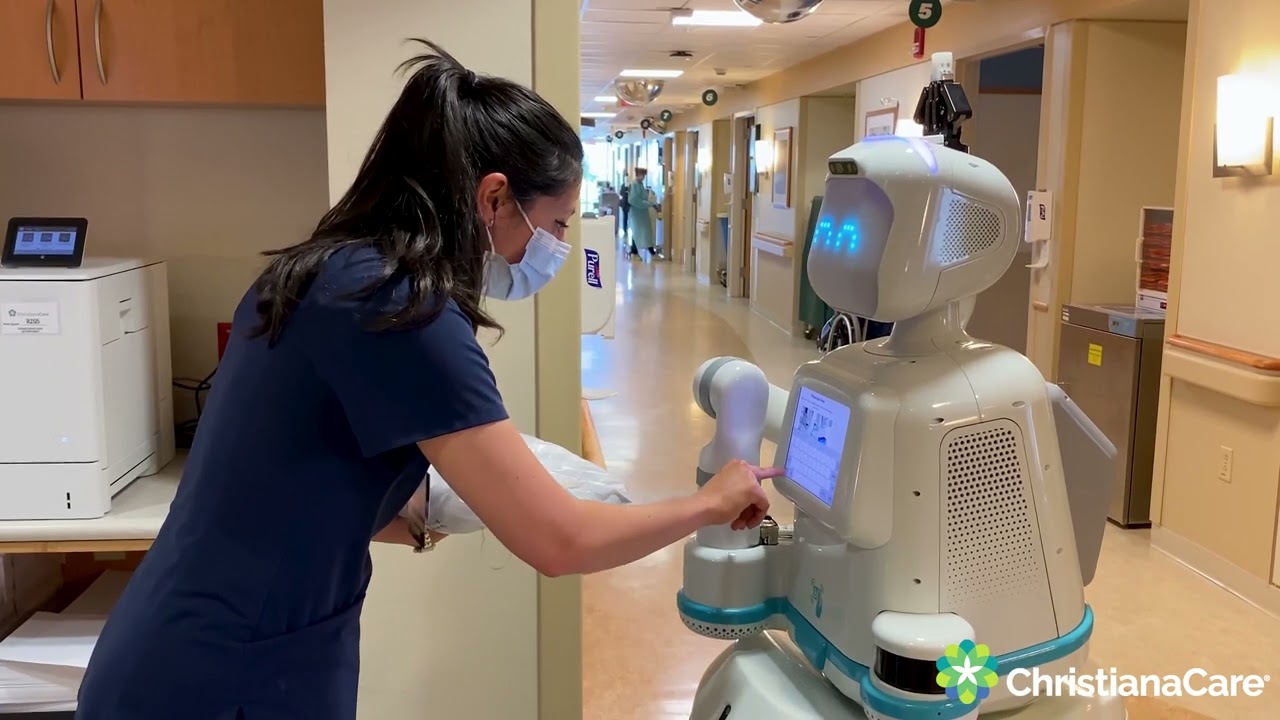
ChristianaCare is the first health system in the Philadelphia region piloting an innovative tool called Moxi, a collaborative robot — or “cobot”— that can assist in the hospital by making deliveries and performing other non-clinical tasks so that nurses and other clinical staff can spend more time focused on what they do best—caring for patients. With a landmark $1.5 million grant from the American Nurses Foundation, ChristianaCare will deploy a total of five Moxi cobots at Christiana Hospital. It is the largest single grant in the history of Nursing at ChristianaCare. Research published in the Journal of Nursing Management shows that nurses spend a significant amount of time — up to 33% of their shifts — on time-consuming but simple tasks such as dropping off lab specimens, collecting supplies or picking up medications from the pharmacy. By taking over these time-consuming but simple tasks, Moxi enables nurses to focus on patient care, where their skills are most needed. “Nurses need the time and space to deliver care and patient education at the top of their license,” said Ric Cuming, Ed.D., MSN, RN, NEA-BC, FAAN, chief nurse executive and president, ChristianaCare HomeHealth. “Moxi will be doing those hunting and gathering tasks such as getting equipment and supplies, which nurses are doing today but don’t need to be doing.” Cobots are designed to share workspace and interact directly with people. In ChristianaCare’s initiative, the Moxi cobots will be integrated with the Cerner Corporation electronic health record (EHR) platform and use artificial intelligence to proactively identify when nurses will need equipment, supplies, medications and lab tests. The Moxi cobots will be deployed to 11 inpatient units, partnering with more than 400 nurses. The American Nurses Foundation grant will enable ChristianaCare to evaluate the impact of cobots on nursing practice with the goal of scaling the technology if successful. “Moxi is not a replacement for a nurse or nursing position — or any position,” Cuming said. “It is an additional resource for nurses and their teams. “With robotic technology, we are using resources wisely and effectively, creating more efficient workflows, reducing repetitive tasks and freeing up nurses’ time for the complex clinical work that they excel at doing.” Reimagining Nursing ChristianaCare is one of 10 grant recipients from the American Nurses Foundation Reimagining Nursing (RN) Initiative. “We are proud that the American Nurses Foundation has the confidence in bold nurse-led ideas that will lead to large-scale, replicable change,” said Katherine Collard, MS, RN-BC, chief nursing informatics officer at ChristianaCare. “This grant will support nurses at ChristianaCare and our nursing colleagues across the nation in realizing their full potential, giving them the tools, resources and power to improve health care now and in the future.” With the American Nurses Foundation grant, ChristianaCare will conduct research on driving nursing outcomes through robotics. “We have a transformative opportunity to generate new knowledge and to move the science forward around robotics in nursing and in health care,” said Susan Birkhoff, Ph.D., RN, nurse scientist at ChristianaCare. “Through research, we will study Moxi’s impact to nursing caregivers that will have broad implications for nursing practice, workforce and education,” she said. ChristianaCare began exploring the potential of robotics to support Nursing with two Moxi cobots acquired in February, funded through the generosity of donors including Good Samaritan, Inc. and E.J. “Woody” Rice. With the grant, said Birkhoff, ChristianaCare will take Moxi to the next “bold frontier,” adding three more cobots with the goal of automating and optimizing nurses’ workflow without interrupting care. With five total cobots, ChristianaCare will be home to the largest number of Moxi robots in health care. The Little Bot That Can Before Moxi can become fully part of the care team, it must learn to navigate the hospital and respond to the nurses’ needs. Using artificial intelligence, Moxi is mapping out Christiana Hospital through sensors and other machine-learning technology so that the cobots can ultimately navigate and work autonomously. “When the Moxi cobots are fully integrated, we anticipate that they will complete up to 200 delivery tasks a day,” Collard said. “By making point-to-point deliveries, Moxi can save nurses hours of time and thousands of steps.” Designed to be compatible with the busy environments of hospitals, Moxi’s features include: Social intelligence: Moxi won’t bump into people or objects in hallways, waves when it sees someone new and happily poses for selfies. Mobile manipulation: Moxi can learn to use its robotic arm to operate existing automatic doors and elevator panels. Human-guided learning: The more Moxi is used, the more Moxi learns and adapts to the environment and specific ways of doing things. Friendly and safe design: With heart-shaped eyes and a friendly appearance, Moxi is designed to navigate safely and get the job done so nurses can focus on patient care. “What Moxi is doing in health systems like ChristianaCare is really transforming the way we think about health care and allowing staff to focus on the people in the hospital as opposed to the tasks,” said Dr. Andrea Thomaz, CEO and co-founder of Diligent Robotics, which created Moxi. “Robots are not something way in the future. Our robots work side-by-side with humans to ease the stress and workload of one of the most demanding jobs in society, nursing. The partnership between Diligent and ChristianaCare shows that the future is now.” Hospital Helper Directly from the Cerner EHR, Moxi will be able to anticipate clinician and patient needs and perform tasks without human involvement. Examples could include: Delivering items to patients based on nurses’ order requests. Making rounds across units to deliver lab samples on collections completed in the electronic health record. Making just-in-time deliveries of pharmaceuticals not stocked on the floor. Prioritizing tasks based on the nursing workload in a unit, so that the busiest nurses will get help first. “Connecting Moxi to the existing technology that clinicians use on a daily basis is key to making it easier to anticipate needs so clinicians can spend more time on patient care,” says Eva Karp, DHA, MBA, RN-BC, senior vice president, chief clinical and patient safety, Cerner. “Moxi could make a real difference in a nurse’s day — alleviating burnout and staffing shortages, which have become especially prevalent since the pandemic.” Incorporating the electronic health record into Moxi is part of the study funded by the American Nurses Foundation. “It’s absolutely in the best interest of our patients that Moxi can work alongside nurses so we can spend more time working directly with our patients to do what we do best,” said Pam Owen, MSN, RN-BC, nurse manager on 7E, one of the pilot units. “And Moxi brings a smile to people’s faces.” Fast Facts About Moxi Works in 22-hour shifts. Needs only two hours of charging time. Weighs about 300 pounds. Can carry a total weight of 70 pounds. Gender-neutral. Pronouns are “it” for a single Moxi cobot and “they” for more than one. Named one of America’s Greatest Disruptors in 2021 by Newsweek and one of the Best Inventions of 2019 by Time Magazine. About ChristianaCare Headquartered in Wilmington, Delaware, ChristianaCare is one of the country’s most dynamic health care organizations, centered on improving health outcomes, making high-quality care more accessible and lowering health care costs. ChristianaCare includes an extensive network of primary care and outpatient services, home health care, urgent care centers, three hospitals (1,299 beds), a freestanding emergency department, a Level I trauma center and a Level III neonatal intensive care unit, a comprehensive stroke center and regional centers of excellence in heart and vascular care, cancer care and women’s health. It also includes the pioneering Gene Editing Institute. ChristianaCare is nationally recognized as a great place to work, rated by Forbes as the 2nd best health system for diversity and inclusion, and the 29th best health system to work for in the United States, and by IDG Computerworld as one of the nation’s Best Places to Work in IT. ChristianaCare is rated by Healthgrades as one of America’s 50 Best Hospitals and continually ranked among the nation’s best by U.S. News & World Report, Newsweek and other national quality ratings. ChristianaCare is a nonprofit teaching health system with more than 260 residents and fellows. With its groundbreaking Center for Virtual Health and a focus on population health and value-based care, ChristianaCare is shaping the future of health care.



Expert Opinion: Understanding Whiteness to Understand White Supremacy
In the aftermath of last week's tragic shooting in Buffalo, many have described the violence as representative of a mental health crisis, growing extremism, hatred, and bigotry, likening manifestos left by shooters as the racist rhetoric of radicalized individuals. "But that conclusion is a pleasant fiction," writes Matthew Hughey -- a professor of sociology at UConn and a renowned scholar of racism and racial inequality in identity formation, organizations, media, politics, science, religion, and public advocacy -- in a powerful new essay for Slate. As part of his work as a researcher, Hughey examines the manifestos of white-supremacist shooters as well as their intersection with race, knowledge, media, power, religion, and science. To understand white supremacy and the violence it precipitates, Hughey explains, we need to first understand whiteness: The category of whiteness, like “race,” is a biological fiction with a social function. Whiteness emerged early in American history to rationalize exploitation. Early American colonists were slow to develop racial worldviews. But by the mid-1600s, philosophers and scientists like Bernard Varen, John Ray, and François Bernier began to publish ideas about African savagery and European civilization, which were progressively applied to resolve who should be the rulers versus the ruled. These ideas were codified into our legal system. In 1662, for instance, British statutory law conferred slavery with a biological status: Any child born to an enslaved woman would also be a slave. Over time, through a series of laws and social mores, a hierarchy that conferred legal privileges to “white” men, while stripping Black people and Native Americans of their humanity and standing in the legal and political arenas, was cemented. Put another way, whiteness is not an inherent identity so much as a consolidation of lofty biological, legal, and theological notions that serve to buttress the social and political power of people bearing lighter skin. As W.E.B. Du Bois points out in his 1920 essay “The Souls of White Folk,” whiteness is a modern concept: "The discovery of personal whiteness among the world’s peoples is a very modern thing. … The ancient world would have laughed at such a distinction. … This assumption that of all the hues of God whiteness alone is inherently and obviously better than brownness or tan leads to curious acts. … I am given to understand that whiteness is the ownership of the earth forever and ever, Amen! Now what is the effect on a man or a nation when it comes passionately to believe such an extraordinary dictum as this?" The effect is a Faustian bargain. And as a result, whiteness exists in a state of perpetual social anxiety. White people are taught that their biological, cultural, and/or God-given nature is to be “inherently and obviously better” than people of color and to have “ownership of the earth.” These ideals are, of course, so lofty that they are unachievable. Discontent is inevitable. Whiteness is a deal with the devil. Consequently, white people move neither into nor out of moments of racial anxiety, nor do they—despite the popularity of the cliché—experience flashes of “white fragility.” Whiteness does not wax or wane relative to racial pressures, cracking to expose either reactionary political movements or even the occasional mass shooting. Rather, whiteness is an omnipresent imbroglio; it cannot live up to the greatness it assumes it can naturally realize. Reconciling the peril that results from the inability to fully manifest white power necessitates a scapegoat. And so the crisis of whiteness is continually externalized onto racial “others.” This helps to explain why an increasing number of white people now believe they have been cheated out of their birthright—an inheritance of domination stolen by people of color. White nationalism and supremacy could not function under absolutist apartheid; it is an ideology and practice that requires the presence of people of color to justify its own shortcomings. White peril and white power go hand in hand. Professor Hughey is available for interviews -- click on his icon to contact him today.


Villa Vision receives £20K from Wesleyan to measure impact of child eye health project
Villa Vision programmes provide access to eye health care for children from deprived areas of Birmingham. 5,500 children have been reached so far. The Wesleyan Foundation and Aston University’s five-year partnership is valued at over £250K The findings of the evaluation will be shared with the Villa Vision team and all partners including participating schools, parents and children. Villa Vision, a project that delivers eye health care to children from deprived areas of Birmingham, has received £20,000 from the Wesleyan Foundation. The money will help evaluate the impact of the project to date which has reached approximately 5,500 children across the West Midlands. Villa Vision programmes are designed to increase access to eye health education, eye screening, eye examinations and to dispense glasses to children who need them with the aim of providing them with the visual foundation to succeed. The Villa Vision project is a collaboration between the Aston Villa Foundation, Aston University and optical lens supplier Essilor Vision For Life. The money donated by Birmingham based Wesleyan, alongside the Aston University funding of almost £15,000, will pay for research assistants to evaluate the first three years of the project. The objectives of the impact evaluation are to: • Review how many children have been screened, detail the coverage of the programme and its reach within the city • Analyse Villa Vision’s data recording children’s eye screening tests and eye examinations • Examine the potential impact on student’s performance on tasks that require attention to detail after being given glasses • Work with children to explore their experience of the Villa Vision programme to help develop the educational part of the programme • Work with teachers to examine the potential impact of corrected vision on children’s classroom behaviour (their integration into class, their reading at distance and close-up, their English and maths) • Work with parents to understand the impact of Villa Vision on their eye health knowledge and the quality of life of the children involved in the programme and the family more generally. The findings of the evaluation will be shared with the Villa Vision team and all collaborating partners as well as participating schools, teachers, parents and children. The findings will also be published in peer-reviewed journals, online and in newsletters to reach interested audiences. Dr Rachel Shaw, a health psychologist in Aston Institute for Health & Neurodevelopment, and project lead, said: “Villa Vision is an inspirational project offering children eye care in their schools. Not only that, Nik Sonpal and Zak El Khalifi from the Villa Vision team, have created an educational, entertaining, and imaginative workshop helping children to understand the importance of eye health, bringing it to life with the help of Aston Villa and a footballing theme.” Leon Davies, professor of optometry and physiological optics in the School of Optometry at Aston University and Vice President of the College of Optometrists said: “The team led by Dr Rachel Shaw with support from Dr Laura Shapiro, Esra Yeter, Sidratul Kazi and myself will provide robust evidence to demonstrate the impact and value of Villa Vision on children’s eye health and education in Birmingham, which we believe will help secure Villa Vision’s long-term future.” Nathan Wallis, Chief of Staff at Wesleyan said: “We are proud to be supporting Villa Vision and its research, they are making a huge difference to the lives of so many primary school children across the West Midlands. It is vital for all children to be given access to good eye care, not just to improve engagement in the classroom but for their overall quality of life and self-confidence. “As a financial service mutual for teachers and doctors it is important to us that we support the things that matter most to our customers and supporting Villa Vision is a great example of this.” Nikhil Sonpal, Villa Vision Project Manager and optometrist at Aston Villa Foundation, said: “Villa Vision and the Aston Villa Foundation are incredibly excited to have the support of both the Wesleyan Foundation and Aston University in helping to establish a deeper understanding of our eye health project. "Not only will this evaluation help unearth the level of impact our intervention is having within the community, but it will also allow us to discover ways to develop our provision further and strengthen our reach when trying to address local inequalities in eye care.”



How should we measure faculty expertise? This week the UK provides its answer to this question via its highly significant and formal (government-directed) assessment of academic research - which grades academic teams on a scale of 1* to 4* for their ability to deliver, share and create impact globally outstanding research. This process is known as the REF (the Research Excellence Framework) - and the results will be publicly released this Thursday (12th May) with universities themselves finding out how they’ve performed in advance today (Monday 9th May). The process was last carried out 8 years ago and has been delayed by a year due to the pandemic. Why is the Research Excellence Framework (REF) Significant? The Research Excellence Framework steers the level of UK public funds - allocated via research councils - that will be invested in research for each academic department (or so-called “Unit of Assessment”) for the next few years. It is also a way of comparing performance against other universities that are offering similar research expertise, and of strengthening (or weakening) global research reputations. During the next three days, UK universities will be digging into the detail of their REF gradings and the accompanying feedback. There will be some very nervous university leaders and research heads delving into why this peer-assessed review of their research has not gone as well as they expected and why their percentages in each of the four grade areas have dropped - or even been given the “unclassified” career-damaging stamp. How are the REF Scores for Universities Determined? The measurement process is based on three aspects: Quality of outputs (such as: publications, performances, and exhibitions), Impact beyond academia The environment that supports research The preparation, participation, and assessment process takes a massive amount of time, attention and energy. Last time (2014) there were 1,911 submissions to review. Research teams, designated REF leaders and senior staff will have spent long hours across many months preparing their submissions and making sure they are presenting hard evidence and the best case possible to meet the above criteria at the highest possible level. There are 34 subject areas that are covered in the latest REF - and three tiers of expert panels (some with about 20 or more senior academics, international subject leaders, and research users) will have reviewed each submission and compared notes to come to decisions. How do these Key Categories within the REF Contribute to the Rating for a University? The Research Excellence Framework is actually an intensive and highly important approach to expert assessment. These are the key factors and their definitions (with the assigned weighting of each of the criteria in steering final grades): Outputs (60%): the quality of submitted research outputs in terms of their ‘originality, significance and rigour’, with reference to international research quality standards. This element will carry a weighting of 60 per cent in the overall outcome awarded to each submission. Impact (25%): the ‘reach and significance’ of impacts on the economy, society, culture, public policy or services, health, the environment or quality of life that were underpinned by excellent research conducted in the submitted unit. This element carries a weighting of 25 per cent. Environment (15%): the research environment in terms of its ‘vitality and sustainability’, including the approach to enabling impact from its research, and its contribution to the vitality and sustainability of the wider discipline or research base. This element accounts for 15 per cent. Taking a Closer Look at the Categories - Are We Focusing Enough on Research Impact? In 2014 a formal review was carried out in order to improve and evolve the REF process which made a number of recommendations. Most notably the weighting for “impact” was increased by five percent, with “outputs” being reduced by the same percentage. This is certainly a recognition that the external contribution difference that research makes is more important - but is it enough? Should there be greater emphasis on the return on investment from a beneficiaries and user experience perspective? Many argue that academic research should retain a strong element of ‘”blue sky” experimentation - where outright evidence of impact may take several years (even decades) and so can’t demonstrate such immediate value. A particularly notable benefit of the timing of the COVID-19 pandemic and the effect of this in REF deadlines has allowed the extended assessment period for ‘proof of impact’ from 1 August 2013 to 31 December 2020. This is an extension from the previous end date of 31 July 2020. The extension has been put in place to enable case studies affected by, or focusing on the response to, COVID-19 to be assessed in REF 2021. Going back to the original question: how should we measure faculty expertise? It will be interesting to monitor the views and responses of university leaders and faculty members at the end of this week as to whether they feel that - standing back from it all - this UK-centric method of measurement is the best that can be done, a neat compromise or isn’t really what we really need. For more information on the Research Excellence Framework visit www.ref.ac.uk/ Justin Shaw Justin is UK and Ireland Development Director for ExpertFile and Chief Higher Education Consultant at Communications Management. An authority on University strategy and communications, he has worked in and with leadership teams at UK universities for over 30 years. In his role he has advised universities on how to promote their expertise and on communications strategies related to the REF.