
Experts Matter. Find Yours.
Connect for media, speaking, professional opportunities & more.

It Works on TV - Do Property Rehabs Drive Up Prices in Surrounding Neighborhoods?
When a house is distressed, the negative impact tends to ricochet around its surrounding neighborhood. Distressed homes (e.g. foreclosures) can significantly bring down the value of other homes in the area, as these properties are often poorly maintained and then typically sold at discounted prices In the past, and particularly in the wake of the 2008 subprime crisis, federal and local governments sought to mitigate this negative effect by incentivizing the rehabilitation of distressed properties through programs like the Neighborhood Stabilization Program (NSP). Until now, there has been some skepticism as to whether or not these kinds of initiatives actually work. New research by Goizueta Foundation Term Associate Professor of Finance Gonzalo Maturana and Goizueta’s Assistant Professor of Finance Rohan Ganduri might change the narrative definitively. They have analyzed new data that shows that rehabilitation projects not only help to stabilize housing prices in affected neighborhoods but can also actually increase the value of neighboring properties by as much as four percentage points. Using highly robust, non-parametric statistical analysis methods, Maturana and Ganduri parsed more than 10 years of information on rehabilitated property transactions and real estate prices across the United States. The effect of renovating dilapidated or derelict houses in these areas pushes prices up between 2.3 and four percentage points in their surrounding blocks, they find. And that’s not all. While the average amount spent by authorities on these renovations comes in at roughly $36,000, their study estimates a societal welfare gain of $134,000 per rehabilitated property—almost four times the cost of the rehabilitation. These insights should provide interesting food for thought for the U.S. Congress and local governments, Maturana notes. After the housing crash in 2008, Congress allocated $6.9 billion in funding to the NSP to help stabilize communities affected by high vacancy and foreclosure rates, but the Department of Housing and Urban Development didn’t find any positive impact on local housing markets at the time. “Our findings suggest that rehabilitation projects do drive a positive uptick in prices that can help revitalize distressed neighborhoods,” says Maturana. “And they provide very timely support for policy interventions, such as President Biden’s infrastructure spending program which proposes an allocation of $20 billion to rehabilitate 500,000 single-family homes in low-income neighborhoods in the United States.” With the current economy facing some uncertain times - this is a topic that is important for everyone. And if you're a reporter looking to know more then let us help. Gonzalo Maturana is an associate professor of finance at the Goizueta Business School. He is an expert in the areas of corporate, household and real estate finance. Rohan Ganduri's research interests include banking, credit risk, real estate, household finance, and corporate finance. Both Gonzalo and Rohan are available to speak to media regarding this topic – simply click on either icon now to arrange an interview today.



Housing bubbles, student debt, stagnant salaries – America need a reset?
There’s an old saying we all know about those who don’t pay attention to history … they’re doomed to repeat it. Over and over and over sometimes. One would think after the 2008 housing crisis that nearly decimated the American and global economy – that we’d all be somewhat wiser. According to some, that may not be the case. America is once again approaching the same cliff it took a decade to climb up from. The measures that were put in place to prevent massive amounts of foreclosures a decade ago are now coming home to roost. “This massive problem of underwater homeowners could not be resolved only by shutting off the spigot of foreclosures. That is why a total of 25 million permanent mortgage modifications and other so-called 'workout plans' were put in place from 2008 until June 2018 according to data provider Hope Now. Modifying mortgages as an alternative to foreclosure just kicked the can down the road. It succeeded in bringing these delinquent homeowners into current status. Yet millions of them are re-defaulting on these modified mortgages. The number of re-defaults is increasing relentlessly around the U.S. Worse yet, many re-defaulters are on their second- or third mortgage modification.” - MarketWatch Mortgages once again are vulnerable as the housing market remains painfully out of sync with the rest of the economy. As well, with millennials facing massive student debt, a shortage of new builds means fewer people can enter the market nor can they afford to. Combine that with salaries flatlining and not keeping pace with the rising price of goods – it’s not a sunny forecast. Are you covering this potential financial crisis? What will America have to do to course correct and ensure we don’t have a repeat of the 2008 meltdown? And how did the country’s leaders allow this to happen? Did no one see this coming? There are a lot of questions and that’s where an expert from New Jersey Institute of Technology can help. Professor Michael Ehrlich's research focuses on financial markets and institutions, with an emphasis on market failures. He has written about the unintended consequences of financial market innovation and is Associate Director of the Leir Center for Financial Bubble Research. To reach Michael, simply click on the button below.


Aston University offers emergency interpreter training for Ukrainian speakers to support refugees
Dr Emmanuelle Labeau and Dr Yvonne Fowler are running Emergency Interpreting Training for Ukrainian Speakers to introduce them to the basics of interpreting The 10-hour training (10 x one hour) will take place on Tuesday and Thursday evenings online for five weeks It is part of an Arts and Humanities Research Council (AHRC) project with support from Aston University’s College of Business and Social Sciences. Aston University has kicked off a five-week introduction to interpreting course for Ukrainian speakers to enable emergency interpreters to support Ukrainian refugees arriving in the UK. It is part of an Arts and Humanities Research Council (AHRC) project called BRUM (Birmingham Research for Upholding Multilingualism) with support from Aston University’s College of Business and Social Sciences. Dr Emmanuelle Labeau (AHRC fellow for the Future of Language Research) and Dr Yvonne Fowler are running Emergency Interpreting Training for Ukrainian Speakers. The 10-hour training scheme (10 one-hour sessions) started on 28 April 2022 and will take place every Tuesday and Thursday evening online for five weeks. It has been devised to enable emergency interpreters to deliver a better service to traumatised Ukrainian refugees whose English is limited and who may require interpreting help in every aspect of their lives to access housing, physical and mental healthcare, educational facilities and welfare benefits. Dr Emmanuelle Labeau, co-director of Aston Centre for Applied Linguistics (ACAL) at Aston University, said: “Ukrainian refugees are arriving in the UK and there are few trained qualified Ukrainian interpreters to support those refugees with limited or no English in their dealings with public services. “We have had a fantastic response to our offer of free emergency training in interpreting for Ukrainian speakers in the West Midlands, as part of the AHRC-funded BRUM project. “I am thrilled that we have been able to pull this together and I am really pleased with how the first session went. We have people of all walks of life such as social services, healthcare, education and even a refugee who are so committed to help in any way they can, and it is lovely to empower them to do so!” Dr Yvonne Fowler said: “I am really proud to see this project get off the ground and help people in need. “I have been a public service interpreter trainer for the last 25 years. “My work has mostly involved preparing interpreters for the Diploma In Public Service, Interpreting Law and Healthcare options. “But during this period, I delivered emergency interpreter training to support various waves of refugees who have come to Birmingham over the last 20 years: the Vietnamese boat refugees, the Bosnian refugees in the aftermath of the Bosnian war, and a month in Kosovo after the war there to train Albanian and Serbian interpreters at the Organisation for Security and Cooperation in Europe.”


Ask an #Expert - Is there any way to temper America's boiling housing market?
U.S. HOUSING PRICES STILL RISING ALONG WITH MORTGAGE RATES When mortgage rates rise, home prices tend to level off or decline because fewer people can afford to buy. Experts are counting on that adage to help cool the nation’s torrid housing market. But the latest analysis of the most overvalued markets shows prices still are climbing despite the increasing mortgage rates, which last week reached their highest level in more than three years. In all 100 markets surveyed by researchers at Florida Atlantic University and Florida International University, buyers continue to pay higher premiums – that’s the difference between where home prices should be based on historical trends and where they are now. Two months ago, Los Angeles, Provo, Utah and other metro areas in the Western part of the country developed “pricing crowns,” an indication that those housing markets could be slowing. But home values have since reaccelerated, prompting concern that a looming downturn in some areas could be worse than expected. “Eventually mortgage rates will slow down home prices, but it hasn’t happened so far,” said Ken H. Johnson, Ph.D., an economist in FAU’s College of Business. “We should not see rapid upticks in prices as mortgage rates rise. It’s that kind of exuberance that led to past housing downturns.” Boise, Idaho is the nation’s most overvalued housing market, as it has been since the researchers first released their rankings last summer. At the end of February, Boise buyers were paying an average price of $513,849, even though historical trends indicate the average price should be $291,389. That 76.34 percent premium is well ahead of No. 2 Austin, Texas (64.80 percent). The full rankings with interactive graphics can be found here. Charlotte, North Carolina entered the top 10 overvalued markets for the first time with a premium of 50.14 percent. February’s average home price in Charlotte was $353,106, although a history of past sales suggests that price should be $235,188. “Charlotte’s significant and rapidly growing premium is similar to other Southern metros that are all experiencing fast price appreciation,” said Eli Beracha, Ph.D., of FIU’s Hollo School of Real Estate. “The drivers of this appear to be large population increases in these areas combined with a significant shortage in housing inventory.” Each month, Johnson and Beracha rank the most overvalued housing markets of America’s 100 largest metros, similar to the popular S&P CoreLogic Case-Shiller home price index. Johnson and Beracha incorporate average or expected price changes and provide an estimate of how much a market’s housing stock is over- or undervalued, relative to its historic pricing. The data covers single-family homes, townhomes, condominiums and co-ops. Six Florida metros, led by Lakeland, all rank among the nation’s 25 most overvalued markets with premiums of more than 40 percent. The Miami metro, with a premium of nearly 25 percent, remains the least overvalued market in the Sunshine State. As the U.S. housing market cools, metros with strong population gains and shortages of homes for sale will fare best, although those markets will continue to struggle with affordability, the researchers predict. Metros with flat or falling populations and more available homes for sale could face price declines, making those areas more attainable for young families and first-time buyers. Johnson said consumers could be taking big risks if they jump into the U.S. housing market now. “We are near the peak of the current housing cycle, and you never want to buy near the top of the market,” he said. “Consumers need to pause if their main motivation is to buy because they fear prices will rise even higher. Prices are high now, but they always moderate back toward a long-term pricing trend. Perhaps staying where you are now and letting this irrational market settle would be one of the best decisions you could make.” Ken Johnson is the associate dean and professor in the College of Business at Florida Atlantic University. Ken is available to speak to media about this topic – simply click on his icon to arrange an interview and time.


Aston University appoints new Vice-Chancellor
Aston University is delighted to announce that Professor Aleks Subic has been appointed as its next Vice-Chancellor and Chief Executive. He succeeds Professor Alec Cameron, who stepped down after five years in December 2021. He will take up the post in August 2022, until which time Saskia Loer Hansen will continue in her role as Interim Vice-Chancellor. Dame Yve Buckland, Pro-Chancellor of Aston University, said “I am absolutely delighted at Professor Aleks Subic’s appointment. He joins the University at an exciting time and his wide experience of leadership across both academia and industry makes him a perfect fit for Aston University’s needs and ambitions.” Professor Subic said “I feel privileged at being given the opportunity to lead Aston University at this time. The University is renowned for its commitment to graduate employability, translational research and its engagement with business. “I look forward to continuing the momentum built up by Professor Alec Cameron and Saskia Loer Hansen, and I am ambitious to see Aston University continue to build on its reputation for high quality teaching, research and business engagement locally, nationally and internationally.” Saskia Loer Hansen, Interim Vice-Chancellor of Aston University, said “I should like to congratulate Professor Subic warmly on his appointment. His credentials as a leader, both in industry and in higher education, equip him for guiding Aston University to even greater success. “I am sure he will work rigorously to build on our achievements, promote the University worldwide and further strengthen our reputation as a leading university for business and enterprise.” Professor Subic is currently the Deputy Vice-Chancellor (STEM) and Vice President (Digital Innovation) at RMIT University, where he is responsible for leading the STEM College and Digital Innovation portfolio in Australia and globally. Prior to this appointment he was the Deputy Vice-Chancellor (Research & Enterprise) at Swinburne University of Technology, responsible for research, graduate studies, engagement and partnerships, advancement, innovation, enterprise, and commercialisation, leading the research transformation of the university towards top 2% in the world. Before that, he was the Executive Dean of Engineering at RMIT University, one of the largest engineering faculties in Australia, ranked in top 1% in the world and renowned for industry-partnered education and research. Concurrent with his academic appointments, Professor Subic has held notable appointments on the Australian Prime Minister's Industry 4.0 Taskforce and the Australian Advanced Manufacturing Council Leaders Group (Australian Industry Group). Previously he was the Director and Deputy Chair of the Australian Association of Aviation and Aerospace Industries, Director of Oceania Cybersecurity Centre Governing Board, Director of the Society of Automotive Engineers Australasia Board, Director of National Imaging Facility Governing Board, Director of Australian Housing and Urban Research Institute Governing Board, and Director of the Victorian Centre for New Energy Technologies Governing Board. He has served on a number of national and international research committees and expert panels, including as Chair of the European Research Council Expert Panel for Physical Sciences and Engineering, Technology Group of the Global Federation of Competitiveness Councils, Forbes Technology Council, Defence Materials Technology Centre, Editor and Associate Editor of international scholarly journals.

What the Basque Country tells us about 'levelling up' | Aston Angle
What the Basque Country tells us about using local governance to level up By Dr Caroline Gray Lecturer in Politics and International Relations School of Social Science and Humanities January 2022 In a recent interview on his vision of ‘levelling up’, Michael Gove, Secretary of State for Levelling Up, Housing and Communities, cited the Basque Country as one example of where ‘things have been done well’. The Basque Country, an industrial region of northern Spain with a population of just over two million, is widely admired for having undergone a remarkable, industry-focused economic transformation since it was hit by the decline of heavy industry in the 1980s. It is now one of the leading regions in Europe not only in terms of GDP per capita, but also in having a low percentage of population at risk of poverty or social exclusion. Within Spain itself, critics usually attribute this to the way the Basque fiscal autonomy model works, enabling the region to keep more of its own wealth to itself than other similarly prosperous regions in Spain – a form of internal ‘levelling up’ at the expense of other regions. This, however, is not the only contributing factor to the Basque Country’s economic transformation. Effective governance has also played a key role. What takeaways from the Basque experience might be relevant to levelling up in the UK and the devolution framework needed to facilitate it? Through my research on the Basque governance systems, I’ve discovered that some of the most valuable lessons relate to how multi-level governance works within the Basque region itself and how that contributes to economic and social transformation. Devolution does not stop with the powers devolved to regional governments or authorities; the relationship between different stakeholders and layers of governance within a region or locality is equally important. If the UK government wants to learn from what the Basque Country has done well, it should consider the following: 1. Devolution beyond metropolitan areas needs to be flexible and adaptable to place-based specifics In his July 2021 Levelling Up speech, Boris Johnson announced that levelling up would involve extending devolution beyond cities with new deals for the counties. The government must stick to the commitment it made then to shape new devolution deals with local input, avoiding one-size-fits-all approaches. The Basque Country provides valuable evidence for why it’s beneficial to shape governance approaches to the economic geography of an area. As one of Spain’s 17 regions called ‘autonomous communities’, the Basque Country is, in turn, divided into provinces (Araba-Álava, Bizkaia and Gipuzkoa) and municipalities. Counties, which don’t have an administrative body, but which do house county development agencies, make up an additional level between the provinces and municipalities. The economic activity of two of the provinces (Araba-Álava and Bizkaia) is typical of metropolitan areas in that it is centred heavily on their capital cities (Vitoria and Bilbao, respectively), where the provincial councils are based. However, in the third, Gipuzkoa, economic activity is more distributed across different hubs in the province. As a result, in Gipuzkoa, the county development agencies, created in the late 1980s, have acquired a particularly important role, as interviewees from the Basque Institute of Competitiveness explained to me. The counties map particularly well onto the different industrial areas in the province, thanks to the fact that they were designed with the bottom-up input of municipal leaders working together with the provincial council. The county development agencies have, in turn, become a key channel via which the provincial council in Gipuzkoa can reach SMEs more easily, as they are closer to the firms. Such local networks are particularly important in non-metropolitan areas where economic activity can be more dispersed. This is why the UK government must make sure any new devolution framework it designs is flexible enough to allow for local input and adaptations to place-based considerations. 2. Bottom-up, collaborative dynamics are essential to the design and implementation of placed-based strategies Basque economic development has undoubtedly benefitted from the fact that the regional government draws upon input from different levels of administration and a range of other public and private stakeholders in the region when designing its industrial policies. Experiments in collaborative governance have become increasingly innovative over the years, not only at regional but also provincial and local level, designed to reach beyond the largest firms and to engage wider society. The county development agencies in Gipuzkoa, for example, used to provide services to SMEs in an essentially one-way direction – for example, advising them on how to apply policy – but have since evolved more into facilitators of networks for cooperation and mutual learning among public and private actors at county level. This not only facilitates more efficient implementation of regional policies, but also channels local feedback upwards into the policy-making process, adding value. Collaboration among different tiers of governance and different areas, rather than competition, has been the goal of such approaches. Therefore, the UK government needs to reconsider the increasingly competitive dimension of current devolution arrangements. Having areas compete against one another for centrally controlled, often short-term pots of money doesn’t facilitate the formation of robust, collaborative partnerships that could ultimately add value and increase efficiency. Finally, institutional stability is important. From the Regional Development Agencies (RDAs) to the Local Enterprise Partnerships (LEPs), which are now under review, there has been frequent chopping and changing in the institutions and policies meant to tackle the UK’s place-based inequalities in recent decades. The Basque Country shows what can be achieved with a more stable, longer-term institutional and policy framework and vision. If it is to have a meaningful impact in tackling inequalities, the Levelling Up White Paper must provide the basis for a longer-term devolution framework that goes well beyond the current government term, with a clear allocation of resources and responsibility.


American Rescue Plan Act can do more to address racial wealth inequality
While the American Rescue Plan Act provided a major infusion of economic aid to low-income and middle-class Americans, more should be done to tackle racial wealth inequality and the structural issues in the tax code that allow those at the top of the income distribution to benefit disproportionately from tax subsidies, an Indiana University professor wrote. Goldburn P. Maynard Jr., assistant professor of business law and ethics at the IU Kelley School of Business, analyzed the American Rescue Plan Act's major provisions to determine their potential impact on racial equity, presenting his findings in Yale Law Journal. The article, "Biden's Gambit: Advancing Racial Equity While Relying on a Race-Neutral Tax Code," was published Jan. 9 and is part of a series that examines the novel tax implications of the American Rescue Plan Act through the lens of fiscal impoverishment, race, unemployment insurance, and state and local responses to economic crises. "While analysis reveals that the Biden Administration made some progress on (racial equity) through ARPA, in the months since its passage, federal courts have undermined some of this progress by halting race-conscious equity programs in ARPA," wrote Maynard, who worked as an estate tax attorney for the Internal Revenue Service before entering academia. His essay argues that "race consciousness is central to achieving" racial equity and "requires more than traditional policies that target financial need." The bulk of the stimulus measure focused on redistribution through the tax system, which does not incorporate racism and other dimensions of social inequity into its notions of fairness, Maynard wrote. To this day, the IRS does not collect racial data on taxpayers. He also noted that several policies targeted people or groups based on need. For example, the Department of Housing and Urban Development in November provided $14 million in American Rescue Plan funds to support fair housing organizations. But few new policies under the plan have addressed systemic discrimination, and most were designed to be temporary, such as the child tax credit. "Where these policies fall short is their lack of focus on historic systemic discrimination," Maynard wrote. "ARPA does not tackle the central issues that lead to racial inequity in the first place. Because RE requires the consideration social hierarchy and historical injustices, these provisions of ARPA are not as impactful as others." Several core policies in the American Rescue Plan Act target individuals or groups based on need, particularly racial minorities, he said. But several courts with conservative judges have treated race-based policies designed to counteract racial inequities as discriminatory in their interpretations of the Constitution. "Today, many courts equate efforts to promote RE with efforts to promote racial segregation. The odds of having all three branches in perfect alignment are slim," Maynard wrote. "ARPA also illustrates weaknesses in our current understanding of the Constitution as limiting the government's ability to redress historic wrongs. The status quo limitations are so strong that it is hard to imagine any large pro-equality advancements in the foreseeable future. "At our current pace, achieving RE will be a centuries-long project. This is discouraging, but highlights the importance of continuing the fight for wealth taxation and other levies on capital. It also underscores the smallness of the tax system when tackling a problem as embedded as RE. There are many decisions, regulations and laws that have embedded racism structurally and systematically. The tax system serves as an efficient compensator of harm, but this is not always what the victims of harm want. Instead of after-the-fact compensation for discrimination, victims of inequities often prefer to have the discrimination eliminated. That is the purpose of RE. The tax system can play an important role in promoting RE, even if it is not the leading one."


Aston University encourages SMEs to sign up to Innovation Workshops to support business growth
SMEs with a registered or trading address in Birmingham, Solihull, Redditch, Bromsgrove or the Wyre Forest are invited to attend The full series consists of three workshops hosted by academics from Aston Business School and Birmingham City Business School The workshops are part of the Innovation Vouchers scheme to help drive innovation and business growth SMEs with a registered or trading address in Birmingham, Solihull, Redditch, Bromsgrove, or the Wyre Forest have been invited to attend Aston Business School’s Innovation Workshops. The free1 workshops are part of the Innovation Vouchers project, which is part funded by the European Regional Development Fund. The full series consists of three workshops hosted by academics from Aston Business School and Birmingham City Business School on 2, 9 and 23 February 2022 running from 9.30 am to 5.00 pm at The Eastside Rooms in central Birmingham. The academics include Innovation Vouchers project director Professor Nick Theodorakopoulos and head of Aston Business School Professor Pawan Budhwar. The workshops are on three key areas: 2 February 2022: Envisioning Growth through Innovation 9 February 2022: Leadership & Strategy for Innovation 23 February 2022: Marketing for Innovation Attendees who attend all workshop sessions will receive a ‘Managing Innovation in Business’ certificate from Aston Business School. Nick Theodorakopoulos, professor of entrepreneurship development and Innovation Vouchers project director at Aston Business School, said: “The Innovation Workshops support small-and-medium sized businesses to build their capacity to innovate and grow. “Independent evaluations from the previous project phases have showed that workshops have a positive impact on attendees, resulting in substantial increases in gross value added and new job creation. “The staff who deliver the workshops are experts in their field with excellent industry experience. I would encourage businesses owners to attend the Innovation Workshops and grow their business.” Tickets for the Innovation Workshops are available HERE. Notes to Editors 1The workshops are free for eligible businesses. However, de minimis rules apply. The support we plan to provide through the workshops will comply with the State Aid rules using the de minimis exemption (in accordance with Commission Regulation (EU) No 1407/2013, OJ L 352/1). Under this exemption a single undertaking may receive up to the limit of €200,000 of De Minimis aid from the Member State within which it does business and which provides the aid over any period of three fiscal years. To attend the workshops, you will be asked to complete a Statement of Previous Aid received under the De Minimis exemption and arrange for a director of your business to sign it. Using this information we will assess your eligibility to receive assistance. About Innovation Vouchers European Regional Development Fund The project is receiving up to £803,273 of funding from the England European Regional Development Fund as part of the European Structural and Investment Funds Growth Programme 2014-2020. The Ministry of Housing, Communities and Local Government (and in London the intermediate body Greater London Authority) is the Managing Authority for European Regional Development Fund. Established by the European Union, the European Regional Development Fund helps local areas stimulate their economic development by investing in projects which will support innovation, businesses, create jobs and local community regenerations. For more information visit https://www.gov.uk/european-growth-funding Workshop Times and Dates All Innovation Workshops start at 9.30am and end at 5pm.
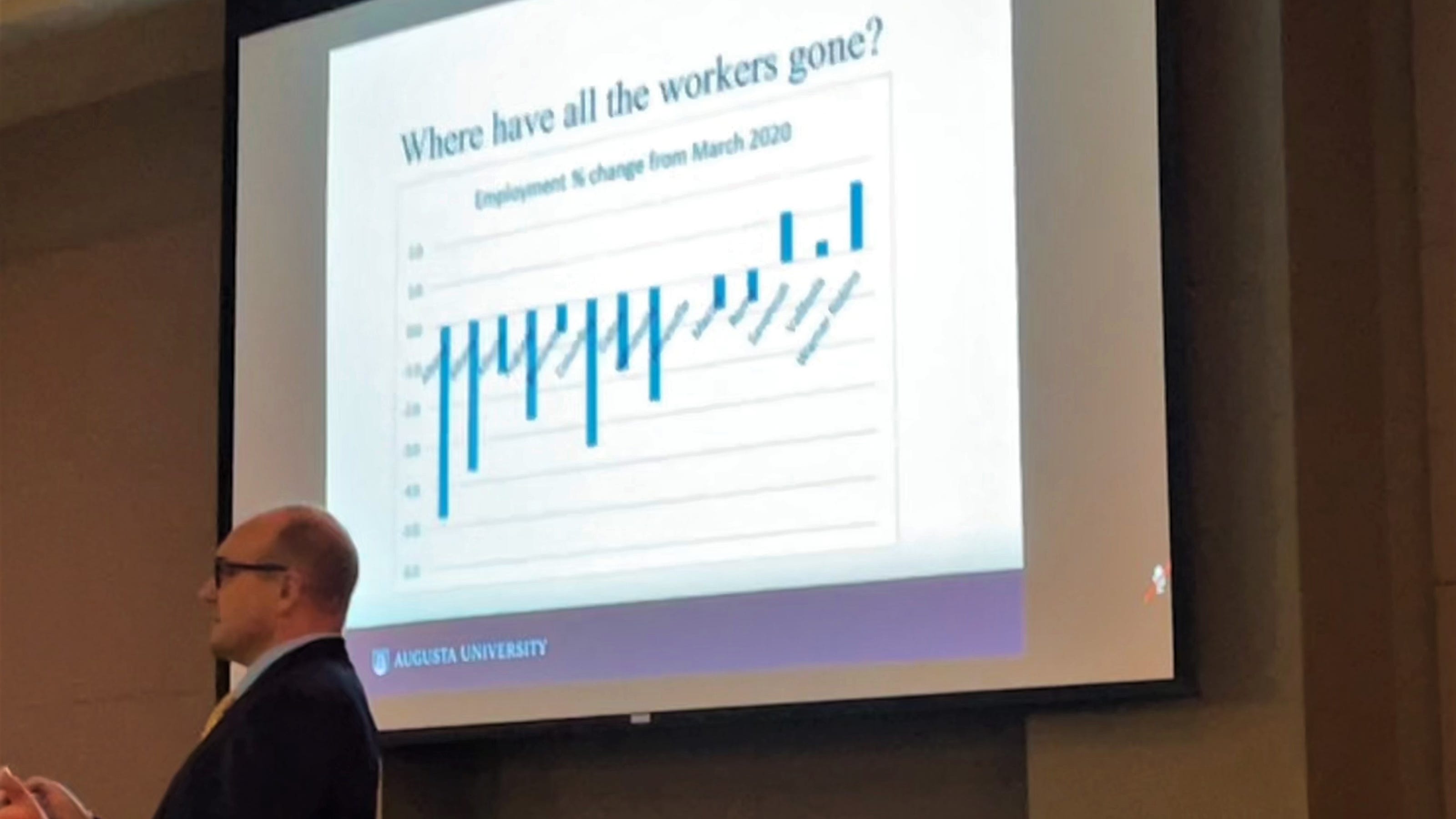
As the legendary political guru James Carville used to say, "It’s the economy, stupid." And these days with housing prices, inflation and the cost of living all pointing up in a very steep trajectory – the state of the economy is front and center for a lot of politicians, Americans and families as the year comes to a close. There’s a lot to be considered, and that’s where experts like Augusta’s Dr. Simon Medcalfe are being sought out to explain economic trends what is behind them. “U.S. retail sales are high,” explains Medcalfe “We had a lot of stimulus checks coming through the door and that’s really spurred extra spending and it’s across a whole range of retail sectors.” According to Medcalfe, household items are also seeing double-digit price increases. “What we’ve seen over the last 18 months during the pandemic, is a shift in our consumer preferences and consumer behavior.” • Furniture sales are up 29% • Used cars and cars in general are up 25-26% • Gardening and building supplies are up 14% • Electronics have seen an almost 30% increase • Clothing sales are up a whopping 50% But it’s not all good news - as the price of everything as we know is going up. “Inflation is running about 6.8% nationally,” Medcalfe explains. “It’s running about 7.2% in the south and it’s certainly a concern of policymakers and economists.” But theirs is sunshine behind those clouds as Medcalfe believes 2022 will see a return to normal. “I think next year inflation will come down. I know it won’t be at these high levels, but I still think it’ll be above the Feds target level of inflation, so look for those interest rate increases next year.” The economy and what to expect locally and nationally are hot topics – and if you are a reporter covering this topic – that’s where we can help. Dr. Simon Medcalfe is a highly regarded economics expert and the Cree Walker Chair in the Hull College of Business at Augusta University. Medcalfe is available to speak with media regarding the economy and its outlook – simply click on his icon now to arrange an interview today.



Will Biden’s Plan to Resettle Afghans Transform the U.S. Refugee Program?
Among the high-profile anti-immigration policies that characterized the four years of Donald Trump’s presidency was a dramatic contraction in refugee resettlement in the United States. President Biden has expressed support for restoring U.S. leadership, and increased commitment is needed to help support the more than 80 million people worldwide displaced by political violence, persecution, and climate change, says UConn expert Kathryn Libal. As Libal writes, with co-author and fellow UConn professor Scott Harding, in a recent article for the Georgetown Journal of International Affairs, the rapid evacuation of more than 60,000 Afghans pushed the Biden administration to innovate by expanding community-based refugee resettlement and creating a private sponsorship program. But more resources are needed to support programs that were severely undermined in previous years and to support community-based programs that help refugees through the resettlement process: Community sponsorship also encourages local residents to “invest” in welcoming refugees. Under existing community sponsorship efforts, volunteers often have deep ties to their local communities—critical for helping refugees secure housing, and gain access to employment, education, and health care. As these programs expand, efforts to connect refugees to community institutions and stakeholders, which are crucial to help facilitate their social integration, may be enhanced. As Chris George, Executive Director of Integrated Refugee and Immigrant Services in New Haven, Connecticut, has observed, “It’s better for the refugee family to have a community group working with them that knows the schools and knows where to shop and knows where the jobs are.” As more local communities take responsibility for sponsoring refugee families, the potential for a more durable resettlement program may be enhanced. In the face of heightened polarization of refugee and immigration policies, community sponsorship programs can also foster broad-based involvement in refugee resettlement. In turn, greater levels of community engagement can help challenge opposition toward and misinformation about refugees and create greater public support for the idea of refugee resettlement. Yet these efforts are also fraught with significant challenges. Sponsor circle members may have limited capacity or skills to navigate the social welfare system, access health care services, or secure affordable housing for refugees. If group members lack familiarity with the intricacies of US immigration law, helping Afghans designated as “humanitarian parolees” attain asylum status may prove daunting. Without adequate training and ongoing support from resettlement agencies and caseworkers, community volunteers may experience “burn out” from these various responsibilities. Finally, “successful” private and community sponsorship efforts risk providing justification to the arguments of those in support of the privatization of the USRAP and who claim that the government’s role in resettlement should be limited. Opponents of refugee resettlement could argue that community groups are more effective than the existing public–private resettlement model and seek to cut federal funding and involvement in resettlement. Such action could ultimately limit the overall number of refugees the United States admits in the future. December 11 - Georgetown Journal of International Affairs. If you are a journalist looking to know more about this topic – then let us help with your coverage and questions. An associate professor of social work and human rights, Kathryn Libal is the director of UConn's Human Rights Institute and is an expert on human rights, refugee resettlement, and social welfare. She is available to speak with media – click on her icon now to arrange an interview.

