
Experts Matter. Find Yours.
Connect for media, speaking, professional opportunities & more.

New research from Goizueta’s Diwas KC unpacks the dual impact of Prescription Drug Monitoring Programs on opioid prescriptions and heroin overdose deaths. More than two million individuals in the US are experiencing Opioid Use Disorder (OUD). The CDC defines OUD as “a problematic pattern of opioid use that causes significant impairment or distress.” Around 130 people die of opioid overdoses every day. Perhaps more startlingly, four million people over the age of 12 have reported using pain medication recreationally, including opioids. Prescription opioids are a highly-regulated class of drug. They interact with the opioid receptors on nerve cells throughout the body, as well as the brain, which reduces the intensity of pain signals to the body. For many, they are a necessary prescription to get through the pain of surgery or injury, as the body heals itself. Unfortunately, the function of opioids in the body—releasing endorphins and boosting feelings of pleasure, as well as reducing pain—also make them highly addictive. PDMP: A Successful Federal Mandate The United States continues to see increases in deaths from opioid overdoses. So, federal and state governments have been working in enact policies that are designed to decrease those fatalities. One of the methods states are using to prevent common abuse patterns like “doctor shopping,” which is the pattern of visiting multiple physicians to obtain prescriptions, is the Prescription Drug Monitoring Program (PDMP), designed to be used in conjunction with Health Information Technology (HIT) programs. PDMP serve two purposes: identifying drug-seeking behaviors in patients, and identifying physicians with patterns of inappropriate prescribing. Nearly all 50 states have enacted PDMPs of some degree. Some programs require physicians to check the PDMP before prescribing restricted pharmaceuticals, but in others it’s only suggested. Intrastate communication between PDMPs is not always possible, however. The Unintended Consequences The use of PDMPs has been shown to reduce the number of opioid prescriptions, the intended outcome of the program. Enter a recently published study by Diwas KC, Goizueta Foundation Term Professor of Information Systems & Operations Management. The research shows that during time the research was conducted, prescriptions for opioids declined by 6.1%. However, the research also brought to light a very serious and unintended consequence of the implementation of PDMPs. The study concluded that while the implementation of PDMPs did reduce opioid prescriptions, it did not reduce overall numbers of prescription opioid deaths. In fact, it may have contributed to a 50% increase in heroin overdose fatalities. “The heroin increase was definitely something we were not expecting, it was a total surprise,” says KC. "It was something that we had hypothesized. You’ve got a bunch of individuals who have used prescription opiates and had presumably been dependent. Now with the passage of this PDMP law, it has become more difficult to obtain prescription opiates. Therefore, some people might be forced to turn to the street version of it." Diwas KC “We didn’t expect the effect size it to be as significant as it is,” says KC. Heroin and commonly prescribed opioids like oxycodone and hydrocodone are very similar on a biochemical level. What’s more, they generate a similar sensation in the body, according to KC. That’s why he and his team had the initial hypothesis that some addicted individuals, when unable to get prescription medication, might turn to street drugs, which are much more dangerous on many levels. “There are many aspects to this. One has to do with the potency and the toxicity of the things you get on the streets. There are very little checks and balances on those. There’s no control in quality for sure,” KC says. He also notes the lack of checks and balances on the frequency of usage. “So the frequency of usage, the quality of the substances you’re putting inside your body, and possibly the circumstances of acquiring it might also be very risky too.” A Dual Impact The research concludes that mandating PDMP use is an example of a successful use of policy for intervention. It does, in fact, decrease the number of opioid prescriptions available to patients. That’s critical information for policy makers and physicians to take in. And it’s a solid reason to keep using and expanding PDMP usage, according to KC. "I should point out very clearly that the policy did have the intended effect of reducing prescriptions. So, it definitely benefited people who might otherwise have become addicted." Diwas KC “By reducing unnecessary prescriptions it might have limited the number of people who would have gotten hooked on the drugs in the first place. So there’s definitely the benefit of that,” says KC. “It’s just that when the policy was implemented, there was also this side effect because of people who were already using it. So, when those people were forced to look for alternatives, that’s when things got bad.” Research papers like this one show an important side of using data to mark successes and failures of government policies. Taken on the surface, data can show a policy’s impact for the greater good. But a deeper dive into the surrounding data—like the increase in heroin use after the implementation of PDMPs—gives everyone a better idea of the full impact of this mandate. "Policies have intended as well as unintended consequences. In this case of PDMP it had the desired effect of reducing prescriptions. That probably helped a lot of people not get addicted to opiates in the first place." Diwas KC “But sometimes policies also have unintended consequences,” says KC. “Like in the case of people who were already addicted to painkillers suddenly stopping it, causing them to take drastic actions, and that’s what happened for some of the people in the study. Policies need to consider the possibility of unintended consequences and take actions to also mitigate those unintended consequences.” Interested in knowing more? Diwas KC is the Goizueta Foundation Term Professor of Information Systems & Operations Management. He is available to talk about this important topic - simply click on his icon now to arrange an interview today



Aston University researcher develops method of making lengthy privacy notices easier to understand
It has been estimated it would take 76 days per year to fully read privacy notices New method makes notices quicker and easier to understand by converting them into machine-readable formats Team designed a JavaScript Object Notation schema which allowed them to validate, annotate, and manipulate documents. An Aston University researcher has suggested a more human-friendly way of reading websites’ long-winded privacy notices. A team led by Dr Vitor Jesus has developed a system of making them quicker and easier to understand by converting them into machine-readable formats. This technique could allow the browser to guide the user through the document with recommendations or highlights of key points. Providing privacy information is one of the key requirements of the UK General Data Protection Regulation (GDPR) and the UK Data protection Act but trawling through them can be a tedious manual process. In 2012, The Atlantic magazine estimated it would take 76 days per year to diligently read privacy notices. Privacy notices let people know what is being done with their data, how it will be kept safe if it’s shared with anyone else and what will happen to it when it’s no longer needed. However, the documents are written in non-computer, often legal language, so in the paper Feasibility of Structured, Machine-Readable Privacy Notices Dr Jesus and his team explored the feasibility of representing privacy notices in a machine-readable format. Dr Jesus said: “The notices are essential to keep the public informed and data controllers accountable, however they inherit a pragmatism that was designed for different contexts such as software licences or to meet the - perhaps not always necessary - verbose completeness of a legal contract. “And there are further challenges concerning updates to notices, another requirement by law, and these are often communicated off-band e.g., by email if a user account exists.” Between August and September 2022, the team examined the privacy notices of 50 of the UK’s most popular websites, from globally organisation such as google.com to UK sites such as john-lewis.com. They covered a number of areas such as online services, news and fashion to be representative. The researchers manually identified the notices’ apparent structure and noted commonly-themed sections, then designed a JavaScript Object Notation (JSON) schema which allowed them to validate, annotate, and manipulate documents. After identifying an overall potential structure, they revisited each notice to convert them into a format that was machine readable but didn’t compromise both legal compliance and the rights of individuals. Although there has been previous work to tackle the same problem, the Aston University team focused primarily on automating the policies rather than data collection and processing. Dr Jesus, who is based at the University’s College of Engineering and Physical Sciences said: “Our research paper offers a novel approach to the long-standing problem of the interface of humans and online privacy notices. “As literature and practice, and even art, for more than a decade have identified, privacy notices are nearly always ignored and ”accepted” with little thought, mostly because it is not practical nor user-friendly to depend on reading a long text simply to access, for example a news website. Nevertheless, privacy notices are a central element in our digital lives, often mandated by law, and with dire, often invisible, consequences.” The paper was published and won best paper at the International Conference on Behavioural and Social Computing, November 2023, now indexed at IEEE Xplore. The team are now examining if AI can be used to further speed up the process by providing recommendations to the user, based on past preferences.


The anniversary of the Watergate arrests marks a pivotal moment in American political history, symbolizing the enduring importance of accountability, transparency, and the role of the media in a democratic society. This event matters to the public because it highlights the critical function of investigative journalism and its impact on government oversight. The Watergate scandal fundamentally transformed American politics and media, providing numerous compelling story angles for journalists to explore: The role of investigative journalism in uncovering the Watergate scandal The impact of Watergate on American political culture and public trust in government Personal accounts from journalists, political figures, and historians who lived through the era The evolution of political scandals and their handling in the media since Watergate The influence of Watergate on contemporary issues of government transparency and accountability Educational initiatives and resources for teaching the significance of Watergate to new generations As we commemorate the anniversary of the Watergate arrests, journalists have an opportunity to delve into these multifaceted narratives, shedding light on the historical significance and lasting impact of this monumental event in American history. Connect with an Expert about the history of Watergate: Stephen Griffin W.R. Irby Chair and Rutledge C. Clement Jr. Professor in Constitutional Law · Tulane University Thomas Schwartz Distinguished Professor of History · Vanderbilt University Michael A. Genovese Professor of Political Science and International Relations · Loyola Marymount University Jim Riddlesperger Professor · Texas Christian University Walter Isaacson University Professor · Tulane University To search our full list of experts visit www.expertfile.com Photo credit: Library of Congress


Need to know more about the importance of Miranda Rights? Our experts are here to help
The anniversary of the landmark Supreme Court decision in Miranda v. Arizona, which established the Miranda Rights, is a pivotal moment in American legal history. This ruling, which ensures that individuals are informed of their rights during an arrest, has profound implications for the criminal justice system, civil liberties, and police procedures. The importance of Miranda Rights remains a relevant and critical topic, especially in discussions about law enforcement practices and legal protections. Understanding the impact of this decision helps to illuminate broader issues of justice and rights in the United States. Key story angles include: Historical Context and Significance: Exploring the background of the Miranda v. Arizona case, its significance at the time, and its long-term effects on the criminal justice system. Impact on Law Enforcement: Analyzing how the Miranda ruling has changed police procedures, training, and accountability measures. Civil Liberties and Legal Protections: Investigating the role of Miranda Rights in protecting individual freedoms and ensuring fair treatment under the law. Contemporary Legal Challenges: Discussing ongoing legal debates and challenges related to Miranda Rights, including Supreme Court interpretations and potential reforms. Public Awareness and Education: Examining efforts to educate the public about their rights during interactions with law enforcement and the importance of knowing one's rights. Personal Stories and Case Studies: Sharing stories of individuals whose cases were affected by Miranda Rights, highlighting the human impact of this legal protection. These angles provide journalists with a comprehensive framework to explore the historical significance and enduring impact of Miranda Rights on the American legal landscape. Connect with an Expert about the importance of Miranda Rights: Christopher Smith Professor of Criminal Justice · Michigan State University Patricia Wilson, J.D. Associate Dean & Professor of Law · Baylor Law School Stephen Griffin W.R. Irby Chair and Rutledge C. Clement Jr. Professor in Constitutional Law · Tulane University Julian Ku Professor of Law and Interim Dean · Hofstra University Ganesh Sitaraman New York Alumni Chancellor's Chair in Law · Vanderbilt University To search our full list of experts visit www.expertfile.com Photo credit: Claire Anderson

Recent Expert Placement: GOP-Led LI Towns Challenge Moving Elections to Even-Numbered Years
Lawrence Levy, associate vice president and executive dean of the National Center for Suburban Studies, spoke to Newsday about five GOP-led towns in Nassau and Suffolk that are challenging a new state law to move most local elections to even-numbered years. Levy called the law “a mixed bag” for political parties and candidates. He said the candidate at the top of the ticket could impact many of the results. “There is the risk that local issues will be drowned out … but it’s also an opportunity for a lot of people, who never bothered to pay attention to local races, to maybe do so if they don’t want to click a lever for just any old person without knowing something,” he said. Lawrence Levy is the Executive Dean of the National Center for Suburban Studies at Hofstra University. He's available to speak with media - simply click on his icon now to arrange an interview today.



Trump’s Election Interference Case on Hold
Professor of Law James Sample appeared on CNN with Julia Chatterley to discuss the Georgia Court of Appeals putting an indefinite hold on former President Donald Trump’s election interference case. James Sample is a Professor of Law at Hofstra University and previously served as an attorney in the Democracy Program at the Brennan Center for Justice at New York University School of Law. James is available to speak with media - simply click on his icon now to arrange an interview today.


On this day in 1981, the Centers for Disease Control and Prevention (CDC) reported the first cases of what would later be known as Acquired Immunodeficiency Syndrome (AIDS). This event marks a crucial moment in medical history, heralding the beginning of an epidemic that would profoundly impact millions of lives globally. This topic remains newsworthy due to its lasting implications on public health, medical research, and social stigma. Understanding the evolution of the AIDS crisis provides insights into ongoing challenges in healthcare, policy, and community support. Key story angles that may engage a broad audience include: Historical Overview of the AIDS Epidemic: Tracing the timeline of the AIDS crisis from its early days to the present, highlighting key medical and social milestones. Advancements in HIV/AIDS Treatment and Research: Exploring the breakthroughs in antiretroviral therapies, the search for a cure, and the latest research developments. Public Health Policies and Responses: Analyzing the effectiveness of public health initiatives and policies in managing and preventing HIV/AIDS, including current strategies and future directions. Social and Cultural Impact: Investigating how the AIDS epidemic has influenced societal attitudes, policies towards marginalized communities, and the ongoing fight against stigma and discrimination. Global Perspective: Examining the global impact of HIV/AIDS, comparing responses and outcomes in different regions, and the role of international organizations in combating the epidemic. Personal Stories and Advocacy: Sharing personal narratives of those affected by HIV/AIDS, the role of advocacy groups, and the importance of community support in addressing the epidemic's challenges. These angles provide journalists with a range of perspectives to explore, ensuring comprehensive coverage of the historical, medical, and societal dimensions of the AIDS epidemic. Connect with an Expert about the History of AIDS in America: Dr. Adey Nyamathi Founding Dean and Distinguished Professor of Nursing · UC Irvine Petra Molnar Associate Director · Refugee Law Lab, Osgoode Hall Law School Andrea Benoit Assistant Professor (Adjunct) · Western University David J. Hardy Professor of Psychology | Psychological Science · Loyola Marymount University Valerie Earnshaw Associate Professor, Human Development and Family Sciences · University of Delaware To search our full list of experts visit www.expertfile.com Photo credit: Ehimetalor Akhere Unuabona

Approximately 4,200 degrees conferred during Georgia Southern’s 2024 Spring Commencement ceremonies
In May, approximately 4,200 graduates from Georgia Southern University’s Statesboro, Armstrong and Liberty campuses received associate, baccalaureate, masters, specialist and doctoral degrees in five Spring 2024 Commencement ceremonies. Georgia Southern President Kyle Marrero welcomed the graduates and their guests to the ceremonies, held at the Allen E. Paulson Stadium in Statesboro on May 7, 8 and 9, and at the EnMarket Arena in Savannah on May 11. “Graduates, I don’t need to tell you about your unique college journey, which has been challenging,” said Marrero to the crowds. “I am very proud of how, together, we have persevered allowing us to have a successful semester and today, our commencement ceremony. This graduation is a momentous occasion for Georgia Southern University, as well as for all of you. Today, you are part of history at Georgia Southern.” Speakers included: Mackenzie Anderson (’07), global director of Corporate Communications at Nike Alton M. Standifer, Ph.D. (’12, ’14), vice provost for Inclusive Excellence and chief of staff to the provost at the University of Georgia (UGA) Kim Greene, chairman, president and chief executive officer of Georgia Power Chris Ahearn (’09), director of research and trade development for the World Trade Center Savannah Candicee Childs, M.D., (’19) an emerging beacon of inspiration in the fields of medicine and literature. At present, she is a resident physician at Massachusetts General Hospital, the largest teaching hospital of Harvard Medical School, with a focus on child and adolescent psychiatry Anderson opened the graduation ceremonies in Statesboro, following a warm introduction from Marrero, who described her leadership role at Nike. “I’m sure you probably expected me to get up here and say something like, ‘Class of 2024, go out into the world and ‘Just Do It,’” Anderson mused. “But here’s the deal. I don’t have to tell you to just do it because you just did it. You did the impossible by making it through the pandemic. “Today you aren’t just graduating with a degree in whatever is written on your diploma. You’re also graduating with a degree in doing hard things. And today we celebrate you.” She continued, saying that earning a degree in “doing hard things” has no doubt been a challenge, but the graduates will soon find out that this is also their superpower. They produced their own playbook, as unique and rare as they are. How they use the playbook moving forward is up to them — to wit, be curious, be wrong while giving yourself permission to make mistakes, be humble and be persistent. “Launch into the world,” Anderson concluded. “And whether you land just across the street, across the country like me or somewhere around the world, remember where you came from. Today you are etching your name alongside a proud Eagle alumni network of more than 147,000 strong. “It is my honor to be the first to say, ‘Georgia Southern University graduating Class of 2024, welcome to the alumni family.'” Standifer shared his own story as a young man, undecided about going to college while he worked as a cashier. A regular customer, Mr. Paul, continuously asked Standifer about whether he’d attend college, until one day Standifer told him he was going to attend Georgia Southern University. With a wide grin, Mr. Paul congratulated him and handed him a $100 bill. Incredulous, Standifer asked why he’d given him such a large tip. Mr. Paul told him it wasn’t a tip. It was an investment, and he’d continue to mentor Standifer in the following years, and remain a profound influence in his life. “I want to encourage you all to think of the Mr. Paul’s in your life,” Standifer said. “Think of the people who have helped you get to today. And then when you leave here, make the conscious effort that you will be Mr. Paul for someone else.” In Savannah, Ahearn shared his journey of discovery in Georgia Southern’s classrooms where he explored Irish film, an introduction to the United Nations, abnormal psychology, Celtic identity and conflict, psychology and law, and gangs, drugs and criminal justice. “There’s a whole menu of choices for you and experiences for you to choose from to really help you discover who you are, where you fit, what drives you, what gets your creative juices flowing, and what options are out there when you graduate from these key interactions,” Ahearn said. Following, he pursued a master’s in international relations in Ireland that gave him a deeper perspective on how the world operates and how interconnected we all are. Ensuing professional roles in higher education, international networking and fundraising, culminated in his current role at World Trade Center, Savannah. From the stage, Ahearn stressed his key takeaways: network, stay in touch with your classmates, be authentic and perhaps, most importantly, travel. “Go outside your comfort zone,” he encouraged. “Try things you’d never try. Expand your horizons. This is your opportunity to learn about different cultures, to embrace the differences and similarities we share with our fellow global citizens and find common ground.” In closing: “Many of you may stay in the region to leave your impact as this community continues to expand,” Ahearn said. “There are plenty of great employment opportunities at your fingertips. Many of you will leave to follow your careers wherever they take you. But please know that you’re part of this institution’s history. You’ll always be an Eagle, and Georgia Southern will always welcome you home." Interested in learning more about Georgia Southern University? Contact Georgia Southern's Director of Communications Jennifer Wise at jwise@georgiasouthern.edu to arrange an interview today.


Trump now a convicted felon.... let our experts explain this unprecedented situation.
Just six months before the upcoming election, former President Donald Trump has become the first U.S. president to be convicted of a felony, following his involvement in the hush money scandal. A Manhattan jury delivered a guilty verdict on 34 counts, raising profound questions about the implications for Trump's political future, the Republican Party, and the broader landscape of American politics. This unprecedented situation marks a historic moment in American politics, as no former president has ever faced such legal repercussions so close to an election. From constitutional debates to shifts in public opinion, and from international reactions to financial impacts, the scope of the story is immense. Here are several journalistic angles to explore this multifaceted issue: Constitutional implications of a felon running for presidency. Republican Party's internal conflicts after Trump's felony conviction. Public opinion on Trump's candidacy post-conviction. Trump's legal appeals and their impact on his campaign. Media's role in shaping perception of Trump's conviction. International reactions to Trump's felony and candidacy. Trump's campaign strategy adjustments after the conviction. Financial implications for Trump's businesses and fundraising. Historical instances of political candidates facing legal troubles. Impact of Trump's legal issues on down-ballot races. The ramifications of Trump's conviction are vast and unpredictable, potentially reshaping the political landscape in ways that are still unfolding. Let our experts assist with your understanding of this complex and evolving situation. Connect with an Expert about the Trump conviction: John Clinton | Vanderbilt University Abby and Jon Winkelried Professor of Political Science Brian Kalt | Michigan State University Professor of Law & Harold Norris Faculty Scholar Mean Bose | Hofstra University Professor of Political Science, Executive Dean for Public Policy & Public Service Programs Michael Genovese | Loyola Marymount University Professor of Political Science and International Relations, President of Global Policy Institute David RedHawks | University of Delaware Professor and Chair, Political Science Political Science and International Relations Tony Smith | UC Irvine Professor of Political Science James Sample | Hofstra University Professor of Law Todd Collins | WCU Steed Distinguished Professor Mark Caleb Smith | Cedarville University Professor of Political Science Stephen Farnsworth | University of Mary Washington Professor of Political Science and International Affairs To search our full list of experts visit www.expertfile.com
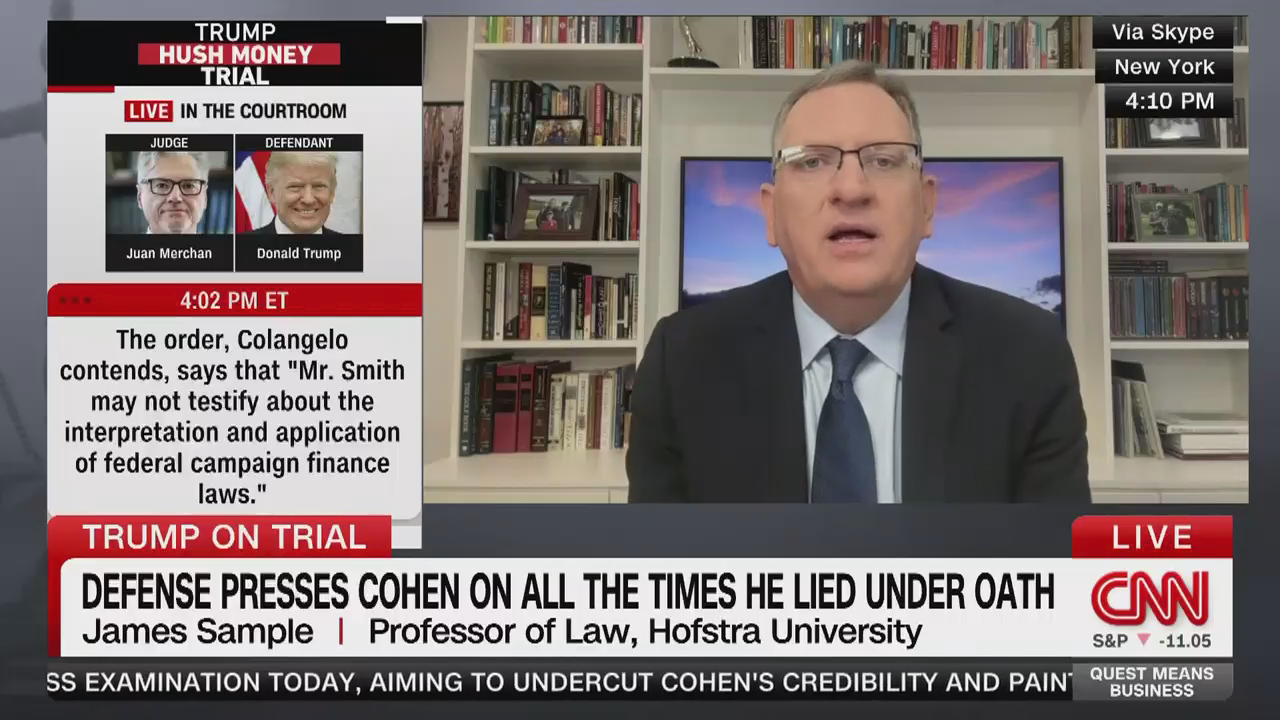
#Experts in the Media: Cohen Testifies in “Hush Money” Trial
The trials of Donald Trump are making headlines across the country and media are looking for key experts to offer opinion, perspective and insight to just about every angle and witness that's playing a part of this legal and political narrative day after day. Professor of Law James Sample was interviewed on CNN International’s Quest Means Business and in The Atlantic about the Michael Cohen’s testimony in former President Trump’s criminal trial in New York. These trials are daily news and if you're a journalist working this story - then let us help. James Sample is a Professor of Law at Hofstra University and previously served as an attorney in the Democracy Program at the Brennan Center for Justice at New York University School of Law. James is available to speak with media - simply click on his icon now to arrange an interview today.