
Experts Matter. Find Yours.
Connect for media, speaking, professional opportunities & more.

Consumer behavior expert and former "Survivor" contestant on holiday deals and scarcity
Kelly Goldsmith, professor of marketing, is available for commentary on holiday deals and anticipated scarcity due to supply chain issues. Kelly is a former Survivor contestant, which influenced her research into consumer behavior in the wake of scarcity. She is an expert in how people think and act when faced with limited availability of what they need and how they perceive competition when it comes to purchasing items that are in limited supply. Topics she can discuss include: How and why the combination of sales and perceived scarcity prompts consumers to behave selfishly (such as buying out entire stock) and other anticipated consumer behaviors and attitudes this holiday season How to plan ahead and find the best deals well in advance and stick to a budget when there are too many good deals to pass up How to keep your cool in the demanding, stressful environment



Emory Experts - Why Companies Invest in Local Social Media Influencers
Companies seek local influencers to pitch products. Even though most influencers amass geographically dispersed followings on social media, companies are willing to funnel billions of sponsorship dollars to multiple influencers located in different geographic areas, effectively creating sponsorships that span cities, countries, and in some cases even, the globe. The desire to work with local influencers has spawned advertising agencies that specialize in connecting companies with influencers and may soon redefine the influencer economy. This trend has merit, our research team finds. In a new Journal of Marketing study, we show a positive link between online influence and how geographically close an influencer’s followers are located. The nearer a follower is geographically to someone who posts an online recommendation, the more likely she is to follow that recommendation. To investigate whether geographical distance still matters when word of mouth is disseminated online, our research team examined thousands of actual purchases made on Twitter. We found the likelihood that people who saw a Tweet mentioning someone they follow bought a product would subsequently also buy the product increases the closer they reside to the purchaser. Not only were followers significantly associated with a higher likelihood to heed an influencer’s recommendation the closer they physically resided to the influencer, the more quickly they were to do so, too. We find that this role of geographic proximity in the effectiveness of online influence occurs across several known retailers and for different types of products, including video game consoles, electronics and sports equipment, gift cards, jewelry, and handbags. We show the results hold even when using different ways to statistically measure the effects, including state-of-the-art machine learning and deep learning techniques on millions of Twitter messages. We posit that this role of geographic proximity may be due to an invisible connection between people that is rooted in the commonality of place. This invisible link can lead people to identify more closely with someone who is located nearby, even if they do not personally know that person. The result is that people are more likely to follow someone’s online recommendation when they live closer to them. These online recommendations can take any form, from a movie review to a restaurant rating to a product pitch. What makes these findings surprising is that experts predicted the opposite effect when the internet first became widely adopted. Experts declared the death of distance. In theory, this makes sense: people don’t need to meet in person to share their opinions, reviews, and purchases when they can do so electronically. What the experts who envisioned the end of geography may have overlooked, however, is how people decide whose online opinion to trust. This is where cues that indicate a person’s identity, such as where that person lives in the real world, come into play. We may be more likely to trust the online opinion from someone who lives in the same city as us than from someone who lives farther away, simply because we have location in common. Known as the social identity theory, this process explains how individuals form perceptions of belonging to and relating to a community. Who we identify with can affect the degree to which we are influenced, even when this influence occurs online. Our findings imply that technology and electronic communications do not completely overcome the forces that govern influence in the real world. Geographical proximity still matters, even in the digital space. The findings also suggest that information and cues about an individual’s identity online, such as where he/she lives, may affect his/her influence on others through the extent to which others feel they can relate to him/her. These findings on how spatial proximity may still be a tie that binds even in an online world affirm what some companies have long suspected. Local influencers may have a leg up in the influence game and are worth their weight in location. For these reasons, companies may want to work with influencers who have more proximal connections to increase the persuasiveness of their online advertising, product recommendation, and referral programs. Government officials and not-for-profit organizations may similarly want to partner with local ambassadors to more effectively raise awareness of—and change attitudes and behaviors towards—important social issues. Goizueta faculty members Vilma Todri, assistant professor of Information Systems & Operations Management, Panagiotis (Panos) Adamopoulos, assistant professor of Information Systems & Operations Management, and Michelle Andrews, assistant professor of marketing, shared the following article with the American Marketing Association to highlight their new study published in the Journal of Marketing. To contact any of the experts for an interview regarding this topic, simply click on their icon to arrange a time to talk today.




When it comes to marketing, the endgame is almost always to increase brand awareness, strengthen relationships between companies and consumers, and boost market share. But counter-marketing efforts are often employed to reduce consumption of “vice” goods such as cigarettes, sugary sodas, and fast food. Earlier this year, Michael “Mike” Lewis, professor of marketing, faculty director, Emory Marketing Analytics Center, published “Investigating the Effects of Excise Taxes, Public Usage Restrictions, and Anti-Smoking Ads across Cigarette Brands.” in the Journal of Marketing. Mike, along with co-authors, Yanwen Wang PhD14, associate professor of marketing and Canada research chair in Marketing Analytics at the University British Columbia, and Vishal Singh, professor of marketing, Leonard N. Stern School of Business, New York University, took a closer look at the role counter-marketing plays in the consumption of “vice” goods. Given that many “vice” categories are dominated by high-equity brands such as Marlboro, McDonald’s, and The Coca-Cola Company, the authors wanted to explore whether or not strong brands “might also affect the efforts of advocacy groups and regulators to disrupt these relationships and reduce consumption,” they note in their paper. The research focused specifically on the interplay between branding and counter-marketing with respect to cigarette consumption. By focusing on brand manufacturers rather than on regulators and consumers, the authors believe they’ve closed a gap. “The literature on smoking cessation has largely ignored the impact of branding on efforts to reduce cigarette consumption,” they write. “This is an oversight given that marketing researchers have found that brand-consumers’ relationships have significant effects on consumer decision-making.” A full article on the research is attached and is well worth the read. In that piece, readers will learn more about how the researchers expected that strong brands would take advantage of their increased customer loyalty and diminished price sensitivity to protect them from counter-marketing tactics. And while it might be counter-intuitive, the author’s research suggests that market leading cigarette brands would be better off pushing for excise taxes on cigarettes (versus smoking restrictions), as such tax increases would be attractive to government agencies (by increasing government revenue), and big brand cigarette companies would capture more market share. In other words, when it comes to combating counter-marketing efforts, “brand managers may devise strategies or lobbying efforts based on their category position,” suggest the researchers. “This isn’t a clear-cut battle of good versus evil. It’s more a matter of a brand’s people advocating for one position,” said Lewis. “A position that’s going to make them more resilient to some of these tactics.” In addition to big brand cigarette companies, the paper’s findings have implications for brands that anchor other vice categories, such as McDonald’s and The Coca-Cola Company, entities that have been the target of counter-marketing campaigns by various anti-obesity groups. According to Lewis, Wang, and Singh’s research, much of the response by these brands to the counter-marketing attempts has been centered around public relations, but the authors see opportunities to employ “different tactics” that are “appropriate for different brands,” they write. "Relationships between consumers and relatively weak brands may be disrupted using taxes, while for strong brands, the appropriate tactic seems to be usage restriction that limit public consumption. Our results suggest that brand building is the correct response to taxes, whereas usage restrictions would call for other responses, such as lobbying.” If you are a reporter looking to know more about this subject or if you have questions, then let our experts help. Professor Michael Lewis is an Associate Professor of Marketing at Emory University’s Goizueta Business School. In addition to exploring trends in the overall marketing landscape, Lewis is an expert in sports analytics and marketing. He is available for interview - simply click on his icon to arrange a discussion today.


Covering World Breastfeeding Week? Our experts are here to help
August 1-7 is World Breastfeeding Week, and the University of Mary Washington has the ideal expert for any journalist looking to learn more or cover this important topic. Did you know that breastfeeding is one of the top maternal priorities for many organizations, including the World Health Organization (WHO), the American Academy of Pediatrics (AAP) and the Centers for Disease Control and Prevention (CDC)? Assistant Professor of Communication Elizabeth Johnson-Young has done extensive research on women’s intentions to breastfeed and how the communication they receive during pregnancy and postpartum from various sources such as doctors, lactation consultants, friends and family, magazines, books and parenting groups can impact the decision to breastfeed. She's also explored the connections between breastfeeding and body satisfaction. Dr. Elizabeth Johnson-Young is a published expert on health communication, especially maternal and family health. She is ready to help if you are looking to cover this topic - simply click on her icon now to arrange an interview today.


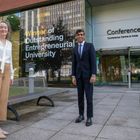
Rishi Sunak kickstarts Help to Grow scheme at Aston Business School
"It was a pleasure to host the chancellor at Aston Business School today. As a small business leader you have to know about all the key business functions and how to optimise them to drive high performance in your business." Paula Whitehouse, Aston Business School Paula Whitehouse (L) & Rishi Sunak (R) The Chancellor of the Exchequer met with Aston University’s deputy vice-chancellor engagement and associate dean enterprise of the College of Business and Social Sciences to launch Help to Grow: Management The scheme will support senior managers of small and medium-sized businesses to boost performance, resilience, and long-term growth The 12-week programme is 90% funded by the Government and participants can complete it alongside full-time work. The Chancellor has called on the leaders of small and medium-sized businesses to sign up to a new programme designed to hone their expertise as he attended one of the first courses in the UK today (August 2). Rishi Sunak joined a class taking part in the government-funded Help to Grow: Management scheme at Aston Business School, Aston University, alongside small business owners, to see first-hand how it is giving them the tools they need to innovate, grow and help drive the recovery from the pandemic. The Chancellor delivered a talk to participants at Aston Business School on the critical role small businesses can play in boosting UK productivity. He then took part in a group activity and led a discussion about their own business models and opportunities for growth. The scheme, which was announced at the March Budget and opened for applications in May, will give 30,000 SMEs access to world-class business expertise on everything from financial management to marketing and is a pivotal part of the government’s Plan for Jobs. Rishi Sunak, the chancellor of the exchequer, said: “Small businesses are key to our innovation and economy and will therefore be an essential part to our recovery from the pandemic, which is why we are levelling up their skills through the Help to Grow schemes. “I want to bring some of the best bits of management training from around the world to help boost productivity here in the UK. “Help to Grow: Management will ensure our brilliant SMEs seize every opportunity to grow, fuelling our Plan for Jobs by boosting productivity in all corners of the UK.” Experts in small business and entrepreneurship from Aston University have played a significant role in developing the programme. Paula Whitehouse, curriculum director for Help to Grow: Management and associate dean enterprise of the College of Business and Social Sciences, said: "It was a pleasure to host the chancellor at Aston Business School today. As a small business leader you have to know about all the key business functions and how to optimise them to drive high performance in your business. “Help to Grow: Management will combine this essential business education with the creation of a like-minded business network and support for the practical application of the learning to ensure businesses get immediate results. “I am excited to be working with Small Business Charter business school colleagues all over the country to roll out the Help to Grow: Management curriculum and ultimately to be introducing many more business leaders from the West Midlands into Aston's vibrant entrepreneurial community." Mark Hart, professor of small business and entrepreneurship at Aston University and associate director of Aston Centre for Growth, said: “The launch of the Government’s Help to Grow: Management programme for SMEs is a welcome addition at a critical time to the range of support available to small business leaders across the UK. “Small firms will drive the recovery as they have always done in previous economic downturns and equipping their leaders with the leadership and management skills from the UK’s leading business schools will ensure that they will build even more resilient, innovative and sustainable businesses capable of responding to the emerging opportunities in their chosen markets. “This is a practical, intensive 12-week programme designed by some of our top academics to provide the skills required to improve the performance and productivity of small firms across all sectors of the economy”. Mark Hart (L) & Rishi Sunak (R) take part in a class at Aston Business School


How to find a job in Canada and position yourself as an ideal candidate
Whether you’ve just received your Confirmation of Permanent Residence (CoPR) or have recently moved to Canada, finding employment and getting back in your field of work is always top of mind for many. As you begin your job search in Canada, there are a few things that are must-haves: A Social Insurance Number (SIN) – A nine-digit number that you need to work in Canada or to have access to government programs and benefits. Credential assessment for occupations such as teachers, accountants, medical professionals, engineers, social workers, etc. Credential assessment is a process through which you can get certified, registered, or licensed to practice your occupation in Canada. A Canadian-style resume and cover letter. Remember to customize your resume for each job application. Tip: To learn about the scope of your role in Canada and get deeper insights into specific job markets such as Information Technology (IT), Finance, Sales and Marketing, Project Management, Healthcare, Human Resources (HR), and others, download Arrive’s free guide for the Canadian job market. Once you’re equipped with these basic tools and resources, you’re ready to start looking for relevant opportunities. Here are a few ways you can get started with your job search in Canada. 8 ways to find a job in Canada 1. Browse job search websites Most job seekers use job search websites as the starting point while looking for opportunities. In Canada, many locally-popular sites provide more than just job listings. You can get access to employment trends, salary trends, career-planning tools, and industry information. The Canadian government’s Job Bank website is one such exhaustive resource. It is a job-listing aggregator so it pulls listings from multiple job sites which makes it convenient to browse opportunities. You can also check the provincial and territorial websites for more newcomer employment resources. What are the best job sites in Canada? Some popular job search websites are: LinkedIn Jobs, Indeed, Monster, Glassdoor, Workopolis, CareerBuilder, and SimplyHired. If you’re looking for freelancing opportunities or remote work, sites like UpWork, Fiverr, Jobboom, Jobillico, and Jobspresso are good options. 2. Network and volunteer One of the things to know as a job seeker is that Canada has a hidden job market. The hidden job market refers to positions that are filled without the employer advertising for it publicly. It is said that as much as 65-85 per cent of the jobs are not posted online. This is why networking is crucial to finding relevant opportunities – and LinkedIn is an excellent tool to get you started. You can use websites like Eventbrite and Meetup to locate industry-specific networking events near you. These events are excellent forums to find people from your field of work and strengthen your professional network. Giving back to the community (or volunteering) is usually well-regarded and valued in Canadian society. It can help you gain Canadian experience and learn the local culture and serves as a good way to meet other people and build your network. Tip: Volunteering can help you build your network and earn Canadian experience. To discover the importance of volunteering in Canada and learn how to find volunteering opportunities, read The benefits of volunteering as a newcomer in Canada. 3. Enrol with immigrant-serving organizations In Canada, there are various government-funded organizations such as ACCES Employment and COSTI that help newcomers find employment. Some are province and city-specific, so you can look up the government website to find one closest to you. These organizations help newcomers with a wide range of online and in-person career services such as resume building, interview preparation, language assessment, and finding a job. 4. Attend job fairs Many immigrant-serving organizations also organize job fairs. Some of these fairs are virtual and span a couple of days, while others are in-person events. Prepare for Canada, and JVS Toronto are organizations that do online job fairs periodically. One of the benefits of enrolling with a government-funded settlement organization is getting alerts for these job fairs. Following the social media channels for these organizations and browsing sites like Eventbrite and Meetup are also good ways to find upcoming job fairs. 5. Reach out to employment agencies and recruiters There are many employment agencies and specialized recruiters that can help you find a job in your field in Canada. These agencies and recruiters match jobseekers to employer positions. You can search for recruiters from your industry on sites like LinkedIn. Recruitment agencies in Canada may be nationally and/or internationally licensed. Those with a national license are only authorized to assist job seekers within Canada, while those with an international license can recruit overseas employees wanting to work in Canada. Who are the top recruitment agencies in Canada? Some popular employment agencies in Canada are Robert Half, Randstad Canada, and Hays Canada. Employment/recruitment/placement/staffing agencies cannot demand a fee from a jobseeker to help them find work. However, they can charge for additional services such as resume preparation, interview preparation, and job skills training. Tip: Beware of any employment agencies or recruiters asking you to pay a fee in exchange for a job offer, especially if you haven’t moved to Canada yet. Learn more about employment scams in Canada in the article, Common scams that newcomers to Canada should know about. 6. Browse career sections on company websites A good way to go about your job search is to make a list of organizations you would like to work at and then check the career sections on their respective websites. Most websites will let you send a job application for open positions directly through their site. Reach out to current or past employees through LinkedIn for a coffee chat to better understand the organizational structure and learn more about your desired role – this will also help you prepare for your interview. These conversations are also a great way to know about future job openings at the organization. Tip: Check out the list of top 100 employers in Canada and find organizations from your industry. 7. Enrol in bridging programs Bridging programs are designed for internationally-trained professionals and tradespeople who want to work in their field in Canada. They can help you get a licence or certification and integrate into the Canadian workplace. Some of the bridging programs’ services include courses, education and skills assessment, practical or workplace experience, exam preparation for licenses or certificates, language training, and action and learning plans to help you identify the training you may need. These programs may be virtual, or in-person or a combination of both. Usually, classroom training or work experience is part of the program. Depending on the bridging program you choose, there may be a fee associated with it. Contact a newcomer settlement agency near you or check local university or college websites to learn more about enrolment processes and eligibility criteria for specific bridging programs. 8. Look for a mentor Many Canadian professionals and industry leaders provide free advice and coaching to newcomers settling in Canada. This is a good way to learn how to adapt your skills and experience for the local job market and find relevant opportunities. You can look for a mentor through organizations like: Immigrant Services Association of Nova Scotia (ISANS) Calgary Region Immigrant Employment Council (CRIEC) Toronto Region Immigrant Employment Council (TRIEC) Edmonton Region Immigrant Employment Council (ERIEC) Ottawa Community Immigrant Services Organization (OCISO) How to position yourself as an ideal candidate and get a job offer The job market in Canada is competitive. Once you’ve identified a job position that’s a good fit for your skills and experience, it’s time to stand out from the crowd and market yourself as the ideal candidate. Positioning yourself as a strong candidate to an employer begins with building your personal brand. Here are a few other aspects to keep in mind as you prepare for a job application. Be confident and tell your story Practise responses to basic interview questions and have an elevator pitch so you’ll be more confident during the interview. Elevator pitches are a good way to introduce yourself and make an impression at the start of an interview. They can also serve as an answer to the “tell me about yourself” question. Think of your achievements and use specific examples or stories to demonstrate how you are a good fit for the role. Job interview resources: How to prepare for a job interview 10 common job interview questions and how to answer them The interview process in Canada may seem nerve-wracking. Prepped is an excellent resource for you to practise your interview skills and confidently prepare for the interview process. 6 Tips for improving your job search in the Canadian market 1. Customize your resume and add a cover letter A generic resume and cover letter sent to multiple employers may not yield much success in your job search journey. Be sure to customize your resume to each position that you’re applying for by tailoring your work experience, skills, and any additional information to the role. The cover letter is a good way to justify any gaps in your resume or provide any additional info that your resume can’t. Adding a custom, well-written cover letter to your resume can make you stand out from the competition, thus improving your chances of being approached for an interview. 2.Research the company and the role Be sure to research the company you are interviewing with – this will help you have more meaningful conversations with the employer and ask relevant questions. Look up the company mission, vision, some of its history, and market standing. Align your responses to the organization’s goals. Candid reviews on sites like Glassdoor can help you get insight into the operations and culture of the company. Get the names and titles of people who will be interviewing you and learn a bit about their background – this information can come in handy while making small talk with interviewers. Network with current or past employees through LinkedIn to learn more about the company and identify their needs – it will help you suggest potential solutions during the interview. 3. Polish your LinkedIn profile In Canada, it is common for employers and recruiters to search your name online. Brush up and polish your LinkedIn profile so that it’s up-to-date with your experience and qualifications. Also, ensure your social media or blogs don’t raise any red flags about you or portray you in a negative light. 4.For virtual interviews: Check your connectivity and surrounding environment With the coronavirus pandemic, many organizations have their employees working remotely. There is also a growing trend of candidates being interviewed virtually or over the phone. With this new setup, it is essential to showcase soft skills such as self-motivation and communication and demonstrate your comfort level using technology to connect. Be sure to check your phone reception, internet bandwidth and hardware or software requirements to ensure a smooth audio/video call for your interview. Avoid taking such calls from a coffee shop or a place where background noise levels may be high. 5.Be punctual and dress for the job you want Whether it’s a virtual or an in-person interview, make sure you’re punctual and dress for the job you want. For in-person interviews, plan your journey beforehand and consider the traffic and weather conditions. With the dress code, you can never go wrong with formals – this applies to in-person as well as virtual interviews. 6.Follow-up after the interview After the interview, take the time to send a thank you note to each of your interviewers. While this reflects your enthusiasm for the position, it also ensures the interviewer remembers you while deciding whom to hire. Finding meaningful employment in Canada can take anywhere from a few weeks to a few months. Preparation, persistence, determination, a positive attitude, and access to the right resources will help you find relevant opportunities. Original article located here, published by Arrive.


Aston University – inspiring more women into engineering careers
• Aston University is celebrating International Women in Engineering Day • College of Engineering and Physical Sciences photography campaign of females as #EngineeringHeroes • Campaign aims to encourage girls into engineering careers A team of female engineering heroes from Aston University’s College of Engineering and Physical Sciences has banded together to encourage girls into STEM careers. As part of International Women in Engineering Day (INWED), the world’s largest initiative to celebrate the achievements of women in engineering, Aston University’s very own team of engineers have shown themselves to be the very best STEM superheroes. Aston University Mechanical Engineering Student and STEM Ambassador Olamide Olabode Dressed in capes and taking selfies for the event on Wednesday 23 June, female ambassadors from the College, in collaboration with the Greater Birmingham and Solihull Institute of Technology, have also put together video content to show off their engineering skills and become ‘heroes’ for girls wanting to do the same. Also launching on the day will be a competition for participating schools linked to Aston University. Girls are being challenged to come up with their own superhero gadget / gizmo idea. Professor Sarah Hainsworth OBE FREng, Pro-Vice Chancellor and Executive Dean of the College of Engineering and Physical Sciences at Aston University, said they were proud to be a part of INWED2021. “It is so important to us to encourage more girls into STEM subjects. Our hope is that through our teaching, and our partnership with the Greater Birmingham and Solihull Institute of Technology with its focus on technical skills for advanced manufacturing and giving students a clear route to technical employment, many will follow in the footsteps of our incredible team and be the STEM leaders of the future. “At Aston University, we work on sustainability for the environment, bioengineering, robotics, machine learning, sensors, communications, artificial intelligence, technologies for future vehicles and the issues that shape our future. On International Women in Engineering Day (INWED 2021), our College of Engineering and Physical Sciences celebrates the amazing contribution of our women colleagues who represent the cutting edge of engineering who are making vital contributions to our health and wellbeing, our society and our planet,” she added. Katy Lewis, marketing manager, said schools invited to take part were from the Aspire to Aston progressive programme, which works with 10 schools in and around Birmingham from areas of high deprivation. “At each of these schools there are up to 40 pupils per year group who have the academic ability to aim for university but lack the knowledge and confidence to do so and are selected for the programme. Our aim is to raise aspirations and normalise the idea of going into higher education, which is why us doing challenges like this one is so vitally important, so we can’t wait to help find the STEM female stars of the future,” she said. Currently the College of Engineering and Physical Sciences has 25% female academic staff (the UK STEM staff benchmark being 17 – 19%). The amount of female students studying the engineering subjects at Aston University has also grown over the past five years from 22% - 27%, above the UK STEM benchmark of 17% – 19%. To find out more about engineering at Aston University, visit ww.aston.ac.uk/eps For more details about the Greater Birmingham and Solihull Institute of Technology, visit this link: http://gbsiot.ac.uk/

Baylor Consumerism Expert Shares Five Tips to Make the Most of Your Stimulus Check
With President Joe Biden’s $1.9 trillion American Rescue Plan Act, citizens nationwide received a second round of stimulus checks in the form of $1,400 per person and an additional $1,400 per dependent. The Rescue Plan also brought increased child tax credits and unemployment benefits. James Roberts, Ph.D., The Ben H. Williams Professor of Marketing in the Hankamer School of Business, is an internationally recognized expert on consumerism and the author of “Shiny Objects: Why We Spend Money We Don’t Have in Search of Happiness We Can't Buy.” He said the latest round of stimulus funds offer consumers bright opportunities, but he also cautioned against pitfalls in uncertain times. Roberts said that people should first consider building up their emergency savings funds – a step, he said, more Americans seem to be taking during this time of pandemic and economic fluctuation . “Over the last 20 years or so, Americans have not saved much. However, in the first nine months of the pandemic, the U.S. savings rate increased by a whopping 100 percent. By some estimates we are at a national savings rate that hovers around 20 percent – which is incredible,” Roberts said. Roberts shared a few tips on how to get the best value for your stimulus check and prepare for times ahead: 1. Enhance your savings. Save a portion of your stimulus check for the inevitable rainy days ahead. Start with $1,000 to your short-term emergency fund. If possible, every family should have a $2,500 emergency fund. This provides peace of mind and avoids having to borrow from friends or family, or even worse, max out your credit cards or take out a “payday” loan, which I strongly advised against. 2. Invest in experiences. Given that a lot of Americans have significantly increased their savings and lowered their credit card debt, I say people should splurge a little on something for themselves or their families with the remaining $400. Remember, experiences bring more lasting happiness than buying stuff. Good mental health is critical to our well-being. 3. Start early. Don’t forget that the $1,400 stimulus check is only a small part of the money that may come your way. The child tax credits are a great opportunity to save for your children’s college. The earlier you start saving, the better. This is the beauty of compounding interest. 4. Save while unemployed I suggest any extra boost you might get in your unemployment check be saved for the days ahead. Don’t let money burn a hole in your pocket. 5. Plan ahead. Every family’s goal should be to set aside six months in living expenses so if you do lose your job, it doesn’t put you and your family into an immediate financial death spiral. ABOUT DR. JAMES ROBERTS James Roberts, Ph.D., is The Ben H. Williams Professor of Marketing in Baylor University’s Hankamer School of Business. He is a nationally recognized expert on consumer behavior and has been quoted extensively in the media and has appeared on the CBS Early Show, ABC World News Tonight, ABC Good Morning America, NBC The Today Show, Yahoo.com’s “The Daily Ticker,” and has been quoted and/or featured in The New York Times, The Wall Street Journal, National Public Radio, USA TODAY, TIME, FOX News, The Doctors on CBS, US News & World Report, Cosmopolitan, Glamour, and many other media. His books include “Shiny Objects: Why We Spend Money We Don’t Have in Search of Happiness We Can't Buy” and “Too Much of a Good Thing: Are You Addicted to your Smartphone?” ABOUT BAYLOR UNIVERSITY Baylor University is a private Christian University and a nationally ranked research institution. The University provides a vibrant campus community for more than 19,000 students by blending interdisciplinary research with an international reputation for educational excellence and a faculty commitment to teaching and scholarship. Chartered in 1845 by the Republic of Texas through the efforts of Baptist pioneers, Baylor is the oldest continually operating University in Texas. Located in Waco, Baylor welcomes students from all 50 states and more than 90 countries to study a broad range of degrees among its 12 nationally recognized academic divisions. ABOUT HANKAMER SCHOOL OF BUSINESS AT BAYLOR UNIVERSITY At Baylor University’s Hankamer School of Business, top-ranked programs combine rigorous classroom learning, hands-on experience in the real world, a solid foundation in Christian values and a global outlook. Making up approximately 25 percent of the University’s total enrollment, undergraduate students choose from 16 major areas of study. Graduate students choose from full-time, executive or online MBA or other specialized master’s programs, and Ph.D. programs in Information Systems, Entrepreneurship or Health Services Research. The Business School also has campuses located in Austin and Dallas, Texas. Visit baylor.edu/business.


Scarcity expert on gas shortage and panic buying
Kelly Goldsmith, associate professor of marketing, is available for commentary on the gasoline shortage and panic buying/hoarding. Goldsmith is a former Survivor contestant, which influenced her research into consumer behavior in the wake of scarcity. She is an expert in how people think and act when faced with limited availability of what they need and how they perceive competition when it comes to purchasing items that are in limited supply. She can discuss: The types of consumers that tend to buy up and hoard all available stock, therefore leaving none for others How and why consumers become selfish in a situation where access to desired goods is limited Making a plan when it comes to purchasing what you need and how to keep your cool in the demanding, stressful environment

Expert available to discuss Facebook Oversight Board's decision on Trump's account
Reporters: Girish Mallapragada, a social media marketing expert at the Indiana University Kelley School of Business, is available Wednesday (May 5) to discuss the Facebook Oversight Board's decision to uphold Facebook's ban on former President Donald Trump. In advance of the announcement, Mallapragada, an associate professor of marketing and Weimer Faculty Fellow, said he questioned whether the board’s decision will have much of an impact on Trump’s outreach to his followers. He noted that Trump’s rise in popularity primarly came through his use of another social media platform, Twitter, and not as much through Facebook. “He was more adept at short form communication than long contextual messages. Twitter is ideal for the former, Facebook for the latter,” Mallapragada said. “Twitter is closest online to a live large audience, where he thrives.” “If Facebook allows him to comeback, it might make people unhappy and others happy, but I don’t think it would be impactful to make a big difference.” George Vlahakis, associate director of communications and media relations at Kelley, can help arrange for interviews with Mallapragada, and can be reached at vlahakis@iu.edu.
