
Experts Matter. Find Yours.
Connect for media, speaking, professional opportunities & more.
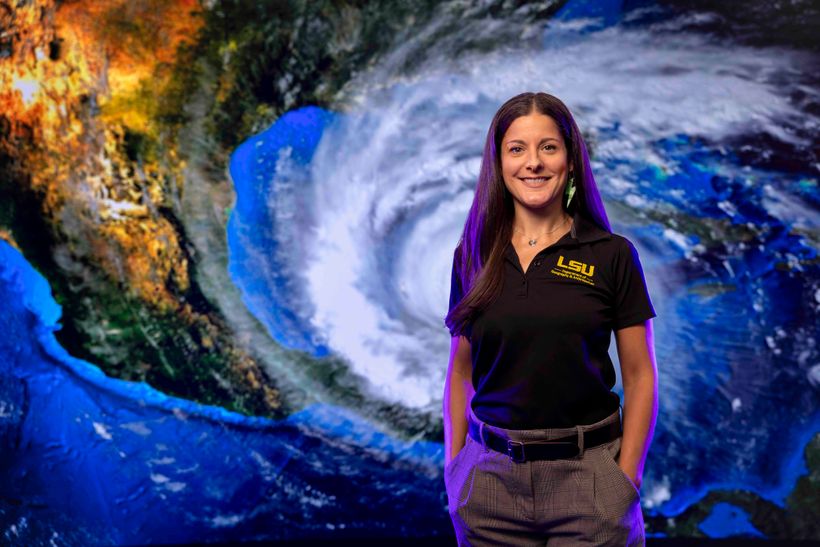
LSU’s Jill Trepanier Educating K-12 Louisiana Students About the Environment
What began in 2018 as a single rooftop weather station on LSU’s campus as a tool to help freshmen connect to the science happening around them, has grown into an educational network in the southern part of the state, connecting K-12 students with the sky through real-time data, interactive technology, and hands-on learning. Trepanier, a professor and department chair in LSU’s Department of Geography & Anthropology, leads a project that now includes 10 weather stations installed at or near K–12 schools from Lake Charles to Grand Isle. “The environment is harsh in Louisiana. Beautiful, but harsh,” Trepanier said. “The more students know about it, the better they can protect themselves and their families. For me, that’s what it is all about.” The project all started to help college students in Trepanier’s meteorology and physical geography classes connect more deeply with the material by using weather data collected from the air around them. “These were 400 freshmen every semester who were not geography majors, so they didn't really love the science of the atmosphere. But they were able to connect with the information because they could see the data on an app on their phone as they were living in it.” Installed across South Louisiana, each weather station is solar-powered and connected to a console that uploads data to an online web platform and displays it on a dashboard. Then an app shows the local students the current conditions and records for the day. “When we look at data from the community, it might be many miles from where you are. And most people live within a few miles or less of their schools. It allows them a close-up view of what is happening, instead of relying on something miles away,” she said. Teachers can use the data with certain lessons or during a passing storm. But the available data also educates them on things like solar radiation, “It also helps aid things like seasonality and our relationship with the sun. It extends well beyond just rain.” The material is also aligned with the Louisiana Student Science Standards for environmental and Earth sciences. “By allowing students to compare real data across space and time, it helps them to understand how systems are connected. And most of these science standards have them focusing on system theory, in one way or another,” Trepanier said. Read the full story here.


'Chemtrails' and other climate conspiracies: Florida Tech's expert sets the record straight
When Florida Today columnist Tim Walters wanted to 'clear the air' about a popular conspiracy theory, he connected with Michael Splitt, an assistant professor at Florida Institute of Technology's College of Aeronautics with a focus on meteorology. The "chemtrail" conspiracy follows the erroneous belief that condensation trails (contrails) that trail behind jets are actually being used on a large scale to manage radiation and combat global warming. In the column, Splitt argued against the conspiracy by explaining what might happen if that level of "climate engineering" was actually going on. I recently wrote a column about the “chemtrail” conspiracy theory, and to say it caused quite a stir would be a serious understatement. My motivation for writing the piece came because there is a bill being looked at by the Florida legislature to address concerns of people who think the skies are being seeded by commercial airplanes with poisonous, weather-manipulating substances. Some of those raising concerns claim there are vague amorphous operatives in the federal government leading this charge. I decided I’d try to find answers, and I did so by asking someone credible in the field of weather sciences. Answers from climate expert Can the climate be altered by humans? The idea of trying to manipulate weather is called “climate engineering.” There is a form of this called solar geoengineering. “We've been doing things like this for decades in terms of, for example, fog management products. People have used this kind of methodology of adding things to the air to help get rid of fog, like the ice fog problem in Salt Lake City. So, there are places where people try to manage a local cloud layer,” Splitt said. However, it’s not done to a scale that would impact the country or globe. That’s where conspiracy theorists take climate engineering a step too far. There are those who say commercial airliners are spraying other substances like aluminum and barium (and other metallic) nano particles to reflect the sun's heat to reduce global warming. Splitt said if this were real, it might have the opposite effect. “When you have more contrails, it actually ends up warming the planet. The cirrus clouds created by aircraft and their reflective power isn't as much as let's say, the warming impact from below, from infrared radiation, so they end up being warmer." March 20 - Florida Today In the full column, Splitt also takes on other common misconceptions such as, "Why do some contrails last longer than others?" And, "Are ‘chemtrails’ steering, strengthening storms?" It's a worthwhile read for those interested in meteorology or conspiracy theories. Are you curious or looking to know more about those chasing clouds? Michael Splitt is available to speak with media. Contact Adam Lowenstein, Director of Media Communications at Florida Institute of Technology, at adam@fit.edu to arrange an interview today.


How authorship language helped catch a domestic terrorist – new podcast
In the latest episode of Writing Wrongs, hosts Professor Tim Grant and Dr Nicci MacLeod interview Dr Isobelle Clarke to unravel a case where forensic linguistics helped track down and convict a dangerous individual. Episode three, Imposters Tending to the Wild with Dr Isobelle Clarke, dives into the chilling case of Nikolaos Karvounakis, a self-proclaimed anarchist who planted a viable explosive device in Princes Street Gardens, Edinburgh, in 2018. Karvounakis, a Greek national, evaded capture for years, hiding behind online anonymity and extremist rhetoric. However, forensic linguists stepped in to analyse his anonymous blog posts, revealing patterns in his language that ultimately helped Police Scotland link him to the crime. The case not only demonstrates how linguistic evidence can be a powerful forensic tool but also raises crucial questions about the role of language analysis in modern terrorism investigations. On 11 January 2018, a suspicious cardboard box was discovered in a public seating area in Edinburgh’s Princes Street Gardens. After a controlled explosion, investigators determined the device could have caused serious harm had it detonated. With no immediate leads, the investigation stalled - until an anonymous blog post surfaced, claiming responsibility for the attack. The post, written in both English and Spanish, was linked to an eco-anarchist group called Individualists Tending to the Wild, a Mexican-based extremist organisation advocating violent action against technological progress. Crucially, the post included an image of the bomb’s interior, a detail only the perpetrator or law enforcement could have known. Police Scotland sought the expertise of Professor Tim Grant, who analysed the text, producing a linguistic profile that suggested the writer was neither a native English nor Spanish speaker - but rather someone influenced by another language entirely. Two years later, police identified Nikolaos Karvounakis as a suspect. Using comparative authorship analysis, Professor Tim Grant compared his online writings - including song lyrics from his rock band - to the manifesto. By dissecting word patterns, grammatical structures and stylistic quirks, he established that Karvounakis was the likely author. This evidence -alongside forensic meteorology, which linked photos of clouds in Karvounakis’ blog posts to the same weather conditions on the day of the crime - was used to secure a warrant and seize computers containing known writings by Karvounakis. To eliminate inevitable bias that would result from having worked the case for more than two years, Professor Grant invited Dr Isabelle Clarke onto the case as an independent forensic linguist. Using a version of the General Imposters Method, a technique similar to a police lineup but for language, Dr Clarke confirmed that the writing style in the blog post was the closest to Karvounakis’ known writings. Police Scotland put the evidence in the case, including the linguistic evidence, to Karvounakis, and secured a guilty plea. In February 2022, Nikolaos Karvounakis was sentenced to over eight years in prison under the UK’s Terrorism Act. Tim Grant, professor of forensic linguistics at Aston University, said: “The case highlights the growing importance of forensic linguistics in solving crimes, particularly in an age where digital anonymity combines with extremist ideologies. “It also highlights the how different types of language analysis can assist as a case moves through different stages of investigation.” Dr Nicci MacLeod, deputy director of the Aston Institute for Forensic Linguistics, said: “This episode offers listeners a behind-the-scenes look at the forensic methods that expose deception, identify threats and ultimately bring criminals to justice.” Dr Isobelle Clarke, a lecturer in security and protection science at Lancaster University and one of the first graduates from the campus-based MA Forensic Linguistics programme at Aston University, said: “It was great to be back at Aston University talking about the Karvounakis case for the Writing Wrongs podcast. “It’s an interesting case to highlight, as it shows how different types of language analysis can help with police investigations.” Writing Wrongs is available on Spotify, Apple Podcasts and all major streaming platforms. Listeners are encouraged to subscribe, share and engage with the hosts by submitting their forensic linguistics questions. Whether it’s about this case or broader forensic linguistic techniques, Professor Grant and Dr MacLeod welcome inquiries from listeners.


Teaching the Dangers of Snow Squalls
Dr. Jase E. Bernhardt, associate professor of geology, environment, and sustainability and director of meteorology, was featured on WPSU/Pennsylvania Cable and on The Weather Channel’s Weather Geek podcast about his VR research that demonstrates the danger of driving in a snow squall and the science behind these dangerous bursts of weather.


Jase E. Bernhardt, associate professor of geology, environment, and sustainability and director of meteorology at Hofstra University, talked to WCBS-TV about the string of snow storms forecasted for the New York metropolitan area recently.

Hurricane Season Quiet, But Not Yet Over
Jase Bernhardt, associate professor and director of Sustainability Studies and Meteorology in the Department of Geology, Environment and Sustainability, was interviewed by WNYW-TV Fox 5 about this year’s hurricane season. Though there aren’t any storms currently brewing in the Atlantic, Dr. Bernhardt says we are only midway through hurricane season and should not yet let our guard down. Jase Bernhardt is available to speak with media about this topic - simply click on his icon now to arrange an interview today.

States Most and Least Impacted by Natural Disasters
For a report on states with the most (and least) climate risk today, MoneyGeek interviewed Jase Bernhardt, associate professor and director of Sustainability Studies and Meteorology in the Department of Geology, Environment and Sustainability. Dr. Bernhardt talked about the biggest natural hazards that are affecting the country and how the population can prepare for events like flooding, extreme heat, and severe thunderstorms. Jase Bernhardt is also an expert on hurricane preparedness. He is available to speak with media about these topics - simply click on his icon now to arrange an interview today.
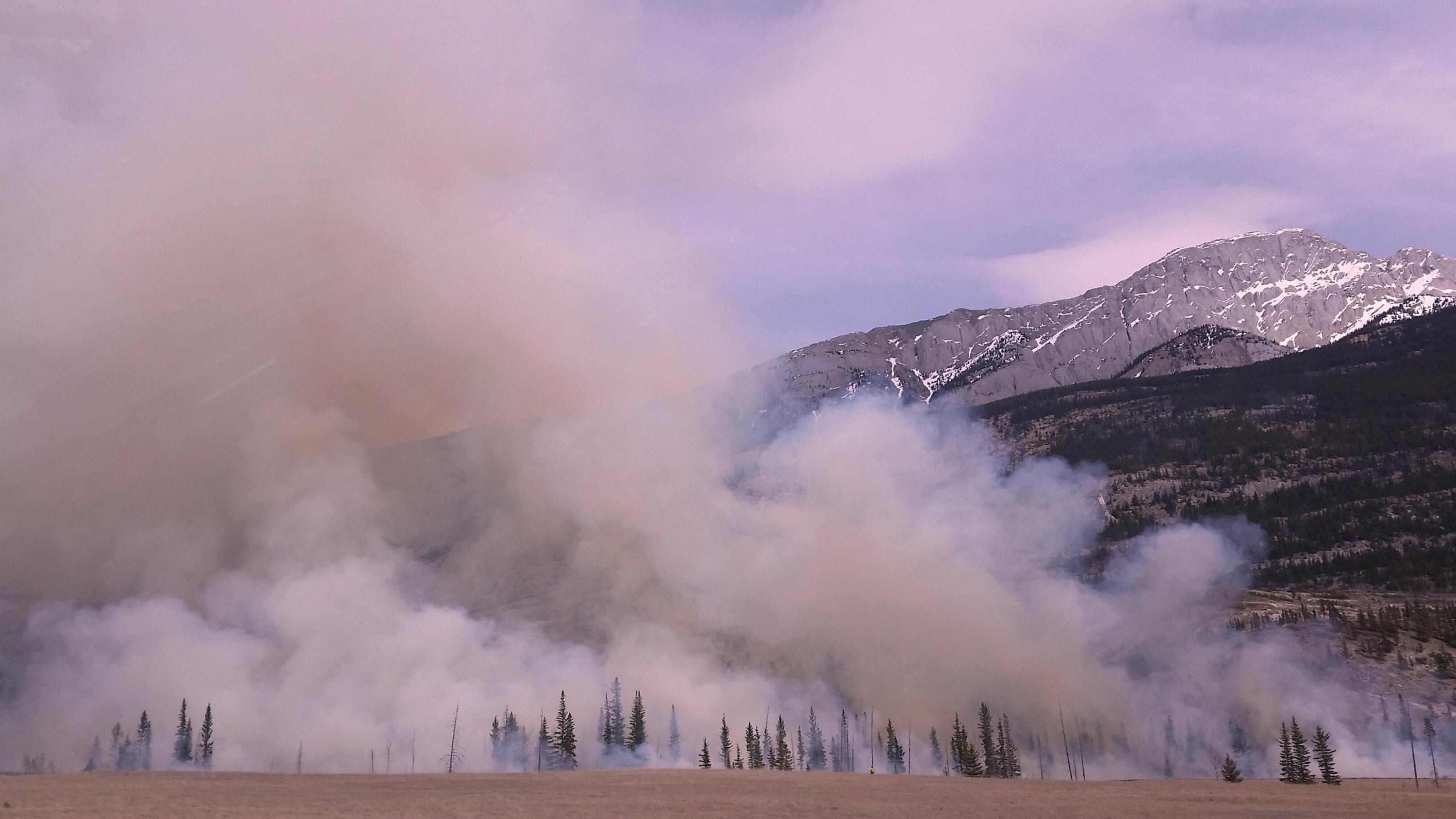
#Expert Q&A: Amid the Wildfire Haze, NJIT's Alexei Khalizov Explains What's in the Air
The soot that permeated the air in New Jersey and New York this summer — courtesy of massive wildfires in Canada — is exactly what a New Jersey Institute of Technology professor is studying to determine its impact on climate change. Alexei Khalizov, an associate professor of chemistry and environmental science, is partnering with Associate Professor Gennady Gor on the three-year project, which began last year and is supported by a $620,000 grant from the National Science Foundation. Specifically, they’re examining the soot created by wildfires and the burning of fossil fuels in hopes of better predicting its impact on climate. Khalizov, who’s been at NJIT since 2013, took time out from his research to explain what millions of residents of N.J. and N.Y. are experiencing as a result of the wildfires hundreds of miles to the north. Q: What’s in the smoke? Small particles and some gas chemicals. These particles and chemicals were released by wildfires and they were picked up by the air mass and carried all the way to New Jersey from Canada. Those particles are extremely small: you can stack maybe a hundred of such particles across single human hair thickness. Q: Is breathing it the equivalent of smoking a pack of cigarettes? That would be a reasonable comparison. A cigarette is made of plant material. When it smolders and burns it releases particles that are very much like those particles from wildfires. Maybe the only difference is that the wildfires have no nicotine. But they have lots of other chemicals. Q: What factors contribute to the density of the smoke? Well, it's a major wildfire. It covers a huge territory in Canada. And the meteorology is such that this smoke is carried all the way from Canada to the U.S. without significant dilution. And due to that, the concentration of those particles is very high. Q: When did we last experienced something of this magnitude? We had some Canadian and Alaskan wildfires a few years ago. And air mass transport brought the smoke all the way to New Jersey, but it wasn't as bad as what we are observing today. Q: What about in terms of EPA standards? The Environmental Protection Agency has a list of criteria pollutants. One of those pollutants is particles smaller than 2.5 microns. And typically, if the concentration of those particles exceeds 35 micrograms per cubic meter, the air is considered unhealthy. When I looked at the map of pollution today (June 7, 2023), it showed that throughout the majority of New Jersey, the concentration is around 90 micrograms, which is two to three times higher than this unhealthy threshold. And actually, there is a location, I believe it's around Paterson, where the concentration is 140 micrograms, which is four to five times above the threshold. Q: Can the wildfires in South Jersey be contributing to this? It's possible, but probably it's not a major contribution. Also, if you look at the wind pattern, it's probably not a major factor at all. Q: Why is wind unable to disperse the smoke? For the wind to disperse the smoke, one needs to mix clean air with all this contaminated air and the amount of contaminated air is so high that there’s no clean air around to actually produce any dilution. Q: Why is there so much haze? It’s because of the continuous inflow of air, which is contaminated by emissions from the wildfires. The haze itself has a relatively short lifespan. Q: How does temperature change affect the smoke? If the temperature increases that may accelerate the rate of some chemical reactions that will also be accelerated by the sunlight. And that's one reason why the smoke that was released in Canada is not exactly the same smoke that we experience in New Jersey. As this haze is traveling over three to six hundred miles, it undergoes a number of chemical reactions and even the smell changes. You know how freshly released wood smoke smells — it's actually pretty pleasant. What we're smelling now, it's not pleasant at all. That's the result of those chemical reactions, which makes this even more unhealthy. Q: Will rain immediately clear the smoke? Yes, it will. If we could have rain, then the rain would remove the majority of these particles. And in fact, I believe we've been experiencing the smoke for several days, almost a week now. It would go up and decrease. And we’ve had several rains and those rains did really clear out some smoke. Q: What can we do individually and collectively to protect ourselves? We can help ourselves by staying indoors and wearing masks if you have to go outside. Certainly, exercising outside is not a good idea even while wearing a mask. Also, if you have a central air conditioning system, you can turn on the fan to run the air through the filter, which will remove some of these particles. It depends on what kind of filter you have — high efficiency or regular. Q: What kind of mask? Make sure that it's an N-95 mask, not a surgical mask. A surgical mask is not is not going to help you at all. Q: How does what we’re experiencing relate to your research? My collaborator and I received a major grant from the National Science Foundation to study the particles released by combustion. As they travel through the air, they change both in shape and in composition. And these changes affect their toxicity and they affect their impact on climate. These particles actually are one of the warming agents. So, we hope that within about three years of working on this project, we’ll be able to explain better what happens and then modelers will be able to predict the impacts of such events with better accuracy. Looking to know more - we can help. Alexei Khalizov is available to discuss this important topic with media - simply click on his icon now to arrange an interview.

