
Experts Matter. Find Yours.
Connect for media, speaking, professional opportunities & more.
Simulations of Exoplanet Formation May Help Inform Search for Extraterrestrial Life
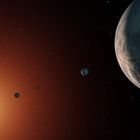
Florida Tech astrophysicist Howard Chen is offering new insights to help aid NASA’s search for life beyond Earth. His latest theoretical work investigates the TRAPPIST-1 planetary system, one of the most widely studied exoplanetary systems in the galaxy. It has captured scientists’ attention for its potential to host water, and thus possibly life, on its planets. Now, he’s offering an explanation for why telescopes have yet to find definitive signs of either. The paper “Born Dry or Born Wet? A Palette of Water Growth Histories in TRAPPIST-1 Analogs and Compact Planetary Systems” was authored by Chen, an assistant professor of space sciences, and researchers from NASA, Johns Hopkins University and Harvard University, was published in The Astrophysical Journal Letters in September. It explores the likelihood that TRAPPIST-1’s three innermost exoplanets contained no water when they formed, despite existing in a zone where water is viable. TRAPPIST-1 is a red dwarf star located about 40 light-years away from us. (One light year is about 6 trillion miles.) It is thought to be about 7.6 billion years old, or 3 billion years older than our Sun. Astronomers are captivated by the TRAPPIST-1 system because its seven known planets are rocky and Earth-like. They also fall within the star’s habitable zone: the distance range from a star at which temperatures are not too hot or cold to support liquid water. Researchers are searching for any evidence of water on these planets, but have yet to detect anything. Some think a lack of gas in the atmosphere is disrupting the light needed to pick up detailed visuals. Others predict water could have escaped the planets’ atmospheres throughout their evolution. Chen and his team, however, decided to research a different theory: that there was no water to begin with because there was no gas to contain it. He would test it not from an observational perspective, but with mathematical modeling of the planets’ initial formation. “You have astronomers who are using telescopes to see what’s out there. I come from a different perspective,” Chen said. “I’m both trying to explain what we’re seeing while trying to make predictions about what we can’t.” The researchers created models that examined the composition and growth of these planets starting when they were as small as one kilometer wide. They simulated how material aggregated during collisions with other celestial objects until they reached their final planetary formations. There are several key factors in collision events that heavily influence a planet’s final composition. Chen’s models incorporated impact delivery, which is the transfer of materials like water and gases during a celestial collision; impact erosion, which refers to the removal of materials in a planet’s atmosphere due to impact; and mantle-atmosphere exchange, which is the transfer of water and gases between a planet’s atmosphere and mantle to maintain its conditions. The team ran hundreds of collision simulations, which returned thousands of different possibilities for how TRAPPIST-1’s planets might have formed. They varied several components, such as the amount of water available to the system, the profile of the initial planet formation environment, the planets’ density profiles and the initial system conditions. For the inner worlds, specifically the first three planets, most of the simulations came back dry. “Whatever we did, we couldn’t get much water in these inner planets,” Chen said. He believes that the main reason the planets couldn’t acquire water is due to the nature of the collision events. Compact planet collisions are higher velocity, so they are more aggressive and energetic, Chen said. This means that instead of acquiring material for a gaseous atmosphere, planets’ atmospheres were completely cleared out by the power of the collisions. With no gas in the atmosphere to contain water, it’s possible that any previously existing water escaped back into space during these collision events. Understanding a planet’s earliest characteristics, its water, air and carbon content, builds the foundation for how they evolve. That way, when researchers identify a planet that seems viable for life at the surface level, they can use Chen’s model to simulate what these distant worlds might be like on the inside, on the surface and in the air. Combining the theoretical context of a planet’s formation with the state in which it was discovered can help researchers – and NASA – make informed, efficient decisions on which planets are worth investigating and when it’s time to move on to the next. If you're interested in connecting with Howard Chen about the search for life beyond Earth, let us help. Contact Adam Lowenstein, Assistant Vice President for External Affairs at Florida Institute of Technology, at adam@fit.edu to arrange an interview today.


Expert Research: The Fourth Industrial Revolution, Artificial Intelligence and Domestic Conflict
Artificial Intelligence is often framed as a driver of innovation. But it also has the power to disrupt the very foundations of our societies. In a recent study, experts Craig Albert, PhD, and Lance Hunter, PhD, from Augusta University explored how AI, as part of the Fourth Industrial Revolution, could reshape economies, politics and security within states. Here are three key takeaways from the research: AI brings breakthroughs in health care, logistics and engineering, but also disrupts jobs and economies. Unmanaged disruption can fuel instability, widening inequality and increasing risks of unrest or domestic conflict. Governments must act now with retraining, adaptive policies and strong governance to harness AI’s benefits while reducing risks. Lance Hunter, PhD, is an assistant professor of political science with a background in international relations. His research focuses on how terrorist attacks influence politics in democratic countries and how political decisions within countries affect conflicts worldwide. Hunter teaches courses in international relations, security studies and research methods. He received his PhD in Political Science from Texas Tech University in 2011. View his profile here. Craig Albert, PhD, is a professor of Political Science and the graduate director of the PhD in Intelligence, Defense, and Cybersecurity Policy and the Master of Arts in Intelligence and Security Studies at Augusta University. His areas of concentration include international security studies, cybersecurity policy, information warfare/influence operations/propaganda, ethnic conflict, cyberterrorism and cyberwar, and political philosophy. View his profile here. The question we face is not whether AI will transform society (it already is!) but how we will manage that transformation to strengthen rather than destabilize. What steps do you think policymakers should prioritize to prepare for this future? Here's the abstract from the paper in Research Gate: An emerging field of scholarship in Artificial Intelligence (AI) and computing posits that AI has the potential to significantly alter political and economic landscapes within states by reconfiguring labor markets, economies and political alliances, leading to possible societal disruptions. Thus, this study examines the potential destabilizing economic and political effects AI technology can have on societies and the resulting implications for domestic conflict based on research within the fields of political science, sociology, economics and artificial intelligence. In addition, we conduct interviews with 10 international AI experts from think tanks, academia, multinational technology companies, the military and cyber to assess the possible disruptive effects of AI and how they can affect domestic conflict. Lastly, the study offers steps governments can take to mitigate the potentially destabilizing effects of AI technology to reduce the likelihood of civil conflict and domestic terrorism within states. Read the full report here: Looking to know more? Let us help. Both Albert and Hunter are available to speak with media. Simply click on either experts icon now to arrange an interview today.



The First Amendment: Foundations, Freedoms, and Why It Still Matters
The First Amendment is more than just words on paper — it’s a bedrock of American democracy. Adopted in 1791 as part of the Bill of Rights, it protects fundamental freedoms: speech, religion, press, assembly, and petition. Its influence ripples through every aspect of civic life, shaping what citizens can say, believe, hear, and demand from government. How It Started In the wake of the Revolutionary War and under the new Constitution, many Americans worried that the federal government could become too powerful — especially over individual rights. To allay those concerns, the Bill of Rights was proposed. The First Amendment was among those first protections ratified in December 1791, explicitly forbidding Congress from making laws that establish religion, restrain free speech or press, or curb the rights of people to assemble and petition their government. Over time, this compact set of protections has been tested, expanded, and clarified. Landmark court decisions and historical crises—from the Sedition Act era in the 1790s, World Wars, civil rights struggles, to modern debates—have shaped how these freedoms are understood in practice. What It Means Today For citizens, the First Amendment offers more than legal guarantees: it gives voice. It underpins political debate, dissent, journalism, artistic expression, religious diversity, protests—and it enables citizens to hold power accountable. At school, at work, on social media, in place of worship, or in the press, these freedoms allow Americans to share ideas, critique policy, and petition for change. But First Amendment rights are not unlimited. Legal doctrine has evolved to balance free speech with other social interests—such as national security, public safety, protection from defamation, or decency norms. The courts continue to adjudicate what constitutes protected speech, what kinds of regulations are permissible, and how emerging issues—like the internet, social media, and new forms of communication—fit into long-standing legal principles. Why This Matters The First Amendment remains essential because it shapes both the rights and responsibilities of citizenship. Without it, political dissent—vital to healthy democracy—can be stifled. Without free press, government actions may go unchecked. Without freedom of religion and conscience, personal beliefs may be coerced or marginalized. As society changes—through technology, demographic shifts, and cultural dialogues—these freedoms are continually negotiated. Understanding the First Amendment helps individuals understand their power and limits. It shows why protests matter, why journalism matters, why speaking up matters. It also frames why legal protection matters in areas such as whistleblowing, religious diversity, and minority rights. Connect with our experts about the history, protections, and current significance of the First Amendment for all Americans: Check out our experts here : www.expertfile.com


MSU researchers develop wood-based material that improves safety and life of lithium-ion batteries
For consumers worried about the risks associated with using lithium-ion batteries — which are used in everything from phones to laptops to electric vehicles — Michigan State University has discovered that a natural material found in wood can improve battery safety while also improving the battery’s life. Chengcheng Fang, assistant professor in the College of Engineering, and Mojgan Nejad, an associate professor in the College of Agriculture and Natural Resources, collaborated to engineer lignin, a natural ingredient of wood that provides support and rigidity, into a thin film separator that can be used inside lithium-ion batteries to prevent short circuits that can cause a fire. “We wanted to build a better battery,” said Fang. “But we also wanted it to be safe, efficient and sustainable.” Inside a battery, the positively charged cathode and negatively charged anode electrodes help the flow of electricity. To keep these electrodes apart, a commercial separator is typically made from polyethylene and polypropylene plastic materials, which can shrink at temperatures near 100 degrees Celsius. Without the protection of the separator, the cathode and anode sides of the battery have the potential to touch, causing an accidental short circuit and possible fire or explosion. In contrast, the lignin-based separators developed remained stable and didn’t become smaller in size up to temperatures of 300 degrees Celsius. Fang and her team tested varying thicknesses of lignin and found that films measuring 25 micrometers, which is thinner than one quarter of a human hair, were the most effective at keeping the inside of the battery stable and keeping the anode and cathode from connecting. Using the lignin film inside the battery had another benefit: the increased stability inside the battery also resulted in an improved cycle life, or how many times the battery can be charged and used. “We were surprised to see that the lignin film also improved the battery’s cycle life,” said Fang. “We increased the battery’s cycle life by 60%.” A third advantage of this research is an environmentally friendly one. The team was able to manufacture the lignin separators using a low-cost dry processing method. This meant that the team was able to produce large quantities of the lignin film, on demand, while avoiding the use of harmful solvents commonly used in traditional separator manufacturing, which can be harmful to the environment. In this case, the researchers were able to use lignin and other materials that provided a 100% raw material conversion to create a film without creating any waste or pollution. “Lignin, particularly lignosulfonate, is naturally abundant and it doesn’t need any further treatment to function in batteries,” said Fang. “This work demonstrates a new design pathway to improve both the safety and manufacturability of battery materials.” This research was published in Advanced Materials, and the technology is patent pending through the MSU Innovation Center.


First scientific paper on 3I/ATLAS interstellar object
When the news started to spread on July 1, 2025, about a new object that was spotted from outside our solar system, only the third of its kind ever known, astronomers at Michigan State University — along with a team of international researchers — turned their telescopes to capture data on the new celestial sighting. The team rushed to write a scientific paper on what they know so far about the object, now called 3I/ATLAS, after NASA’s Asteroid Terrestrial-impact Last Alert System, or ATLAS. ATLAS consists of four telescopes — two in Hawaii, one in Chile and one in South Africa — which automatically scans the whole sky several times every night looking for moving objects. MSU’s Darryl Seligman, a member of the scientific team and an assistant professor in the College of Natural Science, took the lead on writing the paper. “I heard something about the object before I went to bed, but we didn’t have a lot of information yet,” Seligman said. “By the time I woke up around 1 a.m., my colleagues, Marco Micheli from the European Space Agency and Davide Farnocchia from NASA’s Jet Propulsion Laboratory, were emailing me that this was likely for real. I started sending messages telling everyone to turn their telescopes to look at this object and started writing the paper to document what we know to date. We have data coming in from across the globe about this object.” The discovery Larry Denneau, a member of the ATLAS team reviewed and submitted the observations from the European Southern Observatory's Very Large Telescope in Chile shortly after it was observed on the night of July 1. Denneau said that he was cautiously excited. “We have had false alarms in the past about interesting objects, so we know not to get too excited on the first day. But the incoming observations were all consistent, and late that night it looked like we had the real thing. “It is especially gratifying that we found it in the Milky Way in the direction of the galactic center, which is a very challenging place to survey for asteroids because of all the stars in the background,” Denneau said. “Most other surveys don't look there.” John Tonry, another member of ATLAS and professor at the University of Hawaii, was instrumental in design and construction of ATLAS, the survey that discovered 3I. Tonry said, “It's really gratifying every time our hard work surveying the sky discovers something new, and this comet that has been traveling for millions of years from another star system is particularly interesting.” Once 3I/ATLAS was confirmed, Seligman and Karen Meech, faculty chair for the Institute for Astronomy at the University of Hawaii, both managed the communications flow and worked on getting the data pulled together for submitting the paper. “Once 3I/ATLAS was identified as likely interstellar, we mobilized rapidly,” Meech said. “We activated observing time on major facilities like the Southern Astrophysical Research Telescope and the Gemini Observatory to capture early, high-quality data and build a foundation for detailed follow-up studies.” After confirmation of the interstellar object, institutions from around the world began sharing information about 3I/ATLAS with Seligman. What scientists know about 3I/ATLAS so far Though data is pouring in about the discovery, it’s still so far away from Earth, which leaves many unanswered questions. Here’s what the scientific team knows at this point: It is only the third interstellar (meaning from outside our solar system) object to be detected passing through our solar system. It’s potentially giving off gas like other comets do, but that needs to be confirmed. It’s moving really fast at 60 kilometers per second, or 134,000 miles per hour, relative to the sun. It’s on an orbital path that is shaped like a boomerang or hyperbola. It’s very bright. It’s on a path that will leave our solar system and not return, but scientists will be able to study it for several months before it leaves. The James Webb Space Telescope and the Hubble Space Telescope are expected to reveal more information about its size, composition, spin and how it reacts to being heated over the next few months. “We have these images of 3I/ATLAS where it’s not entirely clear and it looks fuzzier than the other stars in the same image,” said James Wray, a professor at Georgia Tech. “But the object is pretty far away and, so, we just don’t know.” Seligman and his team are specifically interested in 3I/ATLAS’s brightness because it informs us about the evolution of the coma, a cloud of dust and gas. They’ve been tracking it to see if it has been changing over time as the object moves and turns in space. They also want to monitor for sudden outburst events in which the object gets much brighter. “3I/ATLAS likely contains ices, especially below the surface, and those ices may start to activate as it nears the sun,” Seligman said. “But until we detect specific gas emissions, like H₂O, CO or CO₂, we can’t say for sure what kinds of ice or how much are there.” The discovery of 3I/ATLAS is just the beginning. For Tessa Frincke, who came to MSU in late June to begin her career as a doctoral student with Seligman, having the opportunity to analyze data from 3I/ATLAS to predict its future path could lead to her publishing a scientific paper of her own. “I’ve had to learn a lot quickly, and I was shocked at how many people were involved,” said Frincke. “Discoveries like this have a domino effect that inspires novel engineering and mission planning.” For Atsuhiro Yaginuma, a fourth-year undergraduate student on Seligman’s team, this discovery has inspired him to apply his current research to see if it is possible to launch a spacecraft from Earth to get it within hundreds of miles or kilometers to 3I/ATLAS to capture some images and learn more about the object. “The closest approach to Earth will be in December,” said Yaginuma. “It would require a lot of fuel and a lot of rapid mobilization from people here on Earth. But getting close to an interstellar object could be a once-in-a-lifetime opportunity.” “We can’t continue to do this research and experiment with new ideas from Frincke and Yaginuma without federal funding,” said Seligman, who also is a postdoctoral fellow of the National Science Foundation. Seligman and Aster Taylor, who is a former student of Seligman’s and now a doctoral candidate in astronomy and astrophysics and a 2023 Fannie and John Hertz Foundation Fellow, wrote the following: “At a critical moment, given the current congressional discussions on science funding, 3I/ATLAS also reminds us of the broader impact of astronomical research. An example like 3I is particularly important to astronomy — as a science, we are supported almost entirely by government and philanthropic funding. The fact that this science is not funded by commercial enterprise indicates that our field does not provide a financial return on investment, but instead responds to the public’s curiosity about the deep questions of the universe: Where did we come from? Are we alone? What else is out there? The curiosity of the public, as expressed by the will of the U.S. Congress and made manifest in the federal budget, is the reason that astronomy exists.” In addition to MSU, contributors to this research and paper include European Space Agency Near-Earth Objects Coordination Centre (Italy), NASA Jet Propulsion Laboratory/Caltech (USA), University of Hawaii (USA), Auburn University (USA), Universidad de Alicante (Spain), Universitat de Barcelona (Spain), European Southern Observatory (Germany), Villanova University (USA), Lowell Observatory (USA), University of Maryland (USA), Las Cumbres Observatory (USA), University of Belgrade (Serbia), Politecnico di Milano (Italy), University of Michigan (USA), University of Western Ontario (Canada), Georgia Institute of Technology (USA), Universidad Diego Portales, Santiago (Chile) and Boston University (USA).

LSU, FUEL, Syngenta Partner to Develop Low-cost Digital Twins for Chemical Processing Facilities
Derick Ostrenko and Jason Jamerson, faculty in the LSU College of Art & Design, along with engineering advisor David Ben Spry, are pioneering a new approach to industrial innovation using digital twins. The effort is supported by a $217,403 use-inspired research and development (UIRD) award from Future Use of Energy in Louisiana (FUEL). Digital twins are highly detailed, virtual replicas of physical assets. The technology is used in engineering to enhance efficiency, safety, and training; however, their creation often requires costly specialized hardware, proprietary software, and engineering-intensive workflows. “This initiative not only advances digital twin technology but also highlights the interdisciplinary power of design and engineering,” FUEL UIRD Director Ashwith Chilvery said. “By applying creative tools in an industrial setting, we’re demonstrating new ways to lower costs and expand access to advanced digital infrastructure.” The collaborative effort between LSU, FUEL, and Syngenta aims to reduce costs by applying techniques more commonly used in the entertainment industry, leveraging free and open-source software and consumer-grade hardware, such as gaming PCs and digital cameras. Most of the work will be conducted by digital art students skilled in 3D modeling and video game production, offering a cost-effective alternative to traditional engineering services. “3D artists and game developers bring both technical expertise and creative vision that can add significant value when paired with traditional engineering approaches,” Spry said. “We’re eager to demonstrate how this talent pool can help accelerate digital transformation in industry.” “Working with an innovative company like Syngenta to advance digital twins for chemical manufacturing is an outstanding opportunity for our researchers and students, and we’re proud of the techniques and talent we’ve developed at LSU. FUEL’s support of digital twin development for the energy and chemical sectors helps build this technology and unique artistry in Louisiana, for our industries, and for the rest of the nation.” - Greg Trahan, LSU Assistant Vice President of Strategic Research Partnerships In addition to producing a high-fidelity digital twin of a process unit within an active chemical manufacturing facility, the project will deliver a virtual reality application that allows immersive interaction with the 3D model. Future extensions may include augmented reality overlays of physical equipment or integration of live process data for real-time monitoring and troubleshooting. The ultimate outcome of the project is a validated workflow that reduces the cost of producing digital twins by a factor of at least five compared to conventional engineering methods. This breakthrough has the potential to redefine digital infrastructure for the chemical processing industry, making it more accessible, scalable, and adaptable to future needs. Learn more about LSU's digital twin work with Syngenta as well as NASA: About FUEL Future Use of Energy in Louisiana (FUEL) positions the state as a global energy innovation leader through high-impact technology development and innovation that supports the energy industry in lowering carbon emissions. FUEL brings together a growing team of universities, community and technical colleges, state agencies and industry and capital partners led by LSU. With the potential to receive up to $160 million in funding from the U.S. National Science Foundation through the NSF Regional Innovation Engines program and an additional $67.5 million from Louisiana Economic Development, FUEL will advance our nation’s capacity for energy innovation through use-inspired research and development, workforce development, and technology commercialization. For more information, visit fuelouisiana.org. About Syngenta Syngenta Crop Protection is a global leader in agricultural innovation. It is focused on empowering farmers to make the transformation required to feed the world’s population while protecting our planet. Its bold scientific discoveries deliver better benefits for farmers and society on a bigger scale than ever before. Syngenta CP offers a leading portfolio of crop protection technologies and solutions that support farmers to grow healthier plants with higher yields. Its 17,700 employees are helping to transform agriculture in more than 90 countries. Syngenta Crop Protection is headquartered in Basel, Switzerland, and is part of the Syngenta Group. Read our stories and follow us on LinkedIn, Instagram & X.



Expert Insight: Understanding the Pacific Ocean's Missing Cold Water Surge
There's a mystery brewing in the Pacific Ocean, and it's worrying marine researchers. Every winter, between January and April, a blast of cold water surges from the bottom to the top of the Gulf of Panama. The cold surge helps marine life survive heat waves. However, this year, there was no blast. Researchers are concerned about the disappearance and believe it could be a sign of a larger problem. The phenomenon has garnered the attention of reporters from outlets like the New York Times, as well as others from across the nation. They're looking for answers. To help find those answers, experts such as the Florida Institute of Technology's Richard Aronson are available to help explain what's happening deep beneath the surface. Each year between January and April, a blob of cold water rises from the depths of the Gulf of Panama to the surface, playing an essential role in supporting marine life in the region. But this year, it never arrived. “It came as a surprise,” said Ralf Schiebel, a paleoceanographer at the Max Planck Institute for Chemistry who studies the region. “We’ve never seen something like this before.” Richard Aronson, a professor of marine sciences at the Florida Institute of Technology, has studied this particular patch of ocean off the coast of Panama for decades. The cold blob gives those corals a better chance of surviving marine heat waves than other areas, he said. Heat stress has plunged the world’s coral reefs into ongoing mass bleaching that began in January 2023. About 85 percent of the world’s coral reef areas have been affected, according to the National Oceanic and Atmospheric Administration. “The climate is warming, that’s putting coral reefs at risk,” said Dr. Aronson, who was not involved with the paper. While corals can adapt to changes in temperature, the climate is changing too quickly for them to keep up in the long run, he said. Sea surface temperatures have risen by more than 1 degree Celsius since humans began burning fossil fuels during the Industrial Revolution, breaking records in 2024 and 2023. It’s too soon to tell if the blob will return in future years. But if it disappears repeatedly, then “it’s cause for grave concern,” Dr. Aronson said. If you’re covering this topic or looking to speak with an expert about climate change and its impact on our oceans, Richard Aronson is available for interviews. Simply click the icon below to connect with him today.

The Sky’s the Limit: Researching surface impacts to improve the durability of aircraft
Associate professor Ibrahim Guven, Ph.D. from the Department of Mechanical and Nuclear Engineering is conducting a research project funded by the Department of Defense (DoD) that explores building aircraft for military purposes and civilian transportation that can travel more than five times the speed of sound. Guven’s role in this project is to consider the durability of aircraft surfaces against elements such as rain, ice, and debris. His research group is composed of Ph.D. students who assist with the study and has collaborated with other institutions, including the University of Minnesota, Stevens Institute of Technology and the University of Maryland. Why did you get involved with this research project? The intersection of need and our interests decides what we research. I’m interested in physics and have been working on methods to strengthen aircraft exteriors against the elements for 12 years. We started with looking at sand particle impact damage, and then we graduated from that to studying raindrop impact because that’s a more challenging problem. Sand impact is not as challenging in terms of physics. A liquid and a solid behave differently under impact conditions. The shape of the raindrop changes prior to the impact due to the shock layer ahead of the aircraft. Researching this impact requires simulating the raindrop-shock layer interaction that gives us the shape of the droplet at the time of contact with the aircraft surface. Unlike with sand, analyzing raindrop impact starts at that point, which requires accurate modeling of the pressure being applied. As the aerospace community achieves faster speeds, there’s a need to understand what will affect a flight’s safety and the aircraft’s structural integrity. That need is what I’m helping to fulfill. Were there any challenges you and your research group faced while working on this study? How did you overcome them? Finding data was hard. I’m a computational scientist, meaning I implement mathematical differential equations that govern physics to write computer code that predicts how something will behave. My experiments are virtual, so to ensure that my models work well, I need experimental data for validation. However, conducting experiments on this problem is extremely challenging. That’s the roadblock. Currently, we refer to data from the seventies and eighties. Beyond that, this kind of information is not available. We are working to generate data that my computational methods need for their validation. An example is the nylon bead impact experiment. Some researchers found that if you shoot a nylon bead at a target, it leads to damage similar to that from a raindrop of the same size. It is much easier and cheaper to shoot nylon beads compared to the experiments involving raindrops. However, this similarity vanishes as we go into higher velocities. How do you typically gather data for a project of this nature? We are working with a laboratory under the U.S. Navy. They can accelerate specimens to relevant speeds, meaning they can shoot them into the air at the desired velocity. A colleague at Stevens Institute of Technology also came up with a droplet levitator. He uses acoustic waves emitted by tiny speakers to play a certain sound at a certain frequency to create enough air pressure to suspend droplets midair. To an untrained eye, it looks like magic. They levitate droplets and use a railgun to shoot our samples at the droplets. Our samples hitting the droplets are stand-ins for the aircraft surface material. Once this is done successfully, they shoot a sample with high-speed cameras that can take ten million frames per second. As a result, we get a good, high-fidelity picture of this impact event. That is the type of data I’m seeking, and this is how I get it from my collaborators. What was your overall experience working with the students in your research group? I like to think it was positive. I try to be a nice advisor and give them space to explore, fail, and bring their own ideas. Even if I feel like we’re at a dead-end, I step back and let them figure it out. My role is to help them grow. Teach them, train them and help them along the way. That’s the experience. Did you notice any personal changes in your students during this project? Yeah, I have. When they’re just out of their undergraduate programs, confidence is lacking sometimes. You see them become more sure of themselves as they learn more and more. Often, regardless of whether English is their native language or not, writing is a big issue for every student. How one presents ideas in written form is a persistent problem in engineering. I see the most growth in that area. Again, an advisor has to be a guide and also have patience. Eventually, after working on multiple paper drafts, I can see tremendous improvement. You must allow them to see their shortcomings. It’s important to work with students to refine how they frame a problem, explain it to a wide audience in concise terms, and use neutral language without leading them to certain conclusions. Why do you think that this research is important? Somebody has to do it, right? I believe that I’m the right person because of my background. Personally, I think if this research makes for safer travel conditions, and if I have something to offer, then why not? If we can accurately simulate what happens in these conditions, we can use our methods to test out designs for damage mitigation. For example, we can perform simulations with different surface materials for the aircraft to see if using a different material or layered coating system leads to less damage. In a bigger picture, we’re working on a very narrow problem in our field, but we don’t know how useful that’s going to be in 10, 15 or 30 years from now. Whatever we study and put out there in terms of publications, it may help some other researcher in a different context many years later. This could be space research, modeling an atmosphere on a different planet, or something that is related to our bodies. There are parts of physics in this problem that do not necessarily only apply to high-speed flight. It could be many different things. One has to understand that what is studied may seem obscure today, but because the universe is more or less governed by the same physics, everything should be put in a theoretical framework, done right and shared with the community. People may learn things that could become relevant in the future. It’s not uncommon. What is another subject that you plan to study? The next natural step is coming up with strategies to mitigate damage in these scenarios. If avoiding a risk is not an option, can we actually come up with a solution? We have to determine how to modify an aircraft’s design to prevent a catastrophe. Another extension of my research would be to examine the landing of spacecraft on dusty planetary bodies. During landing on Earth, aircraft approach and reach the ground very smoothly. On the other hand, a spacecraft comes down slowly and needs a lot of reverse propulsion for a soft landing. As it does, it kicks up a large amount of dust, which blows back and hits the spacecraft. Taking into account the damage that occurs due to particle impact is a direct connection to my work. This again is an open area, and because we have ambitions to have a permanent presence on dusty places like the moon and Mars, we have to nail down the concept of landing safely. That is where my research could help.


This strategic move aligns with LSU’s Scholarship First Agenda, where energy is one of five core focus areas for research critical to the future of Louisiana and the nation. It also builds on the successes of LSU’s Institute for Energy Innovation, Center for Energy Studies, Louisiana Geological Survey, and the LSU-led FUEL team while assuming a leadership role in how the university engages with its partners—industry, communities, donors, and state and federal agencies—through collaboration and service. “As Louisiana’s flagship research university, LSU is committed to organizing our efforts in ways that maximize impact and reflect institutional priorities,” said Robert Twilley, LSU vice president of research and economic development. “The LSU Energy Institute will provide a platform for faculty across multiple colleges and disciplines to collaborate on solutions to Louisiana’s most pressing energy and environmental challenges.” The LSU Energy Institute will unify and expand several longstanding programs, chiefly the Center for Energy Studies, the Louisiana Geological Survey, and a range of externally funded initiatives, including cutting-edge energy research catalyzed by the LSU Institute for Energy Innovation through a dedicated $25 million investment from Shell. This results-focused realignment reflects a broader effort across LSU to improve coordination between strategic research projects and teams with increased support from research centers, institutes, and core facilities. As LSU’s flagship unit in the energy domain, the Energy Institute will enhance the university’s ability to align interdisciplinary research and policy with Louisiana’s energy economy and environmental stewardship goals. “The reorganization of LSU energy efforts into this institute reflects both a long-standing legacy of service and a renewed vision for the future of energy research in Louisiana. It’s about building on 40 years of trusted work while expanding our capacity to innovate, support decisionmakers, and serve the people of our state, said Greg Upton, interim director of the LSU Energy Institute and executive director of the LSU Center for Energy Studies. The LSU Energy Institute will serve as a central hub for faculty, students, industry, and public agencies working at the intersection of energy technology, resource economics, environmental protection, and policy. The integration of the Louisiana Geological Survey will further reinforce the university’s role in providing critical data and analysis to support state planning and hazard assessment. The institute will also continue to seed competitive, high-quality research focused on energy systems resilience, carbon management, and economic opportunity. These investments reflect LSU’s broader vision to translate research into impact and fuel new jobs and technologies to power Louisiana’s future. Original article posted here.

Delaware INBRE Summer Scholars Complete Biomedical Research Projects at ChristianaCare
Eight undergraduate scholars recently completed a 10-week immersion in biomedical research through the Delaware IDeA Network of Biomedical Research Excellence (INBRE) Summer Scholars Program at ChristianaCare. Their projects, spanning oncology, emergency medicine and community health, culminated in a capstone presentation and celebration on August 13 at Christiana Hospital. This year’s cohort included students from University of Delaware, Delaware State University and Delaware Technical Community College, as well as Delaware residents attending college out of state. Each student was paired with expert mentors from across ChristianaCare, contributing to research designed to improve patient care and outcomes. In addition to their primary projects, the scholars explored ChristianaCare’s advanced facilities such as the Gene Editing Institute Learning Lab, gaining hands-on exposure to cutting-edge methods in biomedical research. “This year’s DE-INBRE program at ChristianaCare was a one-of-a-kind experience,” said Susan Smith, Ph.D., RN, program director of Technology Research & Education at ChristianaCare and the INBRE site principal investigator. “We brought together undergraduates from various academic backgrounds and immersed them in real, hands-on biomedical research with some of our most accomplished investigators. “Watching these students go from a little unsure on day one to confidently presenting their own findings by the end of the summer was inspiring, and proof that programs like this are building the next generation of biomedical researchers in Delaware.” Delaware INBRE is a statewide initiative funded by the National Institutes of Health to strengthen Delaware’s biomedical research infrastructure. It supports undergraduate research training, faculty development and core facility investments across partner institutions. At ChristianaCare, the program offers students immersive, hands-on research experiences guided by seasoned investigators, equipping them with the skills, mentorship and exposure essential for careers in science and medicine. Madeline Rowland, a Delaware resident and rising senior at Williams College in Massachusetts, collaborated with Hank Chen, senior medical physicist at the Helen F. Graham Cancer Center & Research Institute, to evaluate tattoo-free, surface-guided radiation therapy for breast cancer patients. She also worked with leaders of ChristianaCare’s Center for Virtual Health to explore how different patient populations experience virtual primary care. Rowland praised the program for the research skills and knowledge she gained as well as the meaningful relationships she built with mentors, health care professionals and fellow scholars she might not have otherwise met. “Dr. Chen and the whole Radiation team really adopted me into the department,” Rowland said. “From sitting on the CT simulation table in my first week to working on my project, I felt fully welcomed. I’ve learned so much, and the people I’ve met made this summer unforgettable.” Chen was recognized as the program’s inaugural “Mentor of the Summer” for his exceptional dedication and thoughtful approach to teaching. Having now mentored INBRE scholars for three years, Chen has a personal connection to the program. His own daughter participated as an undergraduate and recently began her general surgery residency after graduating from Sidney Kimmel Medical College at Thomas Jefferson University in Philadelphia. For Chen, mentoring represents an investment in health care’s future. “The greatest asset of any institution is its talent,” he explained. “When you welcome students into your environment, you draw good people to your field, and patients ultimately benefit from that.” Naana Twusami, a rising senior at Delaware State University, spent her summer with the Oral & Maxillofacial Surgery and Hospital Dentistry Department. She examined social determinants of health in facial trauma patients, analyzing how factors like income, education, transportation and insurance status influence recovery. “Being here showed me that things like income or transportation can matter just as much as the medical care itself,” she said. “The INBRE Summer Scholars Program gave me a real look at how health care works, and how places like ChristianaCare are helping shape where it’s headed.” Amy Minsker, continuing medical education manager, Academic Affairs, served as manager of the summer scholars program. Read more on news.christianacare.org.

