
Experts Matter. Find Yours.
Connect for media, speaking, professional opportunities & more.

Harvey Weinstein Found Guilty. What's Next?
Harvey Weinstein was found guilty on two charges but acquitted on three of the more serious charges in a New York courtroom on February 23. He will be sentenced on March 11, facing five to 29 years in prison. He also awaits criminal charges of sexual assault in Los Angeles. Michelle Madden Dempsey, professor of law at Villanova University's Charles Widger School of Law, says there are three main takeaways from this verdict: Prosecutors were right to take this case to a jury, and even if the jury had acquitted, it still would've been an important "win" simply because it went to trial. The jury seems to have taken the case seriously and delivered a fair verdict. We can't read too much into this verdict (as far as #MeToo is concerned). When women and girls of color, socio-economically marginalized women and girls, prostituted people and others who lack relative structural power receive justice from the criminal legal system, then we can start to celebrate. That is to say, there's still a lot of work to be done before all sexual assaults are taken seriously in our criminal justice system. Prof. Dempsey also says we shouldn't be too quick to assume that a social movement is driving this verdict. "The social movement, I think, is driving prosecutors to take these cases to a jury—which is a good thing. But I think juries typically try to reach verdicts based on the fact and particular law of the jurisdiction in which the alleged offense occurred."


The coronavirus will impact these three things in a major way
The coronavirus has already sent ripple effects through the global economy, according to Michael Ehrlich, professor of finance at New Jersey Institute of Technology. Reports of Wall Street reacting, automakers scrambling to avoid major disruptions and the Mobile World Congress cancellation has demonstrated the effects of COVID-19. According to Ehrlich, some of the biggest indirect impacts of the virus will be felt in tourism and travel, supply chain disruption and the flight to quality. Airlines have begun to cut routes to destinations with high risk, and tourism in major European countries have forecasted a decline, as much as 30-40% in France according to a report in Forbes. "We're already seeing people decide to not go on cruise ships or not to travel on airplanes because of the coronavirus," said Ehrlich. Supply chains are being met with challenges due to China's factory shutdowns. "The real impact of where it's going to affect the economy is supply chain. China is the factory of the world, and those factories are being shut down in order to contain the virus and slow down the transmission of the virus," said Ehrlich. Finally, the third impact is a phenomenon called flight to quality. This is when investors move capital from risky investments to safer ones, a reaction when there is uncertainty in international markets. The move, according to Ehrlich, can see investors take up more U.S. stocks, bonds, and dollars that are viewed as more stable long term investments. The downstream effect could lead to a boost in the U.S. economy as it allows national manufacturing sectors to better compete in a marketplace where they are in higher demand. Michael Ehrlich is an expert on financial markets and institutions, with an emphasis on market failures. Simply click on the button below to arrange an interview.



Well it’s obvious now – the gloves are off. The Nevada debate on NBC was the closest thing to a prize fight the network has aired in decades. No punches were pulled, it got personal quick for newcomer Michael Bloomberg. In fact, if anyone thought that the contest to lead the Democrats against Donald Trump in November was going to be a polite conversation abut ideas and policy, was proven dead wrong. Here are just a few of the memorable moments captured by media: Warren labeled Bloomberg “a billionaire who calls people fat broads and horse-faced lesbians.” Sanders lashed out at Bloomberg’s policing policies as New York City mayor that he said targeted “African-American and Latinos in an outrageous way.” And former Vice President Joe Biden charged that Bloomberg’s “stop-and-frisk” policy ended up “throwing 5 million black men up against the wall.” Watching from afar, Trump joined the Bloomberg pile on. “I hear he’s getting pounded tonight, you know he’s in a debate,” Trump said at a rally in Phoenix. “I don’t think there’s any chance of the senator beating Donald Trump,” Bloomberg declared before noting Sanders’ rising wealth. “The best-known socialist in the country happens to be a millionaire with three houses!” And ongoing animosity flared between Buttigieg and Klobuchar when the former Indiana mayor slammed the three-term Minnesota senator for failing to answer questions in a recent interview about Mexican policy and forgetting the name of the Mexican president. Buttigieg noted that she’s on a committee that oversees trade issues in Mexico and she “was not able to speak to literally the first thing about the politics of the country.” She shot back: “Are you trying to say I’m dumb? Are you mocking me here?”Later in the night she lashed out at Buttigieg again: “I wish everyone else was as perfect as you, Pete.” February 19 – Associated Press There’s a long way to go, but the next couple of weeks could be crucial as Super Tuesday approaches. And if you are a journalist looking for a media-ready expert who can provide insight, perspective and objective opinions about who will win, who needs to drop out and who is the best possible challenger for the Whitehouse – let us help. Mark Caleb Smith is the Director of the Center for Political Studies at Cedarville University. Mark is available to speak with media regarding the DNC Primary and the upcoming election. Simply click on his icon to arrange an interview.


New Data Protection Agency: Good or Bad? It Depends.
New York senator Kirsten Gillibrand has proposed legislation to create a new data protection agency. She cites the need as personal information is freely sold across the internet without users' knowledge. She specifically calls out Facebook and Google for their misuse of consumer information. Similar legislation has been proposed in California. But is this a good idea or a bad idea? Law professor and privacy expert Doris DelTosto Brogan says it ultimately depends. "It will depend on how well resourced the new agency is both in terms of human and financial resources, and whether it is truly independent," Prof. Brogan said. "The area is huge and complex and ever-changing. The problems are often under the radar until they explode, and the nature of the threats are often nuanced and subtle. So, a good idea to create a dedicated agency? Yes, to the extent the agency comes to the table with real independence, adequate resources and genuine expertise." But the answer isn't all that simple, she says. "In terms of expertise, the agency will need people who understand the threats, and the reality of how the organizations that are managing data work. It will also need the financial resources to pursue a broad range of matters across a wide landscape not only of subject areas (hotels, airlines, credit reporting agencies, social media, financial institutions, etc.) but also the technology of how data is obtained, and accumulated, stored, used, manipulated and 'shared' by the players. "One concern with a subject-specific agency is the tendency to become overly reliant on and enmeshed with the industry being regulated. This is always an issue (like the critiques of the FAA in the Boeing matter), but with the oversized influence of big tech, and the issues of understanding a dense, rapidly evolving, tech-heavy industry the risk is significant. "Finally, if we are going to take seriously an agency dedicated to protecting privacy, in addition to mastering the market and developing technical expertise the new agency, if it is truly privacy-focused, it will have to develop a robust understanding of privacy conceptually—that is, privacy as more than just a consequentialist understanding. "A dedicated agency, if properly created, will come to the task with a deep understanding of privacy beyond just the implications of my social security number being hacked—but rather an understanding of privacy as essential to humanness, to intimacy, to thought and to informed self-governance."

Does the height of a person really matter? In America, if you are running for office, it might. Augusta’s Dr. Gregg Murray was on CNN this weekend discussing how height can play an advantage in American politics. Murray does confirm how a candidate’s height (or perception of) does make a difference in the minds of voters. "Yes, there does seem to be some sort of relationship between an elected leader's height and how her or she is perceived, "says Murray. Here’s the segment: As the long road to November winds and weaves along the campaign trail, there are going to be many, many different factors that candidates look to capitalize on to gobble up every available vote. And if you are a journalist covering the election – that’s where our media-ready experts can help. Dr. Gregg R. Murray, professor of political science at Augusta University, is available to talk about the upcoming election and all aspects surrounding each campaign. Murray’s research focuses on political behavior and psychology with specific interests in voter mobilization and turnout. He is also executive director of the Association for Politics and the Life Sciences.


After New Hampshire - What’s next for Bernie and is it time for Biden to bail?
As we all know, you can’t win a presidential primary with only two states, but you sure can lose one. And after a long summer and fall of campaigning, the results from Iowa and New Hampshire are revealing the frontrunners of who will most likely lead the Democrats in the quest to unseat President Donald Trump. Coming into the New Hampshire primary, Augusta’s Dr. Gregg Murray offered this insight, “It looks like Sanders is comfortably in the lead, which is not surprising given he comes from a neighboring state. Mayor Pete is surprisingly staying strong and Klobuchar is hanging in there. Other than Sanders, this is not the leader board that most people would have expected before the start of the primary season. Biden and Warren, who many people not too long ago would have thought would be making strong showings, are surprisingly a good distance back in the pack.” But now that the first crucial two states have been heard and the primaries shift focus toward South Carolina and Nevada – what’s next? Joe Biden is ‘all in’ on South Carolina, but after two abysmal showings, is it enough? Amy Klobuchar seems to be surging – can she capitalize on that momentum? And, Pete Buttigieg and Bernie Sanders are neck and neck – what will it take for one to emerge as the frontrunner? As the next phase of primaries approach – there’s a lot to cover, and that’s where our experts can help. Dr. Gregg R. Murray, professor of political science at Augusta University, is available to talk about the current race to lead the DNC. Murray’s research focuses on political behavior and psychology with specific interests in voter mobilization and turnout. He is also executive director of the Association for Politics and the Life Sciences.

As Mayor Pete pops and Democrats feel the ‘Bern’ – is Biden a bust for the third time?
As the results from Iowa seem to be still trickling in, it looks like it could be either a slim lead or even a pretty much statistical tie between Indiana’s (former) Mayor Pete Buttigieg and Vermont Senator Bernie Sanders. Both spent a lot of time, money and energy campaigning across Iowa and that seems to have paid off. For Democratic candidate Joe Biden – it must feel like Groundhog Day. For the third time, his presidential bid that started with high hopes and promise seems to be crashing down in front of him. And as the critical primary in New Hampshire approaches – there are a lot of questions to be asked as this once crowded field of close to two dozen might be down to four or even fewer. Can Biden recover? With two losses in a row, can he sustain, and should he? What about Elizabeth Warren? If her ‘plan’ can’t attract the support of even 15 percent of any primary, perhaps it’s back to the drawing board? And what are the key differences between Buttigieg and Sanders? Which one has the upper hand with voters, organizers and finances? Oh … and the legend of Michael Bloomberg and his gold-plated campaign team are reaching an almost legendary status. When is the time right for the former mayor of New York City and does he risk being too late to the game? It is going to be a wild-ride for those who follow politics over the next few months and if you are a journalist covering this road to November – let our experts help. Mark Caleb Smith is the Director of the Center for Political Studies at Cedarville University. Mark and Marc are both available to speak with media regarding the DNC Primary and the upcoming election. Simply click on either icon to arrange an interview. Dr. Marc Clauson is a professor of history and law at Cedarville and is an expert in the fields of political and economic philosophy.

Economic Impact of Macy's Closures, Sephora Openings
On February 4, Macy's announced that it will lay off 2,000 employees at corporate-level positions and close 125 stores over the next three years. They will also look to open smaller store concepts in shopping center locations, which have become more popular destinations for consumers than shopping malls. On the same day, Sephora announced it was going to open 100 stores in 2020. Villanova's David Fiorenza, an assistant professor of economics, has provided comments on both retailers' moves: "Macy's closing about 125 stores with a couple thousand jobs lost is basic economics. Supply and demand has been changing for many years, as people are shopping online, visiting boutique stores, travelling to smaller stores in strip malls, and visiting the urban-style malls that are popping up in suburban towns. These town centers, like King of Prussia Town Center, offer everything a mall or city shopping district does—but with smaller stores such as Sephora or Ulta." "Specialty stores like Sephora and Ulta will continue to see good growth in 2020 and beyond, as this is one area of retail that cannot be replaced with online shopping. The servicing of makeup, cosmetics, hair salons and fragrances needs to be experienced in a store with a knowledgeable sales representative." "The cosmetics counters in the large stores that are anchors in malls, such as Nordstrom, Neiman Marcus and Bloomingdale's, continue to show strong sales. However, in other departments within these stores, the sales are flat or declining." "Most of the smaller strip malls and suburban town centers do not have the competition you see at the larger malls." "Since the economy has been thriving for some time now, people have more discretionary income to spend. This is another bonus for Sephora and even Ulta to expand." "Macy's is a great organization but some of the stores look old and tired, similar to what happened with Toys 'R' Us' shops. I can see Macy's opening smaller boutiques, like what Best Buy has done, or discount stores, like Nordstrom Rack." "Landlords in these small strip centers and urban centers look for a certain type of business, and the large format of Macy's does not work at this point."
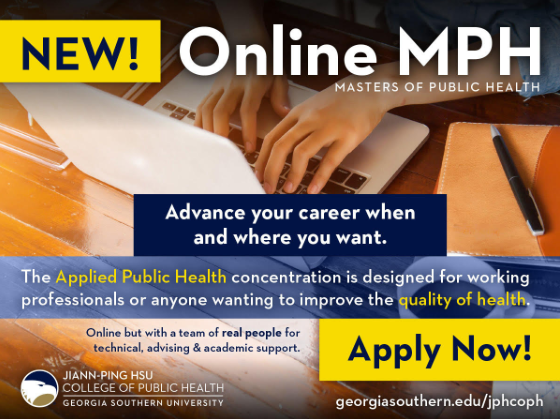
Beginning in Fall 2020 Georgia Southern University will offer its first fully online Master of Public Health (MPH) degree with a concentration in applied public health. “For those who do not have the ability to enroll in one of our on-campus MPH concentrations, the online applied public health option would be ideal for anyone passionate about improving health and making a difference in their community,” stated Interim Dean Stuart Tedders, Ph.D. Students will complete a broad-based program of study with a focus on public health education, information and advocacy, and with the flexibility to tailor their elective options. Students will apply their skills and knowledge to become front-line public health practitioners or public health leaders. Academic advisors and technical support will be provided to all students enrolled in the online master’s program. Additionally, the online program includes a field experience located within reach of the student’s location. Are you a journalist looking to cover this topic or learn more about Georgia Southern University and the programs it offers? Simply contact Melanie Simón at 912.344.2904 to arrange an interview or contact Karl Peace via his icon directly.


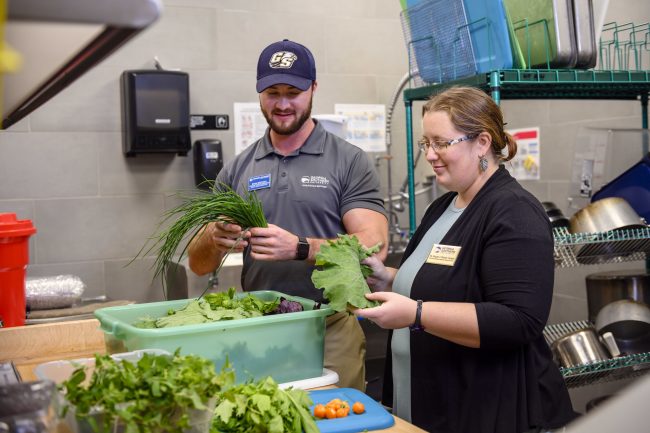
Find out how sustainable dining at Georgia Southern provides fresh options for students
As more and more people are eating out – the expectations of customers of restaurants to be environmentally friendly are ever increasing. However, operating with a reduced carbon footprint all the while being sustainable and profitable are no easy task. That’s where Georgia Southern University is making a difference. The newest restaurant on the Georgia Southern University Armstrong Campus offers diners comfort in knowing that some of the ingredients were grown just a few hundred yards away in the campus’ aquaponics farm in the Sustainable Aquaponics Research Center (SARC). The agriculture and food industry is one of the largest users of water and producers of greenhouse gas emissions, but growing food by using aquaponics, a system of growing produce by using water fertilized by fish, cuts down on both significantly. “SARC produce only travels a quarter mile from where it’s grown,” SARC curator Brigette Brinton said. “Locally grown food offers large advantages in terms of increased sustainability and freshness, and SARC produce is grown organically and using sound ecological principles that minimize water consumption.” Brinton said minimizing emissions and water use does not diminish the quality or taste of the produce. To the contrary, it makes the food taste better because aquaponics produce often has higher concentrations of various compounds that give the foods their flavor, and they are grown in more ideal environments. Brzycki said Georgia Southern wants to expand on using ultra-local, fresh produce and vegetables, as a part of the partnership with the aquaponics farm. “When we consider redesigns of existing or new dining locations on the Armstrong Campus in the future, we want to see how we can incorporate these same principles,” he said. “But for now, Southern Cafe is the flagship unit for the aquaponics partnership, as well as sustainability and healthy eating, of Eagle Dining.” Brinton said she hopes the Southern Cafe will inspire the students, faculty and staff who eat there to make healthier and more sustainable choices in other areas of their lives. “Showcasing local, sustainable produce increases students’ awareness that there are better options, and Georgia Southern is going the extra mile to show them how to start making better choices,” she said. “Each time students see they made a sustainable choice at the Southern Cafe, they’re more likely to choose sustainable options on their own.” Are you a journalist looking to cover this story or learn more about how Georgia Southern University is developing new programs that help traditional industries adapt to a more sustainable and environmentally friendly business model? If so – then let our experts help with your coverage. Simply contact Melanie Simón at 912.344.2904 to arrange an interview.