Experts Matter. Find Yours.
Connect for media, speaking, professional opportunities & more.

MEDIA RELEASE: CAA survey says gas prices affecting summer travel plans
Rising fuel prices means those heading out on road trips this year are being forced to make adjustments. A recent survey conducted by CAA South Central Ontario has found that rising gas prices are having an impact on road trip plans now that gas is higher than $2 per litre. Seventy-six per cent of those surveyed say they have a road trip planned within the province this year, while 26 per cent are planning an out-of-province road trip, and 23 per cent are planning to drive to the US. Of those who are planning a road trip, 64 per cent of these respondents said gas prices are likely to impact their road trip plans. While some are limiting the number of trips they take overall or driving shorter distances, some travelers are planning around gas prices, and others are adjusting their budget to accommodate fuel prices during their trip. As we transition into summer, there are easy ways to save money on fuel. This includes controlling speed and limiting hard stopping, avoiding unnecessary idling, and being mindful of your vehicle’s temperature. Savings can also start at the pump, as CAA Members save 3 cents per litre when filling up at select Shell gas stations. More summer fuel saving tips: Don’t start your car until you need to – your vehicle will “loosen up” as you drive. Turn off your vehicle if you’re going to be waiting for longer than a stoplight. Avoid “jackrabbit” starts and hard braking. Fuel economy peaks between 80-90km/h. Use cruise control to maintain your speed to get more distance out of your fuel tank. Gradually cool down your vehicle by first rolling down your windows to air out the vehicle, then turn on your air conditioning gradually. Close your windows and sunroof when highway driving, and use a window shade when the car is parked to help keep the vehicle cooler Keep your tires at the manufacturer’s recommended pressure. Set a reminder on your phone to check it monthly. Plan your route to avoid backtracking and unnecessary mileage. Planning is essential to ensure road trip safety. “We recommend you plan routes ahead of time and share them with someone, bring a map as a backup to your GPS, and check the weather ahead of time,” says Kaitlynn Furse, Director of Corporate Communications, CAA South Central Ontario. “We recommend a daily driving maximum of 800km per day with 15-minute breaks every two hours to ensure you are well rested before you get behind the wheel.” Be sure to pack your CAA membership or download the CAA app for peace of mind on the road. As a part of planning a trip, it’s important to ensure your vehicle is safe and reliable. Here are some ways to get your car road trip ready: Check your tires. Ensure the tire pressure meets the manufacturer's recommendations to improve your vehicle's handling and extend the life cycle of your tires. Top up your fluids. Consider packing extra summer washer fluid and change your oil if you are close to your regularly scheduled appointment. Clean your windshield. Clean any debris inside and out and replace worn wiper blades. Check your lights. Make sure your headlights, brake lights and turn signals are working properly. If you have kids, teach them about road safety by involving them in the process. Test the battery. Intense heat can cause just as much havoc on your car battery as the frigid cold. If your battery is older than three years, have a professional test your car battery and replace it. CAA Battery Service will test, boost or replace your battery. Pack an emergency roadside kit. Whether you buy a pre-assembled kit or create your own, it should include a few essentials like a flashlight, jumper cables, working jack cellphone battery charger, water and non-perishable food. Double check your licence plates are renewed. Doing a quick spot-check online is easy and will help you avoid the risk of getting a ticket. Renewing your licence plate is free. For CAA Members, when you run out of gas, a limited supply of gasoline will be delivered to your disabled vehicle to enable you to reach the nearest open service station, or in accordance with towing service provisions, a tow will be provided to a facility where fuel is available. Specific brands or octane ratings cannot be promised. CAA surveyed 1,697 respondents via a CAA Member Matters Panel in South Central Ontario from May 27 to June 5, 2022.


ChristianaCare’s Future of Health Scholarship Program Honors 10 HBCU-Bound Students
Unique opportunity pairs $500,000 in support with paid summer internships To strengthen and diversify the health care workforce for years to come, ChristianaCare has provided $500,000 in scholarships to 10 students in Delaware who plan to pursue degrees in health care. The financial support, through ChristianaCare’s Future of Health scholarship program, provides $12,500 in support annually per student, plus a paid internship each summer, for students to attend historically Black colleges and universities (HBCUs). “Partnering with the HBCU Week Foundation this year was an exciting new adventure for ChristianaCare, and one we knew we needed to be a part of, given our commitment to the community and to building our health care workforce of the future – in and of the community,” said Bettina Tweardy Riveros, J.D., chief health equity officer and senior vice president of Government Affairs and Community Engagement at ChristianaCare. “It is important for us to remove barriers that are impacting Delaware residents from being able to pursue higher education at historically Black colleges and universities. Being able to offer scholarships, internships and support to these students is another way that we know we are opening up the door to diversify the health care profession.” The scholarships represent an ongoing approach by ChristianaCare to improve health equity, community health and inclusivity and diversity. In 2020, ChristianaCare made a public commitment to being an anti-racism organization. For its efforts, ChristianaCare has been ranked one of the Best Employers for Diversity by Forbes magazine, as well as the No. 2 health care employer in the nation for diversity and inclusion and the No. 40 employer nationally overall. “If you want to know more about an organization, see where they invest their dollars,” said Pamela Ridgeway, chief diversity officer for ChristianaCare. “An investment of $500,000 for Delaware residents who choose to go to HBCUs says a lot. The fact that it comes with summer internships for every year and the expectation of employment at the end shows that we are an organization with a commitment.” “The HBCU Week Foundation is proud to partner with ChristianaCare to help support these future health care professionals by giving them the academic and networking experiences needed to excel in their intended career choices,” said Ashley Christopher, Esq., founder and chief executive officer of HBCU Week Foundation, and an alumna of both Howard University and the University of the District of Columbia David A. Clarke School of Law. “The medical field should reflect the communities it serves, and this partnership is one way to help make that happen.” Here are the students who earned scholarships through ChristianaCare’s Future of Health scholarship program, and the HBCUs they elected to attend: Aniyah Barnett, Hampton University. Brooke Brothers, Delaware State University. Solomon Devard, Lincoln University. Mychele Gibson, Howard University. Aa’khai Hollis, Bowie State University. Kianna Kelley, Delaware State University. Delaney Leonard, Howard University. Madison Perry, Jackson State University. Tania Paden, Delaware State University. Cierra Holmes, Delaware State University.



Worth Longest research on more targeted aerosol drug delivery systems
Michael Hindle, Ph.D., a professor in the VCU Department of Pharmaceutics, and P. Worth Longest, a professor in the VCU Department of Mechanical and Nuclear Engineering, have invested years of time and millions of dollars to address challenges found in the field of medical aerosols. In particular: While smaller particles are more effective in delivering drugs into the lungs and airways, these tiny particles are often exhaled out immediately when taking a dose. Current aerosol delivery systems — think asthma inhalers — effectively deliver just 10 percent of an aerosolized dose. That’s fine for most asthma and COPD sufferers who use standard inhalers with existing medications, as these patients only need a small amount of the potent drugs to reach the lungs and have an effect. “But the medical world wants to use the lungs for delivery of other drugs, whether it’s locally to the airways or systemically to the body, and for that, you need more efficient devices,” Hindle says. To effectively use inhaled drugs for complex medical conditions requires more of the aerosol to reach the airways and to potentially target different regions of the airways — plus the devices to get them there. “Our work is about doing something different — changing that ballgame from having 90% of the drug wasted and 10% make it to the lungs, and flip it so that we get just 10% lost and 90% in the lungs,” Hindle says. “That’s always been our goal.” Taking aerosols from lab to lung Over more than a decade, the duo and their teams have created the three keys to making aerosol drug-delivery work: “developing the strategy, developing the device, and developing the formulation,” says Longest, the College of Engineering’s Louis S. and Ruth S. Harris Exceptional Scholar Professor. “When you see inhalation of aerosols fail, or a new pharmaceutical aerosol product fail, one of these areas has often been neglected. Between my lab and the Hindle lab, we have expertise in each of these different areas.” The fourth component — commercializing their inventions — is underway through a partner in Quench Medical in a deal signed in 2020 thanks to VCU Innovation Gateway. The Minnesota-based company, led by founder and CEO Bryce Beverlin II, Ph.D., has identified lung cancer, severe asthma, and cystic fibrosis as potential initial applications using VCU’s intellectual property, the licensing of which covers both the aerosols and the delivery devices. “It’s very difficult for an academic institution to develop a drug product,” says Hindle, the Peter R. Byron Distinguished Professor in Pharmaceutics. “So Bryce has moved forward with a team of manufacturers, clinical testing plans, and is talking to the Food and Drug Administration.” The VCU researchers had not previously pursued lung cancer as a possible application until Quench came along, Hindle says. “The idea that you could deliver a chemotherapy locally to the lungs is obviously very advantageous, because you don’t get the systemic side effects through the body like with traditional chemotherapy,” he says. “You’re just delivering drugs direct to that site of action for targeting the metastases in the lung.” In May, Quench presented data using the VCU technology to the Respiratory Drug Delivery conference in Florida showing that using a chemotherapeutic dry powder aerosol in rats was highly effective. It significantly reduced tumor burden but used half of the standard IV-delivered chemo dose. “This approach also aims to decrease the total drug delivered with reduced systemic drug levels in the circulation to decrease systemic toxicity,” the report read. It noted the efforts “solve a critical unmet medical need to develop new strategies to improve treatment outcomes in patients with lung cancer.” Heavy interest nationally Hindle and Longest have millions of dollars in funded projects underway, backed by the National Institutes of Health, U.S. Food & Drug Administration, and the Bill & Melinda Gates Foundation. Their work is building on the reputation of VCU’s Aerosol Research Group, founded in 1988 by emeritus professor Dr. Peter Byron (the name on Hindle’s professorship). The group’s work spans a wide variety of research areas in aerosol formulation and delivery. Hindle and Longest have worked together since 2006. While Hindle is focused on drug formulations, Longest is the engineering and computer modeling expert. His background is in biological fluid flow, and prior to joining VCU in 2004 had worked in the area of blood flow in vascular disease. But he wanted to differentiate his work, and found VCU’s reputation in medical aerosols was the place he could, in his words, “make an impact.” Through computer models, Longest and his team can understand how powders or liquids will turn into aerosol particles and the behaviors they will undertake when delivered into the body. “The lung is an area of the body where we have all these complex phenomena occurring with airflow and moving walls,’” he says. “It really takes high performance computers to understand it.” Drs. Longest and Hindle have developed a series of technology platforms that produce particles that are tiny when entering the lungs to minimize deposition losses in the mouth and throat — but grow in size as they travel down the warm, humid airways. One of the devices uses a mixer-heater to produce tiny particles, other technologies use a pharmaceutical powder or liquid containing a simple hygroscopic excipient such as sodium chloride; it is this excipient that attracts water from the lungs and makes the particles grow and deposit in the lungs with high efficiency. Eyes on infants Lately, the pair have been working on a method of aerosol drug delivery to newborns and prematurely born babies. “It’s a different set of challenges when you’re trying to deliver aerosols to infants who are born prematurely, and don’t have the ability to breathe on their own due to the lack of airway surfactant,” Hindle says. “And that’s something that, academically, we thought we were in a position to try and make a contribution to the field.” The group is working with funding from the NIH and the Bill and Melinda Gates Foundation to develop a method of delivering an aerosol surfactant to infants that will hopefully remove the need to intubate these fragile babies. In addition to striking licensing deals with Quench and building relationships with additional partners, Innovation Gateway has backed the pair’s work with an initial $25,000 from VCU’s Commercialization Fund as well as a just-awarded additional $35,000. “We turned that into a series of intellectual property that has resulted in three licensed patents and a whole family of IP in relation to both formulations and devices,” Hindle says. “There’s been lots of interest in delivering drugs to the lungs, it’s just been very difficult to institute any sea change, because the pharmaceutical industry is relatively risk averse.” And so their research continues, as Quench moves forward to bring their inventions to the bedside. “What I’m doing, I don’t really consider it work — it’s an opportunity to interact with great colleagues and contribute to a mission that will be very helpful to a broad range of people,” Longest says. “I also see it as a big responsibility. We want to do this in the right way. Because people’s health and lives are at stake. We want to make sure we approach this with a large sense of responsibility, and do our best.”


Aston University signs City of Sanctuary pledge
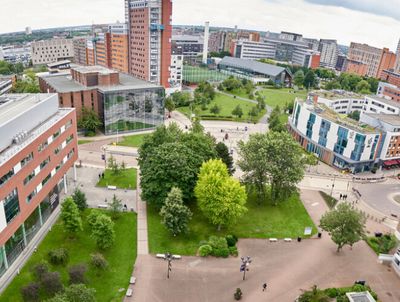
City of Sanctuary supports groups and organisations to build a culture of welcome and hospitality Aston University has become a supporting organisation of City of Sanctuary It is committed to achieving University of Sanctuary status. Aston University has become a supporting organisation of City of Sanctuary UK to demonstrate its commitment to helping people fleeing violence and persecution. City of Sanctuary is a charity supporting a network of groups across the UK and Ireland working to build a culture of welcome and hospitality within their communities. Earlier this year, the University opened a new Centre for Migration and Forced Displacement. The centre officially launched with an event bringing together designers, artists and academics to discuss how to investigate and publicise violence against migrants. Other initiatives set up by Aston University to support refugees and asylum seekers include: a new sanctuary scholarship scheme for students who have sought refuge in the UK the student-led Enactus Society Chance for Change project, facilitating integration and employment for refugees supporting the Kozminski Foundation run by Kozminski University in Poland, which provides support for victims of the war in Ukraine students in the University’s Centre for Research in Ethnic Minority Entrepreneurship undertaking PhD research into refugee entrepreneurship funding for an emergency training package for Ukrainian interpreters, supporting local organisations in contact with Ukrainian refugees. Dr Angela Jeffery, director of regional strategy at Aston University, said: “Aston University recently launched its Civic University Agreement, outlining our commitment as an anchor institution to improving the economic, social, environmental and cultural life of our local communities. “Becoming a supporting organisation of the City of Sanctuary is one of many steps the University is taking to support our region and society. We endorse the City of Sanctuary Charter and agree to act in accordance with its values. We are committed to achieving University of Sanctuary status by welcoming asylum seekers and refugees into the university community and fostering a culture of welcome and inclusion for all.” City of Sanctuary chair, David Brown, said: “As a diverse and vibrant university in a diverse and vibrant city, Aston University is in a really strong position to welcome and support asylum seekers, refugees and other migrants as they seek to build new lives in the UK, and to contribute their skills and energy to the University community, to Birmingham and to the Midlands. “With colleagues in the City of Sanctuary movement, I warmly welcome Aston University’s commitment to become a University of Sanctuary.”

Aston University wins share of £118m funding to accelerate its research impact
The Impact Acceleration Account (IAA) investment over three years focuses on maximising impact, knowledge exchange, translation and commercialisation potential within research organisations Funding allows researchers to unlock the value of their work, including early-stage commercialisation of new technologies The University will receive over £580,000 ‘to accelerate UK bright ideas into global opportunities'. Aston University has won a share of £118m in UK Research and Innovation (UKRI) funding. The Impact Acceleration Account (IAA) investment over three years focuses on maximising impact, knowledge exchange, translation and commercialisation potential within research organisations. Funding allows researchers to unlock the value of their work, including early-stage commercialisation of new technologies and advancing changes to public policy and services such as NHS clinical practice. UKRI, a government body responsible for delivering £8bn research and innovation funding each year, is investing £118 million in the latest round of IAAs to translate research across 64 universities and research organisations. Aston University was successful in gaining both Engineering and Physical Sciences Research Council (EPSRC) and Biotechnology and Biological Sciences Research Council (BBSRC) IAA funding – the latter one of only 15 IAA full awards nationally. Luke Southan, technology transfer manager at Aston University, said: “This funding will be transformational for Aston University’s capacity to get the best good from the research it carries out. “We have a pipeline of world-changing inventions, medical treatments, net-zero initiatives and spinout companies that we can give the greatest chance of success through these highly prestigious pots of funding.” UKRI director of commercialisation, Tony Soteriou, said: “The UK is home to some of the brightest, most innovative and creative research teams in the world. They have the ideas and they have the entrepreneurial energy to create businesses and services that could turn sectors on their head. “What they need, what every great commercial idea needs, is support in the critical early stages. The Impact Acceleration Account is the catalyst that allows projects to grow to the next level, attracting investment, forging partnerships and creating jobs. “The breadth of UKRI allows us to work right across the UK’s world-class research and innovation system to ensure it builds a green future, secures better health, ageing and wellbeing, tackles infections, and builds a secure and resilient world.”

Has your cell phone data ever inexplicably slowed down? Worse still, perhaps you’ve had a mobile bill come in way higher than you expected. Keeping track of your data usage can be tough, especially when the billing mechanisms routinely deployed by digital service providers are often more complex than they seem. Things like three-part tariffs bundle a certain amount of “free” data or services into a fixed monthly fee, with an excess charge payable whenever you go over your allocation. These packages are usually marketed to consumers as being simple as well as attractive (who after all doesn’t love the sound of “free data?”) but in reality, they can be hard for people to manage—and failing to do so, punitive. Exceed your allotted data and you end up with subpar services or unwanted costs. Underutilize your allocation and you’re leaving money on the table. Meanwhile, in a world where we use digital services to do any number of things—from scrolling to streaming to storing and beyond—how can we accurately track just how much of our allowance we’re getting through? To address this, service providers are increasingly sending usage notifications to customers at different points of the billing cycle. These nudges are designed to help us to act in our own best interest: to take stock and modify our usage accordingly. But do they work? It depends, says Anandhi Bharadwaj, Vice-Dean for Faculty and Research at Goizueta. She and her colleagues have published a study that looks at the impact of these nudges, and they’ve found that they do help all customers adjust their behavior to stay within their allowance, irrespective of how attentive or inattentive they might be to their consumption speed in general. But there are provisos. First off, these consumption nudges seem to be significantly more effective with customers who have purchased higher data allowance than those who opt for low-capped packages. Then, the timing of nudges matters. When notifications arrive later in the billing cycle—right before a bill is due, say—they have significantly more impact across the board, says Bharadwaj. Companies should take note. “Ours is the first study to really unpack the efficacy of nudges in the digital services space, and it shows that who and when are important factors that service providers will need to take into account if they want to improve customer experiences.” Interested in knowing more - let us help. Anandhi Bharadwaj is an information systems expert bringing a wide range of development and executive training experience to the classroom. Her research examines the adoption, use, and impact patterns associated with technological change. Anandhi is available to speak with reporters - simply click on her icon now to arrange an interview today.



Professor Jun Du and Dr Oleksandr Shepotylo from Aston University analysed the effects of the end of the Brexit transition period on UK exports This equals to a nearly 16% of UK total exports in the first half of 2019 and 70% of the documented total reduction in the EU exports in the same period The research suggests non-tariff measures (NTMs) are responsible for the fall in trade between the UK and EU. New research by experts at Aston University for the Enterprise Research Centre (ERC) has found that UK exports experienced a large, negative, statistically significant decline in 2021 at the end of transition after the EU-UK Trade and Cooperation Agreement (TCA) was put in force. The TCA is a free trade agreement signed on 30 December 2020 between the European Union (EU), the European Atomic Energy Community (Euratom) and the United Kingdom (UK). Professor Jun Du and Dr Oleksandr Shepotylo used a Synthetic Difference in Differences (SDID) estimator to construct a counterfactual of the UK had it not exited the EU and entered the TCA, to compare its trading performance. This was done by comparing the actual performance of the UK with the modelled performance in 2021 with the same periods of 2018-2020. They also examined the extent to which the overall TCA effect has been due to the increased frictions due to non-tariff measures (NTMs). They estimate that this amounts to a 22 per cent reduction in exports to the EU and a 26 per cent reduction in imports from the EU over the first half of 2021, relative to the counterfactual scenario of the UK remaining in the EU. The research confirmed that NTMs are responsible for the adverse TCA effect on UK trade with the EU and that the magnitude of loss was significant. It was equivalent to a reduction of £12.4 billion in UK exports over the first six months period of 2021, notably in food and drink, wood and chemicals sectors. This equals to 15.6% of UK total exports in the first half of 2019, and 70% of the documented total reduction in the EU exports in the same period. Jun Du, professor of economics at Aston University, lead on internationalisation research at the ERC and director of the Centre for Business Prosperity (CBP), said: “These results underscore the heavy costs of erecting trade barriers on the UK’s side with its largest trade partner. “Trade frictions, due to sanitary and phytosanitary (SPS) measures (measures to protect humans, animals, and plants from diseases, pests, or contaminants), are acute problems due to the EU exit. “Reducing some of the NTMs between the EU-UK, by exploring mechanisms such as equivalence in SPS measures or other ways to reduce businesses’ burden to the minimum level possible. “More complicated and challenging are the technical barriers to trade, but they could potentially cause significant damage to the UK economy. Maintaining and broadening the established arrangements of the current TCA provision, despite being limited, through some form of mutual recognition of specific practices or international regulations for selected sectors, should be the ambition of UK government to ease the TBT (technical barriers to trade). “Future EU-UK co-operation is critical and mutually beneficial but requires political will and strong leadership.” Dr Oleksandr Shepotylo, a senior lecturer in Economics, Finance and Entrepreneurship Department at Aston Business School, co-wrote the working paper and said: “Continued alignment with the EU regulations was a demand from many businesses throughout the Brexit process, and it is expected to be still important post Brexit. This must be conveyed to policy makers. “In the short term, preparedness and adaptability have rewarded and will continue to reward businesses facing challenges and disruptions. The need for learning and training remains paramount. “In the medium and longer term, businesses will have to stay competitive to retain access to the global market, to perform better in it, and to gain more benefit from it. This is the case for all firms even if the ways to achieve it may differ. In addition, businesses need to consider adopting new business models through which they can balance the need for lean production with resilience, as well as weighing up economic, social, and environmental gains. Despite the many considerable challenges, there are boundless avenues where opportunities for breaking through are present.” You can read the full report on the ERC website here.


There's a lot more to bats than their spooky reputation
By Emma Richards More than 50,000 students call the University of Florida home, and while that is a lot of Gators, the campus is home to even more bats. Hundreds of thousands of the misunderstood mammals live across from Lake Alice, where they dwell in the world’s largest occupied bat houses. The colony of bats was initially discovered at the UF track and tennis stadiums in 1991. In the spots where fans were cheering, bats were roosting – causing a mess and a notable stench. That same year, the UF Athletics Association built a house to rehome the bats from the stadiums. But the night after they were transported to their new home, all the bats left, and did not return for three years. Now, the houses are primarily occupied by around 400,000 to 500,000 Brazilian free-tailed bats that remain at UF year-round and do not hibernate or migrate. “They do all these great things for us and then we turn around and we're scared of them,” Mathis said. Verity Mathis, the mammal collections manager at the Florida Museum of Natural History says bats are the only mammals that can fly, and the Brazilian free-tailed species found at UF are tremendous at it. “They’ve actually been documented to go as fast as 100 miles an hour in like short bursts, which is just amazing to think about,” she said in an episode of the From Florida podcast. “This one species is just capable of so much.” Along with their fast flight, Brazilian free-tailed bats can go as high as 9,000 to 10,000 feet in the air and venture over 30 miles a night forging for insects like mosquitos, moths, beetles and flies. Despite being associated with blood-sucking vampires in popular culture, only three out of 1,400 bat species drink blood and they aren’t located in North America. Bats do not want to attack humans; in fact, they avoid people using their vision and echolocation skills. Bats can live for many decades and are more closely related to humans than they are to rodents. They also provide critical environmental services such as pest control, fertilization and pollination. Mathis says bats are misunderstood. “They do all these great things for us and then we turn around and we're scared of them,” she said. “We want to be respectful of them and of their lifestyle and we don't want to encroach upon them and bother them.” Mathis says if people do encounter an injured bat, they should not touch it with their bare hands because bats can carry rabies. It is best to put on thick gloves, place the bat into a container and call a local wildlife rehabilitation center. There are 13 bat species in Florida, and two of them are endangered. The Florida Wildlife Commission is actively monitoring those populations. In Alachua County, people and businesses, including Swamp House Brewery and Lubee Bat Conservancy, have bat houses on their properties. Mathis advises those interested in putting a bat house in their yard to do research to ensure that the right kind of house is purchased and that it is placed in the proper location to align with Florida’s specific requirements, which can be found here on the UF/IFAS website. For Mathis, these are all steps toward accepting a widely misunderstood mammal. “I think as long as we continue these conversations about telling people how cool bats are then maybe eventually pop culture will catch up to that,” she said. To hear more about bats, listen to the episode on From Florida at this link. Listen to other episodes in the From Florida podcast here. Watch a recent video featuring Verity Mathis here: https://youtu.be/vbFZfVwGwYE


Looking for a 'real' expert to explain the latest advances in virtual reality? We're here to help!
Virtual reality is quickly becoming an actual necessity in all facets of technology, education, entertainment and the workplace. It's a popular topic, and Augusta University's Lynsey Steinberg sat down to answer a few questions about how far VR has come and where it's going. VR is changing everyday life for many. What are the biggest advances you've seen in VR use? Virtual reality is rapidly evolving and expanding. It wasn’t too long ago we were excited for the idea of a wireless head set. Now there are companies such as Virtuix creating 360-degree treadmills to interact with your experience in VR and Hypnos VR (a product which releases scents in the air based on the experience in VR). There have been advances of adaptive and stress response simulations based on pupillometry measurements or even integration of physiological sensors for behavioral research. The biggest advancements are solutions that have been unimaginable before that are now entirely possible. It seems the medical field has been a big benefactor of VR. Is this giving students a better way to "learn" about anatomy and other aspects of the field? I believe all experience is valuable to learning. VR is unique in allowing an individual to view as if from their own perspective for virtual experiential learning. We often hear the phrase, “If you could imagine walking a mile in someone else’s shoes,” and now we can provide perspective, allowing another person to view the world as someone with a particular disease or simulate training in a low-risk environment. One example, Fire in the OR, is a VR simulation allowing medical professionals to train safely on how to remove fire danger in the operating room. I believe simulations like these are remarkable examples of how valuable VR can be in education, to remove elements of danger in everyday life. Their research showed 250% improvement rate on fire safety in the OR. A huge industry leader in surgical simulations is Osso VR, creating surgical training procedures for surgeons and hiring some of our Augusta University medical illustration graduates. How is this being applied at Augusta University? The Center for Instructional Innovation created modules with the Medical College of Georgia on handwashing hygiene health and end-of-life care scenarios with the College of Nursing. We encourage faculty to develop multiple methods of interactive modules for the benefit of all learning styles. VR certainly provides engaging and enriching materials for a low-risk environment in instruction. The Center for Instructional Innovation is currently working with the Academic Student Success Center to implement Oculus Quest head sets for anatomy and physiology students to benefit from application use in VR. Augusta University student Henry Oh and his 3D printed pottery from VR sculpture. How else has VR and its use changed the way we go about our daily lives? VR head sets are known in robotics, manufacturing, therapeutic modalities, gaming capabilities, technology in research and education. Any scene you can film in 360 degrees you can now watch in a headset and be fully immersed in the scene (ie: a theater production, a museum tour, an art exhibit, a temple historically preserved, etc). We have gone from telling a story to being immersed in a story. We have been able to utilize VR technology integration and innovation on campus to create enriching learning experiences. We collaborated with our Ceramics department (with Brian McGrath and Raoul Pachecho) to support students in virtual clay sculpting with Adobe Medium. Students 3D printed their works of art after exporting the files from the VR simulation. Where do you see the future of VR? The future developments for integrating systems for haptic feedback will be remarkable integrations. The continued development of behavioral research and integration of gamification is an exciting opportunity in VR as well as the continued development for protocols and appropriate safety procedures. The cross-platform and cross-disciplinary possibilities will allow for creativity to blossom in new world solutions. It is clear, the ongoing need for technical workforce required to create and support more VR and other high-impact technology is rapidly growing. VR is a fascinating topic and if you're a journalist looking to know more by speaking with Steinberg, then let us help. Steinberg is one of the 300 board-certified medical illustrators with experience in hands-on surgery in the operating room, utilizing development in virtual reality, 3D printing, animation, gamification and graphic design while working directly with students, faculty and physicians. Steinberg is available to speak with media -- simply click on her icon now to arrange an interview today.


It Works on TV - Do Property Rehabs Drive Up Prices in Surrounding Neighborhoods?
When a house is distressed, the negative impact tends to ricochet around its surrounding neighborhood. Distressed homes (e.g. foreclosures) can significantly bring down the value of other homes in the area, as these properties are often poorly maintained and then typically sold at discounted prices In the past, and particularly in the wake of the 2008 subprime crisis, federal and local governments sought to mitigate this negative effect by incentivizing the rehabilitation of distressed properties through programs like the Neighborhood Stabilization Program (NSP). Until now, there has been some skepticism as to whether or not these kinds of initiatives actually work. New research by Goizueta Foundation Term Associate Professor of Finance Gonzalo Maturana and Goizueta’s Assistant Professor of Finance Rohan Ganduri might change the narrative definitively. They have analyzed new data that shows that rehabilitation projects not only help to stabilize housing prices in affected neighborhoods but can also actually increase the value of neighboring properties by as much as four percentage points. Using highly robust, non-parametric statistical analysis methods, Maturana and Ganduri parsed more than 10 years of information on rehabilitated property transactions and real estate prices across the United States. The effect of renovating dilapidated or derelict houses in these areas pushes prices up between 2.3 and four percentage points in their surrounding blocks, they find. And that’s not all. While the average amount spent by authorities on these renovations comes in at roughly $36,000, their study estimates a societal welfare gain of $134,000 per rehabilitated property—almost four times the cost of the rehabilitation. These insights should provide interesting food for thought for the U.S. Congress and local governments, Maturana notes. After the housing crash in 2008, Congress allocated $6.9 billion in funding to the NSP to help stabilize communities affected by high vacancy and foreclosure rates, but the Department of Housing and Urban Development didn’t find any positive impact on local housing markets at the time. “Our findings suggest that rehabilitation projects do drive a positive uptick in prices that can help revitalize distressed neighborhoods,” says Maturana. “And they provide very timely support for policy interventions, such as President Biden’s infrastructure spending program which proposes an allocation of $20 billion to rehabilitate 500,000 single-family homes in low-income neighborhoods in the United States.” With the current economy facing some uncertain times - this is a topic that is important for everyone. And if you're a reporter looking to know more then let us help. Gonzalo Maturana is an associate professor of finance at the Goizueta Business School. He is an expert in the areas of corporate, household and real estate finance. Rohan Ganduri's research interests include banking, credit risk, real estate, household finance, and corporate finance. Both Gonzalo and Rohan are available to speak to media regarding this topic – simply click on either icon now to arrange an interview today.