Experts Matter. Find Yours.
Connect for media, speaking, professional opportunities & more.

When the Cheque Stops Coming: Canada Post, Seniors, and the Quiet Cost of Modernization
There’s an old line that has saved more awkward conversations than most of us care to admit: “The cheque is in the mail.” It has been used to buy time, soften bad news, and occasionally stretch the definition of truth. But it worked because, deep down, everyone believed the premise. The mail would come. Eventually. Reliably. Without negotiation. That quiet assumption carried a surprising amount of weight — especially for the 79-year-old navigating an icy driveway. Now, it seems, even that assumption is up for review. I understand the economic argument. Big Losses: The official Canada Post 2024 Annual Report shows they have racked up $3.8 billion in losses since 2018. Lower Letter Volumes: The shift to email has hit Canada Post hard. Letter volumes have dropped dramatically. Less in the mailbag equals far less revenue to offset costs. Increasing Costs Factors: The number of Canadian addresses continues to grow. The math is not subtle, and change is clearly required. But this deserves more attention. Modernization is not the problem. Thoughtless modernization is. Cuts to Canada Post Service May Not Land Equally Not all Canadians experience change the same way, and this particular shift will land unevenly if proper consultation isn't done. We're getting older: According to Statistics Canada, nearly one in five Canadians is now over the age of 65, and that proportion continues to rise. A meaningful share of those older Canadians also live outside major urban centers. We're spread out geographically: Depending on how you measure it, we're also far apart compared to most other countries. According to the Public Health Agency of Canada & the Vanier Institute of the Family, roughly one-quarter to one-third of seniors live in rural or small communities, where services are more dispersed, and distances are longer. Rural Canada is also aging faster than urban Canada. In other words, the places most likely to lose convenient access are often the places with the highest concentration of people who rely on it. This is not a niche issue. It is a structural one. The Real Issue Isn’t the Mailbox. It’s the Journey. Policy discussions tend to reduce this to a simple question of location. Move the mailbox, problem solved. But the issue is not where the mailbox is. The issue is whether someone can get to it safely, consistently, and without turning a routine task into a risk calculation. I am thinking of a client. She is 79, sharp, organized, and fully in charge of her life. Her bills are paid on time, her paperwork is immaculate, and she has no interest in becoming dependent on anyone. In the summer, she walks daily without a second thought. In the winter, she studies the ground before every step. Ice changes everything. A short walk becomes a decision. A slightly longer one becomes a concern. For her, a community mailbox is not a mild inconvenience. It is a variable she now has to manage. That is the difference between designing for the ideal user and designing for the real one. Mail Still Matters More Than We Pretend There is a quiet assumption that everything important has already moved online. That assumption works well for people who are comfortable navigating digital systems. It does not work for everyone. For many seniors, mail remains the backbone of how they manage their lives. Pension statements, government notices, insurance documents, tax slips, prescription information, and replacement banking cards still arrive in envelopes, not inboxes. And yes, occasionally, an actual cheque. The phrase “the cheque is in the mail” may be fading, but the need behind it has not disappeared. For some Canadians, that envelope still represents income, security, and peace of mind. Digital systems are efficient when they work. When they do not, they can be frustrating and, at times, risky. One expired password or one convincing phishing email can turn a simple task into an afternoon of confusion. It is easy to underestimate the value of paper systems when you no longer rely on them. It is harder to replace them when you still do. Efficiency Has a Way of Moving Downward There is a pattern in modern service design worth naming. Call it effort laundering: the practice of shifting work from institutions to individuals in the name of efficiency. We see it in banking, where branches quietly disappear. We see it in healthcare systems that assume patients are comfortable online. We see it in customer service models built around apps and automated menus. And now we may see it in mail delivery. Where the service moves from your front door to a location you must reach yourself. For many Canadians, this is manageable. For others, it is not. When the burden of efficiency lands on those least able to absorb it, the system may be efficient on paper but inequitable in practice. If Change Is Necessary, It Should Be Smarter I understand that change is necessary. The cost differences between door-to-door delivery and centralized delivery are real, and the financial pressures on Canada Post are not going away. But the choice is not between doing nothing and eliminating access. There is a middle path, and other countries have already explored it. In Norway, proposed postal reforms included reducing delivery frequency to once per week. Following public consultation, the government stepped back earlier this year from that plan and maintained more frequent delivery, recognizing the impact on certain populations (Norwegian Ministry of Transport, 2026). In the United Kingdom, the regulator Ofcom has examined reducing delivery to 5 or even 3 days per week as a way to manage costs while preserving universal service (Ofcom, 2025). Research from Sweden and New Zealand shows that older adults rely more heavily on traditional mail systems than the general population, particularly for official and financial communication (Crew & Kleindorfer, 2012; New Zealand Ministry of Business, Innovation and Employment, 2021). These examples point to a practical conclusion. Reducing frequency can achieve savings without removing access. Eliminating access altogether is a different decision with different consequences. Canada Is Not Denmark Denmark has gone further than most, effectively ending traditional letter delivery after a dramatic decline in mail volumes of roughly 90 percent since 2000. The move is often cited as a model of modernization. It should be considered with caution. Denmark operates within a context of high digital adoption, a compact geography, and milder weather conditions. Notably, Canada’s digital divide among seniors is more pronounced than Denmark’s, meaning the proportion of older Canadians who cannot easily go online is higher to begin with. Even so, a significant number of Danish residents have been classified as "digitally exempt" and continue to rely on alternative arrangements to receive essential communications (PostNord, 2025). Canada is not Denmark. Our geography is larger, our winters are harsher, and our population is more dispersed. Also, we play better hockey. If Home Delivery Changes, People Will Adapt Canadians are remarkably adaptable, and seniors are often the most resourceful of all. If home delivery is reduced, practical solutions will emerge. Neighbours will organize. Families will build mail pickup into regular visits, turning a logistical task into a reason to connect. Some seniors will finally set up paperless billing, one account at a time. These are workable adjustments. But they should be supported by thoughtful policy, not forced by avoidable design choices. The Problem With Accommodation Accommodation programs will likely exist, but their effectiveness depends on how easy they are to access. Systems that require people to search, apply, document their needs, and follow up repeatedly tend to favour those with the time and persistence to navigate them. The seniors who most need support are often the least inclined to engage in that process. The real test is not whether accommodation exists. It is whether it is simple, visible, and available before a problem becomes a crisis. This Is About More Than Mail At its core, this debate is not really about mail. It is about independence. It is about whether people can continue to manage their own lives without unnecessary friction. It is about whether public systems are designed for real users rather than ideal ones. The ideal user is mobile, tech-savvy, and well-supported. The real user may be older, living alone, and quietly determined to remain independent. That determination deserves to be supported, not complicated. Modernization, With a Memory Home delivery is not just a legacy feature. For many seniors, it remains a small but meaningful part of how life stays organized and manageable. When that support disappears, the burden does not disappear with it. It shifts to individuals, to families, and to systems that will eventually feel the impact. If the greatest disruption falls on those least able to absorb it, the design needs a second look. And About That Cheque... We may be moving toward a world where fewer things arrive by mail. That is probably inevitable. But before we retire the idea entirely, it is worth remembering why that old line worked in the first place. “The cheque is in the mail” was believable because the system behind it was dependable. It showed up. It connected people. It did its job quietly and consistently. Modernization should aim for the same thing. Not nostalgia. Not resistance to change. Just reliability that works for everyone. Because if the day comes when the cheque is no longer in the mail, we should at least be able to say that whatever replaces it works just as well for the people who need it most. Ideally, without requiring ice cleats, a flashlight, and a willingness to sign a waiver. Sue Don’t Retire…ReWire! My Book is Now Available for Pre-Order I hope you will consider pre-ordering a copy of Your Retirement Reset for you, a friend or loved one. It's available September 8, 2026 - You can now order on the ECW Press site here. And if you love supporting Canadian booksellers, please also check with your local independent bookstore. Most can easily order it for you.


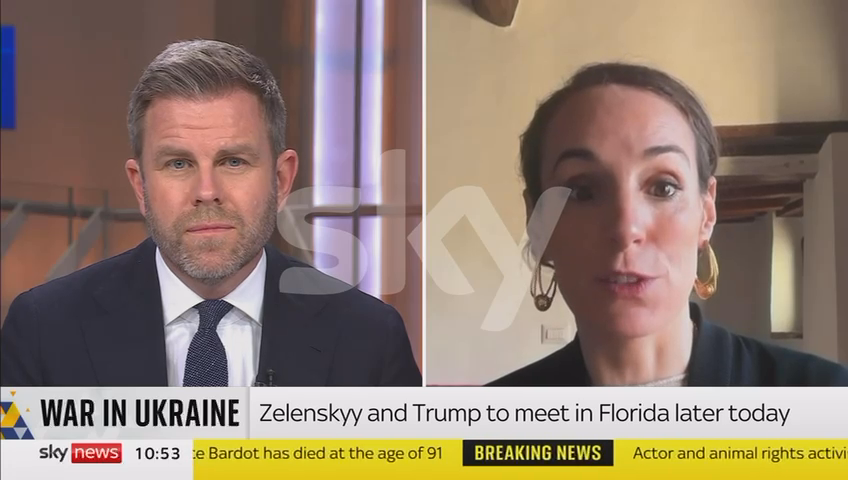
In a recent interview, Livia Paggi of J.S. Held discussed the implications of reported discussions between President Donald Trump and President Volodymyr Zelensky about a potential peace plan aimed at ending the war in Ukraine. The conversation focused on what these talks signal politically, what pressure points may be shaping each leader’s approach, and why the timing and framing of any “peace plan” matters as much as the details themselves. Paggi emphasized that peace-plan conversations at this level often have multiple audiences at once: domestic political constituencies, international allies, and adversaries assessing resolve and leverage. She explored how diplomatic positioning can influence the credibility of negotiations and how public messaging, even before formal agreements exist, can shift perceptions on the battlefield, at the negotiating table, and across NATO-aligned capitals. The interview also examined the risks embedded in any peace-plan narrative. Paggi highlighted that negotiation efforts can introduce uncertainty for markets, governments, and populations when expectations outpace realities. She discussed how the mechanics of ending a war extend beyond a headline announcement, including enforcement, guarantees, verification, and the long-term stability of whatever framework is proposed. When we look at what Trump is likely to do, he's going to try to go back and forth, favor different political actors and see what he can do to unlock the situation. A copy of the full interview is below: For journalists following the Ukraine war, shifting diplomatic strategies, or the real-world consequences of peace negotiations, Livia Paggi offers a clear, practical lens on what these discussions could mean next. Her perspective helps reporters move beyond political theatre and toward the key questions: what’s being signaled, who gains leverage, what conditions would make an agreement durable, and what risks emerge if the process breaks down. Looking to connect with Livia Paggi? Livia is a sought-after speaker and regularly provides commentary on global political trends for the media, including for the BBC, Bloomberg TV, CNN, and the Financial Times. Livia is the recipient of numerous awards for her work. Most recently, she was named by Management Today as one of Britain’s top women in business under 35 and Bloomberg TV named her as one of the top female foreign policy commentators. Click on her profile icon to arrange an interview or get deeper insights into geopolitical risk, government relations, and business impacts.


Myanmar’s earthquake crisis demands international humanitarian intervention - before it’s too late
We are at a crossroads. Will the international community intervene in Myanmar to save lives, or will it once again retreat into silence until it is too late? In the shadow of disaster, silence is complicity. The devastating earthquake that recently struck Myanmar, registering a magnitude of 7.7 and claiming over a thousand lives with the potential for fatalities to rise into the tens of thousands, is far more than a natural calamity - it is a preventable humanitarian catastrophe. The international community must confront a difficult question: How many more lives must be lost before the world steps in? As someone who has studied disaster governance for over two decades, I can say with a heavy heart that what we are witnessing in Myanmar is a textbook case of systemic failure - of national crisis management, of international humanitarian coordination and, most disturbingly, of disaster diplomacy. A Crisis Exacerbated by Inaction The situation on the ground is dire. Entire villages lie in ruins across Shan State and Mandalay. Liquefaction, caused by the shifting of tectonic plates, has turned many areas into unstable wetlands, with water seeping through the ground continuously. With countless bodies left unrecovered and proper sanitation systems overwhelmed, the risk of cholera and other waterborne diseases looms large. In past disasters - be it Haiti in 2010, Nepal in 2015 or the Turkey-Syria earthquake of 2023 - we saw the tragic consequences of slow and politicised humanitarian responses. But Myanmar’s case is uniquely perilous. The country is not only facing a natural disaster but also the aftermath of years of civil conflict, military rule and geopolitical paralysis. The ruling junta’s statements and figures are unreliable at best and disinformation is hampering coordinated international support. When Aid Needs Armour The reality is that humanitarian intervention in Myanmar now requires more than blankets and bottled water - it needs boots on the ground. Given the multiplicity of armed rebel groups and the entrenched conflict dynamics, any aid convoy risks becoming a pawn in a larger power struggle. We need an international peacekeeping force, mandated strictly for humanitarian purposes, to ensure safe and unfettered access to affected populations. This must be a neutral, apolitical force, equipped to operate in a complex, high-risk environment - not to take sides, but to protect lives. Without such security guarantees, humanitarian agencies cannot function, and the crisis will evolve into famine, mass migration, and possibly regional instability across Southeast Asia. A Crisis of Leadership The United Nations, ASEAN, WHO and other key global institutions have yet again fallen short of timely action. The ineffectiveness of their response should prompt a critical reevaluation of their governance structures and crisis leadership models. The deeper issue is not just logistical - it’s moral. In the absence of strong, scientifically-informed and transparent leadership, international aid becomes another layer of dysfunction. We need a new generation of disaster governance professionals - leaders trained not only in logistics and law, but in negotiation, ethics and diplomacy. The Cost of Indifference Myanmar’s crisis will not remain confined within its borders. Already, we are seeing early signs of mass displacement towards India, Thailand and Bangladesh. If left unchecked, these flows will eventually extend to Europe, the UK and beyond, burdening an already overstretched global refugee system. The longer we delay, the greater the consequences - not just for Myanmar, but for the world. A Call for Science, Transparency and Regional Solidarity As academics and practitioners in the field of Disaster Risk Reduction (DRR), we must hold ourselves to the highest standard of integrity. DRR in regions like South and Southeast Asia must be built on inclusive science, open data, regional collaboration and local knowledge. Taiwan and Singapore offer examples of how early warning systems and data transparency can save lives - why aren't we replicating these models more widely? If this disaster teaches us anything, it is that sovereignty cannot be used as a shield for inaction. A disaster of this magnitude transcends politics. It is a test of our global conscience.


Three Year Anniversary of Ukraine War
Three years ago, this Monday, Russian troops invaded Ukraine expecting a a quick victory. This invasion has incited Europe's largest conflict since WWII, taking tens of thousands of lives, destruction of countless cities, and the isolation of Russia. Despite this, Putin appears closer to taking a fifth of Ukraine's territory and preventing it's membership. President Trump broke the three year long policy of isolating Russia by working with Putin to work together to end the war. President Trump's explicit support for Russia's demand against Ukraine's NATO membership reveals a shift in U.S. policy. How will President's Trump's relationship with Putin shift U.S. policy? Despite majority of the West and Ukraine seeing Russia's invasion as an unprovoked act of aggression, Putin continues to insists it's necessity for Russia's security and protection of citizens in Ukraine. In 2023 Russia momentum with offensives across a 1,000kilometer front, securing necessary territorial gains. How does the progression of Russia's invasion effect it's image for American citizens? In response to the invasion, Ukrainian President Zelenskyy demanded Russia's retreat as a condition to talk. President Zelensky emphasizes Ukrainians need for support from the West; while stressing Ukraine goal to join NATO. How will the shift of support affect Ukraine mission to join NATO? Putin refuses a truce, hoping to weaken the Ukrainian government through a contentious election. Ukraine argues elections are not possible during war times. Putin refuses to accept international peacekeeping forces, remain confident in Russia ability to achieve its goal without negotiation with Ukraine. How will Putin's refusal to find a truce affect Russia and Ukraine's role in the war? Dr. Duerr is an expert on this subject and is available to speak to media regarding this ongoing conflict in the Middle East and the ongoing the war between Israel and Hamas – simply click on his icon to arrange an interview. Or schedule an interview by contacting Mark Weinstein at mweinstein@cedarville.edu


Study: Intuitive introverts lead the most successful teams
An unwritten law of leadership states the loudest voices in the room are not always the wisest. Some of history’s most notable and successful leaders were known introverts who wrangled loads of information for sizable teams: Abraham Lincoln, Bill Gates and Oprah Winfrey, to name a few. New research from the University of Delaware found introverted leaders who rely on intuition to handle this large bundle of information lead the most successful teams. The research, co-authored by professor Dustin Sleesman, explored the concept of intuition and when it's helpful for leaders who are in charge of large teams. Sleesman and his co-authors from Michigan State University studied more than 3,000 U.S. Air Force captains at a military base in Alabama. As part of their leadership training, the captains participated in a team-based battlefield simulation, which gave the researchers an opportunity to observe and analyze their behavior. Sleesman and his co-authors accurately predicted that teams performed better when their leaders were armed with high amounts of information. But they made two interesting findings they didn't expect: • Introverted leaders led more successful teams when intuitively handling large amounts of information. • Intuitive leaders, in general, led more successful teams when they had to handle a lot of information. "Introverted people tend to be more reflective, more introspective, they tend to be more observational than extroverted leaders," Sleesman said. "So pairing intuition with introversion tended to be very effective for team performance." Sleesman, an associate professor of management in UD's Lerner College of Business & Economics, studies the psychology of decision-making, negotiation and conflict resolution, as well as team effectiveness. To set up an interview, click on the link below.


With dockworkers on the picket line - what can consumers expect as shipping dries up?
As port workers strike across the country, the shutdown at ports could have reverberating effects on consumers, the economy, and businesses. With consumers already facing higher prices, the strikes will likely cause more supply chain delays and price increases that will be passed on to consumers. There will be a lot of media attention surrounding the looming shortages, the implications for the economy, and how retailers will recover as workers and companies attempt to reach a negotiation. Steven Carnovale, Ph.D., associate professor of supply chain management and David Menachof, Ph.D., associate professor of supply chains and operations management, have the expertise in supply chain, global sourcing and production networks, logistics, and transportation to help reporters make sense of the various impacts this will have. Both experts are ready to help with your stories and contribute to your coverage. To connect with Steven Carnovale and David Menachof - click on their icons below. Photo credit: New York Times


Year three: What fate awaits the fighting in Ukraine?
As we enter year three of the war between Ukraine and Russia, the death toll continues to rise, and there doesn’t appear to be any end in sight to the war. Craig Albert, PhD, professor of politics and director of the Master of Arts in Intelligence and Security Studies at Pamplin College of Arts, Humanities, and Social Sciences at Augusta University, said it appears victory does not seem likely for either side, and he expects it to form into a “frozen conflict.” “There are two ways out of this, however,” said Albert. “The first is that the West, mainly the United States, does not continue to arm Ukraine. If this becomes the new normal, then Ukraine will not be able to keep up against Russia and will eventually fall through a war of attrition being waged by Russia.” “The second, less likely but far more threatening scenario, is that Russia expands the war to other states in the area or inadvertently hits a NATO-member state with either kinetic or massive cyberattacks. It may draw NATO into the war directly. In this case, Ukraine takes the advantage, but the war expands to something not seen since World War II.” Albert added that the war is becoming a war of attrition, and, if one side maintains morale, weapons and supply-chain logistics and if one side can maintain air superiority, it’s likely to have an advantage. “If Ukraine manages to get F-16s in the fight sooner rather than later, and longer-ranged missiles are given to them as well, this could cause a stalemate and force Russia into negotiation,” Albert said. He noted Ukraine is making significant gains in the air and has managed to shoot down seven sophisticated aircraft recently, forcing Russian air units to be more cautious about their tactics and even move further away from the frontline. “If this continues, Ukraine can exploit this as Russian forces would likely be left without air cover in future battles.” With everything that has happened in the first two years of the war, it has not deterred Russian President Vladimir Putin from ramping up his resolve. “Putin has doubled-down,” Albert said. “He has increased his forces in the fight, made more aggressive postures to NATO member states and has unleashed his cyber and informational capabilities across the world to take advantage in those realms. Putin continues to pursue pure power politics and is unlikely to back down.” Craig Albert, PhD, is director of the Master of Arts in Intelligence and Security Studies at Augusta University. He is a leading expert on war, terrorism and American politics. This is an important international and national issue. Albert is available to speak with media – simply click on his name to arrange an interview today.


Unveiling the Unseen: Exploring Salary Transparency and How it Contributes to the Gender Pay Gap
We have all heard about the gender pay gap, but do we truly understand the underlying factors that contribute to this inequality? A common proposal for reducing the pay gap between men and women is to increase pay transparency — letting job seekers know up front how much the job pays. But does the way the information is presented have an impact? University of Delaware associate professor Dustin Sleesman's recent research sheds light on salary requests from male and female job seekers, and how those change based on the framing of the salary information. Sleesman, affiliated with UD's Alfred Lerner College of Business & Economics, studies the psychology of decision-making, including why people become committed to their decisions and how biases can influence them. Second, he focuses on negotiation and conflict resolution — and especially how they are affected by our thoughts and perceptions. Third, he studies team effectiveness, such as understanding how the motivation and personality of team members influence their interactions.

Last month, workers at an Amazon warehouse in Staten Island voted to unionize. In the decision's wake, employees across other firms—backed by national labor organizations—are following suit. Villanova University economics professor Cheryl Carleton, PhD, explains that the successful warehouse unionization in New York (a grassroots initiative) is changing the way we view labor unions. "It prevents employees from thinking about unions as just the large existing unions," notes Dr. Carleton. "Workers themselves can coalesce and maintain a unified front to negotiate for what they need from firms." And if unions succeed, firms without unions must compete to entice employees to their operations. As a counterweight to growing unionization efforts, companies have increasingly engaged in the use of intimidation tactics. We see this in the ways firms retaliate against union organizers. "Many large firms that have lots of money and have fostered strong relationships with political powers do not want to let workers have a stronger voice in negotiation of wages, benefits and work rules. They will try to have these unions nullified or intimidate workers not to join them," says Dr. Carleton. "There has been considerable consolidation in industries in the United States, which gives firms a lot more power." And according to economics professor Mary Kelly, PhD, "firms will argue that if they compensate existing [union-represented] workers with higher pay, better benefits and improved working conditions, those higher costs will limit the number of new workers hired, encourage the replacement of some labor with capital/technology if possible and/or 'force' prices higher to consumers." But even if unionization fails, there are still costs to the company. "We see this now with companies increasing the benefits they provide and spending more money to prevent more unionization efforts. The 'spillover' effects of the presence or threat of unions increases cost to firms," says Dr. Carleton. But we still don't know the final economic impact of unionization. "Companies, the stock market and shareholders always respond to change and uncertainty, so when a company unionizes it is a period of uncertainty," says Dr. Carleton. "If the company does unionize, does it create more stability and more profitability? Or does it end up being more costly for the firm? Time will tell!" Despite all the uncertainty, "the idea of unions and the need for unions is still present, and the current labor market situation has given workers the impetus they need," Dr. Carleton says. "Unions are necessary to stand up to industries. Each worker has little power, but combined workers have a stronger voice."


An Opening Day Predicament—Will Baseball Fans Side with Billionaire Owners or Millionaire Players?
A percolating labor showdown between well-heeled Major League Baseball team owners and well-paid baseball players threatens spring training and Opening Day. For the time being, it is an amicable negotiation to carve a new Collective Bargaining Agreement in time for the 2022 season, but it could turn sour, as these things tend to do. As usual, the fans are in that empty, helpless space between billionaire owners and millionaire players. “There’s still a little bit of time here before panic and pressure set in,” said Mike Lewis, Goizueta professor of marketing and a national expert on fandom who also serves as the faculty director of the Emory Marketing Analytics Center (EmoryMAC). “If we get to Opening Day and there is no baseball that is going to be a major shock to the system, and it is going to have major ramifications.” Lewis explains, “Fandom is built by the epic moment, the walk-off home run and the spectacular catch, but fandom is also hurt by the epic failure, such as canceling Opening Day. You might not see it in the data for this season, but it is going to be a hit on the fans’ long-term appreciation for their team.” So, whose side should fandom be on? The billionaire owners or the many millionaire players? The Baseball Collective Bargaining Agreement, Explained Lewis spells out the current baseball dilemma. Players want to reduce the time they have to wait to enter full free agency, which is currently six seasons. The players also want teams to be able to spend at least $245 million a season, per team, on salaries before MLB hits the clubs with a luxury tax, which is a way to keep rich teams from buying all the talent. The luxury tax ceiling is currently $210 million. Players are not happy with the luxury tax because it resembles a “soft” salary cap, or a limit on their pay. “A lot of what the players are looking for is the freedom for the owners to spend,” Lewis says. “And more freedom for the owners to spend is going to make the competitive balance issues in Major League Baseball worse.” Do the fans really want that the players to win this labor fight? Major League Baseball instituted a luxury tax system in 2002 with a new Collective Bargaining Agreement that charged a fee to teams whose payrolls passed a certain threshold. It was done to keep clubs like the Yankees, Red Sox, Dodgers, and Cubs with their massive local television revenues from stockpiling all the stars, Lewis explains. He goes on to say that the luxury tax penalty has slowly lost its effectiveness because revenues have grown in MLB. The rich teams shrug at the tax and the results have been awful for competitive balance in the game. Fans of less wealthy teams despair in this state of oligopoly in baseball. There have been as many 100-loss teams in the past three full seasons (2018, 2019, 2021) as there were from 2007-2017 combined (11). Good players flee the less wealthy teams, losses pile up, and fans are put off. If we move back to the wild west with the market it is going to be harder to keep the franchise superstar in town. “We know what the system’s going to look like with a more open market. It’s going to look like the New York Yankees dominating, as they did in the late 90s and early 2000s. It’s going to look like Alabama in college football.” If the players have their way in this latest bargaining, they will be “stuck” for just three or four years with the team that drafts them, not six, before they hit free agency. Morgan Ward, Goizueta assistant professor of marketing with a research focus on consumer behavior, said the labor tussle between wealthy owners and wealthy players is a “rich people problem” that threatens the “folklore” of the game. “I think it could have a really alienating effect overall on the general public just because it changes the focus of the game, it takes something very communal and familial and makes it very transactional,” Ward says. “It can be very distancing for the fans and, if anything, illustrates the schism between the fans and these players. These are not your friends or neighbors. They are in a very different place in life.” So, Will Fans Side with the Owners? It’s more complicated than that. “The fans have an emotional attachment with the players and no real emotional attachment with the owners,” Ward says. What the Major League Baseball Players Association, or the union, better not count on, Ward notes, is the fandom rallying to the players just because we have seen a national shift toward worker’s rights that arrived with the COVID-19 pandemic. One of those shifts was college athletes, at last, being able to make money off their name, image, and likeness. Labor has been humanized on a certain level, but even though the baseball players are “labor” and in a “union,” Ward says there is no comparison between the fight for college athletes against the majordomo NCAA, the governing body of college athletics, and baseball players against baseball owners. “The public is sympathetic with people in low-wage, high-service industries that finally have the ability to negotiate,” Ward says. “But it’s hard for me to see the same victimization of baseball players that happened with college athletes.” The last time there was a prolonged labor dispute between the owners and players, which was in 1994, it was disastrous for baseball. The players went on strike in August that season, which canceled the World Series. Average attendance per game that season was a then-record of 31,256. It took 10 years for baseball to average more than 30,000 fans to a game because fans became disgusted with the owners and players. “How much should we expect fans to endure this time?” Lewis asks. “They just came off Covid when there were restrictions on attendance and a shortened season,” Lewis said. “This stuff adds up. The fan is going to say, ‘Why am I loyal to these guys?’” If you're a reporter looking to know more - then let us help. Professor Mike Lewis is an Associate Professor of Marketing at Emory University’s Goizueta Business School and is an expert in sports analytics and marketing. Morgan Ward is an Assistant Professor of Marketing at Emory University’s Goizueta Business School and is an expert in consumer behavior. Both experts are available to speak with media - simply click on an icon to arrange a discussion today.