
Experts Matter. Find Yours.
Connect for media, speaking, professional opportunities & more.
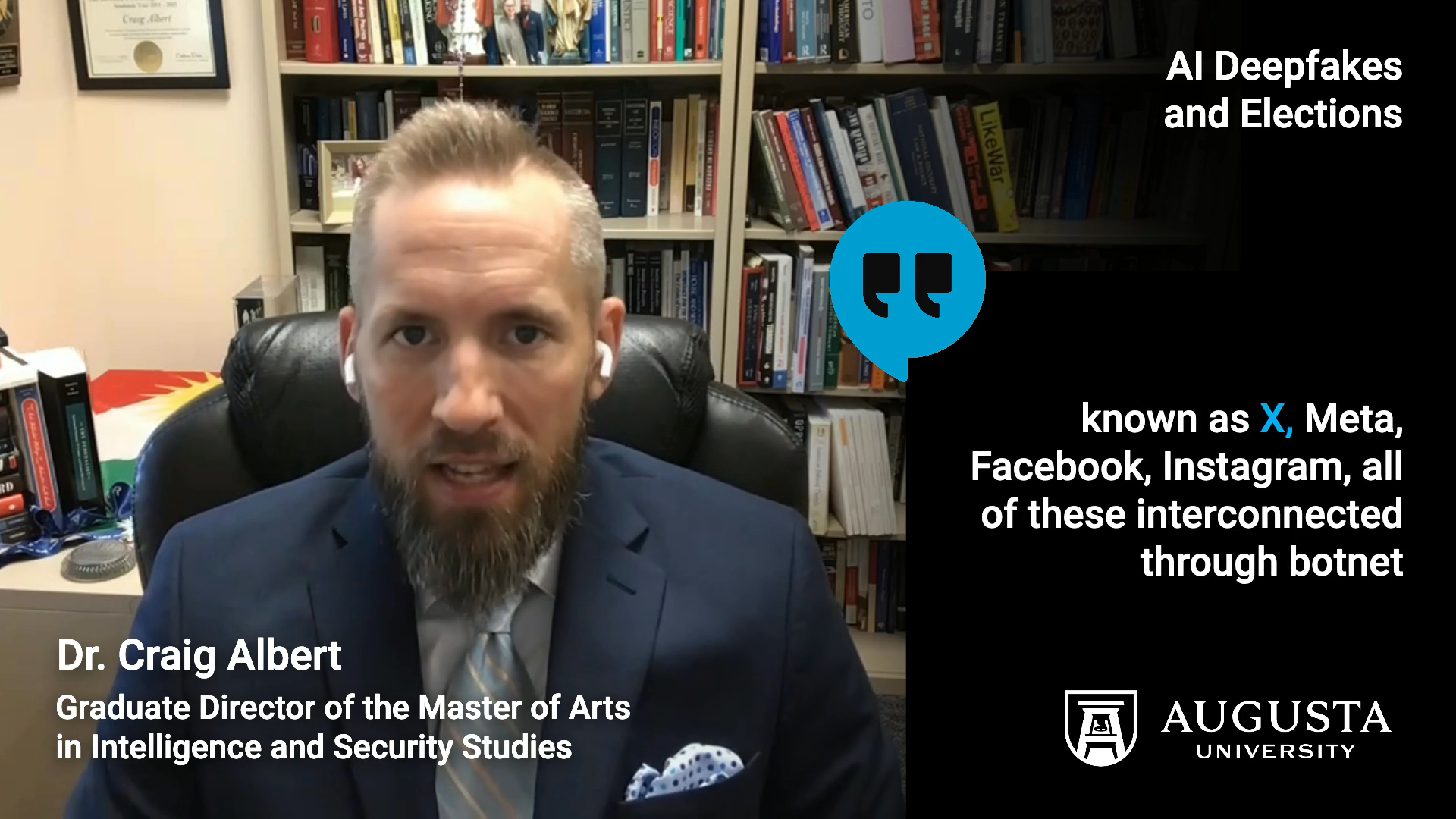
#ExpertSpots: AI, Deepfakes and Elections
The election in November is coming fast. And with voters divided and with what could be a small margin of Americans deciding who wins or loses in the race for the Whitehouse - the worry over misinformation and election interference has never been higher. It's why Dr. Craig Albert is here to break down just how AI and deepfakes might be used against any of the candidates leading up to November 05. Craig Albert, PhD, is director of the Master of Arts in Intelligence and Security Studies at Augusta University. He is a leading expert on war, terrorism and American politics. AI and the upcoming election is a serious topic. Albert is available to speak with media – simply click on his name to arrange an interview today.


Sunday is Cinco de Mayo. Do you know the history behind the day?
Celebrated annually on May 5th, Cinco de Mayo commemorates the Mexican army's victory over French forces at the Battle of Puebla in 1862. While often associated with festive gatherings and cultural celebrations, Cinco de Mayo also holds significant relevance beyond its historical origins, offering various story angles that appeal to a broad audience. Cultural significance and heritage preservation: Explore the historical context of Cinco de Mayo and its importance in Mexican culture, highlighting the traditions, food, music, and art associated with the holiday. Immigration and identity: Examine how Cinco de Mayo is celebrated in different parts of the world, particularly in the United States, and its role in shaping the Mexican-American identity and fostering cross-cultural understanding. Political implications and national pride: Investigate the political undertones of Cinco de Mayo, considering its significance in Mexican nationalism and its portrayal in international relations. Economic impact and tourism: Analyze the economic implications of Cinco de Mayo festivities, including the boost in tourism, sales of Mexican-themed products, and the commercialization of cultural heritage. Education and historical awareness: Discuss the educational value of Cinco de Mayo in schools and communities, examining how it promotes historical awareness, tolerance, and multiculturalism. Social justice and activism: Explore how Cinco de Mayo intersects with social justice movements, addressing issues such as immigration reform, cultural appropriation, and representation in media and politics. By covering these angles, journalists can provide their audiences with a deeper understanding of Cinco de Mayo beyond its surface-level festivities, fostering meaningful dialogue and engagement with the holiday's historical, cultural, and societal significance. Connect with an Expert about Cinco de Mayo: Margarita R. Ochoa Associate Professor and Associate Chair of History · Loyola Marymount University Timothy Matovina Chair, Department of Theology · University of Notre Dame Rodrigo Vargas Professor, Ecosystem Ecology and Environmental Change · University of Delaware Heather Chiero, PhD Associate Professor of History, Anthropology and Philosophy · Augusta University To search our full list of experts visit www.expertfile.com Photo Credit: Daniel Lloyd Blunk-Fernández


Dr Carl Senior identified two types of smile – affiliative and reward – given by political leaders during the last UK general election in 2019 The eventual winner, Boris Johnson, was found to display the affiliative smile, which acts to align voter behaviour The study is the first to look at how supporters of election losers react to the eventual winner. New research led by Aston University’s Dr Carl Senior has found that the type of smile used by a political leader can influence voters to support them and their political agenda. There are many different types of smile, and the researchers, which also included Professor Patrick Stewart from the University of Arkansas, US, Professor Erik Bucy from Texas Tech University, US, and Professor Nick Lee from Warwick Business School at the University of Warwick, UK, focused on two in particular – the ‘reward’ smile and the ‘affiliative’ smile. They used videos from political leaders from the 2019 UK general election, which was won by the Conservative party, then led by Boris Johnson. The Labour party, then led by Jeremy Corbyn, came second. Jo Swinson was the leader of the third-placed Liberal Democrat party. The ‘reward’ smile is the genuine, or felt smile, associated with joy and enthusiasm. It is the smile most likely to be contagious with onlookers, and has been linked to higher levels of trust. The ‘affiliative’ smile, meanwhile, communicates approachability, acknowledgement, and appeasement. It is associated with an affinity towards the onlooker and is thought to be important for developing cooperative relationships. The researchers selected volunteers professing to be supporters of each of the three main parties and showed them the same video footage of the three leaders – Johnson, Corbyn and Swinson – before and after the 2019 election. The team assessed the emotional response to the different smiles for the candidates, whether positive (happiness and affinity) or negative (anger and distress). When shown footage of election winner Johnson’s affiliative smile after the election, people in all groups showed an increase in happiness and affinity compared to when they were shown the footage before the election. Supporters of the losing parties showed an overall decrease in the negative effect. It was only this affiliative smile which was found to act as a mechanism to align voter feelings and behaviour to the dominant, or winning, political message. The reward smile did not have the same effect. Supporters of Labour showed an increased level of anger and distress when viewing Johnson’s reward smile after the election compared to before it. The effects for Corbyn and Swinson were less marked, showing that they failed to significantly change voters’ responses to them. Their appeal was somewhat fixed and failed to match Johnson’s charm. Johnson tapped into the voters’ feeling of annoyance about the slow Brexit process with his ‘Get Brexit done’ slogan, while Corbyn’s position was ambiguous. Swinson’s party was pro-Europe but lacked Johnson’s performative abilities to link a strong message to his nonverbal communication. Previous work by various researchers has shown that observers judge leadership traits and behaviour, or a lack thereof, from non-verbal cues such as facial expressions. However, there has, until now, been little research outside the US on the effect of facial displays on voter behaviour. Dr Senior said: “The human smile can convey both rewarding and affiliative social intent and thus has significant utility in politics, where the ability to bond with and reassure voters is vital to electoral success. We are in an unprecedented year as there are numerous elections scheduled to take place across several continents. The outcome of these campaigns will have a significant impact on millions of people across vast geopolitical regions. Given that almost all politicians involved in these election campaigns will make full use of broadcast media to reach voters, it is crucial to understand the effectiveness of their non-verbal displays in shifting voting preference.” Professor Lee said: “The individual appeal of party leaders has become increasingly influential. A smile can’t win an election on its own. But Johnson’s personal appeal transcended party policies, connecting with people who hadn’t planned to vote for him. “The upside for today’s politicians is that charisma is not an innate quality. It can be taught. By paying attention to their facial behaviour and ensuring they display the right smile in the right context, they can still leverage the power of emotional responses. It is something leaders of all organisations can learn.” The researchers say more work is required to understand how smiles work together with other verbal and nonverbal displays to generate affinity in voters and convey social dominance to other leaders. PLOS ONE DOI: 10.1371/journal.pone.0301113

Two decades ago, the European Union welcomed ten new member states, including Cyprus, Czech Republic, Estonia, Hungary, Latvia, Lithuania, Malta, Poland, Slovakia, and Slovenia. This historic expansion not only reshaped the geopolitical landscape of Europe but also holds significance for global politics, economics, and cultural integration. Understanding this event's importance requires recognizing its impact on various fronts, from fostering regional stability to influencing trade dynamics and promoting cross-cultural exchange. Key sub-topics that may interest journalists and the public include: European Integration and Unity: Exploring how the expansion has contributed to the European Union's efforts towards unity, cooperation, and peace among member states. Economic Implications: Analyzing the economic effects of the expansion on both existing and new member states, including trade patterns, investment flows, and disparities in development. Political Dynamics: Investigating the political changes within the European Union, such as shifts in power dynamics, decision-making processes, and the challenges of governance in a larger union. Cultural Exchange and Identity: Examining the cultural exchange and diversity resulting from the inclusion of new member states, and how it has enriched the European cultural tapestry. Challenges and Achievements: Assessing the successes and ongoing challenges faced by the European Union post-expansion, including issues related to migration, integration, and institutional reforms. Future Prospects: Speculating on the future of the European Union, considering factors like potential further expansions, the rise of Euroscepticism, and the Union's role in global affairs. The 20th Anniversary of the Expansion of the European Union marks a significant milestone in the continent's history, offering journalists and the public alike a chance to reflect on the achievements, challenges, and the future trajectory of European integration. Connect with an Expert about the EU: Carolyn Dudek Professor of Political Science · Hofstra University Dr Martin Brenncke Lecturer in Law · Aston University David R. Dorondo Professor · Western Carolina University To search our full list of experts visit www.expertfile.com Photo Credit: Guillaume Périgois

Major League Baseball celebrates Jackie Robinson Day | Media Advisory
Today professional baseball commemorate Jackie Robinson Day, where the league, players and fans across the world not only honor a baseball legend but also celebrate a pivotal moment in the ongoing struggle for racial equality and social justice. This day marks Robinson's historic debut in Major League Baseball on April 15, 1947, breaking the sport's color barrier and paving the way for future generations. Beyond its significance in sports history, Jackie Robinson Day serves as a reminder of the enduring impact of one individual's courage and determination in challenging systemic racism. Key story angles for journalists to explore include: Legacy of Jackie Robinson: Reflecting on his contributions to sports and civil rights activism. Continuing fight for racial equality in sports: Examining current initiatives and challenges in promoting diversity and inclusion. Impact of Robinson's legacy beyond baseball: Exploring his influence on other fields such as business, politics, and social activism. Diversity in Major League Baseball today: Assessing progress and remaining barriers for minority players and personnel. Educational initiatives inspired by Jackie Robinson: Highlighting programs that use his legacy to teach lessons of tolerance, resilience, and leadership. Intersection of sports and social justice: Investigating how athletes and sports organizations continue to advocate for change on and off the field. Connect with an Expert about Jackie Robinson For journalists with questions or looking to cover the history of Jackie Robinson and how he changed the game, here is a select list of experts. To search our full list of experts visit www.expertfile.com Curt Smith Senior Lecturer · University of Rochester Christopher Philips Associate Professor · Carnegie Mellon University Michael Lewis Professor of Marketing· Emory University, Goizueta Business School Mark Feinsand Sports Reporter · New York Daily News Photo Credit: The New York Public Library

Tackling Tik Tok - Our expert explains what the problem is and what's next for the Chinese owned app
TikTok is one of the most popular social media sites in the world. In the United States, more than 170 million people and businesses use the app on a regular basis. Now, the federal government has taken the first step in banning the China-based app unless the ownership group, ByteDance, sells TikTok. The House of Representatives passed a bipartisan bill in support of the ban, and now it awaits Congress to act. President Joe Biden has indicated he would sign the bill banning TikTok unless it’s sold, but whether it reaches his desk remains to be seen. This stems from the fear that China uses user information to their advantage. According to Lance Hunter, PhD, associate professor of political science in Pamplin College of Arts, Humanities and Social Sciences, the concern is well deserved. “Even if it’s a privately-owned enterprise, China can still control it, they can still manipulate it to some degree as if it was a state -owned enterprise,” said Hunter. Hunter’s research focuses on how informational warfare attacks influence politics worldwide. He said the algorithm TikTok uses can play a major role in informational warfare on two fronts. “One, it’s the data gathering, and that can be used for micro targeting because basically what TikTok can do is collect the data and provide information as to what certain individuals respond to an this is exactly how you can persuade them.” “Also, there is empirical evidence that China has used TikTok before to try to influence elections to some degree. One example in the 2022 midterm elections in which some candidates from both parties were targeted by TikTok accounts that were controlled by a propaganda agency operating within the Chinese government.” Hunter added the TikTok algorithm is more advanced than some other social media platforms and more effective in knowing what people like and why they like it. With so many AI-generated posts, it can be difficult for the consumer to decipher what is legitimate, and what isn’t. There are some red flags for people to be on the lookout for. “One thing the average person can do is be very wary of what you’re seeing and ask yourself does this seem legitimate?” he added. “If everyone is saying the exact same thing, that’s a tell sometimes. Also, where does this information originate from, and what are the timestamps on the posts? Something else is to look at the individual who made the post. Who are these people and who’s following them? You may be able to see if they are legitimate accounts.” While China, and Russia for that matter, are trying to influence people in several ways, Hunter said they are also trying to cause division among the American people. “They do want to influence elections at times, absolutely. But one of their other goals, and sometimes even more predominant goals for them, is to increase division, increase polarization, and that’s a great way to do that,” Hunter said. “Even if you have a temporary reaction, you’ve increased that division which could have longer term effects.” Are you covering this important and ongoing story? Then let us help with your stories and questions. Lance Hunter is an assistant professor of political science with a background in international relations. His research focuses on how terrorist attacks influence politics in democratic countries and how political decisions within countries affect conflicts worldwide. He is available to speak with media about this important topic - simply click on his icon to arrange an interview today.


It's going to be a busy week in America when it comes to politics. And if you're covering - we have experts who can help with any of your questions or stories. Tom Smith - Professor in the Practice of Finance - Professor Smith is an expert in labor economics, entertainment and healthcare economics, as well as real estate and urban economies. David Schweidel - Professor of Marketing - Professor Schweidel has been closely researching the impact of AI in society, especially elections. He can speak on the impact AI is expected to have in this year’s elections. Professor Schweidel also has extensive work in election marketing. He researched negative campaign advertising and if a negative tone has a positive impact on election results. Ramnath Chellappa - Professor of Information Systems & Operations Management - Professor Chellappa is available to discuss the economics of information security and privacy. He can also discuss the economics and impact of AI. Raymond Hill - Professor Emeritus Hill is available to discuss any issues on the economy related to energy. If you are looking to arrange an interview - simply click any of the listed expert's icons to set up a time today or email Kim Speece for assistance.




Year three: What fate awaits the fighting in Ukraine?
As we enter year three of the war between Ukraine and Russia, the death toll continues to rise, and there doesn’t appear to be any end in sight to the war. Craig Albert, PhD, professor of politics and director of the Master of Arts in Intelligence and Security Studies at Pamplin College of Arts, Humanities, and Social Sciences at Augusta University, said it appears victory does not seem likely for either side, and he expects it to form into a “frozen conflict.” “There are two ways out of this, however,” said Albert. “The first is that the West, mainly the United States, does not continue to arm Ukraine. If this becomes the new normal, then Ukraine will not be able to keep up against Russia and will eventually fall through a war of attrition being waged by Russia.” “The second, less likely but far more threatening scenario, is that Russia expands the war to other states in the area or inadvertently hits a NATO-member state with either kinetic or massive cyberattacks. It may draw NATO into the war directly. In this case, Ukraine takes the advantage, but the war expands to something not seen since World War II.” Albert added that the war is becoming a war of attrition, and, if one side maintains morale, weapons and supply-chain logistics and if one side can maintain air superiority, it’s likely to have an advantage. “If Ukraine manages to get F-16s in the fight sooner rather than later, and longer-ranged missiles are given to them as well, this could cause a stalemate and force Russia into negotiation,” Albert said. He noted Ukraine is making significant gains in the air and has managed to shoot down seven sophisticated aircraft recently, forcing Russian air units to be more cautious about their tactics and even move further away from the frontline. “If this continues, Ukraine can exploit this as Russian forces would likely be left without air cover in future battles.” With everything that has happened in the first two years of the war, it has not deterred Russian President Vladimir Putin from ramping up his resolve. “Putin has doubled-down,” Albert said. “He has increased his forces in the fight, made more aggressive postures to NATO member states and has unleashed his cyber and informational capabilities across the world to take advantage in those realms. Putin continues to pursue pure power politics and is unlikely to back down.” Craig Albert, PhD, is director of the Master of Arts in Intelligence and Security Studies at Augusta University. He is a leading expert on war, terrorism and American politics. This is an important international and national issue. Albert is available to speak with media – simply click on his name to arrange an interview today.

2024 presidential and Michigan state elections: MSU experts can comment
MSU experts can discuss national political issues to the Supreme Court and constitutional issues to Michigan's state politics and races The 2024 presidential election is in full swing. As President Joe Biden is set to cruise to the Democratic nomination and former President Donald Trump is likely poised to receive the Republican nomination, 2024 is setting up to be a rematch of 2020. Michigan’s primary is now earlier on the calendar, Feb. 27, with the Republicans holding a caucus to award their remaining delegates on March 2. Despite being a presidential election year, Michigan has important statewide elections. An open U.S. Senate seat, vacated by retiring Sen. Debbie Stabenow, could tip the balance of power in the Senate, potentially deciding which party holds the majority. Michigan’s seventh and eight congressional races have incumbents leaving office, making those set to be some of the most nationally watched and funded races nationally. The state House currently has an exact bipartisan split, setting up races with very high stakes. Michigan State University experts are available to comment on many issues of the presidential election including: political parties and their evolution, campaign strategy and polling, Trump’s legal troubles and the U.S. Supreme Court, political diversity and messaging and local elections and voting. Additionally, several of these experts can comment on Michigan’s federal and state elections. General presidential and Michigan election issues Corwin Smidt is an associate professor of American politics and research methods in the Department of Political Science in the College of Social Science. He can comment on national elections and polling for the presidential election as well as statewide elections. Contact: smidtc@msu.edu "Michigan continues to trend toward being a battleground state, but right now it looks like a battle of attrition. Donald Trump's poll numbers really haven't improved as much since 2021 as Joe Biden's have declined, but Governor Whitmer's popularity remains high. The state Republican party continues to have fights over its management and will have a contested and possibly divisive Senate primary. Despite this, Republicans have a chance to pick up seats in the US House and state legislature because of Democratic retirements and ongoing redistricting changes." Matt Grossmann is the director of MSU’s Institute for Public Policy and Social Research and a professor of political science. He is an expert on a broad range of topics surrounding the 2024 election, including political parties ,campaigns and elections. He also oversees survey research, candidate development and legislative training at MSU. Additionally, he can discuss Michigan’s primary and elections. Contact: grossm63@msu.edu “The presidential nomination process evolved out of reforms to the delegate selection process for those conventions, which now means delegates are overwhelmingly selected based on presidential primary results. From the voters’ perspective, it often looks like any other election where you select your preferred candidate. But the parties still have power to coordinate their rules and selection procedures. Michigan has an opportunity to set the terms for future elections, showing that it can become engaged, with diverse interests, and earn the right to vote early in the process in 2028. Since Michigan does not have party registration, voters will be able to participate in the primary of their choice, which has provided an incentive for individuals to vote in the contest that presents the most uncertainty.” Read more from Grossmann on MSUToday. Dante Chinni is a research specialist in MSU’s School of Journalism and is the director of the American Communities Project in the College of Communication Arts and Sciences. He can discuss polling and changes in the parties over time, as well as the voting patterns among groups in specific places. He can also comment on various Michigan political issues. Contact: chinni@msu.edu “In Michigan, and in other states, the 2024 election will be determined by the margin of victory in different kinds of places. Can the Democrats get what they need out of the big city and college town communities, like Wayne, Ingham and Washtenaw counties? Can the Republicans get the numbers they need out of blue-collar middle suburbs, such as Macomb? The turnout and margins in those kinds of places, and others, will determine who wins in November.” Constitutional issues and the Supreme Court Jordan Cash is an assistant professor of political theory and constitutional democracy in James Madison College. He can comment on general requests about the presidency and national elections as well as issues surrounding the Supreme Court. Contact: cashjor1@msu.edu “The 2024 election is already shaping up to be one of the most unusual elections in American history, but one of the most unique aspects is the role that the judiciary is likely to play in the process. With former president and likely Republican nominee Donald Trump facing indictments at both the state and federal levels, the election season is as likely to be punctuated with legal news and updates as it is with campaign speeches and negative advertising. Moreover, the Supreme Court will be critical as it has heard or will likely be hearing cases surrounding whether states can disqualify Trump from the ballot under the 14th Amendment and whether he has absolute immunity from when he was president. When we also consider that President Joe Biden is facing his own investigations from House Republicans, the election seems poised to not only raise the political stakes but also considerable constitutional and legal questions.” Read more from Cash about presidential elections on MSUToday. Brian Kalt is a professor of law and the Harold Norris Faculty Scholar in the College of Law. He can comment on 20th Amendment issues, the electoral college and presidential prosecution and immunities. Contact: kalt@law.msu.edu “A lot of constitutional law questions that seemed purely theoretical are now front and center in our election campaign. Hopefully, the Supreme Court will move quickly and provide some clarity and certainty on these issues so that when November rolls around, voters can make a fully informed choice.” Ryan Black is a professor of American politics in the Department of Political Science in the College of Social Science, and a faculty affiliate in the College of Law. His expertise includes public opinion and the Supreme Court, and he can speak to appointments and vacancies. Contact: rcblack@msu.edu “Results of the 2024 election have the potential to profoundly shift the center of gravity in the politics of appointments to the federal judiciary, which includes, most importantly, the Supreme Court. There is no doubt that a president's most enduring legacy is who they put on the High Court, but confirmation politics today make the partisan makeup of the Senate a prominent roadblock in a president’s path to success.” Erica Frantz is an associate professor of comparative politics in the Department of Political Science in the College of Social Science. She is a specialist on issues and themes relating to authoritarianism. Contact: frantzer@msu.edu “Today’s democracies typically fall apart at the hands of their elected leaders, such that elections are critical focal points for understanding democratic trajectories. Importantly, research shows that where leaders come to power backed by personalist parties – or parties that are synonymous with the leader’s persona – the risk of democratic erosion increases substantially. For the U.S., this implies that the more the Republican Party becomes indistinguishable from Trump, the more American democracy is vulnerable to collapse from within should Trump return to the presidency.” Political messaging and diversity Dustin Carnahan is an associate professor in the College of Communication Arts and Sciences. His work focuses on how exposure to political information influences people’s attitudes, beliefs and decisions. His recent research focuses on how people come to encounter and believe misinformation and the effectiveness of messages designed to correct misinformed beliefs. Contact: carnaha9@msu.edu “While research suggests that political misinformation does not have a profound impact on voters’ decisions, the proliferation of misinformation can have more subtle effects on voters and elections – such as fostering toxic discourse around issues and candidates, promoting political polarization and distracting from more substantive matters. Concerns around misinformation are likely to be of great interest during the upcoming election cycle as advances in AI technology pose significant challenges to voters’ ability to identify what is real and what is fake.” Eric Juenke is an associate professor of American politics in the Department of Political Science in the College of Social Science. He can comment on issues relating to minority candidates, specifically the candidacy and election of minority candidates. Additionally, he teaches in the Chicano/Latino Studies program. Contact: juenke@msu.edu “While we do seem to have a rematch at the top of the ticket, with a vice president who is a woman of color and another vice president who has yet to be announced but could also be a woman candidate, we will be seeing a continued diverse candidate pool this cycle, I expect. It’s still early yet in the congressional races, but there should be a number of high-profile races in the country and in Michigan that should highlight a more diverse candidate pool. While the parties still have a long, long way to go in recruiting and supporting women and racial and ethnic minority candidates to run for office, the trajectory is positive.” Daniel Bergan is an associate professor and the director of master’s studies in the College of Communication Arts and Sciences, who also has an appointment in James Madison College. His research focuses on constituent communications with policymakers. Contact: bergan@msu.edu “When communicating with a policymaker, especially one with whom you disagree, you want to prevent them from discounting your opinion. One way to do this is by citing quality evidence to support your position. When contacting a policymaker about an issue, be aware that they may discount your opinion if they disagree. But note also that carefully crafted communications can convey your position without being written off — and could improve how accurately the policymaker understands public attitudes about public policies.” Read more from Bergan on MSUToday. Importance of local elections Sarah Reckhow is a professor of American politics in the Department of Political Science in the College of Social Science. She can comment on topics related to education policy in the presidential election. She is a specialist on local elections and school board elections. Contact: reckhow@msu.edu “Partisan polarization is having a growing impact on education politics, and we can see growing disagreement between Democrats and Republicans on key issues such as school choice and curriculum. This polarization is playing a role in elections, even nonpartisan school board elections, and it will be an important trend to watch in 2024.” Erin Kramer is the community liaison coordinator for MSU Community and Student Relations. She also advises MSUVote to support students and the local community voting. She can comment on efforts to promote voting efforts and resources that can be offered by universities and municipalities. Contact: kramere6@msu.edu “Michigan State University is home to MSUvote, an Initiative that strives to support students in their civic engagement. Student participation in voting is both a right and a responsibility. MSUvote is committed to getting out the vote,getting out the vote, reducing barriers to registration, and supporting all educational initiatives. Over the years, Michigan State has been fortunate to work with the East Lansing, Lansing, Meridian Township, and Bath Clerks to support our students in exercising their right to vote. Participation is foundational to the function of democracy, and we are committed to supporting students in that activity. MSUvote has hosted registration rallies, absentee parties, and worked to facilitate awareness of elections through multiple campus channels over the years to support participation and education. This year, the MSU STEM Building will be home to one of East Lansing’s Early Voting Centers, it will be operating Saturday Feb. 17 through Sunday Feb. 25.” Top issues for voters David Ortega is an associate professor in the Department of Agricultural, Food and Resource Economics in the College of Agriculture and Natural Resources, where he is also a faculty laureate. He can comment on consumer, producer and agribusiness decisions that affect the agricultural and food sectors, including the cost of food, which remains a concern for many Americans. Contact: dlortega@msu.edu “Persistent high food prices are a constant reminder of the economic difficulties facing voters. Although overall inflation has cooled and grocery price increases have moderated, food costs 25% more today than it did four years ago. And given the frequent nature of grocery shopping, food costs have a disproportionate impact on how voters perceive inflation.” Robert Brathwaite is the associate dean for research and an associate professor with a specialization in international relations in James Madison College. He can comment on foreign conflict and relations, including how it will impact U.S. policy and the presidential election. Contact: brathwa1@msu.edu “As the war between Russia and Ukraine approaches it two-year mark, the political and economic ramifications of this conflict are becoming more profound. Some political dynamics to watch this year associated with this conflict include changes in NATO’s military posture, political unity of the European Union, deepening Sino-Russian strategic cooperation, and the 2024 US presidential election. This conflict will also impact important global economic trends this year that include global energy supplies, food security, technology export controls, and the role of the US dollar in the global economy. More importantly, this ongoing conflict is a catalyst to evolving changes in the global security architecture with costs and consequences that are unknown.” Jason Miller is the interim chairperson of them Department of Supply Chain Management and the Eli Broad Professor in Supply Chain Management in the Broad College of Business. He can comment on various supply chain issues such as the impact of Suez Canal diversions on disruptions and inflation as well as the impact of tariffs on U.S. firms and consumers, as foreign conflict and trade are top of mind this presidential election. Contact: mill2831@broad.msu.edu “Business leader across industries ranging from manufacturing and mining to retailing are closely watching the 2024 election cycle, as the outcome could substantially shape the business landscape in the form of tariffs, foreign policy toward China and Russia, and the extent of military escalation in the Mideast. All of these policies affect strategic, long-term decisions regarding global sourcing, market entry strategies, and capacity and demand planning.” Antonio Doblas Madrid is an associate professor in the Department of Economics in the College of Social Science. He can comment on the economy and the effect of inflation, which remains a top issue for voters this year. Contact: doblasma@msu.edu “The economy and inflation is an issue on the minds of many Americans.Forecasters and market-based measures of expectations both predict that inflation is likely to continue falling gradually in 2024, to about 2.5%. Thus, the inflation shock that hit the economy is expected to continue fading, although it may take some time to go that last mile from 3% to 2%. The Fed also appears to be quite optimistic on inflation, given its latest forward guidance.” Read more from Doblas Madrid on the economy and inflation on MSUToday.


Covering King Charles? Our Expert can Help
It's news that has shocked the world and has citizens across Britain and the Commonwealth as well loyal watchers of the British monarchy in deep concern. This week, King Charles was diagnosed with cancer. News was released Monday in a statement from the palalce. This news will raise many questions both in the UK and abroad. Will his medical condition make him consider stepping down? Is William ready to be King? Is there still a time, place and relevance for Royals in these modern times? If you're covering - let our experts help. Dr. Glen Duerr is a citizen of three countries. He was born in the United Kingdom, moved to Canada as a teenager, and then to the United States to obtain his Ph.D. His teaching and research interests comparative politics and international relations theory. Dr. Duerr is available to speak to media regarding this topic– simply click on his icon to arrange an interview.

