
Experts Matter. Find Yours.
Connect for media, speaking, professional opportunities & more.
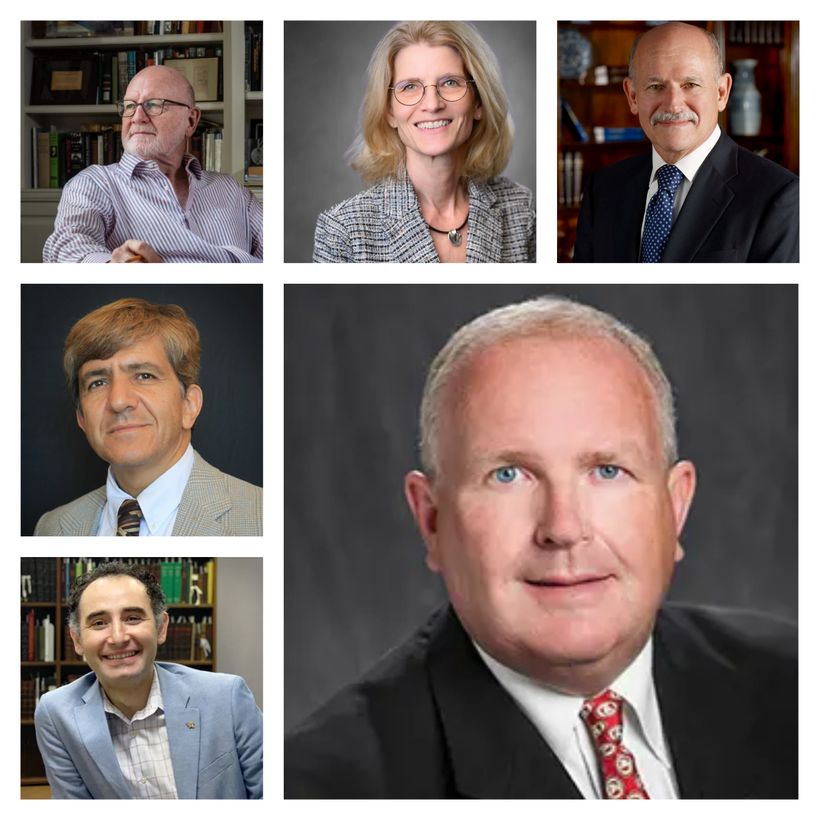
Largest Cohort in LSU History: Six Distinguished Faculty Members Named Boyd Professors
Named in honor of brothers Thomas and David Boyd, early presidents and faculty members of LSU, the Boyd Professorship recognizes faculty who bring honor and prestige to LSU through their national and, as appropriate, international recognition for outstanding achievements. Before today, only 79 faculty members from all of LSU’s campuses have ever achieved this distinguished rank. The newest cohort of Boyd Professors represent a wide variety of disciplines and hail from three of LSU’s eight campuses: LSU A&M, Pennington Biomedical Research Center, and LSU Shreveport. This group includes LSU Shreveport’s first-ever Boyd Professor, a landmark achievement for the campus and a testament to its academic distinction. As the largest group of Boyd Professors ever named at one time, this cohort underscores LSU’s rising reputation for research excellence across all of its campuses. “This is a moment of real pride for LSU. Naming six new Boyd Professors is not only historic in scale, it's a clear reflection of the extraordinary strength and momentum of our academic enterprise,” said Interim LSU President Matt Lee. “These scholars are advancing knowledge in ways that reach far beyond our campuses, and their work is helping to define LSU’s place on the national and global stage. I am especially proud to see LSU Shreveport represented for the first time, a milestone that reflects the growing excellence across our campuses. This achievement is a powerful reminder of our commitment to advancing scholarship and shaping the future through research, education, and service.” The newest Boyd Professors are: Mette Gaarde, Les and Dot Broussard Alumni Professor, Department of Physics and Astronomy, College of Science, LSU A&M John Maxwell Hamilton, Hopkins P. Breazeale LSU Foundation Professor, Manship School of Mass Communication, LSU A&M Steven Heymsfield, Professor of Metabolism and Body Composition, Pennington Biomedical Research Center Michael Khonsari, Dow Chemical Endowed Chair and Professor, Department of Mechanical Engineering, College of Engineering, LSU A&M Alexander Mikaberidze, Professor of History, Ruth Herring Noel Endowed Chair, College of Arts & Sciences, LSU Shreveport R. Kelley Pace, Professor, Department of Finance, E. J. Ourso College of Business, LSU A&M Nominations for the Boyd Professorship are initiated in the college, routed for review and support at the campus level, then considered by the LSU Boyd Professorship Review Committee, which seeks confidential evaluations from dozens of distinguished scholars in the candidate’s field of expertise. Once endorsed by the review committee, the nomination is forwarded to the LSU President and Board of Supervisors for consideration. With this distinction, a Boyd Professor’s compensation is elevated to reflect the stature of LSU’s most distinguished faculty, with a salary set at no less than the 95th percentile of full professors in comparable disciplines at peer public institutions across the southeastern United States. They also receive an annual stipend to further support their research and scholarly pursuits. Please join us in congratulating these faculty on this outstanding accomplishment.



As Trump rolls back regulations, this expert examines the costs of compliance
President Donald Trump has signaled a push to scale back federal regulation across a wide range of industries, reigniting a national debate over the costs and benefits of government rules. For Joseph Kalmenovitz, an assistant professor of finance at the University of Rochester’s Simon Business School who studies the economics of regulation, the moment underscores the importance of understanding not just what regulations do — but how much they cost. Kalmenovitz, who combines legal training with cutting-edge empirical methods, has developed innovative ways to measure regulatory intensity. His research shows how compliance requirements translate into millions of additional hours of paperwork for firms — costs that often fall outside public view. A recent Bloomberg Law article cited his work in explaining how Wall Street alone devotes an estimated 51 million extra hours each year to compliance since the Great Financial Crisis. Beyond tallying hours, Kalmenovitz’s studies also explore how overlapping rules across agencies — what he calls “regulatory fragmentation” — can stifle productivity, profitability, and growth, especially for smaller firms. His long-term aim is to provide evidence-based insights that can guide smarter rulemaking in Washington. “The dream is that people will take insights from my work and use them to improve the way regulation is conceived,” he told Simon Business Magazine. Kalmenovitz is a leading voice in translating data into meaningful insights about the hidden costs and design of regulation whose work has been published in the Journal of Finance, the Review of Financial Studies, Management Science, and the Journal of Law and Economics. He is available for interviews and can be contacted through his profile.



Play, Learn, Lead: How Aston’s Gamification-Driven MBA Is Redefining Business Learning
Professor Helen Higson OBE of Aston Business School, discusses why gamification is embedded in all of the School's postgraduate portfolio of degrees Give the students something to do, not something to learn; and the doing is of such a nature as to demand thinking; learning naturally results. (attributed to John Dewey, US educational psychologist (1859-1952) Imagine you’re the CEO of a cutting-edge robotics firm in 2031, making high-stakes decisions on R&D, marketing and finance; one misstep and your virtual company could collapse. You win, lose, adapt, and grow. This isn’t a case study, it’s your classroom experience at Aston Business School in Birmingham. Imagine you’re participating in Europe’s biggest MBA tournament, the University Business Challenge, where your strategic flair and financial acumen will be tested against the continent’s sharpest minds. Then you’re solving real-world sustainability crises in the Accounting for Sustainability Case Competition, crafting solutions that could be showcased in Canada. What if you could do all this from your classroom seat, armed with only your MBA learnings, teamwork and the thrill of gamified learning. At Aston, we believe the best way to master business is by doing business. That’s why we’ve embedded active learning through games, simulations, and competitions across all our postgraduate programs. The results? Higher engagement, deeper learning, and students who graduate with confidence and real-world skills. Research says gamified learning boosts motivation, lowers stress, and helps students adopt new habits for lifelong success. As educational researchers Kirillov et al. (2016) found, “Gamification creates the right conditions for student motivation, reduces stress, and promotes the adoption of learning material—shaping new habits and behaviours.” This has led to what Wiggins (2016), calls the “repackaging of traditional instructional strategies”. In Aston Business Sschool we have long embraced this approach as a way of increasing student outcomes and stimulating more student engagement in their learning. Our Centre for Gamification in Education (A-GamE), launched in 2018, is dedicated to advancing innovative teaching methods. We run regular seminars with internal and external speakers showcasing gamification adoption, design and research and we use these techniques across the ABS in a wide range of disciplines. (We have included two examples of this work in our list of references.) Furthermore, in 2021 we published a book which outlines the diverse ways in which we use these methods (Elliott et al. 2021). Subsequently, during 2024 we redesigned all our postgraduate portfolio of degrees, and as part of this initiative games and simulations were embedded across all programmes. Why Gamification Works Through simulations like BISSIM, students step into executive roles, steering futuristic companies through the twists and turns of a dynamic marketplace. A flagship programme running since 1981, BISSIM was developed in collaboration between academics from ABS and Warwick Business School, and every decision on R&D, marketing, or HR has real consequences as teams battle each other for the top spot. After each year of trading the results are input into the computer model. The results are then generated for each company in the form of financial reports, KPIs and other non-financial results and messages. Each team’s results are affected by their own decisions and the competitive actions of the other teams, as well as the market that they all influence. This year one of our academics, Matt Davies, has been awarded an Innovation Fellowship further to commercialise the game. Competitions with Global Impact We also encourage students to take part in national and international competitions which have the same effect of developing their engagement with real-life business problems on a global scale. Beyond the classroom, Aston students represent the university in major competitions like the University Business Challenge (in which ABS had the highest number of UK teams this year) and the Accounting for Sustainability (A4S) Case Competition, for which we are an “anchor business school”. Here, theory gets stress-tested against real-world scenarios and top talent from around the globe. The result? Award-winning teams, global experience, and friendships built under pressure. At the heart of this approach is Aston’s Centre for Gamification (A-GamE), dedicated to making learning interactive, motivating, and fun. Regular seminars, fresh research, and close ties to industry keep the curriculum evolving and relevant, so students graduate ready to lead, adapt, and thrive in any business environment. Why does it matter? In a volatile, fast-paced economy, employers appreciate agility, teamwork and decisiveness. At Aston, every simulation and competition is geared towards sharpening these skills. Graduates emerge not only knowledgeable, but prepared for the job market. Engagement Our students have been embracing these opportunities. Six MBA/Msc teams developed their A4S videos, hoping to reach the final in Canada early in 2025, and three teams out of nine reached the national UBC finals. Additionally, the BISSEM simulation has just finished inspiring another group of MBA students (particularly as the prize for the winning team was tickets to a game at our local Aston Villa premiership football (soccer) club, currently riding high in the league!). Typical feedback from non-Finance specialists is that they suddenly surprised themselves during their participation in the simulation and were reconsidering the options of taking a career in Finance. It seems that our original purposes have been met – increased confidence, passion, deep learning and engagement have been achieved. To interivew Professor Higson, contact Nicola Jones, Press and Communications Manager, on (+44) 7825 342091 or email: n.jones6@aston.ac.uk Elliott, C., Guest, J. and Vettraino, E. (editors) (2021), Games, Simulations and Playful Learning in Business Education, Edward Elgar. Kirillov, A. V., Vinichenko, M. V., Melnichuk, A. V., Melnichuk, Y. A., and Vinogradova, M. V. (2016), ‘Improvement in the Learning Environment through Gamification of the Educational Process’, International Electronic Journal of Mathematics Education, 11(7), pp. 2071-2085. Olczak, M, Guest, J. and Riegler, R. (2022), ‘The Use of Robotic Players in Online Games’, in Conference Proceedings, Chartered Association of Business Schools, LTSE Conference, Belfast, 24 May 2022, p. 79-81. Wiggins, B. E. (2016), ‘An Overview and Study on the Use of Games, Simulations, and Gamification in Higher Education’, International Journal of Game-Based Learning (IJGBL), 6(1), 18-29. https://doi.org/10.4018/IJGBL.2016010102


Covering "meme stocks"? Our expert can help.
"Meme stock" fever in the financial markets is back and hotter than ever. If you're a reporter covering the trend now or in the future (because history suggests it'll boomerang), the University of Rochester invites you to reach out to Daniel Burnside, clinical professor of finance at the Simon School of Business, for insight. Burnside has held various roles in the investment, risk management and financial planning fields, and has worked extensively with both individual and institutional clientele. He recently helped Forbes explain the trend affecting stocks like Krispy Kreme and Kohl's and other brands, and offered advice on how investors should proceed. "You’re not investing in fundamentals, you’re betting on crowd psychology and social media dynamics,” Burnside told Forbes. Burnside encouraged potential investors to “keep it small.” “No more than, say, 5% of your portfolio,” he added. “It’s speculation, not strategy. If you can’t afford to lose it, you can’t afford to meme it.” Contact Burnside by clicking on is profile.


Lending Survey Results Reveal Recent and Dramatic Concern Due to Tariff Policy
Global consulting firm J.S. Held releases its proprietary “Lending Climate in America” survey results from Phoenix Management, a part of J.S. Held. The second quarter survey results highlight lenders’ views on important issues, including policy decisions along with their national and global impact. Each quarter, Phoenix Management, a part of J.S. Held, surveys lenders to identify important trends focused on the latest economic issues, business drivers, and credit trends in the current lending climate. The “Lending Climate in America” survey provides valuable information to lenders, attorneys, private equity sponsors, and the financial news media, exploring topics like: What factors do lenders see as most likely to impact the US economy in the next six months? Phoenix’s Q2 2025 “Lending Climate in America” survey asked lenders which factors could have the strongest potential to impact the economy in the upcoming six months. Sixty-seven percent of lenders are paying the most attention to the possibility of a U.S. recession, while 40% of lenders believe overall political uncertainty has the strongest potential to impact the economy. Lenders also expressed moderate concern regarding the possibility of constrained liquidity in capital markets. To see the full results of Phoenix’s “Lending Climate in America” Survey, please visit: https://www.phoenixmanagement.com/lending-survey/ What shifts do lenders observe in their customers’ hiring and capital improvement plans? Lenders revealed what actions their customers may take in the next six months. Over half of the surveyed lenders believe their customers will raise additional capital. Most telling was that lenders believe only 3% of their customers have plans to hire new employees (down from 56% in 1Q) and only 23% have plans for capital improvements (down from 67% in 1Q). Which industries are expected to see the most volatility over the next six months? For the first time in recent memory, the 3 industries that respondents identified as most likely to experience volatility in the next six months were different from the prior quarter - consumer products (60.0% versus 20.7%), retail trade (43.3% versus 31.0%), and manufacturing (33.3% versus 20.7%). How do lenders plan to adjust their loan structures? Additionally, Phoenix’s “Lending Climate in America” survey asked lenders if their respective institutions plan to tighten, maintain, or relax their loan structures for various sized loans. For larger loan structures (greater than $25M), the plan to maintain loan structures remained relatively constant from Q1 to Q2, decreasing by 8 percentage points. As loan sizes decrease, the percentage of lenders that plan to maintain (as opposed to increase) their loan structures increased – quite dramatically in the under $15M range. How has lender sentiment toward the US economy changed from Q1 to Q2? Lender optimism in the U.S. economy decreased for the near term, moving from 2.33 in Q1 2025 to 2.10 in Q2 2025. In this current quarter, there is heavy expectation of a C level performance (63%), with the remainder split between D and B levels. More telling, lender expectations for the U.S. economy’s performance in the longer term increased sharply from 2.11 to 2.53. Of the lenders surveyed, 57% believe the U.S. economy will perform at a B level during the next twelve months, a hefty increase from the prior quarter. The “Lending Climate in America” survey is administered quarterly to lenders from various commercial banks, finance companies, and factors across the country. Phoenix Management, a part of J.S. Held, collects, tabulates, and analyzes the results to create a complete evaluation of national attitudes and trends. To view the full results, click on the button below: To connect with Michael Jacoby or for any other media inquiries, please contact: Kristi L. Stathis, J.S. Held +1 786 833 4864 Kristi.Stathis@JSHeld.com


FAU Data Analysis: Falling Rates Bring Some Relief to Banks
Falling interest rates brought some relief to banks’ portfolios for unrealized losses on investment securities, according to a data analysis from a finance professor at Florida Atlantic University. Only two banks with assets over $1 billion reported unbooked securities losses greater than their total equity in the first quarter of 2025, down from three in the last quarter of 2024, according to the U.S. Banks’ Unrealized Losses on Investment Securities screener. For unbooked losses equal to 50% of Common Equity Tier 1 Capital (CET1) equity, 24 banks were on the list for the first quarter of this year, down from 34 in the fourth quarter of 2024. Rates dropped from the end of 2024 through the end of March, providing some relief to banks that had extensive interest rate risk in their investment securities portfolios. The yield on the 10-year treasury bond fell from 4.57 to 4.25 as of the end of March. “While this would appear to be good news for the U.S. banking industry, with unrealized securities losses declining by $69 billion from the end of 2024 to March, rates have climbed back to where they were at the end of 2024 so that losses today would be back up close to $500 billion,” said Rebel Cole, Ph.D., Lynn Eminent Scholar Chaired Professor of Finance in the College of Business. The aggregate unbooked securities losses on bank balance sheets declined by $69 billion from $483 billion at the end of the fourth quarter in 2024 to $414 billion at the end of the first quarter this year. The quarterly U.S. Banks’ Unrealized Losses on Investment Securities Screener, produced as part of The Banking Initiative in FAU’s College of Business, measures banks’ exposure to risk based on their unrealized losses in their investment securities portfolios. To calculate a bank’s risk, Cole uses the most recently available data from quarterly call reports published by the U.S. Federal Financial Institutions Examination Council. Of the 4,543 banks reporting in the first quarter for this year, Cole focused on 1,042 banks with more than $1 billion in assets to calculate unrealized losses on investment securities and compare those losses to a bank’s CET1. Regulators would force a bank that lost half of its CET1 capital to take remedial actions, such as raising new capital or seeking a merger partner; in the worst case, a bank may face closure by the FDIC. “It’s likely that unbooked losses will continue to grow as interest rates continue to move higher” Cole said. “Both the 50-day and 200-day moving average rate on the 10-Year Treasury bond are rising so losses are growing, not shrinking. And this is only one part of banks’ balance sheets that are suffering from rising rates. There also are massive unrealized losses on banks’ residential and commercial mortgage portfolios that total to another $500 billion.” Looking to know more? We can help. Rebel Cole is available to speak with media about banking and the impact on interest rates. Simply click on his icon now to arrange an interview today.


Reclaiming 'Spend': A Retirement Rebellion
June is Pride Month—a celebration of identity, resilience, and the powerful act of reclaiming. Over the years, LGBTQ+ communities have reclaimed words that once marginalized them. “Queer” used to be a slur. Now, it’s a proud badge of honor. Similarly, the Black community has transformed language once used to oppress into expressions of cultural pride and connection. So, here's a thought: What if retirees approached the word “spend” similarly? Yes, you read that right. The psychological Tug-of-War This isn't just about numbers; it’s about narratives. Most retirees have spent their entire adult lives in accumulation mode: save, earn, invest, delay gratification, rinse, and repeat. But retirement flips that formula on its head, and most people weren’t provided with a “mental user guide” for the transition. Now, instead of saving, they’re expected to spend? Without a paycheck? It triggers everything from guilt to fear to a low-grade existential crisis. The Challenge of Saving for an Extended Period Let’s get serious for a moment. The data tells a troubling story: - Canadians over 65 collectively hold $1.5 trillion in home equity (CMHC, 2023) - The average retiree spends just $33,000 per year, despite often having far more resources (StatsCan, 2022) - Nearly 70% of retirees express anxiety about running out of money—despite having significant savings (FCAC, 2022) We’re talking about seniors who could afford dinner out, a trip to Tuscany, or finally buying that electric bike—and instead, they’re clipping coupons and debating the cost of almond milk. Why? Because spending still feels wrong. I Know a Thing or Two About Reclaiming Words As a proud member of the LGBTQ2+ community and a woman who has worked in the traditionally male-dominated world of finance, I’ve had a front-row seat to the power of language, both its ability to uplift and its tendency to wound. There were many boardrooms where I was not only the only woman but also the only gay person, and often the oldest person in the room. I didn’t just have a seat at the table; I had to earn, protect, and sometimes fight to keep it. I’ve learned that words can be weapons, but they can also be amour—if you know how to use them. Reflect on Your Boundaries Take a moment. Have you ever felt prejudged, marginalized, or dismissed? Perhaps it was due to your gender, sexuality, accent, skin colour, culture, or age. It leaves a mark. One way to preserve your dignity is by building a mental toolkit in advance. Prepare a few lines, questions, or quiet comebacks you can use when someone crosses the line—whether they intend to or not. Here are five strategies that helped me stand tall—even at five feet nothing: 1. Humour – A clever remark can defuse tension or highlight bias without confrontation. 2. Wit – A precisely timed comeback can silence a room more effectively than an argument. 3. Over-preparation – Know your stuff inside and out. Knowledge is power. 4. Grace under fire – Not everything deserves your energy. Rise above it when it matters. 5. Vulnerability – A simple “Ouch” or “Did you mean to hurt me?” can be quietly disarming—and deeply human. Let’s Talk About Microaggressions The term microaggression may sound small, but its effects are significant. These are the subtle, often unintentional slights: backhanded compliments, dismissive glances, and “jokes” that aren’t funny. They quietly chip away at your sense of belonging. Dr. Robin DiAngelo’s book White Fragility is a brilliant read on this topic. She explains how early socialization creates bias— “Good guys wear white hats. Bad guys wear black hats.” These unconscious associations become ingrained from an early age. Some people still say, “I’m not racist—I have a Black friend,” or “I’m not homophobic—my cousin is gay.” The truth? Knowing someone from a marginalized group doesn’t exempt you from unconscious bias. It might explain the behaviour, but it doesn’t excuse it. And no, there is no such thing as reverse discrimination. Discrimination operates within systems of power and history. When someone points out a biased comment or unconscious microaggression, they’re not discriminating against you—they’re holding up a mirror. That sting you feel? It’s not oppression. It’s shame—and it’s warranted. It signals that your intentions clashed with your impact. And that’s not a failure; it’s an invitation to grow. Calling it “reverse discrimination” is just a way to dodge discomfort. But real progress comes when we sit with that discomfort and ask: Why did this land the way it did? What am I missing? Because the truth is, being uncomfortable doesn’t mean you’re being attacked. It often means you’re being invited into a deeper understanding—and that’s something worth showing up for. Let’s Reclaim 'Spend' What if we flipped the script? What if spending in retirement was viewed as a badge of honour? Spending on your grandkids’ education, your bucket list adventures or even a high-end patio chair should not come with any shame. You’ve earned this. You’ve planned for this. It’s time to reclaim it. Let’s make “spend” the new “thrive.” Let’s make super-saver syndrome a thing of the past. Let the Parade Begin Imagine it: a Seniors’ Spend Parade. Golden confetti. Wheelchairs with spoilers. Luxury walkers with cupholders and chrome rims. T-shirts that say: - “Proud Spender. Zero Shame.” - “I’m not broke—I’m retired and woke.” - “My equity funds my gelato tour.” Dreams Aren’t Just for the Young What’s the point of spending decades building wealth if you never enjoy it? Reclaiming “spend” isn’t about being reckless—it’s about being intentional. So go ahead—book the trip. Upgrade the sofa. Take the wine tour. You’re not being irresponsible; you’re living the life you’ve earned. And if anyone questions it? Smile and say: “I’m reclaiming the word spend. Care to join the parade?” Sue Don’t Retire…Rewire! 8 Guilt-Free Ways to Spend in Retirement A checklist to help you spend proudly, wisely, and joyfully: ☐ Book the Trip – Travel isn’t a luxury; it’s a memory maker. ☐ Upgrade for Comfort – That recliner? That mattress? Worth every penny. ☐ Gift a Down Payment – Help your kids become homeowners. ☐ Fund a Grandchild’s Dream – Tuition, ballet, a first car—you’re building a legacy. ☐ Outsource the Chores – Pay for help so you can reclaim your time. ☐ Invest in Wellness – Healthy food, massage therapy, yoga. Health is wealth. ☐ Pursue a Passion – From pottery to piloting drones, go for it. ☐ Celebrate Milestones – Anniversaries, birthdays… or Tuesdays. Celebrate always! Want More? If this speaks to you, visit www.retirewithequity.ca and explore more: - From Saver to Spender: Navigating the Retirement Mindset - Money vs. Memories in Retirement - Fear Of Running Out (FORO) Each piece explores the emotional and psychological aspects of retirement—the parts no one talks about at your pension seminar.


Why Your Experts Might Not Show Up in Google AI Overviews — And How to Fix It
The way we find expert information online is changing fast. With the rise of Google’s AI-generated overviews (formerly called Search Generative Experience), the top spot on the search page no longer goes to the highest-ranking blue link. Instead, AI now summarizes answers using a blend of machine learning, structured data, and trust signals—pulling directly from a variety of select sources across the web. If institutions—whether academic, healthcare, corporate or others—aren't aligning its expert content with these new rules of discovery, your experts may be left out of the conversation altogether. Don't miss being featured in media stories, invited to speak at events, or approached for business and collaboration opportunities. This is the moment to double down on structured data and transparent authorship—because AI-first search is rewarding expert clarity, not just content volume. The following provides a quick breakdown as to how AI Search, Google’s EEAT principles, and Schema.org structured data work together—and what you can do to ensure your expert content...and your experts, gets surfaced, cited, and trusted. What Is EEAT and Why It Matters in AI Search EEAT stands for Experience, Expertise, Authoritativeness, and Trustworthiness—the core framework Google uses to evaluate whether content is reliable and deserves to rank, especially in high-stakes areas like health, education, and finance. In AI-powered summaries, Google doesn’t just look at keywords—it looks for: Real people with demonstrable credentials Clear affiliations with reputable institutions Consistent authorship and transparency Trust signals like citations, bios, and professional history EEAT in Action: Why Schema Markup Is Your AI SEO Power Tool EEAT signals work best when they’re machine-readable—that’s where Schema.org structured data comes in. It acts as a translator between your content and Google’s AI. Schema tags are pieces of structured data that help search engines understand the content and context of your web pages. They translate human-readable information—like author names, job titles, and article types—into machine-readable signals that boost visibility AI overviews and search results. Implementing Schema helps ensure your expert content is eligible for inclusion in AI overviews. Key schema types include: {Person} – for expert bios {ScholarlyArticle}, {Article}, {FAQ} – for authored content {Organization}, {MedicalOrganization}, {EducationalOrganization} – to establish credibility {sameAs} – to reinforce expertise by connecting external profiles (LinkedIn, ORCID, Google Scholar) Schema in Action: AI Overviews Favor Structured, Credible Expert Content Google’s AI overviews are designed to synthesize trustworthy sources—not just surface-level blog posts or SEO-churned pages. That means expert content that is: Authored by named individuals with clear credentials Structured for readability and machine parsing Linked to institutional authority and trust domains If your experts don’t meet these criteria—or if Google’s crawlers can’t understand the relationships between person, organization, and content—your insights may never reach the surface of the AI summary box. How ExpertFile Optimizes for AI-Driven Search AI search is no longer just about keywords—it’s about credibility, structure, and clarity. Institutions that invest in properly structured expert content will not only rank better—they’ll become the source quoted in the next generation of search. ExpertFile is purpose-built to maximize visibility and trust in this new era of AI search. Here’s how: Structured Expert Profiles: Every expert has a dedicated page with rich Person schema, bios, credentials, affiliations, and publication history. Schema-Tagged Content: Articles, media spotlights, and FAQs are marked up using Schema.org types like ScholarlyArticle, FAQPage, and Article. Institutional Credibility: Profiles are embedded within .edu, .org, or corporate domains—reinforcing trust with Google’s algorithms. Cross-Linked Authority: Integration with Google Scholar, LinkedIn, and ORCID ensures a 360° trust profile across the web. Mobile-Ready & Indexed: ExpertFile content is fully indexable and distributed across web and mobile platforms—supporting discoverability everywhere AI pulls from. With ExpertFile, your experts are not just listed—they’re positioned, structured, and ready for the AI spotlight. Learn more about how ExpertFile helps organization's benefit in the new era of AI.



From Saver to Spender: Navigating the Retirement Mindset Shift
Let’s start with a familiar—and slightly ridiculous—scene: a retired couple with $750,000 safely tucked away in investments, quietly nibbling no-name tuna on toast while muttering, “We just can’t afford steak anymore.” Sound absurd? Sadly, it’s not fiction. Despite having ample savings, many retirees live with perpetual financial anxiety, clinging to their nest egg as if it were their last roll of toilet paper during a pandemic. Meanwhile, they try to survive solely on government pensions, making life unnecessarily stressful and, let’s face it, a bit joyless. I've wrestled with this as someone who entered retirement earlier than expected. Years in finance taught me how to budget, invest, and plan, but transitioning from saving to spending required a whole new mindset. I learned quickly that being financially “prepared” doesn’t mean you’re emotionally or psychologically ready to spend. So, what’s going on here? The Hypothesis: Individuals Prefer Spending Income Rather Than Saving Retirees prefer spending income (pensions or annuities) rather than withdrawing from savings or investment accounts. This isn’t just a quirky behavioural trend—it’s a deeply ingrained bias, and neuroscience supports it. Research by Michael S. Finke, a professor at The American College and noted researcher in retirement economics, revealed that retirees tend to spend most of their guaranteed income but only withdraw about half of their savings. In his words: “Retirees spend lifetime income, not savings.” The implication is clear: it’s not about how much money you have but how it feels to use it. This is partly due to what behavioral economists call “mental accounting.” We categorize our money into imaginary buckets: income is for spending, and savings are for safekeeping. Unfortunately, this can lead to financially irrational and highly risk-averse behaviors, such as eating cat food while having six figures in a TFSA. The Neuroscience of Spending Fear Add a little neuroscience, and the story deepens. As we age, changes in the brain, particularly in the prefrontal cortex, can affect how we assess risk and manage uncertainty. This can lead to: • Increased loss aversion: We more acutely feel the pain of spending or loss. • Decision paralysis: We delay or avoid withdrawals, even when reasonable. • Heightened anxiety about the future: We fear running out more than we enjoy spending in the present. This Fear of Running Out (FORO), which I’ve written about in a previous post, keeps many retirees in a defensive crouch, emotionally hoarding their savings rather than using them to enrich the years they worked so hard to reach. It’s no wonder money stress impacts us so deeply—our brains are wired that way. From an evolutionary perspective, our minds are designed to fear scarcity because running out of resources once posed a real danger. When we perceive that threat today, whether it’s a dip in our investments or rising grocery bills, our brain shifts into fight-or-flight mode and begins releasing cortisol—the stress hormone that heightens our anxiety. Then our amygdala, that little alarm system in our brain designed to protect us from danger, can’t differentiate between a financial crisis and a sabre-toothed tiger. So, it reacts similarly, nudging us toward quick, often irrational decisions. Sometimes that means freezing and doing nothing; other times, it leads to panicking and regretful choices. Understanding how our brains function under financial stress allows us to step back, breathe, and make better, calmer decisions—ones that serve us, not scare us. Retirement can be wonderfully freeing—no more commutes, no more meetings—but let’s be honest: it also comes with a significant shift in financial responsibility. Without that steady paycheck, it’s completely normal to feel uneasy about how you'll manage your money, especially when unexpected expenses arise. Sure, there are mindset tools and mental prep strategies that can help ease that existential “What now?” feeling before retirement. But let’s be specific—here are the real, concrete financial stressors that keep many retirees awake at night: • Not Enough Income: One of the biggest fears? Your savings won’t stretch far enough to support the life you want—or handle surprises. • Healthcare Costs: As we age, medical expenses climb. It’s not just the big stuff, either. Even prescriptions and dental bills can blow a hole in your budget. • Market Ups and Downs: A stock market dip can uniquely affect retirees. Observing your investments fluctuate can cause genuine anxiety regarding your income, especially in today’s “trade war” environment. • Inflation: We all feel it. The gradual rise of higher prices erodes your purchasing power, making that carefully saved nest egg feel less secure. • Living Longer Than Planned: It's both a blessing and a challenge. If you're healthy and living well into your 90s (and many do), the big question becomes: will your money last as long as you do? Here’s the good news: when you acknowledge these risks and build a plan around them, you exchange fear for control. And with power comes clarity, confidence, and significantly less stress. That’s when you can truly enjoy retirement—on your terms. How to Flip the Script: Make Savings Feel Like Income So, how can retirees overcome this psychological hurdle? Here are 3 powerful strategies: 1. Create Artificial Income Streams Turn a portion of your savings into predictable, automatic income. This could mean: • Setting up regular monthly withdrawals from an RRIF • Purchasing an annuity • Utilizing a bucket strategy, in which one portion of savings is maintained in a cash-like account to replicate a paycheck When money shows up like a salary, you’re more likely to feel permission to spend it. 2. Use Home Equity as a Back-Up Income Source A secured line of credit (HELOC) or a reverse mortgage can serve as a “Plan B” or income buffer. Knowing that the funds are available can alleviate anxiety, whether you use them or not. 3. Involve Family in Income Planning Sometimes, the best way to reframe a spending decision is through conversation. Adult children or trusted advisors can help develop a spending strategy that feels both secure and reasonable. Families can be invaluable in helping you design: • Emergency funding plans for unexpected expenses like healthcare • Gifting strategies (Want to help the kids or grandkids? Do it while you’re alive to see the joy!) • Income simulations replacing a regular paycheck Open conversations can also help uncover mismatched expectations. For instance, some older adults worry that spending their savings will leave less of an inheritance for their children, which might cause disappointment. But in many cases, their children would much rather see their parents use that money to care for themselves and enjoy their retirement years. The great irony of retirement? The hardest part isn’t building wealth; it’s allowing yourself to enjoy it. So, let’s retire the notion that frugality is forever. Replace the guilt of spending with the confidence of an income strategy. And if you're facing your savings with trepidation, remember: cat food may be a pantry staple for your pet, but it’s no reward for 40 years of hard work. Retirement isn't merely a financial phase—it’s a shift in mindset. That shift begins when we stop hoarding and start living.

Data Analysis: Commercial Real Estate Troubles Threaten U.S. Banks
The U.S. banking system is on a precipice as exposures to commercial real estate grow and banks grapple with high interest rates, according to an analysis by a finance professor at Florida Atlantic University. Of the 158 largest banks, 59 in the country are facing exposures to commercial real estate greater than 300% of their total equity capital, as reported in the fourth quarter 2024 regulatory data and shown by the U.S. Banks’ Exposure to Risk from Commercial Real Estate screener. “Regulators have been putting pressure on banks to reduce their exposures. However, it’s a very difficult thing to do without sending a signal of weakness to the market and creating more problems,” said Rebel A. Cole, Ph.D., Lynn Eminent Scholar Chaired Professor of Finance in FAU’s College of Business. “To get around this, many banks are ‘extending and pretending’ by restructuring their loans.” The U.S. Banks’ Exposure to Risk from Real Estate screener, a part of the Banking Initiative at Florida Atlantic University, measures the risk to exposure from commercial real estate at the 158 largest banks in the country with more than $10 billion in total assets. Using publicly available data released quarterly from the Federal Financial Institutions Examination Council (FFIEC) Central Data Repository, Cole calculates each bank’s total CRE exposure as a percentage of the bank’s total equity. Bank regulators view any ratio over 300% as excess exposure to CRE, which puts the bank at greater risk of failure. Troubled debt restructuring for commercial construction, multifamily, owner-occupied and owner-non-occupied mortgages tripled since 2023. They reached $18 billion in the fourth quarter of 2024, up from $6 billion in Q2 2023, according to data from the FFIEC. While non-owner occupied nonfarm, non-residential accounts for more than half of these amounts, there is also serious deterioration in multifamily and commercial construction loans. “Banks choose to extend these loans, hoping interest rates might drop. While the Fed did cut rates,” Cole said. “If a loan is maturing from five years ago in today’s rate environment, rather than refinance it with today’s terms, they will restructure the loan under the same terms from five years ago for another year. This all depends on interest rates falling, which is not likely to happen this year.” Among banks of any size, 1,788 have total CRE exposures greater than 300%, up from 1,697 in Q3; 1,077 have exposures greater than 400%, up from 971 in Q3; 504 have exposures greater than 500%, up from 426 in Q3; 216 have exposures greater than 600%, up from 166 in Q3. For comparison, the aggregate industry total CRE exposure is 132% of the total, unchanged from the third quarter of 2024. Looking to know more? We can help. Rebel Cole is available to speak with media about commercial real estate and the potential threats to the American banking system, Simply click on his icon now to arrange an interview today.