
Experts Matter. Find Yours.
Connect for media, speaking, professional opportunities & more.

Aston University offers emergency interpreter training for Ukrainian speakers to support refugees
Dr Emmanuelle Labeau and Dr Yvonne Fowler are running Emergency Interpreting Training for Ukrainian Speakers to introduce them to the basics of interpreting The 10-hour training (10 x one hour) will take place on Tuesday and Thursday evenings online for five weeks It is part of an Arts and Humanities Research Council (AHRC) project with support from Aston University’s College of Business and Social Sciences. Aston University has kicked off a five-week introduction to interpreting course for Ukrainian speakers to enable emergency interpreters to support Ukrainian refugees arriving in the UK. It is part of an Arts and Humanities Research Council (AHRC) project called BRUM (Birmingham Research for Upholding Multilingualism) with support from Aston University’s College of Business and Social Sciences. Dr Emmanuelle Labeau (AHRC fellow for the Future of Language Research) and Dr Yvonne Fowler are running Emergency Interpreting Training for Ukrainian Speakers. The 10-hour training scheme (10 one-hour sessions) started on 28 April 2022 and will take place every Tuesday and Thursday evening online for five weeks. It has been devised to enable emergency interpreters to deliver a better service to traumatised Ukrainian refugees whose English is limited and who may require interpreting help in every aspect of their lives to access housing, physical and mental healthcare, educational facilities and welfare benefits. Dr Emmanuelle Labeau, co-director of Aston Centre for Applied Linguistics (ACAL) at Aston University, said: “Ukrainian refugees are arriving in the UK and there are few trained qualified Ukrainian interpreters to support those refugees with limited or no English in their dealings with public services. “We have had a fantastic response to our offer of free emergency training in interpreting for Ukrainian speakers in the West Midlands, as part of the AHRC-funded BRUM project. “I am thrilled that we have been able to pull this together and I am really pleased with how the first session went. We have people of all walks of life such as social services, healthcare, education and even a refugee who are so committed to help in any way they can, and it is lovely to empower them to do so!” Dr Yvonne Fowler said: “I am really proud to see this project get off the ground and help people in need. “I have been a public service interpreter trainer for the last 25 years. “My work has mostly involved preparing interpreters for the Diploma In Public Service, Interpreting Law and Healthcare options. “But during this period, I delivered emergency interpreter training to support various waves of refugees who have come to Birmingham over the last 20 years: the Vietnamese boat refugees, the Bosnian refugees in the aftermath of the Bosnian war, and a month in Kosovo after the war there to train Albanian and Serbian interpreters at the Organisation for Security and Cooperation in Europe.”


STORY: CAA named Canada’s most trusted brand across all age categories
Gustavson Brand Trust Index also ranks CAA first in insurance for the fifth straight year . The Canadian Automobile Association (CAA) has been named the most trusted brand in Canada for 2022 in the annual Gustavson Brand Trust Index. This is the third consecutive year that CAA has topped the list, beating out several hundred other prominent international and Canadian brands. CAA was the only company to finish in the Gustavson Top Ten across all age groups and grabbed first in brand trust among insurance companies for the fifth year running. Brand performance tends to vary by age, but CAA placed among the top 10 for people ages 35 and under, 35 to 55 years of age, and 55 years and older. CAA has been rated one of Canada’s top two most trusted brands in the index for six years running. Conducted by the Peter B. Gustavson School of Business at the University of Victoria, the seventh annual Gustavson Brand Trust Index asked more than 9,000 consumers to score 412 prominent national and global companies and brands, across 33 industry sectors, on a range of brand value measures. Consumers are asked to assess their perception of the reliability, consistency, honesty, societal responsibility and integrity of the brands surveyed.


Disney and other corporations are being pushed into social and political battles
At one time, corporations didn't get get in the middle of social and political battles, according to David Primo, professor of political science and business administration at the University of Rochester. The Disney Corporation recently came out in opposition to Florida's "Don't Say Gay" law, and Primo says it was "dramatic" how quickly the state responded by removing the company's self-governing special district status. As Primo sees it, increased political polarization across the country is leading employees, consumers, and activists to push corporations to take positions on issues like police brutality and LGBTQ rights. The irony, though, is that Americans are polarized over whether corporations ought to be doing this. "In general, Democrats are highly supportive of this, and Republicans are not," says Primo. "It's pretty straight forward to think that a corporation ought to be taking positions on issues related to its core business operations," says Primo. "The challenge for an executive, who has a fiduciary responsibility to the company, is knowing where to draw the line." So, if a company stakes out a position, Primo says it's just as likely to alienate a significant portion of its consumer base, as it is to gain the support of another portion of its base.



Disney, DeSantis, and Corporate Dilemmas
The Florida state legislature recently voted to end the Walt Disney Co.’s special tax district, which has permitted the Orlando amusement park to govern its land and save millions each year in taxes. The decision followed a clash between Disney executives and Florida Gov. Ron DeSantis over recent legislation that prohibits instruction on sexual orientation or gender identity for children in kindergarten through Grade 3. UConn's Professor Robert Bird, the Eversource Energy Chair in Business Ethics and past president of the Academy of Legal Studies in Business, sat down with UConn Today to talk about clash between the corporation and Florida government as well as the implications for other companies that may be facing similar moral and ethical dilemmas: Q: There are so many layers to this story, from taxation to self-governance, political power to human rights. What strikes you as most significant? From one perspective, this is a debate over the role of LGBTQ+ education in schools. From another perspective, this raises the broader issue of the implications of private companies speaking and acting on matters of public policy. Corporations can no longer remain neutral or silent on major issues facing American society. Consumers, employees, shareholders, and the public are increasingly expecting companies to take a stand on controversies that matter to them. Just as some companies are being punished for not severing their relationships with Russia, because of Russia’s invasion of Ukraine, so are companies like Disney expected to speak out against public policies that contradict the values of its stakeholders. Q: Why does Disney play an important role in this issue? Disney is an important participant in the underlying “Don’t Say Gay” dispute. Disney has a powerful public brand and takes care to cultivate a family-friendly image worldwide. Disney has also been a long-standing leader in supporting LGBTQ+ rights. Disney has provided health benefits to same-sex partners since 1995, and allowed “Gay Days” at Walt Disney World since 1991. Public opinion was more hostile toward LGBTQ+ rights then, and Disney stood by its values even with the ensuing controversy. For Disney to “stand down” when so many people were advocating for Disney’s support in opposition to the bill, would have eroded its long-standing support of gay rights generally. Q: What message does this send to other CEOs who might be caught in a moral, ethical, or environmental debate with government leaders? The message sent to other companies is that politicians will not remain idle if a company opposes favored legislation or enters the sphere of public debate. Firms need to walk a fine line between standing up for their values and eroding relationships with political leaders. This is an important story, and if you're a reporter looking to know more or would like to schedule and interview with Professor Bird, then let us help. Click on his icon now to arrange an interview today.



Will tourism bounce back as the Sunshine State gets ready for a post-COVID return?
The COVID-19 pandemic wreaked havoc on the globe, leaving few industries untouched in its wake. Florida’s tourism industry was hit particularly hard, with resorts shuttered and millions of visitors to the Sunshine State canceling their vacation plans. In fact, it’s estimated Walt Disney World lost more than $7 billion in 2020, all because of COVID. But with Florida back open and visitors returning, what's next for hospitality and tourism? And how will organizations handle staffing, pricing, inflation and other issues? If you are a journalist looking to cover the tourism sector in Florida, let us help. Peter Ricci is a clinical associate professor and director of the Hospitality and Tourism Management program in FAU’s College of Business. He is a hospitality industry veteran with more than 20 years of managerial experience in segments including food service, lodging, incentive travel and destination marketing. Peter is available to speak with the media. Simply click on his icon to arrange an interview.



Aston University launches community project to promote healthy lives in East Birmingham
The Knowledge Exchange project is led by Aston University with Birmingham Community Healthcare NHS Foundation Trust, in partnership with Citizens UK It aims to identify local barriers that lead to poor health outcomes A total of £6,390 has been awarded to five projects to support local residents. Aston University and Birmingham Community Healthcare NHS Foundation Trust, in partnership with Citizens UK, have launched a community project to identify local barriers that lead to poor health outcomes. Dr Céline Benoit (Sociology and Policy), Dr Alexis Paton (Sociology and Policy), Dr Angela Jeffery (RKE) and Aisha Masood (RKE) have been leading on the Knowledge Exchange project in East Birmingham to help improve health and wellbeing. On 17 March, the team hosted the first community sandpit at Aston University, where a number of community-led organisations and charities came together to identify small-scale projects to support local residents and promote healthy lives. A total of £6,390 was awarded to five projects which will submit a report by 31 July 2022 and meet again in the autumn to share their journeys with each other as well as representatives from the NHS and Birmingham City Council. Dr Céline Benoit, associate dean for public engagement for the College of Business and Social Sciences at Aston University, said: “It was such a privilege to host a community sandpit at Aston University and have the NHS and local organisations talk to one another and come up with joint projects to help promote health and wellbeing in East Birmingham. “It was truly inspiring to see how many brilliant projects were put forward. “It not only helped us get a better understanding of the challenges local residents face when it comes to health and accessing healthcare services, but it was also a great reminder of how much we can achieve when we work collaboratively”.

Aston University experts to co-chair The Spring Servitization Conference 2022
The Conference is dedicated to understanding how organisations can develop and adapt their business models through servitization and advances services The theme is Achieving Net-Zero through Servitization and it will be held in Florence, Italy on 9 and 10 May Professor Tim Baines and Dr Ali Z. Bigdeli, from the Advanced Services Group at Aston University, will be co-chairs. Two Aston University experts are set to co-chair a major conference around servitization in Italy in May. Professor Tim Baines and Dr Ali Z. Bigdeli, from the Advanced Services Group (ASG) at Aston University, will be co-chairs alongside Professor Mario Rapaccini (University of Florence), Professor Nicola Saccani and Dr Federico Adrodegari (both University of Brescia) while Jill Forrest (also ASG) will be conference administrator. The Spring Servitization Conference (SSC) was first launched more than 10 years ago at Aston University in Birmingham. It was created to build and formalise a research community around the topic of servitization, and to understand how organisations can develop and adapt their business models through servitization and advances services. Servitization is a term used to describe the process through which a business transitions from selling products alone to selling a combination of product and service, and ultimately outcomes. The theme of the 2022 edition of the conference will be Achieving Net-Zero through Servitization and will be held at Istituto degli Innocenti in Florence on Monday 9 and Tuesday 10 May. The event will bring together the world’s leading researchers, practitioners and doctoral students to debate and engage with the theory and practice of servitization. Professor Tim Baines, executive director of The Advanced Services Group at Aston University and co-chair The Spring Servitization Conference 2022, said: “Servitization has already helped to transform the fortunes of many UK manufacturing businesses and I am looking forward to showcasing what it can do for businesses abroad too. “SSC2022 will follow the now established format of a single stream where all contributors have an opportunity to present to the whole conference audience and engage in both structured and semi-structured panel sessions to discuss their work. “The programme is designed to encourage extensive debate and bridge research theory and industrial practice. “We have some fantastic keynote speeches from senior executives at leading manufacturing businesses including Tim Foreman, European R&D manager, OMRON Europe and Paolo Mauri, Electrolux Professional.” You can find out more about The Spring Servitization Conference 2022 here.



The research looked into the means for achieving higher sustainability performance through circular economy adoption The project was led by Professor Prasanta Dey and Professor Pawan Budhwar from Aston Business School Data was gathered from around 100 SMEs from Greece, France, Spain and the UK. New findings from an Aston University-led study have found Small and Medium Sized Enterprises (SMEs) are likely to achieve higher environmental performance through circular economy (CE) adoption. CE is a systemic approach to economic development designed to benefit businesses, society, and the environment. In contrast to the 'take-make-waste' linear model, a circular economy is regenerative by design and aims to gradually decouple growth from the consumption of finite resources. The project was led by Professor Prasanta Dey and Professor Pawan Budhwar from Aston Business School along with Soumyadeb Chowdhury (Toulouse Business School), Krishnendu Saha (Birmingham City University), Debashree De (University of Essex) and Chrysovalantis Malesios (Agricultural University of Athens). Data was gathered from around 100 SMEs from each of the four selected countries – Greece, France, Spain and the UK using a survey to study the current state of CE adoption, and subsequently, focus groups were organised which involved SMEs owners and managers, policymakers, SMEs' customers and suppliers, in each country to derive means for improving sustainability performance. The study reveals that SMEs in all the participating countries are likely to achieve higher environmental performance through CE adoption. SMEs in France were likely to achieve higher overall sustainability performance than other participating countries. It also found products, processes and facilities design is likely to help SMEs most in all the participating countries to adopt CE, while their waste management all needed improvement. Professor Budhwar, head of Aston Business School, said: “Although from prior research there is evidence of SMEs achieving superior environmental performance by adopting CE, economic and social performances are not assured. This motivated us to undertake empirical research to reveal the means for achieving higher sustainability performance (economic, environmental, and social) through CE adoption”. “The findings of this research enable us to continue CE adoption not only in other European countries but also in India, Thailand, Vietnam and Kenya”. Professor Dey, a professor in operations and information management at Aston Business School, said: “SMEs in the EU countries are likely to have sustainable design practices aligned with the CE philosophy. On the contrary, SMEs in the participating countries are likely to have worst recover function. “This implies that customers' pressure works for SMEs to adopt CE principles as design function in most of the SMEs' businesses is governed by SMEs' customers. Whereas effective recover function depends on SMEs' self-motivation and policymakers’ pressure.” “CE adoption needs a structured approach of analysing current state of CE through analysing correlation of organisational value functions with sustainability performance, identifying issues and challenges, and suggesting means for improvement across value functions.” You can read the full report here.

Aston MBA students take top prize at Universities Business Challenge Global Masters 2022
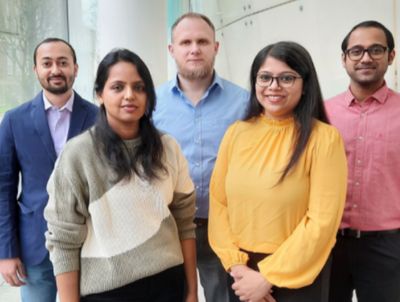
The competition helps develop the skills needed to move into corporate/public sector life The Grand Final took place in Liverpool where 10 teams from different universities competed for the title They were assessed on their team strengths and presented a one-minute pitch on a creative social business idea to an entrepreneur. A team of Aston MBA students has taken the top prize at the Universities Business Challenge (UBC) Global Masters 2022. Team GE7, which included Aishwarya Nagath Menon, Nashit Khalifa, Vasilijs Garbacevics, Divya Krisitipati led by Mithun Joy and mentored by Aston Business School’s Dr Julius Stephan, will receive a trophy on campus on 12 May. The competition offers postgraduate students a unique opportunity to develop the skills that you will need when moving into the working world and consists of 80 teams, drawn from a wide range of UK and Irish universities. The UBC Global Masters is a team-based business simulation event that provides participants with the opportunity to act as a board of directors, who have taken responsibility for improving the performance of a company. The finals took place in Liverpool where 10 teams from different universities, including two from Aston University, competed against each other tasked to run a simulated business under difficult trading conditions and also introduce an innovative idea to link the business to a social or environmental cause. The teams were assessed on their team strengths and presented a one-minute pitch on a creative social business idea to an entrepreneur. Mithun Joy, an Aston MBA student and team winner, said: “I am really proud to be part of the first Aston Business School team to win this competition. “It was a really competitive event against other universities, including the UBC's defending champion.” Clive Kerridge, course director at Aston Business School, said: “Although an Aston University MSc team made the podium in 2022, we are delighted to have our first ever winners of this excellent competition. “Taking part in the UBC Global Masters Challenge has been a great opportunity for our students to apply their theoretical knowledge to a complex, yet highly practical and topical business setting. “It allows for personal and professional development that is intellectually challenging and practically relevant, equipping participants with essential skills. Working in competitive teams enables peer to peer learning and interaction.” Find out more about the competition here.

Aston University expert to talk on gender diversity and inclusion at major cyber security event
The Ethnic Minority in Cyber (EMiC) network's flagship event is supported by the Department for Digital, Culture, Media and Sport Attendees will hear from inspirational speakers looking at current and future initiatives to increase diversity in the cyber sector Dr Anitha Chinnaswamy from Aston University will be presenting a talk on gender diversity and inclusion in cyber. An Aston University expert and founding group member of Ethnic Minority in Cyber (EMiC) is set to present a talk at a major cybersecurity event on 28 April 2022. The EMiC network's flagship symposium is supported by the Department for Digital, Culture, Media and Sport and will take place at Edgbaston Park Hotel in Birmingham. Attendees will hear from inspirational speakers looking at current and future initiatives aimed around increasing diversity in the cyber sector and will also be able to provide feedback into the initiative and policies going forward. The symposium will consist of a keynote speech, invited talks, panel sessions and round table workshops. Dr Anitha Chinnaswamy from the Cyber Security Innovation (CSI) Centre at Aston Business School will present a talk on gender diversity and inclusion in cyber and the outreach work of the Centre with schools to increase representation. Simon Hepburn, CEO UK, Cyber Security Council is the keynote speaker. The EMiC network, of which Aston University is a founding member, is a pilot network for Black, Asian and Ethnic Minority cyber academia, professionals and businesses, with the long-term aim of significantly improving representation across the cyber sector. Dr Anitha Chinnaswamy, lecturer in cyber security management at the CSI Centre at Aston Business School, says: “I am looking forward to speaking at such an important event about an ever-important topic in cyber. “While there is a growing cyber security skills gap and high shortage in the UK cyber sector, a recent survey found that only 17 per cent of cyber professionals are from ethnic minority backgrounds across all cyber roles. “The cyber sector remains relatively nondiverse in terms of gender. Just 16 per cent of the workforce across these firms is female, compared to 28 per cent in other UK digital sectors. “Those filling senior roles, typically with six or more years of experience, are particularly nondiverse across a range of characteristics including gender, ethnicity, disability and neurodiversity. “For example, just three per cent of senior roles are filled by women.” Aston University’s CSI centre, led by Professor Vladlena Benson, is the only female-led cyber security centre in the Midlands region and serves on the UK Cyber Security Council (UKCSC), alongside Simon Hepburn its CEO, to promote professionalism standards in cybersecurity. Professor Benson, director of the CSI Centre at Aston Business School, said: “Aston University CSI is actively involved in shaping diversity policy, such as with the launch of the NCS22 strategy in Birmingham and enabling the Cyber Explorer programme as a first schools’ engagement for girls from diverse backgrounds. “As ambassadors we are passionate about working towards closing the gender gap. This will help pave the way for a future of gender diversity, and hopefully other types of diversity, in the cyber security field. “Our work with female students in a highly diverse Midlands’ landscape highlights the challenges that are yet to overcome with the levelling up agenda.” To find out more about the event please visit the site here.
