
Experts Matter. Find Yours.
Connect for media, speaking, professional opportunities & more.

Education expert: Delaware needs to reform its education funding system
In the next year, residents of Delaware will have the opportunity to voice their opinions about school funding in support of the students and teachers in the state's public schools. School funding reform is urgently needed. Delaware has an unusually high number of students requiring additional resources to succeed — including students with disabilities, students living in poverty, and English learners. While Delaware spends more than the national average on public education, the funding is not sufficient to meet the needs of these students and their teachers. The evidence is clear. Compared to other states, Delaware ranks near the bottom in reading and math performance, according to the Nation’s Report Card (the National Assessment of Educational Progress). Reading and math scores have been declining for the past decade, with 8th grade reading reaching an all-time low in 2024. Delaware’s spending has not kept up with student needs, and the state struggles to compete with neighboring states for top teaching talent. Beginning teacher salaries are the lowest among nearby states, with even lower salaries in less wealthy communities. Unlike every other state, Delaware does not allocate more funds to districts with less property wealth, further deepening disparities. The stakes are high. Delaware’s students and teachers deserve strong support, and the state’s economy — including businesses, employers, and universities — depends on graduates who are well-prepared for careers and higher education. Delaware’s current school funding system, largely unchanged for 80 years, lags behind reforms enacted in other states. Many states have shifted funding to prioritize student needs and address inequities, resulting in measurable improvements in academic achievement, graduation rates, school climate, and college and career readiness. In the coming months, the Public Education Funding Commission will complete its review and present recommendations to update the funding system. When Governor Matt Meyer — a champion for Delaware’s public schools — sends his recommendations to the General Assembly for consideration, public understanding and engagement will be crucial. –––– Gary Henry is a professor at the University of Delaware and a commissioner on the Public Education Funding Commission. He specializes in education policy, educational evaluation, educator labor markets, and quantitative research methods. He is available for interviews on education funding, accountability and related policy changes, helping ensure Delawareans are fully informed as they prepare to voice their views on this important investment in the state’s future. He has advised various states on education funding including Virginia, North Carolina, Georgia and Texas.


Name: Linxia Gu Title: Professor of biomedical engineering and science, department head Department/college: Department of Biomedical Engineering and Science/College of Engineering and Science Current research funding: $5 million as co-PI of ASCEND General research focus: My research focuses on developing physically based computational models and conducting mechanical testing to investigate how mechanical stimuli influence cell and tissue responses, providing new insights into the interplay between mechanics and biology. Dr. Gu’s research expertise lies in the biomechanics and biomaterials using both computational and experimental methods. The specific application areas include vascular mechanics and indirect traumatic injury to the brain and eye. Her group is particularly interested in developing multi-scale multi-physics models to study and exploit tissue responses and cellular mechanotransduction, and to gain new mechanistic insights into the interplay of mechanics and human body. The multidisciplinary effort has resulted in > 130 journal papers, and $11 million research funding from NIH, NSF, ARO, and NASA. Q: What has you excited about your current research? The opportunity to bridge the gap between mechanics and biology drives my research. By integrating computational models with experimental data, we are uncovering how mechanical forces influence tissue and cellular responses, particularly in the areas of vascular stenting and traumatic injury to the eye and brain. This had the potential to drive breakthroughs in understanding, prevention and treatment. Q: Why is it important to conduct research? Conducting research is vital for addressing pressing societal challenges and advancing our understanding of complex biomedical systems. Linxia Gu is available to speak with media. Contact Adam Lowenstein, Director of Media Communications at Florida Institute of Technology, at adam@fit.edu to arrange an interview today.


Research Matters: Targeting ‘jumping genes’ holds promise for treating age-related diseases
A growing number of clinical trials gauging the effects of inhibiting transposons, so-called “jumping genes,” have yielded encouraging results for treating Alzheimer’s and a wide range of other conditions. Vera Gorbunova, a molecular biologist at the University of Rochester whose research on the causes of aging and cancer is widely regarded as pioneering, says researchers tackling aging “need something new, and inhibiting transposons shows great promise.” Gorbunova’s comments were recently featured in Science magazine, a leading news outlet for cutting-edge research in all areas of science. Researchers say clinical trials of transposon inhibitors are important not just to identify potential treatments, but also to test whether jumping genes do, in fact, drive human diseases, as many suspect. Transposon genes are found in a diverse variety of organisms, from miniscule bacteria to humans, and they are known in biological terms as “transposable elements” because they literally jump around the genome. Their vagrancy has been implicated in illnesses such as lupus, Parkinson’s disease, cancer, and aging. Gorbunova is a recognized expert in aging and cancer whose research has been featured in high-profile publications ranging from Nature to The New York Times. Reach out to Gorbunova by clicking on her profile.



Hurricane Preparedness Week reminds everyone to plan ahead
Hurricane season officially begins June 1, and now is the time to get ready for potential storms. Hurricane Preparedness Week, observed May 4 to 10, is a reminder for Louisiana residents to review their emergency plans, strengthen their homes, and prepare their families before a major storm arrives. “Preparedness saves lives, protects property and reduces recovery time,” said Carol Friedland, director of the LSU AgCenter LaHouse Research and Education Center. “By taking a few proactive steps now, families can be better protected during hurricane season.” Even though hurricane season does not begin for another month, starting your preparation now can save time and hassle later. The following are good projects you can start in the coming weeks to prepare for severe weather: Create and practice a family emergency plan and make sure it has updated contact information and evacuation information. Assemble an emergency supply kit or go through your existing kit to make sure nothing is expired or missing. Update it to make sure your entire family, including your pets, will have supplies during an evacuation. Review insurance coverage and understand flood risks. Some companies or policies have a waiting period before your coverage begins, so contact your agent or representative now. Strengthen your home against high winds and flooding. Do an overview of your home’s exterior and note any areas that look like they need repairs, like patches of missing shingles. Repairing these smaller problems now can reduce the likelihood of your home experiencing more severe damage during a storm. “Taking the time to check your home and yard early and getting bigger projects or repairs started ahead of hurricane season can save you a lot of stress later, especially when materials become harder to find right before a storm,” said Rubayet Bin Mostafiz, assistant director of research at LaHouse. Don’t wait until a storm is in the forecast. Start preparing today. Visit www.LSUAgCenter.com/LaHouse for more information, downloadable preparedness publications, and guidance tailored to Louisiana homes and families. The LaHouse Research and Education Center is dedicated to providing science-based solutions to improve home resilience, sustainability, and health. Through research, extension and education, LaHouse seeks to address the challenges of severe weather, with a particular focus on helping Louisiana residents protect their homes and communities from natural disasters. Article originally posted here.



From Saver to Spender: Navigating the Retirement Mindset Shift
Let’s start with a familiar—and slightly ridiculous—scene: a retired couple with $750,000 safely tucked away in investments, quietly nibbling no-name tuna on toast while muttering, “We just can’t afford steak anymore.” Sound absurd? Sadly, it’s not fiction. Despite having ample savings, many retirees live with perpetual financial anxiety, clinging to their nest egg as if it were their last roll of toilet paper during a pandemic. Meanwhile, they try to survive solely on government pensions, making life unnecessarily stressful and, let’s face it, a bit joyless. I've wrestled with this as someone who entered retirement earlier than expected. Years in finance taught me how to budget, invest, and plan, but transitioning from saving to spending required a whole new mindset. I learned quickly that being financially “prepared” doesn’t mean you’re emotionally or psychologically ready to spend. So, what’s going on here? The Hypothesis: Individuals Prefer Spending Income Rather Than Saving Retirees prefer spending income (pensions or annuities) rather than withdrawing from savings or investment accounts. This isn’t just a quirky behavioural trend—it’s a deeply ingrained bias, and neuroscience supports it. Research by Michael S. Finke, a professor at The American College and noted researcher in retirement economics, revealed that retirees tend to spend most of their guaranteed income but only withdraw about half of their savings. In his words: “Retirees spend lifetime income, not savings.” The implication is clear: it’s not about how much money you have but how it feels to use it. This is partly due to what behavioral economists call “mental accounting.” We categorize our money into imaginary buckets: income is for spending, and savings are for safekeeping. Unfortunately, this can lead to financially irrational and highly risk-averse behaviors, such as eating cat food while having six figures in a TFSA. The Neuroscience of Spending Fear Add a little neuroscience, and the story deepens. As we age, changes in the brain, particularly in the prefrontal cortex, can affect how we assess risk and manage uncertainty. This can lead to: • Increased loss aversion: We more acutely feel the pain of spending or loss. • Decision paralysis: We delay or avoid withdrawals, even when reasonable. • Heightened anxiety about the future: We fear running out more than we enjoy spending in the present. This Fear of Running Out (FORO), which I’ve written about in a previous post, keeps many retirees in a defensive crouch, emotionally hoarding their savings rather than using them to enrich the years they worked so hard to reach. It’s no wonder money stress impacts us so deeply—our brains are wired that way. From an evolutionary perspective, our minds are designed to fear scarcity because running out of resources once posed a real danger. When we perceive that threat today, whether it’s a dip in our investments or rising grocery bills, our brain shifts into fight-or-flight mode and begins releasing cortisol—the stress hormone that heightens our anxiety. Then our amygdala, that little alarm system in our brain designed to protect us from danger, can’t differentiate between a financial crisis and a sabre-toothed tiger. So, it reacts similarly, nudging us toward quick, often irrational decisions. Sometimes that means freezing and doing nothing; other times, it leads to panicking and regretful choices. Understanding how our brains function under financial stress allows us to step back, breathe, and make better, calmer decisions—ones that serve us, not scare us. Retirement can be wonderfully freeing—no more commutes, no more meetings—but let’s be honest: it also comes with a significant shift in financial responsibility. Without that steady paycheck, it’s completely normal to feel uneasy about how you'll manage your money, especially when unexpected expenses arise. Sure, there are mindset tools and mental prep strategies that can help ease that existential “What now?” feeling before retirement. But let’s be specific—here are the real, concrete financial stressors that keep many retirees awake at night: • Not Enough Income: One of the biggest fears? Your savings won’t stretch far enough to support the life you want—or handle surprises. • Healthcare Costs: As we age, medical expenses climb. It’s not just the big stuff, either. Even prescriptions and dental bills can blow a hole in your budget. • Market Ups and Downs: A stock market dip can uniquely affect retirees. Observing your investments fluctuate can cause genuine anxiety regarding your income, especially in today’s “trade war” environment. • Inflation: We all feel it. The gradual rise of higher prices erodes your purchasing power, making that carefully saved nest egg feel less secure. • Living Longer Than Planned: It's both a blessing and a challenge. If you're healthy and living well into your 90s (and many do), the big question becomes: will your money last as long as you do? Here’s the good news: when you acknowledge these risks and build a plan around them, you exchange fear for control. And with power comes clarity, confidence, and significantly less stress. That’s when you can truly enjoy retirement—on your terms. How to Flip the Script: Make Savings Feel Like Income So, how can retirees overcome this psychological hurdle? Here are 3 powerful strategies: 1. Create Artificial Income Streams Turn a portion of your savings into predictable, automatic income. This could mean: • Setting up regular monthly withdrawals from an RRIF • Purchasing an annuity • Utilizing a bucket strategy, in which one portion of savings is maintained in a cash-like account to replicate a paycheck When money shows up like a salary, you’re more likely to feel permission to spend it. 2. Use Home Equity as a Back-Up Income Source A secured line of credit (HELOC) or a reverse mortgage can serve as a “Plan B” or income buffer. Knowing that the funds are available can alleviate anxiety, whether you use them or not. 3. Involve Family in Income Planning Sometimes, the best way to reframe a spending decision is through conversation. Adult children or trusted advisors can help develop a spending strategy that feels both secure and reasonable. Families can be invaluable in helping you design: • Emergency funding plans for unexpected expenses like healthcare • Gifting strategies (Want to help the kids or grandkids? Do it while you’re alive to see the joy!) • Income simulations replacing a regular paycheck Open conversations can also help uncover mismatched expectations. For instance, some older adults worry that spending their savings will leave less of an inheritance for their children, which might cause disappointment. But in many cases, their children would much rather see their parents use that money to care for themselves and enjoy their retirement years. The great irony of retirement? The hardest part isn’t building wealth; it’s allowing yourself to enjoy it. So, let’s retire the notion that frugality is forever. Replace the guilt of spending with the confidence of an income strategy. And if you're facing your savings with trepidation, remember: cat food may be a pantry staple for your pet, but it’s no reward for 40 years of hard work. Retirement isn't merely a financial phase—it’s a shift in mindset. That shift begins when we stop hoarding and start living.


Research Matters: Physics Magic with a Twist
University of Rochester scientists have discovered that twisting together two atom-thin flakes of molybdenum diselenide at high angles produces artificial atoms that can act as quantum information bits, or qubits. The discovery was made in the laboratory of Nickolas Vamivakas, the Marie C. Wilson and Joseph C. Wilson Professor of Optical Physics, who says he hopes the artificial atoms can be used like memory or nodes in a quantum network. “These could be the backbone for devices like the next generation of lasers or even tools to stimulate quantum physics,” Vamivakas says. The revelations built on experiments that found twisting a pair of one-atom-thick layers of graphene at the “magic” angle of 1.1 degrees created a superconductive material. Molybdenum diselenide, like graphene, is a 2D material. When monolayers of it are twisted at angles up to 40 degrees, they produce excitons, or artificial atoms, that retain information when activated by light. The discovery was recently published in Nano Letters. To learn more about Vamivakas’s research, read about it at the University of Rochester News Center and contact him at nick.vamivakas@rochester.edu.
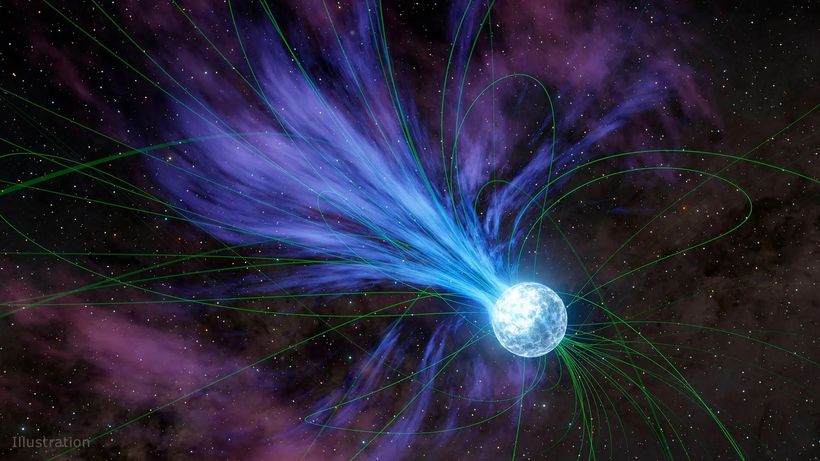
BATON ROUGE – Since the Big Bang, the early universe had hydrogen, helium, and a scant amount of lithium. Later, some heavier elements, including iron, were forged in stars. But one of the biggest mysteries in astrophysics is: How did the first elements heavier than iron, such as gold, get created and distributed throughout the universe? A new answer has come from an unexpected place – magnetars. Neutron stars are the collapsed cores of stars that have exploded. They are so dense that one teaspoon of neutron star material, on Earth, would weigh as much as a billion tons. A magnetar is a neutron star with an extremely powerful magnetic field. On rare occasions, magnetars release an enormous amount of high-energy radiation when they undergo “starquakes,” which, like earthquakes, fracture the neutron star’s crust. Starquakes may also be associated with powerful bursts of radiation called magnetar giant flares, which can even affect Earth’s atmosphere. Only three magnetar giant flares have been observed in the Milky Way and the nearby Large Magellanic Cloud, and seven from other nearby galaxies. Astrophysicist Eric Burns and his team of researchers at Louisiana State University in Baton Rouge study magnetars extensively through the observation of gamma-rays. These are the most energetic photons, most famous for turning Bruce Banner into the Incredible Hulk. Burns joined with researchers at Columbia University and other institutions to see if we could use gamma-rays to understand if magnetar giant flares forge the heaviest elements, and unexpectedly found the smoking-gun signature in decades-old data. The study, led by Anirudh Patel, a doctoral student at Columbia University in New York, is published in The Astrophysical Journal Letters. “It’s answering one of the questions of the century and solving a mystery using archival data that people had just forgotten about, demonstrating something that occurred when the Universe was younger,” said Burns. “Giant flares should occur just after the first stars died, meaning we have identified what could be the origin of the first gold in the universe.” How could gold be made at a magnetar? Patel and colleagues, including his advisor Brian Metzger, Professor at Columbia University and senior research scientist at the Flatiron Institute in New York, have been thinking about how radiation from giant flares could correspond to heavy elements forming there. This would happen through a “rapid process” of neutrons forging lighter atomic nuclei into heavier ones. Protons define the element’s identity on the periodic table: hydrogen has 1 proton, helium has 2, lithium has 3, and so on. Atoms also have neutrons which do not affect identity, but do add mass. Sometimes when an atom captures an extra neutron the atom becomes unstable and a nuclear decay process happens that converts a neutron into a proton, moving the atom forward on the periodic table. This is how, for example, a gold atom could take on an extra neutron and then transform into mercury. In the unique environment of a disrupted neutron star, in which the density of neutrons is extremely high, something even stranger happens: single atoms can rapidly capture so many neutrons that they undergo multiple decays, leading to the creation of a much heavier element like uranium. When astronomers observed the collision of two neutron stars in 2017 using NASA telescopes and the gravitational wave observatory LIGO, they confirmed that this event could have created gold, platinum, and other heavy elements. “LIGO tells us there was a merger of compact objects, and Fermi tells us there was a short gamma-ray burst. Together, we know that what we observed was the merging of two neutron stars, dramatically confirming the relationship,” said Burns. But neutron star mergers happen too late in the universe’s history to explain the earliest gold and other heavy elements. Finding secrets in old data At first, Metzger and colleagues thought that the easiest signature to study from the creation and distribution of heavy elements at a magnetar would appear in the visible and ultraviolet light, and published their predictions. But Burns in Louisiana wondered if there could be a gamma ray signal bright enough to be detected, too. He asked Metzger and Patel to work out what that signal could look like. Burns looked up the gamma ray data from the last giant flare that was observed, which was in December 2004. He realized that while scientists had explained the beginning of the outburst, they had also identified a smaller signal from the magnetar, in data from ESA (European Space Agency)’s INTEGRAL, a retired mission with NASA contributions. “It was noted at the time, but nobody had any conception of what it could be,” Burns said. Metzger remembers that Burns thought he and Patel were “pulling his leg” because the prediction from their team’s model so closely matched the mystery signal in the 2004 data. In other words, the gamma ray signal detected over 20 years ago corresponded to what thought it should look like when heavy elements are created and then distributed in a magnetar giant flare. "This is my favorite discovery I've contributed to,” said Burns. “My colleagues found this signal in the past, but nobody knew what it could be at the time. Once these models were ready, everything fit like a perfect puzzle, which is extremely rare in science." Researchers supported their conclusion using data from two NASA heliophysics missions: the retired RHESSI (Reuven Ramaty High Energy Solar Spectroscopic Imager) and the ongoing NASA Wind satellite, which had also observed the magnetar giant flare. Other collaborators on the new study included Jared Goldberg at the Flatiron Institute. Next steps in the magnetar gold rush Patel’s study estimates that magnetar giant flares could contribute about 10% of the total abundance of elements heavier than iron in the galaxy. Since magnetars existed relatively early in the history of the universe, the first gold could have been created this way. LSU PhD candidate Aaron Trigg, a NASA FINESST (Future Investigators in NASA Earth and Space Science and Technology) fellow, who works with Burns, is responsible for finding more magnetar giant flares to study. “These are gargantuan outbursts of energy from the strongest magnets in the Universe, which are powerful enough to affect Earth’s atmosphere,” said Burns. Trigg’s work will help us better understand these sources.” NASA’s forthcoming COSI (Compton Spectrometer and Imager) mission can follow up on these results. COSI, a wide-field gamma ray telescope, is expected to launch in 2027 and will study energetic phenomena in the cosmos, such as magnetar giant flares. COSI will be able to identify individual elements created in these events, providing a new advancement in understanding the origin of the elements. LSU is one of the lead science institutes for COSI. Burns and LSU Assistant Professor Michela Negro have key responsibilities in the mission, and Trigg is working through how best to study giant flares with COSI. These LSU astrophysicists will be growing their research group as they approach launch in 2027. “I have so many questions about the cosmos and our place in it,” said Trigg. “This research allows me to explore those questions and share the answers with the world.”

Reflecting on the Legacy of Pope Francis
Phyllis Zagano, Senior Research Associate-in-Residence, was interviewed by numerous media outlets following the passing of Pope Francis on April 21, 2025. Dr. Zagano is one of the world’s foremost experts on the question of women deacons and in 2016 was appointed to serve on Pope Francis’ “Commission of Study on the Diaconate of Women” to study this issue. She was the only commissioner to travel from the Western Hemisphere. Dr. Zagano was interviewed by the following media outlets: ABC News (Digital) CNN International National Catholic Reporter Newsday New York Post Religion News Service (column) Reuters WCBS-TV Washington Times

With Rise in US Autism Rates, Florida Tech Expert Clarifies What We Know About the Disorder
A new report from the Centers for Disease Control and Prevention (CDC) found that an estimated 1 in 31 U.S. children has autism; that's about a 15% increase from a 2020 report, which estimated 1 in 36. The latest numbers come from the CDC’s Autism and Developmental Disabilities Monitoring (ADDM) Network, which tracked diagnoses in 2022 among 8-year-old children. Autism spectrum disorder (ASD) is a neurological disorder that refers to a broad range of conditions affecting social interaction. People with autism may experience challenges with social skills, repetitive behaviors, speech and nonverbal communication. The news has experts like Florida Tech's Kimberly Sloman, Ph.D, weighing in on the matter. She noted that the definition of autism was expanded to include mild cases, which could explain the increase. “Research shows that increased rates are largely due to increased awareness and changes to diagnostic criteria. Much of the increase reflects individuals who have fewer support needs, women and girls and others who may have been misdiagnosed previously," said Sloman. Her insight follows federal health secretary Robert F. Kennedy Jr.'s recent declaration, vowing to conduct further studies to identify environmental factors that could cause the disorder. In his remarks, he also miscategorized autism as a "preventable disease," prompting scrutiny from experts and media attention. “Autism destroys families,” Kennedy said. “More importantly, it destroys our greatest resource, which is our children. These are children who should not be suffering like this.” Kennedy described autism as a “preventable disease,” although researchers and scientists have identified genetic factors that are associated with it. Autism is not considered a disease, but a complex disorder that affects the brain. Cases range widely in severity, with symptoms that can include delays in language, learning, and social or emotional skills. Some autistic traits can go unnoticed well into adulthood. Those who have spent decades researching autism have found no single cause. Besides genetics, scientists have identified various possible factors, including the age of a child’s father, the mother’s weight, and whether she had diabetes or was exposed to certain chemicals. Kennedy said his wide-ranging plan to determine the cause of autism will look at all of those environmental factors, and others. He had previously set a September deadline for determining what causes autism, but said Wednesday that by then, his department will determine at least “some” of the answers. The effort will involve issuing grants to universities and researchers, Kennedy said. He said the researchers will be encouraged to “follow the science, no matter what it says.” April 17 - Associated Press Sloman emphasized that experts are confident that autism has a strong genetic component, meaning there's an element of the disorder that may not be preventable. However, scientists are still working to understand the full scope of the disorder, and much is still unknown. “We know that there’s a strong genetic component for autism, but environmental factors may interact with genetic susceptibility," Sloman said. "This is still not well understood.” Kimberly Sloman’s research interests include best practices for treating individuals with autism spectrum disorder (ASD). She studies the assessment and treatment of problem behavior with methods such as stereotypy, individualized skill assessments and generalization of treatment effects. Are you covering this story or looking to know more about autism and the research behind the disorder? Let us help. Kimberly is available to speak with media about this subject. Simply click on her icon now to arrange an interview today.


Navigating the Higher Ed Noise
In 2025, higher education institutions face a perfect storm: shrinking budgets, increasing government scrutiny, widespread misinformation, and growing public skepticism. For marketing and communications professionals, the stakes have never been higher. Key Challenges Cuts to Research Funding Increasing Government Oversight & Regulation Economic Uncertainty & Budget Strains Misinformation & Disinformation 2025 will test how well universities can communicate their value to an increasingly complex world. The Decoder Guide is a smart, timely resource for higher ed leaders ready to rise to that challenge —offering practical, proactive steps to improve transparency, trust, and engagement. DOWNLOAD THE GUIDE HERE (no signup required) Upcoming Speaking Events June 8 IABC World Conference, Vancouver “The Thought Leadership Blueprint: Why & How to Build a High-Impact Program” Register Here Sept. 12-13 PRSA East Central Conference, Cleveland “The New Comms Leadership Skillset” Register Here About ExpertFile ExpertFile is revolutionizing how organizations connect their experts to journalists, podcasters, and conference organizers who need to find credible experts on tight deadlines…fast. Featuring experts on over 50,000 topics, our free Apple and Android mobile app is the go-to resource for journalists at media outlets such as the New York Times, CNN, NPR Radio, Fox News, BBC, The Guardian, ABC News, CBC, AXIOS and Time Magazine. For over a decade, our award-winning software platform has been helping marketing departments better manage and promote their online thought leadership to reach a wider audience. Clients include Carnegie Mellon University, ChristianaCare Health, Villanova University, Aston University and Emory University. Learn more at: expertfile.com/getstarted

