
Experts Matter. Find Yours.
Connect for media, speaking, professional opportunities & more.

Well it’s obvious now – the gloves are off. The Nevada debate on NBC was the closest thing to a prize fight the network has aired in decades. No punches were pulled, it got personal quick for newcomer Michael Bloomberg. In fact, if anyone thought that the contest to lead the Democrats against Donald Trump in November was going to be a polite conversation abut ideas and policy, was proven dead wrong. Here are just a few of the memorable moments captured by media: Warren labeled Bloomberg “a billionaire who calls people fat broads and horse-faced lesbians.” Sanders lashed out at Bloomberg’s policing policies as New York City mayor that he said targeted “African-American and Latinos in an outrageous way.” And former Vice President Joe Biden charged that Bloomberg’s “stop-and-frisk” policy ended up “throwing 5 million black men up against the wall.” Watching from afar, Trump joined the Bloomberg pile on. “I hear he’s getting pounded tonight, you know he’s in a debate,” Trump said at a rally in Phoenix. “I don’t think there’s any chance of the senator beating Donald Trump,” Bloomberg declared before noting Sanders’ rising wealth. “The best-known socialist in the country happens to be a millionaire with three houses!” And ongoing animosity flared between Buttigieg and Klobuchar when the former Indiana mayor slammed the three-term Minnesota senator for failing to answer questions in a recent interview about Mexican policy and forgetting the name of the Mexican president. Buttigieg noted that she’s on a committee that oversees trade issues in Mexico and she “was not able to speak to literally the first thing about the politics of the country.” She shot back: “Are you trying to say I’m dumb? Are you mocking me here?”Later in the night she lashed out at Buttigieg again: “I wish everyone else was as perfect as you, Pete.” February 19 – Associated Press There’s a long way to go, but the next couple of weeks could be crucial as Super Tuesday approaches. And if you are a journalist looking for a media-ready expert who can provide insight, perspective and objective opinions about who will win, who needs to drop out and who is the best possible challenger for the Whitehouse – let us help. Mark Caleb Smith is the Director of the Center for Political Studies at Cedarville University. Mark is available to speak with media regarding the DNC Primary and the upcoming election. Simply click on his icon to arrange an interview.


Does the height of a person really matter? In America, if you are running for office, it might. Augusta’s Dr. Gregg Murray was on CNN this weekend discussing how height can play an advantage in American politics. Murray does confirm how a candidate’s height (or perception of) does make a difference in the minds of voters. "Yes, there does seem to be some sort of relationship between an elected leader's height and how her or she is perceived, "says Murray. Here’s the segment: As the long road to November winds and weaves along the campaign trail, there are going to be many, many different factors that candidates look to capitalize on to gobble up every available vote. And if you are a journalist covering the election – that’s where our media-ready experts can help. Dr. Gregg R. Murray, professor of political science at Augusta University, is available to talk about the upcoming election and all aspects surrounding each campaign. Murray’s research focuses on political behavior and psychology with specific interests in voter mobilization and turnout. He is also executive director of the Association for Politics and the Life Sciences.


After New Hampshire - What’s next for Bernie and is it time for Biden to bail?
As we all know, you can’t win a presidential primary with only two states, but you sure can lose one. And after a long summer and fall of campaigning, the results from Iowa and New Hampshire are revealing the frontrunners of who will most likely lead the Democrats in the quest to unseat President Donald Trump. Coming into the New Hampshire primary, Augusta’s Dr. Gregg Murray offered this insight, “It looks like Sanders is comfortably in the lead, which is not surprising given he comes from a neighboring state. Mayor Pete is surprisingly staying strong and Klobuchar is hanging in there. Other than Sanders, this is not the leader board that most people would have expected before the start of the primary season. Biden and Warren, who many people not too long ago would have thought would be making strong showings, are surprisingly a good distance back in the pack.” But now that the first crucial two states have been heard and the primaries shift focus toward South Carolina and Nevada – what’s next? Joe Biden is ‘all in’ on South Carolina, but after two abysmal showings, is it enough? Amy Klobuchar seems to be surging – can she capitalize on that momentum? And, Pete Buttigieg and Bernie Sanders are neck and neck – what will it take for one to emerge as the frontrunner? As the next phase of primaries approach – there’s a lot to cover, and that’s where our experts can help. Dr. Gregg R. Murray, professor of political science at Augusta University, is available to talk about the current race to lead the DNC. Murray’s research focuses on political behavior and psychology with specific interests in voter mobilization and turnout. He is also executive director of the Association for Politics and the Life Sciences.

As Mayor Pete pops and Democrats feel the ‘Bern’ – is Biden a bust for the third time?
As the results from Iowa seem to be still trickling in, it looks like it could be either a slim lead or even a pretty much statistical tie between Indiana’s (former) Mayor Pete Buttigieg and Vermont Senator Bernie Sanders. Both spent a lot of time, money and energy campaigning across Iowa and that seems to have paid off. For Democratic candidate Joe Biden – it must feel like Groundhog Day. For the third time, his presidential bid that started with high hopes and promise seems to be crashing down in front of him. And as the critical primary in New Hampshire approaches – there are a lot of questions to be asked as this once crowded field of close to two dozen might be down to four or even fewer. Can Biden recover? With two losses in a row, can he sustain, and should he? What about Elizabeth Warren? If her ‘plan’ can’t attract the support of even 15 percent of any primary, perhaps it’s back to the drawing board? And what are the key differences between Buttigieg and Sanders? Which one has the upper hand with voters, organizers and finances? Oh … and the legend of Michael Bloomberg and his gold-plated campaign team are reaching an almost legendary status. When is the time right for the former mayor of New York City and does he risk being too late to the game? It is going to be a wild-ride for those who follow politics over the next few months and if you are a journalist covering this road to November – let our experts help. Mark Caleb Smith is the Director of the Center for Political Studies at Cedarville University. Mark and Marc are both available to speak with media regarding the DNC Primary and the upcoming election. Simply click on either icon to arrange an interview. Dr. Marc Clauson is a professor of history and law at Cedarville and is an expert in the fields of political and economic philosophy.
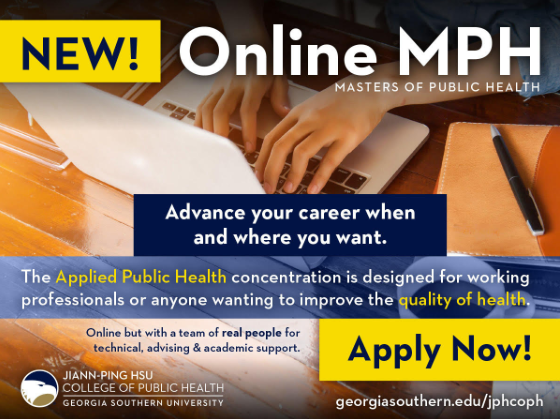
Beginning in Fall 2020 Georgia Southern University will offer its first fully online Master of Public Health (MPH) degree with a concentration in applied public health. “For those who do not have the ability to enroll in one of our on-campus MPH concentrations, the online applied public health option would be ideal for anyone passionate about improving health and making a difference in their community,” stated Interim Dean Stuart Tedders, Ph.D. Students will complete a broad-based program of study with a focus on public health education, information and advocacy, and with the flexibility to tailor their elective options. Students will apply their skills and knowledge to become front-line public health practitioners or public health leaders. Academic advisors and technical support will be provided to all students enrolled in the online master’s program. Additionally, the online program includes a field experience located within reach of the student’s location. Are you a journalist looking to cover this topic or learn more about Georgia Southern University and the programs it offers? Simply contact Melanie Simón at 912.344.2904 to arrange an interview or contact Karl Peace via his icon directly.


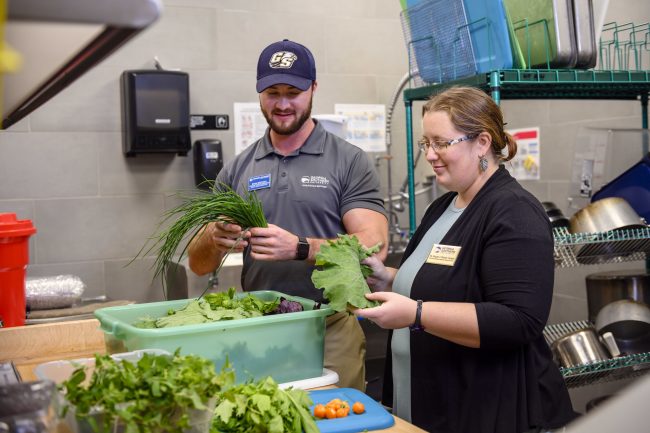
Find out how sustainable dining at Georgia Southern provides fresh options for students
As more and more people are eating out – the expectations of customers of restaurants to be environmentally friendly are ever increasing. However, operating with a reduced carbon footprint all the while being sustainable and profitable are no easy task. That’s where Georgia Southern University is making a difference. The newest restaurant on the Georgia Southern University Armstrong Campus offers diners comfort in knowing that some of the ingredients were grown just a few hundred yards away in the campus’ aquaponics farm in the Sustainable Aquaponics Research Center (SARC). The agriculture and food industry is one of the largest users of water and producers of greenhouse gas emissions, but growing food by using aquaponics, a system of growing produce by using water fertilized by fish, cuts down on both significantly. “SARC produce only travels a quarter mile from where it’s grown,” SARC curator Brigette Brinton said. “Locally grown food offers large advantages in terms of increased sustainability and freshness, and SARC produce is grown organically and using sound ecological principles that minimize water consumption.” Brinton said minimizing emissions and water use does not diminish the quality or taste of the produce. To the contrary, it makes the food taste better because aquaponics produce often has higher concentrations of various compounds that give the foods their flavor, and they are grown in more ideal environments. Brzycki said Georgia Southern wants to expand on using ultra-local, fresh produce and vegetables, as a part of the partnership with the aquaponics farm. “When we consider redesigns of existing or new dining locations on the Armstrong Campus in the future, we want to see how we can incorporate these same principles,” he said. “But for now, Southern Cafe is the flagship unit for the aquaponics partnership, as well as sustainability and healthy eating, of Eagle Dining.” Brinton said she hopes the Southern Cafe will inspire the students, faculty and staff who eat there to make healthier and more sustainable choices in other areas of their lives. “Showcasing local, sustainable produce increases students’ awareness that there are better options, and Georgia Southern is going the extra mile to show them how to start making better choices,” she said. “Each time students see they made a sustainable choice at the Southern Cafe, they’re more likely to choose sustainable options on their own.” Are you a journalist looking to cover this story or learn more about how Georgia Southern University is developing new programs that help traditional industries adapt to a more sustainable and environmentally friendly business model? If so – then let our experts help with your coverage. Simply contact Melanie Simón at 912.344.2904 to arrange an interview.

United Nations’ Sustainable Development Goals fall behind initial hopes, lacks needed funding
In 2000, United Nations member states adopted eight Millennium Development Goals (MDGs), which featured a number of ambitious global initiatives, such as eradicating extreme poverty and hunger, and achieving universal primary education in all countries around the world. As these goals were extremely aspirational, most were far from met by the target date. However, by 2015 significant progress was made in a few areas, such as increased official development assistance (foreign aid), reduced trade barriers for developing country exports, and new debt-reduction strategies for some of the heaviest indebted countries. By the target date of the MDGs, the most notable outcome was the number of people living in extreme poverty around the world had been reduced by 50% since 1990. To keep the sustainable development agenda moving forward, at the end of 2015, the United Nations member states adopted 17 new Sustainable Development Goals (SDGs) to be met by 2030. Since the adoption of the SDGs in 2015, some progress has been on two of the SDGs: eliminating preventable deaths among newborns and children under the age of 5, and getting children into primary schools. These are both important initiatives and progress should be celebrated, says Matt Bluem, assistant dean of graduate programs and MBA director of Saint Mary's University of Minnesota's School of Business and Technology. Unfortunately, progress on the other 15 goals has not kept pace. With just 10 years until the target date for meeting all 17 SDGs, it is becoming increasingly clear that most of these goals will not be met. According to the UN, the biggest challenge in meeting the SDGs is funding. An additional $2-3 trillion is needed to help meet funding requirements. A recent report by the Brookings Institution states that sub-Saharan Africa alone would need hundreds of billions of dollars in additional financial support every year in order to meet the SDGs by the target date of 2030, Bluem says. U.N. Secretary-General António Guterres has argued that public investment by governments is not enough, insisting that private industry is going to need to get involved. To meet the aggressive SDGs, the private and public sectors will need to work together to bring about the investment and policy change. In order to encourage governments and the private sector to put the resources and effort necessary into meeting the SDGs, it is imperative to let world leaders know that goals such as the SDGs are important to the international citizenry, Bluem says. Are you a journalist covering this topic and interested in an interview? That’s where we can help. Matt Bluem, Ph.D., assistant dean of graduate programs and MBA director, has taught business and marketing courses at Saint Mary’s University of Minnesota since 2008. Prior to Saint Mary’s, he worked in both the banking and the nonprofit sectors, most recently with a non-governmental organization (NGO) with operations in more than a dozen countries. Bluem is an expert in political and economic development and is available to speak with media. To arrange an interview with him, simply click below to access his contact information.


Ants and plants, a mutually beneficial relationship
Ant-plant interactions are really common in nature, and while people might most often picture ants as carrying pieces of leaves cut from tropical plants, ant behavior in the Midwest is less appreciated. Moni Berg-Binder, Ph.D., associate professor of biology at Saint Mary’s University, finds ant mediated seed dispersal, called myrmecochory, fascinating and says that the temperate deciduous forests here in North America have many examples of plants that engage with the native plant community. “In myrmecochory, these plants, often spring ephemerals, which are early blooming spring plants, produce seeds with a nutritious structure that sticks off the seed called an elaiosome,” she said. “Typically what happens is the seeds fall to the ground which is called primary dispersal. The Ants forage and find the seeds on the ground and then pick up seeds and carry them to their nest. This is secondary dispersal. Then, once they get the seeds into their nests, those seeds are brought to places where developing larvae eat the elaiosome. But the seed is unharmed.” From there, she said the seeds are then deposited in a chamber inside of their nests or they may take the seeds and put them in a refuse pile or a garbage dump just outside the nest. Ants, apparently, keep a very clean nest. And oftentimes the ground soil around ant activity, is elevated in organic matter, nitrogen, phosphorous, possibly moisture — all really good things for plants and essentially the same thing as fertilizer. So the seed flourishes. “It’s a beautiful example of mutualism,” she said. “The seed is taken and has effectively been planted inside this nest with nature’s fertilizer. The win from the ant perspective is that they received food.” Dr. Berg-Binder and her students have focused their research on a plant called bloodroot. Local ants disperse the seeds of bloodroot. Dr. Berg-Binder became interested in plant interactions while in graduate school when she became intrigued by the win-win scenario of mutualism. For her graduate work, she had been interested in conservation and how invasive species are introduced to a natural area where they did not typically belong. These invasive species can engage in mutualism with native species. She said there is much more studying to be done on the relationship native ants have with both native plants and invasive plants. Are ants helping the invasive species become more invasive? “They’re a great study system, and I find them really fascinating,” she said. Are you looking to know more about invasive species or ant and plant interactions? Or, are you a journalist covering this topic and looking to book an interview? That’s where we can help. To book an interview with Dr. Moni Berg-Binder, simply click below to access her contact information. Connect with: Moni Berg-Binder, Ph.D. Associate Professor, Biology Expertise: Invasive plant species and native plants; ecology and animal-plant interactions View profile https://expertfile.com/experts/moni.bergbinderphd/moni-bergbinder-phd

On average, teachers across the U.S. spend approximately $479 on classroom supplies each year, according to a 2018 study by the National Center of Education Statistics. The Institute for Interdisciplinary STEM Education (i2STEMe) at Georgia Southern University is helping reduce this burden for teachers in southeast Georgia with the School Outreach Program, a lending membership program that provides STEM and social studies materials for K-12 classrooms. i2STEMe, housed in the College of Education, serves as an outreach center for the university, regional educators and the broader community. The School Outreach Program provides STEM and social studies supplies, including consumable and non-consumable materials, equipment, and teaching aids to member teachers, schools and districts. Members can request items and materials that will be delivered to and picked up from their school location. Annual membership for the program can be purchased by entire school districts, schools or individual teachers. The project was recently featured on WTOC 11 where viewers were given a first-hand look at how local teachers and students are benefitting from the program. Alisa Leckie, Ph.D., the interim assistant dean of Partnerships and Outreach at Georgia Southern was on hand to explain how Georgia Southern is making sure students have access to the resources they need to further their learning in areas like STEM. Are you a journalist looking to learn more or cover the School Outreach Program and how institutions like Georgia Southern University are helping teachers, students, and schools across the state? If so – then let our experts help. Leckie's research is focused in the areas of education of language minority students, and analyzing policies impacting education. She is available to speak with media regarding this program – simply click on her icon to arrange an interview.


If it's an election in America or Asia – Mary Washington’s experts are sought out by media
The election in Taiwan on January 10 saw a strong anti-China sentiment reinforced with the re-election of President Tsai Ing-wen. Elections in America, and even an ocean away can have ripple effects on economies, relations and even national security. As the world tuned in the results in Taiwan – it was the media that contacted the experts from Mary Washington for insight and opinion. Elizabeth Freund Larus, Professor of Political Science and International Affairs, offered commentary January 10 on CNBC Asia’s Capital Connection on the 2020 Taiwan presidential election. Professor Larus indicated that incumbent Taiwan President Tsai Ing-wen benefited from the Hong Kong protests and that she would likely be re-elected. Dr. Larus projected that a second Tsai administration will continue to diversify Taiwan’s economy and distance itself from China, and that Beijing will put more heat on Taipei, bringing the U.S. into play. Capital Connection is a television business news program aired every weekday on various CNBC channels around the world. It is broadcast live from Singapore. See more here: Are you a journalist covering Asian politics? That’s where our experts can help. Professor Elizabeth Freund Larus teaches political science at the University of Mary Washington and is an #expert on China and the field of Asian studies. She is available to speak to media – simply click on her icon to arrange an interview.

