
Experts Matter. Find Yours.
Connect for media, speaking, professional opportunities & more.

Election 2024: Providing insight during a pivotal campaign season
Voter behavior and emotion, civil discourse, the spread of misinformation, the role of gender and race in politics and conspiracy theories are among the many topics University of Delaware experts can comment on during this final stretch of the 2024 campaign. David Redlawsk Professor of Political Science and International Relations Expertise: Political psychologist who studies voter behavior and emotion, focuses on how voters process political information to make their decisions. He has written several books on politics, worked behind the scenes on campaigns and ran for local office. Dannagal Young Professor of Communication Director of the Center for Political Communication Expertise: The spread of misinformation in politics and the intersection of entertainment and information, with an emphasis on political satire, political media effects, public opinion and the psychology of political humor. Kassra Oskooii Professor of Political Science and International Relations Expertise: Focuses on the interplay between the contextual and psychological determinants of political opinions and behaviors of high and low status group members. Erin Cassese Professor of Political Science and International Relations Expertise: Explores the behavior of women as voters and candidates for political office, and studies political psychology, gender stereotypes, public opinion, elections and the intersection of religion and politics. Yasser Payne Professor of Sociology and Africana Studies Expertise: Research program also focuses on Black racial identity; street identity; economic and educational opportunity or the impact of structural violence. Tim Shaffer SNF Ithaca Director Stavros Niarchos Foundation (SNF) Chair of Civil Discourse Expertise: Civil discourse in politics; can talk about partisanship, polarization and their impact on media outlets. advancement of democratic practices by focusing on the role of civic professionals in institutional settings. Alice Ba Professor and acting chair, Political Science and International Relations. Expertise: Her work on the international relations of East and Southeast Asia examines the structures, processes, and systemic effects of regionalism and cooperative regime building, as well as relations between smaller and major powers. Joanne Miller Professor of American Politics, Research Methods and Political Psychology Expertise: Studies political psychology, with an emphasis on political propaganda, misinformation and conspiracy theories. Muqtedar Khan Professor of Comparative Politics, International Relations and Political Theory Expertise: Issues surrounding U.S. foreign policy in the Muslim World as well as national security and counter-terrorism. To speak with any of these experts, simply visit their profle and click on the "contact" button, which will send a message directly to them (while also copying UD's media relations team).


Expert Q&A: Should We Permit AI to Determine Gender and Race from Resumes?
The banner ads on your browser, the route Google maps suggests for you, the song Spotify plays next: algorithms are inescapable in our daily lives. Some of us are already aware of the mechanisms behind a targeted ad or a dating profile that lights up our phone screen. However, few of us may actually stop to consider how this technology plays out in the hiring sector. As with any major technological advancement, it usually takes society (and legislation) a while to catch up and adjust for unintended consequences. Ultimately, algorithms are powerful tools. Like any tool, they have the potential for societal benefit or harm, depending on how they’re wielded. Here to weigh in on the matter is Assistant Professor of Information Systems & Operations Management Prasanna Parasurama, who recently joined Emory Goizueta Business School’s faculty in fall of 2023. This interview has been edited for clarity. Describe your research interests in six words. Six words…that’s difficult to do on the spot. How about “the impact of AI and other digital technologies on hiring.” Is that condensed enough? That works! What first interested you in the intersection of AI and hiring practices? Before I did my PhD, I was working as a data scientist in the HR analytics space at a start-up company. That is where my interest in the topic began. But this was a long time ago. People hadn’t started talking much about AI, or algorithmic hiring. The conversation around algorithmic bias and algorithmic fairness picked up steam in the second or third year of my PhD. That had a strong influence on my dissertation focus. And naturally, one of the contexts in which both these matters have large repercussions is in the hiring space. What demographics does your research focus on (gender identity, race/ethnicity, socioeconomic status, all of the above)? Do you focus on a particular job sector? My research mostly looks at gender and race for two main reasons. First, prior research has typically looked at race and gender, which gives us a better foundation to build on. Second, it’s much easier to measure gender and race based on the data that we have available—from resumes, from hiring data, like what we collect from the Equal Employment Opportunity Commission. They typically collect data on gender and race, and our research requires those really large data sets to draw patterns. They don’t ask for socioeconomic status or have an easy way to quantify that information. That’s not to say those are less important factors, or that no one is looking at them. One of the papers you’re working on examines resumes written by self-identified men and women. It looks at how their resumes differ, and how that influenced their likelihood of being contacted for an interview. So in this paper, we’re essentially looking at how men and women write their resumes differently and if that impacts hiring outcomes. Take resume screening algorithms, for example. One proposed way to reduce bias in these screening algorithms is to remove names from resumes to blind the applicant’s gender to the algorithm. But just removing names does very little, because there are so many other things that serve as proxies to someone’s gender. While our research is focused on people applying to jobs in the tech sector, this is true across occupations. "We find it’s easy to train an algorithm to accurately predict gender, even with names redacted." Prasanna Parasurama What are some of those gendered “tells” on a resume? People write down hobbies and extracurricular activities, and some of those are very gendered. Dancing and ballet tend to denote female applicants; you’re more likely to see something like wrestling for male applicants. Beyond hobbies, which is sort of obvious, is just how people write things, or the language they use. Female applicants tend to use a lot more affective words. Men, on the other hand, use more of what we call agentic words. Can you explain that a little more? In social psychology, social role theory argues that men are stereotyped to be more agentic, whereas women are stereotyped to be more communal, and that their communication styles reflect this. There’s essentially a list of agentic words that researchers have come up with that men use a lot more than women. And women are more likely to use affective words, like “warmly” or “closely,” which have to do with emotions or attitudes. These communication differences between men and women have been demonstrated in social sciences before, which has helped inform our work. But we’re not just relying on social science tools—our conclusions are driven by our own data. If a word is able to predict that an applicant’s resume belongs to a female versus male applicant, then we assign different weights, depending on how accurately it can predict that. So we’re not just operating on theories. Were there any gendered patterns that surprised you? If you were to assign masculinity and femininity to particular words, an algorithm would likely assign “married” to be a feminine term in most contexts. But in this particular case, it’s actually more associated with men. Men are much more likely to use it in resumes, because it signals something different to society than when women use it. "One of the most predictive terms for men was references to parenthood. It’s much easier for men to reference kids than for women to reveal information about their household status. Women face a penalty where men receive a boost." Prasanna Parasurama Studies show that people perceive fathers as being more responsible employees, whereas mothers are regarded as less reliable in the workplace. We haven’t studied this, but I would speculate that if you go on a platform like LinkedIn, men are more likely to disclose details about fatherhood, marriage, and kids than women are. There were some other tidbits that I didn’t see coming, like the fact that women are much less likely to put their addresses on their resume. Can AI predict race from a resume as easily as it can predict gender? There’s surprisingly very little we know on that front. From existing literature outside of algorithmic literature, we know differences exist in terms of race, not just on the employer side, where there might be bias, but we also on the worker side. People of different races search for jobs differently. The question is, how do we take this into account in the algorithm? From a technical standpoint, it should be feasible to do the same thing we do with gender, but it just becomes a little bit harder to predict race in practice. The cues are so variable. Gender is also more universal – no matter where you live, there are probably men and women and people who identify as in between or other. Whereas the concept of race can be very specific in different geographic regions. Racial identities in America are very different from racial identities in India, for instance. And in a place like India, religion matters a lot more than it does in the United States. So this conversation around algorithms and bias will look different across the globe. Beyond screening resumes, how does AI impact people’s access to job opportunities? A lot of hiring platforms and labor market intermediaries such as LinkedIn use AI. Their task is to match workers to these different jobs. There’s so many jobs and so many workers. No one can manually go through each one. So they have to train algorithms based on existing behavior and existing design decisions on the platform to recommend applicants to particular jobs and vice versa. When we talk about algorithmic hiring, it’s not just hiring per se, but spaces like these which dictate what opportunities you’re exposed to. It has a huge impact on who ends up with what job. What impact do you want your research to have in the real world? Do you think that we actually should use algorithms to figure out gender or race? Is it even possible to blind AI to gender or race? Algorithms are here to stay, for better or worse. We need them. When we think about algorithmic hiring, I think people picture an actual robot deciding who to hire. That’s not the case. Algorithms are typically only taking the space of the initial part of hiring. "I think overall, algorithms make our lives better. They can recommend a job to you based on more sophisticated factors than when the job was chronologically posted. There’s also no reason to believe that a human will be less biased than an algorithm." Prasanna Parasurama I think the consensus is that we can’t blind the algorithm to gender or other factors. Instead, we do have to take people’s demographics into account and monitor outcomes to correct for any sort of demonstrable bias. LinkedIn, for example, does a fairly good job publishing research on how they train their algorithms. It’s better to address the problem head on, to take demographic factors into account upfront and make sure that there aren’t drastic differences in outcomes between different demographics. What advice would you give to hopeful job candidates navigating these systems? Years of research have shown that going through a connection or a referral is by far the best way to increase your odds of getting an interview—by a factor of literally 200 to 300 percent. Hiring is still a very personal thing. People typically trust people they know. Prasanna Parasurama is an Assistant Professor of Information Systems & Operations Management at Emory University’s Goizueta Business School. Prasanna’s research areas include algorithmic hiring, algorithmic bias and fairness, and human-AI interaction. His research leverages a wide array of quantitative methods including econometrics, machine learning, and natural language processing. Prasanna is available to talk about this important and developing topic - simply click on his icon now to arrange an interview today.



#ExpertSpotlight: Who is Julian Assange?
In the ever-evolving landscape of digital information and cybersecurity, Julian Assange stands as a central figure, symbolizing the complex intersection of transparency, secrecy, and journalism in the modern world. This topic is not only newsworthy because of Assange’s controversial role in founding WikiLeaks and exposing classified information, but also due to the profound implications his actions have had on national security, international relations, and the ethics of journalism. Furthermore, Assange's ongoing legal battles and the broader debates they spark about freedom of speech, whistleblower protections, and government accountability are crucial for understanding the dynamics of information control in contemporary society. The story of Julian Assange offers multiple angles of interest, including: The Genesis of WikiLeaks: Exploring the foundation and mission of WikiLeaks, and how it has changed the landscape of journalism and whistleblowing. Major Leaks and Their Impact: Analyzing significant leaks published by WikiLeaks, such as the Iraq War Logs and the diplomatic cables, and their impact on global politics and public opinion. Legal Battles and Extradition: Investigating Assange’s legal challenges, including the charges against him, the extradition process, and the implications for international law and human rights. Freedom of Speech vs. National Security: Examining the debates surrounding Assange's actions, balancing the right to information with concerns over national security and the protection of sensitive information. Role of Journalism in the Digital Age: Discussing the ethical considerations and responsibilities of journalists and media organizations in handling leaked information. Assange’s Personal Journey: Delving into Assange’s personal life, his motivations, and the psychological and physical toll of his prolonged legal and diplomatic battles. The life and actions of Julian Assange provide journalists with a wealth of storylines that illuminate the complex and often contentious relationship between transparency, security, and the right to know in the digital age. Connect with an Expert about Julian Assange : Keith Werhan Professor Emeritus · Tulane University School of Law Samantha Bradshaw Doctor of Philosophy Candidate · Oxford Internet Institute Michael Moreland, JD, PhD University Professor of Law and Religion; Director, Eleanor H. McCullen Center for Law, Religion and Public Policy | Charles Widger School of Law · Villanova University Craig Albert, PhD Professor of Political Science and Graduate Director of the Master of Arts in Intelligence and Security Studies · Augusta University Michael S. Rogers Senior Advisor, Washington, D.C. · Brunswick Group Robert Anderson National Security Consultant & Intelligence Analyst · Altadena Group To search our full list of experts visit www.expertfile.com Photo credit: Markus Spiske


Podcast: Equality must become the norm, not just a box ticking exercise
Equality, diversity and inclusion (EDI) must become “everybody’s business” EDI can reduce pay gaps and open up opportunities for SMEs Aston University now celebrating Athena Swan Gold award for gender equality. Equality, diversity and inclusion (EDI) needs to become “the norm” in organisations to escape “disappointing” government criticism that it is a waste of time. That’s the guidance coming from the latest episode of ‘Aston means business’, a podcast from Aston University presented by journalist Steve Dyson. Professor Shivani Sharma, the new deputy dean of people, culture and inclusion at the University’s College of Business and Social Sciences, explained that EDI cultures must become “everybody’s business” to address the existing gender and ethnicity pay gaps. Responding to recent government criticisms of EDI schemes, Professor Sharma said: “Not enough investment has gone into these roles because, if we look at the history, it tells us that just relying on everybody to do the right thing doesn’t work.” Also interviewed in the podcast was Omar Rashid, a director of The HR Dept, a human resources franchise for Birmingham Central & Wolverhampton. Mr Rashid, who specialises in diversity and recruitment, said that government criticism of EDI initiatives was “disappointing”. But he acknowledged: “I understand where they’re coming from because, if it’s seen as a scheme, as something we’ve got to do, and it’s not done properly, then maybe it is a waste of time and a waste of money. It has to be seen as the norm.” He said people need to realise they live in a multicultural world, with a diverse workforce, supply chain and customers, and that if implemented properly the benefits of EDI are there. Mr Rashid, who is also president of the Asian Business Chamber of Commerce in Birmingham, specialises in diversity and recruitment. He added: “There is opportunity there through different skills. “Each individual, whether it’s race, religion, will bring their own perspectives, their own unique skills, even people with a disability. It shouldn’t be seen as a barrier.” He said examples of a “tick box mentality” were where businesses might adopt Black History Month but do nothing for the other 11 months of the year, or provide a prayer room during Ramadan but not at any other time. He added: “When it’s tick box, it’s not worth it because you’ll have a business or someone who will do something for a short period of time. They half-heartedly did something without the conviction. Diversity shouldn’t be just a little bit here and there.” Professor Sharma went on to say that ‘world days’ such as International Women’s Day can act as a catalyst to focus attention on an issue. But she added: “It’s really important that why you’re doing that is clear, and that the strategy of raising awareness, to remove barriers to women, equitable inclusion in the workplace or in society, continues throughout the year.” She said that Aston University had recently gained an Athena Swan Gold award for promoting gender equality in higher education, but that the “scale” of the problem meant there was still lots more to achieve. She explained that proportions of women entering as students into higher education was really positive, as were degree completion rates. But she pointed to the fact that around 80 per cent of university vice chancellors identified as men, with low representations of ethnic minority women among professors. Professor Sharma added: “It will take a sustained effort to undo that over time.” She also praised the Inclusive Aston networking initiative at Aston University, with senior leaders mentoring colleagues of minority ethnic heritage. Mr Rashid said SMEs needed to look at the opportunities that a diverse workforce and culture can bring to their business. He added: “One SME business engaged with someone from an Asian background, wanted to tap into India, and guess what? He has the connections and they were able to open a branch in India.” Catch up on all of the previous ‘Aston means business’ podcast episodes here.


Baylor Expert: Don't Lose Focus on Spiritual and Mental Well-being
Baylor Social Work professor shares tips and resources during stressful half-way mark of semester Holly Oxhandler, Ph.D., LMSW., associate dean for research and faculty development and associate professor in the Diana R. Garland School of Social Work. October marks the halfway point to the fall semester and can carry all the excitement, stress and anxiety of another academic term winding to a close. The month also typically marks one of the busiest times of the year for university counseling centers across the nation. With unique challenges in 2020 related to COVID-19, the University has acknowledged those hardships for all in the Baylor Family by taking the initiative to focus on mental health throughout October. Baylor University’s Holly Oxhandler, Ph.D., LMSW, associate dean for research and faculty development and associate professor in the Diana R. Garland School of Social Work, is an expert on mental health, primarily anxiety and depression, as well as religion and spirituality in clinical practice. In this Q&A, she shares tips and resources to students, faculty and staff who are facing all of the typical challenges of another mid-term while also navigating a global health crisis. Q: The 2020 fall semester provided challenges and obstacles never seen before in higher education. Why has COVID-19 been a uniquely stressful influence on the mental and spiritual well-being of students, faculty and staff? There are a number of reasons COVID-19 has been a uniquely stressful influence on the mental and spiritual well-being of those in higher education. First, there are the unanticipated layers and learning curves of new considerations and adjustments to course delivery, safety protocols, dining, campus activities and communication, to name a few, on top of the typical adjustments and emotions we all navigate at the beginning of each fall semester. Second, those in higher education entered fall 2020 without the “typical” summer that’s needed to reset, make adjustments and plan for the upcoming year’s activities. For example, many administrators, faculty and staff spent the summer not only planning for the usual upcoming academic year but also reconfiguring classes to be hybrid or online or simultaneously include both in-person and online students, in addition to modifying student activities and faculty research project timelines and plans. For degree programs that include internships, like social work, there have also been additional layers of consideration in order to comply with our professional accreditation standards. Third, we recognize that many students, their family members, as well as Baylor faculty and staff members’ loved ones, have been affected by the economic impact of COVID-19, adding a layer of financial stress. Fourth, many within the Baylor community – staff, faculty and students – have needed to juggle childcare and homeschooling their children as they continue to engage in their own work and/or educational expectations. Finally, the fear of contracting COVID-19, especially among the most vulnerable and high-risk populations, has been constantly present. Not only are we adjusting to this academic year with new ways of being and new protocols that keep us and one another safe, we’re also facing unexpected waves of fear and layers of grief for the missed events, opportunities and connections we had hoped to experience. As resilient as our community is, I think it’s important to remember we cannot “operate as usual” because things aren’t usual. Instead, we must allow ourselves and one another the time, margin, flexibility and grace needed to sit with and move through the rising emotions, grief, stress, loneliness, fear and uncertainty as they come. We cannot skip or bypass these emotions, but instead, must move through them, often with the support of loved ones and/or a trained mental health care provider. Q: Mental and spiritual health are challenging during even a typical semester experience. What are some of the effects and reactions you’ve witnessed to these circumstances among students, faculty and staff compared to a non-COVID-19 semester? As human beings navigating a global pandemic to the best of our ability, our mental and spiritual health have all been impacted to some degree this semester as we have individually and collectively faced a number of unexpected difficulties. I have also seen a beautiful response to the reality of this collective struggle in my interactions with Baylor faculty, staff and students that includes deep empathy for one another and an increase in valuing authenticity as we engage in the high-quality, meaningful work we each do. It has been a gift to witness Baylor community members holding space for colleagues’ and students’ vulnerability as we admit this is hard for various reasons and recognize that we cannot just push our way through this season. When we admit this isn’t easy and that we are all juggling so much to the best of our ability through thick layers of uncertainty, it gives those around us permission to admit their experiences, too. In fact, I think when we create space for that shared vulnerability and empathy in our interactions with others, we can better assess the current situation, remain present to one another and discern what steps are needed to move forward together, particularly because we’re not carrying an additional layer of effort pretending that everything is fine. That said, the Garland School of Social Work conducted a couple of well-being surveys since this summer to internally check in on how our faculty and staff are coping with this season and identify the biggest stressors they’re facing and sources of support. Our faculty and staff have also been continually checking in on our students through this season. Not only do we see many noting the same stressors that we’re all facing these days, normalizing how difficult this is for each of us, but the act of nonjudgmentally holding that space for ourselves and one another has been a tangible step of offering the care we know is uniquely woven into the Baylor experience. Q: How can individuals within the campus community tend to their spiritual health to close out the semester? I would invite readers to take a moment to pause and identify a few spiritual practices that uniquely support them well, even if that means thinking back to less stressful seasons. The key to note here is that these are practices which require regular engagement, similar to if we were to practice a new instrument or sport. Spiritual practices can vary based on our faith tradition and may include praying; meditating; centering prayer; reading our religious text; walking a labyrinth; journaling; practicing gratitude; listening to a sermon or faith-based podcast; praying over and contemplating scripture; engaging in creativity; practicing daily examen; or listening to spiritual music. Some practices may involve other individuals that can be done safely, including seeking spiritual direction, participating in a Bible or faith-based book study with others or engaging in worship (even virtually!). These practices can offer a sense of groundedness and a reminder that God is with us, including through this season. As we continue to navigate this season of uncertainty, it is critical that we intentionally weave in spiritual practices that offer rhythms, routines and a grounded faith that can support us well through the waves of difficulty. Especially on campus, I would encourage Baylor community members to follow along with Spiritual Life’s resources and events, or check out Better Together BU, a partnership supported by both Spiritual Life and Multicultural Affairs. Q: How can individuals within the campus community tend to their mental health to close out the semester? Tending to our mental health in this last stretch of the semester will be so important as we move into the stress of finals, the complex emotions tied to the holidays, grief with upcoming celebrations looking different this year (including how we celebrate holidays, who we celebrate with and the reality of many having lost loved ones to COVID-19) and the reality of seasonal affective disorder on the horizon. In fact, in a typical year, about 5% of U.S. adults have seasonal affective disorder (SAD), with another 10-20% having mild forms of it. In light of all of the added transition, uncertainty, complexity of caregiving and homeschooling while working/studying at home, layers of loneliness and grief, I do hope our Baylor students, staff and faculty will actively prioritize taking good care of their mental health and supporting others’ mental health care, too. One way I highlight this with my social work students is by recommending creating a self-care plan that pays attention to our physical health, mental health, social support and spiritual health. If we can identify some strategies to holistically care for ourselves well and be mindful of potential barriers to navigate, we may have more resilience and practices to draw from to cope with challenges and stressors that arise. Finally, although NAMI highlights that 1 in 5 of us are currently facing a mental health struggle, some studies have shown that over 80% of us will meet criteria for a mental illness by young adulthood or middle-age. Therefore, I highly recommend that anyone who is noticing any changes in their mood, diet, sleep habits, behaviors or overall well-being immediately reach out for help. Students are encouraged to reach out to Baylor’s Counseling Center, CARE team or the BARC. Faculty and staff also have resources available through Baylor’s employee assistance program. Other resources for finding a mental health provider include HelpPRO, Psychology Today, Low Cost Help or these additional resources. For those who are deeply struggling, please reach out to the Suicide Prevention Lifeline at 1-800-273-8255 or text ‘HOME’ to 741-741 for the Crisis Text Line. As part of my faith and my social work values, I believe that each of us are worth caring for ourselves, including caring for our mental health alongside our spiritual and physical health. Q: What successes or bright spots have you seen within your campus experience that offer encouragement to how the Baylor Family has handled the crisis throughout the semester? I am regularly amazed by the Baylor students, faculty and staff, the ways we have navigated the crisis together this semester, and I am especially grateful for President Livingstone’s and Provost Brickhouse’s leadership since March. This semester, some bright spots have included Dr. Deborah Birx’s reflections on Baylor’s efforts to keep everyone safe from COVID-19, the Fall Faculty meeting and Dr. Peter Hotez’s appreciation of how Baylor leaders have kept the Baylor and Waco community safe and following along when Baylor students take over Baylor’s Instagram account (like Brandon Nottingham’s takeover on World Mental Health Day!). As the Garland School of Social Work’s associate dean for research and faculty development, I have also loved learning about the ways so many Baylor faculty are offering their unique research expertise and wisdom to serve others through this difficult time, such as Dr. Emily Smith’s “Friendly Neighbor Epidemiologist” Facebook page to explain COVID-19 information. I’ve also been reminded of what a gift it is to be a part of the Garland School of Social Work (GSSW) and this community of faculty, staff and students. The resilience, creativity, love for serving others, dedication to the social work profession and care for our students is so apparent within the GSSW. I have especially seen how my faculty and staff colleagues have adapted courses and assignments, creatively considered students’ needs and juggled their research responsibilities while extending grace to themselves and one another as we navigate this season together as a school to the best of our ability. Similarly, seeing our students’ resilience, flexibility, support of one another, commitment to the profession and heart for the clients and communities they serve is truly inspiring. Finally, Dean Jon Singletary’s servant-leader heart for the GSSW and the ways he has supported our school through so much transition over the last five years has been a gift. One example of this includes the two hours of weekly well-being time he extends for all GSSW staff and faculty to use in support of our spiritual and mental health care. Q: What gives you hope for the spring semester and beyond as students continue through their academic endeavors? Truthfully, our students’ presence and their enthusiasm over the fields of study they are dedicating their lives to gives me hope. As a professor, there is nothing like watching a student become fully alive in the work they are passionate about and feel as though they were made to do. Our students’ willingness to fully participate in the transformational education that Baylor offers, especially in this difficult season of COVID-19, is an honor to witness as a professor and certainly gives me hope. Further, seeing the ways our students are empathically caring for their neighbor by following Baylor’s safety guidelines, growing in their faith, checking in on one another, understanding faculty and staff are doing their very best and continuing to demonstrate their determination to learn and grow is an inspiration. My hope and prayer for our students as well as our staff and faculty colleagues as we move through the remainder of the fall semester and into the spring is that they rest as they need to and prioritize taking good care of their mental and spiritual health. I also pray that we recognize as a community that by caring for our spiritual and mental health, by taking this season one day at a time, by trusting we are doing our best and by reaching out for help when needed, we give others permission to do the same.


Coping with Grief During the Holiday Season
Baylor experts suggest three strategies to help cope with grief during the holidays (Image Credit: D-Keine/Getty Images) The holidays are typically a time of joy and celebration for most people, but this time of year can be very different for grieving people. The death of a loved one can be especially hard during the holidays as they are full of memories, traditions, and sensations associated with the holidays – all reminders that this year is different, and someone is no longer here. What can someone in the midst of grief do to make this time more positive and step toward emotional healing? William (Bill) G. Hoy, D.Min, FT., clinical professor and associate director of Medical Humanities, and Candi Cann, Ph.D., associate professor of religion in the Honors College at Baylor, suggest three strategies for grieving people to cope with their loss during the holidays. “Holidays are also hard in grief because they are built around relationships,” Hoy said. “Family gatherings cannot ever be the same, and, of course, memories of bad relationships cause us to realize the past cannot be changed.” Acknowledge your pain The first step is to admit the pain of grieving. “Saying goodbye to a loved one is no easy task, and, undoubtedly, it feels different than you could ever have expected,” said Hoy. Cann pointed out that some deaths bring about complicated grief if the loss is from a difficult relationship. “It is okay to feel relief in addition to grief and it is important to validate all of your feelings – it’s a complicated grief because it was a complicated relationship.” Hoy said that culturally people tend to try to get around the pain without facing it, which only makes it harder later on. “There is an empty chair at the table on this special occasion. The grief following a death assault at every turn with the reality that they will not be returning to the table. Because holiday grief is so painful, there is no need to try to escape the pain this holiday season.” Take care of yourself Self-care is vital during this time, said Cann. She encourages grieving people to stay active, eat healthy, go outside to be in nature and get enough sleep. “It’s totally normal to need more sleep when you're depressed and grieving, you just have to be gracious with yourself about that,” she said. Hoy added, “Remember that grief is very tiring and - even under the best of circumstances - holidays are very taxing.” Give yourself permission to turn down invitations or leave parties early. In addition to taking care of your physical health, Cann recommends staying engaged in your community or church. “Being in community with others is very beneficial for your mental health.” At the same time, be honest with yourself about what you want to do and only accept invitations or participate in activities that you feel you can handle, said Hoy. Evaluate traditions and embrace memories When the holidays arrive, many people want to change everything about the holidays to avoid the sad feelings, said Hoy. Both he and Cann suggest evaluating family traditions, choosing those traditions that are most important to continue and including the dead through new traditions. “Don't forget to embrace your memories of past holidays and special events as you face this season,” Hoy said. “We cannot have things like they were, but we can hold in our hearts the memories of days gone by. You may want to light a special candle or purchase a special holiday decoration and hang it in your loved one's memory.” “A lot of people feel like when that person is gone, the love is gone too, but the love is still there,” Cann said. “You wouldn't feel the grief or the big hole that you now have if you didn't have all of this love in the first place.” She suggests embracing their presence by including a place at the table for Christmas dinner, making their favorite recipe or many other ways to continue the bonds and positively remember the dead in your life. By doing these things, “you're including them in your conversation, and you're making space for that person, both literally and symbolically.” How to support someone who is grieving Being supportive of someone grieving requires patience and vulnerability. “Engage with the person and ask how you can best support them,” Cann said. “And let them know that you are thinking about them during this time.” “A lot of people don't want to bring it up because they don't want to make people sad at a joyful time,” Cann said. “But the point is, they already are sad, so bringing it up allows them to express it” and feel accepted in their pain. Hoy said to remember that there is no set timeline for an individual grief journey. It is also important to remember that not all grief is related to death. There are many types of loss that people experience such as divorce or disease. We can’t decide or predict what defines another person's grief, but we can offer love and support. Approaching the holidays when experiencing grief over the death of someone or a deep loss may be painful at first, but using these strategies can help us face the future by celebrating with gratitude what we had in the past.


Where Will Millennials Take Us?
They’ve been described as entitled, self-centered and shallow. “Selfie-stick wielding, ‘KeepingUp with the Kardashians’-watching, soft-in-the-middle whiners” – Psychology Today. Worldwide, though, millennials (to whom also are attributed awesome characteristics like adaptability and creativity) are 1.8 billion strong, the most populated age group in modern history. And they’re soon to be our political, economic and social leaders. Where will they take us? How will their views shape our world? Jared McDonald’s new book, Citizens of the World, Political Engagement and Policy Attitudes of Millennials Across the Globe, uses data to examine this generation, born into technology, the “war on terror,” global interconnectedness and high unemployment. Published by Barnes & Noble in October 2022, the text looks at millennials’ attitudes about lifestyle, family life, gender roles, politics, religion and the future to better understand how governance might change under their leadership … and the influence they already wield. Millennials are a hot topic ... and for better or worse always in the news it seems as journalists, employers, parents and even professors work to figure this generation out. And if you'd like to know more - that where we can help. Published author and Assistant Professor of Political Science and International Affairs, Jared McDonald is available to speak with media - simply click on his icon now to arrange an interview today.



Baylor Expert: Día De Los Muertos - A Celebration of Life and Death
Día De Los Muertos – or Day of the Dead – has grown in popularity in the United States over the past decade, with the 2017 Disney/Pixar film, Coco, bringing greater attention to the holiday and its colorful sugar skulls and skeleton decorations. Although these decorations can be found in stores next to Halloween items, this unique Mexican holiday – celebrated Nov. 1 through Nov. 2 – isn’t another version of Halloween but a way for families to honor and remember their loved ones who have died, said Baylor University death studies scholar and author Candi Cann, Ph.D. It’s importance to world culture as recognized in 2008 when UNESCO inscribed the holiday in the Representative List of Intangible Cultural Heritage of Humanity. Cann, who is an associate professor of religion in the Honors College at Baylor, said it’s not surprising that the holiday is becoming popular outside of Mexico. There are no other traditions in the United States about death that are not mournful. The opportunity to celebrate loved ones in a way beyond the funeral process resonates with people, Cann said. “It’s a beautiful tradition that helps people with the grief process,” she said. Día De Los Muertos is time for past and present generations to come together. Unlike Halloween, interacting with the dead isn’t scary, but more like a family reunion, Cann said. “On that day, the dead return to visit the living,” she said. “It is a time to have fun and celebrate our connection to our ancestors.” Traditional Día De Los Muertos Celebrations can include: Calaveras – The most recognized symbol of the holiday, sugar skulls are offered as gifts to both the living and the dead. A representation of the La Calavera Catrina, the skulls are decorated with colorful icing, sequins or feathers. The Ofrenda – Families will set up altars in their house or at the grave site to honor their family members. The Ofrenda is colorfully decorated with pictures of the deceased along with paper banners, candles, marigolds, small gifts, favorite foods and calaveras. Costumes – Colorful costumes with vibrant skull makeup reminiscent of the Calaveras are another way to celebrate Día De Los Muertos. Children and adults alike can dress up in Calaveras makeup. The purpose is not to look macabre but to be a festive way to celebrate all members of the family living and dead. Food and Drink – This not only is an offering to the deceased but a way for the living to come together and share a meal with their loved ones. Traditional dishes included tamales, Pan de Muerto (or “Bread of the Dead”) and Pan dulce. Cann suggests if you are interested in celebrating Día De Los Muertos, start by finding a community festival or parade, such as Saturday’s Día De Los Muertos Parade & Festival at Indian Spring Park in downtown Waco. “This is a great way to learn more about the holiday and how you can celebrate with your family,” Cann said. “Most importantly, keep the focus on the family. The heart of the holiday is on remembering and honoring our loved ones.”

Combating Hate Speech in 2023 (and Beyond)
The arrival of a new year often initiates a reflection on the previous one. And according to Billie Murray, PhD, associate professor in the Department of Communication, reflecting on America’s past begins with acknowledging the country’s history of and ever-growing propensity towards hate speech. As defined by Dr. Murray in her book Combating Hate: A Framework for Direct Action, hate speech “defames, denigrates, dehumanizes and/or inspires violence against particular groups of people on the basis of their religion, ethnicity, nationality, race, gender or other identity category.” Hateful rhetoric is not restricted to the fringes of society as it once might have been. It is emerging within schools, localities and central government. Yet, as Dr. Murray points out, America’s enmeshment is not fated. Dr. Murray’s commitment to fieldwork has taken her throughout the country to protests at hate group rallies in Stone Mountain and Newnan, Georgia, Columbia, South Carolina, and Washington, D.C. At these rallies, and through the lens of a researcher, scholar and activist, Dr. Murray sought to identify oppositional tactics used by counter-protestors that succeeded in diminishing the presence and the effects of hate speech. As a result of her observations, Dr. Murray devised the Counterspeech System, a strategy based on the idea that more speech (not avoidance) is the best way to counter hate speech. And there are two successful ways of doing just that: Confrontational Tactics focus on combating hate through direct action. For example, ‘Angel Action’ is a term used for a confrontational tactic employed at funerals in which activists dress in white angel costumes, rising seven feet tall with ten-foot wing spans, to form a shield with their bodies while creating a barrier between mourners and hate groups. For non-funeral occasions, counteractive celebratory events such as public dance parties, pride celebrations and noise brigades (the drowning out of hate speech with things like kazoos or brass bands) aim to quell hate with love. Persuasive-Dialogic Tactics focus on both public and interpersonal discussions. For example, persuadable members of the general public may receive the message that hate is a problem (through media campaigns and education) and thus come to the conclusion that action must be taken to combat it. Additionally, an interpersonal dialogue with individual members of a hate group in which messaging about compassion, human dignity and mutual respect is initiated can lead to self-reflection and the use of resources such as de-radicalization support groups (like Life After Hate). It is important to acknowledge that although successful, Counterspeech System tactics do not prevent hate groups from organizing or disseminating information. More speech serves to combat existing hateful rhetoric. “Our country needs a shift in how it understands free speech and the role of police protection of hate groups, especially if we are going to continue to win this fight,” says Dr. Murray. It will take federal action coupled with a coalition of those engaging in oppositional tactics to bring about lasting change. However, despite the challenges, Dr. Murray affirms that combating hate speech is worth the fight.


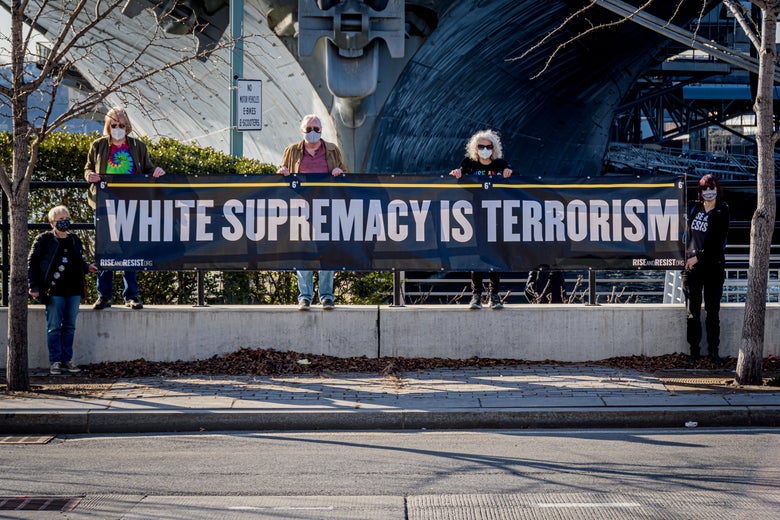
Expert Opinion: Understanding Whiteness to Understand White Supremacy
In the aftermath of last week's tragic shooting in Buffalo, many have described the violence as representative of a mental health crisis, growing extremism, hatred, and bigotry, likening manifestos left by shooters as the racist rhetoric of radicalized individuals. "But that conclusion is a pleasant fiction," writes Matthew Hughey -- a professor of sociology at UConn and a renowned scholar of racism and racial inequality in identity formation, organizations, media, politics, science, religion, and public advocacy -- in a powerful new essay for Slate. As part of his work as a researcher, Hughey examines the manifestos of white-supremacist shooters as well as their intersection with race, knowledge, media, power, religion, and science. To understand white supremacy and the violence it precipitates, Hughey explains, we need to first understand whiteness: The category of whiteness, like “race,” is a biological fiction with a social function. Whiteness emerged early in American history to rationalize exploitation. Early American colonists were slow to develop racial worldviews. But by the mid-1600s, philosophers and scientists like Bernard Varen, John Ray, and François Bernier began to publish ideas about African savagery and European civilization, which were progressively applied to resolve who should be the rulers versus the ruled. These ideas were codified into our legal system. In 1662, for instance, British statutory law conferred slavery with a biological status: Any child born to an enslaved woman would also be a slave. Over time, through a series of laws and social mores, a hierarchy that conferred legal privileges to “white” men, while stripping Black people and Native Americans of their humanity and standing in the legal and political arenas, was cemented. Put another way, whiteness is not an inherent identity so much as a consolidation of lofty biological, legal, and theological notions that serve to buttress the social and political power of people bearing lighter skin. As W.E.B. Du Bois points out in his 1920 essay “The Souls of White Folk,” whiteness is a modern concept: "The discovery of personal whiteness among the world’s peoples is a very modern thing. … The ancient world would have laughed at such a distinction. … This assumption that of all the hues of God whiteness alone is inherently and obviously better than brownness or tan leads to curious acts. … I am given to understand that whiteness is the ownership of the earth forever and ever, Amen! Now what is the effect on a man or a nation when it comes passionately to believe such an extraordinary dictum as this?" The effect is a Faustian bargain. And as a result, whiteness exists in a state of perpetual social anxiety. White people are taught that their biological, cultural, and/or God-given nature is to be “inherently and obviously better” than people of color and to have “ownership of the earth.” These ideals are, of course, so lofty that they are unachievable. Discontent is inevitable. Whiteness is a deal with the devil. Consequently, white people move neither into nor out of moments of racial anxiety, nor do they—despite the popularity of the cliché—experience flashes of “white fragility.” Whiteness does not wax or wane relative to racial pressures, cracking to expose either reactionary political movements or even the occasional mass shooting. Rather, whiteness is an omnipresent imbroglio; it cannot live up to the greatness it assumes it can naturally realize. Reconciling the peril that results from the inability to fully manifest white power necessitates a scapegoat. And so the crisis of whiteness is continually externalized onto racial “others.” This helps to explain why an increasing number of white people now believe they have been cheated out of their birthright—an inheritance of domination stolen by people of color. White nationalism and supremacy could not function under absolutist apartheid; it is an ideology and practice that requires the presence of people of color to justify its own shortcomings. White peril and white power go hand in hand. Professor Hughey is available for interviews -- click on his icon to contact him today.

